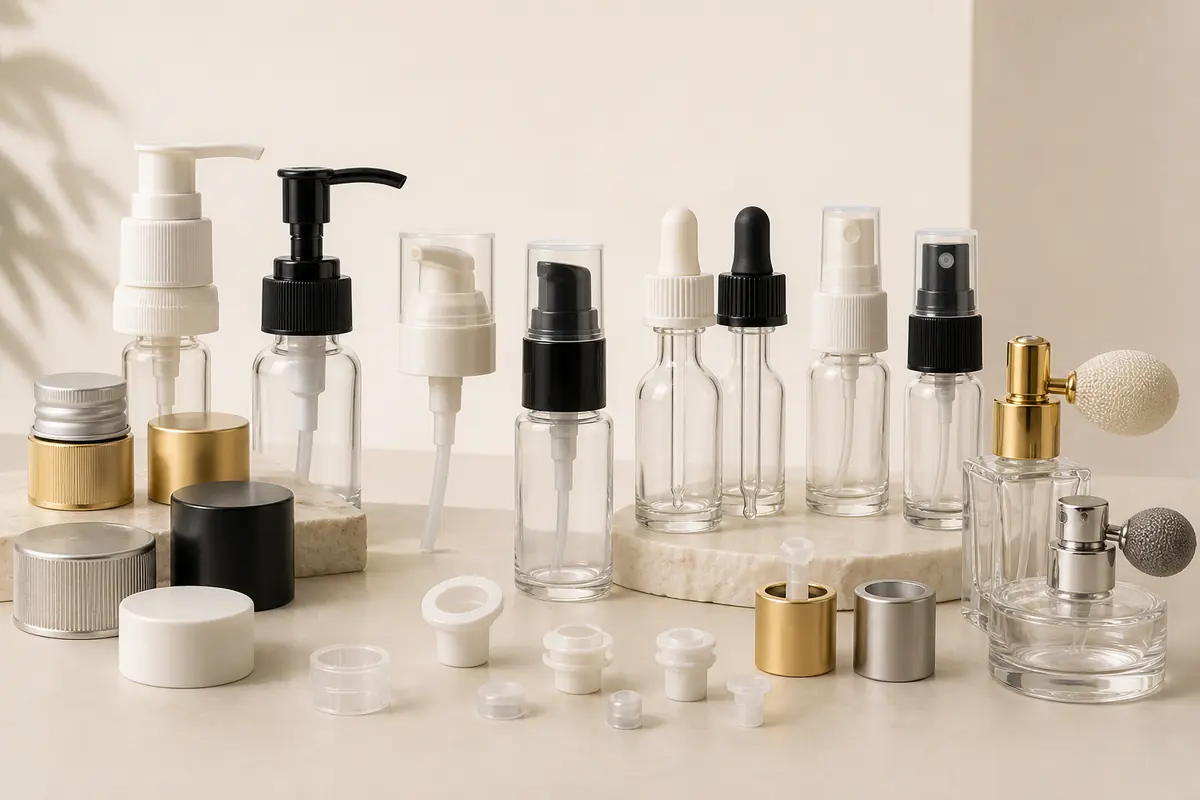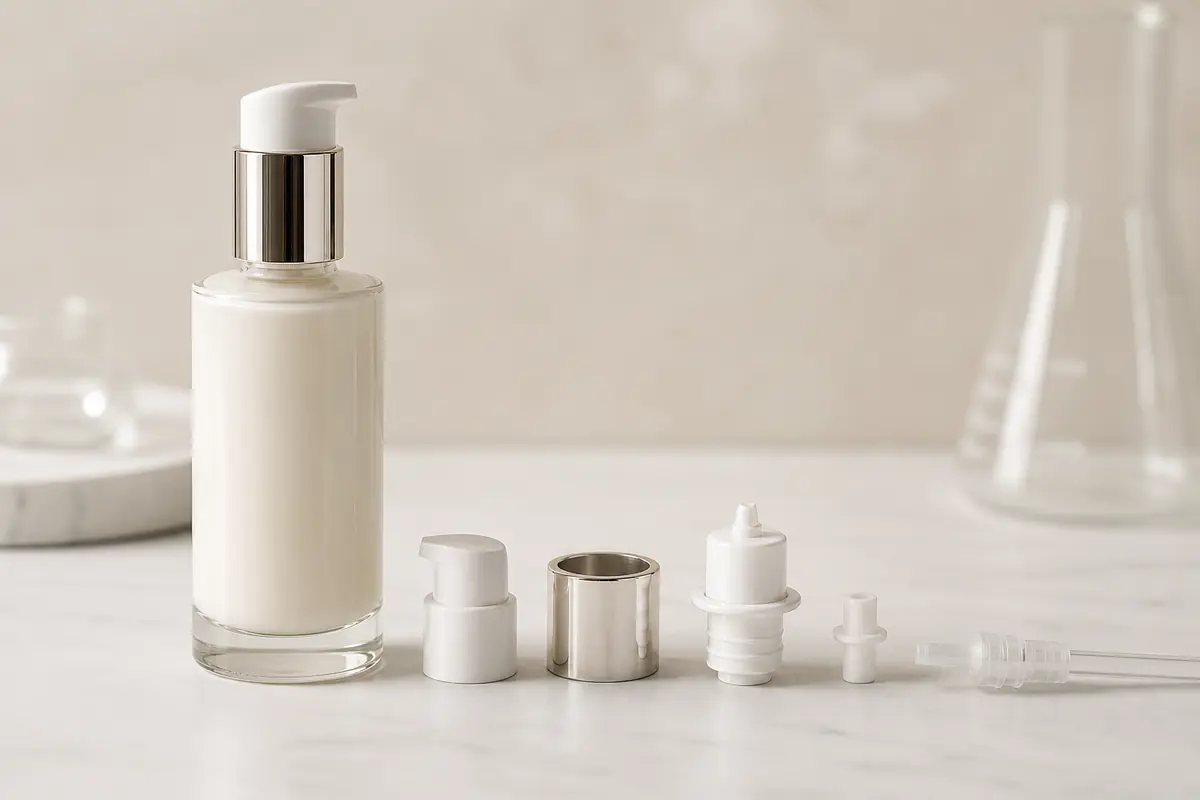
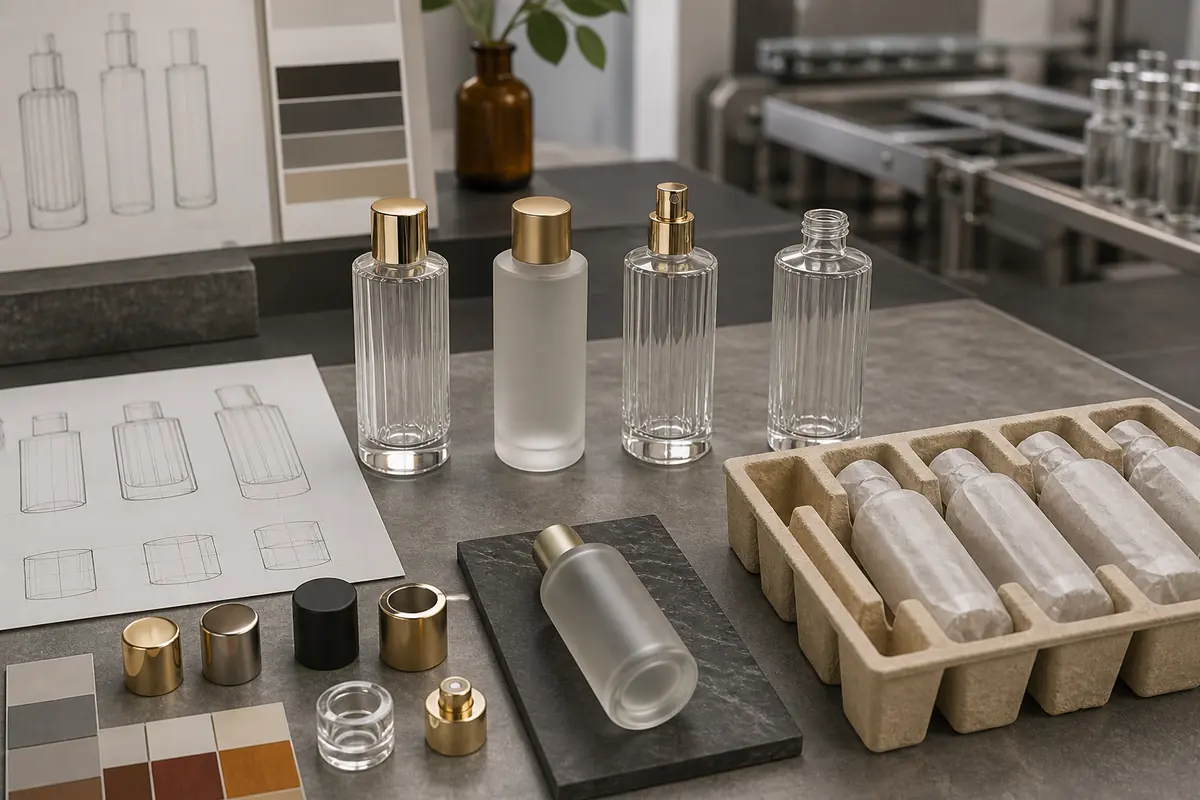
Custom cosmetic glass bottles move from an idea to mass production through a controlled sequence of commercial, design, engineering, sampling and approval decisions. The process is more than selecting a bottle and adding a logo: the formula, capacity, closure, decoration, order quantity, target market and launch schedule must work as one packaging brief. Brands reduce avoidable rework when they freeze critical interfaces early, test the assembled package and approve physical references before production.
For buyers, the central rule is simple: digital design is not production approval. A rendering can communicate shape and branding direction, but the selected bottle, neck, closure, decoration, formula-contact system and packing configuration still require physical validation before bulk production.
Step 1 — Define the Packaging Brief
A useful brief explains what the package must achieve before anyone starts drawing a bottle. State the product type, intended formula, target capacity, dispensing method, preferred shape, decoration direction, quantity range, destination market and target launch timing. Add practical requirements such as secondary packaging, component sourcing and documents that may be required for the finished configuration.
The brief should separate fixed requirements from preferences. A fixed neck or filling-line constraint can affect the entire structure, while a preferred shoulder curve may remain open to feasibility review. If the formula is still changing, record that uncertainty rather than presenting it as a final specification. A supplier evaluation should confirm which project questions, responsibilities and evidence must be resolved before either party commits to development.
Destination market belongs in the brief because packaging evidence may become part of the finished cosmetic product’s safety and documentation work. For cosmetics placed on the EU market, Regulation (EC) No 1223/2009 requires a safety assessment before the product is placed on the market. Annex I specifically includes relevant characteristics of the packaging material, particularly purity and stability, in the Cosmetic Product Safety Report. Article 11 also requires the Product Information File to be kept for 10 years after the last batch of the cosmetic product was placed on the market. This does not mean a packaging supplier performs the finished-product safety assessment; it means the buyer should identify market and documentation requirements before the packaging configuration is finalized.
Information to Include in the First Brief
- Product type, formula characteristics and intended use
- Target capacity and acceptable dimensional boundaries
- Pump, sprayer, dropper, cap or other dispensing requirement
- Brand position, preferred shape, color and decoration
- Expected order quantity and future SKU plan
- Destination market, outer packing and target timeline
- Known filling-line, carton or component constraints
- Documentation or testing requirements that must apply to the final configuration
Step 2 — Choose Stock Bottle Customization or a New Mold
Stock bottle customization starts with an existing bottle structure and differentiates it through compatible closures, coating, frosting, printing, hot stamping, labels or outer packaging. It reduces structural development work and can suit product launches, market testing and multi-SKU programs. “Stock” does not mean generic: a coordinated color, closure and decoration system can create a distinctive range.
A new mold creates a brand-specific bottle geometry. It can support a signature profile, distinctive proportions, molded branding or structural features that available bottles cannot provide. It also adds tooling, feasibility, sampling and revision decisions. The right route depends on differentiation, quantity, budget, schedule and willingness to manage structural risk. The detailed comparison of stock cosmetic bottles and custom molds helps teams choose without assuming that the more complex option is automatically better.
| Development Route | Best Fit | Main Buyer Decision |
|---|---|---|
| Stock bottle customization | Faster launches, testing demand, multiple SKUs | Confirm availability, closure fit, decoration feasibility and repeat supply |
| New custom mold | Signature geometry and long-term structural differentiation | Confirm feasibility, tooling scope, samples, revisions, ownership and commercial terms |
| Hybrid program | Existing structure with a strongly customized brand system | Coordinate color, decoration, closures and secondary packaging as one system |
Step 3 — Confirm the Bottle and Closure Structure
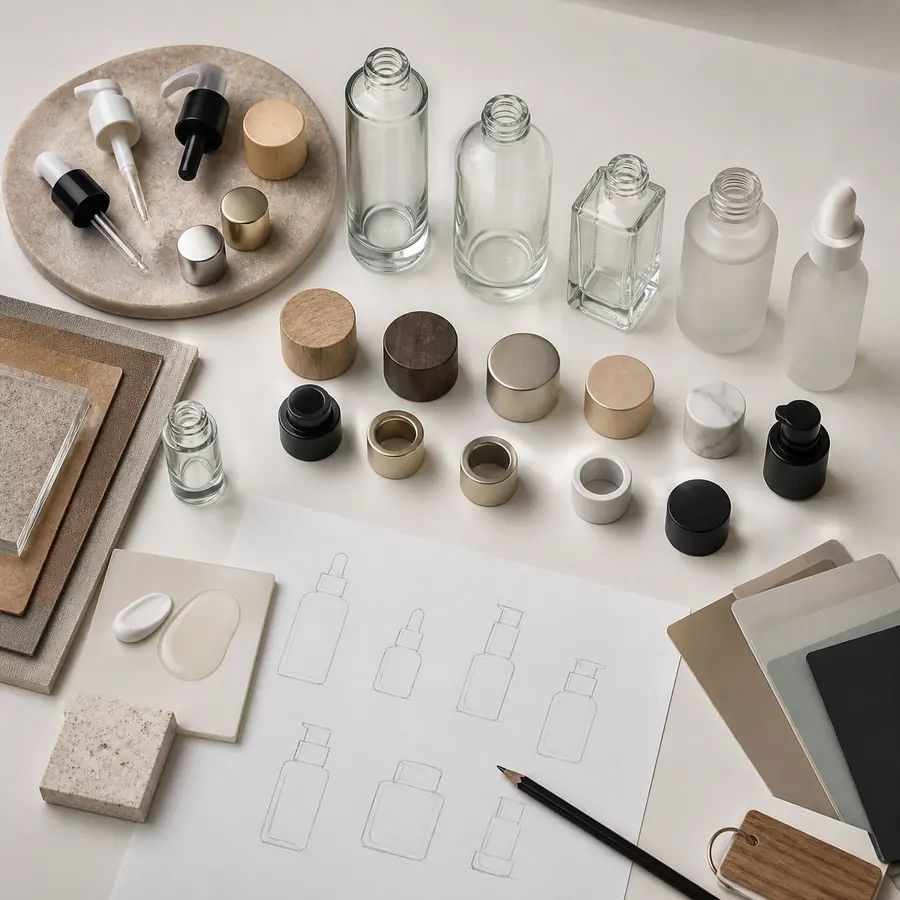
The bottle is only one part of the package. Confirm the neck finish and the intended pump, sprayer, dropper, cap, collar, liner, gasket or insert before the bottle design is frozen. Similar-looking components are not automatically interchangeable. Thread or crimp structure, sealing geometry, closure construction, dip tube or pipette dimensions, bottle height and assembly method can all affect the final system.
Use specification drawings and physical samples to review the selected combination. If a closure changes late, reopen the affected review: the neck, bottle height, overcap relationship, decoration area, dispenser geometry or carton may also change. Buyers can explore cosmetic and skincare glass packaging, but any final bottle-and-closure compatibility claim must remain tied to the exact components selected for the project.
Compatibility rule: final bottle and closure compatibility should be confirmed using the selected components and physical samples before bulk production. A matching nominal size or similar appearance is not sufficient evidence of fit, sealing or dispensing performance.
Step 4 — Develop a Manufacturable Bottle Design
A concept must be converted into geometry that can be manufactured, filled, decorated, assembled and packed. Review overall proportions, base and shoulder transitions, neck position, glass-distribution concept, decoration area and how the bottle will stand, travel on a line and fit its closure and carton. Exact dimensions, glass weight and tolerances belong in project-specific drawings rather than generic marketing copy.
Design review should also consider where brand elements belong. Molded logos, reliefs and textures interact with glass forming and mold release; large flat decoration panels behave differently from tight curves. A visually attractive rendering is not production approval. For proprietary structures, the dedicated custom bottle development process should connect drawing, feasibility, tooling, closure coordination and sample approval before mass production.
Published glass-container standards can provide useful measurement frameworks without replacing the project drawing. ISO 12818:2013, which remains a current standard for flaconnage, covers tolerances for bottles used for pharmaceutical, cosmetic and perfumery products and addresses four dimensional areas: brimful capacity, height, diameter or width, and verticality. ISO 8106:2004 describes a gravimetric method for determining glass-container capacity and compliance with specification limits, while ISO 9008:1991 provides a test method for bottle verticality.
These standards do not create one universal dimensional tolerance for every FOLOVER project. The applicable drawing, measurement method, acceptance criteria and bottle configuration still need to be agreed for the specific development.
Step 5 — Select Decoration as a Process System
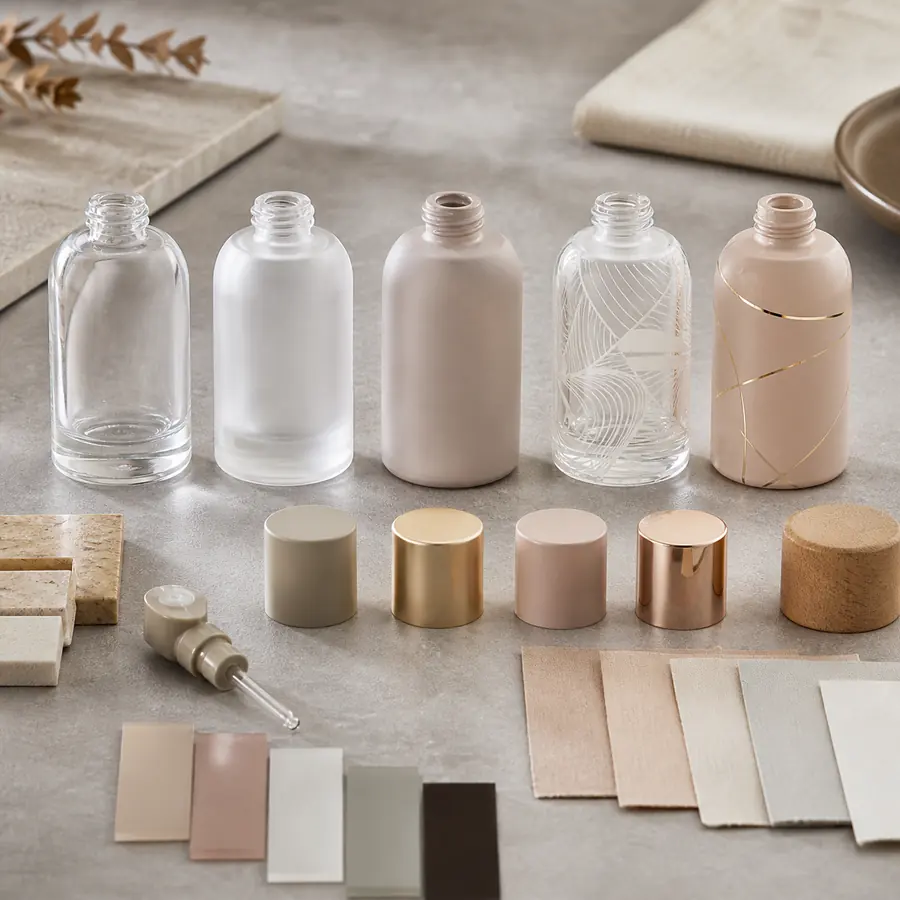
Common options include spray coating, frosting, screen printing, hot stamping, labels and decorated components. Each process changes the appearance in a different way and has its own artwork, surface and approval considerations. Multi-process designs require a defined sequence because a coating may become the surface for later printing or stamping.
Plan decoration around the actual bottle shape, handling areas and component contact. Fine artwork, multiple colors, curved surfaces and close registration can increase production sensitivity. The guide to cosmetic glass bottle decoration methods compares the main visual routes without treating coating, printing and hot stamping as interchangeable.
Do not approve decoration from artwork files alone. The selected base glass, coating or frosting, print, foil, logo position and assembled components should be reviewed on a physical sample. If one of those elements changes after approval, the affected decoration review should be reopened.
Step 6 — Produce and Review the Right Samples
Different samples answer different questions. An existing bottle sample can help evaluate basic shape, glass appearance and component fit. A decorated sample can show color, finish, logo scale and interaction between processes. A mold or prototype sample may help review a new structure, while a pre-production reference can confirm the intended assembled package before the main run.
Do not treat one sample type as proof of everything. A visual prototype may not represent production glass, and an undecorated stock sample cannot approve a final coating. Record the sample revision, component codes, artwork and decision. Existing bottle samples may be available for quality and compatibility evaluation, but costs, timing and quantities must be confirmed for the actual project.
The detailed guide on how to evaluate cosmetic packaging samples can be used to separate visual, dimensional, functional, compatibility and packing approvals instead of treating “sample approved” as one undefined decision.
What to Approve on Physical Samples
- Bottle shape, visible glass quality and stable standing
- Neck, closure, cap and dispenser relationship
- Color, frosting, printing, stamping and logo position
- Assembly appearance and intended opening or dispensing behavior
- Fit inside trays, cartons and protective packing where relevant
- Clear revision identification for the approved reference
Step 7 — Test the Complete Packaging System
Compatibility approval should evaluate the actual formulation and assembled package whenever possible. Bottle, seal, closure, dispenser, dip tube or pipette, decoration and intended storage or transport conditions can interact. Review sealing, leakage, dispensing, visible material change, decoration condition and usability with methods defined for the product and project.
A generic component statement is not final-system evidence. The cosmetic packaging compatibility testing guide explains how to connect risks, samples, conditions, observations and approval records without inventing one universal protocol.
This distinction also matters in regulatory work. The U.S. FDA’s cosmetic GMP guidance and inspection checklist states that a cosmetic may be considered adulterated if its container is composed of a potentially harmful substance and calls for control records for raw materials and primary packaging materials. The FDA guidance does not certify any specific FOLOVER bottle or closure; it reinforces why the exact package and product relationship must be evaluated rather than inferred from appearance.
Compatibility boundary: approving an attractive empty package does not prove formula stability, dispensing performance or leak resistance. Packaging compatibility should be evaluated with the actual formulation under intended storage and use conditions, and conclusions must match the exact samples and tests that support them.
Step 8 — Freeze Color, Decoration and Assembly References
Digital files communicate intent, but physical samples establish the production reference. Approve the color on the selected base glass, confirm matte or gloss appearance, check artwork position and scale, and review the assembled bottle with its closure and cap. If several components use similar colors, compare them together because glass, coating, plastic and metal can render the same target differently.
Maintain one clearly identified approved reference—often called a master or golden sample—together with artwork, color references and component specifications. Record acceptable boundaries where the project requires them. Never promise exact screen-to-product color matching, and do not assign an unverified universal color tolerance.
Where numerical color measurement is required, ISO/CIE 11664-6:2022 defines the CIEDE2000 colour-difference calculation based on CIELAB values. The standard provides a calculation method; it does not establish one universal ΔE00 acceptance limit for cosmetic bottles. Any numeric tolerance should therefore be agreed for the actual material, finish, measurement method and visual requirement rather than copied from an unrelated project.
Step 9 — Plan Mass Production and Component Coordination
Production planning may include glass bottle manufacture or availability, component sourcing, decoration, assembly where applicable, inspection and protective packing. Sequence matters: a delayed closure can prevent an assembled inspection, and a late artwork revision can disrupt a decoration schedule. One owner should maintain the latest specification and confirm which revision each supplier is using.
There is no universal production or development time that applies to every custom cosmetic glass bottle. A stock-bottle project can omit new structural tooling, while a custom-mold project adds feasibility review, tooling, samples and possible revision cycles. Decoration complexity, component availability, order quantity, testing and approval speed can all change the schedule. Buyers should therefore obtain a project-specific timeline after the selected bottle, closure, decoration and approval route are defined.
Manufacturer Insight
In FOLOVER packaging projects, the most disruptive changes are usually changes to an interface that another step already depends on. A closure change can reopen neck and assembled-height review; an artwork change can invalidate a decorated sample; a bottle change can affect trays or cartons. We normally recommend keeping the current bottle drawing, closure and accessory references, decoration artwork, approved physical sample and packing specification aligned under one controlled project revision.
Step 10 — Inspect, Pack and Prepare for Shipping
Final quality review may cover visual appearance, relevant dimensions, component fit, decoration consistency, functional checks, closure or leakage checks where applicable and final packing inspection. The inspection plan must be based on the approved specification; generic claims such as “perfect quality” or “zero defects” are not useful acceptance criteria.
For lot inspection, the current ISO 2859-1:2026 provides sampling schemes indexed by acceptance quality limit (AQL) for lot-by-lot inspection. Referencing an AQL standard is not the same as choosing the acceptance criteria: inspection level, defect classification and AQL values still need to be agreed for the product and purchasing program. One supplier’s AQL setting should not be copied automatically to a different bottle, decoration or component risk.
Protective packing should reflect bottle shape, decoration sensitivity, components and transport route. Review dividers, trays, bags, cartons and the way decorated surfaces contact surrounding materials. Where distribution testing is required, ASTM D5276-19(2023) is an active method for free-fall drop testing of loaded containers and can be used to evaluate sudden-shock performance or compare package designs. It does not establish one universal drop height for every cosmetic shipment; test severity and package configuration should be defined for the actual distribution requirement.
If outer packaging is part of the program, confirm it against the final assembled package rather than an early bottle-only estimate. The guide to cosmetic glass bottle export packing covers dividers, protective contact points, inspection and shipment preparation in more detail.

Why Custom Packaging Projects Get Delayed
Most delays are not caused by one manufacturing step. They come from decisions that remain open while dependent work proceeds. Common examples include an incomplete brief, a late closure change, artwork revisions after samples, unapproved color references, formula testing that starts too late, mold revisions without a frozen drawing and components ordered from separate sources without one coordinated specification.
Commercial assumptions create the same problem. There is no universal MOQ for custom cosmetic glass packaging: the glass bottle, custom mold, coating, printing, closure, dropper or pump and secondary packaging may each have different production minimums. Review the custom cosmetic packaging MOQ guide and confirm the minimums for the exact configuration instead of treating a general website number as a project commitment.
Common Failure Modes Before Production Approval
- Closure changed after the bottle was approved: reopen neck, sealing, assembled-height and packing review.
- Decoration approved only from a rendering: confirm the final color, coating, print or foil on physical samples.
- Formula testing starts after packaging is ordered: the package may already be commercially committed before compatibility questions are resolved.
- Different suppliers use different revisions: one component may be produced against an obsolete drawing or artwork file.
- A sample photograph becomes the “standard”: photographs do not replace the controlled drawing, artwork, component references and retained physical sample.
- Cartons are ordered before assembly is frozen: a later cap, pump or bottle change can affect dimensions and protective packing.
Build an Approval Record, Not Just an Email Trail
A controlled approval package should identify the current bottle drawing, closure and accessory codes, artwork revision, color or finish reference, approved samples, test evidence, packing specification and authorized decision. If a change occurs, record what changed and which approvals must be repeated. This prevents an older sample photograph or informal message from being mistaken for the final instruction.
For multi-SKU ranges, create a component matrix showing which bottle, closure, color and artwork belong to each SKU. Shared components can reduce complexity, but only after compatibility and appearance are confirmed for every intended combination.
Buyer action: before issuing the bulk-production approval, verify that the latest drawing, bottle, closure, decoration sample, formula-testing record and packing specification all refer to the same current configuration.
Where FOLOVER Fits in the Process
FOLOVER PACK supports bottle development, custom molds, decoration, component matching and OEM/ODM packaging supply for perfume, skincare, essential oil and beauty projects. Buyers can use the skincare packaging guide to frame the package selection, discuss end-to-end requirements through custom packaging solutions, and review coordinated manufacturing programs through OEM and ODM packaging services.
The appropriate support depends on the confirmed brief. OEM/ODM in this context means packaging development and supply; it does not imply cosmetic formulation, filling or finished-product regulatory registration unless separately confirmed. Documents and reports may also vary by bottle, glass, closure, decoration, formula-contact configuration and destination market.
Explore the complete topic cluster under Customization & Manufacturing, and use Packaging Buying Guides for related sourcing, sample, MOQ and supplier decisions.
Conclusion
Frequently Asked Questions
How are custom cosmetic glass bottles made?
The process normally moves from a packaging brief through stock-or-mold selection, structural design, closure coordination, decoration, samples, compatibility review, approval, production, inspection and packing. The exact sequence depends on the confirmed project.
Do branded cosmetic bottles always require a custom mold?
No. Existing bottles can be differentiated with coordinated closures, colors, frosting, printing, hot stamping, labels and outer packaging. A new mold is most useful when the brand requires a proprietary structure that stock bottles cannot provide.
Can stock glass bottles look unique?
Yes. A coherent decoration and component system can create strong differentiation while retaining an existing bottle structure. Physical samples should confirm the final color, artwork and assembled appearance.
How long does custom bottle development take?
There is no universal development time. A stock-bottle route can avoid new structural tooling, while a custom mold adds feasibility review, tooling, samples and possible revisions. Decoration, components, testing, order quantity and approval speed also affect the schedule, so buyers should confirm a project-specific timeline for the selected configuration.
When should decoration be approved?
Approve final color, finish, logo position and multi-process decoration on physical samples before bulk production. Digital renderings and screen colors are useful communication tools but are not final production references.
Should the bottle and closure be tested together?
Yes. The exact bottle, closure, sealing parts, dispenser and intended formula should be evaluated as an assembled system. Visual similarity alone does not establish fit, sealing or dispensing compatibility.
What should a buyer provide before development starts?
Provide the product and formula context, target capacity, dispensing method, shape and decoration direction, expected quantity, destination market, documentation needs, packing requirements and launch schedule. Mark any item that is still provisional.