Custom cosmetic packaging MOQ is not one universal number. A packaging project may have separate minimums for the glass bottle, pump or dropper, component color, decoration, custom mold, and packing materials. The practical order quantity is therefore determined by the complete approved configuration, not by the container alone.
For buyers, the useful question is not simply “What is your MOQ?” It is: “What is the MOQ for each part of this exact packaging system, and which requirement controls the final order?” That distinction makes quotations easier to compare and helps prevent a higher component or decoration minimum from appearing after the design has already been approved.
Buyer conclusion: Treat MOQ as a bill-of-materials question. The bottle may be available at one quantity while a custom-colored pump, printed artwork, cap finish, carton or mold requires another. The effective project MOQ is normally controlled by the requirement that cannot economically or operationally be produced at the buyer’s requested quantity.
| Packaging Route | Typical MOQ Logic | Main Advantage | Main Limitation | What Buyers Should Verify |
|---|---|---|---|---|
| Stock bottle + standard closure | Usually closest to the supplier’s standard product minimum | Lower development complexity | Less structural exclusivity | Current stock, closure compatibility and exact quoted MOQ |
| Stock bottle + custom decoration | Bottle MOQ and decoration MOQ may be different | Brand differentiation without new bottle tooling | Each color, artwork or process may create a separate minimum | MOQ per artwork, color and decoration process |
| Stock bottle + custom-colored closure | The closure supplier or finishing batch may control the project | Stronger component coordination | Extra components may be required even when the bottle quantity is lower | Closure MOQ, finish MOQ, color approval and compatibility |
| Custom-mold bottle | Project-specific tooling and production requirements apply | Proprietary bottle geometry | Higher development commitment and more approval stages | Tooling terms, sampling sequence, production quantity and component matching |
What Does MOQ Mean in Cosmetic Packaging?
MOQ means minimum order quantity: the smallest quantity a supplier will normally accept for a defined product or production condition. In cosmetic packaging, that number must always be attached to a specific scope. An MOQ may apply per bottle model, per color, per decoration design, per closure, per component finish, or per custom mold.
A quotation stating “MOQ 1,000 pcs” is incomplete unless it also identifies what those 1,000 pieces include. Buyers should confirm the bottle, closure, finish, artwork, color and packing configuration behind the number.
FOLOVER’s current general planning baseline is that standard MOQ usually starts from 500–1,000 pieces per model, depending on bottle design, decoration and selected components. This is a general starting point rather than a guaranteed MOQ for every SKU. The final quantity must come from the current quotation for the exact packaging configuration.
Why Do Packaging Suppliers Have MOQs?
MOQ is usually connected to setup, purchasing and process efficiency rather than an arbitrary restriction on small brands. Before sellable packaging is produced, suppliers may need to prepare equipment, source components, mix colors, prepare printing screens or tooling, arrange fixtures, allocate cartons and complete production changeovers.
The exact cause depends on the item and process:
- Glass bottle production: existing stock and existing molds are different from a new production run or a newly developed structure.
- Spray coating: color preparation, fixtures or hanging arrangements, line setup, curing and cleaning all create work before the first approved finished piece.
- Screen printing: artwork preparation, screen setup, ink matching, registration, curing and cleaning can make each artwork or color a separate production condition.
- Hot stamping: foil, tooling, positioning and setup depend on the bottle and artwork.
- Closures and accessories: pumps, droppers, caps, collars, liners and decorative parts may come from separate component production or finishing batches.
- Packing materials: cartons, inserts, trays and other protective materials can also have their own purchase quantities.
These are process drivers, not universal numeric rules. A buyer should ask the supplier which specific operation creates the quoted minimum instead of assuming that every MOQ comes from the glass factory.
Buyer action: When a supplier says the MOQ cannot be reduced, ask what prevents the reduction. If the constraint is a custom pump color or decoration rather than the bottle itself, changing that one requirement may create a more practical first-order configuration.
Stock Bottle MOQ vs Custom Bottle MOQ
A stock bottle uses an existing shape and mold. It can still be combined with selected closures, colors and decoration, but the bottle structure itself does not require new tooling. This often makes stock packaging a practical starting point for market testing, smaller launches or projects with limited development time.
A custom bottle introduces a proprietary shape, size or structural requirement. The project may require design development, drawings, tooling, samples, component coordination and production approval. It should therefore be evaluated as a development program rather than as a standard bottle with a different logo.
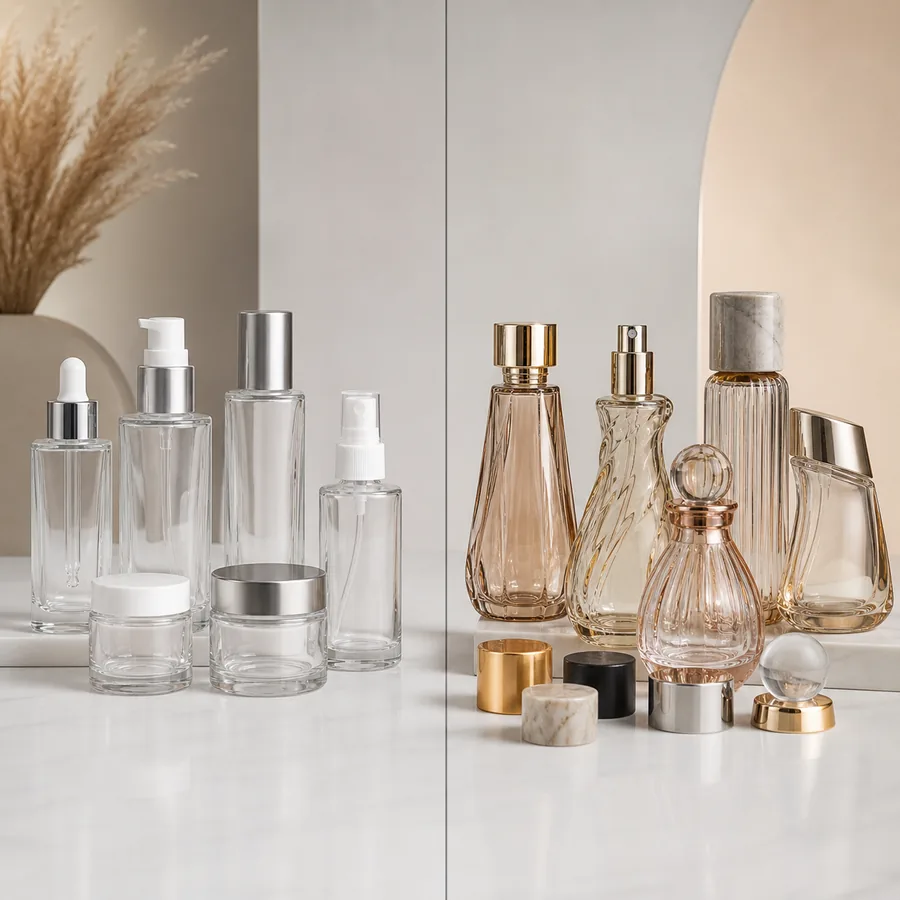
Buyers comparing the two routes can review stock cosmetic bottles versus custom molds and the custom cosmetic glass bottle process. When proprietary geometry is genuinely required, FOLOVER’s custom bottle development service provides the commercial path from drawing and mold development through physical sample approval.
How Decoration Changes MOQ
Decoration can create a minimum separate from the undecorated bottle. Screen printing, hot stamping, spray coating, frosting, labels and custom colors use different materials and production setups. A clear stock bottle may therefore be available at one quantity while the final decorated version requires another.
Decoration should also be broken down accurately. Bottle-glass color, spray coating, printing ink, metallic foil, electroplated or anodized component finishes and label colors are different processes. If a project includes several shades, logos or artworks, ask whether each variation must run separately.
Example: If one order contains four bottle colors, do not assume that the supplier can combine all four colors into one MOQ simply because the bottle shape is identical. Each color may require separate preparation and production planning. Ask whether the quoted MOQ is per model, per color, per artwork or per decoration run.
The custom packaging solutions page provides context for coordinating bottles, components and finishes. Final MOQ still needs to be confirmed after the exact decoration and component configuration is selected.
How Pumps, Droppers and Caps Affect MOQ
The complete pack is often controlled by the component with the highest usable minimum. A bottle may be available at the requested quantity while a matching pump color, dropper collar, cap finish or decorative component requires a larger batch.
That does not mean buyers should automatically purchase excess closures. Extra components create their own questions: Will the same bottle neck be used for the next order? Will the color remain acceptable? Can the parts be stored correctly? Will the formula and dispensing requirement stay the same?
Component availability must also be separated from compatibility. Confirm the neck finish, sealing geometry, gasket or liner where applicable, dip tube or pipette requirement, assembly method and intended formula. A pump or dropper that is available at a convenient MOQ is not automatically correct for the selected bottle.
Compatibility rule: Final bottle and closure compatibility should be confirmed using the selected components and physical samples before bulk production.
How Custom Molds Change the Project
Custom molds add tooling economics and development risk to the quantity decision. Tooling cost, drawings, mold samples, production readiness and any ownership, reuse or maintenance terms should be documented separately from the unit price. Buyers should also establish which drawings and physical samples become the approved production reference.
A custom bottle may be commercially justified when proprietary geometry creates meaningful brand or functional value and the expected program can support the development work. It may be less suitable when demand is uncertain, launch timing is short or the brand has not yet validated the formula and dispensing system.
In those situations, an existing glass structure plus selected decoration or coordinated components can reduce early development complexity without preventing the brand from moving to a custom mold later.
Do not assume: mold fee, mold lead time, mold ownership, expected mold life, exclusivity and future production MOQ are project-specific commercial terms. They should be confirmed in writing for the selected bottle rather than copied from another project.
Why Very Low MOQ Can Increase Unit Cost
Fixed setup and handling costs are spread across fewer units in a small production run. A supplier may also have less flexibility in component purchasing, custom colors, printing arrangements or packing formats. A lower MOQ can therefore produce a higher unit price even when the buyer commits less total cash.
That can still be a rational business decision. Paying more per unit may be preferable when it reduces unsold inventory, allows a controlled launch or provides real market feedback before a larger commitment.
| Decision | Possible Benefit | Main Trade-Off |
|---|---|---|
| Lower initial quantity | Lower inventory exposure and easier market testing | Higher unit cost or fewer customization choices |
| Larger standard run | Better setup efficiency and potentially lower unit cost | More cash and inventory committed before market feedback |
| Stock bottle + decoration | Balances differentiation with existing glass tooling | Decoration or component MOQ may still control the project |
| Custom mold | Greater structural differentiation | Additional tooling, sampling and production commitment |
Buyers should compare unit price with total committed cash, tooling, samples, freight, storage, inspection, potential rework and the likelihood of repeat orders. MOQ is therefore a risk-management decision as much as a unit-price decision.
How Buyers Can Reduce MOQ Risk

- Start with an existing bottle shape when proprietary geometry is not essential to the first launch.
- Standardize the neck and closure platform across multiple SKUs only when the selected components and formulas are physically verified.
- Use stock component colors first if a custom pump, cap or dropper finish creates the controlling MOQ.
- Reduce artwork fragmentation by identifying whether every SKU really requires a separate bottle color, print color or finishing setup.
- Separate the market-test configuration from the long-term custom program instead of trying to achieve every customization feature in the first production run.
- Approve physical samples before bulk commitment so a low MOQ does not simply become a smaller batch of the wrong configuration.
The aim is not to strip away every distinctive element. The better approach is to place customization where customers can see or use it while keeping the first production system manageable. Buyers can review existing cosmetic and skincare glass packaging before adding custom components and decoration.
What to Ask When a Supplier Quotes an MOQ
Request MOQ in a line-by-line format that follows the actual packaging bill of materials. If a quotation gives one total number, ask which component or process determines it.
| Question | Why It Matters |
|---|---|
| Is the MOQ per bottle model or per purchase order? | Prevents unrelated SKUs from being assumed combinable. |
| Does each color carry a separate MOQ? | Shows whether color variants fragment the production run. |
| Is decoration MOQ per artwork, color or process? | Clarifies whether different logos or finishes can share production. |
| Do pumps, droppers or caps have separate minimums? | Identifies whether an accessory controls the finished-pack quantity. |
| Can compatible SKUs share components? | Tests whether standardization can reduce the number of unique purchased parts. |
| What overrun or underrun terms apply? | Helps purchasing plan the quantity that may actually be delivered and invoiced. |
| Which samples must be approved before production? | Connects the quantity commitment to the final physical configuration. |
| What exactly changes if I request a lower quantity? | Shows whether the trade-off is unit price, decoration, component color, tooling or something else. |
For a wider supplier review, use the 12-question cosmetic packaging supplier guide. It covers specifications, quality, documentation, tooling, lead time and problem resolution beyond MOQ.
MOQ vs Total Project Cost
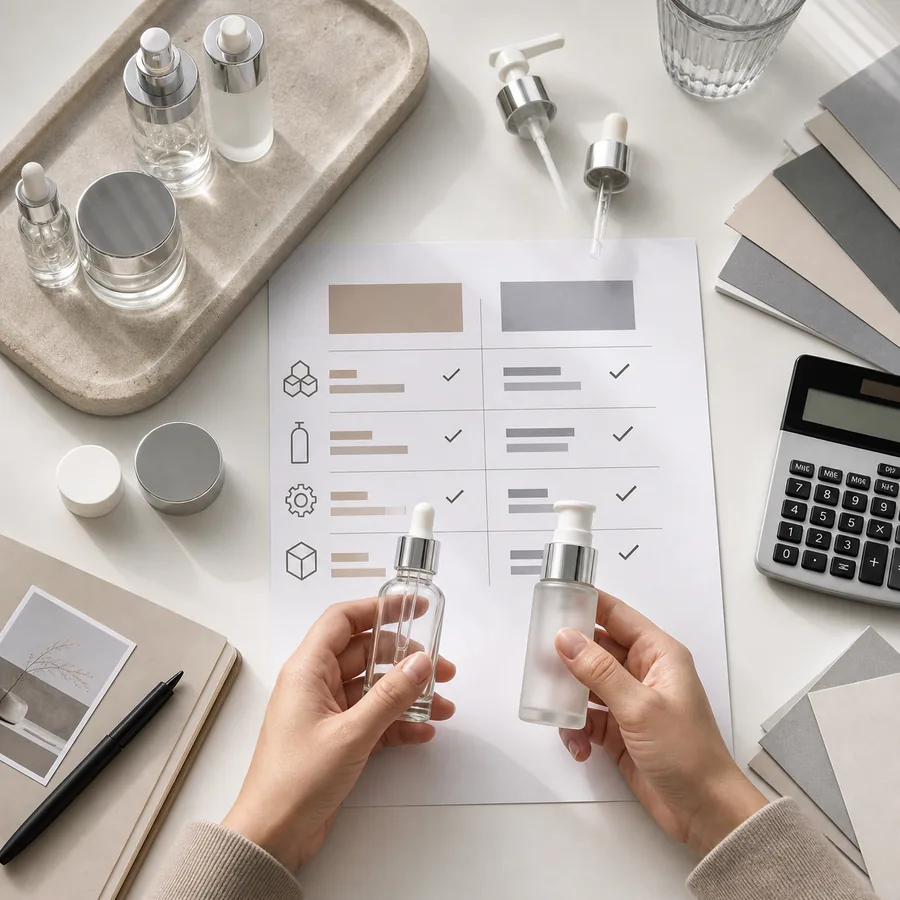
MOQ tells you the minimum quantity under a defined production condition. It does not show the full commercial commitment. A complete comparison can include bottles, closures, decoration, tooling, samples, inspection, secondary packaging, freight, duties where applicable, storage, assembly, agreed production allowances and potential rework.
When international freight is included in a quotation, compare suppliers using the same trade term and named place. The International Chamber of Commerce explains that Incoterms® rules allocate defined delivery tasks, costs and risks between seller and buyer. A lower product MOQ does not make two quotations financially comparable if one price stops at the factory while another includes additional transport responsibilities.
The guide to the true cost of custom cosmetic packaging expands this financial comparison. MOQ should be treated as one input in the sourcing decision rather than the only rule.
Commercial decision: The lowest MOQ is not automatically the lowest-risk or lowest-cost option. Compare the quantity you must buy, the money you must commit, the customization you actually receive and the likelihood that the approved configuration can be reordered consistently.
Frequently Asked Questions
What is a typical MOQ for custom cosmetic bottles?
There is no universal MOQ. FOLOVER’s current general baseline usually starts from 500–1,000 pieces per model, depending on bottle design, decoration and selected components. Stock availability or a specific SKU may differ, so confirm the current quantity for the exact bottle, closure and finished configuration.
Why is printed packaging MOQ sometimes higher?
Printing introduces artwork-specific setup, ink or foil preparation, positioning, curing and production changeover. The minimum may apply per artwork, print color, bottle model or process. Ask the supplier which operation creates the minimum before simplifying the design or increasing the order.
Can different bottle colors be mixed in one MOQ?
Only when the supplier confirms that the selected process allows it. Different glass colors, spray colors or other finishes may require separate production batches. Ask whether MOQ applies per bottle model, per color or to the combined order before planning multiple SKUs.
Does a custom cap have a separate MOQ?
It may. A cap can have separate material, color, finishing, tooling or component-supplier requirements from the bottle. Confirm the cap MOQ independently and then verify the final cap, closure and bottle assembly on physical samples before production.
Can I order a lower MOQ at a higher unit price?
Sometimes. The answer depends on which process creates the minimum. A supplier may be able to quote a smaller stock configuration at a higher unit price, while a custom color, mold or component batch may have a practical production minimum that price alone cannot remove.
Is stock packaging better for startup brands?
Stock packaging is often a lower-complexity starting point because it avoids new bottle tooling and can reduce early development risk. It is not automatically the right solution for every brand. Compare positioning, forecast, required differentiation, formula, component compatibility and launch plan before choosing stock or custom development.
More quantity, cost, supplier and sample-planning resources are organized in the packaging buying guides.
Conclusion
Custom cosmetic packaging MOQ should be evaluated at configuration level. Separate the bottle, closure, color, decoration, mold and packing requirements, then identify the component or process that controls the practical minimum. A smaller first order can reduce inventory exposure, but only when the resulting package still meets the technical, branding and commercial requirements of the project.
FOLOVER PACK supports stock and custom cosmetic glass packaging, matched components, decoration, samples and custom development. Buyers can use the skincare packaging guide to define the application before requesting a project-specific MOQ.
For an MOQ review, send the target bottle or reference, closure type, decoration, quantity by SKU, formula type and destination. The useful output is not simply one minimum number—it is a breakdown showing which part of the packaging system controls the order and what can realistically be simplified.