
The correct cosmetic pump dip tube length is determined by the fully assembled pump position, the bottle’s internal geometry and the intended location of the tube inlet. A tube that is too short may stop picking up product while a significant amount remains. A tube that is too long may bend excessively, press against the base, restrict the inlet or interfere with consistent assembly. Bottle capacity alone cannot determine the correct length.
For cosmetic packaging buyers, the practical approach is to establish the measurement reference, calculate an initial tube position, and verify the result using the selected bottle, pump and actual formulation. There is no universal bottom clearance suitable for every lotion pump or bottle. The final specification should be approved using physical samples before bulk production.
What Is a Dip Tube?
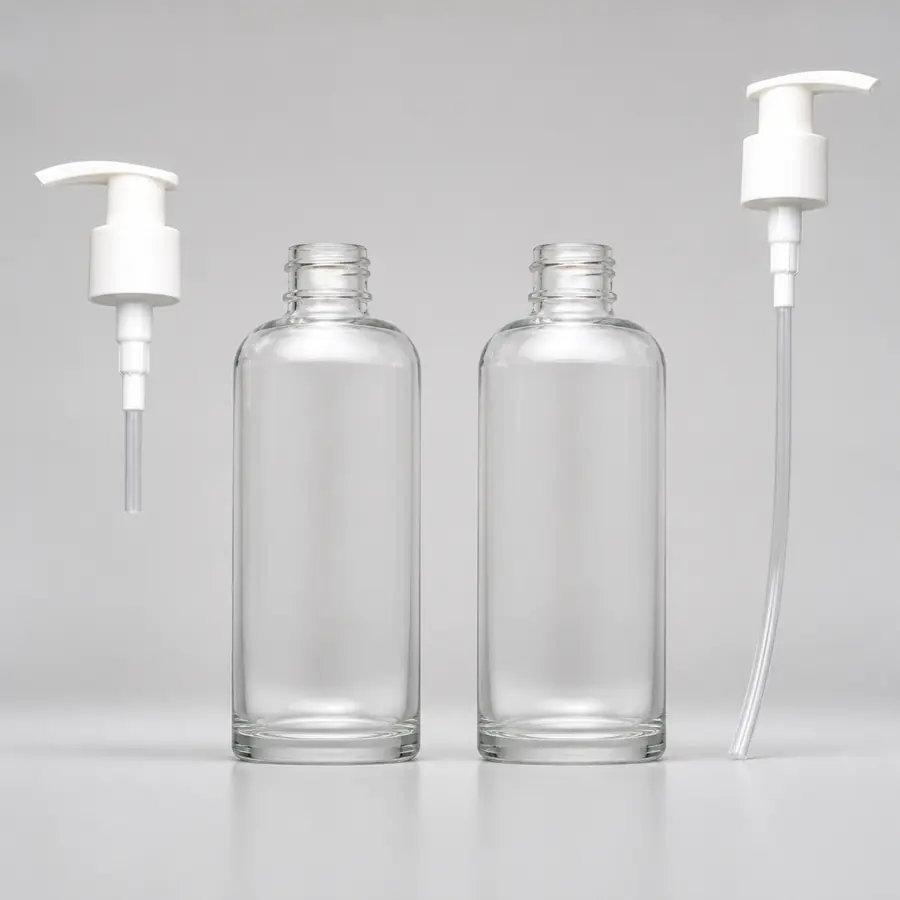
A dip tube is the narrow tube that connects the pump inlet to the product inside the bottle. When the pump chamber refills, formula moves upward through this tube. Its position affects priming, product pickup, residual volume and performance as the bottle empties.
The full explanation of the actuator, chamber and refill cycle is covered in how cosmetic pumps work. Here, the focus is the narrower question of selecting and validating tube length.
The tube should be specified as part of the complete pump assembly. Its diameter, material, flexibility, connection to the pump and inlet design can all affect the final result. A replacement tube of the same nominal length is not automatically equivalent to the original component.
Why Dip Tube Length Matters
The lower end of the tube must reach product without creating an unsuitable restriction. Bottle bases are not always flat internally, and the pump sits at a height determined by the closure and neck finish. Two bottles with the same nominal capacity can therefore require different tubes.
Dip tube length also affects user expectations. If the pump loses prime early, the user may believe the package is empty even when product remains. The future troubleshooting article on why a lotion pump stops working before the bottle is empty addresses other causes as well, so early failure should not automatically be blamed on tube length.
For a bottle containing lotion or serum, the buyer should define the acceptable product pickup behavior at lower fill levels. Minimizing the visible amount of remaining product is useful, but extending the tube until it presses against the bottle base can introduce a different dispensing problem.

What Measurements and References Are Needed?
Dip tube selection requires a consistent measurement reference and the internal dimensions of the actual bottle. Measuring the exposed tube alone is not the same as measuring the installed distance from the pump’s sealing reference to the tube tip.
- The bottle’s internal height and base geometry.
- The final closure seating position on the neck finish.
- The pump’s tube connection point and installed geometry.
- The desired tube position or clearance near the base.
- Any effect of the shoulder or internal wall on tube routing.
- The production cutting method and acceptable component variation.
Use the actual approved bottle and pump drawings when available. Measuring the outside of an unassembled bottle and subtracting an assumed amount can miss closure seating and internal base details. The cosmetic bottle neck finish guide explains why visible diameter alone does not define the installed closure position.
How to Calculate an Initial Dip Tube Length
For a straight tube intended to reach the bottom-center area of a bottle, an initial installed-length estimate can be expressed as:
Initial installed length = Distance from the selected pump reference plane to the intended bottle-base position − Required inlet clearance.
This is an initial geometry estimate for a straight, unbent tube. It is not automatically the exposed tube cut length or the supplier’s specified overall dip tube length.
The calculation should follow these steps:
- Identify the agreed measurement reference on the pump, such as the specified sealing or gasket reference plane.
- Determine the distance from that reference to the intended pickup position inside the bottle when the pump is fully seated.
- Account for the inlet clearance required by the selected tube, bottle base and dispensing design.
- Convert the resulting installed position to the tube-length dimension defined on the pump supplier’s drawing.
- Confirm the proposed length by assembling the actual components and evaluating the tube position and dispensing performance.
If the supplier measures only the exposed tube below the pump body, the portion extending into the pump assembly must be accounted for separately. Do not transfer a measurement between different reference conventions without confirming how each dimension is defined.
A tube deliberately designed to curve toward the bottom corner follows a different geometric path. Its required length cannot be established simply by applying the straight-tube calculation.
For a recognized measurement reference, ASTM D6536/D6536M-18(2025) addresses measurement of specified mechanical pump dip tube lengths, including measurement from the bottom of the sealing surface to the tube end.
ASTM D6535/D6535M-18(2025) addresses determining mechanical pump dip tube length for bottom-center and bottom-corner configurations.
These standards provide measurement and determination practices. They should not be interpreted as proof that one fixed clearance, cut length or dispensing result applies to every cosmetic bottle and pump.
Straight Cut vs Angled Cut
Dip tube ends may be supplied in different cut forms depending on the component design. An angled end can help preserve an inlet path if the tube approaches a surface, but it does not make every overlong tube acceptable. The selected cut must be part of the verified pump specification.
For a relatively straight tube positioned near the bottle base, the inlet must remain open under normal assembly and dispensing conditions. A tube designed to curve toward the lower sidewall or corner may require a different cut form and flexibility.
Do not manually change the end form without confirming that the cut is clean, repeatable and allowed for the production component. Burrs, loose particles, deformation or inconsistent cut angles can create additional dispensing and cleanliness risks.
Buyers should confirm whether the supplier’s approved tube-length dimension includes the final angled tip and whether the production cutting method reproduces the approved sample consistently.
What Happens if the Tube Is Too Short?
An undersized tube can sit above the remaining formula as the fill level drops. The pump may draw air, produce intermittent output or lose prime. The effect can be more noticeable when the bottle is held upright and product does not naturally move toward the inlet. A short tube may also increase the amount of product the user cannot access.
However, product remaining in the bottle is not sufficient evidence that the tube is too short. The formulation’s flow behavior, bottle-base geometry and pump’s ability to maintain prime can also influence how much product is dispensed.
Before increasing tube length, compare the installed inlet position with the actual product level at which dispensing becomes inconsistent. Confirm whether the proposed longer tube improves pickup without introducing bending or inlet restriction.
What Happens if the Tube Is Too Long?
An overlong tube may bend sharply, rest under compression or cover its inlet against the base. It can push sideways during assembly or create sample-to-sample variation in tube position. Excessive bending is not a reliable way to accommodate an uncertain measurement.
A long tube may also make the pump more difficult to install or cause the lower end to move away from the intended pickup position. In some configurations, the tube can contact the bottle’s internal wall or base in a way that reduces the available inlet opening.
The future article on bottle and closure tolerances explains why normal part variation also belongs in the decision.
Buyers should inspect the final tube position with the closure fully seated. If several representative assemblies show different bending behavior or interference, review the tube specification and component geometry before approving a production cut length.
Should the Dip Tube Touch the Bottom?
There is no universal yes-or-no rule for every pump and bottle. The required position depends on the tube inlet, base shape, formula, pump design and expected handling. Hard contact can restrict some configurations, while excessive clearance can leave more product inaccessible.
For a straight tube intended to remain near the center of the base, the selected inlet clearance should allow product to enter without the tube opening becoming blocked. For a system intentionally designed with a curved tube, controlled contact or positioning near the lower sidewall may be part of the approved configuration.
Neither arrangement should be accepted solely because the tube visually reaches the bottom. The buyer should confirm that the inlet remains open, the pump can be fully assembled and product pickup remains acceptable at the intended fill levels.
Manufacturer Insight: Approve the Installed Tube Position, Not Just the Cut Length
For FOLOVER PACK cosmetic bottle and pump matching projects, the important distinction is between the supplied tube dimension and its final position inside the assembled bottle.
Consider two glass lotion bottles with the same nominal capacity but different internal base profiles. A tube approved for the first bottle may sit too far above the usable base area or press against the raised center of the second bottle.
Likewise, replacing a pump with another model can change the tube connection position or final closure seating height, even when both pumps use the same nominal neck finish.
The appropriate response is to review the actual component drawings and assembled samples, then establish the tube specification for that exact combination. A previous cut length should not automatically be transferred to another bottle or pump.
This is a component-matching scenario, not a documented customer incident or a claim that one universal tube length applies to all bottles of the same capacity.
How Formula Behavior Changes the Result
A tube that appears correctly positioned with water may behave differently with the actual lotion or serum. Viscosity, air bubbles, product adhesion and flow toward the inlet can change priming and end-of-use pickup. The planned guide to packaging for lotions and emulsions provides the wider formula-selection context.
With a relatively free-flowing product, liquid may move toward the inlet more readily as the bottle empties. A thicker formulation may flow more slowly or remain on the bottle walls and around the base, affecting the amount of product the pump can retrieve.
These differences do not mean that a particular viscosity requires a universal tube clearance or diameter. Tube geometry, the pump’s dispensing mechanism and the actual formulation must be evaluated together.
Buyers can review cosmetic lotion pumps and related pumps, droppers and bottle accessories, but the commercial category does not replace compatibility testing. The skincare packaging guide helps connect the dispensing choice with formula and brand requirements.
Final dispensing performance should be evaluated with the actual formulation under intended storage and use conditions. Successful preliminary water testing is not sufficient evidence that the selected pump and tube will perform identically with a thicker or otherwise different cosmetic product.
What to Include in a Dip Tube Approval Record
A useful approval record identifies the bottle, pump, closure and tube as one configuration. Include the approved sample references, drawing revisions where available, tube end form, assembly method, test formula and the observations used to accept the result. Photographs can document the installed tube position, but they should support rather than replace dimensional and functional records.
The record should also identify the measurement reference used to specify tube length. A number without its reference point, unit and end-form definition may be interpreted differently by the pump supplier and filling or assembly team.
This becomes important when production moves between lots or when a supplier proposes a substitute. A tube described only as “for this bottle” is difficult to control. A clear configuration allows buyers to identify changes and determine which tests must be repeated.
Sample Validation Procedure
Initial geometry establishes a candidate length. Final approval requires representative physical assemblies and repeatable dispensing observations.
- Confirm the exact bottle, pump, closure and proposed tube specification, including the measurement reference and end form.
- Assemble representative samples using the intended closure application method.
- Inspect tube position for insufficient reach, hard contact, inlet obstruction or excessive bending.
- Fill the samples with the actual formulation for final compatibility and dispensing evaluation. A representative liquid may be used for preliminary mechanical screening only.
- Prime each pump using a consistent procedure and record its initial behavior.
- Dispense repeatedly while observing product pickup, output consistency and pump return.
- Recheck performance as the fill level decreases and assess the amount of product remaining when dispensing becomes inconsistent.
- Inspect the tube for deformation, displacement or inlet restriction after testing.
- Document the approved configuration, observations and applicable acceptance criteria.
- Repeat the affected checks after a relevant bottle, pump, tube, formula or supplier change.
There is no universal number of samples, dispensing cycles or acceptable residual volume suitable for every cosmetic pump project. The testing plan should reflect the actual formulation, selected components, production variation and intended product-use requirements.

Dip Tube Specifications to Confirm Before Ordering
- Selected bottle and pump references, including the intended neck finish.
- Approved tube-length measurement reference, unit and cut length.
- Tube material, diameter, flexibility and connection to the pump.
- Intended installed tip position and inlet clearance or routing.
- Approved tube end form and production cutting method.
- Representative assembly and dispensing results with the actual formulation.
- Production inspection criteria and responsibility for tube cutting and final assembly.
Find related mechanisms in the Packaging Technology hub and formula-use cases in Packaging Applications.
Conclusion
Choose cosmetic pump dip tube length from the final assembled geometry, not capacity or appearance. The goal is usable product pickup without excessive bending or inlet restriction. Drawings and a consistent measurement reference provide the starting point; filled-package priming, repeated dispensing and end-of-use evaluation provide the approval evidence.
For B2B packaging buyers, the priority is to confirm the exact bottle, pump and tube configuration before bulk production. Do not transfer an approved tube length to another bottle shape or pump without checking how the new components affect the installed geometry.
FOLOVER PACK supports cosmetic glass bottle selection, pump matching and coordinated packaging sample development. Share your selected bottle reference, available dimensions, pump specifications, formulation type and dispensing requirements to discuss suitable component options and dip tube sample evaluation.
Frequently Asked Questions
How do I measure a cosmetic pump dip tube?
Use the agreed measurement reference on the selected pump and measure to the tube end according to its specification. Determine the required installed position from the fully seated pump and actual bottle geometry. Confirm whether the supplier specifies overall or exposed tube length, then validate the proposed length using assembled physical samples.
Should a dip tube touch the bottom?
Not as a universal rule. The correct position depends on the inlet, bottle base, formula and pump design. A straight tube may require clearance to keep its opening unobstructed, while some configurations are designed for controlled positioning near the lower sidewall. Buyers should verify the installed tube position and product pickup using the selected physical components.
What happens if a pump tube is too long?
An overlong tube may bend excessively, sit under compression, shift during assembly or restrict pickup against the bottle base. It may also affect the consistency of the installed position across samples. Buyers should inspect the fully seated assembly and confirm the proposed cut length through physical fit and dispensing tests.
Can I cut dip tubes manually?
Only if the approved production method permits it and controls length, cleanliness and end form consistently. Manual cutting may support sample development, but an unverified hand-cut sample does not establish production consistency. Buyers should confirm the final cutting specification and inspect representative production samples before approving bulk orders.
Does bottle shape affect dip tube length?
Yes. Internal height, shoulder and base geometry affect the necessary tube position even when nominal capacity is the same. A tube approved for one bottle may be too short or contact the base in another. Buyers should confirm the final assembled geometry and evaluate the selected pump and bottle together before approving the tube length.