
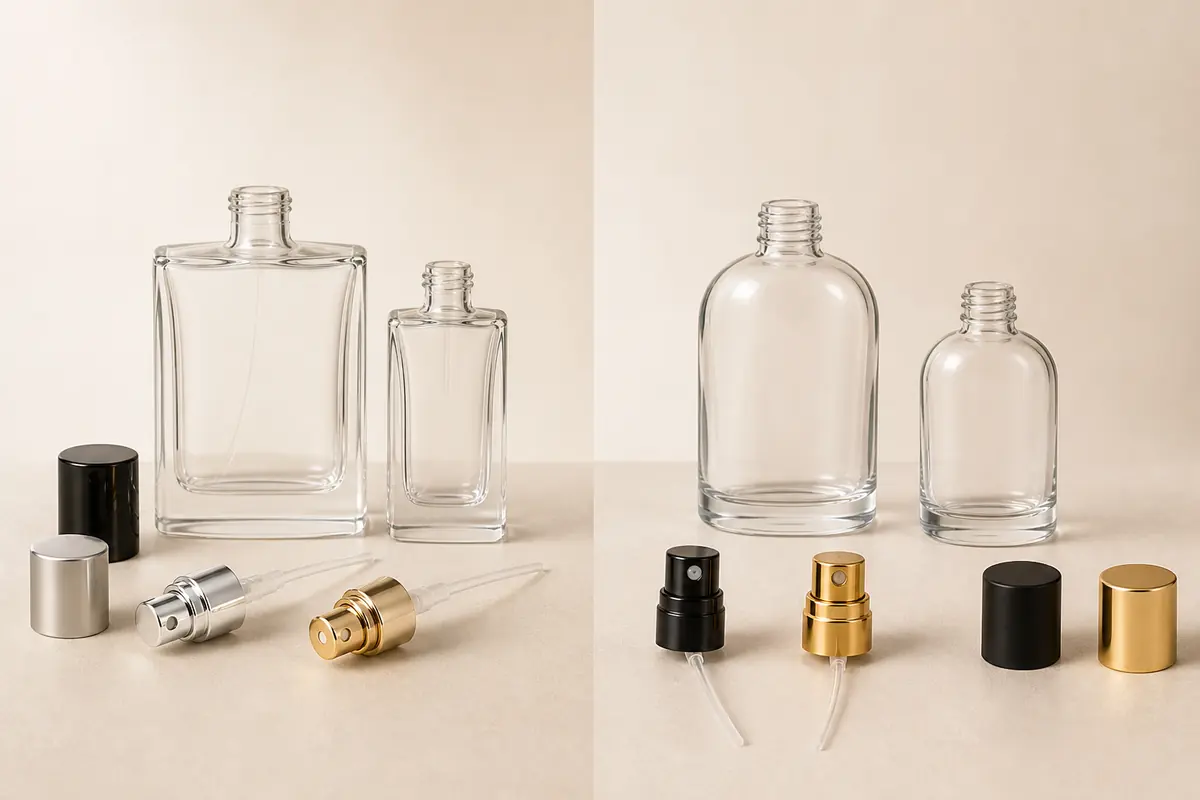
Crimp and screw perfume bottles differ mainly in neck finish, atomizer attachment and assembly method. A crimp bottle uses a neck designed for a mechanically crimped atomizer. A screw bottle uses a threaded neck and a compatible screw-on pump or closure. Neither system is universally better, and neither attachment method automatically guarantees better sealing or spray performance.
The choice also affects equipment, component sourcing, visual finishing, reopening and potential refill concepts. Buyers should compare the complete bottle, atomizer, gasket, dip tube, collar and cap rather than treating “crimp” or “screw” as a stand-alone quality grade.
In both cases, the fragrance formula and expected distribution conditions remain part of validation. Neck attachment describes how the atomizer connects to the bottle; it does not by itself define spray quality, sealing performance, shelf life or consumer experience.
What Is a Crimp Perfume Bottle?
A crimp perfume bottle has a neck profile designed for a matched atomizer ferrule. During assembly, the atomizer is positioned with its gasket and dip tube, then crimped around the bottle neck using suitable equipment and validated settings. A decorative collar usually covers the ferrule, and a cap completes the package.
The crimped atomizer is not intended to function like a hand-removable screw closure. Correct attachment depends on bottle and pump geometry, gasket, crimping equipment and process control. A visual fit before crimping does not prove compatibility.
For a brand using a crimp system, the key procurement decision is whether the selected bottle, atomizer and filling or assembly partner can support a repeatable crimping process. Buyers should confirm the intended neck finish, matching ferrule and gasket, suitable assembly equipment and sample approval requirements before ordering production quantities.
What Is a Screw Perfume Bottle?
A screw perfume bottle uses a threaded neck and a compatible screw-on atomizer or closure. Assembly engages the component thread with the bottle finish and may use a gasket or integrated sealing feature. The closing method and controls should match the exact component system.
Screw components may be easier to remove and reinstall, but removability alone does not create a safe or durable refill system. Thread design, sealing, user access, refill interface, formula exposure and repeated-use performance remain project-specific.
For buyers, the important distinction is between a removable atomizer and a complete refillable packaging system. A threaded neck may simplify access, but the selected pump must still maintain the intended sealing and dispensing performance after assembly and, where applicable, repeated removal and reinstallation.
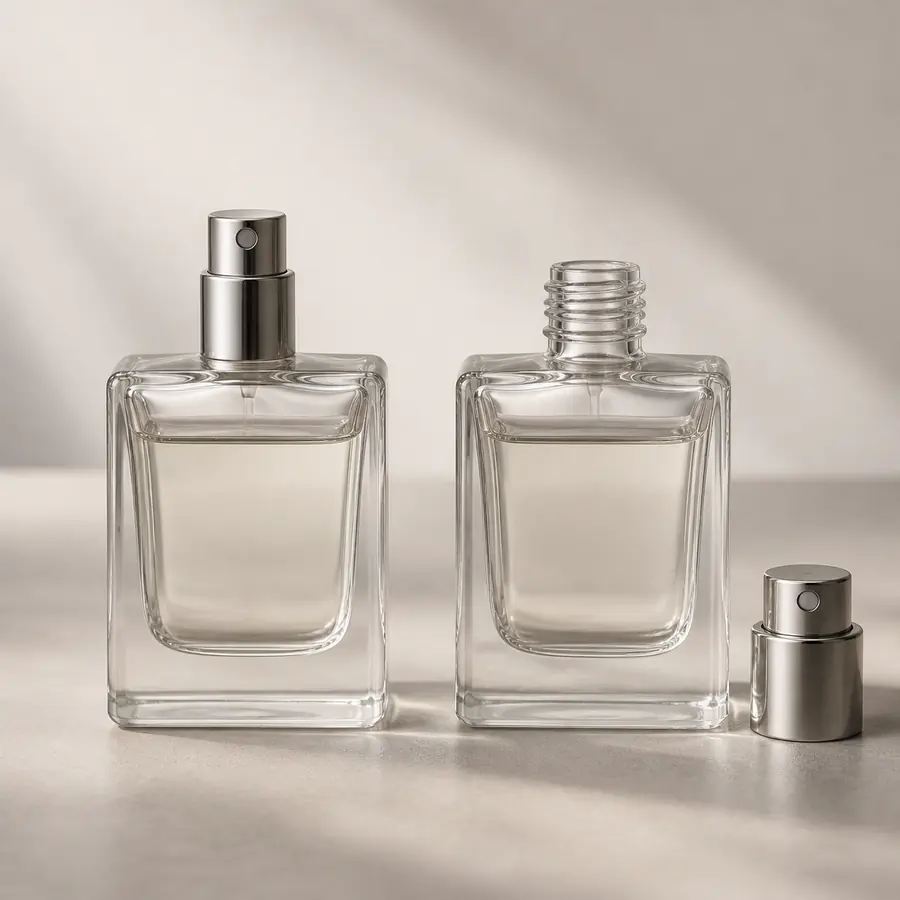
Crimp vs Screw: Technical Comparison
The main difference between crimp and screw perfume bottles is how the atomizer is retained on the bottle neck. The table below compares the practical implications for packaging selection, assembly and buyer approval.
| Factor | Crimp system | Screw system |
|---|---|---|
| Neck | Crimp finish or bead | Threaded finish |
| Attachment | Atomizer ferrule mechanically crimped | Compatible component screwed on |
| Assembly | Crimping equipment and validated settings | Defined screw-closing process |
| Sealing | Depends on neck geometry, gasket, ferrule deformation and assembly control | Depends on thread engagement, sealing structure, gasket and closing conditions |
| Visual finish | Ferrule often covered by collar | Threaded component appearance depends on design |
| Reopening | Not normally a hand-removable closure | Often easier to remove, system-specific |
| Refill potential | Requires a designed refill solution | Possible only in a validated refill system |
| Main buyer verification | Confirm neck and ferrule matching, gasket, crimping equipment and finished assembly performance | Confirm thread matching, sealing geometry, closing method and performance after intended use |
For a conventional perfume project that does not require the user to remove the atomizer, a validated crimp system may fit the intended packaging and filling process. Where planned user access is part of the product concept, a purpose-designed screw or other refillable mechanism may be more appropriate.
The final choice should follow the intended product function and available assembly capability, not an assumption that one system is inherently more luxurious, leak resistant or environmentally preferable.
Atomizer Compatibility
Crimp and screw atomizers are not interchangeable as direct replacements. Each must match the bottle neck, gasket, dip tube, collar and cap system. Even within one attachment type, nominal size or appearance does not establish fit.
A common sourcing mistake is selecting an attractive perfume bottle and assuming that any atomizer described with a similar neck size will fit. The same nominal designation does not confirm matching ferrule geometry, thread profile, sealing surfaces or assembled height.
For a crimp system, the ferrule must be suitable for the selected bottle finish and assembly process. For a screw system, buyers must confirm the mating thread and sealing structure. In both cases, the gasket, dip tube and decorative components must be evaluated as part of the final assembly.
The perfume bottle anatomy article explains how bottle, atomizer, collar, cap and neck finish work together. The article on how perfume atomizers work covers pump mechanisms, crimping and spray performance in more depth.
Assembly Equipment and Process
Crimp assembly requires equipment capable of forming the atomizer ferrule around the neck to the validated condition. Tooling, head condition, alignment, bottle support and settings can influence the result. The process must be established for the exact bottle and atomizer.
An incorrectly adjusted crimping process may produce uneven ferrule deformation, an improperly seated pump or damage to the bottle neck. A decorative collar can conceal the ferrule, so a visually complete package is not sufficient evidence that the functional attachment has been approved.
Screw assembly avoids the crimping step but still needs a controlled method. Under-closing, over-closing, damaged threads, gasket issues or inconsistent alignment can affect the package. “Hand tightened” is not a sufficient mass-production specification unless the approved process explicitly defines and controls it.
For applicable continuous-thread closure systems, ASTM D2063/D2063M-24 describes methods for measuring closure removal torque under specified conditions. It can support packaging engineering evaluation where the selected closure falls within its scope. It does not establish a universal tightening torque for perfume atomizers or replace sealing and dispensing tests.
Buyers should obtain the applicable assembly requirements for the selected components and confirm that the filling or assembly partner has the necessary equipment and process controls.
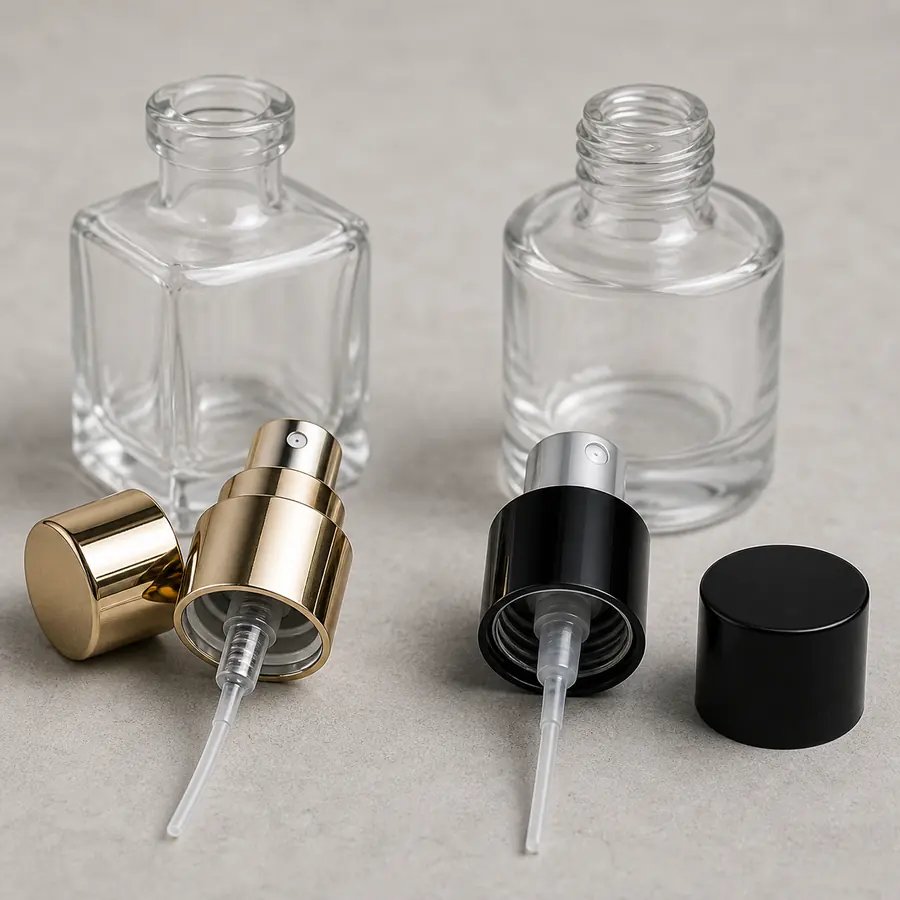
Leakage and Sealing Considerations
Neither crimp nor screw packaging is automatically more leak resistant. Sealing depends on the bottle finish, atomizer or closure, gasket, assembly, formula, orientation and handling conditions. A well-designed system can still fail if components are mismatched or assembly is inconsistent.
For a crimp bottle, insufficient or uneven ferrule deformation may affect retention and gasket compression. For a screw bottle, inadequate thread engagement, incorrect closing conditions or gasket displacement may compromise the intended seal.
Evaluation should use agreed conditions and the actual fragrance formula. Check the assembled package rather than testing an empty bottle or isolated atomizer. Results from one component set should not be transferred to another without review.
Technical note: An atomizer that fits securely on an empty bottle has not necessarily passed fragrance compatibility testing. The actual formulation may interact with the gasket, pump or other product-contact components. Packaging compatibility should be evaluated with the actual formulation under intended storage and use conditions.
If leakage appears during sample testing, inspect the location of the leak before changing the bottle or pump. Leakage around the neck may involve the sealing interface or assembly, while liquid at the actuator or spray outlet may require a different investigation.
Buyers should document the observed failure and confirm the cause before approving a revised component combination.
What the Assembly Team Needs to Know
The selected attachment method should be communicated before filling trials. For a crimp package, the team needs the correct crimp head or tooling, bottle support, atomizer orientation and validated settings. Setup should be checked with representative bottles and pumps, not one ideal unit. Tool condition and alignment may need routine monitoring during production.
For a screw package, the team needs the approved closing method, component presentation and alignment requirements. The screw atomizer must start correctly on the thread and seat as designed. Excessive or insufficient closing can create visual or functional variation. A decorative collar or cap may add an orientation requirement after the pump is installed.
Both systems require controlled handling of dip tubes, gaskets and product-contact parts. A correct bottle and atomizer pairing can still produce an inconsistent result if a gasket is missing, a tube is damaged or the assembly method changes.
Before confirming a bulk order, buyers should establish whether the components will be supplied loose or as a completed assembly, who will carry out the final pump installation and which party is responsible for inspecting the finished package.
Decoration, Collar and Cap Design
Crimp systems commonly use a collar to hide the ferrule and coordinate the bottle with the cap. Collar height, diameter, finish and fit affect the visual transition. Screw systems may also use collars or decorative covers, depending on the component design.
Cap engagement and alignment should be checked on the assembled atomizer. A cap can look correct in a rendering but sit too high, rotate unexpectedly or contact the shoulder when real components are installed. Review decoration, collar, cap and carton together.
For branded perfume packaging, buyers should approve the complete assembled appearance on physical samples. If the glass bottle, collar and cap use different materials or decorative finishes, review their color and surface appearance together rather than approving each component from a digital rendering alone.
Decorative changes should also be checked for possible effects on component seating, cap removal and the final package dimensions.
Refillable vs Non-Refillable Considerations
A screw neck may make access easier, but not every screw perfume bottle is designed for consumer refilling. A refillable system must address opening, refill transfer, resealing, repeated cycles, formula exposure, instructions and component durability. The brand should define the intended refill model before choosing the package.
A conventional crimped atomizer is not normally intended for routine user removal. Nevertheless, a crimp bottle can form part of a specially designed refill solution if the overall mechanism supports the intended process. Refillability is a property of the complete packaging system, not simply the presence or absence of a threaded neck.
Where consumers are expected to remove and reinstall a screw atomizer, the package should be evaluated for repeated handling, sealing and dispensing after the intended number of refill operations. A bottle that can be opened once during development is not automatically suitable for repeated consumer refilling.
For brands evaluating reuse and refill concepts, Regulation (EU) 2025/40 on packaging and packaging waste provides the relevant EU regulatory framework, including provisions concerning reusable packaging and refill. Its requirements and applicable dates must be evaluated according to the specific packaging system, economic operator and intended market.
Choosing a screw bottle does not, by itself, establish compliance with refill-related requirements or prove an environmental advantage. Buyers should evaluate the complete refill design, product safety, component durability, actual reuse conditions and relevant destination-market obligations.
Browse refillable perfume bottles for the relevant product category and use the refillable perfume packaging guide for the broader decision framework.
Sourcing and Component-Control Implications
A perfume bottle should be sourced with its intended atomizer family in mind. When the bottle, pump, collar and cap come from different suppliers, the buyer must control specifications and sample approval across all sources. One supplier’s “standard” crimp or screw description may not be sufficient to qualify another supplier’s component.
Request exact component codes, current drawings or specifications, product-contact material information where available, and assembled samples. Confirm who is responsible for dip-tube preparation, crimping or screw closing, collar installation and final inspection. These responsibilities can affect both quotation scope and production readiness.
Manufacturer Insight: Confirm the Atomizer Before Final Bottle Approval
For a new perfume packaging project, the bottle and atomizer should be evaluated as one system before the final decoration and bulk-production specifications are approved.
At FOLOVER PACK, the recommended sourcing sequence is to identify the intended bottle neck system, select a compatible atomizer family, confirm the gasket and dip-tube configuration, and then evaluate the complete assembly with the selected collar and cap.
For projects involving separately sourced components, the buyer should request physical samples from the intended suppliers and confirm which party is responsible for final assembly validation. A bottle sample approved with one atomizer should not automatically be treated as approved for a replacement pump.
This approach is especially important when a brand is developing several perfume SKUs that share one bottle shape but use different caps, decorative finishes or atomizer components.
Changing the atomizer after bottle approval should trigger a compatibility review. Changing only the collar or cap may still affect assembled height, alignment, removal force or carton fit. Maintain a controlled bill of components rather than purchasing by appearance.
How to Compare Production-Intent Samples
Prepare crimp and screw candidates with comparable bottle capacity, fragrance formula, spray requirement and visual brief where possible. Assemble each using its intended process. This prevents a high-quality finished sample from being compared with an incomplete loose-component mockup.
Review initial appearance, pump priming, spray behavior, cap fit and any defined leakage conditions. Repeat actuation and opening or handling checks appropriate to the intended use. Place the assembled bottles in their proposed inserts and cartons because a different neck and atomizer system can change height and protection needs.
Record what was tested, how samples were assembled, which component revisions were used and why one option was selected. The objective is not to declare one attachment method technically superior in every situation, but to show which complete system meets the specific project requirements.
Which System Should a Brand Choose?
Choose a crimp system when the verified package, assembly capability and desired appearance support crimped atomizers. Choose a screw system when the threaded bottle and component family, assembly route and access requirements better fit the project. The decision must also consider supplier availability, quantity, filling line, cap and collar design, carton and testing.
For a conventional perfume launch with no planned consumer refill function, the buyer should prioritize the system that can be assembled consistently with the available equipment and approved components. For a fragrance product designed around repeated consumer access, a purpose-designed refillable system should be evaluated from the beginning rather than assuming an ordinary screw atomizer will meet that requirement.
Browse perfume glass bottles to compare product directions. The perfume packaging guide covers the wider system, while how to choose a perfume bottle provides the buyer-level selection sequence.
The Q&A is a screw perfume bottle better than a crimp bottle? gives a shorter decision-oriented answer without replacing this technical comparison.
Sample Testing Checklist
Before approving a crimp or screw perfume packaging system, evaluate physical samples representing the intended production configuration. The following checks should be completed using the selected components and agreed project requirements.
- Confirm exact bottle, atomizer, gasket, collar and cap codes.
- Verify crimp or thread finish against current specifications.
- Approve dip-tube length and assembly method.
- Assemble samples using production-intent equipment and controls.
- Evaluate sealing and leakage under defined conditions.
- Test priming, spray pattern, output and repeated actuation.
- Review collar and cap fit, alignment and assembled height.
- Include actual formula, carton and transport conditions where relevant.
- Record approved sample identity and revisions.
For a crimp system, include inspection of the finished ferrule and pump seating. For a screw system intended for repeated opening, evaluate the relevant removal, reinstallation and resealing behavior. Test requirements and acceptance criteria should be agreed for the actual product and intended use rather than copied from an unrelated perfume bottle.

Explore the Packaging Technology hub for technical mechanisms and the Packaging Buying Guides hub for sourcing decisions.
Frequently Asked Questions
What is a crimp perfume bottle?
It is a bottle with a neck designed for a matched atomizer that is mechanically crimped onto the finish.
What is a screw perfume bottle?
It uses a threaded neck and a compatible screw-on atomizer or closure.
Is a screw bottle refillable?
Not automatically. Refillability requires a complete system designed and validated for repeated access and resealing.
Is crimp packaging more leak resistant?
Not inherently. Performance depends on matched components, assembly, formula and validation.
Can the same atomizer fit crimp and screw bottles?
No. Crimp and screw atomizers use different attachment systems.
Do crimp bottles require special equipment?
They require appropriate crimping equipment and validated settings for the selected bottle and atomizer.
Conclusion
Crimp and screw perfume bottles use different necks, atomizers and assembly processes. Neither is universally superior or automatically refillable or leak resistant. Choose the system that matches the complete packaging brief, production capability and verified sample results.
For B2B perfume packaging buyers, the most important step is to approve the bottle, atomizer, gasket, dip tube, collar and cap as one complete system before bulk production. A suitable neck attachment is only the starting point; sealing, dispensing, assembly consistency and intended use must also be verified.
FOLOVER PACK supports perfume glass bottle selection, atomizer and closure matching, component coordination and custom packaging development. Share your intended bottle design, preferred crimp or screw system, fragrance formula and component requirements to discuss suitable packaging options and sample evaluation.