

Round vs square perfume bottles differ in surface geometry, visual orientation, decoration requirements, handling and secondary packaging. Round bottles provide continuous curved surfaces and a softer silhouette, while square bottles offer flatter panels, defined corners and a clearer front-facing presentation.
For fragrance brands, the practical choice is not simply about appearance. Round bottles are worth prioritizing when continuous curvature, a cylindrical design or rotational presentation supports the concept. Square bottles are worth considering when flat artwork panels, geometric proportions and coordinated cap alignment are central to the design. Neither shape automatically offers lower manufacturing costs, better fragrance protection or greater packing efficiency. Buyers should compare the exact bottle dimensions, neck finish, atomizer, decoration, cap and carton before approving production.
Shape and Brand Impression
Round bottles can support classic, soft, fluid or minimalist directions, depending on proportion, glass distribution, decoration and cap design. Square bottles can support geometric, architectural or structured directions. These are design tendencies, not rules: a round bottle can look highly contemporary, while a square bottle can look traditional.
Proportion often matters as much as footprint. A tall, narrow square bottle communicates differently from a low, wide square bottle, and the same is true for round forms. The planned article on cosmetic packaging shape and proportion explores how geometry affects brand perception across a wider packaging system.
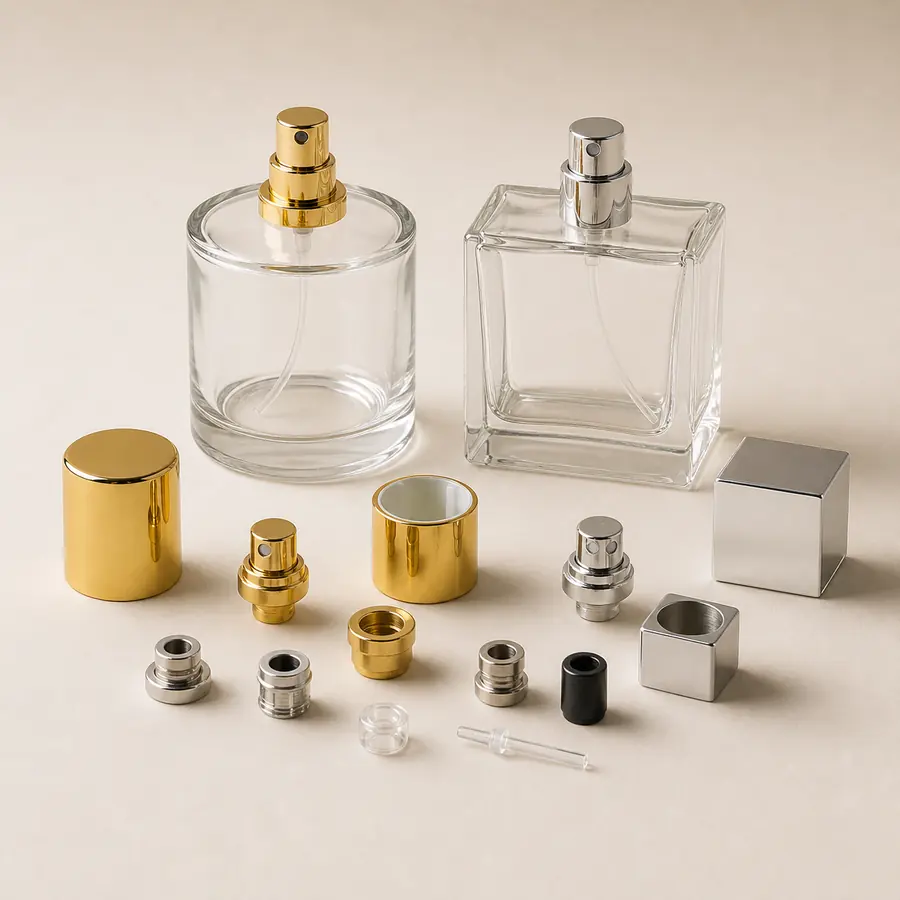
For buyers developing a fragrance collection, the assembled silhouette should be evaluated before selecting a bottle. A cylindrical bottle paired with a broad square cap creates a different impression from the same bottle fitted with a slim cylindrical cap. Likewise, a square bottle with rounded shoulders can communicate a softer identity than a sharp-edged geometric design.
Decoration Area: Curved Surfaces vs Flat Panels
A round perfume bottle provides a continuous curved surface. Coating and frosting can follow the form, while printing or labeling must account for curvature and the chosen artwork width. A square bottle often provides flatter front and side panels, which can establish a clear artwork orientation. Corners and panel transitions may limit where decoration can be applied consistently.
Screen printing: A suitable cylindrical round bottle may be decorated using a rotating fixture that moves the bottle surface relative to the printing screen. Artwork must account for the bottle circumference, print registration and available decoration area. Full-wrap printing is not automatically possible on every round bottle, especially when shoulders, recessed surfaces or irregular contours interrupt the printable area.
Square bottles offer defined front or side panels for individual logos and artwork. However, printing across a corner or transferring a continuous design between adjacent panels requires separate feasibility assessment. A printing process suitable for one flat panel may not reproduce uninterrupted artwork across the entire bottle perimeter.
Spray coating: Round and square bottles require appropriate positioning, rotation or fixture arrangements to achieve the specified appearance. On square bottles, corners, shoulders and recessed areas deserve particular attention because the local geometry can affect coating coverage and visual consistency. Round bottles may present their own challenges around the shoulder, base and transitions between surfaces.
Hot stamping and labels: A flat square panel can provide a defined placement area for a logo or label, while a cylindrical surface requires the decoration method and artwork to accommodate curvature. The achievable decoration area depends on the actual bottle geometry, equipment and selected finishing system.
Neither shape is automatically easier to decorate. Buyers should request the verified decoration zone, confirm the proposed artwork dimensions and approve decorated physical samples before bulk production. FOLOVER PACK’s decoration and finishing options can help buyers review coating, printing and other surface-treatment directions for their selected bottle.

Packaging and Carton Efficiency
Square perfume bottles may appear to use space efficiently because their footprints can align, but corners, protective gaps, caps and inserts affect the actual carton. Round bottles may create spaces between units, yet exact diameter, arrangement and protective packaging determine the result. No reliable quantitative conclusion can be made from shape name alone.
Compare the complete assembled dimensions, orientation, insert design, master-carton layout and transport protection. A bottle that looks compact on a shelf may require more protective space because of a projecting cap, decorative detail or vulnerable corner.
For example, a square glass bottle with prominent corners may require an insert that separates those contact points from adjacent bottles. A cylindrical bottle may fit efficiently into an appropriately designed divider or molded insert despite the spaces between its curved surfaces. The actual result must be evaluated using the selected bottle and packaging configuration.
Buyer action: Request a packing proposal showing the number of assembled bottles per inner carton and master carton, protective insert structure, total carton dimensions and shipping weight. Compare the proposed packing configurations rather than assuming that square bottles always offer better shipping efficiency.
Handling, Filling and Label Positioning
Round bottles have no natural front face unless decoration, an asymmetric cap or another feature establishes one. Square bottles provide clearer panel orientation, which may assist artwork alignment, but they may also require controlled orientation during printing, labeling or packing. Line behavior depends on exact base stability, center of mass, dimensions and handling equipment.
For a square perfume bottle with a front-facing logo, the filling and decoration process may require an orientation reference or suitable fixture to maintain consistent placement. If the bottle rotates before labeling or inspection, the artwork may no longer face the intended direction.
A round bottle with a symmetrical design may require less visible front-to-back alignment, but orientation becomes important when its decoration, cap or collar establishes a specific front view.
Bottle shape alone does not prove filling-line suitability. Production teams should review conveyor contact, guides, filling position, crimping or closing access, labeling orientation and inspection method using the intended components.
Buyer action: Before approving a bottle for automated filling or decoration, provide the selected sample and dimensional drawing to the filling or decorating partner. Confirm whether the existing equipment can handle the bottle consistently or whether specific guides, holders or orientation controls are required.
Cap and Atomizer Compatibility
The neck finish is the technical interface for the atomizer or closure; the external body shape is not. A round and a square bottle can sometimes use components from the same general system when their verified neck specifications match, but visual similarity is insufficient evidence.
Perfume bottles may use crimp, screw or other designated pump-attachment systems. For example, FEA neck-finish designations are used for specified fragrance spray packaging interfaces. The packaging technical organization Cetie provides technical documentation for glass neck finishes, including finishes used with crimped and screw-mounted dispensing systems.
However, an FEA designation or another nominal neck specification does not establish compatibility by itself. The exact bottle drawing, pump specification, sealing geometry, component tolerances and intended assembly process must be reviewed together. A neck specification should never be inferred from bottle capacity or body shape.
The perfume bottle anatomy article explains the roles of bottle, atomizer, collar, cap and neck finish. Buyers should confirm the exact pump, gasket, crimp or screw interface, collar, cap fit, dip tube, assembled height and spray requirements for each bottle.
For example, a round and a square bottle may have independently verified neck systems that accommodate the same selected atomizer. Even then, differences in bottle height, internal base geometry and cap construction may require different dip-tube configurations or decorative components.
Final bottle and closure compatibility should be confirmed using the selected components and physical samples before bulk production.
Custom Mold Considerations
Custom round and square perfume bottles both require an approved technical design. Square forms may introduce visible corner, panel and cap-alignment considerations, while round forms may make front orientation dependent on decoration. Manufacturing feasibility, glass distribution, draft, base design and dimensional tolerances require engineering review for the exact concept.
For a custom square bottle, the engineering review should consider corner geometry, wall transitions, glass distribution, base structure and the relationship between the bottle body and neck. Sharp external styling does not mean that every internal transition can or should reproduce the same geometry.
Glass distribution, forming conditions, mold design and annealing requirements should be evaluated for the proposed design. These considerations do not establish that every square bottle requires a more expensive mold or a longer production cycle than a round bottle. The actual design and manufacturing process determine the development requirements.
For a custom round bottle, buyers should also review symmetry, glass distribution, shoulder transitions, base geometry and the intended decoration method. A rotationally symmetrical design may simplify certain orientation requirements, but it does not eliminate the need for manufacturing validation.
Do not assume that one shape is always easier, cheaper or faster to develop. Tooling, sampling, quantity, decoration, component sourcing and revisions influence the project. The planned guide to custom perfume bottle design connects shape with cap, atomizer and brand identity.
Manufacturer Insight: Approve the Complete Design Before Starting a Custom Mold
When developing custom perfume packaging, FOLOVER PACK recommends confirming the bottle geometry, target capacity, neck system, atomizer, collar, cap and decoration requirements before finalizing the mold design.
For a square bottle, cap alignment and front-facing artwork should be reviewed together. Changing the cap dimensions or bottle proportions after the tooling design has been approved may require additional engineering review and could affect the originally planned appearance or assembly.
For a round bottle, buyers should confirm the decoration orientation and the relationship between bottle curvature, cap diameter and the assembled silhouette.
Where a suitable stock bottle already meets the project requirements, buyers can compare stock-bottle decoration and component customization against full custom mold development. Request project-specific tooling, sampling and production quotations rather than applying a generic cost or MOQ assumption to either bottle shape.
Which Shape Fits Different Brand Directions?
Classic or Soft Presentation
A balanced round bottle can support a familiar or fluid presentation, especially with restrained decoration and a coordinated cap. The result still depends on proportion and detail.
For a fragrance concept emphasizing continuous curves, a cylindrical or softly contoured bottle may provide a suitable starting point. Buyers can explore the round perfume bottle packaging guide when comparing round-format options, decoration requirements and assembled packaging choices.
Minimalist or Architectural Presentation
A square bottle with clean panels can support a structured visual system. A simple round cylinder can be equally minimalist, so buyers should evaluate the full design rather than use a shape stereotype.
Square bottles are particularly worth evaluating when a defined front panel, rectangular label or aligned geometric cap is central to the proposed design. Buyers should review the usable decoration area, corner treatment and component alignment together. The square perfume bottle packaging guide provides a focused route for evaluating these requirements.
Luxury or Niche Presentation
Luxury is not created by shape alone. Glass distribution, finish quality, cap construction, atomizer details, decoration, secondary packaging and consistency all contribute. Browse square perfume bottles and the wider perfume glass bottle range to compare available product directions.
For niche fragrance projects, a thick-base square bottle may support a substantial architectural presentation, while a rounded bottle with carefully coordinated proportions and decoration may support a softer or more sculptural identity. The appropriate choice depends on the intended brand presentation and the feasibility of the complete packaging configuration.
Buyers should compare physical samples with their intended caps and collars rather than assessing an isolated empty bottle or rendering.
Round vs Square Perfume Bottle Comparison
| Factor | Round Bottle | Square Bottle | What Buyers Should Verify |
|---|---|---|---|
| Surface | Continuous curved surface; suitable for designs that emphasize a cylindrical or fluid silhouette. | Flatter panels with corners; suitable for designs requiring a defined geometric presentation. | Actual body dimensions, surface transitions and usable decoration area. |
| Orientation | Front orientation may depend on decoration or asymmetric components. | Front panel can be more clearly defined, but orientation may require additional control. | Logo positioning, fixture requirements and cap-to-bottle alignment. |
| Decoration | Artwork follows curvature; cylindrical printing may require a rotating fixture. | Panels can support defined placement; printing across corners requires feasibility review. | Artwork size, print registration, coating appearance and decorated physical samples. |
| Carton Planning | Depends on diameter, cap dimensions, layout and protective inserts. | Depends on corners, assembled dimensions, layout and protective inserts. | Actual carton dimensions, bottle separation, packing quantity and transport protection. |
| Atomizer Fit | Defined by the verified neck system, not the round body. | Defined by the verified neck system, not the square body. | Neck finish, pump, gasket, dip tube, collar, cap and physical compatibility. |
| Custom Development | Requires review of glass distribution, geometry, base, decoration and component coordination. | Requires the same review, with particular attention to corner geometry, panel consistency and alignment. | Approved drawings, production feasibility, tooling quotation and complete prototype assembly. |
Selection takeaway: Choose a round bottle when continuous curvature and a soft or cylindrical design are important to the packaging concept. Choose a square bottle when defined flat panels and geometric alignment provide a clearer route to the intended design. For both shapes, verify the exact components, decoration, manufacturing feasibility and carton before approving the selected configuration.
Cap Alignment and the Assembled Silhouette
A perfume bottle is viewed as an assembled object, so the cap and collar can strengthen or weaken the shape concept. A cylindrical cap can soften a square bottle, while a square cap may create a strong geometric continuation. With a square bottle, buyers often notice whether cap edges align with the bottle panels. With a round bottle, rotational alignment may be less visible unless the cap, collar or decoration has a defined front.
Alignment expectations should be described before sample approval. The buyer should identify which elements must face forward, what visual variation is acceptable, and how the component will be oriented during assembly. A cap that appears correct in a rendering may rotate, sit at a different height, or reveal a gap when installed on the production-intent pump and collar.
For square perfume bottles with square caps, the assembled sample should be checked from the front, side and top. Review cap rotation, collar position, visible gaps and the alignment between the cap edges and bottle panels.
If the cap is removable, its final rotational position after repeated replacement should also be evaluated. An assembly that looks aligned during initial presentation may not retain the intended orientation after normal use.
Common mistake: Approving a square bottle and square cap separately without evaluating the complete assembly. A compatible neck connection does not automatically guarantee correct visual alignment. Buyers should confirm the intended cap position, assembly method and acceptable appearance on physical samples before bulk production.
Stability, Weight and User Handling
Footprint shape influences how a bottle feels, but stability depends on the actual base dimensions, glass distribution, filled weight, cap mass and center of gravity. A broad square bottle may appear stable, yet a tall heavy cap can change handling. A compact round bottle may be easy to rotate in the hand, but smooth decoration or a large diameter can affect grip.
Buyers should assess the filled or representative-weight package on a flat surface and in the intended carton. Review pickup, spraying, cap removal, replacement and return to the shelf. Sharp-looking corners should also be evaluated physically for comfort and protection. These checks are more reliable than assigning handling qualities to an entire shape category.
A bottle’s appearance does not establish its actual weight or glass thickness. A thick-base round bottle may weigh more than a square bottle of similar nominal capacity, while another design may produce the opposite result. Request the verified specifications for the exact samples being compared.
How to Compare Samples Fairly
A useful comparison holds the important variables as constant as possible. If a round sample uses a lightweight stock cap while a square sample uses a heavy custom cap and elaborate decoration, the buyer is comparing two complete design directions rather than shape alone. Prepare the same review criteria for both candidates.
- compare intended fill and assembled dimensions;
- review the same decoration concept where technically feasible;
- use matched atomizer performance requirements;
- check front orientation and cap alignment;
- place both options in realistic cartons or inserts;
- record handling, shelf presentation and approval comments consistently.
Where the samples use different neck finishes or atomizer systems, evaluate those differences separately rather than attributing the results to bottle shape.
The final choice may still favor one complete design, which is appropriate. The purpose of a controlled comparison is not to remove brand judgment but to prevent unsupported assumptions from being mistaken for technical facts.
What Buyers Should Decide First
- target brand impression and proportion;
- verified capacity and intended fill;
- neck finish, atomizer, collar and cap system;
- decoration method and usable artwork area;
- assembled dimensions and carton design;
- line orientation, filling, closing and inspection needs;
- stock bottle or custom mold direction;
- production-intent sample approval.
For the wider decision sequence, see how to choose a perfume bottle. The square perfume bottle packaging guide focuses on square-format decisions, while the perfume packaging guide covers the complete system.
When requesting a quotation, buyers should provide the preferred bottle shape, target capacity, reference images or drawings, quantity, neck and atomizer requirements, cap design, decoration artwork and destination-market requirements. Specify whether the project should prioritize an available stock bottle or evaluate custom mold development.
FOLOVER PACK recommends approving the final assembled bottle, atomizer, collar, cap and decoration before releasing the selected packaging configuration for bulk production.

Use the Product Knowledge hub for component fundamentals and the Packaging Buying Guides hub for purchasing decisions.
Frequently Asked Questions
Are square perfume bottles more premium?
Not automatically. Square perfume bottles can support a structured or architectural presentation, but premium perception depends on the complete design, glass distribution, finish quality, atomizer, cap, decoration and secondary packaging. A well-designed round bottle can achieve a similarly refined appearance. Buyers should compare complete physical samples rather than treating square geometry or heavy glass as proof of superior packaging quality.
Are round perfume bottles easier to decorate?
Not universally. A suitable cylindrical bottle may support rotary screen printing, while a square bottle can provide defined flat panels for individual logos and artwork. Round bottles require attention to curvature and print registration; square bottles require attention to corners, panel transitions and orientation. Coating and hot stamping also have process-specific limitations. Buyers should confirm the usable decoration area and approve physical samples before production.
Does bottle shape affect perfume quality?
Shape alone does not determine fragrance quality. Formula compatibility, sealing, atomizer performance and storage conditions require separate evaluation. Round and square bottles can both be considered for fragrance packaging when the selected glass container and complete closure system meet the formulation and application requirements. Buyers should validate the actual filled packaging configuration rather than assuming that a particular exterior shape provides better fragrance protection.
Can round and square bottles use the same atomizer?
Yes, they may use the same selected atomizer when the verified neck finish, attachment method, sealing geometry and relevant component specifications are compatible. Body shape is not the compatibility interface. However, differences in bottle height, internal geometry, collar design or cap construction may require separate component evaluation. Final compatibility should be confirmed with the exact bottle and atomizer assemblies before bulk production.
Which shape is better for custom branding?
Round perfume bottles are worth considering for continuous curved designs, cylindrical silhouettes and softer visual concepts. Square bottles are worth considering when defined front panels, geometric proportions or cap alignment are central to the design. Neither shape guarantees better branding results. Buyers should evaluate the proposed decoration, assembled components, carton, production feasibility and physical samples before selecting the final direction.
Conclusion
Round perfume bottles offer continuous curves; square bottles offer flatter panels and clearer orientation. For fragrance projects prioritizing cylindrical presentation or continuous curved decoration, a round bottle may provide a suitable starting point. When defined artwork panels, geometric proportions and coordinated cap alignment are central to the packaging concept, a square bottle may be more appropriate.
The final decision should be based on verified proportions, neck and atomizer compatibility, decoration feasibility, handling, carton design, project quantity and approved assembled samples. Bottle shape alone cannot establish manufacturing cost, packing efficiency or fragrance protection.
FOLOVER PACK supports B2B perfume glass bottle selection, component matching, decoration and custom packaging development. Share your preferred bottle shape, target capacity, quantity, atomizer requirements and design references to review suitable packaging options for your fragrance project.