
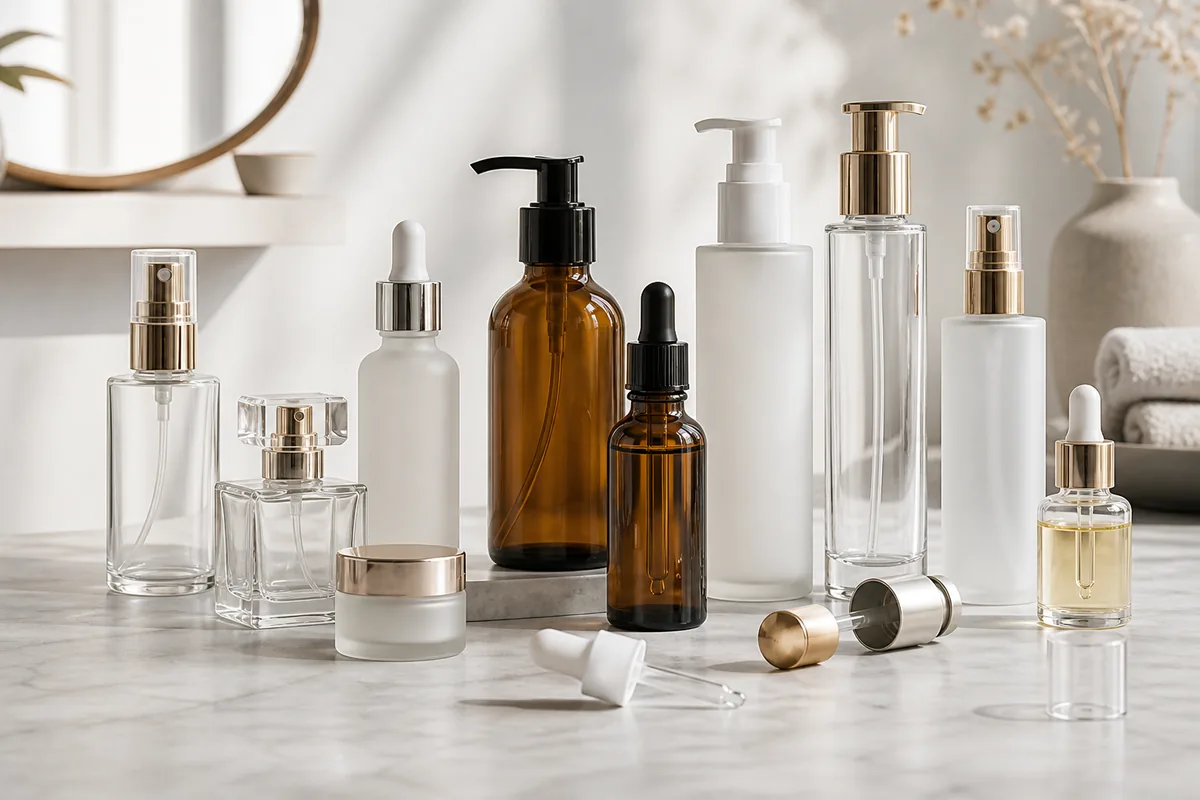
Cosmetic glass bottles hold serums, lotions, toners, facial oils, essential oils and fragrances. The right type depends on the formula, intended fill, neck finish, dispensing method and brand requirements. A clear, amber or decorated bottle is not automatically compatible with a particular pump, dropper or cap.
For B2B buyers, the practical sequence is to choose the container for the actual formulation, verify the neck and dispensing components, then approve the assembled package before bulk production.
What Is a Cosmetic Glass Bottle?
A cosmetic glass bottle is a glass container designed or selected for a beauty, skincare, fragrance, personal-care, or related formulation. Its main structural features include the body, shoulder, base, opening, and neck finish. Capacity and geometry describe the container, while the neck finish defines the interface used to attach a closure or dispensing component.
The complete packaging system can include:
- the glass bottle;
- a pump, sprayer, atomizer, dropper, reducer, or cap;
- a liner, gasket, seal, wiper, pipette, or dip tube where applicable;
- decoration such as coating, frosting, printing, hot stamping, or labels;
- protective and presentation packaging.
Key concept: The same glass bottle can behave differently when the closure, seal, dispensing component, formula, assembly method, or decoration changes. A cosmetic glass bottle should therefore be evaluated as part of a complete packaging system, not as an isolated container.
Why Glass Is Used in Cosmetic Packaging
Glass provides a rigid container, a clear or colored visual surface, and broad decoration possibilities. Its weight, transparency, tactile feel, and ability to form distinctive shapes can support different brand directions. These characteristics explain why glass is used across skincare, fragrance, facial-oil, and treatment packaging.
Glass is only one product-contact material in an assembled package. A dropper bulb, pump seal or atomizer may require separate formula-compatibility evaluation even when the glass container is suitable.
Breakage risk, weight, filling, closure attachment, transport, and consumer handling also remain part of the packaging decision.
Glass is not automatically the more sustainable option: container weight, attached components, decoration, transport and local end-of-life infrastructure affect the assessment.
Main Types of Cosmetic Glass Bottles
Serum Bottles
Serum bottles commonly use droppers or treatment pumps for controlled application. Clear, amber, colored, frosted, or coated glass may be used depending on the design and verified formula requirements.
Selection involves formula viscosity, intended dose, neck finish, component fit, pipette or dip-tube configuration, and user experience. A dropper may be considered for compatible fluid serums requiring manual application, while a treatment pump may suit products requiring one-handed dispensing.
The serum bottles explained article covers dropper, pump, size, and glass directions in detail.
Lotion Bottles
Glass lotion bottles often use pumps, but the word “lotion” covers formulas with different viscosities and dispensing needs. Pump output, actuator design, dip-tube length, priming, bottle height, and formula behavior must be assessed together.
Buyer action: Evaluate the selected pump with the production-intent bottle and actual lotion. Confirm priming, dispensing consistency, dip-tube position, and remaining product access before approving the assembly.
Toner and Liquid-Treatment Bottles
Toner and other low-viscosity products may use screw caps, reducers, treatment pumps, or sprayers depending on how the brand wants the product applied. The intended flow, spray, dose, leak control, and consumer handling determine the appropriate direction.
For a toner intended for direct application to a cotton pad, a compatible controlled-flow insert may be considered. For a facial mist, the spray pattern and dispensing experience become more important.
Essential-Oil and Facial-Oil Bottles
Essential-oil and facial-oil bottles may use droppers, Euro-dropper inserts, reducers, or caps. Amber glass is common, but color alone does not establish sufficient light protection or formula compatibility.
For concentrated oils requiring controlled dispensing, buyers should confirm the reducer opening, insert retention, cap engagement, and actual flow behavior using the intended formulation.
Perfume Glass Bottles
Perfume bottles typically combine glass with an atomizer, neck system, collar, and cap. Crimp and screw configurations use different neck and attachment structures.
Bottle geometry also interacts with decoration, cap proportion, packing, filling, and brand presentation. A bottle and atomizer that appear compatible must still be checked for the correct neck interface, sealing components, dip-tube configuration, and dispensing performance.

Compare available cosmetic and skincare glass packaging after defining your formula, target capacity and dispensing requirements.
Common Glass Colors and Surface Finishes
Clear glass shows the product and provides a clean visual direction. Amber and other colored glass change appearance and may be chosen as part of a verified protection strategy. Spray coating can create different visual colors, frosting produces a diffused surface, and printing or hot stamping adds graphics and metallic accents.
These terms should not be treated as interchangeable. Glass color is part of the glass appearance; spray coating is an applied surface finish; frosting changes the surface; printing applies artwork; and hot stamping applies a foil effect.
Important: Dark appearance does not automatically prove a defined UV or light-protection performance. Protection claims require evidence for the exact bottle, finish, formula, exposure conditions, and project requirements.
The guide to clear, amber, and colored cosmetic glass explains these choices separately.
Common Bottle Shapes
Round, square, rectangular, cylindrical, tapered, and custom shapes can all be used in cosmetic packaging. Shape influences brand identity, shelf presence, label or print area, handling, packing density, decoration setup, mold complexity, and component proportions.
Heavy-base designs can create visual weight, while slim cylinders may support a minimalist direction. Square or rectangular bottles can offer broad front panels but may need different packing and orientation controls.
For example, a square perfume bottle with a directional cap and front-facing logo may require alignment controls during decoration and assembly. A cylindrical bottle may provide a continuous curved surface for decoration, but the selected printing process must accommodate its actual curvature.
No shape is universally more functional. For stock bottles, assess decoration, filling and carton fit; for custom molds, confirm geometry, capacity, neck and closure before tooling approval.
Capacity, Dimensions, and Fill Volume
Capacity names help buyers organize a range, but nominal capacity, brimful capacity, intended fill, headspace, external dimensions, and component displacement are different concepts. The usable fill quantity must be confirmed for the selected bottle, formula, closure, and filling process.
External height and diameter affect label or print areas, cartons, filling-line handling, shelf fit, and transport density. Bottle weight and base design can influence presentation and logistics.
When a brand develops several capacities, do not assume every bottle shares the same neck, closure, pipette, dip tube, or decoration area. Treat each SKU as a defined configuration while coordinating common visual elements where verified.
Common purchasing mistake: Ordering a dropper or pump based only on bottle capacity. Two bottles with the same nominal volume may have different internal heights, base shapes, and neck finishes. Their dispensing components must be checked separately.
Common Closure and Dispensing Systems
| System | Typical Role | What Must Be Verified |
|---|---|---|
| Treatment or lotion pump | Dispenses compatible liquid, gel, serum, or lotion in controlled strokes. | Neck, seal, output, actuator, dip tube, formula, and assembly. Confirm priming and dispensing with the actual formulation. |
| Fine-mist sprayer / atomizer | Creates a spray for toner, mist, or fragrance applications. | Neck system, spray performance, formula, tube, seal, and attachment. Verify the intended spray pattern and repeated-use behavior. |
| Dropper | Draws and releases liquid through a bulb and pipette system. | Neck, wiper or seal, bulb material, pipette length, formula, and dosing behavior. Confirm liquid uptake and product access. |
| Euro-dropper insert / reducer | Controls flow for compatible essential oils and other products requiring drop-by-drop dispensing. | Insert and bottle fit, orifice, formula, cap, seal, and flow behavior. Verify insert retention during normal use. |
| Screw cap | Closes the bottle for pouring, reducer use, or separate application. | Thread, liner or seal, engagement, formula, and use conditions. Confirm the intended sealing interface rather than thread engagement alone. |
The cosmetic bottle closures overview compares these component families more deeply.
What Does Neck Finish Mean?
Neck finish describes the engineered geometry at the bottle opening that interfaces with a closure or dispensing component. It can include thread structure, crimp structure, sealing surfaces, opening dimensions, and other design details needed for attachment and sealing.
For example, a bottle described as having a 24 mm neck should not automatically be paired with any pump advertised with the same nominal diameter. Thread-finish series, closure depth, gasket position, and sealing geometry may differ.
The packaging technical organization Cetie publishes glass neck-finish technical data sheets covering defined attachment systems and dimensional requirements. These resources provide technical references for specific finish designs; they do not establish universal interchangeability between bottles and closures with similar nominal dimensions.
The cosmetic bottle neck finish guide is the dedicated technical reference for threads, crimp systems, and closure interfaces.
How Cosmetic Glass Bottles Are Customized
Customization can involve an existing bottle with a new color, logo, finish, or closure, or a custom mold for exclusive geometry. FOLOVER supports coating, frosting, screen printing, hot stamping, electroplated components, labels, customized logo decoration, and custom bottle development depending on the selected product and project.
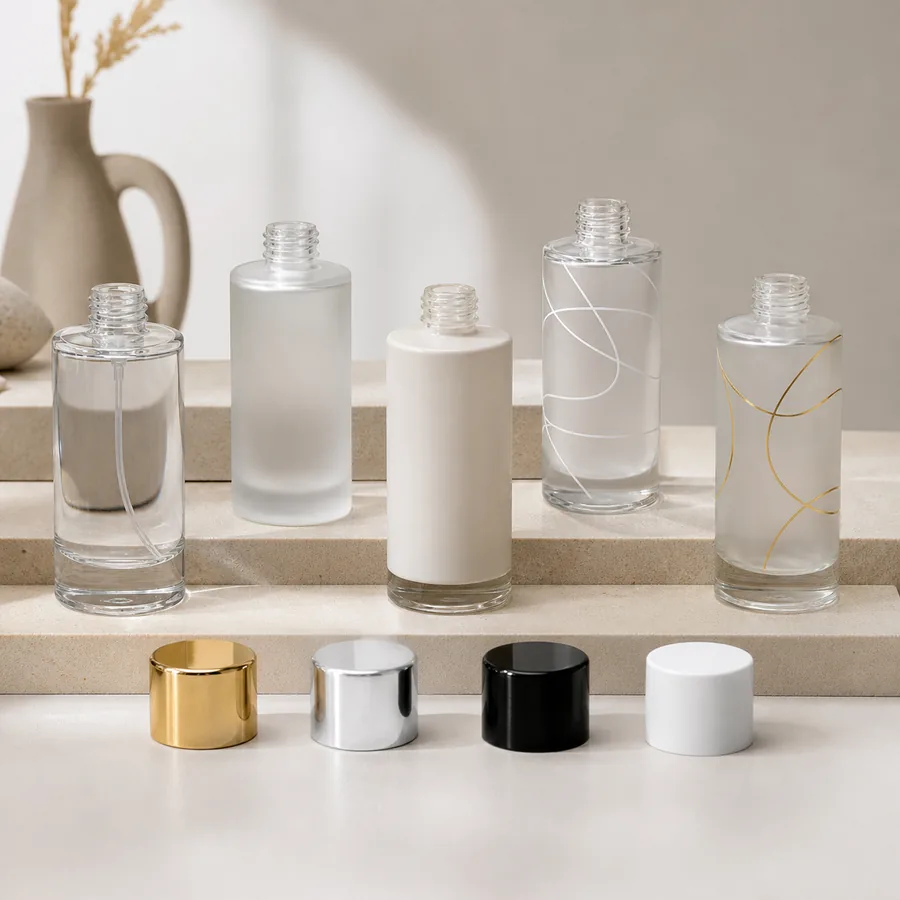
Artwork position, physical color, finish interaction, adhesion or durability requirements, component color, and assembled appearance should be approved on suitable samples. Do not assume a digital rendering guarantees the final physical result.
For stock-bottle customization, confirm that the selected bottle and closure are compatible before approving decoration. For custom-mold projects, finalize the required capacity, geometry, neck system, and component configuration before releasing the mold design for production.
Glass Bottle vs Complete Packaging System
A matching bottle and closure must meet three distinct checks: mechanical attachment, an effective seal, and dispensing with the actual formula. Passing one does not prove the others.
Manufacturer Insight: Identify the Failed Interface Before Changing the Bottle
When a filled bottle shows residue around the neck, first check the approved bottle and closure codes, neck finish, thread engagement, gasket position and sealing geometry. A tighter-looking cap does not establish that the sealing interface is correct.
If the attachment is correct, examine the closing process and formula contact with the seal. Change only the component or process implicated by the findings, then evaluate the revised assembly with the actual formulation before bulk production.
A pump that stops dispensing while product remains in the bottle requires a separate intake and priming review; replacing the glass bottle may not address the cause. These are diagnostic examples, not reports of customer incidents.
Which Cosmetic Products Commonly Use Glass Bottles?
| Product | Common Direction | Key Consideration |
|---|---|---|
| Serum | Dropper or treatment-pump bottle | Viscosity, dose, formula, and component fit. Confirm pipette or pump performance with the actual serum. |
| Lotion | Pump bottle | Output, priming, dip tube, and formula behavior. Verify that the selected pump can dispense the intended lotion consistently. |
| Toner / mist | Pump, sprayer, reducer, or cap | Application method, spray or flow, and seal. Select the dispenser according to the intended consumer experience. |
| Facial / essential oil | Dropper or reducer bottle | Dosing, formula compatibility, light strategy, and seal. Evaluate the actual formulation against the selected product-contact components. |
| Perfume | Atomizer bottle | Neck, atomizer, collar, cap, spray, and decoration. Approve the complete fragrance packaging assembly. |
Buyer decision: Start with the formulation and required dispensing experience, then select the bottle and compatible components. A dropper bottle may be appropriate for a fluid serum requiring manual dosing, while a pump bottle may be preferable for a lotion requiring repeated one-handed dispensing. The final decision depends on the actual formula and verified component performance.
What Buyers Should Confirm Before Ordering

- intended product and actual formula characteristics;
- target capacity, intended fill, and bottle geometry;
- verified neck finish and selected closure or dispenser;
- tube, pipette, seal, liner, gasket, or reducer requirements;
- color, decoration, artwork, and physical reference;
- quantity, MOQ by component or process, and project schedule;
- samples, formula compatibility, assembly, inspection, and packing plan.
For a multi-SKU project, buyers should also identify which bottles, closures, colors, and decoration processes are intended to be shared across the product range. A shared component should only be approved for multiple bottles when the exact interfaces and functional requirements have been verified.
For the full purchasing workflow rather than a product-family overview, use how to choose the right cosmetic glass bottle.
Frequently Asked Questions
What products can be packaged in cosmetic glass bottles?
Cosmetic glass bottles are commonly considered for serums, lotions, toners, facial oils, essential oils, fragrances, and other beauty formulations. The appropriate bottle depends on formula characteristics, intended fill, dispensing requirements, neck finish, and closure compatibility. Buyers should select and evaluate the complete bottle-and-closure system with the actual formulation before bulk production.
What is the difference between serum and lotion bottles?
Serum bottles often use pipette droppers or treatment pumps, while lotion bottles commonly use pumps designed for compatible formulations. However, the distinction is not determined by the product name alone. Formula viscosity, intended dose, bottle geometry, neck finish, and dispenser performance influence the selection. Buyers should verify the selected components with the actual product.
Are amber bottles only used for essential oils?
No. Amber glass may be used for essential oils, facial oils, serums, and other cosmetic products. It provides a particular glass appearance and may form part of a light-protection strategy. However, color alone does not establish a specific protection level or formula compatibility. Buyers should confirm the required protection and evaluate the selected packaging under relevant conditions.
Can glass cosmetic bottles use pumps or droppers?
Yes. Glass cosmetic bottles can use compatible pumps, droppers, sprayers, and other dispensing components when their neck finish, sealing geometry, and assembly requirements match. Pipette or dip-tube length and formula compatibility must also be evaluated. Final bottle and closure compatibility should be confirmed using the selected components and physical samples before bulk production.
Can cosmetic glass bottles be spray coated?
Yes. Selected cosmetic glass bottles can use spray coating and other decoration processes depending on bottle geometry, surface condition, finishing requirements, and project feasibility. Coating can create different colors and visual effects, but appearance does not establish formula compatibility or a defined light-protection level. Buyers should approve the intended color, artwork, finish, and assembled appearance on physical samples.
How do I know whether a closure fits a bottle?
Compare the exact bottle neck and closure specifications, including the attachment structure, sealing interface, and relevant dimensions. Assemble the selected physical components and evaluate sealing, dispensing, and component alignment with the actual formulation under intended storage and use conditions. A closure that attaches to the bottle is not automatically suitable for the complete packaging system.
Browse the Product Knowledge hub for related bottle, closure, dispensing, and material fundamentals.
Conclusion
Cosmetic glass bottles vary by product use, shape, color, neck finish, dispenser and decoration. Start with the formula and intended application, then compare the exact container and closure specifications.
Approve the production-intent assembled package—including sealing, dispensing and decoration—with the actual formulation before placing a bulk order.
FOLOVER PACK supports component matching, decoration, samples and custom development. The skincare packaging guide connects these options to an application-specific purchasing brief.
Share your formula type, target capacity, preferred bottle design, required dispenser, decoration references, and planned order quantity to discuss suitable packaging options.