
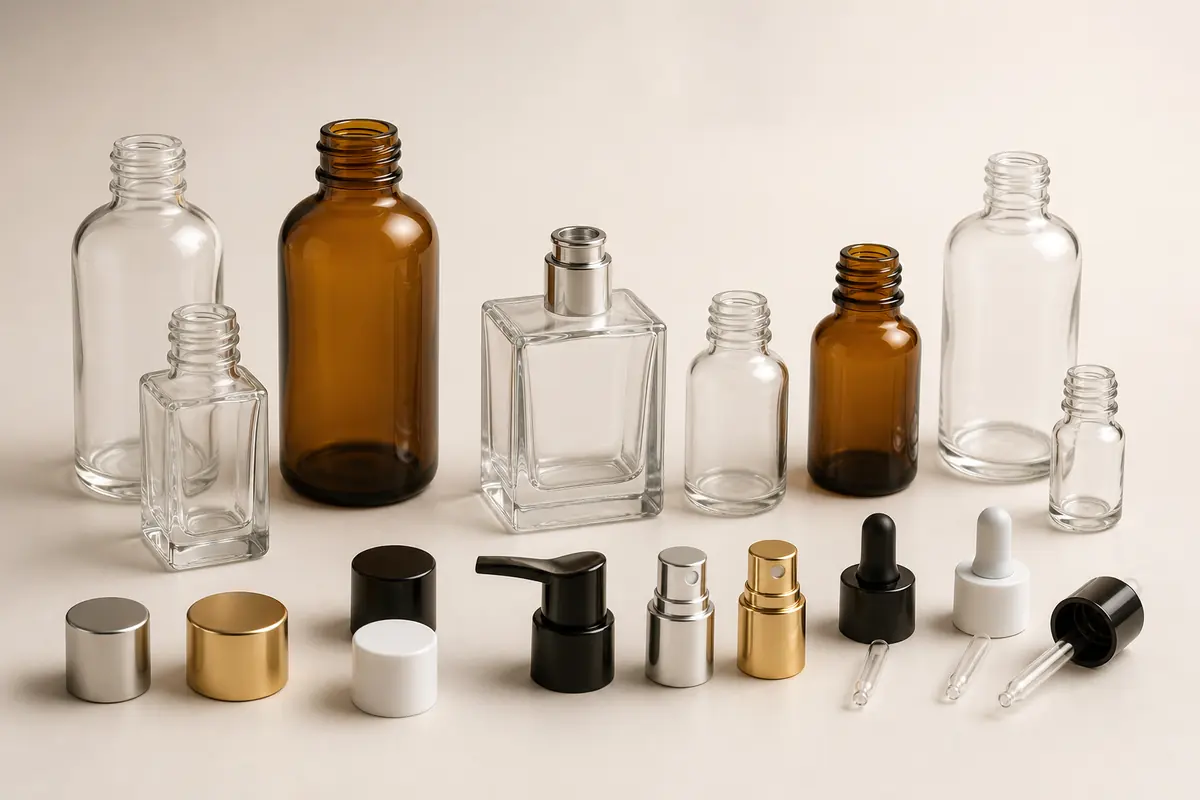
A cosmetic bottle neck finish is the engineered upper portion of a container that interfaces with a cap, pump, dropper, reducer or atomizer. It includes more than the visible opening. The finish may contain a thread, crimp bead, sealing land, support feature and defined height or diameter needed by the selected closure system.
The neck finish is one of the most important compatibility interfaces in cosmetic packaging. Two bottles with the same nominal neck diameter may require different closures because their thread geometry, finish height or sealing surfaces differ. A closure that attaches to a bottle is not necessarily a closure that seals correctly.
For B2B buyers, the practical rule is to confirm the exact bottle neck specification, select the corresponding closure and approve their physical assembly before bulk production. When pumps, droppers or atomizers are involved, the formula, dispensing components and intended assembly process must also be evaluated.
Parts of a Bottle Neck Finish
A bottle neck finish includes several geometric features that determine how the selected closure attaches, seals and functions. The relevant dimensions depend on the bottle and closure system.
Opening
The opening is the passage through which the product is filled or dispensed. Its inside diameter affects filling access and the space available for components such as pipettes, dip tubes, reducer inserts and plugs.
The opening diameter alone does not describe the complete neck finish or establish closure compatibility.
Thread or Crimp Bead
A screw finish uses thread geometry to engage a compatible threaded closure. A crimp finish uses a defined neck profile designed for a matched crimp atomizer or related component.
These attachment methods require different closure structures and assembly processes. A standard screw closure should not be assumed to fit a crimp neck, or vice versa.
Sealing Surface
The sealing surface is the area against which a liner, gasket, plug or integrated closure feature may act. Its geometry and condition influence sealing performance.
For example, a pump may engage the bottle thread while its gasket fails to contact the intended sealing surface correctly. The assembled package can therefore have an apparent mechanical fit without an acceptable seal.
Finish Height and Diameter
Finish height and diameter help describe the neck geometry, but neither value alone proves compatibility. Thread profile, thread start, sealing land, bead geometry and dimensional tolerances must also be considered.
Buyers should compare the complete neck-finish specification with the selected closure drawing rather than relying on a single measurement.
Support Features
Some bottle systems include a support ring, transfer feature or other geometry used during manufacturing, filling or assembly.
Such features should only be included in the specification when they exist on the exact bottle. Their dimensions and functions should not be inferred from another bottle with a similar appearance.

Screw Neck Finishes
A screw neck finish connects to a threaded closure. Depending on the bottle family, the closure may be a simple cap, lotion pump, treatment pump, dropper or fine mist sprayer.
Thread engagement secures the component, while a liner, gasket, plug or designed sealing surface may complete the seal. A component can rotate onto a bottle without providing the correct sealing compression, closure position or assembled height.
Common neck-finish designations include 18/410, 24/410 and 24/400. These are examples of nominal thread-finish designations, not universal compatibility guarantees or specifications for every cosmetic bottle.
The first number identifies the nominal neck diameter in millimeters, while the second identifies the thread-finish series. For example, 24/400 and 24/410 share the same nominal diameter but refer to different finish series. Their complete thread and closure geometries must be checked against the applicable specifications.
A buyer requesting a 24 mm pump without identifying the finish series may receive a component intended for a different neck configuration. Even when the pump can begin threading onto the bottle, its engagement or sealing position may be unsuitable.
Buyer action: When ordering a screw closure, provide the complete neck-finish designation, exact bottle code and drawing. Ask the closure supplier to identify the corresponding component specification and sealing arrangement. Confirm the complete assembly using physical samples rather than approving it because the cap or pump can be screwed onto the bottle.
Crimp Neck Finishes
A crimp neck is commonly associated with perfume packaging. A matched atomizer is placed on the bottle, and its ferrule is mechanically formed around the specified neck profile during assembly. A decorative collar and cap may then cover the attachment and create the finished appearance.
Crimp compatibility depends on the verified bottle neck, atomizer, gasket, ferrule dimensions, crimping equipment and validated assembly settings. It should not be inferred from bottle capacity, body shape or a general perfume-bottle description.
For fragrance packaging, FEA designations identify defined neck-finish systems used with compatible dispensing components. However, the designation must be checked against the applicable technical specification and the selected pump.
Cetie’s Guide No. 12, Recommendation for Flaconnage Crimping, addresses the application of pumps with aluminum ferrules to FEA-type glass finishes. It provides industry guidance for the crimping process and refers to the relevant glass neck-finish specifications.
This guidance does not establish one universal crimping setting for every perfume bottle. The appropriate equipment, dimensions and process parameters must be confirmed for the selected bottle and atomizer assembly.
For buyers comparing fragrance packaging systems, the article on crimp versus screw perfume bottles examines the differences in assembly, appearance and sourcing.

Other Cosmetic Neck Systems
Some cosmetic bottles use press-fit inserts, reducer systems, snap features, plugs or other designed interfaces. These systems require their own component specifications and should not be treated as variations of a standard threaded closure.
For example, a reducer insert may depend on the internal neck geometry and a defined retention feature. Its fit cannot be established from the bottle’s outside diameter alone.
Similarly, a snap-on dispensing component requires a neck profile designed for that particular attachment system. The presence of a visible bead does not prove that every snap-on component will fit.
For a broader overview of caps, pumps, droppers, sprayers and reducers, see cosmetic bottle closures explained. FOLOVER’s pumps, droppers and bottle accessories category provides the corresponding product-browsing route.
Why Neck Diameter Alone Is Not Enough
Neck diameter describes only one measurement across part of the finish. Two cosmetic glass bottles can share the same nominal diameter while using different thread profiles, finish heights, sealing surfaces, crimp beads or dimensional tolerances.
For example, a buyer may have a glass bottle described as having a 24 mm neck and source a pump advertised with the same nominal diameter. If the bottle and pump use different thread-finish series, the components may not engage or seal as intended.
Even when the thread-finish designation matches, the gasket design, closure depth, bottle tolerances and intended assembly conditions still require review.
The same principle applies to dropper systems. A dropper may attach correctly to the bottle neck but have an unsuitable pipette length, creating problems with product access or assembly.
Manufacturer Insight: Diagnose the Interface Before Replacing the Closure
When a cosmetic bottle and closure do not fit correctly, replacing the closure with a visually similar component may not solve the problem.
For example, if a pump cannot be fully seated on a bottle, the first check should be whether the exact neck-finish and closure specifications match. If the thread engagement is correct but leakage occurs, the evaluation should move to the sealing interface, gasket, closing process and formulation.
FOLOVER PACK recommends requesting the bottle drawing and the proposed closure specification before selecting replacement components. The objective is to identify the mismatched interface rather than repeatedly trying different pumps or caps based on appearance.
These are component-matching and troubleshooting considerations, not a claim about a specific customer incident.
Key point: Nominal diameter is a starting reference, not a compatibility decision. Use the exact neck-finish designation, component drawings, verified sealing arrangement and physical samples.
How to Read a Neck-Finish Specification
A useful neck-finish specification identifies the exact bottle and drawing revision, then defines the geometry required for component selection.
Depending on the finish system, the drawing may include the opening diameter, thread or bead profile, finish height, sealing surface and other relevant dimensions.
The Cetie glass finish glossary and nomenclature resources provide technical references for the terminology used to describe glass bottle and jar neck finishes.
Dimension letters and their definitions should be interpreted according to the applicable finish drawing or specification. Buyers should not assume that a general dimensional chart supplies the acceptance tolerances for their particular bottle.
| Specification Item | What It Describes | What Buyers Should Verify |
|---|---|---|
| Nominal finish designation | The identified neck-finish system or thread series. | Confirm the complete designation used by both the bottle and closure suppliers. |
| Outside neck diameter | The relevant external diameter of the neck or threaded region. | Check the drawing dimension and applicable tolerance rather than relying on a rounded nominal value. |
| Opening or inside diameter | The internal passage through the bottle neck. | Confirm clearance for the selected pipette, dip tube, reducer or filling component. |
| Thread or crimp profile | The geometry used to attach the closure. | Check the complete mating interface, including the relevant thread or bead dimensions. |
| Finish height | The defined vertical geometry of the neck finish. | Confirm closure engagement, seating position and assembled height. |
| Sealing surface | The surface designed to interact with the closure’s sealing element. | Verify the selected gasket, liner or integrated sealing structure and its intended contact area. |
| Dimensional tolerances | The permitted variation in specified bottle and closure dimensions. | Confirm that the complete assembly accommodates the approved manufacturing variation. |
This table identifies the information buyers should request. It is not a universal dimensional compatibility chart. Exact measurements, tolerances and acceptance criteria must come from the applicable technical specification and selected product drawings.
Share the bottle code or controlled drawing with the closure supplier. If a supplier proposes a pump, cap or dropper, confirm that the proposal references the same neck finish and assembly system.
Documentation narrows the component selection, but physical samples remain necessary to evaluate sealing, dispensing, assembled appearance and performance with the actual formula.
Neck Finish and Pump Compatibility
A cosmetic pump closure must match the bottle neck finish and use the appropriate sealing design. The dip tube must also suit the bottle height and internal base geometry.
Formula viscosity, desired output and priming behavior affect pump selection but do not replace the need for a compatible neck interface.
Changing from one pump model to another can alter closure height, thread engagement, gasket compression, actuator position and dip-tube requirements. Two pumps with the same nominal finish designation should not automatically be treated as interchangeable.
For a practical sourcing review, buyers can explore FOLOVER’s cosmetic lotion pumps or fine mist sprayers, then confirm the exact component specification for the selected bottle.
Buyer action: Request the pump drawing and component code, confirm the bottle neck and sealing interface, and evaluate the assembled pump with the intended formulation. Check priming, dispensing, tube clearance and closing performance before approving the final configuration.
Neck Finish and Dropper Compatibility
A bulb-and-pipette dropper combines a closure, bulb, pipette and sealing interface. The closure must match the bottle neck, while the pipette length and tip position must suit the exact bottle.
A dropper from another project is not automatically transferable, even when both bottles have the same nominal capacity or similar neck dimensions.
Reducer-style droppers use a different interface. An insert fits into the designed bottle neck and works with a compatible cap. Insert retention, orifice dimensions, cap engagement and formula flow must be evaluated together.
The buyer should identify whether the required component is a pipette dropper, reducer insert or another dispensing system before requesting a matching neck finish.
For complete dropper selection, compare the selected closure and pipette specifications with the bottle drawing and confirm their assembled performance using the actual formula.
Neck Finish and Perfume Atomizer Compatibility
Perfume atomizers may use crimp or screw attachment systems, depending on the bottle. The atomizer, gasket, dip tube, collar and cap must be evaluated with the exact neck finish.
Body style does not determine which atomizer fits. A square perfume bottle and a round perfume bottle may sometimes accommodate the same atomizer when their verified neck and attachment specifications match. Differences in bottle height or internal geometry may still require separate dip-tube configurations.
For buyers developing a fragrance packaging range, a change from a crimp system to a screw system should be treated as a component-development decision rather than a simple closure substitution.
Cetie’s glass neck-finish data sheets include defined perfume and cosmetic neck systems, including screw and crimp configurations. Certain specially designed systems permit selected component or tooling relationships between screw and crimp versions, but this does not establish general interchangeability between conventional screw and crimp finishes.
Buyers should confirm whether their exact bottle and component specifications support the proposed configuration before changing the attachment system.
Browse perfume glass bottles for the product category, and use the perfume packaging guide for broader bottle, atomizer, cap and sourcing decisions.
How Tolerances Affect Fit
Manufactured components vary within defined dimensional limits. Bottle and closure tolerances can influence thread engagement, sealing contact, assembled height and component alignment.
A design should accommodate the expected variation of both components, not only one ideal sample.
For example, a bottle and closure may fit correctly when both happen to be near their nominal dimensions. However, another acceptable bottle and closure combination may produce a different sealing or engagement condition if the permitted dimensional variation has not been considered together.
Buyers should review the applicable drawings and tolerances, then evaluate representative samples against agreed acceptance criteria.
The article on bottle and closure tolerances explains why nominal dimensions and permitted variation must be considered together during component matching.
Technical boundary: A single well-fitting sample does not prove that every bottle and closure produced within their specified tolerances will assemble or seal correctly. Acceptance criteria must be established for the selected components and intended production process.
Change Control After Compatibility Approval
Compatibility approval belongs to a defined set of components. Replacing the bottle, pump, dropper, atomizer, gasket, insert, cap or tube can alter the interface even when the replacement looks similar.
A supplier change may also introduce a different drawing revision, material or tolerance range.
For example, changing a pump after sample approval may alter its gasket position, assembled height or dip-tube configuration. A replacement cap may use a different internal sealing structure even when its exterior color and shape match the approved component.
Record the approved bottle and closure codes, drawing revisions, finish designation, sealing component, tube or pipette specification, artwork and sample approval date.
When a component changes, identify the affected interfaces and determine which assembly, sealing, dispensing or appearance checks must be repeated.
This is particularly important when the glass bottle and closure are sourced from different suppliers. The purchasing team should ensure that both suppliers are working from the same approved component configuration.
What Buyers Should Ask Suppliers to Confirm
A bottle-and-closure inquiry should identify the complete packaging configuration rather than ask only for a nominal neck diameter.
- Exact bottle code and complete neck-finish designation.
- Current bottle drawing or approved finish specification.
- Exact cap, pump, dropper, reducer or atomizer code.
- Applicable thread, crimp or other attachment specification.
- Sealing interface, gasket or liner and relevant product-contact materials.
- Dip-tube or pipette configuration where applicable.
- Assembly method, equipment and project-specific process controls.
- Assembled height, closure alignment and secondary-packaging fit.
- Formula compatibility and functional evaluation requirements.
- Approved physical sample and component revision before bulk production.
For application-specific neck and cap interaction, the article on nail polish bottle packaging connects bottle shape, brush, cap and neck compatibility.

A Practical Sample Evaluation Sequence
Physical samples should confirm the complete packaging configuration after the preliminary specification review. The following sequence helps buyers separate mechanical fit from sealing and functional performance.
- Confirm the bottle and closure codes against their current specifications and drawings.
- Inspect the bottle neck and closure components for damage, contamination or visible defects.
- Assemble the samples using the intended closing, crimping or insertion process.
- Check attachment, seated height, alignment and the relevant sealing interface.
- Verify the dip tube, pipette, reducer insert, collar and cap configuration where applicable.
- Fill representative samples with the actual formulation and perform the agreed sealing and functional checks.
- Include repeated use, storage orientation and transport conditions where relevant to the project.
- Record the component identity, test conditions, observations, acceptance decision and approved sample reference.
The acceptance criteria should be established before testing. A closure that feels tight or looks correctly positioned is not sufficient evidence of sealing or formula compatibility.
When a sample fails, identify whether the problem concerns attachment, sealing, dispensing, component geometry or assembly. Change the relevant component or process condition, then repeat the affected checks before approval.
For broader dispensing-system selection, use the cosmetic bottle closures and dispensing guide to compare closure families and the corresponding buyer requirements.
Common Neck Finish Mistakes
- Selecting a closure by nominal diameter: A shared diameter does not establish matching thread, crimp or sealing geometry. Request the complete finish designation and drawings.
- Mixing components from different suppliers without validation: Confirm the exact bottle and closure specifications before approving an assembled sample.
- Treating “screw neck” or “crimp neck” as a complete specification: Identify the applicable finish system, component code and attachment requirements.
- Approving the bottle before selecting the production closure: Review the neck, sealing system, dispenser and assembled appearance together.
- Changing a pump, dropper or atomizer after approval: Recheck the affected attachment, sealing, dispensing and dimensional interfaces.
- Ignoring pipette, dip-tube or insert requirements: Verify the internal bottle geometry and actual component configuration.
- Testing only one ideal sample: Include representative manufacturing variation and agreed acceptance criteria.
- Failing to record component revisions: Document the approved bottle, closure, sealing elements and physical sample so that substitutions can be identified before production.
Explore the Product Knowledge hub for packaging fundamentals and the Packaging Technology hub for mechanisms, compatibility and testing.
Frequently Asked Questions
What does bottle neck finish mean?
A bottle neck finish is the engineered upper bottle geometry that interfaces with a cap, pump, dropper, reducer or atomizer. It may include threads, a crimp bead, sealing surfaces, opening dimensions and defined tolerances. Buyers should identify the exact neck-finish specification and confirm that the selected closure is designed for the same attachment and sealing system.
Is neck finish the same as opening diameter?
No. Opening diameter describes only one feature of the bottle neck. The complete neck finish may also include thread or crimp geometry, finish height, sealing surfaces and dimensional tolerances. Two bottles with similar openings may require different closures. Buyers should compare the exact bottle and closure specifications rather than selecting components using opening diameter alone.
What is a crimp neck?
A crimp neck is a bottle neck profile designed for a matched component that is mechanically crimped onto the bottle. It is commonly used with perfume atomizers. Compatibility depends on the specified neck geometry, atomizer, gasket, ferrule and validated crimping process. Buyers should confirm the exact component specifications and approve the assembled package before bulk production.
What is a screw neck?
A screw neck is a threaded bottle neck designed to engage a compatible threaded closure, such as a cap, pump, dropper or sprayer. Its nominal diameter alone does not establish compatibility. Thread-finish series, sealing geometry, closure construction and dimensional tolerances also matter. Buyers should verify the exact bottle and closure specifications and test their physical assembly.
Can the same pump fit different bottles?
Yes, the same pump may fit different bottles when the verified neck finish, attachment geometry, sealing interface and functional requirements are compatible. However, differences in bottle height and internal geometry may require different dip-tube configurations. Buyers should evaluate the selected pump with each bottle and the intended formulation before approving the complete packaging system.
How do I confirm closure compatibility?
Confirm closure compatibility by comparing the exact bottle and closure specifications, including the neck finish, attachment geometry, sealing interface and applicable tolerances. Assemble representative physical samples using the intended production components and closing process. Evaluate the complete package with the actual formulation under relevant storage and use conditions, then document the approved configuration before bulk production.
Conclusion
A cosmetic bottle neck finish is the engineered interface between the container and its closure or dispensing system. Screw threads, crimp profiles, sealing surfaces, dimensions and tolerances work together to determine whether a proposed component can be evaluated for the selected bottle.
For screw closures, confirm the complete thread-finish specification rather than nominal diameter alone. For crimp atomizers, verify the designated neck system, matched components and assembly process. For pumps, droppers and reducer inserts, include the sealing interface and internal component configuration in the compatibility review.
FOLOVER PACK supports B2B cosmetic glass bottle sourcing, closure matching and component coordination. Share your bottle code or neck-finish drawing, required closure type, formulation information and planned order quantity to review the appropriate packaging configuration.