

Cosmetic packaging samples should be evaluated as production references, not simply admired as design objects. A sample may look attractive and still have the wrong neck finish, inconsistent decoration, poor closure engagement, unsuitable dispensing behavior, or an undocumented component substitution.
The most reliable review compares the complete sample with an approved specification, tests the actual bottle-and-closure system under relevant use conditions, and records every decision before mass production. The checks below provide a practical buyer workflow without replacing a project-specific quality plan, compatibility program, or transport validation.
Buyer conclusion: Approve the exact packaging configuration, not a general bottle style. The bottle, closure, dispenser, sealing parts, decoration, formula, artwork revision, assembly method, and physical reference should all point to the same production-intent configuration before bulk production is released.
| Sample Review Area | What to Check | Evidence to Keep | Production Decision |
|---|---|---|---|
| Container | Bottle or jar model, neck, dimensions, surface, base, color, and approved construction | Drawing, specification, measurements, photographs, physical sample | Accept, investigate deviation, or request corrected sample |
| Closure & Dispensing | Fit, sealing interface, assembly, pipette or dip tube, priming, uptake, spray or dose behavior | Exact component model, assembly record, functional observations | Approve only the tested configuration |
| Decoration | Color, print position, registration, coating, foil, labels, and component alignment | Artwork revision, color reference, decorated physical sample | Approve against defined physical criteria |
| Formula Compatibility | Changes in product, seals, dispensing, appearance, coating, and other product-contact parts | Formula identity, test conditions, observations, dated samples | Continue testing or approve only within the defined protocol |
| Golden Sample | Correct final revision and approved attributes | Controlled physical reference and approval record | Use as the comparison reference for bulk production |
First Confirm That the Sample Matches the Approved Specification
Start with documents before judging appearance. Place the current drawing, quotation, component list, artwork, color reference, and approved finish description beside the physical sample. Confirm that every document refers to the same revision.
- bottle model, material, nominal capacity, and dimensions;
- weight only when it is part of the approved specification;
- neck finish and closure model;
- pump, sprayer, dropper, cap, collar, liner, or gasket as applicable;
- dip tube or pipette requirement;
- bottle color, coating, frosting, printing, hot stamping, or label;
- artwork version and placement;
- inner packing and outer-carton configuration when included in the review.
If the sample differs from the specification, stop and identify whether the document or the sample is wrong. Do not approve an unrecorded deviation because it appears minor. A small change in a neck, seal, tube, finish, or component model can alter fit, dispensing, appearance, or later repeatability.
Inspect the Glass Bottle or Jar
Review each glass container under consistent lighting and on a stable surface. Look at overall symmetry, base stability, neck appearance, surface condition, color, and visible variation among the samples. Rotate the container rather than judging it from one front view.
Check dimensions against the current drawing using suitable measuring tools when dimensional requirements are defined. Pay particular attention to features that affect assembly or filling, such as the neck, sealing surface, shoulder, base, and usable internal space. Do not invent a tolerance during inspection; use only the tolerance or acceptance criteria approved for the project.

One attractive unit is not evidence of consistency. Compare several representative samples from the supplied set and record any repeating versus isolated observations. The cosmetic and skincare glass packaging category provides product context, but acceptance must follow the exact selected bottle and project documents.
Buyer action: Separate characteristics that affect function from characteristics that are primarily visual. A neck or sealing-surface issue should not be treated the same way as a minor appearance variation. Define defect categories and acceptance criteria before bulk inspection rather than deciding them after a shipment is produced.
Check Pump, Dropper, or Sprayer Fit
Match the dispensing component to the exact bottle rather than to a visually similar neck. Confirm the specified component model, neck finish, sealing surfaces, liner or gasket where applicable, and tube or pipette configuration. Assemble the parts using the intended method and approved process settings when those are available.
Look for straight seating, stable engagement, appropriate component height, and repeatable assembly. A component that can be forced onto a bottle is not necessarily compatible. If fit is uncertain, flag the configuration for technical review before functional testing or approval.
Compatibility rule: Final bottle and closure compatibility should be confirmed using the selected components and physical samples before bulk production.
Test Closure Engagement and Assembly
For screw closures, examine how the threads engage, whether the closure sits evenly, and whether the agreed application method produces consistent seating. For crimp systems, use the intended crimp specification and equipment rather than hand pressure. For caps and collars, check alignment, retention, finish interaction, and whether decoration is damaged during assembly.
The correct assembly check depends on the package. Do not transfer torque, crimp, or force values from another bottle or closure. Exact settings require verified component data and, where appropriate, controlled trials on the intended filling and assembly line.
Common approval mistake: A sample may close successfully by hand but behave differently during controlled assembly. If production will use defined torque, crimping equipment, pressing, or other assembly conditions, the relevant sample should be reviewed under conditions that reasonably represent that process.
Evaluate Dispensing Performance
Dispensing behavior should be assessed with the intended component and a representative product or suitable approved test medium. Depending on the system, buyers may review pump priming, dose consistency, spray pattern, atomization, dropper uptake, pipette release, dripping, clogging, and residual product behavior.
A dry component test has limits. Viscosity, surface tension, particles, volatility, and other formula characteristics can change performance. Record the formula or test medium, sample identity, component configuration, handling method, and observations so results can be compared rather than remembered informally.
| Dispensing System | Useful Sample Observations | Failure Modes to Watch |
|---|---|---|
| Pump | Priming, repeated actuation, product pickup, release behavior, residual product | Difficult priming, inconsistent actuation, poor pickup, leakage around closure |
| Fine Mist Sprayer | Priming, spray pattern, atomization behavior, actuator return, repeated use | Dripping, poor atomization, clogging, unstable spray behavior |
| Dropper | Bulb rebound, pipette uptake, release, tip behavior, bottle clearance | Incomplete uptake, slow release, dripping, unsuitable pipette fit |
Do not invent an output tolerance or number of cycles because another project used one. If dosage, spray output, pipette pickup, or repeated-use performance is critical, define the method and acceptance range using the selected component data and project requirements.
Check Leakage and Sealing
Leak evaluation should reflect the package’s intended use and distribution risks. Relevant checks may include upright storage, side or inverted orientation where appropriate, repeated opening and closing, handling, and a defined transport-simulation plan. Use the exact filled configuration, including the approved seal, gasket, liner, closure, and assembly method.
Important limitation: Passing one short inversion or hand-shake check does not prove that a package will remain leak-free through filling, storage, temperature exposure, handling, and transport. Test conditions and acceptance criteria must be documented for the actual project.
The guide on why cosmetic bottles leak covers common system-level failure paths. This article stays focused on what a buyer should inspect when samples arrive.
Inspect Decoration Quality
Evaluate decoration in consistent light and against the approved artwork and physical reference. Check color consistency, print position, registration, edge definition, coating uniformity, visible scratches, foil alignment, label placement, and interaction between decorated parts during assembly.
Digital files and screen colors are not sufficient standards for physical color approval. Use the agreed physical reference or controlled color standard for the project. If adhesion or durability is important, define the method, conditioning, sample count, and acceptance criteria before treating an informal rub check as a result.
For example, ISO 2409:2020 describes a cross-cut method for evaluating the resistance of paint and varnish coatings to separation from a substrate. ASTM’s current ASTM D3359-23 addresses tape testing of coating adhesion but was developed for metallic substrates and has stated limitations. Neither reference means that a generic tape pull automatically becomes the correct acceptance test for a coated cosmetic glass bottle. The coating system, substrate, conditioning, method, and agreed pass criteria must be suitable for the actual project.
Decoration may involve coating, frosting, printing, hot stamping, labels, and finished components within a custom packaging solution. Each process should be evaluated according to its approved specification rather than against a generic idea of “premium quality.”
Buyer action: Approve decoration after the bottle and major visible components are sufficiently stable. Changing a collar, cap, dropper, or pump after artwork approval can change the visible spacing, alignment, or handling of the decorated package.
Test the Actual Formula
The actual formula is essential because packaging performance depends on the complete product–package system. A glass bottle may be relatively inert while the formula still interacts with a gasket, liner, adhesive, coating, pump pathway, bulb, wiper, dip tube, pipette, or seal.
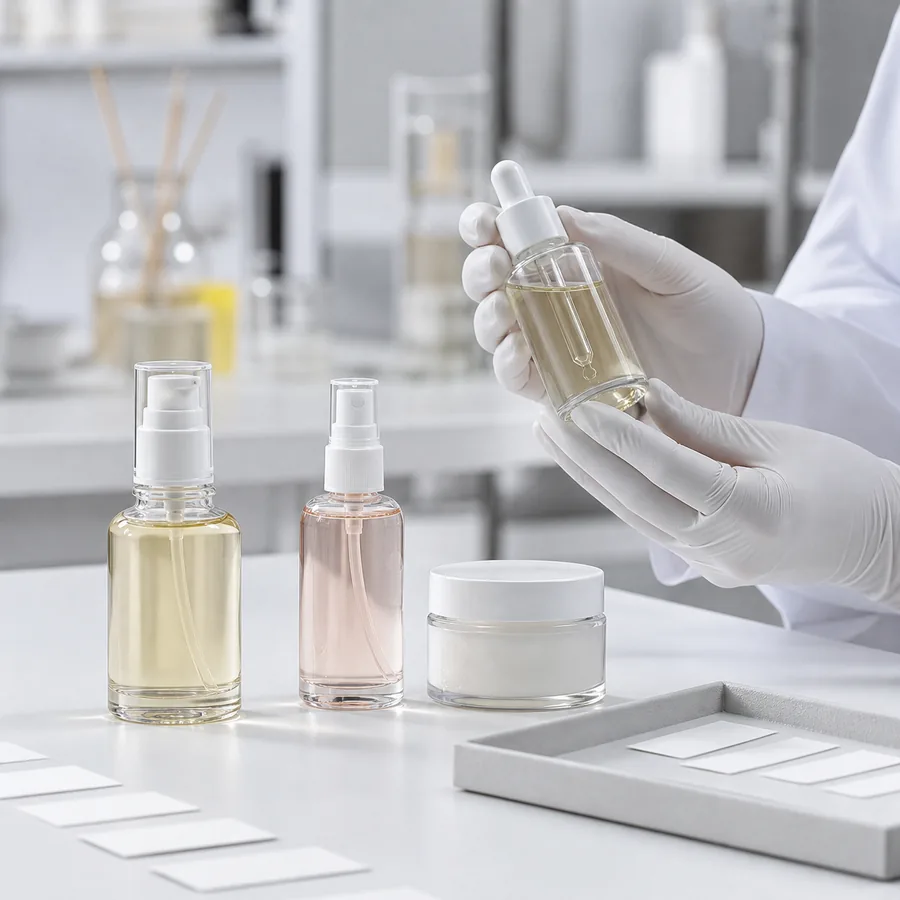
Define a compatibility plan appropriate to the formula, package, destination market, shelf-life objective, and use conditions. Observe relevant changes in the formula, container, component, seal, appearance, and dispensing behavior. Do not claim compatibility from material names, supplier assurances, or visual inspection alone.
The European Commission’s guidelines for the Cosmetic Product Safety Report specifically identify interaction between the product and packaging material, packaging barrier properties, and migration as relevant considerations. The guidance also notes that formulation-packaging suitability studies should use specific and relevant test conditions and that there is no single standard procedure for all cosmetic products.
In the United States, the FDA’s Product Testing of Cosmetics page likewise explains that FDA does not prescribe one fixed list of tests for every cosmetic product. Testing should therefore be based on the actual product and safety needs rather than copied mechanically from another packaging project.
The cosmetic packaging compatibility testing guide addresses full program design. Sample evaluation identifies concerns and confirms that the correct test configuration has been supplied; it does not replace that program.
Formula rule: Packaging compatibility should be evaluated with the actual formulation under intended storage and use conditions.
Compare Samples Against a Golden Sample
A golden sample is a controlled physical reference approved by the relevant parties for defined attributes. It helps the buyer, supplier, inspection team, and production team compare the same bottle, component, decoration, assembly, and appearance rather than relying on photographs or memory.
Label the reference with the project, item, revision, approval date, and responsible approvers. Store it to protect the sample from damage, fading, contamination, or component loss. If a later change is approved, issue a new controlled reference and retire the superseded one from active use.
For multi-component projects, attach or record the component identity together with the golden sample. A bottle without its approved dropper, pump, cap, collar, liner, or sealing part is an incomplete reference when those parts affect final assembly.
Document Every Change Before Mass Production
Sample feedback should be specific and traceable. “Make it better” or “color is wrong” does not tell production what to change. Record the affected component, observation, required action, reference, revision, owner, and approval status.
Useful records may include:
- sample and component version numbers;
- dated photographs from consistent views;
- verified measurements and the method used;
- artwork and physical color references;
- formula or approved test medium;
- test conditions and observations;
- open issues, agreed changes, and approval date.
Verbal approval can be misunderstood when several vendors or internal teams are involved. A written change log protects both buyer and supplier and helps ensure that mass production follows the intended revision.
Practical approval record:
- Sample ID and date received
- Bottle model and revision
- Closure or dispenser model
- Pipette, dip tube, liner, gasket, or sealing configuration
- Artwork and decoration revision
- Formula or test medium used
- Tests or observations completed
- Open deviation and responsible owner
- Decision: approved, conditionally approved, revise, or reject
- Whether the change requires a new physical sample
Final Pre-Production Evaluation Checklist

- All samples match the current documented configuration.
- Glass appearance, dimensions, neck, and base have been reviewed against approved criteria.
- Closures and dispensing components assemble correctly on the exact bottle.
- Dispensing and sealing checks use the intended configuration and documented method.
- The actual formula is included in an appropriate compatibility plan.
- Decoration is compared with approved artwork and physical references.
- Differences among samples are recorded, not averaged away informally.
- The golden sample and revision record are controlled.
- Every open issue has an owner and resolution before production authorization.
If bulk inspection will use acceptance sampling, the current ISO 2859-1:2026 defines sampling schemes indexed by acceptance quality limit (AQL) for lot-by-lot inspection by attributes. This standard should not be reduced to a universal “AQL number” for cosmetic packaging. Buyers still need to define the relevant lot, inspection level or sampling approach, defect classifications, acceptance criteria, and which characteristics are critical for the specific package.
AQL warning: Numbers such as 2.5 or 4.0 should not be inserted into a project simply because they are common in another buyer’s checklist. The appropriate acceptance plan depends on the agreed quality system, defect definitions, risk, lot structure, and contract between buyer and supplier.
For the formal approval sequence, see the guide to approving cosmetic packaging samples before mass production. Supplier capability, documentation, and problem-handling questions are covered separately in the cosmetic packaging supplier evaluation guide.
Frequently Asked Questions
What should I inspect in a cosmetic bottle sample?
Compare the container, neck, dimensions, closure, dispensing system, color, decoration, assembly, and packing configuration with the current approved specification. Confirm that the physical sample and documents use the same revision, then record deviations rather than approving an undocumented substitute.
How do I test a pump bottle before production?
Use the exact bottle, pump, tube, seal, assembly method, and intended formula or approved test medium. Document priming, dispensing, leakage, and repeat-use observations under a project-specific protocol. Do not transfer output, torque, or cycle limits from an unrelated pump or bottle.
Should I fill the sample with the actual formula?
Yes. Formula characteristics can affect seals, components, decoration, dispensing, and package performance, so compatibility cannot be confirmed from an empty package alone. Evaluate the actual formulation under conditions relevant to intended storage and use and document the exact packaging configuration tested.
What is a golden sample?
A golden sample is a controlled approved physical reference used to compare defined attributes of later production or inspection samples. Record its project, component configuration, revision, approval date, and the characteristics it actually approves so it is not treated as proof of untested performance.
How do I check bottle leakage?
Use a documented protocol appropriate to the filled package, orientation, handling, storage, assembly, and distribution risks. Record the bottle, closure, seal, test medium or formula, and conditions used. A single informal inversion or shake check is useful for screening but is not complete package validation.
Should decoration samples be approved before production?
Yes. Approve the relevant color, artwork, position, finish, adhesion or durability criteria, and interaction with assembled components before bulk decoration. Use a suitable physical reference and agreed method; a digital rendering or informal tape or rub test should not automatically become the production acceptance standard.
For connected sourcing, cost, and supplier-evaluation topics, use the packaging buying guides.
Conclusion
Effective cosmetic packaging sample evaluation connects physical evidence to a controlled specification. Inspect the container and decoration, assemble the exact components, evaluate dispensing and sealing, use the intended formula, compare with a golden sample, and document every approved change.
FOLOVER PACK supports existing bottle samples for quality and compatibility evaluation before bulk production. Buyers can use the skincare packaging guide to define the application or review OEM and ODM packaging services when the project requires coordinated bottles, components, decoration, and custom development.
If you are reviewing a bottle, pump, dropper, cap, decoration, or complete skincare packaging sample, send the intended configuration, formula type, artwork, and approval requirements so the sample can be reviewed as one packaging system before bulk production.