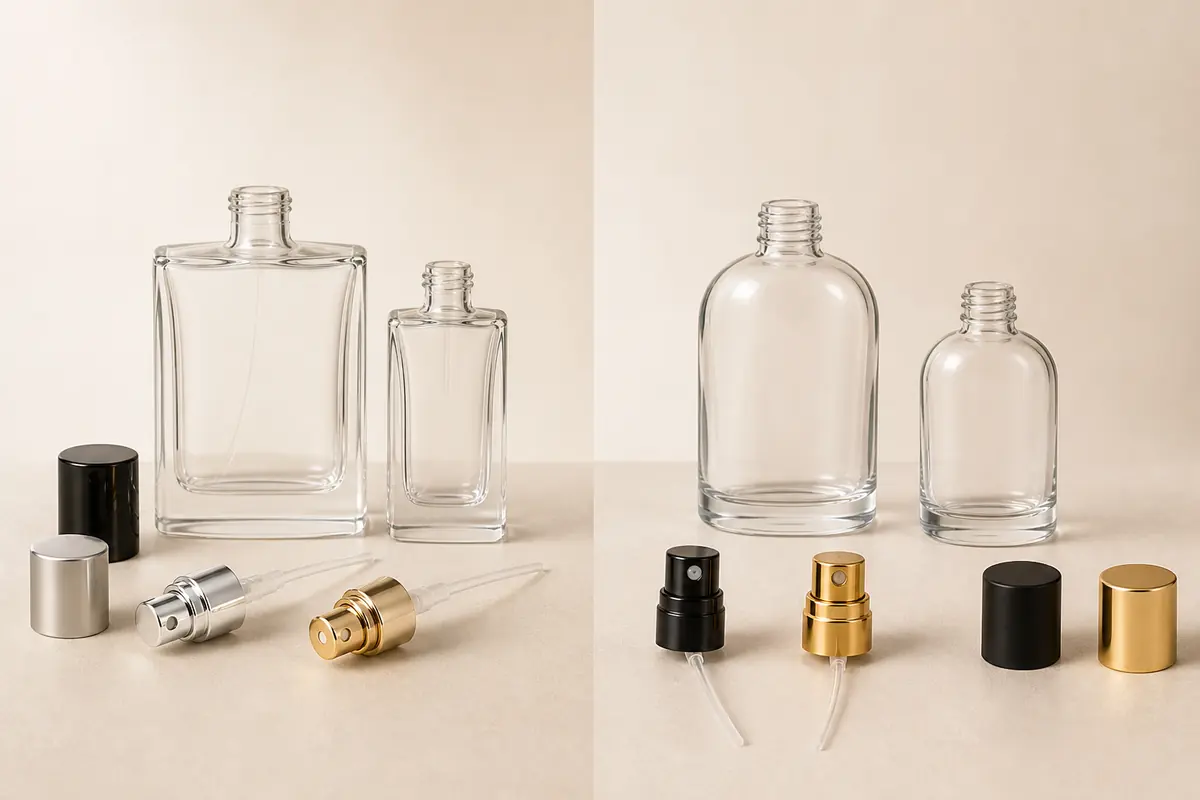
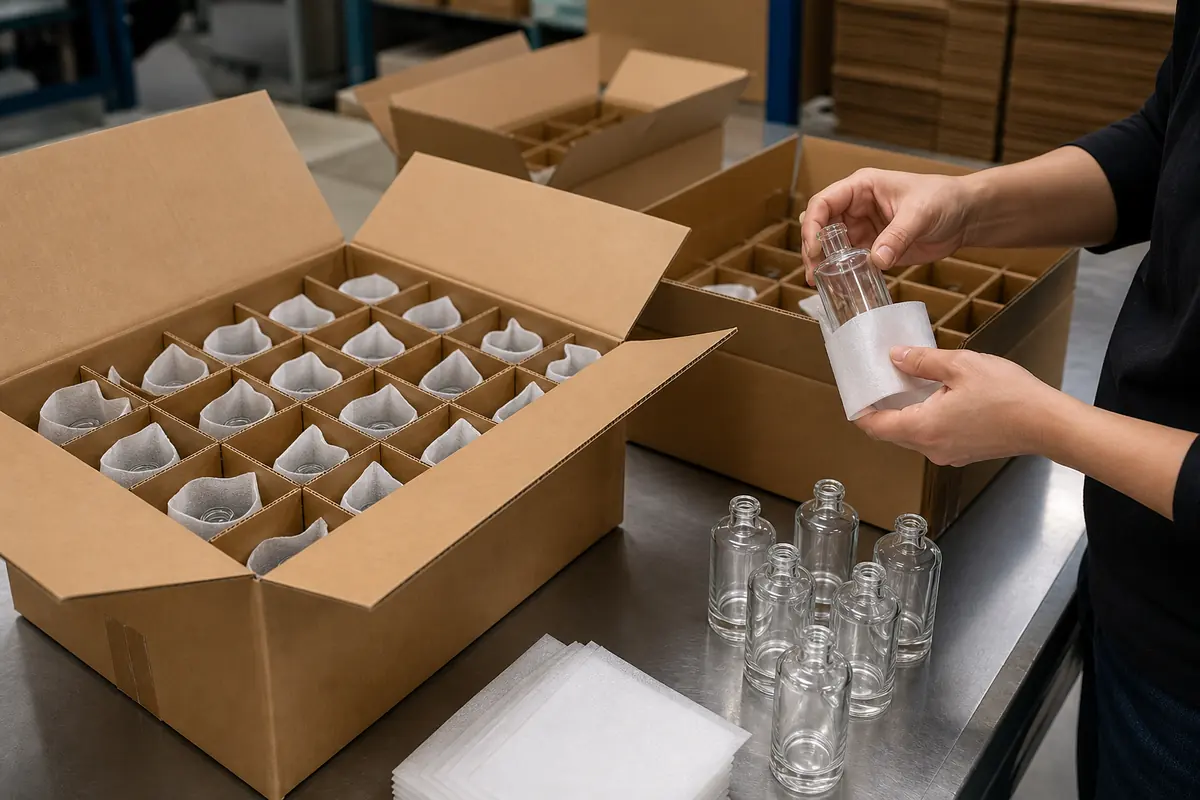
Cosmetic glass bottle export packing protects bottles and components from impact, abrasion, decoration damage and uncontrolled movement during bulk transport. An effective system combines individual protection, dividers or trays, a suitable carton and shipment-specific handling. There is no single mandatory packing method for every product. Bottle geometry, decoration, component configuration, quantity and transport route must guide the final plan. Buyers should approve the packing arrangement against the actual bottle, decoration, components and a representative packed carton rather than relying on a generic packing format.
Primary, Secondary and Transport Packaging
The primary package is the bottle or jar and its functional closure. Secondary packaging may include a retail carton or set box. Transport packaging groups units for storage and shipping through dividers, trays, protective wraps and outer cartons.
These layers have different jobs. A premium retail box may support presentation but still require a stronger transport carton. A bottle divider can limit contact inside the carton but does not replace correct carton closure, handling and shipment planning.
| Packing Element | Main Purpose | Main Advantage | Main Limitation | What Buyers Should Verify |
|---|---|---|---|---|
| Individual wrap or sleeve | Reduce surface contact and protect the individual unit | Can separate glass and decorated surfaces during handling | The material may interact differently with coatings, printing or foil | Check the actual decorated bottle with the selected material |
| Divider or grid | Create separate cells inside the carton | Limits bottle-to-bottle contact and uncontrolled movement | A loose grid may allow impact, while a tight grid may create pressure | Check cell fit, divider height and contact with components |
| Formed tray or insert | Locate and organize bottles or components | Can control position and separate sensitive surfaces | Not every bottle requires a custom insert | Check support points and make sure the insert does not press on closures or decoration |
| Outer carton | Group and protect the complete packed configuration | Provides the main transport container for the packed units | A strong carton cannot compensate for poor internal fit or uncontrolled movement | Review the complete packed carton rather than the empty carton alone |
| Palletization | Organize cartons for unit handling where required | May improve carton organization for some shipment routes | It is not automatically the best arrangement for every shipment | Confirm shipment size, route, warehouse and receiving requirements |
Individual Bottle Protection
Depending on the bottle and project, individual protection may include a bag, paper wrap, sleeve, protective film or another agreed material. The purpose may be to reduce surface contact, contain small parts, protect decoration or prevent dust during handling.
The exact material should suit the glass surface and decoration. A wrap that protects clear glass may rub against a delicate coating or foil in a different way. Confirm the actual packed sample and avoid claiming that one material prevents every type of damage.

Dividers and Grid Packing
Corrugated grids or dividers create separate cells for bottles and help limit bottle-to-bottle contact. Cell size and divider height should be designed for the selected bottle and carton so the units are supported without excessive movement or damaging pressure.
A divider that is too loose may allow impact and abrasion. One that is too tight can make packing difficult or place pressure on decoration and components. A carton divider is effective only when it limits movement without creating damaging pressure on the bottle, decoration or assembled components. Review a representative packed carton rather than selecting a generic grid by appearance.
Trays and Formed Inserts
Paper-based, foam, molded or blister-type trays may be considered when geometry, presentation or protection requirements justify them. A formed insert can locate each unit and separate sensitive surfaces, while stacked trays may organize multiple layers.
Not every bottle requires a custom insert. The decision should balance protection, packing efficiency, material use and cost. Confirm that the insert supports the correct parts of the package and does not press on pumps, droppers or decorative elements.

Carton Selection
The outer carton must match the contents, internal protection, stacking and intended transport conditions. Carton board, dimensions, closure and reinforcement are project-specific. A general guide should not invent carton size, pieces per carton, gross weight or stacking performance.
Review the complete packed carton rather than judging the empty carton alone. Empty space, poorly fitted dividers or uneven weight distribution can reduce protection even when the board looks strong. Shipment method and customer handling requirements may also affect the final specification.
Protecting Decorated Bottles
Coatings, screen printing, hot stamping and labels can be more sensitive to rubbing than undecorated glass. Protection should reduce contact between decorated surfaces, dividers, caps and neighboring bottles. The packing review should use the actual finish and decoration sequence rather than assuming that a packing method approved for undecorated glass will behave the same way.
Visual inspection before and after representative handling can reveal scuffs, foil abrasion, print damage or pressure marks. Final decoration and packing materials should be approved together on physical samples. Do not convert an informal packing check into a universal transport-performance claim. Use the agreed project test and acceptance criteria.
Complete Sets Versus Separate Components
Bottles, pumps, droppers, caps and collars may be shipped assembled, partly assembled or separately, depending on product design, cleanliness, packing efficiency and filling operations. There is no universal best method. Buyers should confirm the intended filling and assembly workflow before the export packing arrangement is finalized.
When components are separate, identify quantities and matching references clearly and protect sealing or functional surfaces. When sets are assembled, ensure caps and pumps do not create pressure points or increase the risk of rubbing during transport. A component change can also alter the assembled geometry, so the final packing review should use the selected production components rather than a visually similar substitute.
Palletized and Non-Palletized Shipments
Palletization may improve unit handling and carton organization for some routes, while non-palletized loading may be used in other commercial arrangements. The decision depends on shipment size, route, warehouse capability, customer requirements and logistics planning.
Do not promise one pallet configuration or container-loading quantity without a confirmed packing list. Those values depend on the exact carton and shipment.
Export Carton Markings
Carton markings can help identify the item, quantity, carton number, handling direction and customer reference. The exact marks should follow the purchase order, destination and logistics instructions.
Keep carton data consistent with the packing list and product records so the receiving team can match each carton to the correct item and shipment reference. Avoid unsupported regulatory or handling symbols. Customer-specific marks should be approved before printing.
Pre-Packing Quality Inspection
Before packing, check that the bottles and components match the approved configuration and that decoration is in acceptable condition. Packing staff should be able to separate damaged or incorrect units before they are hidden inside cartons.
The cosmetic packaging sample evaluation provides a physical reference for approval. Final packing inspection should compare production units with that approved reference and confirm that the correct protective materials, component references and packing arrangement are being used.

What Buyers Should Confirm Before Shipment
- Exact bottle, component and decoration references
- Whether components ship assembled or separately
- Individual wrap, divider, tray and carton arrangement
- Protection for coated, printed or foil surfaces
- Pieces per carton and carton data from the confirmed packing list
- Required carton marks and customer references
- Pallet or loading method when applicable
- A representative packed carton using the intended packing orientation and arrangement
- Inspection and shipment-release records
Review a Representative Packed Carton
Before the main shipment, review a carton packed with the actual bottles, components and protective materials. Check whether cells remain organized, closures contact neighboring surfaces, decorated areas rub against inserts, and empty space allows movement. The review should represent the intended layer count and packing orientation.
Where a transport or handling test is required, define the method and acceptance criteria for the project. Do not claim compliance with a named test protocol or a verified drop height unless the exact packed configuration was tested and documented under that protocol.
Manufacturer Insight
FOLOVER PACK recommends approving export packing only after the final bottle, closure or dispensing components, and decoration configuration are defined. A packing method that works for an undecorated bottle or another SKU should not automatically be copied to the final product because changes in components, decoration, geometry or packing orientation can change contact points and movement inside the carton.
The representative packed carton should match the intended production configuration as closely as practical. If the approved sample uses different components, protective materials or internal arrangement from the bulk shipment, review the packing again before shipment release rather than assuming the earlier approval still applies.
Moisture, Storage and Route Conditions
Cartons and paper-based dividers can be affected by storage and transport conditions. The logistics plan should consider the actual route, warehouse environment and handling duration without making unsupported guarantees. If moisture protection or a special liner is required, specify and approve it for the shipment.
Route conditions also influence palletization, wrapping and carton labeling. Coordinate these requirements with the freight and receiving teams because the packaging supplier alone may not control every stage after shipment release.
Connect Packing to Sourcing and Cost
Export packing should be discussed before the final quotation because materials, carton efficiency, component assembly and shipment configuration can affect total project cost. The guide to calculating custom cosmetic packaging cost helps buyers compare more than the bottle unit price.
For overseas procurement, use the guide to sourcing cosmetic glass bottles from China to coordinate specifications, samples and supplier records. The custom cosmetic glass bottle process places packing after approval, production and inspection rather than treating it as a last-minute detail.
Clear component, carton and shipment records also support cosmetic packaging traceability by helping buyers connect the shipped configuration with the relevant item and packing information.
FOLOVER Packaging Support
FOLOVER can coordinate project-specific export packing requirements for cosmetic glass packaging. Depending on the selected bottle, decoration, components and shipment plan, the arrangement may include individual protection, divider or tray systems, secondary boxes and protective outer cartons. The final method should be confirmed for the exact project rather than treated as a standard configuration for every SKU.
Select the bottle through cosmetic and skincare glass packaging, coordinate project details through custom packaging solutions and use OEM and ODM packaging services where broader development support is required. The skincare packaging guide connects format and dispensing decisions that should be settled before the final export packing configuration is approved.
Related procurement topics appear under Packaging Buying Guides, while production and packing topics are organized under Customization & Manufacturing.
Conclusion
Frequently Asked Questions
How are glass cosmetic bottles packed for shipping?
Glass cosmetic bottles may use individual wraps or bags, dividers, trays and protective outer cartons selected for the actual bottle and shipment. The right combination depends on bottle geometry, decoration, components and route. Buyers should review a representative packed carton instead of assuming that one standard packing method is suitable for every SKU.
Why are carton dividers used?
Carton dividers create separate cells that help reduce bottle-to-bottle contact and uncontrolled movement. They are effective only when the cells fit the selected bottle without being excessively loose or tight. Buyers should check the complete packed carton for movement, pressure points and contact with decoration or components before shipment approval.
How are decorated bottles protected from scratches?
Wraps, sleeves, dividers or trays can reduce contact with coated, printed, foil-stamped or labeled surfaces, but the final decoration and packing materials should be evaluated together. A method that works for undecorated glass may behave differently with a finished surface. Buyers should approve the actual decorated sample in the intended packing arrangement.
Should bottles and pumps be packed together?
Bottles and pumps may ship assembled, partly assembled or separately depending on the package design, filling operation and logistics plan. There is no universal best arrangement. Buyers should confirm the intended assembly workflow, matching component references and protective packing before shipment, and check that assembled pumps or caps do not create pressure points inside the carton.
Are cosmetic glass bottles shipped on pallets?
Some cosmetic glass bottle shipments are palletized and others are not. The decision depends on shipment size, route, warehouse capability, receiving requirements and the confirmed carton arrangement. Buyers should not assume a standard pallet or container quantity until the exact packing list, carton configuration and logistics requirements have been confirmed.
What should be shown on export cartons?
Export cartons may show information such as the item reference, quantity, carton number, approved handling direction and customer-specific marks. The exact content should follow the purchase order, packing list, destination and logistics instructions. Buyers should approve required carton marks before printing and keep carton information consistent with the shipment records.