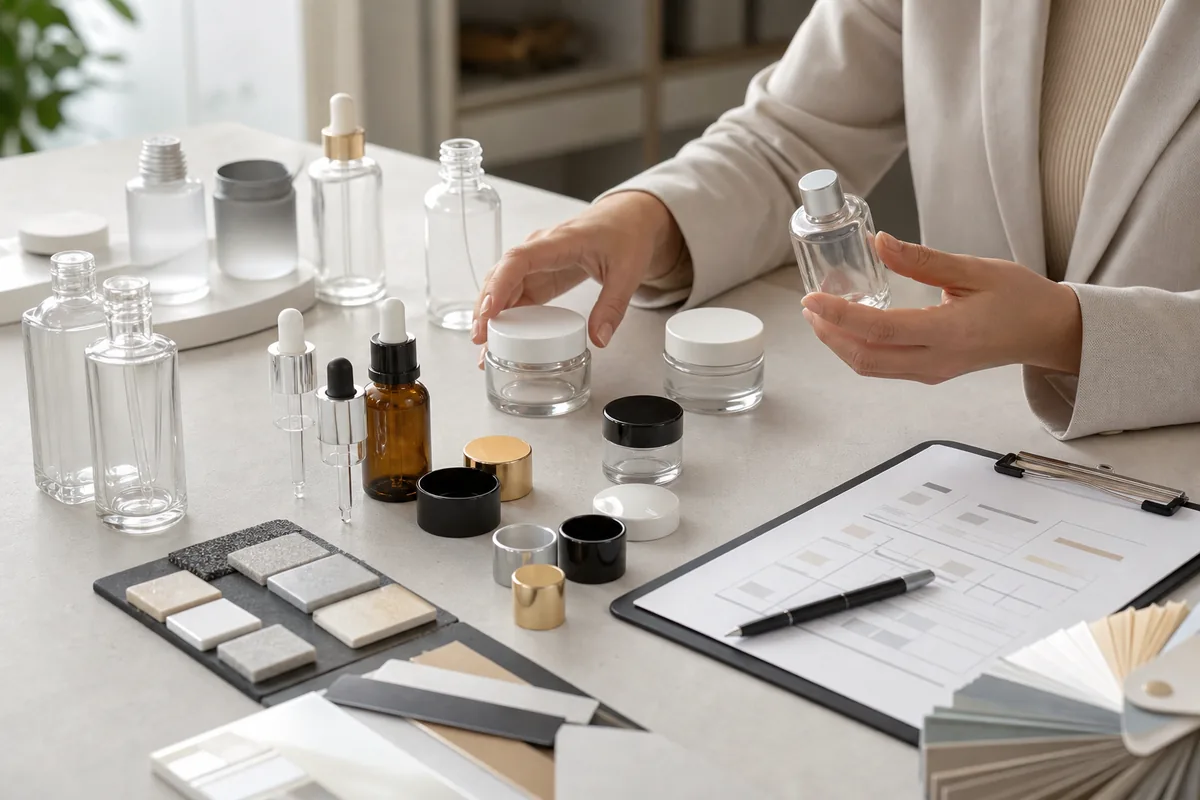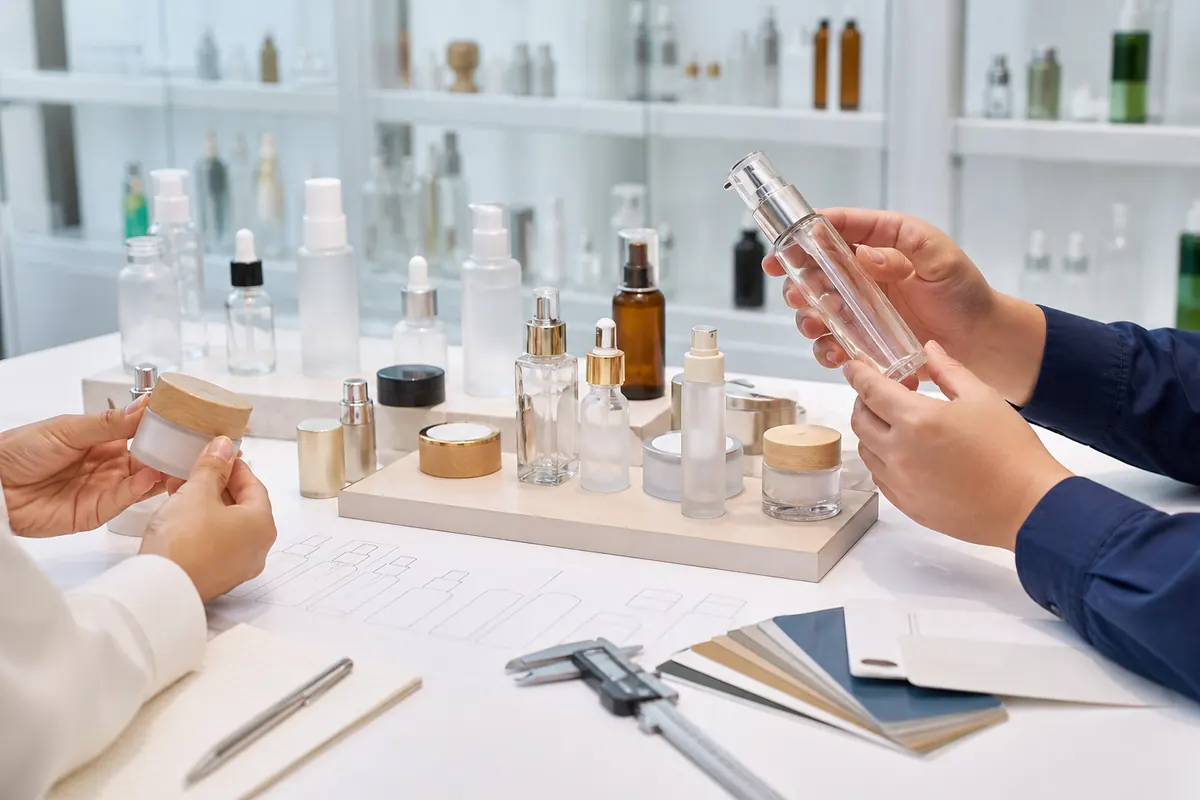

Sourcing custom cosmetic glass bottles from China is not simply a search for a bottle at a low unit price. A commercially usable pack may include the glass container, pump or dropper, cap, collar, seals, decoration, samples, inspection, protective packing, and shipping coordination. Each part can be supplied, approved, and priced differently.
A strong sourcing process makes those dependencies visible before the purchase order. Buyers should define the complete configuration, shortlist suppliers against the same requirements, compare like-for-like quotations, test physical samples with the intended formula, and document production and logistics responsibilities. Country of origin alone does not establish quality, price, compliance, or project fit.
Buyer conclusion: Source the complete packaging system, not only the glass bottle. The RFQ, quotation, samples, purchase order, inspection criteria, and shipment should all refer to the same bottle, closure, decoration, packing, and approved configuration.
Define Your Packaging Specification Before Contacting Suppliers
Begin with the product and use case. A supplier cannot recommend a reliable system from a reference image alone. Prepare enough information to distinguish appearance preferences from functional requirements.
- product type and intended formula characteristics;
- target capacity and acceptable size range;
- bottle or jar style, shape, weight direction, and material;
- neck finish and required dispensing or closure type;
- pump, sprayer, dropper, cap, collar, liner, gasket, pipette, or dip tube requirements;
- color, coating, frosting, printing, hot stamping, label, and artwork scope;
- forecast and initial order quantity by SKU;
- sample, testing, launch, and production schedule;
- delivery destination and expected shipping arrangement;
- required documents for the exact product and destination market.
Separate confirmed requirements from open decisions. If the neck or closure has not been selected, say so and ask for a matched recommendation. If the formula is still changing, do not treat compatibility as approved. The skincare packaging guide can help organize application requirements before an RFQ is issued.
Specification risk: Avoid relying on commercial descriptions such as “premium glass,” “high-white glass,” “standard dropper,” or “matching pump” without a defined reference. Supplier terminology can vary. Use the exact bottle model, physical sample, component specification, artwork revision, and approved finish wherever those details affect the purchase.
Decide Whether You Need Stock Packaging or Custom Development
An existing bottle can reduce tooling and development work while still allowing selected colors, decoration, and matched components. It is often a useful route when speed, lower initial exposure, or market validation matters more than exclusive geometry.
Custom development may be appropriate when a proprietary shape, capacity, structural feature, or long-term brand system justifies design work and tooling. It normally requires drawings, mold terms, development samples, additional approvals, and a quantity plan that supports the investment.
Do not present a stock bottle as custom-mold exclusivity or assume that custom means better. Compare the two routes against forecast, brand value, technical risk, schedule, and lifecycle. The locked guide to the custom cosmetic glass bottle process covers the development sequence in more detail.
Manufacturer Insight
The important decision is often where customization should happen. If an existing glass structure already meets the functional requirement, buyers may be able to differentiate through coating, printing, hot stamping, closures, collars, or coordinated colors instead of immediately opening a new bottle mold. A custom mold becomes more defensible when the geometry itself creates necessary brand or functional value.
How to Shortlist Cosmetic Glass Bottle Suppliers
Shortlist suppliers by evidence relevant to the exact project. A polished catalog shows available styles, but it does not prove component coordination, decoration control, documentation, or problem resolution.
| Evaluation Area | Evidence to Request | Buyer Decision |
|---|---|---|
| Product fit | Relevant bottle and component options tied to the requested specification. | Can the supplier identify the exact proposed configuration rather than only show similar catalog images? |
| Technical communication | Clear drawings, component identification, revision control, and qualified answers. | Are confirmed facts separated from items that still require samples or tests? |
| Complete-pack capability | Defined responsibility for bottles, closures, decoration, assembly, and packing. | Who owns a mismatch if components originate from different sources? |
| Sampling | Available sample types, costs, lead time, and what each sample can validate. | Will the samples represent the configuration that matters to the project? |
| Quality control | Project-relevant inspection points, records, approved references, and escalation process. | Can production be checked against a defined standard rather than subjective appearance? |
| Documentation | Current documents scoped to the exact item, finish, component, and market need. | Does each document actually cover the packaging configuration being purchased? |
| Commercial clarity | Itemized MOQ, pricing, tooling, terms, exclusions, and schedule assumptions. | Can competing quotations be normalized to the same commercial scope? |
Use the 12-question cosmetic packaging supplier guide for a deeper evaluation. Avoid rejecting or selecting a company based only on whether it describes itself as a factory, trading company, or service provider; verify who controls each critical activity and who is accountable.
Map Responsibility for Every Component
A complete cosmetic package may combine glass, a dispensing component, decorative parts, seals, and packing materials from several production sources. Ask the lead supplier to identify which items it produces directly, which items are sourced, who verifies incoming components, and who resolves a mismatch. The purpose is accountability, not a demand that every part come from one building.
Create a simple responsibility map for the bottle, pump or dropper, cap, collar, decoration, assembly, testing support, inspection, and export packing. For each line, record the approved model, responsible party, required evidence, and change-control contact. This prevents a late problem from being passed between vendors without ownership.
If the buyer purchases components separately, define who will confirm compatibility and perform final assembly trials. A bottle supplier cannot safely approve a third-party closure without the exact component and test context, while a closure supplier may not control the bottle neck. Responsibility must follow actual evidence and scope.
Manufacturer Insight
Component coordination becomes especially important when the project combines a glass bottle from one source with a pump, dropper, cap, collar, liner, or decorative component from another. FOLOVER PACK treats the selected components as an assembled system for sample review. A visually similar replacement should not be accepted automatically because a change in sealing geometry, pipette or dip-tube configuration, collar structure, or assembled height can affect both function and appearance.
Send a Clear RFQ
Send the same structured request for quotation to every shortlisted supplier. Include drawings or annotated references where possible, but do not rely on images without dimensions and component requirements.
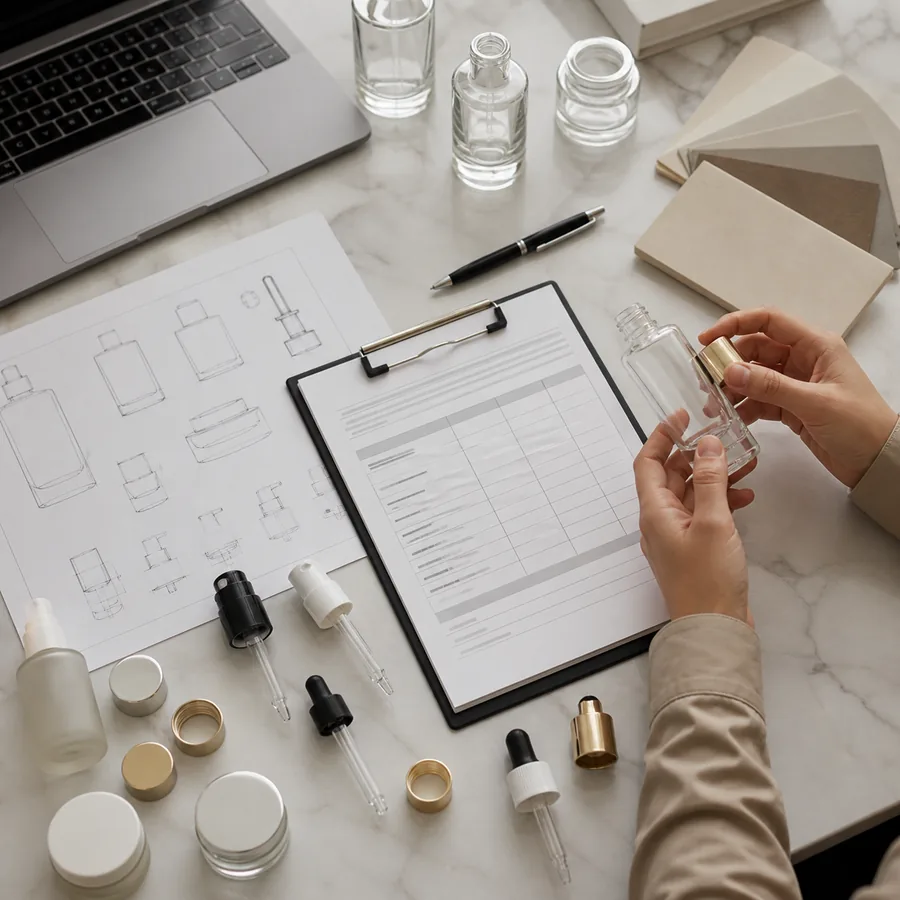
A useful RFQ identifies the bottle, capacity, neck, closure, component finish, decoration, artwork count, quantity by SKU, sample need, destination, target schedule, packing expectation, and requested trade term. State whether the quotation should cover the bottle only or the complete packaging set.
Ask suppliers to mark assumptions and alternatives rather than silently substituting components. If an exact requirement is unavailable, the quotation should identify the proposed alternative and explain what must be sampled or verified.
Copyable RFQ Structure
- Product: intended cosmetic application and formula type;
- Container: bottle or jar type, target capacity, shape, color, and reference;
- Closure: pump, sprayer, dropper, cap, collar, liner, gasket, or other required components;
- Decoration: coating, frosting, printing, hot stamping, labels, artwork variants, and component finishes;
- Quantity: initial quantity and forecast by SKU;
- Samples: stock, assembly, decorated, or production-intent samples required;
- Quality: critical characteristics and inspection evidence expected;
- Packing: inner protection, carton, pallet, and export-packing requirements;
- Commercial: currency, quotation validity, tooling, MOQ, payment scope, and requested trade term;
- Delivery: destination, required arrival date, and documents needed for the exact market.
Compare Quotations on the Same Specification
Two quotations are comparable only when they cover the same configuration and commercial boundary. A low bottle-only price cannot be compared directly with a complete-set price that includes a pump, cap, decoration, and protective packing.
Normalize each quotation: separate the base bottle, closure or dispenser, decorative parts, finishing, tooling, samples, inner packing, outer packing, inspection, and shipping scope. Record the currency, validity period, quantity tier, trade term, and exclusions.
Confirm whether artwork variants, colors, or closure finishes have separate minimums. Check what is included in tooling, whether sample charges are separate, and whether freight is included or excluded. Do not assume mold ownership, maintenance, reuse rights, or future commercial terms unless they are documented for the specific project. The locked guide to custom cosmetic packaging cost provides the broader total-cost model.
A practical comparison should also identify the quotation gap: everything one supplier included but another supplier left undefined. Those gaps often matter more than a small difference in unit price because an excluded closure, decoration setup, export carton, inspection scope, or destination charge can reappear later in the project.
Order and Review Physical Samples
Use samples in stages. Existing samples can demonstrate general glass, component, and decoration quality. Configuration samples help confirm bottle-and-closure fit. Decorated samples show the intended color, artwork, and finish. Pre-production samples should represent the final approved setup closely enough for the defined decision.
Do not use one sample type to answer every question. A clear undecorated bottle cannot approve a custom coating, and an empty package cannot establish formula compatibility. Record which attributes each sample is intended to validate.
For cosmetic products, packaging evaluation must be tied to the actual formulation and intended conditions. The European Commission’s Cosmetic Product Safety Report guidelines identify formulation-packaging interaction, barrier properties, and possible migration as relevant considerations and state that suitability studies should use specific and relevant test conditions. In the United States, the FDA’s Product Testing of Cosmetics guidance does not prescribe one universal test list for every cosmetic product.
The buyer implication is straightforward: do not copy a generic compatibility protocol or pass/fail limit from another product without confirming that it applies to the current formula, packaging materials, storage conditions, and use case.
The practical cosmetic packaging sample evaluation checklist covers glass, components, dispensing, sealing, decoration, formula testing, and golden-sample control.
Sample Approval Record
- exact bottle model and revision;
- exact closure, pump, dropper, cap, liner, gasket, pipette, or dip-tube configuration;
- decoration process, artwork version, color reference, and component finish;
- what the sample has actually been approved to validate;
- formula and test condition used where compatibility is being evaluated;
- dated physical reference or golden sample retained for production comparison;
- changes that would trigger re-sampling or re-approval.
Confirm Decoration and Color Standards
Define each finish precisely. Glass color, spray coating, printing ink, hot-stamped foil, label color, and finished component color use different materials and processes. A digital rendering can communicate direction but should not be treated as final physical color approval.
Provide artwork in the required production format and specify printable areas, orientation, position, finish, and any no-print zones. Approve physical samples or agreed controlled references before mass production. Do not promise exact digital-to-physical matching across different materials and processes.
Manufacturer Insight
Decoration approval should happen after the functional package is sufficiently stable. Changing the pump, collar, cap, bottle height, or assembled position after artwork approval can alter the visible spacing and alignment of the design. For multi-SKU projects, approve both the bottle finish and coordinated component colors rather than evaluating each part in isolation.
Approve the Complete Packaging System
Approval should cover the bottle together with the exact closure, dispenser, seal, decorative component, and formula. Confirm the neck finish, thread or crimp structure, gasket or liner, pipette or dip tube, component height, assembly method, and user interaction.
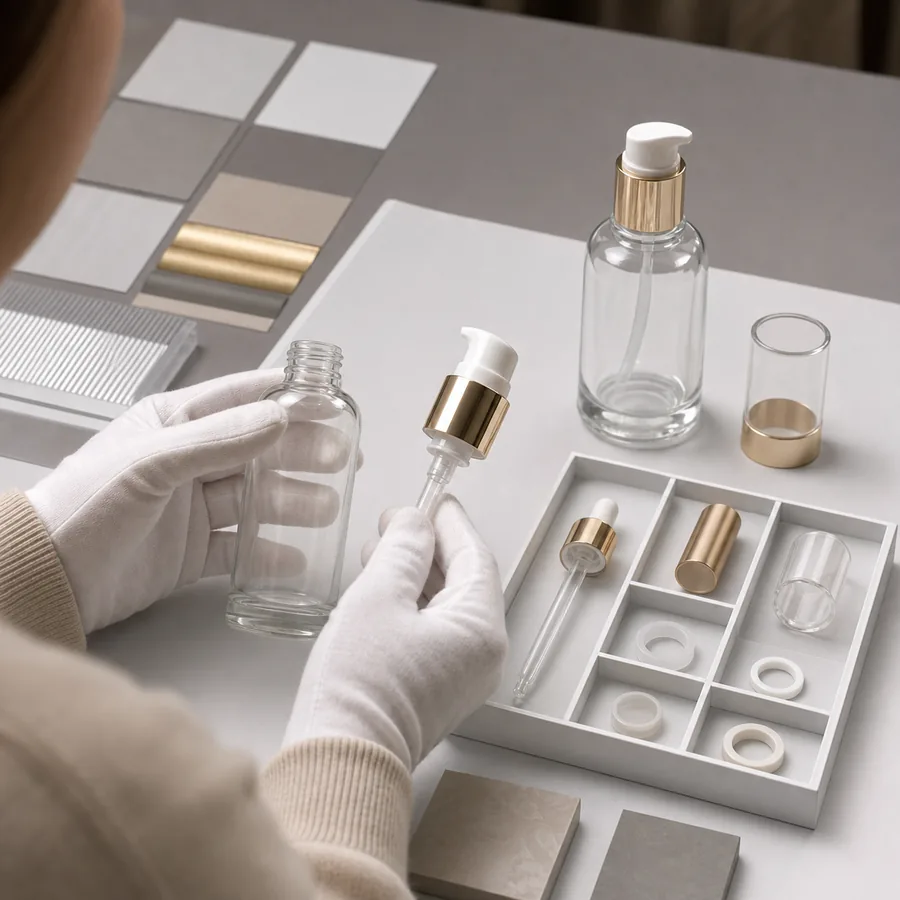
Compatibility cannot be determined from appearance. Use the actual formula and a project-appropriate protocol to evaluate materials, sealing, dispensing, appearance, and use conditions. A component that fits one bottle model should not be transferred automatically to another.
Compatibility rule: Final bottle and closure compatibility should be confirmed using the selected components and physical samples before bulk production.
Typical failure modes to prevent: wrong neck or sealing geometry, incorrect pipette or dip-tube configuration, formula that does not dispense reliably through the selected component, decoration approved before the final closure is fixed, component-color inconsistency, or a carton designed before the final assembled dimensions are confirmed.
Confirm Production and Quality Requirements
Before the purchase order, define the approved revision, golden sample, inspection plan, critical attributes, defect classification, acceptance criteria, sample records, and responsibility for resolving deviations. Do not invent AQL levels, tolerances, test hours, or machine settings; use verified requirements for the project.
If the buyer and supplier use acceptance sampling by attributes, the current ISO 2859-1:2026 provides AQL-indexed sampling schemes for lot-by-lot inspection. The existence of the standard does not mean every cosmetic-packaging project should use the same AQL. Buyers still need to define which defects are critical, major, or minor for the specific bottle, component, decoration, and intended use, and agree the inspection approach before production.
| Quality Area | What to Lock Before Production | What Buyers Should Verify |
|---|---|---|
| Glass container | Approved model, key dimensions or drawing references, appearance criteria, and reference sample | Production is compared against the same approved bottle and revision |
| Closure / dispenser | Exact component model and assembly configuration | No unapproved substitution of pump, dropper, seal, liner, or other functional part |
| Decoration | Artwork revision, location, color reference, and physical approval | Bulk decoration is judged against an agreed physical or documented standard |
| Inspection | Defect definitions, sampling method where applicable, acceptance criteria, and records | Both parties understand how a lot will be accepted, held, reworked, or rejected |
| Packing | Inner protection, carton configuration, labels, and pallet requirement where applicable | The production pack matches the approved shipment configuration |
Confirm how changes will be controlled after approval. A different pump model, liner, color material, coating, or carton may affect performance or appearance even when the supplier considers it equivalent. Require written review of substitutions that affect the approved specification.
FOLOVER’s general production baseline is normally around 25–30 days after sample, artwork, and order details are confirmed. This is not a project guarantee. Custom molds, decoration, component sourcing, complex approval cycles, and current production conditions may change the schedule.
Build the Schedule Backward From the Required Delivery
Work backward from the date when approved packaging must reach the filling or assembly location. Include time for specification review, quotation, stock confirmation or tooling, samples, formula and package testing, artwork revision, physical color approval, purchase-order confirmation, component procurement, production, inspection, packing, export handling, transit, customs, and destination delivery.
Do not compress the plan by assuming every activity can run in parallel. Decoration may depend on approved glass; production may depend on an approved sample; shipping documents may depend on the final order; and filling-line trials may require the exact production configuration. Mark these dependencies and include decision time for the buyer’s own teams.
Ask the supplier to state what starts each quoted lead time and what information remains outstanding. The same quoted duration can mean different things if one supplier starts after deposit, another after artwork approval, and another only after all components are confirmed. A dated milestone plan is more useful than an isolated duration.
Plan Shipping and Export Packing
Glass packaging needs a packing design appropriate to the bottle, decoration, component, shipment mode, handling route, and destination. Confirm inner separation, dividers or trays, carton configuration, component protection, pallet or non-pallet plan, carton marks, and any special handling agreed for the project.
Define who arranges freight, insurance, export clearance, destination clearance, duties, and final delivery under the selected trade term. The International Chamber of Commerce explains that Incoterms® rules clarify the tasks, costs, and risks allocated between sellers and buyers. They do not make two quotations equivalent unless the same rule, named place, shipment assumptions, and commercial scope are being compared.
Taxes, customs requirements, tariff classification, import documentation, and destination charges depend on the market and current rules. Verify them with current official customs sources and qualified logistics or customs professionals rather than relying on a generic blog estimate.
The future locked guide on cosmetic glass bottle export packing addresses protective packing in more depth. Shipping samples or one informal drop check cannot replace a distribution test plan for the final pack when formal transport validation is required.
Common Sourcing Mistakes
- sending a vague photo instead of a structured specification;
- comparing bottle-only and complete-set quotations as if they were equal;
- assuming the lowest unit price means the lowest total project cost;
- approving a bottle without confirming its exact closure or dispensing component;
- skipping samples or approving color only from a screen;
- changing closures, component suppliers, or decoration after compatibility work;
- ordering before the actual formula and dispensing system are evaluated;
- copying an AQL, tolerance, leakage limit, or test method from another project without confirming relevance;
- accepting undocumented component substitutions;
- leaving packing, trade terms, inspection, or shipping responsibility unclear;
- assuming a quotation includes tooling, decoration, inner packing, freight, or destination charges when these are not stated;
- treating a general certificate or report as proof for every bottle, component, decoration, or destination market.
Buyer action: Before releasing the purchase order, compare it line by line with the final approved specification and quotation. The purchase order should not reintroduce an old bottle reference, artwork revision, closure model, quantity split, or trade term that was changed during sampling.
China Sourcing Checklist

- Freeze the current packaging brief and identify open decisions.
- Choose stock packaging or a justified custom-development route.
- Shortlist suppliers using relevant evidence and accountability.
- Issue the same complete RFQ to each supplier.
- Normalize quotation scope, assumptions, terms, and exclusions.
- Map responsibility for every bottle, closure, decoration, and packing component.
- Order representative samples and evaluate the actual configuration.
- Approve decoration and physical color references.
- Confirm bottle-and-closure compatibility using selected components and physical samples.
- Lock the golden sample, inspection plan, acceptance criteria, and change control.
- Agree production timing, export packing, shipping responsibility, and documents.
- Read the final purchase order against the approved specification before release.
Frequently Asked Questions
How do I find a cosmetic glass bottle manufacturer in China?
Start with a defined packaging specification, then shortlist suppliers using evidence relevant to that exact project. Verify bottle capability, component coordination, decoration, samples, quality controls, documentation, commercial scope, and accountability. Do not select a supplier from catalog appearance or company type alone; confirm who owns each critical activity.
What information should I include in an RFQ?
Include product use, bottle type, capacity, neck, closure, components, decoration, quantities by SKU, sample requirements, destination, target schedule, packing expectations, trade term, and required documents. Ask suppliers to identify assumptions and alternatives so every quotation can be compared on the same packaging configuration.
Should I order samples before placing a bulk order?
Yes. Use appropriate sample stages to review the exact container, closure, dispensing components, decoration, assembly, and approved physical reference. When formula compatibility is relevant, evaluate the actual formulation under suitable conditions. A stock or empty sample should not be treated as approval of every production characteristic.
How do I compare packaging quotations?
Normalize each quotation to the same bottle, closure, decoration, quantity, tooling, sample, packing, inspection, currency, trade term, validity period, and exclusions. Separate bottle-only pricing from complete-package pricing and identify undefined items before comparing unit cost or total project cost.
Can Chinese suppliers customize bottle colors and logos?
Many cosmetic glass projects can use coating, frosting, printing, hot stamping, labels, coordinated components, or custom bottle development. Available processes, minimums, sample requirements, and feasibility depend on the selected bottle and project. Final colors, logos, finishes, and component combinations should be approved on physical samples.
What should I check before shipping glass bottles?
Confirm the approved goods, inspection status, protective packing, carton information, component protection, shipment responsibility, Incoterms® rule and named place, documents, insurance arrangements, destination requirements, and delivery plan. The final shipping configuration should match the assumptions used for quotation and transport planning.
Additional supplier, sample, MOQ, and cost resources are available through the packaging buying guides.
Conclusion
To source cosmetic glass bottles from China successfully, manage the complete system from specification through shipment. Compare suppliers and quotations on the same scope, approve physical evidence, protect component compatibility, document changes, and assign responsibility for quality and logistics.
FOLOVER PACK supplies custom glass packaging for perfume, skincare, essential oil, and beauty projects and supports bottle development, decoration, component matching, and OEM packaging coordination. Buyers can review cosmetic and skincare glass packaging, custom packaging solutions, or OEM and ODM services before sending a defined sourcing brief.