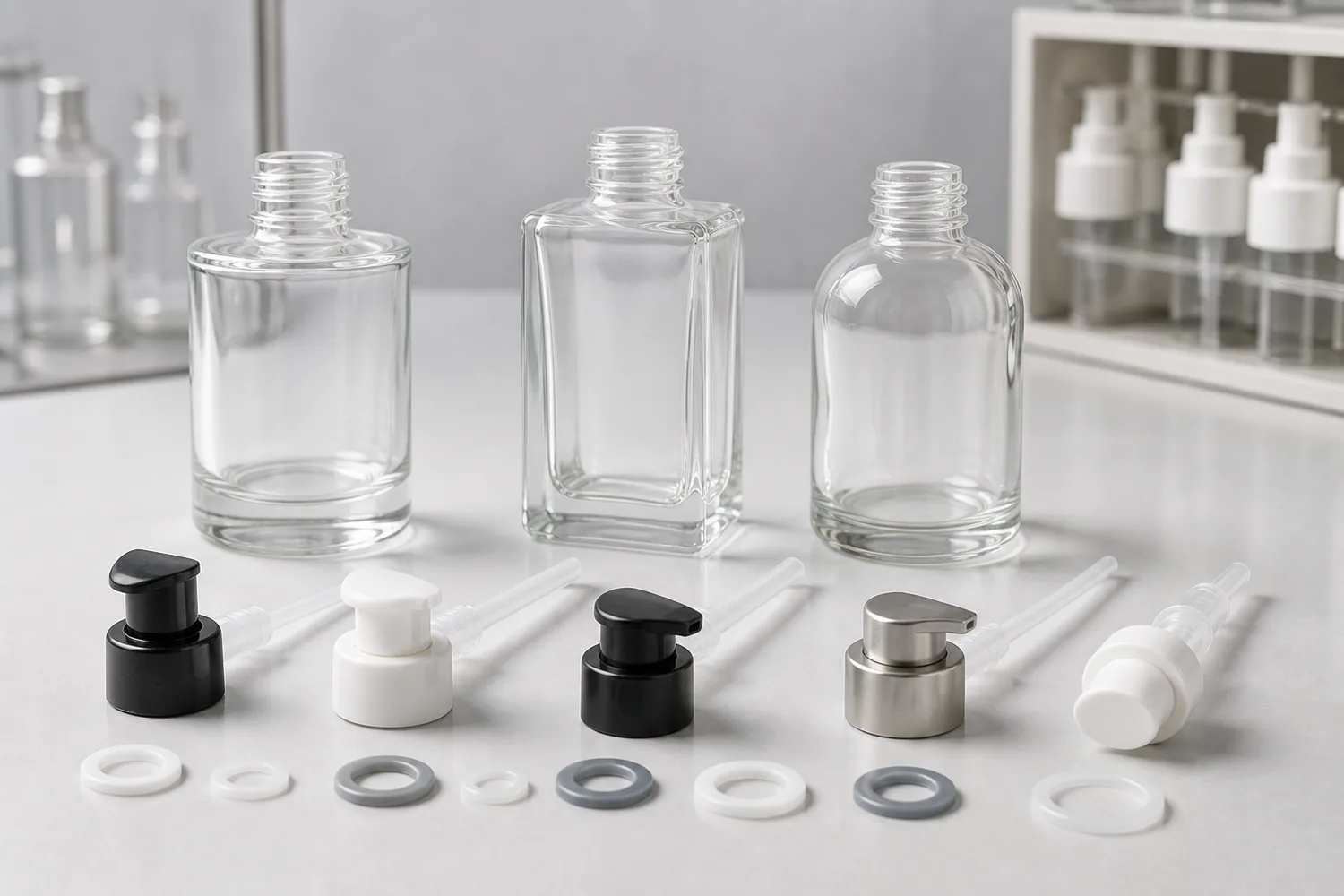
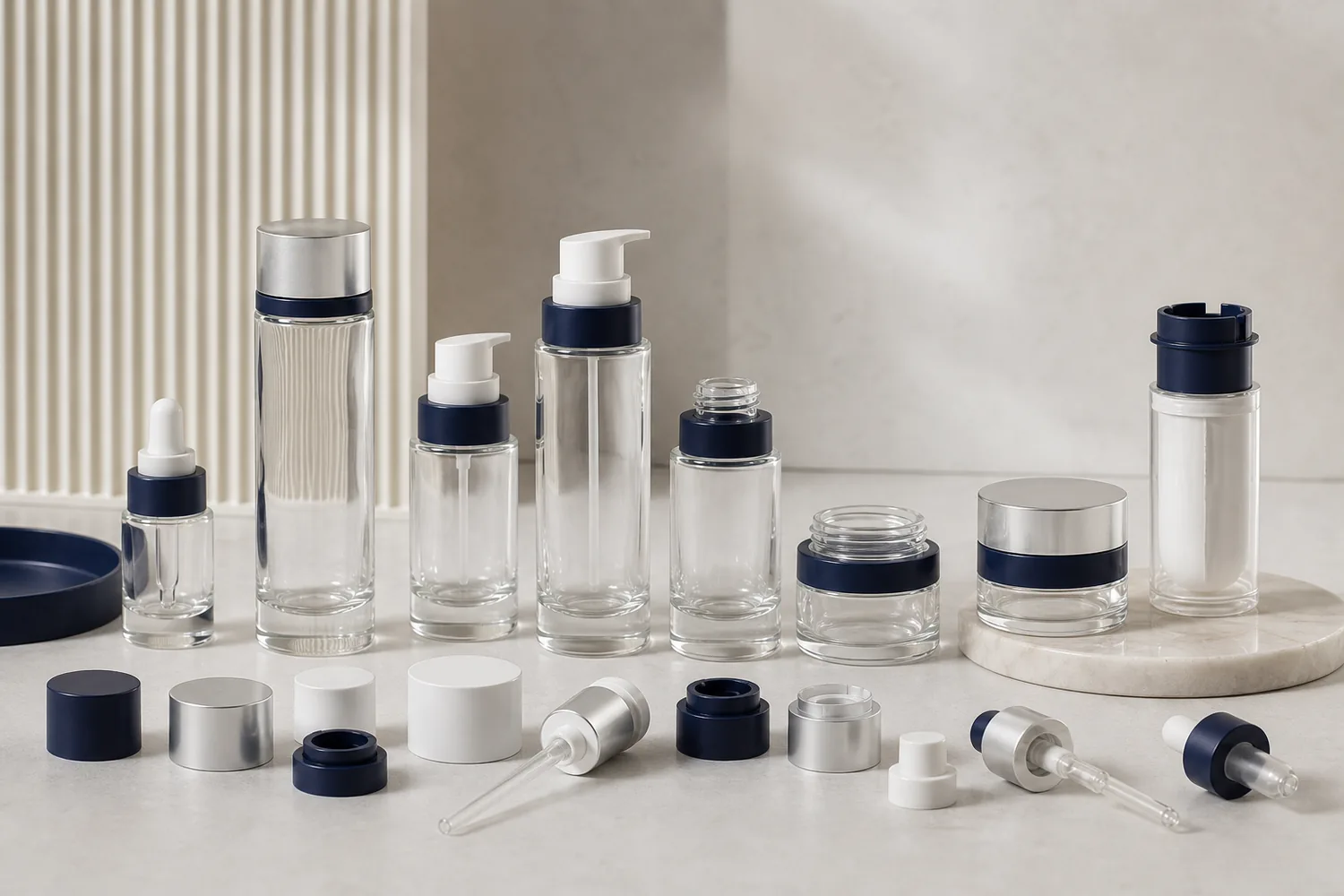
Modular cosmetic packaging systems use controlled component families and interfaces to create several packaging configurations without redesigning every SKU from zero. A brand might share selected glass bottle families, neck finishes, closures, pumps, droppers, caps, outer shells, cartridges, or decoration zones across its portfolio. The potential benefits include faster SKU development, more coherent design, and less fragmented inventory.
The concept is often oversimplified as interchangeable parts. Visual fit is not interchangeability. A closure may attach to two bottles yet seal differently; a pump may fit the neck but have the wrong dip tube, dosage, formula-contact materials, or collar clearance.
Modularity is an interface contract: geometry, materials, function, assembly, evidence, and permitted combinations must be defined and controlled. The objective is not to maximize the number of possible combinations, but to develop a manageable system of technically verified packaging options that serve real product requirements.
Core viewpoint: A modular system creates disciplined variety only when every permitted configuration has a known dependency path. Its boundary is defined by verified interfaces, approved component combinations, and product-specific compatibility evidence—not by the number of parts available in a supplier’s catalog.
Three Forms of Modularity Must Be Separated
Replaceability means one component can be removed and replaced within a defined packaging system, such as a refill cartridge or replaceable pump. Interchangeability means approved alternatives can perform the same controlled role, such as two qualified caps for one selected bottle neck. Configurability means different approved modules create different SKUs, such as pump and dropper versions within a shared bottle family.
One capability does not establish the others. A package may be configurable during manufacturing without being suitable for consumer refilling. Two components may be replaceable without being functionally interchangeable.
This distinction prevents vague sourcing requests. “Make it modular” should become a defined set of permitted component combinations, supplier requirements, assembly instructions, and validation responsibilities.
FOLOVER PACK’s custom bottle development process can support project-specific packaging architecture discussions, but exact interface compatibility must be verified for the selected components.
Shared Necks and Closures Are a Common Starting Point
A controlled neck family can allow several bottles to use selected pumps, droppers, or caps. This may reduce unique closure development requirements and simplify component purchasing and appearance standards.
However, nominal neck-finish designations are not complete compatibility specifications. Thread or crimp geometry, sealing surfaces, dimensional tolerances, gasket compression, collar position, bottle height, pipette or dip-tube length, and closure application method all matter.
A pump approved for one glass bottle should not automatically be considered compatible with another bottle carrying the same nominal neck designation.
The system should therefore include controlled drawings, component item codes, approved combinations, assembly instructions, and relevant test evidence. It should also record prohibited or unverified combinations. The bottle and closure tolerances guide explains why appearance and nominal fit cannot establish reliable sealing or dispensing performance.
Buyers selecting different dispensing configurations can consult the cosmetic bottle closures and dispensing guide before evaluating individual pumps, droppers, and caps.
Manufacturer Insight: Approve the Complete Bottle and Closure Assembly
Consider a serum bottle offered with either a lotion pump or a dropper. Both components may appear to fit the same bottle neck, but their sealing structures, dispensing functions, and internal component lengths can differ.
The pump’s dip tube must be evaluated against the selected bottle height and intended fill level. A dropper requires appropriate pipette geometry and dispensing performance for the actual formulation.
FOLOVER PACK recommends confirming the exact bottle, closure, sealing components, and dispenser together rather than approving accessories independently based on nominal neck specifications.
Final bottle and closure compatibility should be confirmed using the selected components and physical samples before bulk production.

Shared Bottle Families Create Design Coherence
A bottle family may share shoulder geometry, base design, decoration zones, or closure proportions across several capacities. This helps buyers recognize a portfolio and can make artwork development, photography, and retail presentation more coherent.
Yet scaling a bottle shape changes more than volume. Wall distribution, stability, decoration area, closure-to-body proportions, filling behavior, and protective packing requirements may differ by size.
The wider business trend is covered by the Packaging Trends & Insights hub, while shared visual logic belongs in the Packaging Design & Branding hub. Buyers can compare candidate bottle families through the cosmetic skincare glass packaging category.
Each capacity should be reviewed as a related but distinct product requiring verified drawings and physical samples. A formula suited to one dispenser or bottle size is not automatically suited to another.
The skincare packaging guide helps buyers begin with formula characteristics, dispensing requirements, and intended use rather than forcing every product into one visual platform.
Replaceable Components Add a User Interface
Refill cartridges, removable pumps, replaceable caps, and decorative outer shells introduce assembly actions outside the factory. The user must understand orientation, opening, seating, locking, and disposal.
Seals and threads may experience repeated opening and closing cycles. Residual product, hygiene, material wear, and accidental mixing between modules also require consideration. The retained and replaced components should be defined before the refill architecture is finalized.
A reusable outer container does not establish that every inner cartridge is compatible. Formula contact, capacity, venting, pump flow path, tamper features, and regional information requirements may differ.
Claims about refill cycles or environmental benefits require evidence based on the actual packaging configuration and operating model. Modularity creates sustainability potential only when the intended modules remain available and customers use the system as designed.

Modularity Can Accelerate SKU Development
When interfaces and components have already been qualified for a defined use, a new SKU may reuse relevant parts of the existing evidence base. A brand can focus development on the changed formula, dispenser, decoration, capacity, or market requirement instead of reopening every packaging decision.
Shared artwork zones and closure proportions can also simplify design development. However, an existing component approval must not be treated as automatic validation of a new formula or packaging configuration.
The step-by-step custom cosmetic glass bottle process shows where design, samples, decoration approval, and production controls still apply even when a platform reuses modules.
This is controlled reuse, not automatic approval. The development team should identify what changed and which previous evidence remains applicable.
A new high-viscosity formula may require a different pump and additional compatibility evaluation. A larger bottle may need a different dip tube and protective insert. A new coating may require additional decoration testing.
The stock bottles versus custom molds guide helps buyers decide where existing packaging architecture is sufficient and where new tooling creates genuine value.
Illustrative Development Scenario: Three Serum SKUs from One Bottle Family
Consider a beauty brand planning three serum products with different formulations and visual identities.
Instead of selecting three unrelated glass bottles, the brand could begin with one existing bottle family. It could retain consistent bottle geometry, logo placement, and closure proportions while evaluating different dispensing components and bottle colors for the individual products.
For example, one serum might require a dropper, another a lotion pump, and a third a different dispensing configuration. The selected formulations would determine which components are technically suitable.
The development team should first verify which parts can genuinely be shared. Each formula-specific bottle and dispenser combination must then receive the necessary compatibility and functional evaluation.
Decoration can create visual differentiation without requiring a new glass mold for every SKU, provided the existing bottle design and approved decoration processes meet the brand’s requirements.
The commercial advantage is controlled reuse of approved components and development information—not a guarantee that every new SKU can be launched without additional validation.
This is an illustrative packaging-development scenario, not a reported customer project or measured FOLOVER PACK production result. Actual development time, MOQ, tooling cost, and purchasing benefits depend on the selected components, supplier quotations, and project-specific approval requirements.
Inventory Benefits Depend on Postponement
Modular platforms can reduce the number of unique components stocked early. Common bottles or closures may be held before final decoration or SKU assembly, allowing demand to be allocated later.
This postponement can reduce obsolete finished inventory and improve purchasing flexibility. It can also concentrate risk: if one shared component becomes unavailable, several SKUs may stop simultaneously.
Brands need a module dependency graph showing which products depend on each bottle, closure, decoration process, carton, and supplier.
Inventory policy should consider lead time, MOQ, available production capacity, quality history, approved alternatives, and the cost of supply interruption.
Shared inventory should only be consolidated when the component specifications and approved applications genuinely support common use. Visually similar accessories with different sealing materials or performance requirements must remain separately identified.
Buyer action: Before consolidating purchasing quantities, request component-level quotations and confirm whether the same approved part can be allocated across the intended SKUs. Calculate the potential inventory benefit alongside the disruption risk created by shared critical components.
Sustainability Potential Is Conditional
A modular system may reduce tooling requirements, enable refill or repair, simplify component variety, or avoid obsolete inventory. It may also introduce additional collars, adapters, outer shells, or multi-material interfaces.
The environmental outcome depends on actual material consumption, product protection, refill behavior, logistics, and available end-of-life systems.
Modular design is a packaging characteristic, not proof of lower environmental impact.
Brands should make specific, supportable claims. For example, a shared component may eliminate the need for a separate mold, or an approved refill configuration may use less packaging material per replenishment than a defined alternative.
Any claimed reduction should be supported by project-specific evidence rather than an assumed industry percentage. Broader environmental conclusions may require an appropriate assessment of the complete packaging system.
Avoid promising infinite reuse, universal recyclability, or automatic carbon reductions.
Technical Limits Define the System Boundary
Each permitted packaging configuration should have defined technical requirements and corresponding approval evidence. A shared bottle family cannot eliminate the need to evaluate formula compatibility, dispensing performance, assembly, decoration, and distribution conditions.
| Dependency | Question | Possible Boundary | What Buyers Should Verify |
|---|---|---|---|
| Formula | Are contact materials and dispensing suitable? | One closure approved only for selected formulations. | Evaluate the actual formulation with the selected bottle and complete dispensing system. |
| Geometry | Do neck, seal, collar, height, and clearances match? | Same nominal neck designation but different approved combinations. | Confirm drawings, sealing geometry, dimensional tolerances, and assembled physical samples. |
| Capacity | Do pipette length, dip-tube length, dosage, stability, and headspace work? | Different internal component specifications by bottle size. | Evaluate the dispensing function and residual product in each intended configuration. |
| Assembly | Are closure application, crimping, seating, and production setup controlled? | Dedicated assembly requirements for each approved configuration. | Confirm the relevant production process and assembly acceptance criteria. |
| Decoration | Do decoration coverage and assembled components avoid rubbing or interference? | Restricted decoration zones near critical interfaces. | Approve decorated physical samples with the selected closures and components. |
| Distribution | Does every configuration fit the protective packaging? | Different protective inserts by bottle height or closure. | Evaluate the final packed configuration under relevant distribution conditions. |
| Market | Can labeling and supporting documents meet destination-market requirements? | Market-specific cartons, labels, or information modules. | Review applicable requirements for the exact product, packaging configuration, and destination market. |
Boundaries make a platform more reliable and easier to use. A concise permitted-combination matrix is more valuable than a broad claim that all modules fit.
When a proposed combination falls outside the approved matrix, it should return to technical evaluation rather than be forced into the existing architecture.
Design Consistency Needs Controlled Variation
A modular portfolio can become monotonous if every SKU looks identical, or visually fragmented if every module has unrelated colors and geometry.
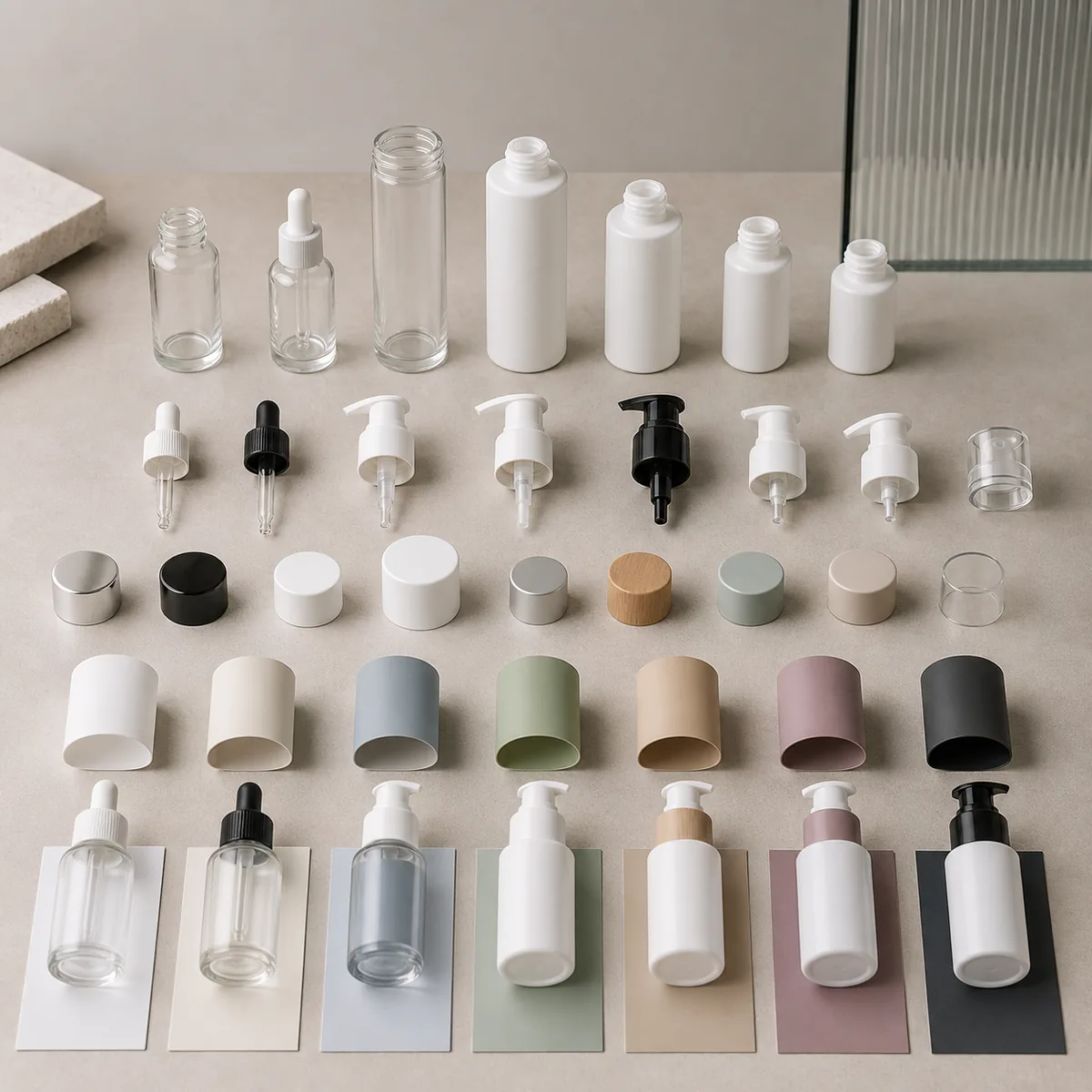
Define consistent visual elements such as shoulder geometry, cap proportions, logo position, and color hierarchy. Then establish which elements may vary by formula, product category, capacity, or brand tier.
This allows consumers to recognize both the overall brand family and individual products.
Decoration should be approved as part of the assembled packaging system. A bottle coating may appear consistent across several SKUs, but different caps, collars, or printed elements can change the final appearance.
For multi-SKU glass packaging projects, FOLOVER PACK recommends confirming bottle colors, printing, coating, and matching closure finishes using physical samples before bulk production.
Buyers should also define which decoration elements remain standardized across the product family and which require individual SKU approval. A shared artwork layout does not guarantee identical appearance across bottles with different dimensions or coatings.
The earlier article on designing packaging systems for multiple SKUs focuses on visual and portfolio logic. The standardized packaging platforms article addresses business governance. Modularity is the component-level implementation layer linking those concerns.
Create a Module Dependency Graph
A module dependency graph lists every approved SKU and the bottle, closure, dispenser, seal, tube or pipette, decoration, carton, insert, supplier, evidence, and assembly process it requires.
It should also identify shared components and change triggers. When one component changes, the graph reveals which configurations require review.
The graph can be managed in a controlled spreadsheet or product lifecycle system. The tool matters less than unique component identities, ownership, revision control, and physical traceability.
Start with one product family, verify its interfaces, remove ambiguous alternatives, and confirm that purchasing, quality, design, and filling teams interpret each configuration consistently.
Example: A Modular Serum Bottle Configuration Matrix
The following example illustrates how buyers can document shared and variable packaging components. It is a planning framework, not a list of tested or approved FOLOVER PACK product configurations.
| Configuration | Shared Components | Variable Components | Required Approval |
|---|---|---|---|
| Serum A | Selected glass bottle family and approved decoration layout. | Dropper assembly and bottle color. | Formula compatibility, pipette geometry, sealing, and final decoration approval. |
| Serum B | Selected glass bottle family and approved decoration layout. | Pump assembly and bottle color. | Pump fit, dip-tube length, dispensing function, formula compatibility, and sealing. |
| Serum C | Selected glass bottle family and approved decoration layout. | Alternative dispensing assembly and printed artwork. | Component specification review, formula-specific performance, and physical sample approval. |
Each configuration should receive a unique controlled identity. The matrix should reference the relevant drawings, physical sample versions, component suppliers, and validation records.
A common bottle shape does not establish that all dispensing configurations can share the same approval.
When Modularity Makes Sense
Modular cosmetic packaging is particularly useful when several products share genuine structural, technical, or branding requirements. It is less suitable when common components would compromise formula compatibility, dispensing performance, assembly reliability, or a product’s intended positioning.
- Use modularity when several SKUs share genuine technical and brand requirements.
- Define replaceability, interchangeability, and configurability separately.
- Confirm controlled drawings, component item codes, suppliers, and approved combinations.
- Verify formula contact, sealing, dispensing, dimensions, and assembly for each intended configuration.
- Map dip-tube length, pipette geometry, dosage, and protective insert differences by bottle capacity.
- Compare inventory benefits with the supply risk created by shared critical components.
- Preserve sufficient visual variation for individual SKU recognition.
- Define refill-cycle, hygiene, and replacement-component availability requirements where relevant.
- Link validation evidence and component changes through the dependency graph.
- Choose a dedicated packaging solution when the shared architecture cannot meet a defined functional or branding requirement.
Manufacturer Insight: A useful modular packaging brief should contain both a permitted-combination table and a prohibited-combination table.
The first identifies combinations supported by appropriate specifications and approval evidence. The second prevents visually plausible but unverified assemblies from becoming production assumptions.
For example, an existing pump may be approved for one bottle and formulation but remain unapproved for another bottle capacity or formula. This restriction should be visible to purchasing and product-development teams before a replacement component is ordered.
Governance Determines Whether the Platform Stays Modular
Platforms tend to fragment after launch. One market requests a different cap, a supplier proposes a similar gasket, the formulation team selects another pump, or design changes the decoration coverage.
If every exception is accepted informally, shared architecture becomes a collection of similar-looking components with different specifications and incomplete approval records.
A platform owner should review proposed modules, component dependencies, supplier changes, and retirement decisions.
Governance does not require a large committee. It requires clear ownership, controlled component identities and revisions, a permitted-combination matrix, change notification, and a documented decision process.
When an exception creates genuine technical or commercial value, it can be approved as a new controlled configuration. When it introduces complexity without sufficient benefit, the existing approved system should be retained.
The GS1 GTIN Management Standard provides rules for identifying new and changed trade items in the supply chain. Its principles help brands evaluate when finished-product identification must change, but they do not replace internal packaging component codes, technical specifications, or compatibility approval.
Brands should distinguish finished-product identification from the controlled identities of individual bottles, closures, dispensers, and other packaging components.
Qualified Alternatives Need Their Own Evidence
Dual sourcing can improve supply resilience, but a second component is not automatically interchangeable merely because it matches nominal dimensions.
Compare drawings, tolerances, formula-contact materials, sealing structures, dispensing performance, appearance, assembly requirements, and relevant test results.
Record which SKUs and formulations each alternative supports. In some cases, a backup component may be approved only for a subset of the platform.
The dependency graph should identify primary and qualified alternative components separately, including their suppliers, controlled item codes, and applicable production versions.
This permits purchasing flexibility without erasing technical traceability. If an alternative changes the user experience or final appearance, design and commercial approval may also be required.
Sample Approval Before Bulk Production
For a proposed alternative bottle, pump, dropper, or closure, the buyer should confirm the applicable specifications and evaluate the actual assembled configuration rather than relying only on a supplier’s statement that the components are equivalent.
Relevant checks may include sealing, leakage, dispensing performance, assembly, formula compatibility, component appearance, and decoration consistency. The exact evaluation should reflect the intended formulation, storage conditions, and use requirements.
The approved physical sample, component item codes, and applicable drawings should be linked to the relevant configuration. Any subsequent supplier, material, structural, or decoration change should trigger a review of affected approvals before bulk production.
Start With One Valuable Family
A modular packaging program should not begin by forcing the entire product catalog into one universal system.
Select a family with repeated interfaces, meaningful purchasing requirements, and sufficient future SKUs to justify the development work.
Map the existing components and approval evidence, identify the most useful shared elements, and remove unnecessary variations. Then validate a manageable number of configurations before expanding the platform.
Track development time, unique component count, inventory exposure, assembly errors, quality events, and supply continuity using the brand’s actual project records.
The purpose is not to maximize theoretical combinations. It is to create a practical system of useful, well-evidenced configurations that supports product development and repeat purchasing with less avoidable complexity.
Frequently Asked Questions
How many modules should a platform contain?
There is no ideal number. Include only configurations that serve a real product, formula, channel, or supply-resilience requirement and can be properly controlled. Additional theoretical combinations increase documentation, inventory, and misuse risk without necessarily improving buyer value. Start with one useful product family, verify its critical interfaces, and expand only when a new configuration has a defined business or technical purpose.
Does the same neck finish mean pumps and droppers are interchangeable?
No. The same nominal neck finish does not guarantee compatibility. Sealing geometry, dimensional tolerances, gasket structure, collar clearance, dip-tube or pipette length, dispensing requirements, formula compatibility, and assembly conditions may differ. Buyers should confirm exact component specifications and evaluate the selected bottle and closure together using physical samples before approving a new configuration for bulk production.
Can modular packaging reduce MOQ?
Shared stock components may help some projects consolidate purchasing requirements, but modular packaging does not automatically reduce MOQ. Minimum quantities depend on the selected bottle, closure, decoration, tooling, carton, supplier, and order configuration. Buyers should request component-specific quotations and confirm whether shared parts can genuinely be purchased together without creating unnecessary inventory or unsupported substitutions.
Is modular packaging always refillable?
No. A modular packaging system may be configurable during manufacturing without being designed for consumer refilling. Refillable packaging introduces additional requirements involving repeated assembly, seal durability, formula residue, hygiene, replacement-component availability, and user instructions. Buyers should distinguish factory-level component configurability from consumer-level refillability and validate the actual refill system before making repeated-use or environmental claims.
Conclusion: Modular cosmetic packaging systems matter because controlled interfaces can support more consistent product families, more efficient component sourcing, and faster development of additional SKUs.
Their value comes from verified component relationships and disciplined variation—not from assuming that similar-looking parts are interchangeable.
For beauty brands, the practical starting point is to select one suitable bottle family, identify the components that can genuinely be shared, and establish approved combinations before expanding the platform.
FOLOVER PACK can support glass bottle selection, component coordination, closure and dispenser matching, decoration development, and physical sample approval for modular cosmetic packaging projects.
Share your planned product range, preferred bottle shapes, formulation types, dispensing requirements, target order quantities, and decoration references to discuss which components may be standardized and which require product-specific development.
A modular platform is successful when purchasing, design, quality, and product-development teams can identify an approved configuration, understand its limitations, retrieve the relevant evidence, and recognize when a new request falls outside the verified system boundary.