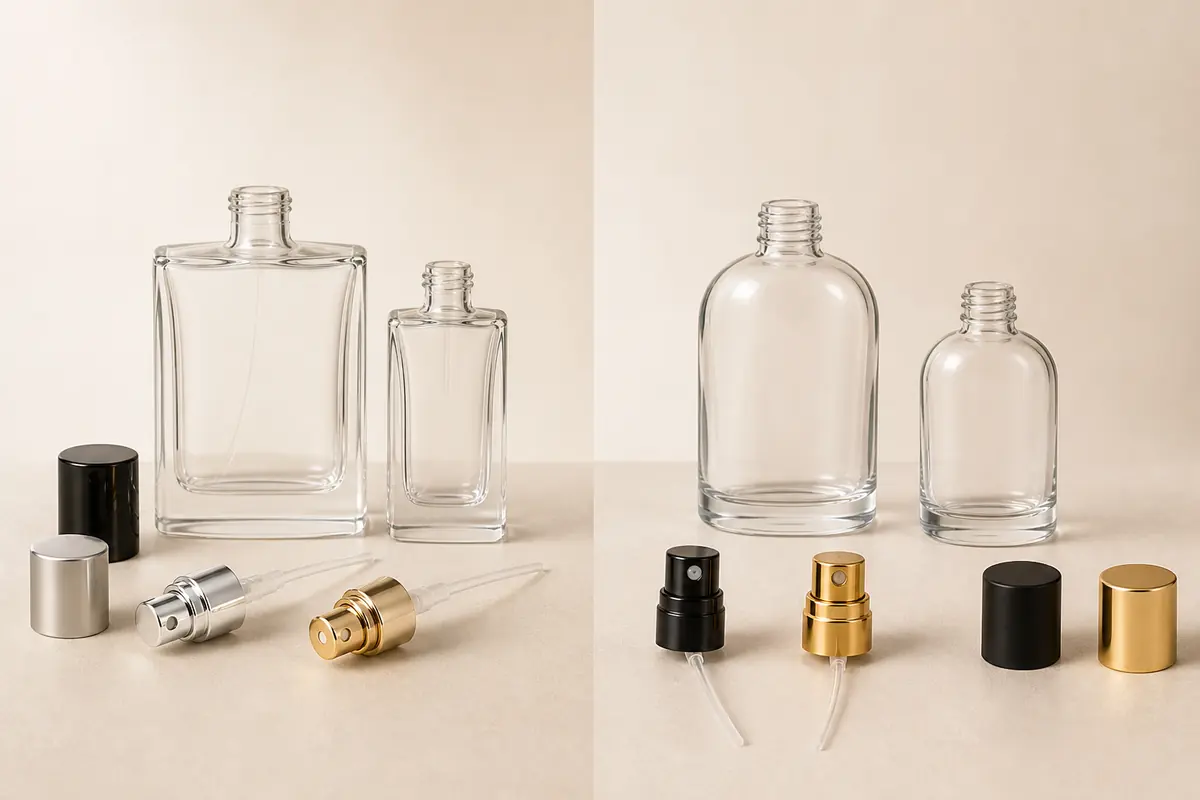

Short answer: Some perfume bottles are purpose-built for refilling; conventional crimped or permanently assembled bottles usually are not intended for consumer disassembly. Refillability depends on the neck, atomizer attachment, refill interface, seal, materials, repeated-use performance, and a controlled user process.
Yes, perfume bottles can be refilled, but not every bottle is designed to be opened, filled again, and reliably resealed. A removable atomizer may provide access to the bottle, but that alone does not establish whether the complete packaging system is suitable for repeated use.
For fragrance brands, the important distinction is between a bottle that can be opened and a packaging system designed for refilling. The latter must provide a practical transfer method, protect the fragrance, maintain sealing and spray performance, and remain safe and understandable throughout its intended use.
This article explains the technical factors that determine whether a perfume bottle can be refilled. For broader bottle selection, refill formats, and development considerations, see our refillable perfume packaging guide.
Refillable is not the same as openable
An openable perfume bottle has a component that can be removed. A refillable perfume bottle is designed to accept additional fragrance through an intended filling method while maintaining acceptable sealing, dispensing, and packaging performance.
Forcing fragrance through an opening or removing a conventional crimped atomizer does not make a bottle refillable. Improvised disassembly can deform the ferrule, damage the gasket or glass finish, introduce debris, or prevent the atomizer from sealing correctly after reassembly.
Before selecting components, brands should establish who will refill the bottle, where refilling will take place, which refill product will be used, and how the package will be closed and handled afterward.
Manufacturer insight: The refill mechanism should be selected before finalizing the decorative bottle. FOLOVER PACK recommends evaluating the original bottle, atomizer, refill container, transfer interface, and closure together. A bottle that looks suitable for refilling may still require changes to its neck, collar, or dispensing components.
For brands comparing existing bottles with custom-developed packaging, this distinction also affects tooling decisions. An existing bottle is a practical starting point only when its neck and available components can support the intended refill method. Otherwise, a different stock bottle or a purpose-built packaging structure may be necessary.
Screw-neck perfume bottles
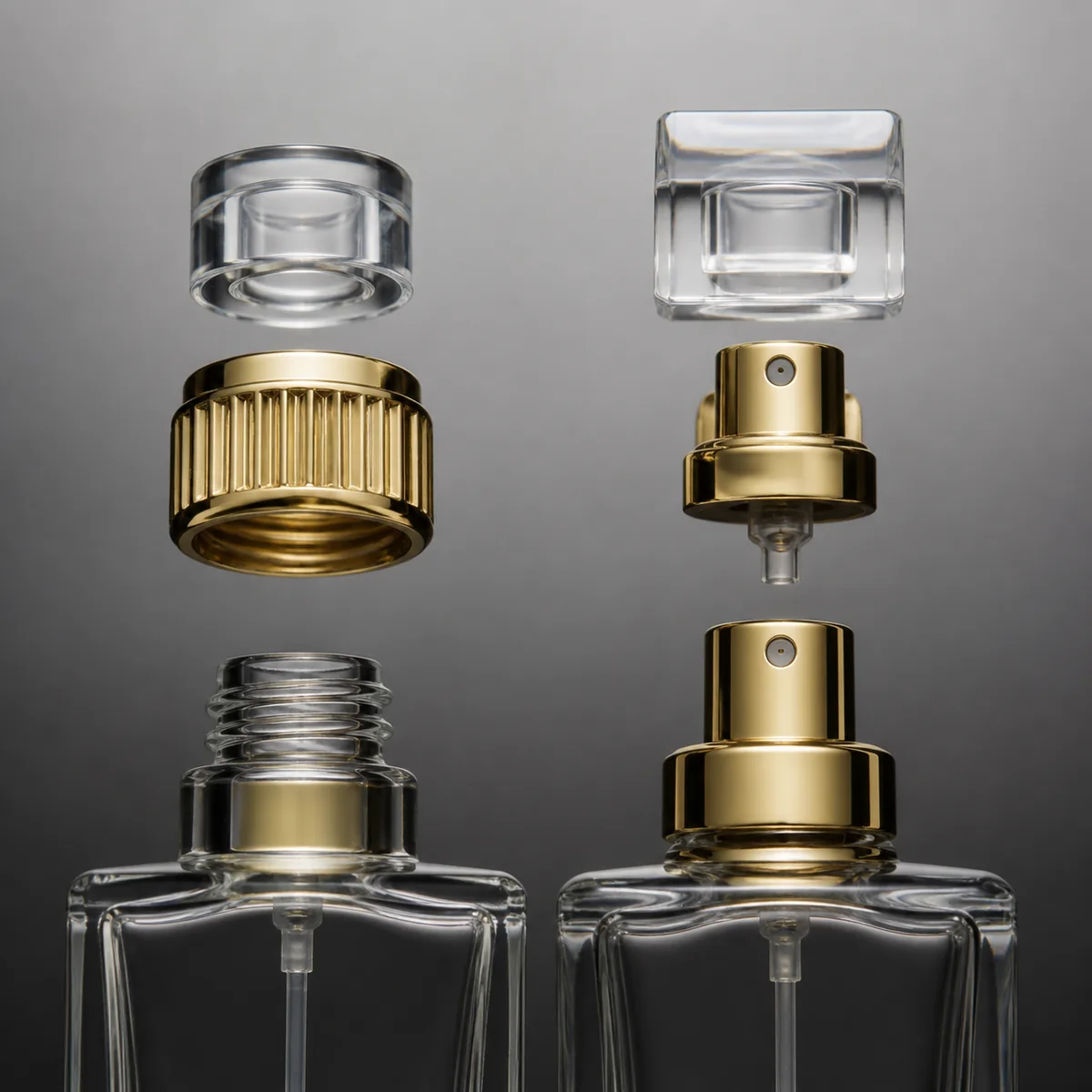
A removable threaded atomizer can provide a relatively straightforward route for refilling. However, a screw-neck perfume bottle is not automatically a consumer-ready refillable system.
The selected atomizer must match the bottle’s actual neck finish, thread geometry, sealing surface, and gasket arrangement. It must also remain accessible for removal and reinstallation without cross-threading, excessive force, or damage to the sealing components.
Repeated opening introduces additional considerations. The collar may obstruct access to the threaded connection, decorated surfaces may become scratched, and the sealing gasket may change condition after repeated compression.
Buyers should request physical samples of the exact perfume glass bottle and selected atomizer rather than assuming that two components will fit because their nominal neck dimensions appear similar.
Crimp-neck perfume bottles
Conventional crimp systems are assembled by deforming a metal ferrule around the bottle finish. They provide a secure, low-profile atomizer attachment but are generally not designed for routine consumer removal and re-crimping.
Removing the ferrule can damage the atomizer, gasket, bottle finish, or decoration. Reinstalling the original assembly does not guarantee that its previous sealing performance will be restored.
For a brand planning a consumer refill program, a conventional crimped bottle should not be treated as a refillable package simply because the pump can be removed with tools.
A crimp-style presentation can still be used in certain purpose-built refill systems. Depending on the design, these may incorporate a separate filling valve, replaceable internal reservoir, or removable cartridge. The feasibility of each option depends on its actual construction and the compatibility of the selected components.
Buyer decision: If regular consumer refilling is a central product requirement, select a packaging architecture specifically designed for that process rather than relying on repeated removal of a conventional crimped atomizer.
Purpose-built refill interfaces
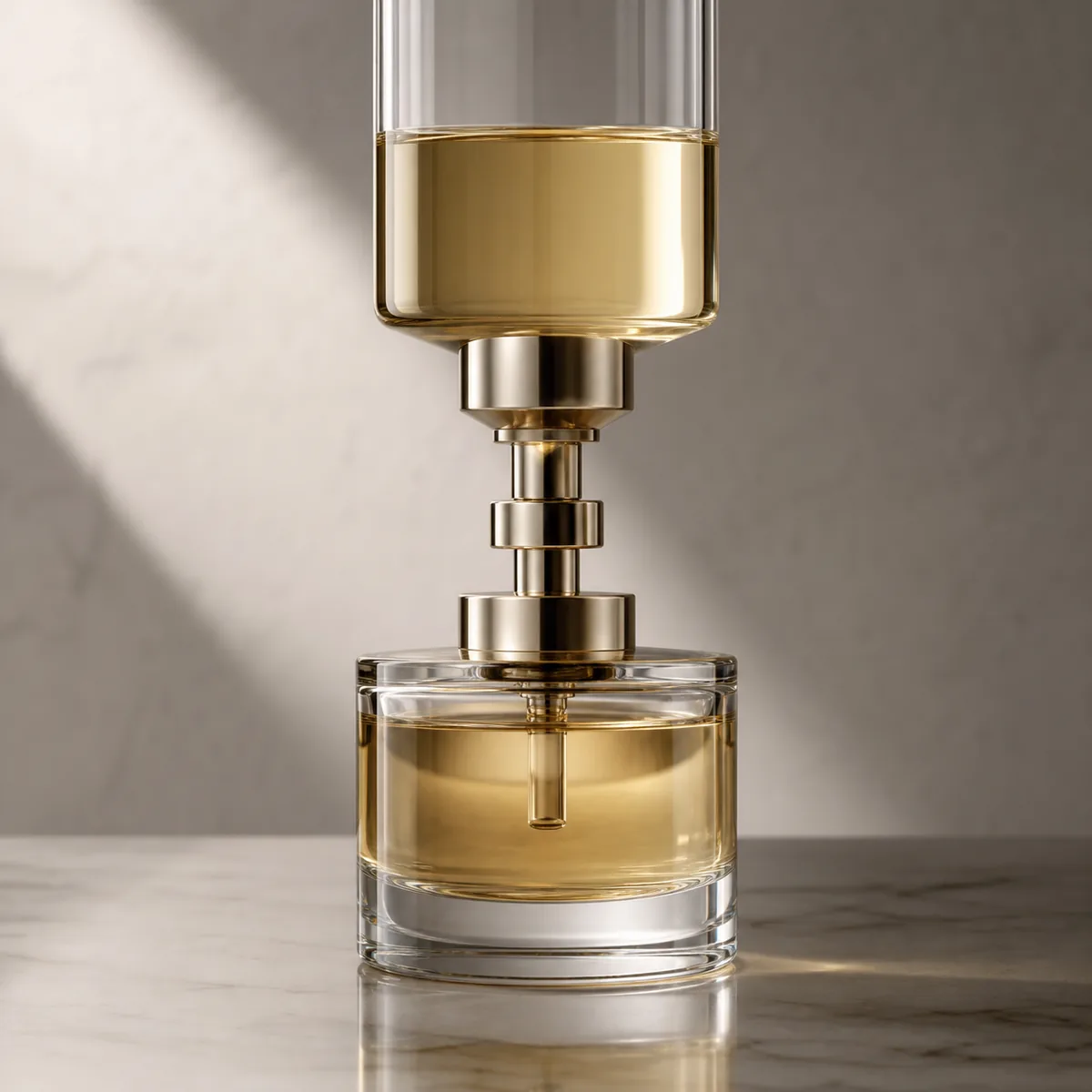
A refill interface is the connection or opening through which additional fragrance enters the original bottle. Its design influences filling convenience, leakage risk, contamination exposure, and the ability to prevent incorrect assembly.
Common development approaches include removable threaded atomizers, matched refill connectors, valve-based transfer systems, controlled filling openings, and replaceable cartridges. These are alternative design concepts, not interchangeable components.
An open filling method may be simple to understand but requires suitable access and overflow control. A valve-based system can reduce open handling, although its connection geometry and actuation must be verified. A cartridge system may simplify replacement but introduces additional material, assembly, and sourcing considerations.
When sourcing refillable perfume bottles, ask the supplier to identify the intended refill method and the complete set of compatible components. A photograph of a removable pump is not sufficient evidence of repeated-use performance.
Fragrance compatibility continues after the first fill
A refillable perfume system must remain compatible with the actual fragrance throughout its intended use. The compatibility assessment should include the glass bottle, gasket, atomizer, dip tube, valve components, and any materials in the refill container that contact the formula.
Alcohol-based fragrances may interact differently with different sealing materials, coatings, and dispensing components. Compatibility should not be assumed from the appearance of a gasket or a supplier’s general statement that a component is suitable for perfume.
Repeated filling can also introduce new conditions. Residual fragrance may mix with the next refill, the closure may undergo additional compression, and surfaces around the opening may experience repeated fragrance exposure.
The refill product should therefore be the authorized fragrance intended for the system, or another formulation whose compatibility has been separately verified. Mixing unrelated perfumes can affect odor, appearance, and formulation stability.
Similarly, cleaning a perfume bottle with water, detergent, or solvent should not be recommended without a validated procedure. Residual cleaning agents may remain inside the pump pathway, affect the fragrance, or damage packaging components.
Technical note: Packaging compatibility should be evaluated with the actual formulation under intended storage and use conditions. Approval of the original filled bottle does not automatically establish compatibility after repeated opening, refilling, cleaning, or component replacement.
Repeated-use testing is the central proof
Refillability should be evaluated through repeated filling and use, not established by a single successful opening or leakage test.
A representative evaluation should follow the intended consumer process: use the product to the specified residual level, open or connect the refill interface, transfer fragrance, reseal the bottle, inspect the assembled package, store it, and operate the atomizer again.
The number of refill cycles and acceptance criteria should reflect the intended product program. There is no universal refill-cycle count that establishes the suitability of every perfume bottle and atomizer combination.

The following table identifies the main validation areas buyers should review with their packaging supplier and formulation team.
| Validation area | Questions | Evidence to retain |
|---|---|---|
| Opening or connection | Is the intended interface accessible and resistant to misuse? | User trial observations, component condition |
| Transfer | Does filling stop predictably and avoid overflow or trapped pressure? | Filled mass or volume, spill observations |
| Resealing | Does the closure return to its intended position and seal? | Torque or assembly record, leakage result |
| Dispensing | Does the atomizer prime and spray consistently after refilling? | Functional observations and agreed output checks |
| Repeated use | Do gasket, thread, valve, decoration, and interface remain acceptable? | Cycle-specific inspection record |
| Distribution | Does the refilled unit tolerate intended storage and transport? | Orientation, leakage, appearance, and function results |
For a formal packaging reuse assessment, ISO 18603:2013, Packaging and the environment — Reuse, provides requirements and assessment procedures for packaging classified as reusable, including the associated reuse system. It is not a perfume-specific leakage test or a substitute for validating the selected bottle, atomizer, and fragrance.
Buyers should agree on the test procedure, acceptance criteria, sample configuration, and responsible parties before approving production. Request the available results for the exact packaging assembly rather than applying test data from a different bottle or pump.
User experience can make or break the system
A technically refillable bottle may still be unsuitable for its intended market if users struggle to remove the atomizer, spill fragrance during transfer, overfill the container, or cannot reinstall the closure correctly.
For example, a brand considering an existing screw-neck bottle should test whether representative users can access the pump without tools, transfer fragrance using the proposed refill container, and reinstall the atomizer without leakage or visible component damage. This is a suggested evaluation scenario, not a verified customer case.
Instructions should identify the compatible refill product and explain opening, transfer, closing, wiping, and storage. They should also warn against foreseeable misuse, including forcing a conventional crimped pump open or filling the bottle with an unapproved product.
The refill interface should make correct operation reasonably straightforward. Written instructions cannot compensate for a connector that is difficult to align or a closure that users cannot reliably reinstall.
Hygiene and product identity
Repeated opening introduces handling and environmental exposure. Open filling methods may create more contact opportunities than closed transfer systems, particularly around the bottle neck, atomizer, and refill vessel.
Brands should define how the package is handled during refilling, whether cleaning is permitted, and which components must remain protected from contamination.
Product identity is equally important when a refillable bottle could accept more than one fragrance. The refill product, concentration, and intended compatibility must be clearly communicated. Appropriate labeling or a dedicated connector can help reduce selection errors, but these measures do not replace formulation and packaging validation.
Refillability does not automatically prove sustainability
A refillable perfume bottle may reduce the need to replace the decorative primary container, but its overall environmental performance depends on how the complete system is designed and used.
Relevant factors include the number of actual refills, refill-container materials, additional components, transport, cleaning, breakage, and end-of-life handling. A refillable bottle that is rarely refilled may deliver a different result from one that remains in regular use.
The Ellen MacArthur Foundation’s reusable packaging framework distinguishes between refill-at-home, refill-on-the-go, and return-based reuse models. It also emphasizes the importance of considering the packaging used to supply refills. This framework helps explain the system-level decision, although it does not establish the environmental performance of any particular perfume bottle.
For additional packaging context, see our refillable cosmetic packaging basics article.
Buyers should distinguish between a verified functional claim, such as a bottle being designed for an approved refill process, and a broader environmental claim. Refillability alone does not establish a specific reduction in emissions, material consumption, or overall environmental impact.
A buyer decision gate before tooling or launch
Before approving a refillable perfume packaging project, brands should confirm the following requirements with their bottle and component suppliers.
- Use case: Name who refills, where, how often, and with which authorized refill.
- Architecture: Confirm whether the neck, pump, valve, cartridge, or shell is designed for the loop.
- Compatibility: Review every contact material in the primary and refill package.
- Transfer: Demonstrate clean filling, stopping, venting, and overflow control.
- Reseal: Verify closure position, leakage, evaporation risk, and loosening after cycles.
- Dispense: Confirm priming and spray quality after each relevant refill stage.
- User proof: Observe representative users and foreseeable errors.
- Claims: Separate technical refillability from lifecycle or sustainability conclusions.
The required evidence should be defined for the actual packaging configuration. Rather than requesting a generic certificate confirming that a bottle is refillable, ask for component specifications, approved samples, and relevant test records demonstrating the intended transfer, resealing, compatibility, and repeated-use performance.
Recommended development sequence
- Write the refill use case and failure conditions.
- Select the complete primary and refill architectures together.
- Screen drawings, materials, and assembly interfaces.
- Build production-representative samples with the real fragrance.
- Run controlled transfer, reseal, spray, storage, and transport cycles.
- Conduct representative user handling and instruction review.
- Freeze item codes, specifications, limits, and change controls before launch.
Common mistakes
Several avoidable mistakes can affect the performance or commercial feasibility of a refillable perfume packaging project.
- Assuming every screw-neck bottle is refillable: A removable atomizer does not establish repeated sealing performance. Confirm the actual bottle, gasket, and pump assembly through physical testing.
- Attempting to reuse a conventional crimped atomizer: Removing the ferrule can damage the components and compromise resealing. Select an intended refill architecture instead.
- Finalizing the decorative bottle before selecting the refill mechanism: The neck, collar, overcap, and bottle geometry may restrict access or component assembly. Confirm the refill interface before approving the final appearance.
- Testing only the first refill: Repeated opening, transfer, and closing can introduce additional risks. Evaluate the intended refill sequence with production-representative samples.
- Approving components independently: A bottle and atomizer may each meet their individual specifications but fail as an assembled refill system. Assign responsibility for matching and approving the complete configuration.
Buyer conclusion
Choose the architecture before styling the bottle
For a fragrance brand developing a refillable product, the practical starting point is the intended refill method, not the appearance of the bottle.
If the concept requires consumers to remove and reinstall an atomizer, evaluate a suitable threaded system. If the brand wants the appearance of a conventional crimped bottle, investigate a purpose-built refill interface or replaceable reservoir rather than assuming the crimped pump can be repeatedly removed.
FOLOVER PACK recommends assigning clear responsibility for the connection between the primary bottle, atomizer, refill vessel, and any adapter. Physical sample approval should cover the complete assembly, including closure access, transfer, leakage, dispensing, and decoration.
Plan the service and end-of-use path
The project should also define what happens when a gasket wears, an atomizer stops functioning, or a glass bottle becomes damaged. A refill program should not encourage users to continue using a package with an unreliable seal or damaged glass.
Before bulk production, retain an approved packaging configuration identifying the authorized refill product, bottle and component codes, refill method, test requirements, user instructions, and changes that require revalidation.
For broader fragrance selection, see the perfume packaging guide. Related technical questions are available in Packaging Q&A, while product-specific use cases are covered in Packaging Applications.
Developing a refillable perfume packaging system?
Perfume bottles can be refilled when the complete package is designed and validated for the intended refill process. FOLOVER PACK can help buyers review candidate glass bottles, atomizer selection, component matching, refill interfaces, and available customization options.
Share your target bottle, fragrance format, neck preference, refill concept, decoration requirements, and expected usage conditions so the appropriate packaging configuration can be evaluated before bulk production.
Contact FOLOVER PACK to discuss your refillable perfume packaging requirements.
Frequently asked questions
Are screw perfume bottles refillable?
They may be candidates because the atomizer can be removable, but the thread, gasket, access, repeated resealing, leakage, formula compatibility, and user process still need validation.
Can crimp perfume bottles be opened?
A crimp assembly can sometimes be removed with tools, but conventional systems are generally not intended for consumer removal and reliable reassembly. Use a purpose-built refill architecture instead.
Does refillability depend on the atomizer?
Yes, but not only on it. The neck, pump attachment, gasket, refill interface, bottle, refill vessel, fragrance, decoration, and user method work as one system.
Are refillable perfume bottles automatically more sustainable?
No. The result depends on actual reuse, refill packaging, transport, durability, cleaning, component use, and end-of-life. Substantiate environmental claims separately.