

Refillable cosmetic packaging is often reduced to a visual idea: a beautiful outer bottle next to a smaller refill. In practice, refillability is a service system. The consumer must be able to obtain the refill, understand the process, open and reassemble the package correctly, preserve product quality and continue using the pack without unacceptable leakage, damage or dispensing decline.
A refillable design creates value only when repeat use actually happens. That makes the most important metric neither the weight of the outer bottle nor a hypothetical maximum cycle count. It is successful repeat use under the intended commercial conditions. This framework helps brands decide when refill makes sense and what must be verified before making sustainability claims.
Direct Answer
Refillable cosmetic packaging is packaging intentionally designed with an available method to replenish the original pack and maintain required function through repeated use. It is not automatically sustainable. Environmental performance depends on the outer pack, refill packaging, actual reuse, transport, cleaning or handling needs, failure and replacement.
The buyer implication is to design the refill journey and evidence at the same time as the container. If consumers cannot obtain, identify or install the refill reliably, or if the pump and seals do not remain suitable, the system is refillable in concept but weak in practice.
For glass cosmetic packaging, a removable closure is not sufficient proof of refillability. The original bottle, replacement container or refill product, dispensing components and intended refill procedure must be evaluated together before approving the commercial system.
FOLOVER Manufacturer Insight
FOLOVER PACK can discuss refillable glass packaging concepts, replaceable inner containers, coordinated outer bottles and refill components, closures, decoration, samples and packaging development. Product-specific compatibility, repeated-use performance and refill-cycle claims require verified testing.
For a refillable glass packaging project, one important purchasing decision is whether an existing bottle and closure platform can support the intended refill method or whether a new structural design is required.
A stock glass bottle may provide a practical starting point for a transfer-refill concept, but its removable closure does not establish that the pump, gasket, dip tube or bottle neck will remain suitable after repeated opening and reassembly. A replaceable-cartridge system may require additional development of the cartridge interface, retention structure and dispensing assembly.
Before approving a custom mold or committing to a shared refill platform, define the component interfaces and the complete consumer refill sequence. Changes to the bottle neck, cartridge seating, pump position or sealing geometry can affect the compatibility of every refill intended for that outer package.
FOLOVER does not automatically claim environmental reductions, a fixed number of refill cycles, universal component compatibility or recyclability of the complete assembled system. A productive inquiry includes formula, fill volume, dose, outer-pack concept, refill method, user sequence, market, filling route, decoration, target quantity and required validation.
What counts as refillable cosmetic packaging?
A package is refillable when the brand provides a practical route to replenish the original container or durable dispensing system. The route may use a replaceable inner cartridge, a refill bottle or pouch, a removable closure that supports controlled transfer, or a managed refill service. The system must be intentionally designed; a customer improvising with an ordinary bottle is not a substantiated refill program.
The US Federal Trade Commission’s Green Guides advise that marketers should not make an unqualified refillable claim unless they provide a way to refill the package, such as a collection and refill system or a refill product consumers can use. This is a useful commercial test: the refill must exist and be accessible to the audience receiving the claim.
The original package, refill and instructions belong to one product architecture. If any part is unavailable or incompatible, the claim and user experience weaken.
Buyer action: Ask the supplier to identify exactly which components remain in use, which are replaced and how the consumer completes the refill. Confirm that the intended refill product and necessary replacement components will be commercially available for the selected system.
Refillable, reusable and recyclable are different
Refillable means the package can be replenished through a provided system. Reusable is broader: an item may be designed for repeated use for the same purpose without necessarily being refilled by the brand. Recyclable concerns an end-of-life collection and processing route. A package can have one, several or none of these attributes.
A durable glass jar is not automatically refillable. A replaceable cartridge may create refillability while the cartridge itself follows a separate disposal route. A refillable outer bottle can eventually be recyclable in one market and not another due to decoration or local infrastructure.
Use the glass packaging sustainability framework to keep these system conditions visible instead of converting “glass” into a blanket environmental conclusion.
Common refill models
Replaceable inner cartridge: A durable outer bottle or jar holds a separate inner vessel. The cartridge may simplify replenishment and protect the outer decoration from direct formula contact, but interfaces, orientation, retention and removal need testing.
Refill bottle or pouch: Product is transferred into the original container. This may reduce material in the refill package, but pouring control, contamination risk, residues, labeling and consumer instructions require careful development.
Reusable closure or pump: A pump, dropper or cap moves to a new refill container. The closure must remain compatible and functional, and the consumer must handle it correctly. Repeated contact and actuation cannot be assumed safe or reliable.
Managed refill service: A retail or return system replenishes or exchanges packaging. This adds operational controls for collection, cleaning, filling, traceability and logistics outside the normal supplier scope.
The application-specific refillable perfume packaging guide examines fragrance bottles, pumps and user experience. This article remains a general cosmetic refill framework.
| Refill Model | Best For | Main Limitation | What Buyers Should Verify |
|---|---|---|---|
| Replaceable inner cartridge | Products using a retained outer bottle or jar with a compatible replacement container. | Cartridge retention, alignment and compatibility with the outer package and dispensing system. | Cartridge dimensions, sealing, removal, installation, formula-contact materials and replacement availability. |
| Refill bottle or pouch | Products for which controlled transfer into the original container is practical. | Spillage, residue, hygiene and possible repeated use of the original dispensing assembly. | Transfer method, formula compatibility, refill instructions and the condition of the retained container and closure. |
| Reusable closure or pump | Systems specifically developed to retain the dispensing component while replacing the product container. | Repeated assembly, sealing, component wear and compatibility between successive refill containers. | Neck finish, sealing geometry, dip-tube or pipette fit, repeated-use performance and the intended consumer sequence. |
| Managed refill service | Programs with an established collection, cleaning and controlled refilling operation. | Operational complexity, reverse logistics, product quality and traceability. | Responsibilities for collection, cleaning, inspection, refilling, distribution and replacement of damaged components. |

Structural durability of the outer pack
The outer package may experience more handling than a single-use pack: opening, cartridge removal, refitting, storage and repeated dispensing. Glass can provide a rigid premium outer structure, while polymers and metal components may create the retention and interface mechanisms. Every material has a specific role.
Durability should be evaluated at likely contact points. Threads, snap features, cartridge retainers, shoulders, base and decorative surfaces can wear or be damaged. A heavy outer bottle may improve perceived permanence but increases the initial material and shipping burden. The design should be durable enough for the intended model, not simply heavier.
Do not state a refill-cycle capability without test evidence for the exact assembly. Define what constitutes a cycle and what failure criteria apply before testing.
For a replaceable-cartridge glass jar, a successful cycle may include opening the outer lid, removing the used cartridge, installing the new cartridge and closing the package correctly. Testing only the glass vessel without its cartridge retention and closure components does not validate the complete refill system.
For a custom glass bottle, confirm the required geometry and component interfaces before mold development. For an existing bottle, verify whether the proposed refill construction can be accommodated without altering the neck, sealing or dispensing requirements.
Closure and pump repeated-use performance
A pump or dropper may be the most vulnerable part of a refill system. Repeated removal and reassembly can affect seals, threads, crimped interfaces, dip-tube position, spring behavior, dosage and leakage. Residual product can also influence handling or formula crossover.
If a closure is intended for reuse, test the exact bottle, closure, gasket, formula and consumer sequence. Evaluate actuation, priming, dose consistency where specified, leakage, loosening, wear and visible damage. The test program should reflect storage and use conditions rather than only rapid dry cycling.
A closure that can be removed is not automatically reusable. Some pumps are designed as permanent assemblies; others may support transfer under controlled conditions. Supplier confirmation and physical verification are required.
Manufacturer Note: Refill Interface Compatibility
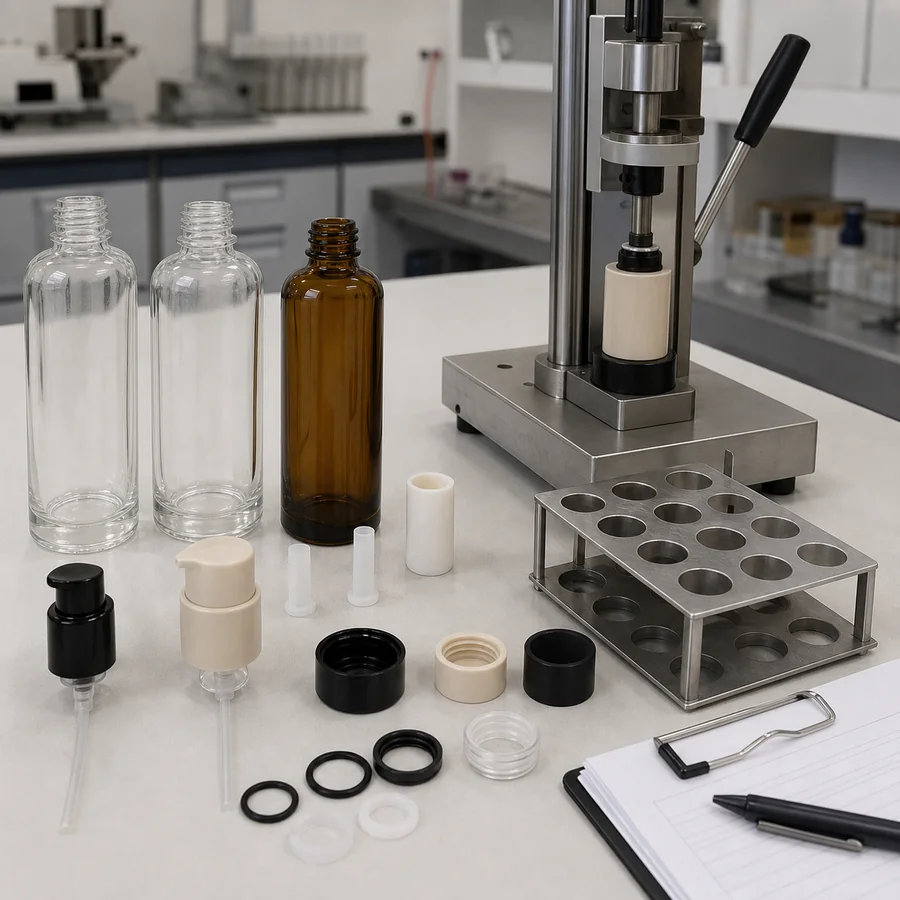
Two bottles with the same nominal capacity or similar appearance may use different neck finishes, thread structures or sealing geometries. A reusable pump should not be assumed compatible with a replacement bottle simply because it can be screwed onto the neck.
When transferring a pump or dropper to a new container, verify the selected bottle neck, closure engagement, gasket, dip-tube or pipette length, formula viscosity and intended dosage. Bottle height or internal geometry changes may require a different dispensing component even when the visible closure is unchanged.
Final bottle and closure compatibility should be confirmed using the selected components and physical samples before bulk production.
Formula compatibility and product quality
Refillable packaging increases the importance of the full contact history. Formula compatibility depends on glass or polymer contact surfaces, closure materials, gaskets, dip tubes, exposure time, temperature and intended use. When different refills or formulas could be introduced, crossover risk must be controlled.
Compatibility should be evaluated with the actual formulation under intended storage and use conditions. A refill cartridge may reduce contact with the outer pack but add new contact materials. A transfer refill may expose the product to the original container and reusable pump for longer than a single-use scenario.
For a serum bottle with a retained treatment pump, the brand should assess whether residual product in the pump or dip tube affects the intended refill procedure and product quality. Replacing the bottle alone does not automatically remove product remaining inside the dispensing assembly.
The skincare packaging guide can help define formula, dose and closure requirements before reuse is layered onto the design.
Cleaning, residue and hygiene boundaries
Cleaning instructions must be developed by the responsible brand, formula, quality and safety teams. Packaging suppliers should not provide generic household cleaning advice for all cosmetics. Water, detergents, drying, heat or tools can affect components, decoration and product quality.
Some refill models are designed so the consumer never cleans the primary contact surface; the new cartridge provides a fresh inner container. Other models require transfer into the original vessel and therefore need clear handling rules. Residual product, incompatible refills and incomplete drying may create quality concerns.
Define whether cleaning is required, permitted or prohibited. Instructions, refill labeling and physical design should communicate the approved route. If safe handling cannot be explained simply, the system may be too complex for the intended channel.
Buyer decision: If the intended product cannot tolerate uncertain consumer cleaning or formula crossover, evaluate whether a replaceable inner container can maintain an appropriate product-contact boundary. Do not assume that the cartridge model removes every hygiene risk, particularly when the pump, applicator or dispensing outlet remains in use.
User experience determines actual reuse
A technically refillable package delivers no benefit if customers discard the outer pack or cannot complete the refill. The sequence should be intuitive: identify the refill, open the package, remove or transfer, lock components, confirm closure and resume dispensing.
Evaluate grip, force, alignment, spill risk, residual product, visual cues and accessibility. Refill components should not be easily confused between incompatible products. Tamper evidence and first-use communication may require separate review.
Test with representative users instead of relying only on engineers familiar with the design. Record failure modes, not just completion time. A consumer who forces a misaligned cartridge can damage the outer pack even if the mechanism works in ideal conditions.
For a refillable glass jar, users should be able to distinguish the removable inner container from the permanent outer vessel and install the replacement without applying unintended force to the glass or lid.
For a transfer-refill serum bottle, the approved instructions should explain how the original closure is handled, how the refill is transferred and how the assembled package is returned to its intended operating condition.
Buyer action: Ask representative users to complete the entire refill procedure using the actual package and instructions. Record incorrect installation, spills, incomplete closure engagement and other observed failures before approving the consumer-facing design.
Logistics and refill availability
Refill systems require inventory discipline. The refill must remain available for the useful life of the outer package and be identifiable by product, formula and version. A redesign that makes future refills incompatible can strand customers with a durable pack they cannot use.
Forecasting must include starter packs, refills, replacement components and regional demand. The refill package still needs protection, labeling and transport. A smaller refill may ship efficiently, but extra stock-keeping units and partial shipments can affect the system.
For e-commerce, assess refill leakage, carton size, protection and returns. For wholesale, ensure distributors can explain compatibility. For managed refill, define collection, cleaning, quality and liability responsibilities with qualified teams.
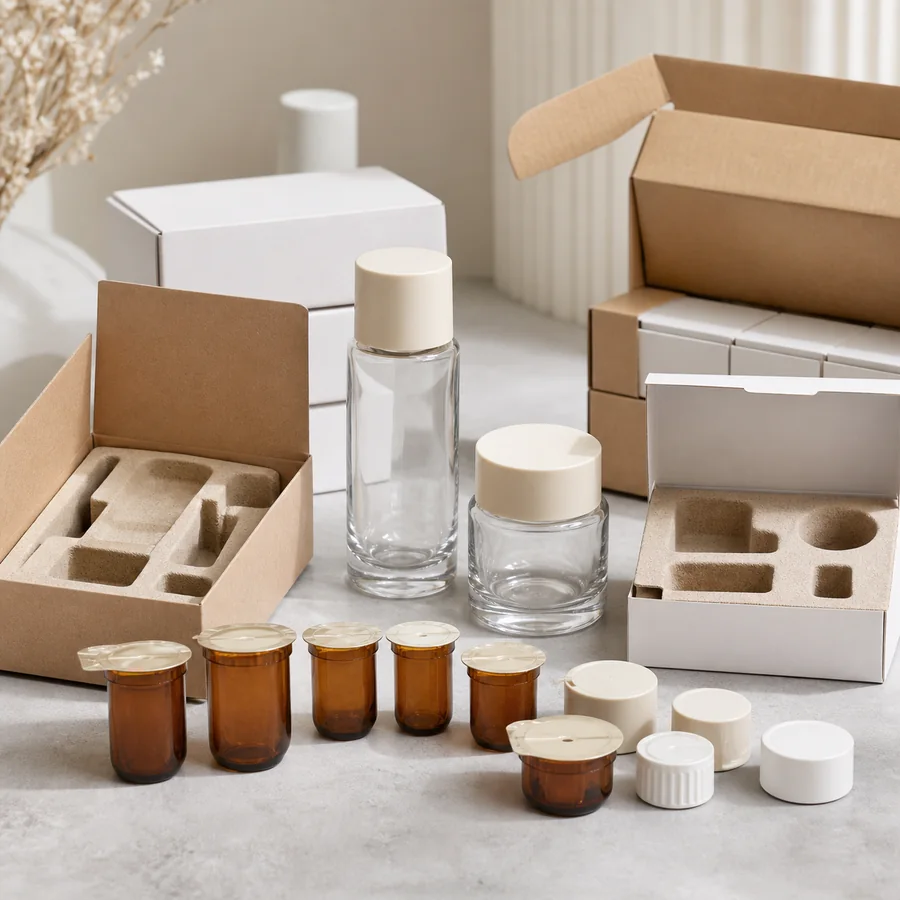
For a glass outer bottle with a replaceable cartridge, the brand should establish a controlled interface specification so that future refills remain compatible with the approved outer pack. An updated cartridge should not be substituted solely because its nominal capacity is unchanged.
Environmental trade-offs
A refillable system can reduce repeated production of a heavy outer package, but it adds refill containers, closures, transport and possible cleaning. The outer pack may be heavier or more decorated because it is designed for retention. The result depends on how many times it is actually reused and what single-use system is being compared.
European Commission Joint Research Centre research on single-use and multiple-use packaging shows that lifecycle results vary by scenario, impact category and assumptions. Its 2024 study covers selected food and beverage packaging applications, including cups, trays and beverage containers, rather than cosmetic packaging systems.
The methodological lesson remains relevant: actual reuse, transport, washing, product loss and system design can change the comparison. The JRC results should not be presented as a measured environmental benefit for a FOLOVER glass cosmetic bottle or a specific refill system.
No universal break-even cycle should be copied into a claim. Build a project model using the actual outer pack, refill, route and observed or responsibly estimated adoption. Distinguish a development scenario from verified market performance.
For an equivalent quantity of product delivered, compare the starter pack and all required refills against a defined single-use alternative. Include any reusable pump, replacement components, refill cartons and relevant cleaning or distribution requirements.
A refill package that uses less material than the original outer bottle does not automatically establish a lower total environmental impact. The comparison must account for the complete system and the number of successful uses actually achieved or appropriately modeled.
What brands should test
Testing should follow the intended refill model rather than a universal cycle count. Before selecting methods, define the actual bottle, refill, closure, formula, consumer sequence, storage conditions and distribution route.
A refill validation program should cover the following areas:
| Test Area | Purpose and Failure Mode | Method or Evidence | Buyer Approval Requirement |
|---|---|---|---|
| Fit and assembly | Confirm that the refill can be installed and retained without misalignment, damage or unintended release. | Repeated representative assembly using the selected outer pack, refill and closure. | Approve the complete interface and define acceptable assembly and retention performance. |
| Closure performance | Evaluate pump, thread, seal and dispensing performance after repeated use. | A project-specific repeated-use protocol covering the intended refill sequence, relevant storage conditions and functional checks. | Confirm sealing, priming, dispensing and component condition against agreed criteria. |
| Formula compatibility | Identify possible interactions between the actual formulation and all relevant product-contact materials. | Filled compatibility testing under intended storage and use conditions, including relevant contact history. | Confirm that the selected bottle, refill container, closure and dispensing components remain suitable for the formulation. |
| Leakage | Determine whether the package remains sealed after refill, handling and distribution. | Project-specific leakage evaluation using the assembled and refilled configuration under agreed conditions. | Confirm that the package meets the defined leakage and sealing requirements. |
| User experience | Identify incorrect installation, spills, excessive force, incomplete closure engagement and other consumer-use failures. | Observed refill exercises with representative users and the intended instructions. | Verify that users can complete the refill procedure correctly and safely. |
| Decoration durability | Assess damage to the retained outer pack during repeated handling, cleaning where applicable and cartridge replacement. | Physical appearance and handling evaluation using the approved coating, printing and decorative components. | Approve the appearance and durability of the actual decorated package. |
| Logistics | Confirm that starter packs and refills remain protected, identifiable and functional during the intended distribution route. | Route-relevant pack-out evaluation and transport testing where appropriate. | Approve the final refill and starter-pack shipping configurations. |
| Environmental claim | Determine whether evidence supports the exact stated benefit or comparative claim. | Appropriate lifecycle analysis, defined system boundaries and documented use assumptions. | Approve only claim wording supported by the relevant evidence and market requirements. |
For transport validation, the International Safe Transit Association (ISTA) test procedures provide recognized approaches for evaluating packaged products against distribution hazards. The appropriate procedure should be selected according to the actual shipment configuration and route.
ISTA testing is a transport-performance framework, not a universal test of refillability or a substitute for formula compatibility, repeated-use and consumer-handling evaluation. Passing a transport test also does not establish that a refill system has a lower environmental impact.
There is no single universal refill-cycle count, leakage threshold or cleaning procedure that establishes suitability for every cosmetic packaging system. Test conditions and acceptance criteria must be agreed for the actual formulation, selected components and intended use.
Use the planned guide to reduce material without sacrificing function when the refill pack itself is being optimized.
Claims to avoid without evidence
Avoid “zero waste,” “infinitely refillable,” “guaranteed sustainable,” “plastic-free,” “carbon neutral” or an exact environmental reduction without substantiation. Do not state that a pump can be reused indefinitely or that the complete assembled system is recyclable in every market.
“Refillable” should describe an available refill method, not only potential disassembly. “Reusable” should identify the intended use. Comparative claims should name the reference system and conditions. If benefits are modeled, disclose key assumptions and avoid presenting projections as measured market results.
For brands selling into the European Union, the European Commission’s Packaging and Packaging Waste Regulation overview provides the relevant packaging policy framework.
Regulation (EU) 2025/40 began applying generally on 12 August 2026, with individual provisions subject to their specified application dates and conditions. Its reuse and refill provisions should be assessed against the actual packaging configuration, distribution model and applicable market requirements.
A refillable cosmetic package should not be described as automatically compliant with the PPWR merely because it contains a removable cartridge or reusable glass vessel. The requirements and supporting documentation must be evaluated for the exact commercial system.
The trend-focused article on why refillable beauty packaging is growing addresses market interest; this guide remains the technical gate for a credible system.
Cost, MOQ and tooling decisions for refillable packaging
Refillable packaging procurement requires a commercial evaluation of both the starter pack and the continuing refill supply. A concept that is technically workable may still require a different component strategy or development sequence to meet the brand’s purchasing requirements.
Stock bottle versus custom development: An existing glass bottle may reduce the need for a new glass mold, provided its neck, geometry and closure can support the intended refill method. A replaceable-cartridge design may require custom inner containers, retention components or a dedicated outer structure.
Component MOQ: The glass bottle, refill container, pump, cap, decoration and protective packaging may have different minimum order quantities. The commercial MOQ for a complete refill system cannot be inferred from the MOQ of the glass vessel alone.
Tooling and development: A new cartridge, locking structure or custom bottle may require additional development and approval. Tooling requirements should be confirmed for the selected design rather than assuming that every refill system needs a custom mold.
Starter pack and refill pricing: Compare the fully assembled starter pack with the complete refill unit, including necessary closures, decoration, packaging and distribution. A cheaper refill container does not establish a lower overall program cost when tooling, inventory, logistics and unused components are excluded.
Replacement and continuity: A brand may need to maintain compatible refills after the original starter-pack production run. Procurement should assess supplier continuity, component version control and the commercial implications of retaining older interfaces.
For an RFQ, request separate quotations for the starter pack, each refill SKU, any reusable dispensing components, proposed decoration, tooling where applicable and the intended packing configuration. Ask suppliers to identify which parts are existing components and which require new development.
Buyer decision: Use an existing bottle and closure platform when it can satisfy the refill procedure and required performance without unnecessary structural changes. Consider custom development when the intended cartridge, interface or user experience cannot be achieved using suitable existing components. Confirm the commercial terms and sample-approval sequence before committing to either route.
Worked Buyer Scenario
The following is an illustrative packaging-development scenario, not a documented FOLOVER customer project or a verified refill-performance or environmental study.
A skincare brand proposes a durable glass jar with a removable inner cup. The development team defines the refill interface, retention, formula-contact materials, lid seal, removal method and labeling. Starter pack and refill are designed together.
The team first evaluates whether the selected outer jar and lid can accommodate a replaceable inner cup without compromising closure engagement or the consumer’s ability to remove and install the refill.
During sample evaluation, a refill cup may appear correctly seated while its upper edge interferes with the intended lid-sealing interface. In this scenario, the team must resolve the actual interface geometry and verify the assembled system rather than assuming that a cup fitting inside the jar is sufficient proof of compatibility.
Representative users install the refill while the team observes alignment and contamination risks. Filled compatibility, leakage, decoration wear and transport are tested. Procurement confirms refill availability and version control.
The brand also compares the proposed system with a single-use reference package. Only after establishing the actual outer jar, inner cup, closures, cartons, distribution route and intended use model can the team evaluate potential environmental performance.
Buyer decision: Proceed with the replaceable-cartridge design only when the outer jar, cartridge and lid function together, the approved refill procedure is practical, and the required product-quality and distribution criteria are met. Do not approve a refill-cycle or environmental-reduction claim based solely on the initial structural concept.
Buyer Checklist
- Define the refill route and who provides it.
- Freeze outer pack, refill, closure and contact materials.
- Specify what counts as one successful reuse cycle.
- Test assembly, seals, pumps, compatibility and leakage.
- Define cleaning or no-cleaning instructions with responsible experts.
- Observe representative users completing the refill.
- Plan refill identification, availability and version control.
- Validate refill and starter-pack transport.
- Model the complete system against a named reference.
- Use only claims supported by current evidence.
Frequently Asked Questions
What is refillable cosmetic packaging?
It is a packaging system intentionally designed with an available method to replenish the original package while maintaining required function.
Is refillable the same as reusable?
No. Refillable specifically provides replenishment; reusable is broader. The exact intended repeated use should be stated.
Is refillable packaging always more sustainable?
No. Results depend on outer-pack burden, refill packaging, actual reuse, logistics, cleaning, failure and the compared alternative.
How many refill cycles are needed to make a difference?
There is no universal number. A project-specific lifecycle model must use the actual packages, route and impact categories.
What should be tested?
Test structure, assembly, closures, leakage, compatibility, dispensing, user experience, decoration, transport and instructions.
Can pumps be reused?
Only when the exact pump, formula, bottle and reuse method are designed and verified for that purpose. Removability alone is insufficient.
Official Sources Reviewed
The following official sources support the environmental-claim, lifecycle-comparison, regulatory and transport-testing principles discussed in this guide. They do not establish product-specific compatibility, repeated-use performance, certification or environmental benefits for any FOLOVER packaging configuration.
Operating governance after launch
A refill program remains a live system after packaging approval. The brand needs ownership for refill availability, component versioning, complaint review, instructions and replacement decisions. Procurement should prevent unreviewed substitutions to cartridges, seals, pumps or outer bottles because a small interface change can break compatibility with packs already in consumers’ hands.
Track practical indicators such as refill sales relative to starter packs, repeat purchase, installation complaints, leakage, damaged outers and obsolete inventory. These metrics do not by themselves prove environmental benefit, but they show whether the reuse scenario used in planning resembles actual behavior.
Define an exit or transition plan before redesigning the system. Existing customers may still need compatible refills. If compatibility cannot continue, communication and stock planning should avoid leaving a retained outer pack without a usable refill route. Long-term service continuity is part of credible refillability.
A pre-launch refill decision gate
Before launch, require one cross-functional approval that covers packaging, formula, quality, operations, logistics, marketing claims and refill supply. The gate should confirm that the starter pack and refill are controlled versions, testing reflects the intended sequence, instructions match the tested method and inventory can support continuing refill access.
Open issues should have owners and dates rather than being hidden inside a sustainability score. If critical compatibility, leakage, usability or supply evidence is incomplete, keep the system in development.
For a glass cosmetic packaging project, the final approval should identify the exact outer bottle or jar, refill component, closure, decoration, commercial packing configuration and applicable sample or test records. Any later substitution affecting the interface or product-contact materials should trigger an appropriate compatibility and performance review.
Conclusion
Refillable cosmetic packaging is successful only when the outer pack, refill, closure, formula, user journey and supply chain continue to work together. The system should be measured by successful repeat use, not by a removable component or hypothetical cycle count.
For a brand developing a refillable glass package, the practical starting point is to define the refill method and validate the complete assembly before selecting a final bottle design or committing to custom tooling. Existing bottle platforms can be considered when they meet the intended interface and functional requirements; custom development should address a demonstrated structural or user requirement.
FOLOVER PACK can support review of cosmetic and skincare glass packaging, coordinated components, samples, decoration and refill concepts. Final performance and environmental claims must follow the exact tested system and real commercial conditions.
Planning a refillable cosmetic glass packaging project? Share your formula type, target capacity, preferred outer bottle or jar, refill method, closure requirements, decoration, destination market and estimated order quantity. Contact FOLOVER PACK to discuss suitable packaging configurations, component matching, sample development and the evidence required before approving your refill system.
A refill concept belongs within the broader sustainable packaging decision because repeat use, refill burden and real user behavior must be evaluated together.