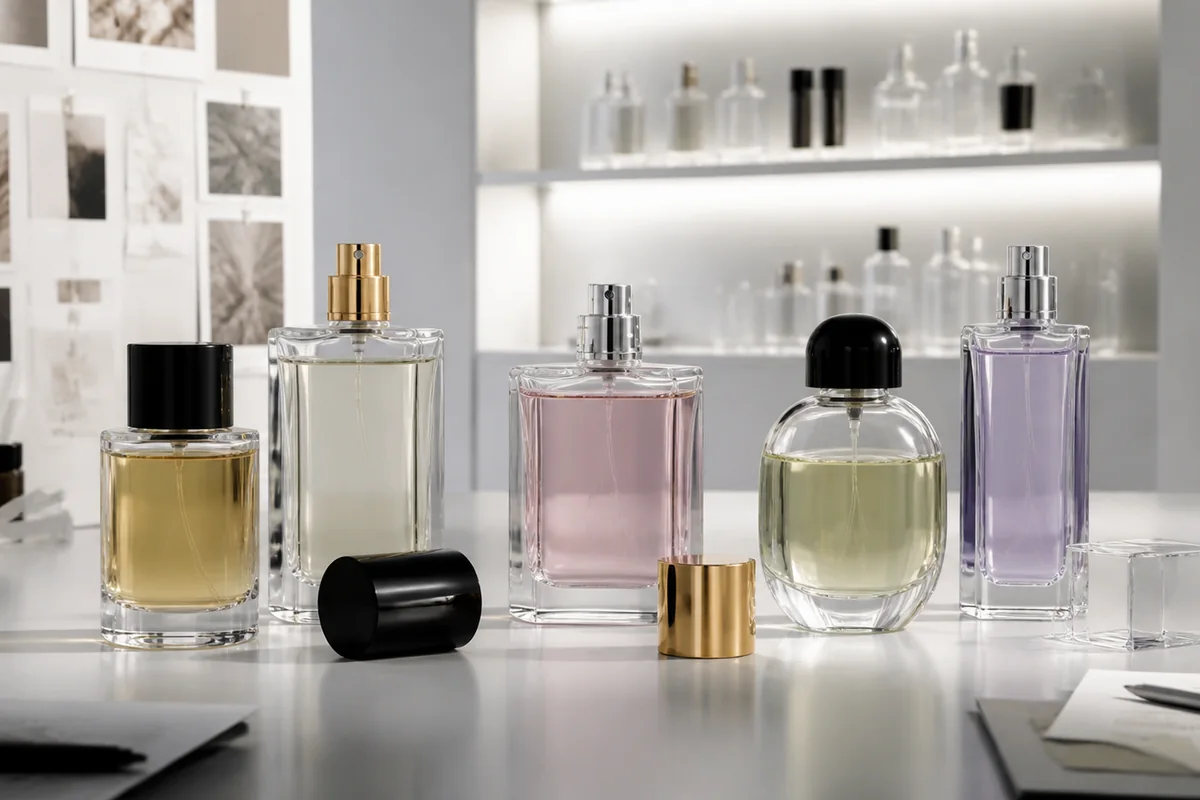

Is glass cosmetic packaging sustainable? The responsible answer is conditional. Glass can offer durable product presentation, established material-recovery routes in many markets, the possibility of recycled input, and a strong platform for some reuse systems. It also requires high-temperature production, is usually heavier than common plastic alternatives, can demand more transport protection, and is often combined with pumps, caps, labels and coatings that follow different end-of-life routes.
This guide is for cosmetic brands, packaging developers, sourcing teams and procurement managers comparing real commercial options. The central principle is simple: sustainability is a system outcome, not a material label. The Sustainable Packaging hub provides the wider decision context.
Direct Answer
Glass cosmetic packaging can be part of a credible sustainability strategy when its functional life, material use, transport, recovery route and claims are managed as one system. Glass is not automatically “eco-friendly,” and one favorable attribute does not prove overall environmental superiority.
For buyers, the next step is to compare complete packaging configurations using measured bottle weight, component materials, decoration, secondary packaging, distribution conditions and destination-market recovery evidence. Refill benefits should be evaluated only where a functioning refill system and realistic use assumptions can be demonstrated.
FOLOVER Manufacturer Insight
FOLOVER PACK supplies custom glass cosmetic packaging and can coordinate bottles, closures, decoration, samples and export-oriented protection. This packaging-development view helps a buyer define the bill of materials, compare practical bottle and component options, and request available product-specific information.
From a packaging supplier’s perspective, one common sourcing risk is approving a sustainability-oriented bottle design before checking whether its closure, decoration and transport protection support the intended use. A lighter bottle may look promising on a specification sheet but still require a different pump, additional protective packing or design revisions after sample testing.
For a productive review, provide the formula and intended use, selected closure, decoration requirements, order quantity, destination market, filling process and distribution conditions. FOLOVER can help define and evaluate the proposed glass packaging configuration, but environmental superiority, recycled-content percentages and actual recyclability must be supported by evidence applicable to the final commercial package.
What makes glass attractive for cosmetic packaging?
Glass offers several useful packaging attributes, but each should be described precisely. A glass bottle can provide a rigid form, dimensional stability, visual clarity or color, a premium tactile impression and a surface suited to many decoration routes. Depending on the exact glass and formula, it can also provide useful barrier performance. Compatibility still must be evaluated with the actual formulation, closure and intended storage conditions; the material name alone is not a compatibility approval.
Glass also has established collection and recycling pathways in many markets. That is a meaningful design advantage where the exact container format is accepted, collected, correctly sorted and processed. It does not prove that every decorated bottle or assembled dispenser will be recycled. A pump may contain polymers, metal and elastomers, while a dropper may combine a bulb, collar and glass pipette. The environmental statement should identify whether it concerns the glass vessel or the entire package.
Premium perception can create commercial value, yet “premium” and “sustainable” are different claims. Extra glass used only to create a heavy base may improve shelf presence while increasing material and transport burdens. The right question is whether the design delivers enough functional, reuse or brand value to justify its complete system impacts.
Sustainability belongs to the complete packaging system
The correct unit of analysis is the package delivered and used—not the glass bottle photographed by itself. A realistic boundary includes the vessel, pump or dropper, cap, gasket, label, coating, carton, insert, transport dividers and any refill container. It also includes product loss, breakage, filling efficiency, distribution, consumer use and end-of-life instructions.
Consider a 30 ml serum bottle. The bottle may enter a glass stream, but the dropper is a separate multi-material assembly. A coating may influence sorting behavior or recovered-glass quality, depending on its properties and the recycling process. A large carton and molded insert add material. Conversely, insufficient protection can create breakage and product loss. Removing one component without testing may shift impact rather than reduce it.
Lifecycle comparisons should also use equivalent functions and clearly defined system boundaries. The European Commission’s Environmental Footprint methods provide a framework for assessing lifecycle impacts across multiple environmental categories. A lower bottle weight or higher recycled-content percentage alone is not sufficient evidence of a lower overall environmental impact.
Before choosing a format, review how the full packaging architecture supports the formula, dispensing and buyer experience in the skincare packaging guide. That functional baseline prevents “sustainable” optimization from producing leakage, contamination, poor evacuation or premature disposal.

The environmental cost of glass weight
Glass weight matters at more than one stage. More material is required to form a heavier bottle, and more mass moves from the glass plant to the decorator or filler, through warehousing, and onward to distributors and customers. Heavier units can also affect carton strength, pallet loading and freight efficiency. Exact impacts depend on transport mode, route, load utilization, breakage, furnace inputs and many other variables, so a generic emissions number should not be invented.
Weight reduction is therefore a valuable design question, but not a command to make every wall as thin as possible. A lighter bottle still needs sufficient mechanical performance, dimensional control, top-load behavior where relevant, filling-line stability and compatibility with the selected closure. Aggressive reduction that increases breakage or rejects can be counterproductive.
A buyer should compare grams per sellable unit, units per carton, carton and divider mass, pallet utilization and damage performance under the actual route. The guide to lightweight cosmetic glass bottles connects reduction targets to manufacturability and testing rather than appearance alone.
Heavy glass, lightweighting and transport
Heavy glass is often chosen for luxury cues: a thick base, strong visual refraction and substantial hand feel. Those cues may support price positioning, but they are not free environmental benefits. A brand should decide which dimensions create consumer value and which merely add mass. It may be possible to preserve a recognizable silhouette while moderating base thickness, shoulder geometry or secondary packaging, subject to manufacturing feasibility and validation.
Transport protection must be considered at the same time. Glass may require dividers, trays, sleeves or stronger cartons depending on bottle geometry, finish and route. Protection is not automatically “excess packaging”; it can prevent loss of both package and filled cosmetic. The target is right-sized protection supported by transit testing and shipment feedback.
Buyer action: When comparing a heavy-base bottle with a lighter alternative, request measured weights for the complete assembled packages, proposed carton configurations and units per pallet. Obtain physical samples of both designs and confirm that the lighter option can retain the intended appearance, closure performance and transport protection before approving a weight-reduction target.
Recycled glass content: ask what the number means
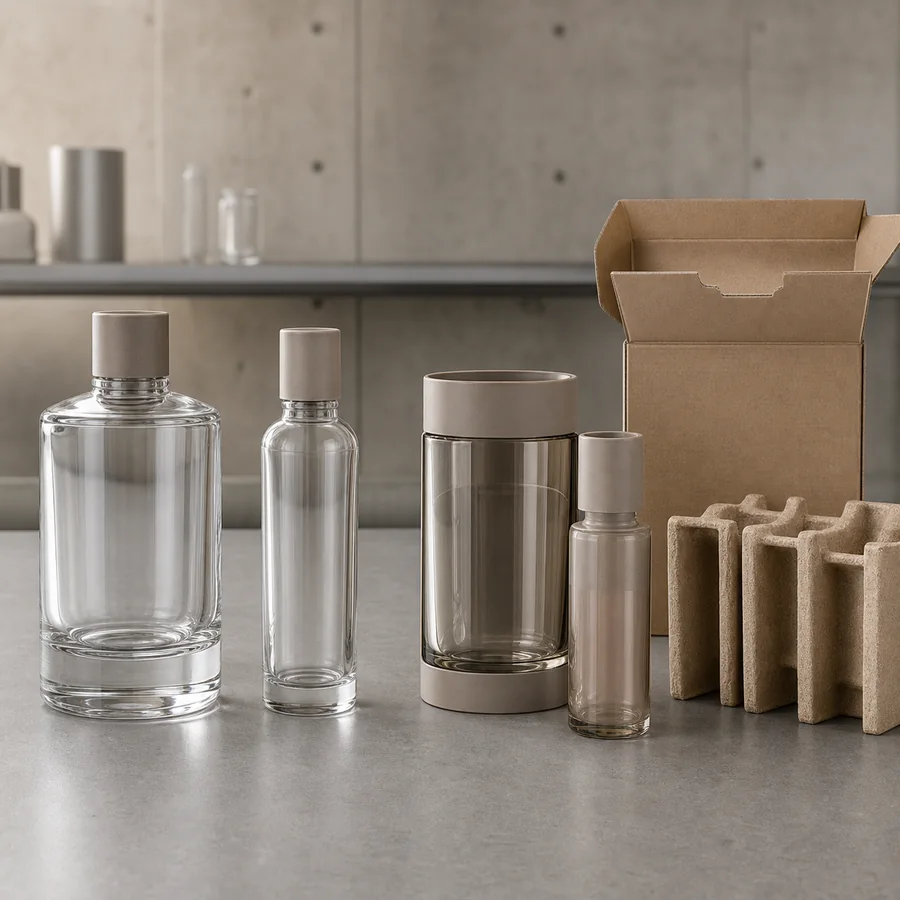
Recycled glass used as furnace input is commonly called cullet. Using suitable cullet can reduce demand for virgin raw materials and supports material circularity, but a buyer needs evidence before publishing a percentage. The claim should specify the component, percentage, measurement basis, time or production scope, and whether the input is post-consumer, post-industrial or another defined category.
Do not transfer a general factory statement to every bottle. Color, quality requirements, furnace operation, supply availability and product specification can affect the actual input. A declaration for the glass vessel also says nothing about the pump, cap, label or carton. The guide to recycled glass in cosmetic packaging examines cullet terminology and supplier questions in detail.
The European Container Glass Federation’s lifecycle assessment resources explain how recycled glass input can affect raw-material demand, melting energy and environmental performance. The cited FEVE industry assessment uses 2019 production data for EU food and beverage container glass, not FOLOVER cosmetic-bottle production data. Industry-level findings cannot be assigned automatically to a specific FOLOVER bottle or supplier. The actual recycled content and manufacturing conditions must be established for the selected product before making a product-specific claim.
Recycled content and recyclability are separate attributes. A bottle may contain recycled input but face poor collection in the target market; another may contain less recycled input yet follow an effective local recovery route. A credible comparison keeps both fields instead of combining them into one unexplained score.
Recyclability is local and configuration-specific
Technical recyclability does not prove actual collection, sorting and recycling wherever a product is sold. Local programs can differ in accepted colors, container formats, minimum dimensions, residual-product rules, closures and decoration. The brand should confirm current guidance for each destination market and qualify claims when access or acceptance is limited.
In the United States, the Federal Trade Commission’s Green Guides advise marketers to avoid broad, unqualified environmental-benefit claims. They also advise qualifying recyclable claims when appropriate recycling facilities are unavailable to at least 60% of consumers or communities where the product is sold. This threshold concerns the availability of suitable recycling facilities for US environmental marketing claims; it is not an actual recycling rate or a universal international standard.
In the European Union, Regulation (EU) 2025/40 began applying on 12 August 2026, while important recyclability and other packaging requirements follow phased implementation timelines. The European Commission’s Packaging and Packaging Waste Regulation overview provides the applicable regulatory framework. Buyers should check the requirements and implementation dates relevant to their exact packaging configuration and destination market rather than assuming that every provision applies immediately or that a recyclable glass vessel establishes compliance for the complete package.
Component separation also matters. A consumer may be asked to remove a pump, but that instruction is useful only if it is clear, feasible and consistent with the local collection route. A “100% recyclable package” statement can be misleading when it silently describes only the glass fraction.

Refillable glass packaging: potential needs proof
Glass can be well suited to some refill architectures because a durable outer bottle may be retained while an inner vessel or refill component is replaced. Yet a bottle that merely looks durable is not a refill system. A credible design needs a practical refill route, compatible components, consumer instructions, supply of refills, appropriate hygiene controls and performance over the intended use pattern.
Environmental improvement is not automatic. The outer pack has an initial material and manufacturing burden; refills also require packaging and distribution. The result depends on how often the system is actually reused, whether consumers can obtain refills, cleaning or handling requirements, damage and replacement rates, and the compared single-use configuration. Without those inputs, an exact environmental saving or break-even cycle should not be claimed.
For packaging development, the refill interface must be evaluated before the outer bottle is approved. A removable cap does not establish that the pump, gasket, closure or inner container can be repeatedly assembled without affecting sealing or dispensing performance. The intended refill procedure should be tested using the selected components and actual formulation.
The guide to refillable cosmetic packaging explains when reuse makes sense and what should be tested. Buyers considering current cosmetic and skincare glass packaging should define whether the project is truly refillable, reusable for another purpose, or simply made from a durable material.
Decoration can change the result
Decoration affects appearance, durability, sorting and evidence. Coatings, metallization, inks, hot stamping, labels, sleeves and bonded accessories can add materials or alter how a container is recognized and processed. The effect depends on chemistry, coverage, thickness, adhesion, separation and the actual recycling system; it is inaccurate to declare every coated glass bottle recyclable or non-recyclable without evidence.
The sustainability brief should therefore be written before artwork approval. Ask which effect is essential, whether coverage can be reduced, whether a removable label is practical, whether color can be achieved in the glass or by another controlled method, and what evidence the chosen route can support. A decoration change after testing can invalidate both appearance approval and an environmental claim.
Manufacturer Insight: What should buyers verify before approving decoration?
For a decorated cosmetic glass bottle, the purchasing decision should begin with the actual decoration specification rather than a generic claim that screen printing or spray coating is recyclable.
- Coating and ink identification: Request available material information and relevant supplier declarations for the selected coating, ink or decorative finish. Review any applicable restricted-substance requirements against the destination market and exact packaging configuration. Do not assume that a generic material declaration covers every color or decoration process.
- Coverage and optical sorting: Record whether the decoration is transparent, translucent, opaque, localized or applied across the entire bottle. Confirm whether the intended recycling system has restrictions affecting the decorated container.
- Attached components: Check whether labels, sleeves, collars or decorative accessories need to be removed and whether separation is practical for consumers and the local collection system.
- Sample approval: Approve the actual decorated bottle and matching closure together. If coating, color, label construction or attached components change, reassess the appearance, durability and any environmental claims affected by the revision.
A 2026 study reported by the European Container Glass Federation examined the optical sorting of opaque glass packaging at European cullet treatment plants. It demonstrates that sorting performance depends on the optical properties of glass fragments and the capabilities of the processing system. The study does not establish that every cosmetic bottle coating, ink or decorative assembly will be accepted by every recycling facility. Do not use this study alone to substantiate a recyclability claim for a specific spray-coated cosmetic bottle.
For FOLOVER buyers, the practical approach is to approve the decoration for manufacturing and appearance while obtaining separate evidence for any recyclability claim. A physical decoration sample alone cannot establish the performance of the destination-market recycling system.
Buyers should also control claim language. “Eco-friendly,” “green” and similar broad claims are difficult to substantiate because audiences may interpret them as overall benefits. A specific statement—properly scoped to a component, percentage, market and condition—is more defensible and more useful.
Secondary packaging and product protection matter
A sustainability review that ignores the carton and transport pack is incomplete. Folding cartons, inserts, molded trays, tissue, dividers, master cartons and pallet materials all contribute to the delivered system. Reducing empty space and unnecessary layers can help, but the package must still protect decorated glass and filled product through the intended route.
Product loss deserves attention. If an under-protected bottle breaks, the impact includes the discarded vessel, formula, dispenser, carton, filling operations and replacement shipment. If an incompatible pump causes leakage or poor evacuation, usable product may be wasted. Packaging reduction should therefore be linked to acceptance criteria for transit, leakage, dispensing and consumer handling.
Review the available FOLOVER packaging products as systems, then request a packaging proposal based on bottle geometry, decoration sensitivity, order route and shipment conditions. The most credible reduction is one that survives verification.
How should brands compare packaging options?
Start with a shared functional brief. Define fill volume, formula characteristics, dose or dispensing need, storage, filling line, market, target quantity, decoration, consumer use and distribution. Eliminate configurations that do not meet essential protection and performance requirements. Sustainability comparison begins only among viable options.
| Decision factor | Evidence to compare | Common mistake |
|---|---|---|
| Material use | Weight of every component and packaging level, including closure and secondary packaging | Comparing bottle weight only |
| Recycled content | Component, percentage, definition, production scope and supplier evidence | Using a general factory claim |
| Transport | Route, mode, units per carton/pallet, protection and damage data | Assuming weight alone predicts the result |
| Reuse/refill | Complete refill route, realistic adoption, replacement and test evidence | Calling a durable bottle refillable |
| Recyclability | Exact configuration, separability, instructions and market infrastructure | Extending a glass-vessel claim to the whole pack |
| Decoration | Actual coating, ink, label and attached components; available material declarations and recovery evidence | Assuming every decorated bottle follows the same recycling route |
| Product protection | Compatibility, leakage, dispensing, transit and product-loss results | Removing material before performance testing |
| Cost and MOQ | Complete packaging quotation, component minimums, decoration requirements and protective packing | Comparing empty-bottle prices while excluding the remaining packaging system |
| Claims | Exact wording, audience interpretation, qualification and current rules | Using an unqualified “eco-friendly” slogan |
Do not collapse the table into a single universal score too early. Weighting depends on project goals and market conditions. A refill program with strong return behavior differs from an e-commerce single-use package crossing long distances. A local market with reliable glass collection differs from one without an accessible route.
For a luxury skincare product without a functioning refill program, a lighter glass bottle that meets the same appearance, formula-protection and distribution requirements may be the more practical material-reduction option. For a genuine refill program, a durable outer bottle may justify additional initial material if repeated use and the complete refill system demonstrate a benefit. Buyers should validate those conditions instead of treating either design as universally superior.
Worked Buyer Scenario
Consider an illustrative sourcing scenario, not a documented FOLOVER customer project or measured environmental study. A skincare brand compares two premium serum packs. Option A uses a heavier decorated glass bottle, multi-material dropper, large carton and insert. Option B uses a lighter undecorated glass bottle, the same functional closure and a right-sized carton. Both are required to pass the same compatibility, leakage, dispensing and transit acceptance criteria.
Option B may reduce glass and secondary-material use and improve shipment density, but the brand still needs measured package weights, verified packing data, physical test results and local glass-collection information. The dropper must be assessed separately. A reduction in container weight is a measurable design attribute, not proof of a specific carbon-footprint reduction.
If Option A is redesigned as a genuine refill system, the comparison must include the refill container, supply route, consumer adoption and validated repeated-use performance. A heavier reusable outer bottle should not be credited with assumed refill cycles before the system exists and its intended use has been evaluated.
Buyer decision: Approve Option B when the reduced-material configuration meets the required functional and brand criteria and its sourcing data support the project objectives. Evaluate Option A as a refill alternative only when the refill format, component compatibility and realistic use model have been established. Record the demonstrated advantages and remaining evidence gaps for either option rather than calling the selected package inherently sustainable.
Buyer Evidence Checklist
- Freeze the exact bottle, closure, gasket, label, decoration, carton and transport configuration before comparing alternatives.
- Record the measured weight and material of each component and packaging level.
- Request product-specific recycled-content evidence before stating a percentage.
- Confirm formula compatibility, sealing, dispensing and product protection using selected components and physical samples.
- Compare transport route, pack density, protective materials and damage results against agreed acceptance criteria.
- Define the complete refill route and validate repeated-use conditions before making a refill benefit claim.
- Check current collection and sorting guidance in every destination market, including the effect of decoration and attached components.
- Separate glass-vessel recyclability statements from claims about pumps, caps and the complete package.
- Review environmental wording for clear scope, relevant evidence, qualifications and applicable market requirements.
- Establish change-control requirements for revisions to weight, material, supplier, decoration, components, market or environmental claims.
Frequently Asked Questions
Is glass cosmetic packaging recyclable?
Glass cosmetic containers may be recyclable where the exact format is accepted by local collection and sorting systems. Color, decoration, residues, closures and market infrastructure affect the practical answer. Check local guidance and distinguish the glass vessel from the complete assembled package.
Is glass always more sustainable than plastic?
No. Neither material is universally better. The comparison depends on weight, production, recycled input, transport, product protection, reuse, recovery and the exact application. The dedicated glass versus plastic cosmetic packaging guide addresses that comparison without treating one material as an automatic winner.
Does heavier glass have a higher environmental impact?
More glass generally means more material mass and transport weight, but the complete impact cannot be calculated from weight alone. Manufacturing inputs, route, pack density, protection, breakage, reuse and product performance also matter.
Can coated glass bottles still be recycled?
Sometimes, but not universally. The answer depends on coating chemistry and coverage, attached materials, sorting and processing requirements, and local facilities. Request evidence for the exact decoration instead of making a blanket statement.
Does recycled glass improve sustainability?
Suitable recycled glass can reduce demand for virgin input and support circular material use. A credible claim still needs the percentage, definition, product scope and production evidence. Recycled content does not by itself prove local recyclability or overall superiority.
Is refillable glass packaging better for the environment?
It can be under the right system conditions, but benefit depends on actual reuse, refill packaging, logistics, cleaning or handling, durability and the compared alternative. Do not claim a specific reduction or break-even cycle without a relevant lifecycle assessment.
Official Sources Reviewed
Environmental requirements and claims guidance change. These primary official sources were checked during preparation and should be reviewed again for a live market decision:
- European Commission: new EU packaging rules enter into application
- European Commission Packaging and Packaging Waste Regulation overview
- European Commission Environmental Footprint methods
- US FTC Environmental Claims Green Guides summary
The industry lifecycle and glass-sorting resources referenced in the relevant sections provide additional technical context. Industry findings and regulatory guidance must not be presented as product-specific FOLOVER test results, certifications or guarantees of recycling acceptance.
Conclusion
A glass packaging sustainability claim should identify the exact component or complete system, the measured attribute and the market or use conditions to which the evidence applies.
For a project without a functioning refill system, prioritize a glass configuration that meets the required appearance and product-protection criteria without unnecessary material or transport burden. For a genuine refill project, evaluate the complete refill architecture and its realistic use conditions before claiming an environmental benefit.
FOLOVER PACK can help buyers define and evaluate a suitable glass packaging configuration through bottle selection, component matching, decoration coordination, physical samples and protective packing.
Planning a cosmetic glass packaging project? Share your formula type, target capacity, preferred bottle style, closure requirements, decoration, destination market and estimated order quantity. Contact FOLOVER PACK for a packaging quotation and sample evaluation to compare practical glass options against your product requirements.