Packaging for alcohol-based fragrance should be approved as one filled packaging system, not as a glass bottle, atomizer, seal or decoration in isolation. Ethanol-containing fragrance can expose the pump pathway, gasket, dip tube and closure interface directly, while vapor or incidental liquid can also affect collars, caps, coatings and printed decoration. The buyer’s task is therefore to confirm sealing, spray performance, formula-contact compatibility, decoration durability and assembly under the intended storage, filling, distribution and use conditions.
This guide gives B2B packaging buyers a practical framework for defining requirements, comparing samples and approving the final assembly. It complements FOLOVER’s Packaging Applications resources and Buying Guides content while keeping the decision focused on the exact fragrance and packaging configuration. Product-specific dimensions, atomizer output, torque, crimp settings, material compatibility and performance should be confirmed through current drawings, supplier documentation and controlled physical evaluation rather than copied from another package.
The Core Buyer View: Closure integrity and decoration durability are connected by migration
A small liquid or vapor pathway may first appear as collar discoloration, print softening, odor change or measurable mass loss rather than as visible droplets. Closure integrity and decoration durability therefore need to be evaluated on the same filled package: controlling migration is also an appearance and brand-quality requirement.
The sourcing question is not simply “Which bottle and pump look suitable?” but “Under which documented conditions does this complete fragrance package remain acceptable?” That shift creates clearer RFQs, more meaningful sample comparisons and stronger change control, and it prevents a successful one-time demonstration from being treated as proof of long-term package performance.
Define the complete fragrance system
Alcohol-based fragrance contacts the glass, pump pathways, seals and dip tube, while vapor and incidental liquid may reach collars, caps and decoration. The approval unit is therefore the entire filled pack. Define the actual formula, fill volume, intended headspace, bottle neck, atomizer, gasket or sealing elements, dip tube, collar, cap and decoration as one controlled configuration. Buyers can use FOLOVER’s decoration and finishing guide when the project includes coating, printing, frosting or hot stamping.
A common failure is testing the empty bottle and atomizer separately and then assuming the assembled package is approved. Empty samples can confirm basic fit and appearance, but they cannot establish formula-contact compatibility, vapor control, long-term sealing, spray behavior after aging or decoration resistance to incidental fragrance contact. Build one component bill for compatibility and transport samples, and record the formula batch, component identities, assembly method and acceptance criteria.
From a procurement perspective, supplier documentation should distinguish verified component specifications from general compatibility guidance. Request current drawings and material information for critical formula-contact parts, identify which characteristics are controlled and agree which component or process changes require notification before production.
Use glass for its strengths without overclaiming
Glass is widely used for fragrance because it supports transparent presentation, substantial package feel and multiple decoration processes, but the glass bottle alone does not establish alcohol compatibility or leak resistance. Package performance still depends on the neck finish, atomizer interface, sealing geometry, formula-contact components, filling cleanliness and decoration system. Buyers can use the perfume packaging guide for broader bottle, atomizer, cap and sourcing decisions.
A common sourcing mistake is treating bottle weight or appearance as evidence of functional performance. A heavier bottle can support a particular design direction, but it does not compensate for a mismatched neck, unsuitable sealing element or poorly controlled assembly. Inspect the bottle and neck to the approved specification, then validate the selected closure system with filled physical samples.
Packaging compatibility should be evaluated with the actual formulation under intended storage and use conditions. Do not generalize a supplier statement such as “alcohol resistant” from one material or component to the complete fragrance package unless the evidence applies to the exact material grade, construction and exposure conditions being ordered.
Compare crimp and screw systems by project needs
Crimp and screw systems can both be used in fragrance packaging, but they create different assembly and service models. A crimp system normally depends on a matched crimp neck, pump cup, gasket and controlled crimping setup. A screw or removable system depends on a matched threaded interface, sealing structure and controlled closure application. Buyers should compare them by assembly capability, removal or refill expectations, appearance, change control and the actual filled-package result rather than by collar style alone. For the underlying neck-system differences, see crimp vs screw perfume bottles.
| Option | Best For | Main Advantage | Main Limitation | What Buyers Should Verify |
|---|---|---|---|---|
| Crimp system | Projects designed around a permanently assembled perfume pump and controlled crimping process | Supports a fixed assembled neck system when the bottle, pump cup, gasket and crimp setup are matched | Requires suitable crimp equipment and process control; it is not inherently superior in sealing simply because it is permanent | Neck and pump-cup match, gasket, crimp setup, collar clearance, filled leakage observations and post-assembly spray performance |
| Screw or removable system | Projects that require removable assembly, serviceability or a refill-oriented architecture | Allows removal and reassembly when the package is designed for that use | Thread engagement, gasket behavior and closure application must be controlled; removability alone does not make a package reliably refillable | Matching thread and closure structure, sealing element, application and removal behavior, filled leakage observations and intended user sequence |
For continuous-thread container and closure systems, ASTM D2063/D2063M provides a method for measuring torque retention under predetermined environmental conditions. It can support engineering evaluation of a threaded system, but it does not provide a universal perfume-bottle torque value, does not apply to a crimp assembly and does not replace fragrance compatibility testing.
Final bottle and closure compatibility should be confirmed using the selected components and physical samples before bulk production.
Match atomizer performance to the fragrance experience
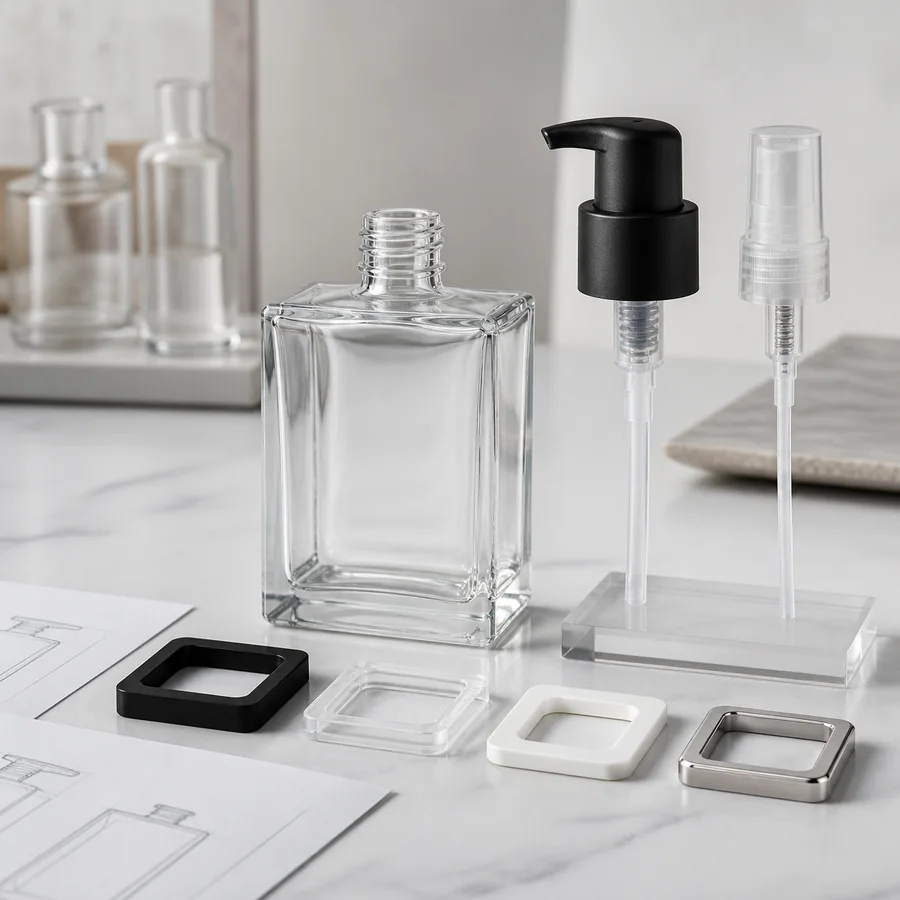
Atomizer performance is part of both package function and fragrance experience. Delivered amount, plume shape, droplet behavior and actuator feel depend on the pump engine, nozzle, dip-tube supply, formula properties and the way the actuator is pressed. The exact output of a pump is product-specific and should come from the selected component specification and filled-package evaluation rather than from a generic fragrance-pump value.
A common failure is approving an atomizer with water and assuming the same spray will be achieved with the intended fragrance. Water can be useful for early mechanical screening, but final approval should use the actual or representative formula because viscosity, surface behavior and fragrance composition can change the observed spray. Buyers can review perfume spray pumps only after the required bottle interface and spray behavior are defined.
Use repeatable observations for priming, spray consistency, recovery, visible leakage around the pump and near-empty delivery. If delivered mass is a critical specification, define the method and acceptance range with the selected atomizer supplier instead of importing a value from a different pump.
Engineer gaskets and seals for alcohol contact
Gaskets and sealing elements must maintain their function in the actual fragrance environment. Material family names alone are not sufficient because compound formulation, hardness, geometry, compression, temperature and exposure conditions can change performance. Buyers should identify the exact formula-contact component rather than approving a generic statement such as “rubber gasket” or “alcohol-resistant seal.”
Published engineering references such as the Parker O-Ring Handbook show why elastomer selection is compound- and media-specific. Such compatibility references are useful for screening, but they are not evidence that a particular perfume atomizer assembly is compatible with a finished fragrance.
A common failure is accepting generic material compatibility as final package approval. The corrective action is to test the exact seal geometry in the selected bottle-and-atomizer assembly with the actual or representative fragrance. Record observations such as sealing condition, visible material change, odor, migration and dispensing performance according to the project’s documented acceptance criteria. Buyers can use how to choose a perfume bottle for the wider bottle, neck and closure decision.
Evidence boundary: A chemical-resistance chart is a screening reference, not a finished-package approval. Fragrance oils, ethanol level, seal compound, geometry, compression and exposure conditions can differ from the reference conditions. Packaging compatibility should be evaluated with the actual formulation under intended storage and use conditions.
Control dip tube, venting and near-empty delivery
Dip-tube length and shape affect supply to the atomizer, while bottle geometry and pump venting influence repeated spray as the fill level falls. A tube that is too short can leave usable fragrance below the pickup point; a tube that is too long can bend excessively or sit against the base in a way that restricts intake. There is no universal dip-tube length for a perfume bottle category.
The correct configuration depends on the selected bottle height and internal base profile, the atomizer body, tube material and stiffness, cut geometry and assembly tolerance. Do not copy the dip-tube specification from a bottle with a similar nominal capacity. Review drawings and approve the production-intent assembly through physical dispensing evaluation at relevant fill levels.
For component relationships around the bottle neck, pump, collar, cap and dip tube, see the anatomy of a perfume bottle. If the bottle or atomizer changes after approval, confirm whether the existing dip-tube specification still applies.

Look for vapor loss and microleakage
Not every fragrance-packaging failure produces visible drops. A small liquid or vapor pathway may first appear as measurable mass change, odor around the cap, localized staining, finish change or altered package condition. A short inverted check can reveal an obvious leak, but it is not a substitute for longer filled-package evaluation under the project’s intended storage and distribution conditions.
For buyer approval, define what will be measured, how samples will be oriented, which storage conditions are relevant and what constitutes a failure. Mass tracking can be useful because it gives an objective signal of package change, but there is no universal acceptable fragrance mass-loss percentage that can be applied to every bottle, closure, formula and test duration.
When abnormal loss is observed, investigate the pathway rather than assuming the glass bottle itself is the cause. Review the neck and sealing interface, atomizer assembly, gasket, venting, process setup and any evidence of formula reaching the collar or decoration. FOLOVER’s article on perfume atomizer selection explains the pump-side variables in more detail.
Qualify decoration after filling and assembly
Coating, printing, hot stamping and metallized components can be exposed to fragrance during filling, from a small leak or through normal consumer spraying. Crimping, collar installation and cap movement can add mechanical contact at the same time. Decoration should therefore be approved on the real bottle after the relevant coating, printing or stamping process, filling and assembly steps have been completed.
A common failure is approving decoration only from an empty display sample or a flat material coupon. That can confirm appearance, but it does not reproduce bottle geometry, neck masking, assembly contact, incidental formula exposure or repeated handling. Evaluate the actual decorated bottle for visible softening, discoloration, transfer, lifting, scuffing or other project-defined defects after the relevant exposure and handling conditions.
Do not copy a universal abrasion cycle, adhesion grade or ethanol-wipe protocol into a project unless it is supported by the decoration supplier and the brand’s acceptance standard. Final color, logo, coating and decoration should be approved on physical samples. For leakage-related pathways that can expose decoration, see why perfume bottles leak.
Control filling and crimping or capping
A correct bottle and atomizer can still perform poorly when the filling or assembly process is inconsistent. Product on the neck or sealing land, an unsuitable fill level, an incorrect crimp setup, insufficient component seating or uncontrolled screw-closure application can all change the final package. Process control is therefore part of packaging performance, not a separate production issue.
For crimp systems, define the equipment setup and inspection features with the selected pump and bottle supplier or filler. For screw systems, define how the closure is applied and how retained sealing performance will be checked. Do not transfer an exact crimp dimension or torque value from another bottle without evidence that the same neck, closure, gasket, equipment and process conditions apply.
When leakage appears during pilot filling, separate component fit from process causes. Review neck cleanliness, fill conditions, component seating, crimp or capping consistency and inspection records before assigning the problem to one supplier. A representative pilot using production-intent components is more informative than repeated hand assembly of a few samples.

Approve transport and presentation together
The perfume package should arrive without leakage, atomizer damage, cap movement, scuffing or decoration marks, and that requires evaluating the primary package together with its secondary and shipping configuration. Divider design, cap clearance, surface protection, carton fit and orientation can affect both physical protection and shelf appearance.
ASTM D4332 describes conditioning atmospheres for containers, packages and packaging components before testing, while ASTM D4169 provides a structured approach for evaluating shipping units against distribution hazards. These references can support transport-test planning, but they do not establish fragrance chemical compatibility, and the applicability of any transport protocol must be determined for the actual product, route and shipping classification.
A common failure is testing a primary bottle by itself and approving the export pack separately. Use production-intent decorated and filled packages in the intended carton, divider or protective configuration so that leakage, cap clearance and surface protection are observed together. If the actual fragrance is subject to dangerous-goods requirements, transport classification and packaging obligations must be confirmed for the specific formulation and transport mode rather than inferred from the product name alone.
Buyer Approval Checklist
- Define the actual or representative fragrance formula, fill volume, intended market, storage conditions and distribution route.
- Identify the exact glass bottle, neck system, atomizer, gasket or sealing elements, dip tube, collar and cap in the proposed assembly.
- Request current drawings and component specifications for critical bottle, atomizer and closure interfaces.
- Compare production-intent samples rather than combining unverified components from separate sources.
- Evaluate the filled package for leakage or migration, spray behavior, visible component change and near-empty delivery under documented project conditions.
- Verify decoration after filling, assembly, relevant formula exposure, handling and transport evaluation.
- Define project-specific acceptance criteria instead of importing universal torque, crimp, mass-loss or aging limits from another package.
- Retain the approved physical assembly and define which formula, material, component, supplier or process changes require review or revalidation.
How to Structure the Sample Evaluation
Begin with a screening round to compare plausible package architectures, then move the strongest candidates into filled compatibility, dispensing and use evaluation. Screening can eliminate obvious fit, spray, sealing or decoration problems, but a successful short test should not be presented as proof of shelf-life performance.
Use the intended or representative fragrance and production-intent components for the confirmation round. Record the formula batch, bottle and atomizer identities, gasket or sealing configuration, dip-tube setup, assembly method, sample date, storage condition and observations. FOLOVER’s cosmetic packaging compatibility testing guide provides the broader framework for evaluating package-formula interactions before production.
If accelerated aging is used, define temperature, duration, orientation, sample count and acceptance limits for the specific project. A commonly repeated temperature-and-time combination is not automatically an industry standard for every fragrance package. The purpose of an accelerated condition is to create decision-relevant evidence under a documented protocol, not to manufacture a pass/fail claim from an arbitrary number.
At each inspection point, record objective observations and the buyer implication. An abnormal result should be investigated rather than averaged away: it may indicate component variation, assembly inconsistency, formula interaction or a test-control problem that becomes more important at production scale.
Frequently Asked Questions
Can packaging be approved from an empty sample?
An empty sample can confirm appearance, basic fit and handling, but it cannot establish fragrance compatibility, long-term sealing, dispensing or decoration durability. Final approval should use the intended or representative fragrance with the selected production-intent assembly under documented conditions.
Is a supplier’s standard component specification enough?
It is a useful starting point, but it is not a substitute for complete-package evaluation. Performance depends on the exact formula, bottle, atomizer, sealing components, dip tube, filling and assembly process, distribution conditions and use pattern. Buyers should use supplier specifications to define what still needs to be verified on the filled package.
What should trigger revalidation?
Changes to the fragrance formula, formula-contact material, critical bottle or atomizer dimensions, gasket or seal, supplier, tooling, decoration system, filling process or assembly settings can affect performance. The project team should define which changes require partial or full revalidation before bulk production.
How should buyers compare two visually similar packages?
Compare controlled drawings, neck and closure architecture, formula-contact materials, filled test observations, atomizer performance, sealing behavior, decoration, assembly process, logistics and change-control requirements. Similar appearance does not establish equivalent sealing, spray or compatibility performance.
Is a crimp perfume bottle automatically better for alcohol-based fragrance than a screw bottle?
No. Crimp and screw systems use different interfaces and assembly methods, but neither is automatically better for every alcohol-based fragrance. The decision should reflect the selected bottle neck, atomizer or closure, gasket, assembly equipment, intended user or refill model and filled-package test results.
Should decoration be tested after the perfume bottle is filled?
Yes when the decoration may encounter fragrance during filling, leakage, spraying, assembly or normal use. Empty decorated samples can confirm appearance, but the final package should be evaluated after the relevant filling, assembly and exposure conditions. Final color, logo, coating and decoration should be approved on physical samples before bulk production.
Conclusion
Alcohol-based fragrance packaging is a system-level decision. A small liquid or vapor pathway may first appear as odor around the cap, mass change, collar staining or decoration damage rather than an obvious leak, so the bottle, atomizer, sealing elements and decoration should be approved together.
For B2B buyers, the strongest decision is based on a defined formula and use case, matched components, production-intent filled samples, documented acceptance criteria and controlled change management. Final compatibility and performance remain formula- and project-specific, so approve the actual filled package before mass production.