

Hot stamping on cosmetic packaging transfers a metallic or pigmented foil effect onto a defined decoration area using controlled heat, pressure and tooling. It is most useful when a brand needs a focused reflective accent rather than a large area of printed color. On glass bottles, coated surfaces, caps and collars, the final result depends on the exact substrate, bottle geometry, foil grade, artwork, tooling and decoration sequence. Buyers should therefore treat the physical decorated sample—not a screen rendering or a foil color name—as the production approval reference.
What Is Hot Stamping on Cosmetic Packaging?
Hot stamping is a decoration process in which a prepared die presses a transferable foil layer onto a selected surface. Unlike printing with metallic-looking ink, the decoration comes from a foil transfer system that can create a more reflective metallic appearance and sharply defined logos, borders or brand marks.
The foil itself is more complex than a single metallic film. Lihyang Foil Technology, an original foil manufacturer, describes a typical hot-stamping foil as a five-layer system consisting of a PET carrier, release layer, metallic or color layer, adhesive layer and, for some grades, an additional sizing layer. This matters to packaging buyers because two foils with a similar gold appearance may still use different release and adhesive systems and may behave differently on glass, coatings or plastics.
Process data must remain foil- and substrate-specific. Published Lihyang guidance gives working examples of 90–180°C temperature, 100–500 kg/cm² pressure and 0.1–2 seconds dwell time across its hot-stamping systems. By contrast, Murata Kimpaku publishes a 200–220°C stamping temperature for one specific GLEAM glass-decoration process that also includes surface pretreatment, screen printing and curing. These figures demonstrate why a generic temperature or pressure should not be copied into a cosmetic bottle specification. The approved foil, substrate, tooling and production trial must determine the actual process settings.
For procurement, the useful question is not “What temperature is hot stamping done at?” but “Can this exact foil and artwork be transferred consistently to this exact surface using the proposed production route?” The answer should come from the selected foil system, supplier setup and representative physical samples.
Where Metallic Decoration Works Best
Hot stamping generally performs most predictably on accessible, consistent areas where the tooling can contact the surface evenly. Flat or gently curved panels may offer more control than shoulders, sharp transitions, recessed details or strongly tapered surfaces. The usable stamping area must therefore be confirmed from the actual component and the production setup rather than from a flat artwork file alone.
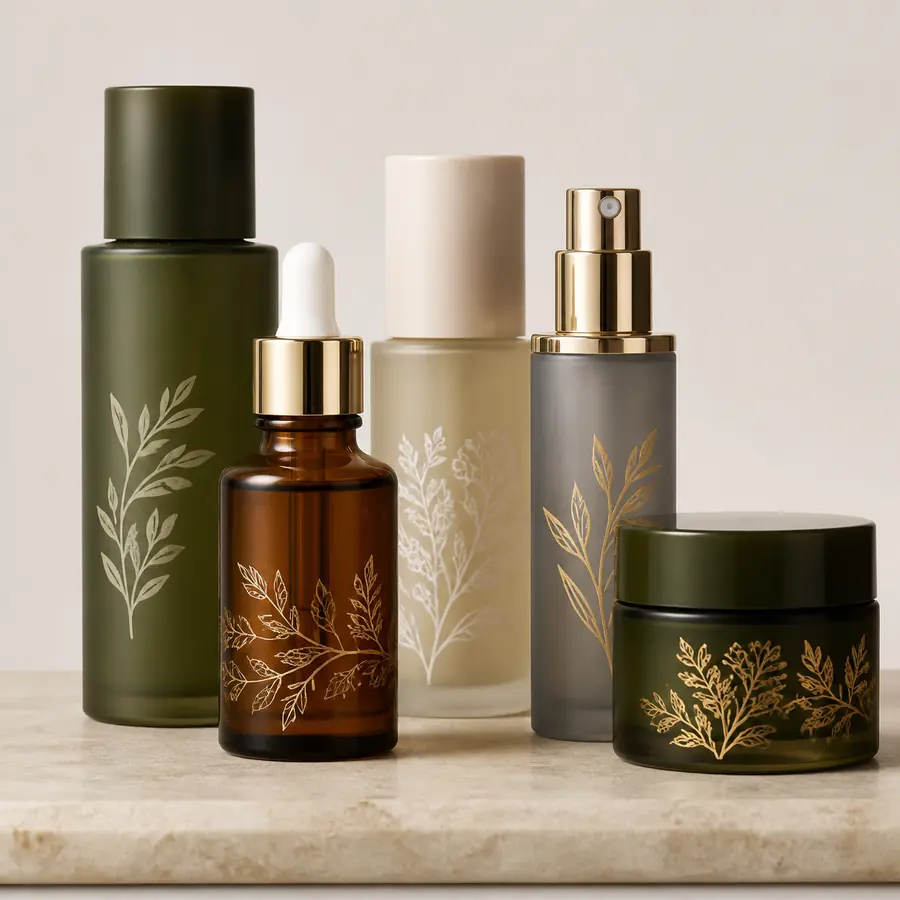
Small metallic accents often communicate premium positioning without overwhelming the package. A simple line, logo or product name can create visual hierarchy while leaving room for glass color, coating and closure design. Buyers comparing the broader range of cosmetic glass bottle decoration methods should decide what the foil needs to contribute that screen printing or coating cannot deliver as effectively.

Gold, Silver and Other Metallic Effects
Gold and silver are familiar directions, but a foil sample or digital color name does not guarantee one universal appearance. Reflectivity, hue and brightness can shift with foil construction, surface color, gloss level, viewing angle and illumination. A warm gold over a cream coating can therefore appear different from a visually similar foil used over clear or dark glass.
Controlled viewing improves approval discipline. ISO 3664:2025 specifies viewing conditions for critical comparison and appraisal of reflective media in graphic technology and photography. It is not a dedicated metallic-foil acceptance standard, but it supports an important packaging principle: comparisons should be made under defined viewing conditions rather than under uncontrolled office, warehouse or phone-camera lighting.
Do not assume every metallic color or finish is available for every substrate. Confirm the actual foil range with the production partner, then approve the selected effect on the final bottle or component. If brand consistency is critical, compare the foil with the cap, pump collar, printed elements and secondary packaging together rather than approving each item independently.
Coated Versus Uncoated Glass
Hot stamping may be applied to compatible coated or uncoated glass systems, but the complete decoration route must be established before approval. A coating changes the surface that receives the foil, including its texture, gloss and bonding behavior. A foil trial on bare glass therefore does not automatically approve the same foil over a matte, colored or otherwise coated bottle.
When stamping follows spray coating, test the real process sequence rather than approving each operation separately. The guide on hot stamping over spray-coated glass addresses this combination directly. The correct conclusion remains conditional: compatibility depends on the actual coating, foil, cure condition, tooling and production process.
Manufacturer Insight
At FOLOVER, we normally treat hot stamping as an approval package rather than as a standalone “gold foil” option. The base bottle, coating or glass surface, foil reference, artwork, decoration sequence and assembled component appearance should be approved together. If the coating, foil grade, logo size or component orientation changes after approval, the affected decoration checks should be reopened instead of carrying the previous sample forward automatically.
Bottle Shape and Decoration Area
Round bottles, square bottles, jars and closures create different tooling and contact conditions. A round bottle may provide only a limited workable arc, while a flat panel can offer a more clearly defined decoration face. Strong taper, embossed details, seams, shoulders and bottom curvature can reduce the reliable decoration area or make positioning more sensitive.
Review the artwork at actual size on the real bottle drawing or confirmed decoration template. Then review the assembled package as well. A foil logo that looks centered on the empty bottle may appear visually displaced after a pump, collar or cap is installed, particularly when the component itself has a front-facing feature. Define the intended front orientation before sample approval where shelf presentation is important.
Logo Size, Fine Detail and Legibility
Hot stamping can reproduce refined detail, but every design has a practical manufacturing limit. Extremely thin strokes, very small counters, dense patterns and narrow gaps may not transfer cleanly. The achievable detail depends on die design, foil release behavior, substrate, bottle geometry and process conditions, so a universal minimum line width should not be invented.
Use vector artwork where required and inspect the design at final production size. Simplifying a mark can improve edge definition and reduce incomplete transfer, filling or broken fine features. For procurement, the correct objective is not the smallest possible logo detail; it is a recognizable brand element that can be reproduced consistently on the selected package.
Registration With Printing and Coating
Multi-process decoration creates alignment relationships. A foil border surrounding a printed logo, for example, requires the print and foil positions to work together. Each additional process introduces another surface, artwork and positioning variable, increasing the importance of a controlled decoration sequence.
The guide to screen printing cosmetic glass bottles explains print registration and coated-surface considerations. When screen printing and foil are combined, record the approved sequence, artwork revision and important alignment points. Do not assume that reversing the process order will preserve the same transfer, appearance or registration.
Durability and Adhesion Checks
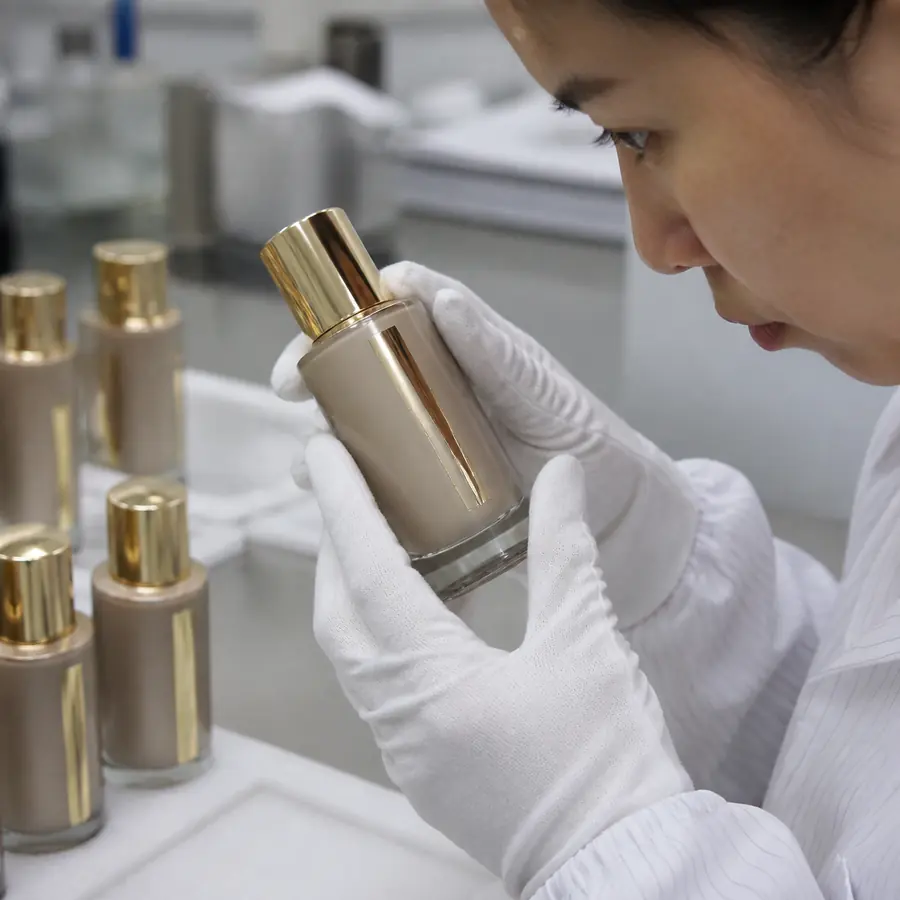
Visual approval does not prove durability. Relevant project checks may consider repeated handling, rubbing, contact between components, filling-line exposure, packing materials, transport and intended consumer use. The method and acceptance criteria should be defined for the actual decorated structure rather than described with a generic claim such as “scratch-proof.”
Published packaging standards also show why the test method and its scope matter. ASTM D5181-24 provides a laboratory practice for comparing abrasion resistance of printed matter and applied graphics on flat substrates and notes that transport and storage abrasion can be affected by variables such as humidity, temperature and packing conditions. Its scope does not make it an automatic hot-stamped-glass-bottle test. For a curved cosmetic bottle, buyers and suppliers still need to define a relevant project-specific method and acceptance requirement.
No foil should be described as universally scratch-proof, solvent-resistant, alcohol-resistant or permanent without evidence tied to the exact foil and decorated construction. A material supplier may publish such properties for a specific grade, but those claims should not be transferred automatically to a different foil, coating or bottle configuration.
Common Problems to Check
- Missing foil, pinholes or incomplete transfer: review the actual foil, surface condition, tooling and production settings rather than assuming the foil color itself is the cause.
- Ragged, blurred or broken edges: check fine artwork, die condition, bottle geometry and whether the design is too demanding for the approved decoration area.
- Unexpected color or reflectivity: compare the foil on the final substrate under agreed viewing conditions, not against a screen image alone.
- Position shift or rotation: inspect orientation on the completed bottle and registration against printing or other decoration.
- Contact or packing marks: check where bottles, caps, collars, trays, dividers or packing materials touch the decorated area.
- Loss of adhesion under relevant use conditions: evaluate the exact foil and surface combination using the project’s agreed durability checks.
Record the bottle model, base finish or coating, foil reference, artwork revision and decoration sequence when approving samples. This prevents a visually similar but technically different configuration from becoming the production reference.
When Hot Stamping Is the Right Choice
Hot stamping is usually the stronger choice when the design depends on a focused reflective metallic accent, a clearly defined logo or a small decorative element with high visual contrast. It is not automatically the best process for every premium package. Large nonmetallic color areas, artwork dominated by printed graphics or designs that change frequently may be better served by other decoration methods.
| Option | Best For | Main Advantage | Main Limitation | What Buyers Should Verify |
|---|---|---|---|---|
| Hot Stamping | Focused metallic logos, lines and accents | Strong reflective contrast and defined metallic appearance | Transfer depends on surface, geometry, tooling and foil system | Foil grade, decoration area, process sequence and physical sample |
| Screen Printing | Solid-color logos, text and graphics | Direct color printing on compatible bottle surfaces | Ink, surface, curvature and registration affect the result | Actual substrate, ink system, artwork and production sample |
| Spray Coating | Broad bottle color, matte or gloss surface effects | Changes the overall visual background of the bottle | The coating becomes the surface for later printing or foil | Color, finish, downstream decoration sequence and physical sample |
The trend toward simpler bottle decoration makes this distinction more important. A restrained metallic accent can be effective when it has a clear visual role; adding foil simply because a package is intended to look “premium” can add another approval and production variable without improving the design.
Cost and timing should be assessed from the real artwork and quantity. Tooling, foil selection, sampling and multi-process handling can affect the project, but there is no defensible universal hot-stamping surcharge or lead time. Request a project-specific quotation and schedule after the bottle, foil area and process sequence are defined.
Buyer Approval Checklist
- Confirm the exact bottle, component and decoration area.
- Identify whether the receiving surface is bare glass, coated glass or another confirmed material.
- Freeze the coating, printing and stamping sequence.
- Review vector artwork at actual production size.
- Confirm the exact foil reference rather than approving only a generic color name.
- Check foil appearance on the final substrate under agreed viewing conditions.
- Review position and orientation on the assembled package.
- Approve registration where multiple decoration processes meet.
- Define relevant handling, abrasion or durability checks for the project.
- Retain the approved physical sample, artwork revision and process specification.
Plan Hot Stamping Within the Packaging System
Decoration should also be reviewed in the context of destination-market requirements. For packaging placed on the EU market, Regulation (EU) 2025/40 on packaging and packaging waste, which applies from 12 August 2026, states that the sum of lead, cadmium, mercury and hexavalent chromium resulting from substances present in packaging or packaging components must not exceed 100 mg/kg. A metallic-looking foil should therefore never be judged by appearance alone when composition documentation is relevant. Buyers should confirm that declarations or test evidence apply to the exact foil, coating and decorated packaging configuration.
Compliance boundary: the 100 mg/kg EU limit is a packaging-composition requirement, not a hot-stamping adhesion or durability standard. Other chemical, cosmetic-product or destination-market requirements may also apply. Available documentation can vary by foil, coating, bottle, closure and decoration system, so the exact configuration should be checked rather than assuming one report covers every decorative option.
Start with the bottle and closure structure. Browse cosmetic and skincare glass packaging, then coordinate the confirmed substrate through FOLOVER’s decoration and finishing options. The skincare packaging guide connects appearance with bottle, formula and dispensing decisions.
More production topics are organized under Customization & Manufacturing, while the process and performance background appears under Packaging Technology.
Conclusion
Frequently Asked Questions
What is hot stamping on cosmetic packaging?
It is a decoration process that transfers a metallic or pigmented foil effect onto a defined package surface using controlled tooling, heat and pressure.
Can hot stamping be applied to coated glass?
It may be possible when the coating, foil and process are compatible. Approve the actual coating and decoration sequence on a representative sample.
Is hot stamping durable?
Durability depends on the substrate, coating, foil, process and use conditions. Confirm it with project-specific checks rather than a universal claim.
Can fine logos be hot stamped?
Fine artwork may be possible, but practical detail depends on tooling, geometry and surface. Review vector artwork at actual size and approve the physical result.
Does hot stamping use metallic ink?
Hot stamping transfers a foil layer; it is different from printing with metallic-looking ink. The visual and production considerations are therefore different.
Should hot stamping be approved before mass production?
Yes. Approve the final substrate, decoration sequence, artwork, foil appearance, position and relevant performance checks on a physical sample.