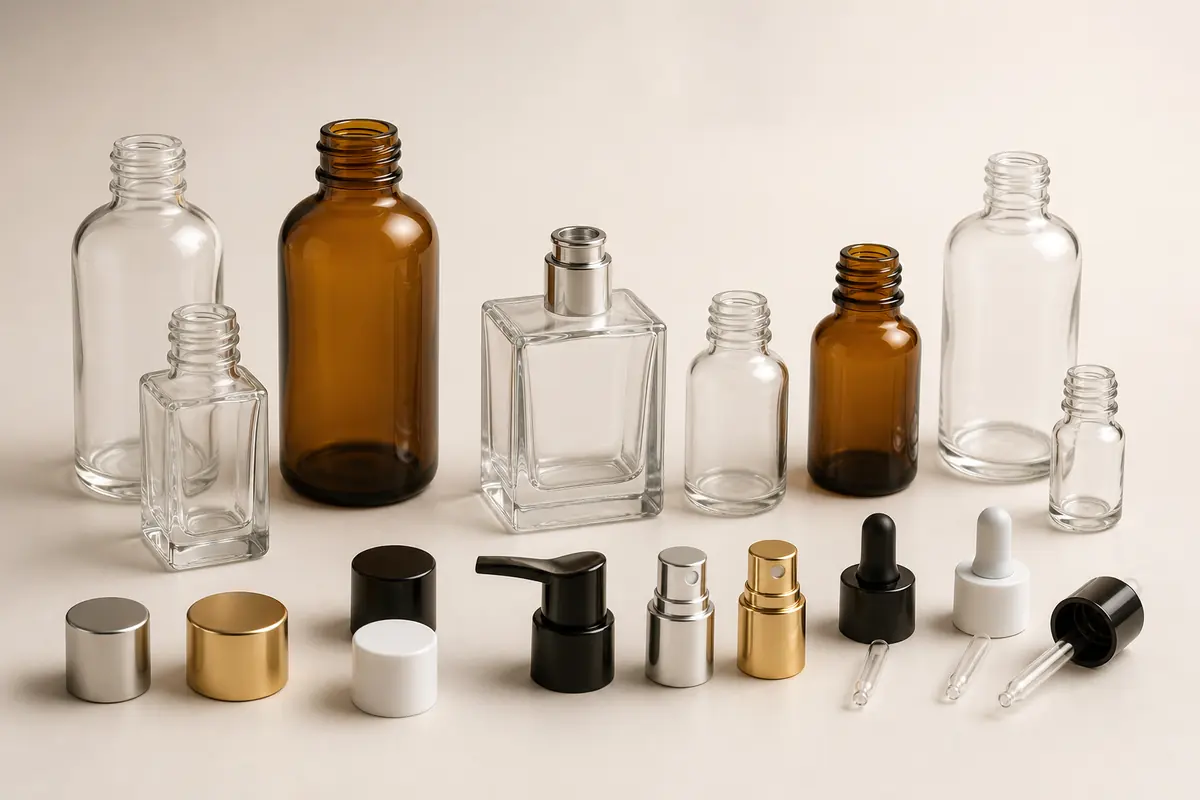

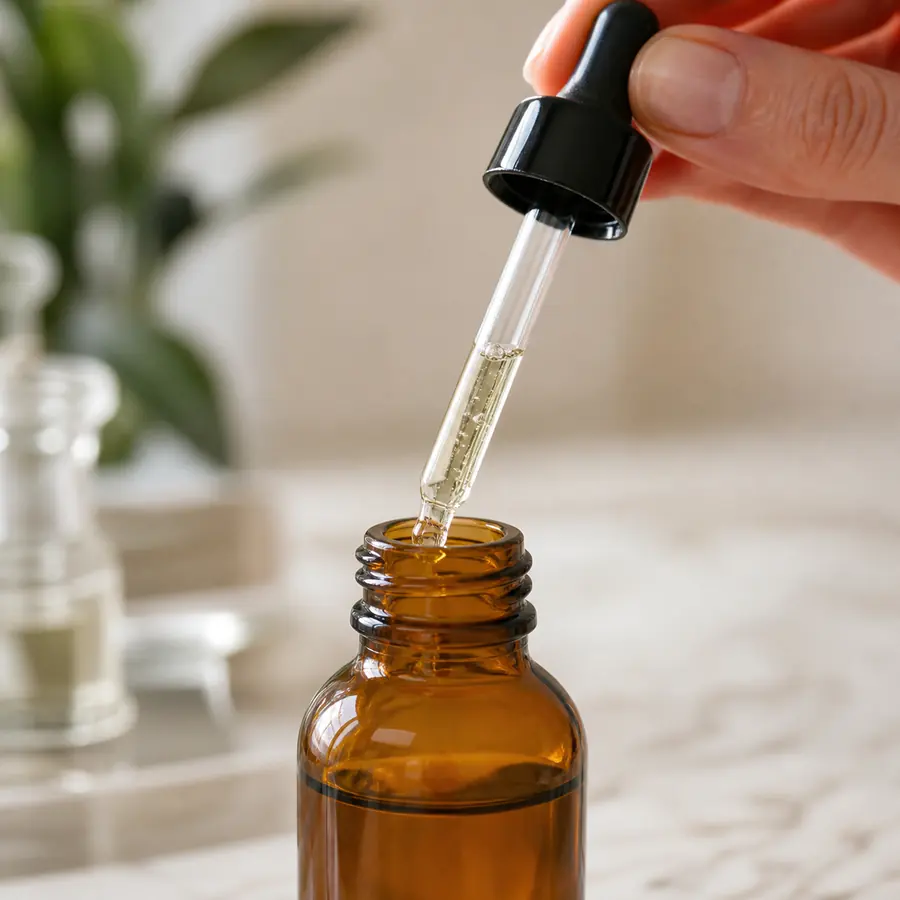
A glass dropper system uses a flexible bulb and a narrow pipette to draw liquid from a bottle and release it in controlled amounts. Squeezing the bulb expels air; releasing it while the pipette tip is submerged creates a pressure difference that draws product into the tube. Squeezing again dispenses the liquid.
Reliable performance depends on more than the visible glass pipette. The bottle, neck finish, closure, bulb, pipette and optional wiper must work together. Formula properties, component materials and user technique also influence product uptake and release. For B2B cosmetic packaging buyers, the complete bottle-and-dropper assembly should be evaluated with the actual formulation before bulk production.
Main Components of a Glass Dropper System
- Bottle: Stores the formula and determines internal depth, shoulder geometry, available product pickup and residual-product behavior.
- Neck finish: Provides the engineered interface for closure attachment and sealing.
- Closure: Holds the bulb and pipette assembly and attaches it to the bottle.
- Bulb: Creates the pressure change used to draw up and release liquid.
- Pipette: Carries liquid from the bottle to the application point. Its length, diameter and tip geometry affect fit and dispensing.
- Wiper, when used: Sits in or near the bottle neck and removes excess liquid from the outside of the pipette during withdrawal.
These components form one dispensing system. A pipette that passes through the bottle opening can still be unsuitable because it is too long, too short, incorrectly secured in the closure or incompatible with the wiper.
Buyers can compare available serum and essential oil droppers when selecting a dispensing configuration. Final compatibility should be confirmed using the selected bottle, dropper components and physical samples rather than relying on product appearance or nominal neck size alone.

How a Dropper Draws Product Into the Pipette
When the user squeezes the bulb, air is displaced from the pipette. If the tip is submerged in the formula when the bulb is released, the bulb returns toward its original shape and lowers the pressure inside the assembly. Atmospheric pressure acting on the product helps move liquid into the pipette until the pressure difference decreases.
When the bulb is squeezed again, the resulting pressure change forces liquid out through the pipette tip. The amount released depends on the system geometry, product properties and how the user operates the bulb.
The pipette does not always fill completely, and complete filling is not a universal measure of quality. Bulb volume, squeeze force, pipette geometry, immersion depth, formula flow and air leakage can all affect uptake.
A brand should define its intended dispensing experience before approving the dropper. For example, if the product is intended to deliver a controlled application amount, buyers should evaluate whether repeated squeeze cycles provide sufficiently consistent delivery with the actual formulation.
The focused guide on why a dropper does not fill completely explains the main troubleshooting considerations when liquid does not reach the expected level inside the pipette.
The Role of the Bulb
The bulb supplies the volume change that moves air and liquid. Its shape, resilience, connection to the closure and response over repeated cycles influence usability.
A bulb that feels soft is not automatically better, and a firm bulb is not automatically more accurate. The correct choice depends on the complete dispensing design and the intended user experience.
Bulb material should not be assumed from appearance. Different elastomers and other flexible materials may behave differently when exposed to cosmetic formulations. Changes in bulb resilience, swelling, discoloration, odor or permanent deformation can affect the product experience.
Buyers should confirm the exact bulb material and its expected formula exposure. If the bulb is exposed to the formulation during normal or foreseeable use, that contact should be included in the compatibility evaluation.
Decorative overcaps or collars can change the visual impression without changing the functional limits of the bulb. Approve bulb appearance and functional performance as separate requirements.
The Role of the Pipette
The pipette provides the product pathway and application point. Its outside diameter must pass through the bottle opening and any wiper, while its length must suit the fully assembled bottle and closure.
The connection at the closure should remain secure during normal use. Tip geometry and internal bore can affect product uptake and release, but their suitability depends on the selected component and formulation.
Nominal bottle capacity does not determine pipette length. Bottles with the same stated fill volume may have different internal depths, bases, shoulders and neck heights.
A pipette that is too short can leave more product inaccessible at lower fill levels. An overlong pipette may contact the bottle base, sit under stress or prevent the closure from reaching its intended seating position.
The guide to choosing the correct dropper pipette length explains how installed geometry, bottom clearance and physical sample evaluation influence length selection.
Buyers should confirm the pipette’s measurement reference points, installed tip position and connection structure with the supplier. Final length approval should be based on the selected bottle and closure assembly rather than a generic capacity-based specification.
What Is a Bottle Wiper?
A wiper is an insert positioned in or near the bottle neck on configurations designed to use one. As the pipette is withdrawn, the wiper can remove excess product from its outer surface.
This may reduce mess around the bottle neck, improve the presentation of the applicator and influence how much external liquid returns to the bottle.
However, a wiper is not automatically a leakproof sealing component. Its primary wiping function should be distinguished from the closure’s intended sealing system.
The wiper also changes the assembly. Its opening must permit pipette movement without excessive scraping, bending or insertion force. The insert must also fit the selected bottle neck and remain correctly positioned during use.
Buyers should evaluate the wiper together with the actual pipette diameter, closure and bottle. A wiper from another packaging system should not be assumed compatible merely because the bottle necks appear similar.
During sample testing, observe whether the pipette passes through the wiper smoothly, whether excess formula accumulates around the neck and whether repeated insertion or withdrawal changes the condition of the components.
Why Formula Behavior Matters
Low-viscosity oils, water-like serums and thicker formulations can move differently through the same pipette. Viscosity affects flow, but it is not the only variable. Surface tension, suspended ingredients, air bubbles and how product coats the glass may also influence uptake and release.
A thicker formulation may enter the pipette more slowly or require a different dispensing configuration. However, increasing pipette diameter or changing bulb characteristics should not be treated as a universal solution. The complete dispensing system must be evaluated against the intended product behavior.
Formula interaction also extends beyond the glass pipette. The bulb, closure insert, gasket, wiper and other relevant materials may be exposed to the formulation during filling, storage or normal use.
For products intended for the European Union, the European Commission’s Guidelines on Annex I to Regulation (EC) No 1223/2009 address the composition of primary packaging materials and potential interactions between packaging and cosmetic formulations as considerations in the finished product’s safety assessment.
These guidelines do not establish a universal compatibility test for every glass dropper system. The required assessment depends on the actual formulation, packaging materials, intended conditions and applicable product-safety requirements.
Packaging compatibility should be evaluated with the actual formulation under intended storage and use conditions. Water or another representative liquid may support preliminary mechanical screening, but it cannot automatically establish final formula compatibility.
The serum bottles overview compares common dispensing options, while the glass dropper bottle buying guide addresses bottle formats, colors and sourcing decisions.
Neck Finish, Closure and Seal Compatibility
The closure must engage the bottle neck correctly and establish the intended sealing condition. Thread profile, finish height, sealing surface, liner or gasket arrangement, closure dimensions and manufacturing variation may all affect performance.
The pipette must also remain correctly positioned so that it enters the bottle and optional wiper without damaging contact.
A closure that screws onto a bottle does not automatically establish compatibility. It may bottom out before achieving the intended seal, engage insufficiently or create inconsistent gasket compression.
Manufacturer Insight: Confirm the Complete Assembly Before Approving Components
For a glass dropper bottle, FOLOVER PACK recommends treating the bottle, closure, bulb, pipette and optional wiper as one packaging configuration rather than approving each component independently.
For example, if a closure seats normally without the pipette but cannot reach the same position when the complete dropper is installed, the pipette’s installed length and possible contact with the bottle base should be investigated.
Similarly, if a pipette moves smoothly through the bottle neck without a wiper but catches when the wiper is installed, buyers should review the pipette diameter, wiper opening and insert position before changing the pipette length.
These comparisons can help identify possible mechanical interference. They do not establish the cause of every sealing or dispensing problem.
Final bottle and closure compatibility should be confirmed using the selected components and physical samples before bulk production. If any component is substituted after approval, the affected fit, sealing and dispensing checks should be repeated.
The cosmetic bottle closures guide provides a broader selection framework, while pumps, droppers and bottle accessories can be reviewed when defining the required component combination.
How Buyers Should Compare Dropper Samples
Begin with a defined packaging configuration rather than a selection of interchangeable-looking parts. Record the bottle code, neck specification, closure, bulb, pipette and optional wiper used in each sample.
Confirm whether every component represents the intended production material and finish. A temporary sample component may be suitable for appearance review, but it should not automatically become evidence of final functional performance.
Evaluate the package in the same sequence a consumer would use it: open the bottle, squeeze and release the bulb, withdraw the pipette, dispense the product, return the pipette through the neck and reseal the closure.
Observe product uptake, release, bulb recovery, wiper movement, residue around the neck and closure seating across multiple samples.
Test at the intended fill level and again after the product volume has decreased. A dropper that works normally in a full bottle may have different pickup behavior when the remaining liquid level is lower.
Separate visual approval from technical approval. Color, collar finish and bulb appearance can be approved as design characteristics, while uptake, sealing and formula interaction require functional evaluation.
Common Dropper Performance Problems
Poor or Variable Uptake
Check whether the pipette tip is submerged, whether the bulb returns normally, whether the assembly allows unwanted air entry and whether the formulation moves reliably through the pipette.
Compare repeated squeeze cycles using the same formula and assembly conditions. Do not assume that incomplete filling is caused by pipette length alone.
Slow Release or Dripping
Formula behavior, pipette tip geometry, bulb characteristics and user technique can affect release. Observe whether the problem appears immediately, after storage or only when residue accumulates near the tip.
Compare the affected sample with an approved reference before changing the dispensing components.
Bulb Deformation
Persistent bulb deformation can involve component construction, material interaction, storage conditions or repeated use.
Record when the deformation occurs and confirm the exact component material. An appropriate compatibility or aging evaluation may be required before determining the cause.
Pipette Contact With the Bottle Base
An overlong pipette can contact the base, sit under stress or interfere with closure seating. A short pipette can leave more product inaccessible at lower fill levels.
Inspect the installed tip position with the closure fully seated. The acceptable bottom clearance should be established for the selected bottle-and-dropper system rather than assumed from a universal numerical recommendation.
Leakage Around the Neck
Inspect closure engagement, sealing surfaces, gasket condition, assembly method, bottle variation and relevant storage or transport conditions.
Leakage is a system symptom, not proof that the visible wet component is defective. Identify where the liquid first appears before selecting a corrective action.
Practical Troubleshooting: When a Dropper Cannot Draw Product Consistently
Consider a development-stage serum bottle that dispenses normally during initial testing but shows inconsistent uptake after repeated use.
A practical investigation should compare the affected sample with an approved reference containing the same formulation. Check the bulb’s recovery, pipette immersion, connection integrity and any visible residue or damage.
If the problem remains, compare the complete assemblies before changing individual components. A shorter pipette, larger bore or different bulb should only be selected when testing identifies a relevant issue that the proposed change addresses.
This is an illustrative troubleshooting scenario, not a documented FOLOVER customer incident or a claim that one component adjustment will resolve every uptake problem.
What to Test With the Actual Formula
Final dropper approval should combine mechanical fit, dispensing performance and material compatibility using representative assembled samples.
- Confirm the exact bottle, closure, bulb, pipette and optional wiper specifications.
- Check closure engagement, seating and the intended sealing interface.
- Verify pipette insertion, bottom clearance and movement through any wiper.
- Fill representative samples with the actual formulation and record the formula and component references.
- Evaluate product uptake and release across repeated complete squeeze cycles.
- Observe bulb recovery, dripping, residue and product accumulation around the neck.
- Check sealing and leakage under storage and handling conditions relevant to the intended package.
- Assess relevant product-contact materials for changes in appearance, shape or function after formula exposure.
- Evaluate performance at different fill levels and compare multiple assemblies rather than one ideal sample.
- Record the approved configuration and repeat affected checks after any material, formula or component change.
The specific test conditions, sample quantity and acceptance criteria should be established for the selected formulation, packaging configuration and intended use. No universal leakage rate, bulb-aging duration or dispensing-volume tolerance should be applied without a relevant product specification or approved test plan.

Explore the Packaging Technology hub for mechanism and testing topics and the Packaging Buying Guides hub for sourcing frameworks.
Conclusion
A glass dropper works through pressure changes created by its bulb, but dependable dispensing requires the bottle, neck, closure, pipette, optional wiper and formula to function together.
For cosmetic packaging buyers, the priority is to select the dispensing system according to the actual formulation and intended user experience, verify the complete bottle-and-dropper assembly, and approve representative physical samples before bulk production.
FOLOVER PACK supports cosmetic glass bottle selection, dropper component matching and coordinated sample development. Share your selected bottle reference, formulation type, intended dispensing requirements, component preferences and project quantity to discuss suitable packaging options.
Frequently Asked Questions
How does a glass dropper work?
A glass dropper uses pressure changes created by a flexible bulb. Squeezing the bulb expels air, and releasing it while the pipette tip is submerged draws liquid into the tube. Squeezing again dispenses the product. Buyers should evaluate the complete bottle, closure and dropper assembly with the intended formulation.
What is the bulb on a dropper for?
The bulb creates the pressure change needed to draw liquid into the pipette and release it during dispensing. Its resilience, material and connection to the closure affect performance. Buyers should confirm the selected bulb’s material and evaluate its recovery, dispensing consistency and compatibility with the actual formulation under intended use conditions.
What does a wiper do?
A wiper removes excess liquid from the outside of the pipette as it is withdrawn from a compatible bottle. This can reduce product accumulation around the neck and improve applicator cleanliness. A wiper is not automatically a leakproof seal. Buyers should confirm its compatibility with the bottle neck, pipette diameter and closure assembly.
Why does a dropper not fill completely?
A dropper may not fill completely because of bulb volume, squeeze technique, pipette geometry, immersion depth, formula properties or unwanted air entry. Complete filling is not always necessary for acceptable dispensing. Buyers should define the intended application amount and test repeated uptake and release using the actual formulation and selected dropper assembly.
Can any pipette fit any bottle?
No. Pipette compatibility depends on installed length, outside diameter, tip geometry, closure connection, bottle depth, neck finish and any optional wiper. Similar bottle capacity does not establish compatibility. Buyers should confirm the selected component specifications and evaluate the assembled pipette position, closure seating and dispensing performance using physical samples.
Does serum viscosity affect dropper performance?
Yes. Serum viscosity can influence how quickly liquid enters and leaves the pipette, but surface tension, bulb characteristics, pipette geometry and other formula properties also affect dispensing. A dropper that works with water may behave differently with the final serum. Buyers should test the actual formulation and complete packaging system before production approval.