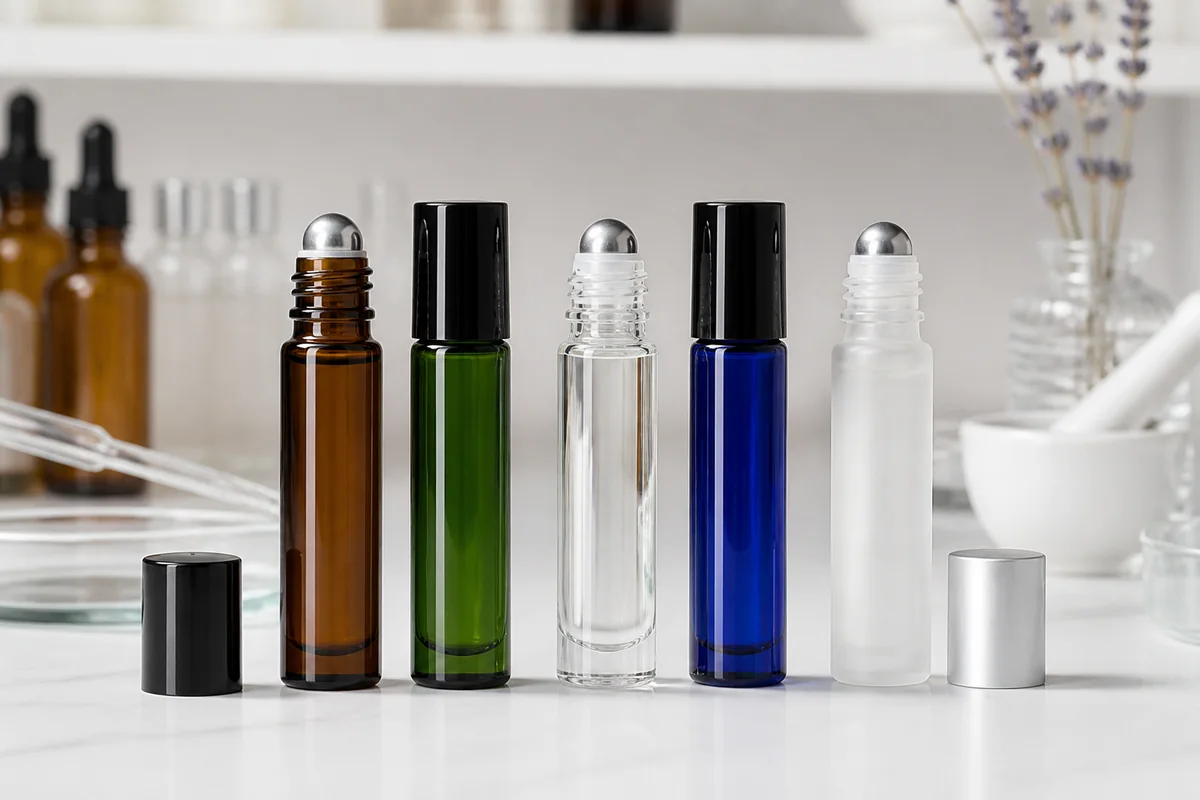

Lightweight cosmetic glass bottles are not defined by one universal weight. Lightweighting means reducing glass relative to a named reference while preserving the capacity, functional requirements and acceptable brand presentation of the package. A bottle can be lighter than its previous version, lighter than another design for the same application, or optimized against a project target. Without that baseline, “lightweight” is only an impression.
The engineering challenge is not to make every surface thin. It is to use glass deliberately across the base, body, shoulders, corners and neck while maintaining manufacturability, closure fit, filling behavior, decoration and transport performance. For buyers, lightweighting is a controlled glass-distribution and validation problem: removing material from one area can introduce risk or require additional protection elsewhere.
Direct Answer
Lightweight cosmetic glass bottles use less glass than a defined reference bottle while meeting the required capacity, structural performance, closure compatibility and appearance standards. Weight reduction can lower material and shipment mass, but it does not automatically prove equal strength, lower total cost or reduced lifecycle impact.
Buyers should compare actual bottle and complete-pack weights, review the revised glass geometry, validate the selected closure, approve physical decoration samples and evaluate filling and transport performance before bulk production.
A meaningful lightweighting claim should identify the original bottle, the revised bottle, the measured weight difference and the comparison boundary. Bottle-level material reduction should not be presented as a verified reduction in the complete packaging system or carbon footprint without supporting evidence.
FOLOVER Manufacturer Insight
FOLOVER PACK supports cosmetic glass packaging projects through stock bottle selection, custom bottle development, closure matching, decoration coordination, sample evaluation and export-oriented packaging.
When a buyer requests a lighter version of an existing glass bottle, the first decision is whether a suitable stock bottle already meets the required capacity, appearance and closure specification, or whether the proposed weight reduction requires structural development.
Changing the glass distribution in an existing bottle design is not simply a matter of requesting a thinner wall. The base, heel, body, shoulder and neck interact with the forming process and the assembled packaging system. A revised bottle may require a new drawing, tooling assessment, production-representative samples and renewed approval.
A common sourcing risk is approving the reduced bottle weight before checking whether the existing pump, dip tube, filling-line equipment and protective insert still work with the revised geometry. The empty bottle may meet its weight target while the complete packaging system requires additional changes.
FOLOVER recommends reviewing the reference bottle, target capacity, measured weight, neck and closure requirements, formula, filling route, decoration, order quantity and shipping configuration together. No universal weight-reduction percentage, strength value or cost saving should be promised without project-specific evidence.
What is lightweighting?
Packaging lightweighting is source reduction: using less material than a defined reference while delivering the required function. For glass bottles, it may involve changing base thickness, wall distribution, body diameter, shoulder geometry, corners or decorative features. It may also involve selecting an existing efficient bottle instead of developing a new heavy custom shape.
Weight must be measured, not estimated visually. A tall, slim bottle can be heavier than a compact one, and a thick base can contain material that is not obvious in front photography.
For a meaningful comparison, buyers should control the reference bottle code, nominal capacity, bottle configuration and measurement method. A bare glass vessel should be compared with another bare glass vessel, while the complete packaging system should be evaluated separately.
The material-reduction percentage can be calculated as follows:
Glass weight reduction (%) = [(Reference bottle weight − Revised bottle weight) / Reference bottle weight] × 100.
The reference and revised weights must be measured on comparable samples using a consistent basis. If the final production-representative weights are not available, the reduction percentage should remain a development target rather than a confirmed product claim.
The US Federal Trade Commission’s Green Guides explain that source-reduction claims should identify the amount and basis of comparison. Buyers should avoid unsupported statements such as “eco-friendly lightweight glass” when the actual material difference and broader environmental impact have not been established.
Why brands are interested in lighter glass
Reducing bottle weight can lower the glass mass purchased and transported per sellable unit. Where bottle dimensions and protective packaging can also be optimized, lighter designs may support more efficient carton and pallet configurations.
Lightweighting can also help brands reconsider heavy-base styling and distinguish the appearance needed for their positioning from glass mass that adds little functional or visual value.
The European Union’s Packaging and Packaging Waste Regulation (PPWR), Regulation (EU) 2025/40, establishes a framework that includes packaging minimization and resource efficiency. The regulation began applying generally on 12 August 2026, with individual requirements subject to their specified application dates and conditions.
The European Commission’s PPWR application update provides the official regulatory context. Buyers should check the requirements applicable to their packaging configuration, destination market and relevant implementation date rather than treating lightweighting alone as proof of regulatory compliance.
Commercial advantages must also be calculated rather than assumed. A custom lightweight bottle may require development or tooling costs, additional production controls or revised protective packaging. Freight savings depend on the shipping method, complete pack-out and actual transport charges.
Buyer decision: Prioritize an existing lighter bottle when it satisfies the required capacity, closure, decoration and brand design. Consider custom lightweight development when the potential material reduction justifies the required investment and validation.
Heavy base versus lightweight base
A heavy glass base creates optical depth, substantial hand feel and a recognizable luxury cue. It can also account for a meaningful share of bottle mass.
A lightweight design may reduce unnecessary base material, but the bottle must retain stable standing, appropriate glass distribution, manufacturing feasibility and acceptable visual quality.
The difference is not simply whether one bottle looks expensive and the other looks economical. A lighter bottle can retain a recognizable silhouette through proportion, clarity, controlled decoration and coordinated components.
For example, a brand considering a lighter version of an existing serum bottle should decide whether the original base thickness is essential to its visual identity. If the desired appearance depends on a particular optical effect, that requirement should be included in the development brief rather than discovered after the revised mold or sample has been approved.
Buyers can also compare a moderately weighted stock bottle with a heavy-base custom design before committing to structural changes.
The relationship between visual positioning and material use is explored further in premiumization versus lightweighting.
The practical decision is which premium design features contribute to recognizable brand value and which add glass mass without a corresponding functional or visual requirement.
Structural considerations
Glass distribution matters more than a single average wall-thickness figure. A bottle’s base, heel, corners, body panels, shoulder and neck experience different manufacturing and handling demands.
Removing glass uniformly can create localized weakness or make consistent forming more difficult. Abrupt geometry transitions, sharp corners and broad flat surfaces may respond differently to impact and handling than rounded structures.
The neck requires particular attention because it interfaces with the closure. Thread or crimp geometry, sealing surface, top dimensions and concentricity can affect assembly and sealing performance. Weight reduction elsewhere must not compromise the neck finish required by the selected pump, cap or dropper.
Where should glass weight be reduced?
The answer depends on the reference design and its actual glass distribution. Buyers should not specify a universal base thickness or sidewall reduction without reviewing the bottle drawing, manufacturing feasibility and relevant performance requirements.
For a bottle with a visually heavy base, the base may be a useful starting point. For another design, improvements to the body or shoulder may be more appropriate. The objective is controlled redistribution, not simply achieving the lowest possible nominal weight.
Request a comparison between the reference and revised drawings that identifies the proposed changes to the base, heel, body, shoulder and neck. Confirm which interfaces and dimensions must remain unchanged.
Failure mode: A lighter bottle may preserve its external silhouette while changing the internal base profile or usable internal height. This can affect filling, product evacuation or the clearance required by the selected dip tube or pipette.
Final bottle and closure compatibility should be confirmed using the selected components and physical samples before bulk production.
Production stability and tolerances
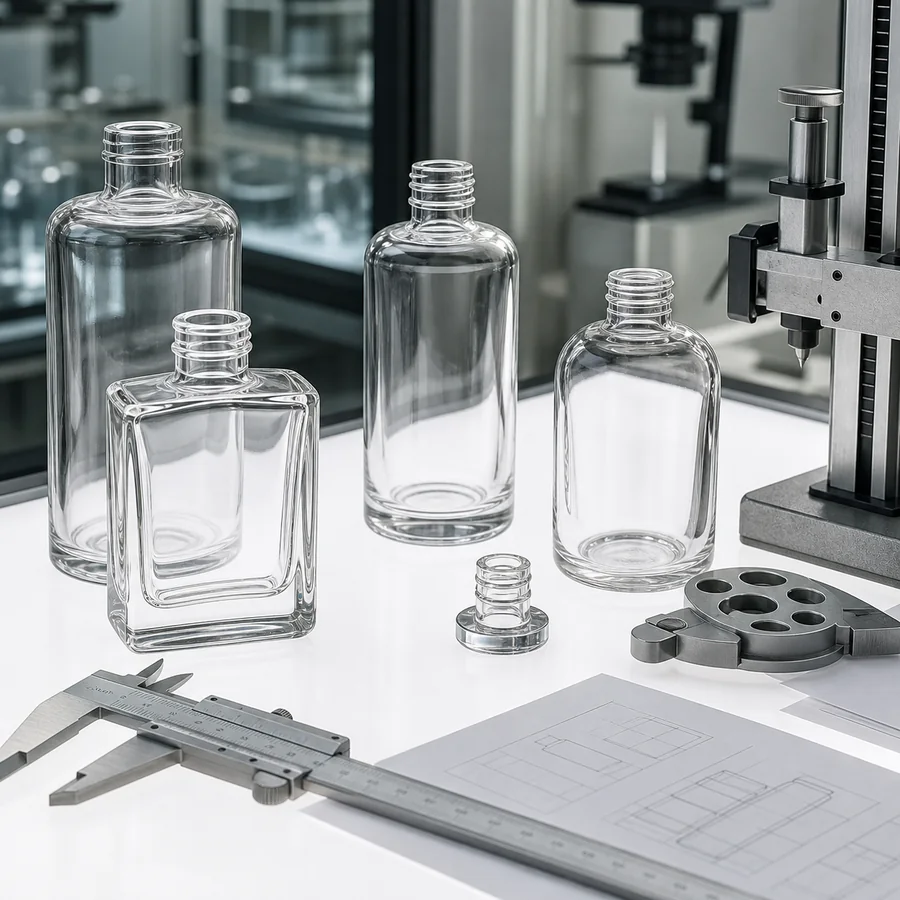
A lightweight bottle that looks acceptable in a rendering must also be manufacturable at the required production scale. Glass forming involves process variation, so the approved drawing and inspection plan should identify relevant dimensions, capacity, weight and visual requirements.
Critical-to-function dimensions deserve priority. These may include the neck finish, sealing surface, overall bottle height, body dimensions required by filling equipment, decoration area and base stability.
A lower nominal bottle weight should not create an unacceptable rejection rate or introduce dimensional variation that prevents consistent assembly.
How can lightweighting affect an existing filling line?
A revised bottle may retain its nominal capacity while changing the external body profile, shoulder position, base geometry or overall height. These changes can affect how the container is located, gripped, conveyed, filled, capped or labeled.
Before approving a new lightweight design, the buyer should provide the proposed drawing and physical samples to the filling-line operator or responsible equipment team.
Check whether the existing conveyor, bottle guide, gripper, filling nozzle, capping equipment and labeling system can accommodate the revised geometry. Confirm the required line settings and acceptable handling performance through an appropriate equipment review or representative production trial.
A successful manually filled sample is not evidence that the revised bottle will run consistently on an automated filling line.
Approve production-representative samples and define which dimensional, material or component changes require renewed testing before bulk production. Tolerances must come from the actual product specification rather than generic editorial values.
Brand perception without excessive weight
Lightweight glass does not need to look inexpensive. A disciplined silhouette, balanced proportions and high-quality component coordination can create premium presentation.
Visual hierarchy can come from the shoulder, cap, color and decoration rather than a large block of glass at the bottom.
A brand should evaluate the desired appearance and hand feel against its intended consumer and product positioning. If substantial hand weight is a defining feature, eliminating too much mass may conflict with the original design brief.
A moderate reduction that preserves the brand’s recognizable appearance may be more commercially useful than pursuing the minimum possible bottle weight.
Compare current cosmetic and skincare glass packaging options before commissioning a custom mold. An existing efficient shape may already support the required closure, decoration and filling process.

Decoration on lightweight bottles
Coating, frosting, screen printing, hot stamping, labels and decorative collars can be considered for lightweight bottles, subject to the selected bottle geometry and process compatibility.
A structural change can affect the available printing area, visual distortion, bottle positioning in decoration fixtures or the handling conditions required by a particular finishing process.
For example, a revised shoulder or body profile may change the position and appearance of a printed logo even when the artwork dimensions remain unchanged. A bottle that passes structural evaluation may still require separate decoration approval.
Lightweighting and decoration development should therefore be coordinated rather than treated as independent projects.
Buyers can review available cosmetic glass bottle decoration and finishing options when defining the required appearance of a lighter design.
Final colors, coatings, printing and logos should be approved using physical samples. Screen mockups cannot establish the actual appearance or durability of decoration on the revised glass bottle.
Buyer action: Confirm the final decoration area, component alignment and visual standard after the lightweight bottle geometry has been approved. If the revised bottle requires different fixtures or decoration methods, include those changes in the commercial and production review.
Filling and closure performance
A lighter bottle must still work with the selected pump, dropper or cap and remain suitable for the intended filling process.
Check bottle handling, conveyor stability, filling nozzle clearance, capping or crimping, label application and final packing. Exact equipment settings belong to the responsible filling-line and packaging-development teams.
Closure compatibility remains an assembled-system question. Neck finish, thread or crimp structure, sealing geometry, gasket, dip tube or pipette, formula viscosity and dispensing requirements may all affect performance.
Do not approve a lightweight bottle merely because the existing closure can be attached by hand. The revised bottle and selected closure should be evaluated together under the intended filling, storage and use conditions.
For a bottle with a pump, confirm the relevant internal height and dip-tube requirements. For a dropper bottle, check the selected pipette and closure assembly against the revised bottle geometry.
Packaging compatibility should be evaluated with the actual formulation under intended storage and use conditions.
The skincare packaging guide provides the application framework for selecting an appropriate container and dispensing system.
Shipping and breakage considerations
Reducing bottle mass can lower the glass weight transported, but breakage risk depends on bottle geometry, glass distribution, contact points, handling conditions and the actual shipping route.
Protective packaging may need to change. The net system benefit should account for the bottle, closure, protective insert, carton, pallet configuration and product damage.
Test the intended pack-out using production-representative bottles and the approved decoration. Filled-package evaluation may also be necessary to assess the complete commercial system.
Check bottle-to-bottle contact, divider fit, movement, abrasion and cap protection. A lighter bottle that requires additional protective material may still be commercially viable, but the trade-off should be measured.
FOLOVER can coordinate export-oriented protective packaging for cosmetic glass bottles. The final packing method should be selected for the actual bottle and distribution requirements.
What transport tests should buyers request?
For individual packaged products moving through parcel delivery systems, the International Safe Transit Association’s test procedures provide recognized approaches to packaged-product performance evaluation.
ISTA Procedure 3A addresses individual packaged products weighing 70 kg or less that are shipped through parcel delivery systems. Different shipping configurations, including palletized bulk shipments, may require a different procedure.
The appropriate test method, conditions, sample configuration and acceptance criteria should be selected according to the actual distribution route.
A transport test should evaluate the final bottle, closure and protective packaging together. Testing only the empty glass vessel cannot establish whether the commercial package will protect the filled product during shipment.
Do not claim a universal drop height, breakage rate or shipping-performance result without evidence for the exact tested configuration.

How buyers should evaluate a lightweight bottle
Lightweighting approval should compare the reference and revised bottles against the same required function. A lower measured weight is only the starting point; structural performance, manufacturability, closure compatibility, filling and distribution must also meet the project requirements.
| Decision | Evidence | Failure to avoid |
|---|---|---|
| Is it genuinely lighter? | Measured weight against a named reference | Visual assumption |
| Can it be produced consistently? | Drawing, tolerances, samples and inspection plan | Prototype-only approval |
| Does the closure work? | Assembled sealing and functional tests | Matching by appearance |
| Can it be decorated? | Decorated physical samples and adhesion/appearance checks | Screen-only approval |
| Can it be filled? | Representative line trial and handling review | Ignoring equipment |
| Can it ship? | Validated pack-out and route-relevant transit test | Counting bottle grams only |
Which technical tests are relevant to lightweight glass bottles?
Testing should be selected according to the bottle geometry, product requirements, manufacturing process and intended distribution conditions. The following standards provide recognized methods for evaluating specific glass-container properties; they are not universal acceptance specifications for every cosmetic bottle.
| Test Area | Reference or Method | What Buyers Should Verify |
|---|---|---|
| Vertical load resistance | ISO 8113:2004 — Glass containers: Resistance to vertical load | Determine whether the selected container requires vertical-load evaluation for its intended handling or production process. Agree on the relevant test conditions and acceptance criteria. |
| Thermal shock resistance | ISO 7459:2004 — Glass containers: Thermal shock resistance and thermal shock endurance | Assess whether the filling, washing, storage or handling process exposes the bottle to relevant temperature changes. Select an appropriate evaluation for the actual product conditions. |
| Internal pressure resistance | ISO 7458:2004 — Glass containers: Internal pressure resistance | Use where internal-pressure resistance is relevant to the intended container and application. Do not automatically apply pressure-container requirements to an ordinary non-pressurized cosmetic serum bottle. |
| Transport performance | ISTA transport test procedures | Select a procedure appropriate to the final packaged product, shipping method and distribution route. Evaluate the bottle, closure and protective packaging as an assembly. |
| Closure and formula compatibility | Project-specific sealing, dispensing and filled compatibility evaluation | Test the actual formulation and selected bottle-and-closure system under intended storage and use conditions. |
| Filling-line handling | Representative production trial or appropriate equipment review | Confirm bottle stability, gripper fit, nozzle clearance, closure application and other relevant equipment interfaces. |
These standards describe test methods, not automatic compliance or strength certifications for FOLOVER products. A test report should identify the exact bottle, method, conditions, sample configuration, results and applicable acceptance criteria. Results from one bottle design should not be transferred to another solely because the nominal capacity is similar.
Record the reference version, measured reduction, final configuration and test status. The broader glass versus plastic cosmetic packaging comparison is useful when the purchasing decision includes a material change rather than only glass optimization.
Lightweighting versus refillability
Lightweighting reduces material per unit relative to a defined reference. Refillability distributes the impact of a retained package across repeated use when the refill system is available and functions as intended.
A lightweight single-use bottle and a heavier refillable outer bottle address different requirements. A project may also combine both strategies, such as a retained outer package with a reduced-material refill container.
Environmental performance depends on the complete packaging system, actual reuse, transport, product protection and other relevant lifecycle conditions. Neither strategy should be treated as universally superior.
The guide to reducing cosmetic packaging material without sacrificing function expands the analysis beyond the glass vessel to closures, decoration and secondary packaging.
Worked Buyer Scenario
The following is an illustrative development scenario, not a documented FOLOVER customer project or verified production test result.
A skincare brand wants to replace its existing heavy 50 ml glass bottle with a lighter version while preserving the recognizable silhouette, nominal capacity, selected pump and decoration.
The purchasing team first records the current bottle code, measured empty-bottle weight, assembled packaging weight, relevant dimensions, neck finish and protective packing configuration.
The development team identifies the heavy base as a possible weight-reduction area and prepares a revised drawing. The required neck and pump interface remain controlled, while the proposed changes to the base and glass distribution are reviewed for manufacturing feasibility.
Before approving the revised bottle, the team identifies three possible failure modes: the new internal base profile may change the required dip-tube clearance; the revised external geometry may affect filling-line handling; and the lighter structure may require a different protective insert during shipping.
Production-representative samples are evaluated for dimensions, appearance, decoration, filling, closure performance and pack-out. Structural and transport testing is selected according to the actual design and distribution requirements.
The final material-reduction claim compares measured bottle weights against the named previous version. If the revised configuration requires additional protective packaging or changes the observed damage performance, those effects are recorded separately.
Buyer decision: Approve the lighter bottle only when it satisfies the required functional, appearance and production criteria. Do not treat a successful weight calculation or an acceptable visual sample as evidence that the complete packaging system is ready for bulk production.
Buyer Checklist
- Identify the reference bottle and define which functions and dimensions must remain unchanged.
- Measure the existing and proposed bottle weights using a consistent comparison basis.
- Review the base, heel, body, shoulder, corners and neck geometry before approving structural changes.
- Confirm manufacturing feasibility and whether new tooling or mold modification is required.
- Verify bottle neck, closure, gasket, dip-tube or pipette compatibility using the selected components.
- Review filling-line handling and approve the final decoration on physical samples.
- Select relevant structural and transport tests with defined acceptance criteria.
- Compare complete-pack weight, carton dimensions, protective materials and shipping performance.
- Control approved drawings, samples, tolerances and component specifications before bulk production.
- Support material-reduction and environmental claims with evidence appropriate to the stated comparison.
Frequently Asked Questions
What is a lightweight glass bottle?
It uses less glass than a defined reference while meeting the project’s capacity, function and appearance requirements.
Are lighter bottles weaker?
Not automatically. Performance depends on geometry, glass distribution, production and handling. The exact design needs testing.
Does lightweighting reduce packaging cost?
It may reduce material or freight mass, but tooling, production, protection and logistics affect the total cost. Calculate the project.
Can luxury brands use lightweight glass?
Yes. Premium perception can come from silhouette, proportion, clarity, decoration and components rather than maximum weight.
Is lightweight glass more sustainable?
It can reduce material per bottle, but overall performance depends on production, transport, protection, damage and end-of-life. Use qualified claims.
Can lightweight bottles still be customized?
Potentially, subject to bottle design, decoration compatibility, manufacturing feasibility and approved samples.
Official Sources Reviewed
The following official resources support the technical testing, regulatory and environmental-claim considerations discussed in this article. They do not establish product-specific test results, weight reductions or compliance for any FOLOVER cosmetic glass bottle.
- ISO 8113:2004 — Glass containers: Resistance to vertical load
- ISO 7459:2004 — Glass containers: Thermal shock resistance and thermal shock endurance
- ISO 7458:2004 — Glass containers: Internal pressure resistance
- International Safe Transit Association — Test Procedures
- European Commission PPWR application update
- US FTC source-reduction claims guidance
How to write a lightweighting development brief
A useful brief begins with a controlled reference, not the phrase “make it lighter.” Record the current bottle code, capacity, measured weight, key dimensions, neck finish, closure, decoration, filling process, pack-out and known performance requirements.
Define which attributes must remain unchanged and which can be modified. The priority may be lower bottle mass, improved carton efficiency or a reduced-material version of an existing brand design. Constraints may include silhouette, usable label area, pump fit, filling-line handling and acceptable transport performance.
If the project also requires a new color, decoration or closure, identify those as simultaneous changes because they make cause-and-effect more difficult to evaluate.
Stock bottle or custom lightweight development?
An existing lighter bottle may be suitable when the buyer can accept its current geometry, capacity, neck finish and decoration area. This route can avoid the need to develop a new glass mold, although component matching and physical sample approval are still required.
Custom development may be appropriate when the project requires a specific silhouette, revised glass distribution or geometry that cannot be achieved using a suitable existing bottle.
For structural development, the buyer should request a feasibility review of the proposed drawing and confirm whether the target can be achieved through the selected manufacturing process.
FOLOVER can coordinate custom glass bottle development for projects requiring new structural designs or mold decisions. Exact tooling requirements, development schedules, MOQ and commercial terms must be confirmed for the selected project rather than estimated from a generic lightweighting target.
Define approval gates before development begins
Establish a sequence covering drawing review, initial glass samples, closure and filling checks, decorated samples, structural and transport evaluation, and final commercial approval.
The target bottle weight should remain conditional until the revised configuration satisfies its agreed performance requirements.
This prevents the development team from achieving a numerical reduction that procurement, quality or production cannot use.
Bottle-level reduction versus system-level reduction
A lighter bottle is a component improvement. The final environmental and commercial outcome belongs to the complete packaging system.
If a lighter design requires additional protective material, increases the rejection rate, reduces pallet efficiency or creates more product damage, the bottle-weight difference alone may overstate the system benefit.
Conversely, a revised bottle that allows a smaller carton or more efficient transport configuration may create additional measurable benefits beyond the weight of the glass vessel.
Buyers should retain two separate sets of data.
Bottle-level data: Reference bottle weight, revised bottle weight, nominal capacity, relevant dimensions, glass design changes and verified material difference.
System-level data: Closure and decoration components, complete-pack weight, protective insert, carton, units per case, units per pallet, transport configuration and relevant product-damage results.
For purchasing purposes, compare the actual complete system used in the intended channel. Do not compare an undecorated empty bottle with a fully assembled commercial package or exclude protective materials added to compensate for the revised design.
For a public source-reduction claim, identify the comparison boundary. “Bottle weight reduced” is different from “total packaging weight reduced.” The latter must be supported by measurements covering all packaging components included in the stated comparison.
Buyer conclusion: Select a lightweight bottle when the measured glass reduction is meaningful, the required package functions are maintained and the total commercial packaging configuration remains acceptable. A lighter vessel should not be presented as proof of lower overall lifecycle impact without an appropriate system-level assessment.
Conclusion
Lightweighting succeeds when less glass delivers the same required package function. It is a controlled redistribution and validation exercise across structure, manufacturing, closure matching, filling, decoration and transport—not a uniform thinning instruction.
For cosmetic glass packaging buyers, the practical starting point is to compare suitable existing bottles against a defined reference. Custom structural development should be considered when the desired weight reduction or brand design cannot be achieved using an appropriate existing platform.
FOLOVER PACK can review existing bottles or custom packaging solutions, coordinate compatible components, prepare physical samples and support pack-out development. Final weight reduction, functional performance and environmental claims must be supported by evidence for the approved commercial configuration.
Planning a lightweight cosmetic glass bottle project? Share your reference bottle, target capacity, current weight if available, preferred closure, decoration requirements, filling process, intended distribution route and estimated order quantity.
Contact FOLOVER PACK to discuss suitable stock bottles, custom lightweight development, component matching and the sample-evaluation requirements for your packaging project.
Lightweighting is one practical route within the wider sustainable packaging framework, not a standalone environmental verdict.