

Cosmetic packaging documents such as TDS, SDS, COA, supplier declarations and laboratory test reports answer different purchasing and technical questions. A Technical Data Sheet describes product characteristics, a Safety Data Sheet communicates chemical hazard and handling information, and a Certificate of Analysis records defined results for an identified material or batch. None of these documents automatically establishes compliance for an entire cosmetic packaging system.
For B2B cosmetic packaging buyers, the practical starting point is to identify the selected bottle, closure, decoration, formulation and destination market. Then determine which document supports each purchasing, compatibility or regulatory decision. A report covering a clear glass bottle, for example, cannot automatically be applied to a different coating, pump or sealing component.
This guide explains what each document can establish, how to verify its scope and how to organize supplier evidence before bulk production. It provides practical procurement and packaging-development guidance rather than legal advice. Explore the Regulations & Compliance hub and Packaging Trends & Insights resources for related decision paths.
Direct Answer
Cosmetic packaging TDS, SDS, COA, supplier declarations and test reports serve different purposes. Buyers should select the document according to the question being evaluated, confirm that it covers the exact commercial component and record the specific decision it supports.
A TDS can help define a bottle or component, an SDS addresses relevant chemical hazards, a COA reports specified results, a declaration records a supplier’s stated position, and a laboratory report provides evidence from defined testing. Each has limitations. Buyers should not combine unrelated documents into an unsupported claim that the complete packaging system is certified or universally compliant.
FOLOVER Manufacturer Insight
FOLOVER PACK can provide or coordinate available product specifications, material information, supplier declarations, relevant test reports and physical samples according to the selected glass bottle, closure, decoration and project requirements.
For a cosmetic bottle project, the first document-control decision is to identify the exact components being purchased. Two bottles may have the same capacity and appearance while using different neck specifications, glass colors, coatings or closure systems. Documents for one configuration should not automatically be applied to the other.
When coordinating multi-component packaging, FOLOVER recommends linking the selected bottle and accessories to their individual specifications and available supporting evidence before the final commercial sample is approved.
FOLOVER can assist with component identification, supplier coordination, decoration approval and packaging sample preparation. Available documentation depends on the selected product and supplier. Finished-product safety assessment, legal interpretation and market-placement responsibilities remain with the appropriate responsible businesses and qualified professionals.
For a productive inquiry, provide the intended application, bottle or jar style, closure system, formulation considerations, decoration, destination market, required documents, target quantity and expected launch timing. Product-specific specifications and evidence should take precedence over general product descriptions.
Start with the question, not the acronym
The same cosmetic packaging project may require technical specifications, chemical safety information, batch records, regulatory declarations and performance testing. No single document answers every question.
Before asking a supplier for all available certificates, define the decision that needs to be made.
For example, a buyer may need to confirm the bottle’s dimensions before selecting a pump, identify the materials used in a coating, evaluate a supplier’s restricted-substance statement or determine whether a particular production batch meets agreed inspection criteria.
These questions require different evidence. Requesting a COA when the actual concern is bottle and closure compatibility may leave the purchasing decision unresolved.
Buyer action: Use cosmetic packaging compliance basics to identify the relevant requirements first. Then request the document that supports each technical, commercial or regulatory decision.
Evidence to retain: Approval question, exact packaging item, applicable requirement or specification, responsible reviewer, requested document and decision status.
What is a packaging TDS?
A Technical Data Sheet (TDS) describes the technical characteristics of a product or material. For cosmetic packaging, it can support product identification and specification review, but it is not automatically a regulatory certificate or proof of compatibility with every formulation.
Depending on the supplier and product, a packaging TDS may contain:
- Product name, model number and relevant material information.
- Nominal capacity, dimensions and weight.
- Neck finish, closure interface and relevant component details.
- Glass color, surface finish or decoration information.
- Relevant technical characteristics or agreed performance information.
- Document revision, issuing supplier and referenced drawings.
Not every packaging TDS contains all these fields. A general material data sheet may describe a material family, while a product-specific specification may identify an individual bottle model.
Buyers must distinguish nominal dimensions from controlled manufacturing tolerances. A TDS that lists a bottle’s nominal neck size does not necessarily provide all the sealing geometry, thread details or tolerances needed to confirm compatibility with a particular pump or closure.
For example, when selecting a serum bottle with a dispensing pump, the buyer should confirm that the technical information corresponds to the exact bottle and closure versions being purchased. Final compatibility should be verified using the selected components and physical samples before bulk production.
Buyer action: Match the TDS revision to the selected cosmetic glass packaging model, approved drawing and commercial quotation. Request additional component specifications where the TDS does not contain enough information for the intended purchasing decision.
Evidence to retain: Document issuer, product code, revision, units, nominal and controlled dimensions where specified, material information and referenced drawings.
When is an SDS relevant?
A Safety Data Sheet (SDS) communicates hazard, safe-handling and related information for substances or mixtures under applicable chemical hazard-communication requirements. An empty, finished cosmetic glass bottle does not automatically require an SDS merely because it is packaging.
The U.S. Occupational Safety and Health Administration (OSHA) requires chemical manufacturers and importers to develop SDSs for hazardous chemicals covered by its Hazard Communication Standard. The standard establishes a 16-section SDS format.
Relevant production materials may include certain spray coatings, printing inks, adhesives, cleaning agents and other chemical mixtures.
However, an SDS for an uncured coating or liquid ink does not automatically establish the chemical compliance, durability or formulation compatibility of the finished decorated bottle.
Buyers should distinguish the chemical mixture handled during manufacturing from the finished packaging article supplied to the cosmetic brand.
The same distinction applies when reviewing EU documentation. Under REACH, SDS obligations relate to substances and mixtures meeting the applicable conditions, while information obligations for articles are addressed separately.
For the relevant legal scope, consult the OSHA Hazard Communication Standard and ECHA guidance on safety data sheets.
Buyer action: Ask which substance or mixture the SDS covers and whether the information is required for workplace handling, processing, transport or another defined assessment. For finished packaging, request appropriate material or product-specific evidence rather than treating an SDS as a universal compliance certificate.
Evidence to retain: Chemical or mixture identity, supplier, relevant product code, SDS revision date, applicable hazard information and the relationship between the chemical and the finished packaging item.

What does a COA prove?
A Certificate of Analysis (COA) generally reports selected test or analysis results for an identified material, batch or lot against stated specifications. Its value depends on the actual results, identification and scope, not the document title alone.
A COA may be useful when a supplied material or component is released according to defined analytical or quality characteristics.
For a cosmetic packaging project, buyers should first determine which characteristic requires batch-level evidence. A COA may cover a raw material, coating batch or specified component rather than the complete assembled bottle and closure system.
A document containing only general specification values should not automatically be interpreted as proof that the delivered lot was individually tested.
When reviewing a COA, confirm the batch or lot identification, relevant test method, acceptance criteria, reported results, units, testing date and issuing organization. Distinguish actual batch measurements from representative results or values copied from a standard specification.
For a finished glass bottle shipment, an agreed production inspection report or other batch-related quality record may answer the purchasing question more directly than a generic raw-material COA.
Buyer action: Define the characteristic that requires verification before requesting a COA. Confirm that the document identifies the relevant delivered material, batch or lot and contains the information necessary for the agreed approval decision.
Evidence to retain: Material or component code, lot or batch number, relevant manufacturing or testing date, stated specifications, actual results where applicable, test methods and authorized issuer.
How should supplier declarations be used?
A supplier declaration states a defined position concerning an identified product, material or requirement. It should be evaluated according to its scope, supporting basis, issuer and applicability to the actual commercial packaging.
Common examples include material composition statements, restricted-substance declarations, REACH/SVHC information and recycled-content declarations.
A declaration may be supported by knowledge of the material formulation, upstream supplier information, laboratory testing or a combination of these sources. These evidence bases are not interchangeable.
For example, a supplier may declare that a particular packaging component has been evaluated against specified REACH requirements. That statement should identify the relevant material or article, the regulatory provisions addressed, the assessment basis and the declaration date.
The buyer should not reinterpret the declaration as evidence that every component in the complete packaging system has been tested or that the finished cosmetic is universally compliant.
For EU-market projects, relevant Candidate List substances can trigger information obligations under REACH Article 33. The ECHA Candidate List obligations guidance explains the applicable conditions.
Buyer action: When reviewing REACH and SVHC for cosmetic packaging, confirm the declaration’s component identity, regulatory scope, supporting basis and Candidate List review date. Request updated information when a relevant material or regulatory change affects the original assessment.
Evidence to retain: Issuing legal entity, authorized signatory, identified component or material, named requirement, evidence basis, assessment date, declared conclusion and applicable limitations.
What does a third-party test report show?
A third-party laboratory report records the evaluation of an identified sample using defined methods and conditions. It does not automatically certify every production batch or establish compliance for the entire packaging system.
Before accepting a report, buyers should confirm:
- The issuing laboratory and report identification.
- The tested sample’s description, material, color and relevant product code.
- The testing method and its applicable version.
- The substances or characteristics evaluated.
- The reported results, units and relevant detection or reporting limits.
- The applicable acceptance criteria and any stated decision rule.
- The report date, complete page set and relevant scope limitations.
- Accreditation and the laboratory’s accredited scope where relevant to the required evaluation.
For example, a laboratory report for an undecorated clear glass bottle should not automatically be applied to a bottle with a new surface coating or differently sourced decorative cap.
Likewise, a material screening report for a pump component does not demonstrate that the assembled pump and glass bottle provide adequate sealing or dispensing performance with the intended cosmetic formulation.
Buyer action: Match the test report to the exact component and approval question. If the sample or testing scope differs from the selected commercial packaging, determine whether existing evidence can be applied or whether additional supplier confirmation or testing is necessary.
Evidence to retain: Complete laboratory report, sample identification, method and version, results and units, applicable acceptance criteria, reported limitations and documented match to the approved commercial item.
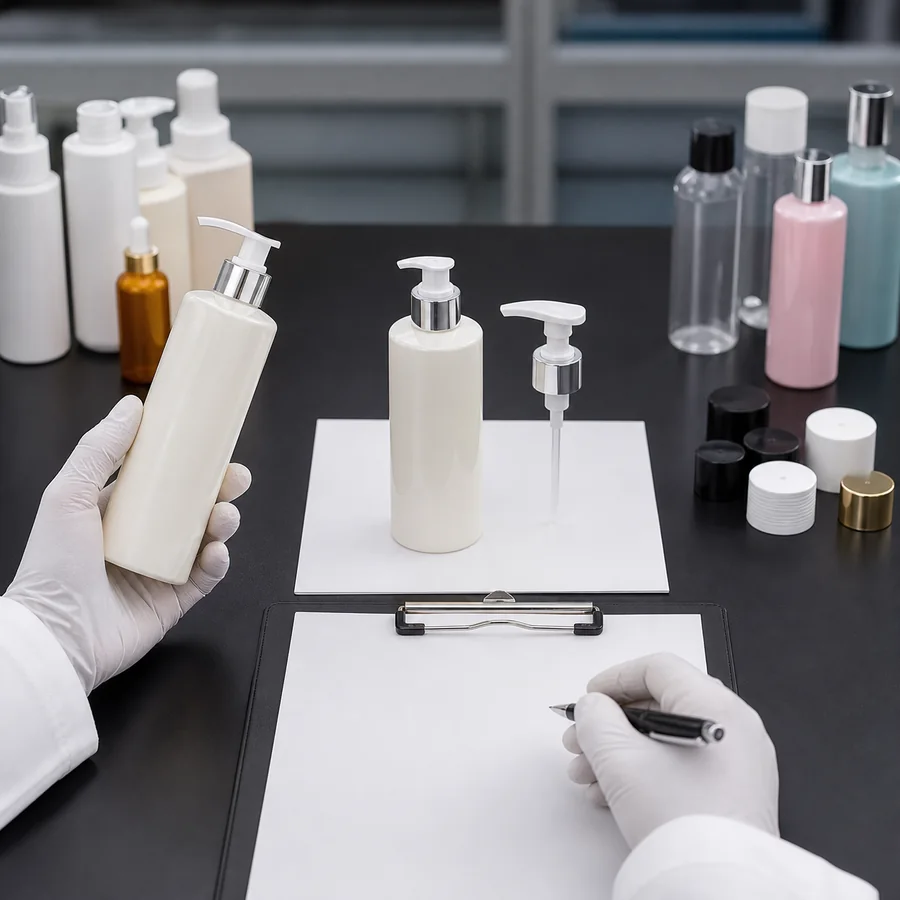
Certificate, test report and factory certification
A supplier certificate, laboratory report and management-system certification provide different evidence. Buyers should not treat them as interchangeable.
A Certificate of Conformity may state that identified goods meet specified requirements. Its relevance depends on the issuer, product identification, referenced criteria and supporting assessment basis.
A laboratory report records the results of defined testing. The report may support a specific product or material decision within its stated sample and method scope.
ISO 9001 certification concerns an organization’s quality management system and the activities covered by the certificate. It does not independently establish that a particular glass bottle, pump, coating or finished cosmetic meets a specified chemical or compatibility requirement.
The International Organization for Standardization’s ISO 9001 information explains the quality-management scope of the standard.
Buyers should also avoid treating RoHS documentation as a universal cosmetic packaging requirement. EU RoHS restrictions principally concern electrical and electronic equipment within the directive’s scope. Their applicability to a particular product must be established rather than assumed from a general packaging checklist.
Buyer action: Review available documentation against FOLOVER PACK manufacturing capabilities and the exact commercial packaging configuration. A supplier’s company profile or management-system certificate should not replace relevant product-specific evidence.
Evidence to retain: Certificate issuer, applicable standard, certified organization and site, covered activities, validity where applicable, and separate evidence for the selected packaging components.
How to verify whether a document applies
A document is applicable only when its stated scope can be connected to the actual purchasing item and the decision being made. Similar appearance, shared capacity or a common supplier name are not sufficient on their own.
Compare the document against the approved packaging BOM, component code, drawing, material, color, decoration and supplier. Confirm the relevant production version and manufacturing source where these affect the assessment.
For example, a glass serum bottle may be offered with two different dispensing pumps. A report covering one pump’s materials should not automatically be applied to the other, even if both pumps fit the same bottle.
The buyer should verify whether the document covers the bottle body alone or also includes the closure, gasket, dip tube, dropper, label and decoration.
Where an existing document covers a material family or group of products, confirm that its defined scope and supporting assessment permit the selected commercial item to be included.
Buyer action: Build a document-to-component cross-reference inside the packaging compliance file. Record which items are supported and which require additional evidence rather than relying on document filenames.
Evidence to retain: Document ID, approved item or BOM code, relevant material and supplier, scope statement, document revision, reviewer conclusion and identified exclusions.
Organize documents by decision and component
A useful packaging document library should allow buyers to retrieve evidence by commercial component and approval question, not only by document type.
For each relevant item, maintain a controlled record connecting its product code, supplier, material, selected version, available documentation and approval status.
Keep original supplier documents unchanged. Record the buyer’s interpretation separately so that another reviewer can distinguish the supplier’s actual statement from the internal conclusion based on that statement.
For example, a document may establish that one specified coating material was evaluated against a named requirement. The internal approval record should not expand that conclusion to every coating, color or decorated bottle supplied by the same company.
Superseded documents should remain traceable but be clearly separated from current approval records. When an approved material or component changes, the affected evidence should be reviewed before the replacement is released for production.
Buyer action: Connect documentation with packaging traceability so that supplier, material and production changes trigger the appropriate review.
Evidence to retain: Controlled document index, original source file, commercial component reference, review conclusion, approval status, applicable validity or review conditions and supersession history.

Common document failures
The main documentation risk is not necessarily a missing certificate. It is using an authentic document to support a conclusion outside its actual scope.
Common purchasing errors include accepting a report for the wrong material or component, using an outdated document after a supplier change, confusing nominal specifications with controlled tolerances, and treating a factory management-system certificate as product compliance evidence.
Other problems include requesting a finished-bottle SDS without identifying the relevant chemical, treating a supplier declaration as a laboratory test report, accepting an incomplete report or failing to link its tested sample to the approved commercial packaging.
For example, a buyer may receive a COA for a coating raw material and assume that it proves the appearance and chemical compliance of the finished decorated bottle. The COA may be authentic, but its results do not automatically establish the performance or regulatory status of the final coating applied to the selected glass container.
Buyer action: Require a short approval conclusion for each critical document. State what the evidence supports, what remains outside its scope and whether additional supplier information, physical sample approval or testing is necessary.
Evidence to retain: Reviewed original document, accurate translation where needed, defined conclusion, stated limitations, responsible reviewer and review date.
Worked Buyer Scenario
Illustrative procurement scenario: A skincare brand is developing a glass serum bottle with a dispensing pump and a custom-colored exterior coating.
The buyer receives a TDS for the bottle, an SDS for the coating material, an ISO 9001 certificate from a supplier, a REACH declaration for the glass body and a laboratory report covering a previously approved coating color.
All five documents may be authentic, yet they answer different questions and do not automatically establish the suitability of the final assembled packaging.
The TDS identifies the bottle’s technical characteristics. The SDS provides relevant chemical hazard and handling information for the coating material. The ISO 9001 certificate concerns the stated quality-management scope. The REACH declaration addresses the identified material and regulatory provisions within its stated scope. The laboratory report provides results for its tested coating sample.
Before approving the commercial configuration, the buyer should confirm whether the new coating uses the same relevant material formulation and whether the existing evidence covers the proposed color.
The selected pump and sealing components also need to be identified. A report covering the glass body cannot automatically establish the suitability of the replacement pump or its internal materials.
The buyer should link the available documents to the approved component list, identify unsupported items and determine which additional supplier confirmations or physical evaluations are necessary.
Final bottle and closure compatibility should be confirmed using the selected components and physical samples before bulk production. Packaging compatibility should be evaluated with the actual formulation under intended storage and use conditions.
The final approval record should identify the selected bottle, pump, coating, relevant supplier documents, outstanding evidence gaps and approved physical sample.
This scenario illustrates a purchasing and documentation review process. It is not presented as a documented FOLOVER customer incident, a confirmed laboratory failure or evidence of an actual regulatory violation.
Decision-Control Matrix
Use the following matrix to distinguish the purposes of common cosmetic packaging documents. The appropriate document depends on the actual approval question, component and applicable requirements.
| Document type | Main purpose | Typical issuer | What buyers should verify |
|---|---|---|---|
| Technical Data Sheet (TDS) | Describe defined product or material characteristics used for technical selection and specification review. | Product or material supplier. | Exact model, material, revision, units, nominal versus controlled values and referenced drawings. |
| Safety Data Sheet (SDS) | Communicate relevant chemical hazards, handling information and other information required under applicable hazard-communication rules. | Chemical manufacturer, importer or relevant supplier. | Actual substance or mixture, supplier, revision, applicable requirements and relationship to the finished packaging. |
| Certificate of Analysis (COA) | Report defined analytical or quality results for an identified material, batch or lot. | Material supplier, manufacturer or relevant testing organization. | Lot identification, actual results, methods, units, acceptance criteria and whether the results apply to the delivered material. |
| Supplier Declaration | State a defined conclusion concerning a specified product, material or regulatory requirement. | Relevant supplier or responsible issuing organization. | Identified components, named requirements, assessment basis, declaration date, issuer and limitations. |
| Third-Party Test Report | Document the results of defined laboratory testing on an identified sample. | Testing laboratory. | Tested sample, method, results, relevant limits, laboratory scope and applicability to the commercial component. |
| Management-System Certificate | Confirm certification of an organization or site within the specified management-system scope. | Certification body. | Certified organization, site, standard, covered activities, certificate status and whether separate product evidence is required. |
None of these documents should be described as universal proof of complete cosmetic packaging compliance. The buyer should connect each record to the specific technical, quality or regulatory decision it supports.
Pre-Production Buyer Checklist
- Identify the destination markets, intended cosmetic application and responsible reviewers.
- Confirm the selected bottle, closure, sealing components, decoration and approved packaging BOM.
- Request the applicable TDS or product specifications for the commercial components.
- Identify whether SDS information is relevant to the specific chemicals or mixtures involved.
- Request COA or batch-related evidence only where defined characteristics require verification.
- Match supplier declarations and laboratory reports to the exact material, component and regulatory or technical question.
- Record document limitations and unresolved evidence gaps.
- Confirm the final assembled packaging using the selected physical samples and relevant compatibility evaluations.
- Establish supplier change-notification requirements before releasing the purchase order.
- Retain the approved component list, original documents, physical sample records and final approval decision.
Frequently Asked Questions
Can one supplier certificate approve the complete cosmetic package?
No. A supplier certificate or declaration supports only the products, materials and requirements within its documented scope. A cosmetic packaging system may include separately supplied glass, pumps, gaskets, caps, coatings and labels. Buyers should match the available evidence to the exact commercial components and obtain additional information where one document does not cover the required approval decision.
Does a third-party report remove the buyer’s responsibility?
No. A third-party report provides evidence for the tested sample, method and conditions. It does not automatically establish compliance for every component, production batch or destination market. The responsible business should review the report’s relevance, identify its limitations and obtain any additional technical or regulatory assessment needed for the actual finished product.
Can similar-looking packaging share the same evidence?
Only when the relevant materials, component construction, manufacturing sources and processes have been evaluated and the evidence scope supports the proposed grouping. Two visually similar bottles may use different coatings or closures. Buyers should confirm the applicable equivalence before reusing material declarations, laboratory reports or existing physical sample approvals.
When should evidence be reviewed again?
Review the affected documents when relevant changes occur to the packaging component, material, supplier, decoration, manufacturing process, formulation, destination market or applicable requirements. A change does not automatically require every test to be repeated. Buyers should identify the affected evidence and determine which additional supplier confirmations, evaluations or approvals are necessary.
What can FOLOVER PACK support?
FOLOVER PACK can support cosmetic glass packaging selection, bottle development, component coordination, decoration, physical samples, relevant quality checks and available product-specific documentation. The exact supporting information depends on the selected commercial configuration and supplier evidence. Buyers can contact FOLOVER with their packaging requirements and requested documents to clarify available support before purchasing.
Is this article legal advice?
No. This article provides practical guidance for reviewing cosmetic packaging documents, supplier evidence and production approval. The applicable requirements depend on the finished product, materials, destination market and business responsibilities. Buyers should consult current official sources and qualified technical or regulatory professionals when determining the obligations applicable to their specific packaging project.
Official Sources Reviewed
Regulatory requirements and technical standards may change. The following official sources provide the context for the documentation and supplier-evidence principles discussed in this guide. Buyers should confirm the requirements applicable to their actual packaging project and destination market.
- OSHA Hazard Communication Standard overview — Explains hazard communication requirements, including the development and provision of SDSs for covered hazardous chemicals.
- OSHA Safety Data Sheets brief — Explains the purpose and structure of safety data sheets.
- ECHA Candidate List obligations — Explains relevant REACH information and notification obligations concerning Candidate List substances in articles, substances and mixtures.
- ECHA Safety Data Sheets — Explains the role of SDSs and relevant supply requirements under REACH.
- ISO 9001 Quality Management — Provides information about the quality-management scope of ISO 9001 and the distinction between management-system requirements and product-specific assessment.
Conclusion
Cosmetic packaging documents are useful only when their scope matches the actual purchasing and approval decision. A TDS, SDS, COA, supplier declaration or test report should not be treated as interchangeable evidence or presented as universal proof of compliance.
Before bulk production, buyers should confirm the exact bottle, closure, decoration and commercial version, then identify which documents support the relevant technical, quality and regulatory decisions. Missing or insufficient evidence should be addressed according to the actual requirement rather than by collecting unrelated certificates.
FOLOVER PACK can assist with cosmetic glass packaging selection, component coordination, decoration, physical sample preparation and available product-specific documentation. These services can support the buyer’s packaging-development and evidence-collection process without replacing the finished product’s legal or safety responsibilities.
If you are developing a cosmetic packaging project, share your preferred bottle or jar, intended application, closure requirements, decoration, destination market and documentation needs. FOLOVER can review the relevant packaging options and clarify which specifications, supplier information and physical samples can be supplied for further evaluation.