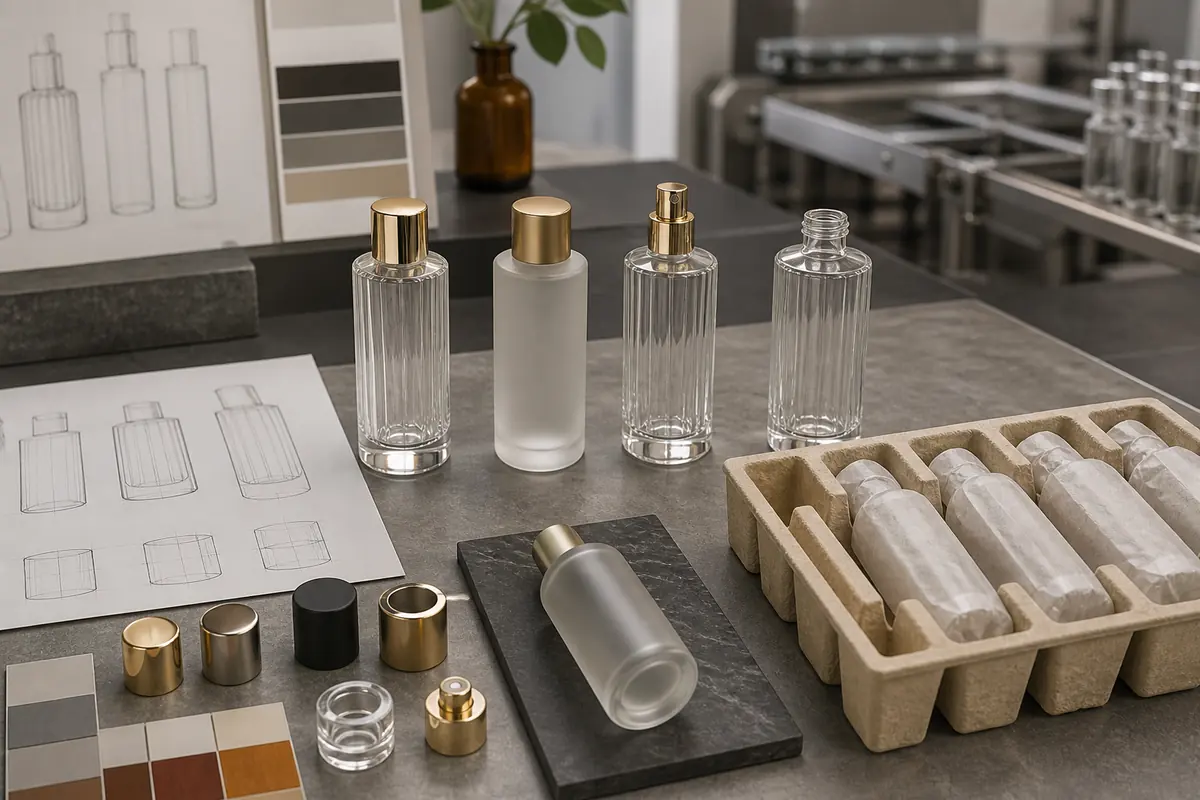

Cosmetic Packaging for Ecommerce and Retail should be designed for more than one viewing condition. The same bottle may appear as a small mobile thumbnail, a studio product image, a social-media crop, a physical retail pack and a parcel shipment. A design that succeeds in only one of those environments can create problems elsewhere.
For B2B buyers, the practical objective is to build one recognizable packaging system that remains readable, photographable, physically functional and controllable in production. Bottle geometry, closure selection, decoration, artwork, secondary packaging and transport protection should therefore be reviewed together. Exact compatibility, performance, test conditions and commercial terms remain project-specific and should be confirmed against the selected components and physical samples before bulk production.
| Channel | Main Packaging Priority | Common Failure | What Buyers Should Approve |
|---|---|---|---|
| Ecommerce listing | Recognizable silhouette, contrast and product identity at small image sizes | Important details disappear in thumbnails | Real product photography at desktop and mobile viewing sizes |
| Retail shelf | Readable hierarchy, physical proportion and shelf-facing recognition | Pack looks strong alone but disappears beside competitors | Actual-size bottle and carton in a realistic shelf context |
| Social media | Recognition in crops, hand-held images and vertical formats | Identity depends on fine text or full-pack visibility | Vertical, cropped and lifestyle photography |
| Parcel shipment | Closure security, surface protection and protective pack-out | Retail carton is treated as the shipping solution | Final assembled package under an agreed transport test plan |
| Repeat production | Traceable component and artwork references | Photography represents a configuration different from bulk production | Approved sample, component list and artwork revision |
Understand Retail Shelf Context
Retail packaging is seen beside other products rather than in isolation. Silhouette, color block, facing width, closure proportion and information hierarchy all affect whether the product remains recognizable at normal shelf distance.
Mock up neighboring products or at least compare representative category packaging before the design is frozen. A bottle that looks distinctive against a white presentation background may become visually quiet when several similar shapes, colors and cartons surround it.
For purchasing, translate the approved shelf direction into identifiable packaging references: bottle, closure, decoration, artwork and carton. “Looks premium on shelf” is a design objective; an approved physical assembly is a purchasing reference.
Key takeaway: Ecommerce and retail should share one brand system, but each channel exposes different weaknesses. Test recognition, readability, photography and physical handling separately before treating the design as approved.
Design for Ecommerce Thumbnails
Ecommerce packaging has to remain identifiable after the image is reduced. A detailed illustration, fine typography or subtle metallic treatment may look excellent at full resolution while contributing very little when the product appears among search results on a phone.
Test the actual bottle and carton as small images. The viewer should still be able to identify the brand, product type or important SKU cue without relying entirely on fine copy. Stable silhouette, controlled contrast and clear color architecture usually carry more recognition at thumbnail scale than additional decorative detail.
Manufacturer Insight
FOLOVER recommends checking thumbnail performance before adding another decoration process. If the brand already reads clearly through bottle shape, closure proportion, color and logo placement, an additional finish may increase sampling and approval complexity without materially improving ecommerce recognition.

Plan Product Photography
Glass packaging changes significantly with lighting. Clear walls reveal the formula and internal dispensing components, frosted surfaces diffuse highlights, dark coatings can show dust or fingerprints, and metallic collars or hot-stamped details may create strong reflections.
Photography should therefore be considered before bulk production rather than after the packaging is finished. Test a representative physical sample from the front, side and three-quarter angle, then include group shots if the brand has several SKUs. Check how the bottle looks filled where formula color, transparency or fill level affects the visual result.
The objective is not to make packaging easier for a photographer at any cost. It is to identify surfaces, reflections, low-contrast artwork or component relationships that become unexpectedly difficult to communicate through product imagery.
Prepare for Social and Mobile Views
Social and mobile content often crops a pack more aggressively than an ecommerce product page. The closure may be outside the frame, a hand may cover part of the bottle and vertical video may show the package for only a short period.
Test whether brand recognition survives those conditions. A consistent logo zone, distinctive silhouette, stable color system or recognizable closure language can help the package remain identifiable when not every detail is visible.
Do not solve mobile visibility by increasing every graphic element. The stronger approach is to decide which one or two cues must survive at small scale and let supporting information remain secondary.
Avoid Render-Only Decisions
Three-dimensional renderings are useful for exploring geometry, color and artwork placement, but they do not establish real glass reflections, tactile feel, decoration appearance, closure fit or carton performance.
A rendering can also make transitions between bottle and closure look cleaner than the physical assembly. Visible gaps, collar height, actuator proportion, surface texture and filled appearance should therefore be evaluated on representative components before the project is released.
Test Real Photography Early
Early photography exposes issues that are difficult to judge from CAD files or artwork. Common examples include glare over fine text, a logo disappearing against a filled formula, unexpected reflections from metallic components or a closure that visually dominates the bottle.
Use a sample that is close enough to the intended final configuration to make the test meaningful. Photographing a clear undecorated bottle does not prove how a coated and printed version will behave under the same lighting.
FOLOVER Project Example: Color and Readability Across a Serum Range
In one multi-SKU serum-packaging project, the bottle shape remained consistent while bottle colors differentiated products in the range. The approval process moved through physical color samples and then logo samples because lighter bottle colors reduced the contrast of similarly light artwork. The project illustrates a useful cross-channel principle: SKU color can support group photography and retail navigation, but bottle color and print legibility should be approved as separate decisions.

Coordinate Bottle and Carton
Retail may present the carton as the main shelf-facing surface, while ecommerce may show the bottle alone, the carton alone or both together. The two packages should therefore use one recognizable hierarchy rather than functioning as separate graphic projects.
Develop the carton around the final assembled bottle. Closure height, bottle orientation, insert structure and decorated surfaces all affect fit. Check whether the product moves inside the insert, whether decoration contacts internal packaging and whether the bottle can be removed without unnecessary friction against finished surfaces.
A visually refined retail carton is not automatically suitable as a direct-shipping container. Retail presentation and distribution protection are related but different packaging decisions.
Keep Information Readable at Several Scales
The bottle, carton, ecommerce gallery and detail page do not need to carry the same information density. The physical pack should preserve required labeling information and a clear hierarchy, while digital channels can provide additional explanation through images and product-page content.
For U.S. cosmetics, the FDA Cosmetics Labeling Guide addresses prominence, conspicuousness, panel placement and type size for required cosmetic labeling. In the EU, Regulation (EC) No 1223/2009, Article 19, requires specified information on cosmetic containers and packaging to be indelible, easily legible and visible.
These requirements vary by market and product configuration. Buyers should confirm the applicable labeling rules before artwork approval instead of shrinking required information to solve a crowded design.
Build a Recognizable SKU System
A strong SKU system helps consumers connect several products to the same brand while still distinguishing formula, function or capacity. Bottle family, typography, logo placement and closure language can remain stable while controlled color, naming or artwork identifies individual variants.
For ecommerce, compare the entire line as thumbnails. For retail, compare the same range side by side at actual size. A differentiation method that works only in enlarged artwork may not provide enough distinction when products appear together.
Brands managing larger ranges can use the cosmetic packaging system across multiple SKUs to map shared and SKU-specific components before sampling expands.

Plan Shipping Protection
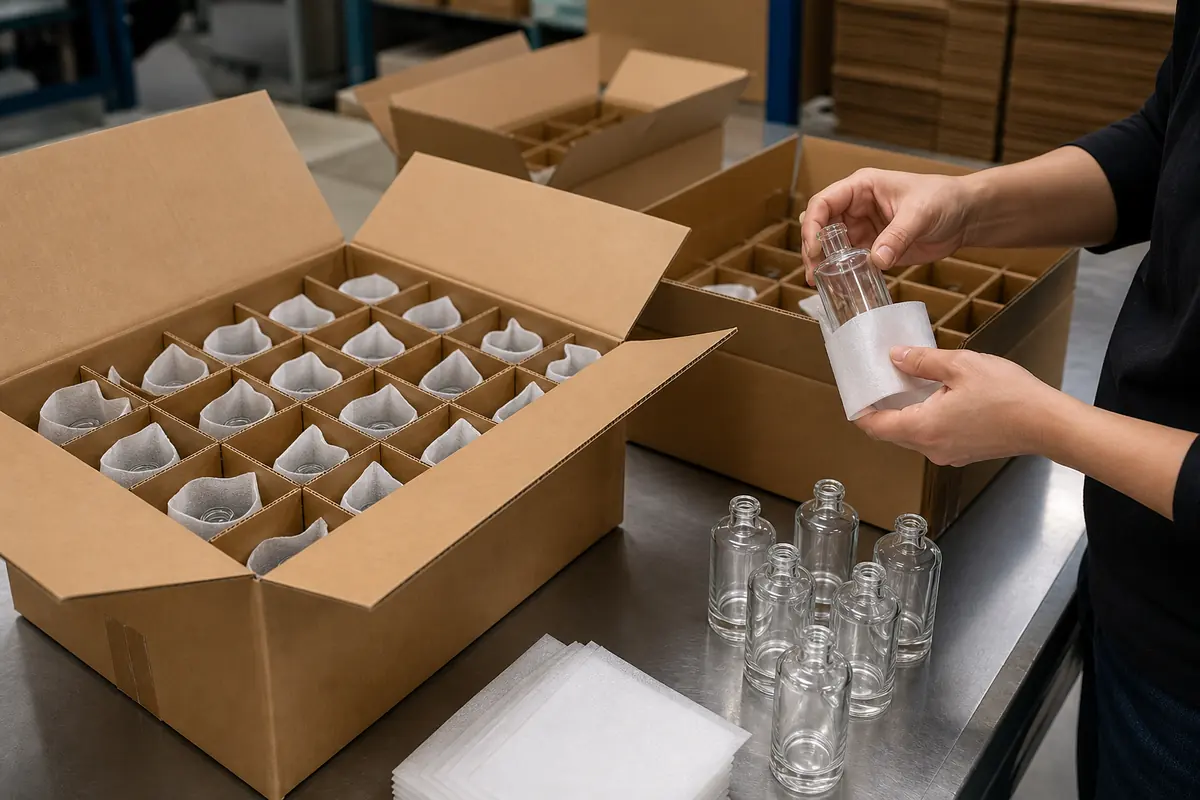
Ecommerce distribution can expose glass packaging, closures and decorated surfaces to repeated handling that is different from simply placing a finished pack on a retail shelf. Review closure security, bottle movement, surface contact, insert fit and outer shipping protection using the final assembled configuration.
Transport testing should match the actual distribution route rather than an arbitrary test copied from another project. The International Safe Transit Association describes ISTA 3-Series procedures as general simulation tests of transport environments. Its Procedure 3A is intended for individual packaged products of 150 lb (70 kg) or less moving through parcel-delivery systems. Whether that procedure or another protocol is appropriate should be agreed for the product, pack-out and distribution channel.
Do not invent a universal acceptable breakage rate, drop height or number of cycles for cosmetic glass packaging. Testing conditions and acceptance criteria should be defined for the actual project.
What to Review for Ecommerce Shipment
- Final bottle and closure assembly
- Closure security under the selected packing method
- Bottle movement inside the carton or insert
- Contact between decorated surfaces and protective materials
- Glass-to-glass or component-to-glass contact where multiple units are packed together
- Outer shipping protection for the intended distribution route
- Package condition after the agreed transport test
Align Claims and Imagery
Online imagery should represent the packaging configuration the customer will actually receive. When a cap, bottle color, decoration or carton changes, obsolete product photography should be reviewed rather than automatically reused.
Claims also require discipline. The U.S. FDA guidance on cosmetic labeling claims states that cosmetic labeling claims must be truthful and not misleading and that claims intended to treat or prevent disease, or affect the structure or function of the body, may cause a product to be regulated as a drug.
Packaging suppliers should not create unsupported efficacy claims from a bottle feature. Amber glass, an airless-style appearance, thick glass or a premium closure does not by itself establish formula stability, treatment performance or universal protection.
Avoid Common Cross-Channel Mistakes
Many cross-channel problems are not dramatic manufacturing failures. They are small decisions made separately: fine artwork that cannot be read online, a high-gloss surface that photographs poorly, a closure change after carton approval or a retail carton that was never evaluated for parcel shipment.
The solution is not to make the package more complicated. It is to identify which channel exposes each risk and build those checks into the approval sequence.
Connect Design Choices to Related Packaging Decisions
Design quality improves when teams connect the main topic with adjacent technical and commercial decisions. Review premium cosmetic packaging design, cosmetic packaging system across multiple SKUs, how ecommerce is changing cosmetic packaging, and cosmetic glass bottle export packing. These related guides address different parts of the same system and are planning resources rather than substitutes for project-specific drawings, samples or tests.
For wider planning, use the skincare packaging guide and custom packaging solutions. Suitable product formats can be reviewed through cosmetic and skincare glass packaging. These pages support selection and development, but the exact bottle, closure, decoration and protective-packaging configuration still requires verification.
What Buyers Should Put in the Design Brief
- Target customer, market, ecommerce channel and retail environment
- Product type, formula considerations and dispensing preference
- Required capacities, bottle family and future SKU plan
- Exact closure, pump, sprayer or dropper interface to validate
- Color, finish, decoration and artwork priorities
- Primary ecommerce image, group-image and mobile-view requirements
- Retail carton and shelf-facing requirements
- Artwork readability and destination-market labeling requirements
- Carton, insert and protective packing requirements
- Expected parcel, case-pack or bulk distribution route
- Agreed sample and transport-evaluation stages
- Approval owners and retained reference samples
- Commercial quantities and timing confirmed separately for the project
Use Samples as Decision Evidence
Physical samples reveal scale, weight, reflection, color, tactile feel, fit and assembly behavior that a rendering cannot fully establish. For a cross-channel project, the sample should also be photographed, handled and packed because those activities reveal different weaknesses.
Cross-Channel Sample Evaluation
- Review actual-size bottle and closure proportion
- Photograph the product against intended ecommerce backgrounds
- Reduce images to realistic mobile and thumbnail sizes
- Compare individual and multi-SKU group images
- Review label and decoration readability on the physical pack
- Confirm carton and insert fit around the final assembly
- Check decorated surfaces for contact within the pack-out
- Evaluate the selected protective packaging under the agreed distribution test
Keep the approved sample, drawing, component list, artwork revision and packaging configuration connected. If a bottle, closure, finish, formula, carton or protective pack changes, identify which earlier approvals need to be repeated rather than assuming the previous evidence still represents the revised product.
Manufacturer Insight
A cross-channel approval sample should represent what purchasing will actually order. If marketing photographs one closure while the purchase specification lists another, the problem is no longer only visual—it can affect assembled height, carton fit, compatibility and repeat-order control. Keep marketing references and purchasing references tied to the same final configuration.
FOLOVER Packaging Resources
FOLOVER organizes related design and sourcing guidance under Packaging Design & Branding and Packaging Trends & Insights. Buyers can use these resources to define cross-channel packaging requirements, prepare supplier-ready information and identify which interfaces require physical validation.
Availability, MOQ, lead time, tooling, compatibility, decoration performance and commercial terms must be confirmed for the exact packaging configuration rather than inferred from a general design article.
Related Blog Articles
Frequently Asked Questions
Should cosmetic packaging be designed differently for ecommerce and retail?
The brand system should remain consistent, but the channels expose different requirements. Ecommerce emphasizes thumbnail recognition, photography and parcel protection, while retail adds shelf context, physical handling and carton presentation. Buyers should evaluate the same final packaging system under both sets of conditions rather than creating disconnected designs.
How can a cosmetic bottle remain recognizable in ecommerce thumbnails?
Prioritize cues that survive image reduction, such as silhouette, major color blocks, closure proportion and clear logo placement. Fine copy or subtle decoration may disappear at small sizes. Test real product images at realistic mobile and search-result sizes before final artwork approval.
Does a retail carton automatically provide enough protection for ecommerce shipping?
No. A retail carton is primarily part of the product presentation and may not provide sufficient protection for parcel distribution by itself. The final bottle, closure, insert, retail carton and outer shipping configuration should be evaluated together using a transport test plan appropriate to the actual distribution route.
Should decorated cosmetic bottles be photographed before bulk production?
Yes, when possible. Representative decorated samples can reveal glare, weak artwork contrast, reflections, formula visibility and closure-to-bottle proportion before bulk production. A rendering is useful for design development, but it cannot fully establish how the physical glass, decoration and components will photograph.
Can one cross-channel sample approval cover a changed closure or bottle?
Not automatically. A closure or bottle change can alter compatibility, assembled height, visual proportion, photography and carton fit. Buyers should identify which earlier approvals and tests need to be repeated whenever the physical configuration changes.
What should buyers approve before releasing cosmetic packaging for ecommerce and retail?
Buyers should confirm the bottle, closure, decoration, artwork, physical readability, ecommerce photography, SKU distinction, carton fit and protective-packaging configuration. Keep the approved sample, component list and artwork revision connected so marketing images and purchasing specifications refer to the same product.