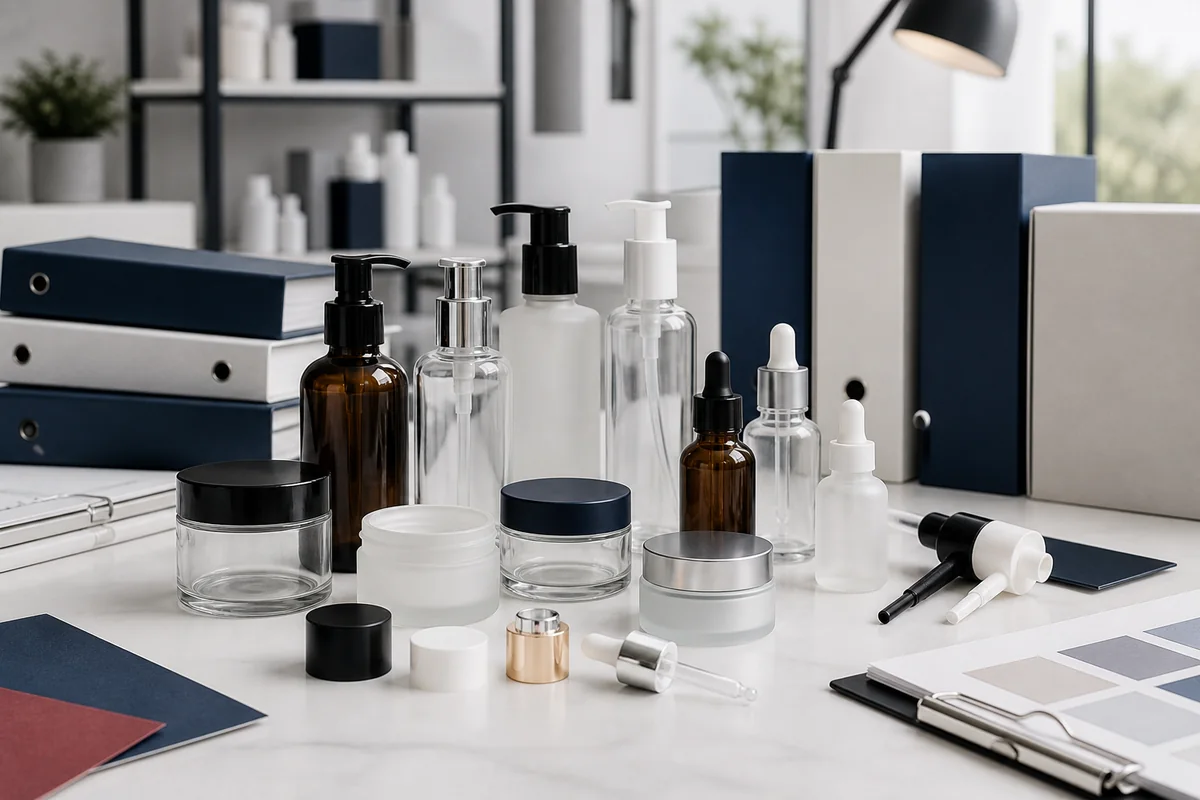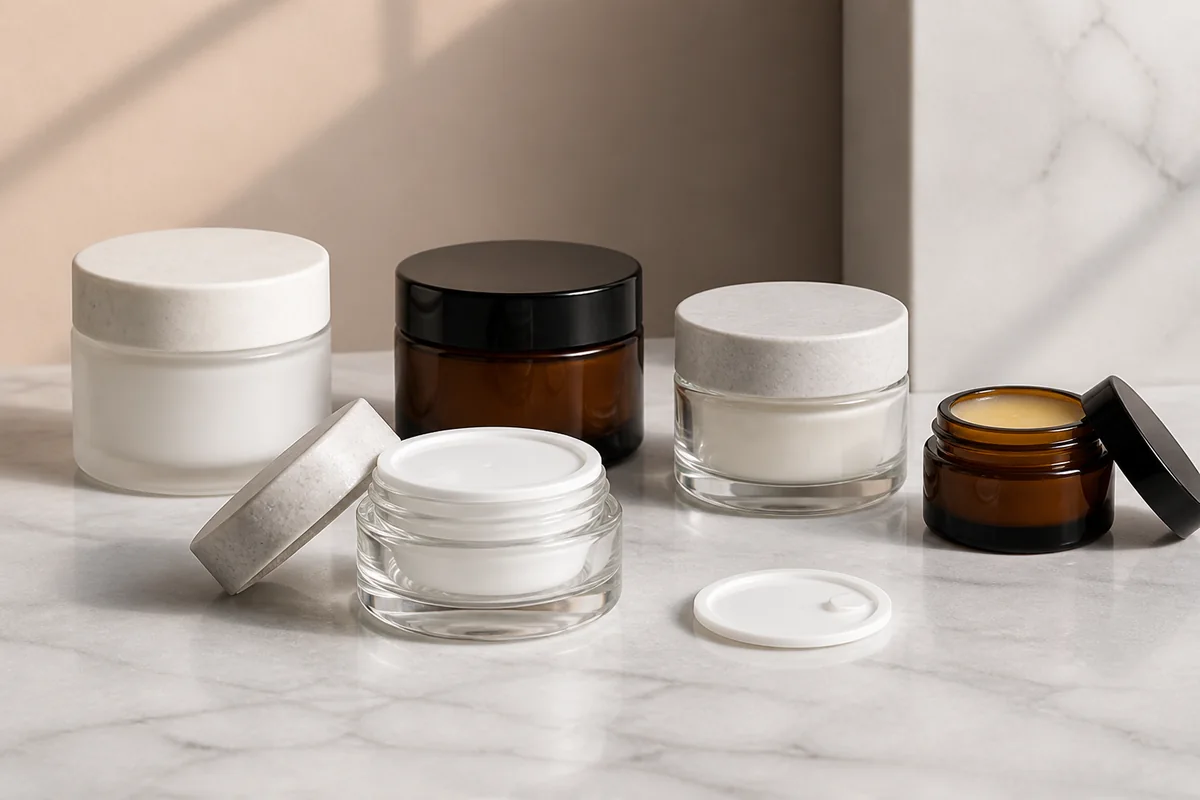
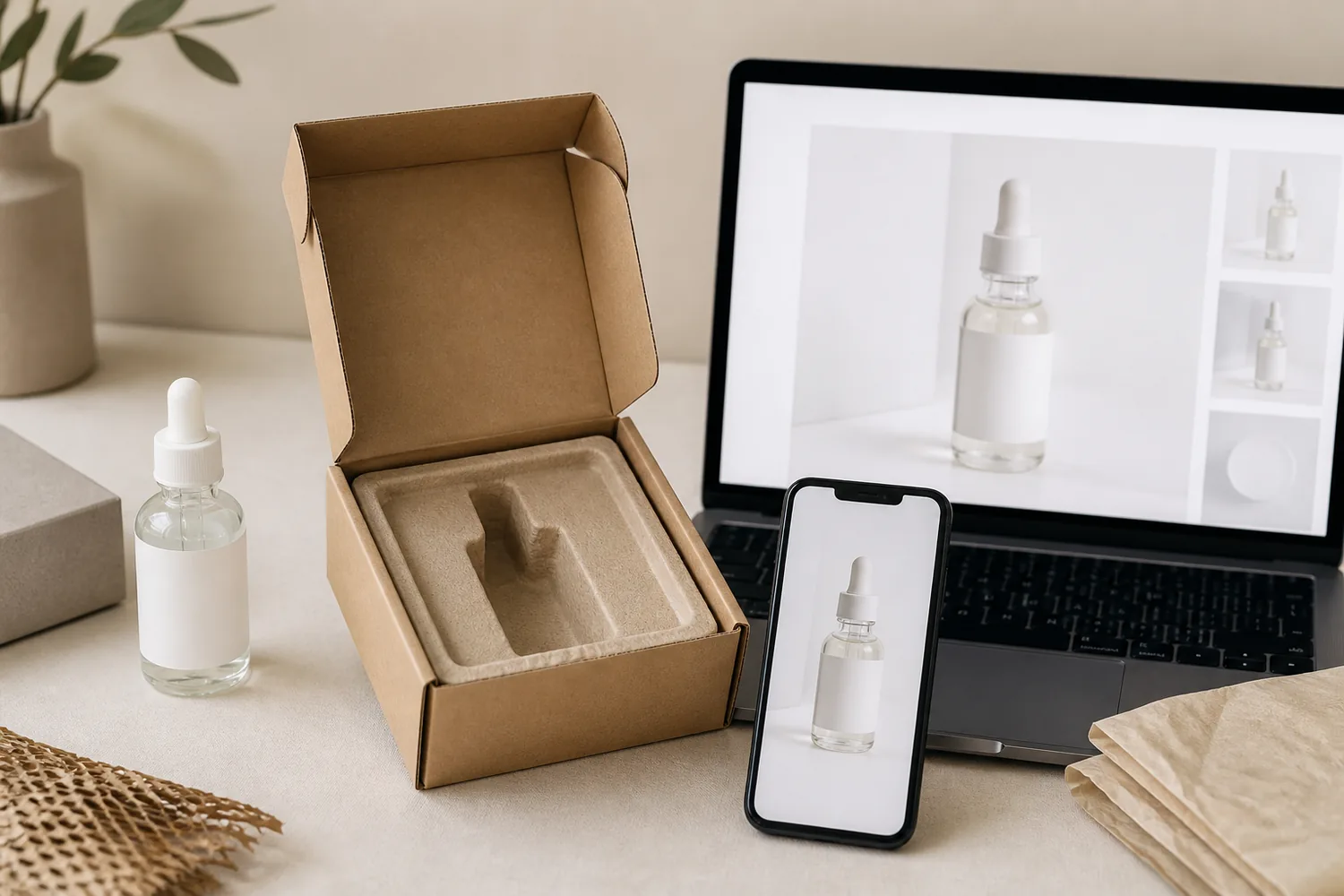
Cosmetic packaging was once designed primarily for a controlled retail sequence: a buyer approached a shelf, saw many packs at full size, picked one up, and compared information in person. E-commerce breaks that sequence apart. A package may first appear as a small thumbnail, then as a product image, then as a parcel moving through a distribution network, and finally as an object photographed by a customer in uncontrolled light.
E-commerce is changing cosmetic packaging design by making digital recognition, accurate product photography, parcel protection, efficient secondary packaging, and the delivered customer experience essential design requirements. A glass bottle must look recognizable online while remaining functional, protected, and visually consistent when it reaches the customer.
The relevant design object is therefore a commerce media stack: thumbnail, product-detail page, delivered parcel, unboxing sequence, and customer-created image. A strong package performs coherently in all five environments without optimizing one at the expense of another.
Core viewpoint: E-commerce has shifted cosmetic packaging design from shelf presence to channel resilience. Visual distinction matters, but so do honest digital representation, packed-product protection, operational efficiency, and the appearance of the product after real delivery. Brands should approve the complete packaging system rather than treating photography, bottle development, and parcel protection as separate projects.
Shelf Presence Is No Longer Enough
Retail packaging benefits from physical scale, lighting, touch, adjacent products, and a shopper’s ability to rotate the pack. Online, much of that context disappears. The same bottle may be cropped tightly on a marketplace, shown without a size reference, or reduced to a small image on a phone.
Fine typography, subtle embossing, and small color differences that feel elegant in person may become almost invisible. Conversely, a dramatic silhouette that dominates a thumbnail may create inefficient cartons or poor case packing.
The objective is not to abandon shelf design. Many brands sell through several channels, and a design that works only online can fail in retail, wholesale samples, or distributor presentations.
Teams should map the actual channel mix and decide which cues must remain constant everywhere: silhouette, color block, closure profile, label hierarchy, and the relationship between bottle and secondary pack.
The Packaging Design & Branding hub covers how those cues build a recognizable system, while the Packaging Trends & Insights hub tracks the commercial forces changing that system.
Packaging Must Work as a Thumbnail
A thumbnail is not a miniature billboard. It is a recognition test under compression. At small scale, the eye tends to register outline, dominant tonal contrast, cap-to-body proportion, and one or two major graphic blocks before it can read words.
Brands should test actual marketplace crops rather than reviewing only a large presentation rendering. The question is whether the correct SKU and brand family remain identifiable without adding visual noise.
Good thumbnail performance often comes from hierarchy. A stable silhouette, controlled color system, legible product type, and one distinctive closure or surface cue can work better than several equally loud effects.
This is also why a premium cosmetic packaging design should be judged by coherence rather than decoration count. Online, uncontrolled reflections or a visually complicated label can collapse into clutter.
Buyer Decision: Test Recognition Before Approving Decoration
Consider a skincare brand developing three serum SKUs using the same glass bottle and closure. The products may be differentiated by subtle coating colors and small printed descriptions.
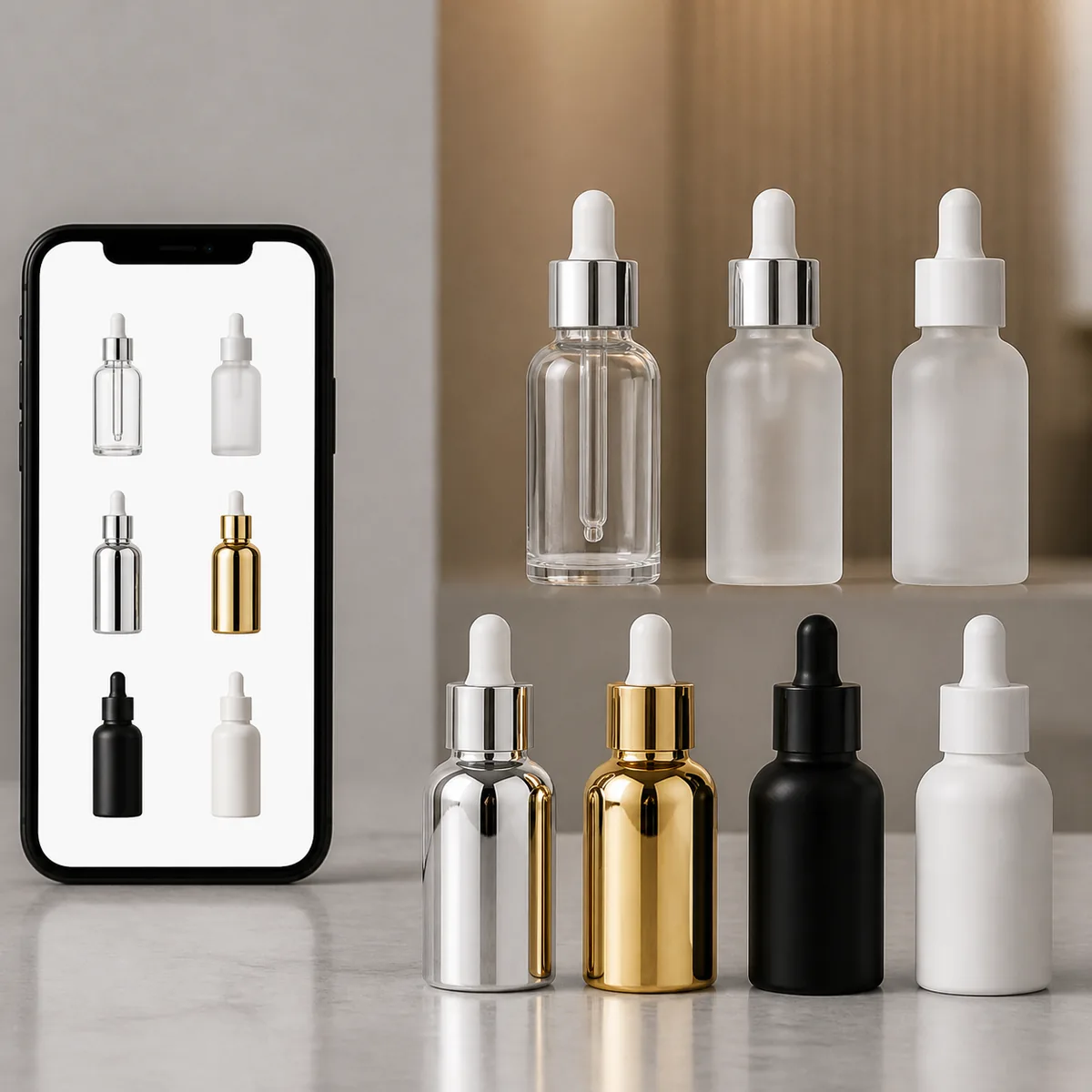
When the designs are reduced to marketplace thumbnail size, the variants may become difficult to distinguish. Adding more decorative processes is not necessarily the solution. A clearer color hierarchy, more visible product identification, or a better-organized label may improve recognition while preserving the shared bottle family.
This is an illustrative design scenario, not a reported customer project or a measured conversion result.
Buyer action: Compare the proposed SKU images at the actual display sizes used by the intended sales platforms. Confirm that the product type, capacity, and variant remain identifiable before approving the final decoration artwork and physical samples.
Product Photography Has Become Part of Package Engineering
Glass, polished metal-look collars, high-gloss coatings, transparent labels, and foil can be difficult to photograph consistently. Reflections may hide contours, reveal studio equipment, or make a color appear darker than the approved sample.
Clear glass can lose its edges against a white background. Frosting may look more opaque online than it is in person. These are not reasons to avoid premium finishes, but they are reasons to include photography trials before the design is frozen.
Brands should compare the physical approval sample with images under the lighting and color-management workflow intended for launch. Product images should clarify rather than exaggerate the package.
If a bottle appears much larger, more opaque, or differently colored online, customers may receive a product that does not match their expectations even when manufacturing meets the approved specification.
A reliable digital asset set includes front, side, closure, dispenser, scale, and pack-out views appropriate to the sales channel.
Manufacturer Insight: Decoration Approval and Photography Approval Are Different Decisions
When developing a decorated cosmetic glass bottle, FOLOVER PACK recommends approving the actual coating, printing, hot stamping, or frosting on physical samples before using the finished design as the reference for commercial photography.
A color approved on a digital rendering may appear different after coating or under retail and home lighting. Metallic collars and decorative finishes can also introduce reflections that change their appearance in photographs.
Buyers should confirm the final bottle color, logo position, decoration finish, and matching closure appearance on the assembled physical sample. Photography should represent that approved configuration rather than establish an appearance that production has not demonstrated.
E-Commerce Makes Shipping Damage More Visible
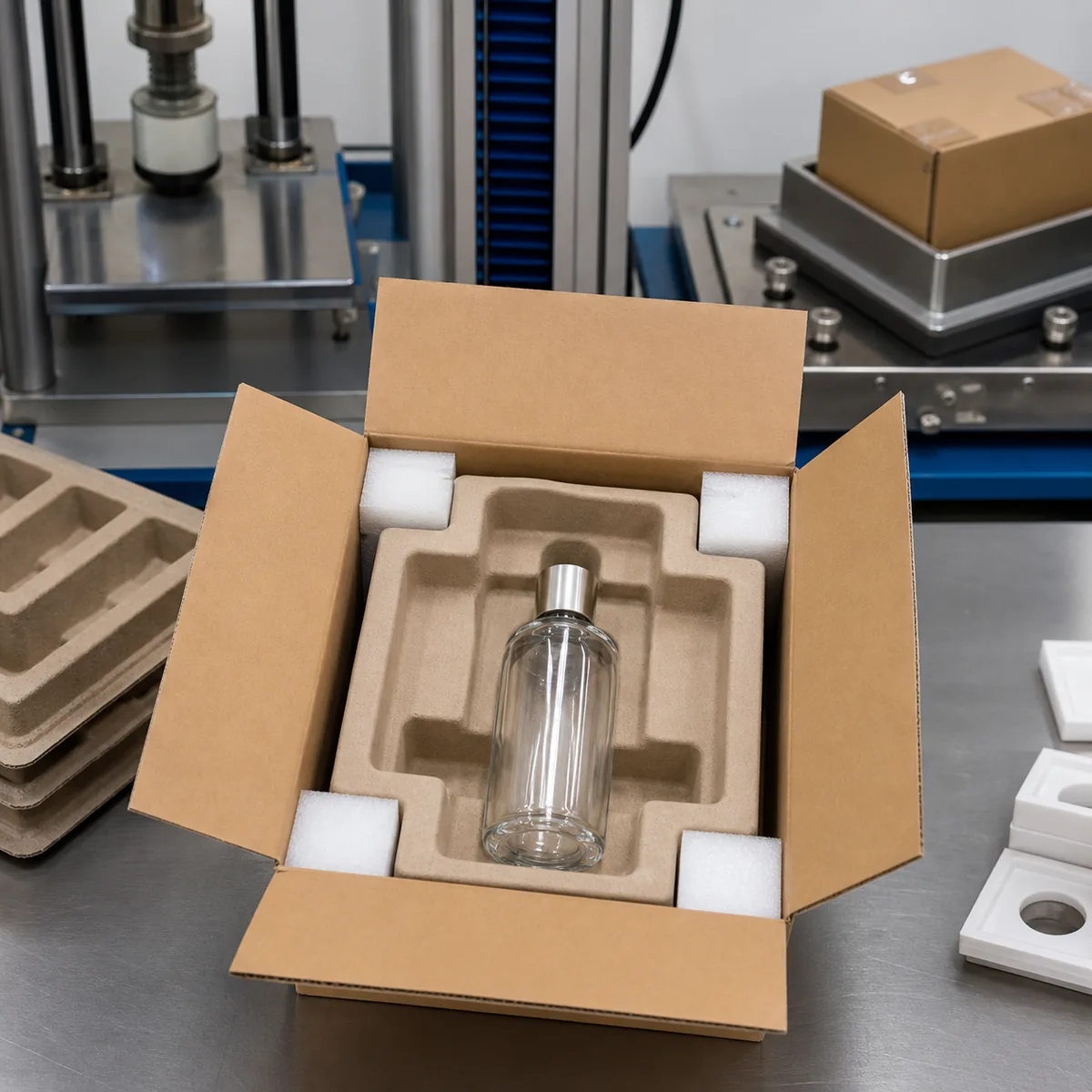
A shelf-ready package may travel to retail in a master carton and reach the shopper under relatively controlled handling. A direct-to-consumer order can move through sorting, drops, vibration, compression, temperature variation, and multiple orientations as an individual parcel.
Glass bottles, pumps, droppers, caps, jars, and decorative surfaces can contact each other or the carton unless they are adequately restrained. Leakage that remains inside a retail shipper becomes a highly visible unboxing failure when it reaches one customer.
Protection should be designed around the complete filled pack, not assumed from carton thickness. Bottle mass, dispenser locking, cap retention, insert contact points, decoration abrasion, and void fill all affect the result.
The cosmetic glass bottle export-packing guide explains upstream transit principles; e-commerce adds a last-mile profile that should be defined and tested for the actual route.
How Should Cosmetic Glass Packaging Be Tested for Parcel Delivery?
Parcel-testing requirements should reflect the final packed product, its intended distribution environment, and the relevant failure risks.
The International Safe Transit Association (ISTA) provides packaged-product testing procedures for different distribution environments. ISTA Procedure 3A addresses individual packaged products shipped through parcel delivery systems, including standard, small, flat, and elongated package types.
ISTA 3A provides a general simulation approach for relevant parcel-distribution hazards. However, the appropriate procedure and test conditions depend on the actual shipping configuration and project requirements. A successful packaged-product test does not automatically establish long-term formula compatibility or reliable dispensing under every use condition.
For cosmetic glass packaging, buyers should evaluate the complete filled bottle, selected closure, decoration, protective insert, product carton, and shipping parcel together.
Physical Sample Evaluation for E-Commerce Packaging
- Bottle integrity: Inspect for breakage, chipping, cracks, and damage after the defined distribution evaluation.
- Closure and leakage: Check sealing, cap retention, pump locking, and leakage at relevant component interfaces.
- Dispensing performance: Confirm that the selected pump, sprayer, or dropper functions with the actual formulation after the relevant exposure.
- Decoration durability: Inspect coating, printing, labels, and metallic finishes for abrasion or damage caused by packaging contact.
- Protective packing: Check bottle movement, contact points, insert deformation, and the condition of the final product carton.
Final bottle and closure compatibility should be confirmed using the selected components and physical samples before bulk production. The brand and qualified testing partners should define appropriate test conditions and acceptance criteria for the intended product and distribution environment.
Unboxing Became a Functional Brand Moment
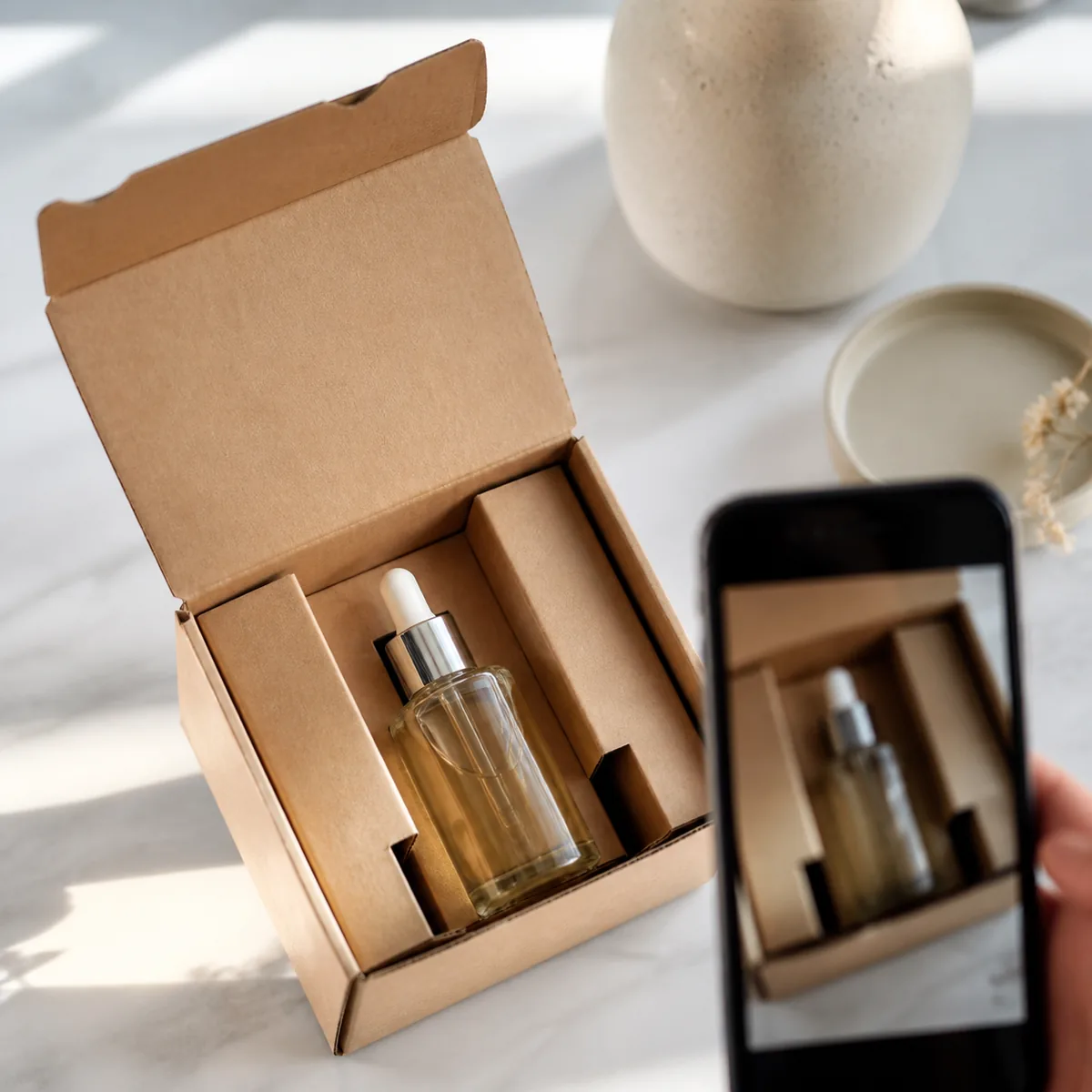
Unboxing is often discussed as theater, but the most valuable experience is usually functional clarity. The customer should recognize the ordered item, remove it without damaging the carton or decoration, understand any transit lock, and access instructions or required information.
Excessive layers can create a premium first impression for a moment while producing frustration, disposal burden, and shipping inefficiency afterward.
A strong sequence makes every layer earn its place. An insert can locate the bottle, protect a pump, separate glass items, or present the product. A sleeve can carry necessary information or control movement. A tamper-evident feature can communicate integrity where appropriate.
A layer whose only role is to fill visual space should be questioned. FOLOVER PACK’s custom packaging solutions can support coordinated bottle, closure, decoration, and pack-development discussions, subject to project-specific validation.
Buyer action: Ask representative users to open the complete shipping parcel without instructions from the packaging-development team. Observe whether they can remove the bottle, identify the product, unlock the dispenser where applicable, and understand how to use or dispose of the packaging components.
Secondary Packaging Is Being Rewritten Around the Parcel
E-commerce can create two opposite mistakes. One is to preserve an oversized retail carton inside an oversized shipping box, multiplying empty space. The other is to remove secondary packaging without testing whether the bottle, closure, label, or decoration remains protected.
Right-sizing is the disciplined middle: the smallest verified system that still performs its protective, information, handling, and presentation functions.
The design team should separate the product carton, insert, shipping parcel, and grouped shipment as different layers with different jobs. Sometimes a robust product carton can reduce extra parcel material; sometimes a fragile decorated bottle needs a dedicated insert.
The trend analysis in how to reduce secondary cosmetic packaging provides the technical companion to this channel shift.
Buyer Scenario: Reducing an Oversized DTC Shipping Box
Consider an independent skincare brand that ships a glass serum bottle inside a retail carton, a protective insert, and a larger parcel box containing additional void fill.
The brand wants a smaller shipping configuration without exposing the bottle to additional damage. The packaging team should first identify which layer restrains the glass bottle, which protects the dropper or pump, and which provides required product information.
A revised configuration could use a better-fitted insert and a more closely sized shipping carton while retaining the product’s required protection and presentation.
However, the revised parcel must be evaluated with the complete filled product. A smaller carton that allows the bottle to contact its walls or creates insufficient closure protection is not an improvement merely because it uses less material.
This is an illustrative packaging-development scenario, not a documented customer project or a measured reduction in shipping costs or breakage.
Packaging Efficiency Also Has a Regulatory Dimension
The European Union’s Packaging and Packaging Waste Regulation (EU) 2025/40 introduces packaging-minimisation requirements and provisions addressing empty space in grouped, transport, and e-commerce packaging.
Article 24 establishes a maximum empty-space ratio of 50% for the packaging within its scope, with the application date determined by the regulation’s specified timeline and implementing measures. The calculation methodology and relevant obligations must be assessed for the exact packaging configuration and destination market.
For buyers, this reinforces the value of documenting packaging dimensions, protective functions, and the reason for each material layer rather than treating oversized secondary packaging as an automatic expression of premium quality.
Review Photos Are a New Packaging Test Environment
Customer images are rarely made under studio lighting. They show fingerprints, label wrinkles, scuffed caps, color variation under warm lamps, leaked product, and the relationship between actual size and the customer’s hand.
They also show when a package arrives clean, coherent, and easy to use. For prospective buyers, these images provide an additional view of the delivered condition beyond the brand’s polished product photography.
This changes design priorities. Surfaces should be reviewed for handling marks, not only first inspection. Decoration should be assessed after packing and transit. Closures should remain aligned. Product information should be readable without perfect lighting.
None of these requirements justify unsupported durability claims; they justify representative sampling and failure-mode reviews before launch.
Buyer action: Photograph the selected physical packaging samples after handling and distribution evaluation under ordinary indoor lighting. Compare those images with the approved product photographs to identify scuffing, visible residue, decoration variation, closure movement, or other discrepancies that may affect the customer experience.
A Better E-Commerce Packaging Brief Uses Five Renderings
An e-commerce cosmetic packaging brief should connect digital presentation, physical product design, and parcel performance. The five-rendering framework below identifies the approval question for each customer encounter.
| Rendering | Design Question | Typical Failure | What Buyers Should Verify |
|---|---|---|---|
| Thumbnail | Can the brand family and SKU be recognized at small scale? | Fine detail collapses or variants look identical. | Compare the actual marketplace image crops for all intended SKUs on mobile and desktop. |
| Product page | Can photography represent color, scale, finish, and function honestly? | Reflection, inaccurate opacity, or misleading size. | Compare approved physical samples with product images, including closure, dispenser, and scale views. |
| Parcel | Can the filled pack survive the defined distribution route? | Leakage, movement, breakage, cap loss, or abrasion. | Evaluate the complete filled and packed product under relevant distribution conditions. |
| Unboxing | Can the customer access and understand the product cleanly? | Excess layers, damage during removal, or unclear dispenser locks. | Observe representative users opening the actual parcel and accessing the product. |
| Review image | Does the delivered pack remain credible in uncontrolled conditions? | Scuffs, fingerprints, misalignment, residue, or poor legibility. | Inspect and photograph production-representative samples after handling and transport evaluation. |
This five-rendering method prevents one channel metric from dominating the brief. A distinctive thumbnail is not successful if the closure leaks. Minimal material is not successful if the bottle breaks. A theatrical unboxing is not successful if it creates excessive freight volume.
The design decision should survive the complete customer sequence, from the first product image to the delivered and used packaging.
Measure the Channel, Not Just the Package
An e-commerce design review becomes more useful when it connects packaging decisions to observable outcomes. Teams can track thumbnail misidentification between variants, product-page questions about size or use, parcel damage by route, leakage or cap-loss complaints, unboxing friction, and the condition visible in customer photographs.
These signals should be segmented where possible. A failure concentrated in one fulfillment route may require a different correction from a failure that appears across every channel.
Metrics also need interpretation. A lower damage rate after adding material does not prove that every added layer is necessary; controlled alternatives may provide equal protection with less volume. A high click-through rate does not prove that the physical product meets expectations. A favorable unboxing comment does not offset leakage.
The practical aim is a balanced scorecard linking recognition, accurate representation, delivered condition, usability, pack efficiency, and returns.
Manufacturer Insight: Approve One Complete E-Commerce Reference Pack
FOLOVER PACK recommends confirming the selected bottle, closure, decoration, carton, insert, and packing method as one reference configuration for the intended e-commerce project.
If the bottle height, cap structure, pump, decoration, or protective insert changes, review whether the previous photography, component compatibility, or transport evaluation remains applicable.
For example, replacing a dropper with a lotion pump may alter the assembled height, required headspace, cap protection, dispensing function, and protective-insert contact points. The original bottle approval alone cannot establish the suitability of the revised finished pack.
Buyers should identify the exact component codes and approved physical samples before bulk production, then document which configurations require separate evaluation.
The commercial importance of the channel is measurable. According to the U.S. Census Bureau’s Quarterly Retail E-Commerce Sales Report, published on August 18, 2026, e-commerce accounted for 17.1% of seasonally adjusted U.S. retail sales in the second quarter of 2026.
This figure covers U.S. retail sales generally. It is not a cosmetic packaging market-share figure, a forecast of beauty-industry growth, or evidence of a specific packaging conversion benefit. It provides broader commercial context for treating digital presentation and parcel performance as continuing design requirements.
What Buyers Should Validate Before Ordering
- Test brand and SKU recognition using actual platform image crops on mobile and desktop.
- Photograph production-representative decorated samples rather than relying on digital renderings alone.
- Confirm the exact bottle, neck finish, closure, dip tube or pipette, and formula compatibility.
- Define the intended parcel-distribution environment and evaluate the complete filled pack under relevant conditions.
- Inspect decoration, sealing, and closure alignment after packing and transport evaluation.
- Measure product-carton and parcel dimensions, empty space, and protective-material requirements.
- Verify that required product information remains legible in the final packaging configuration.
- Observe opening, dispenser unlocking, use, and repacking with representative users.
- Approve the complete bottle, closure, decoration, and protective-packing configuration using physical samples.
- Review customer-service and return data after launch and control any subsequent packaging changes.
Buyers reviewing cosmetic and skincare glass packaging should treat the bottle as one part of this broader system. Exact compatibility, pack-out, test conditions, and approval limits remain project-specific.
The broader skincare packaging guide can help teams connect the online design brief to formula, dispensing, protection, and purchasing decisions before visual concepts are approved.
Frequently Asked Questions
Should e-commerce packaging look different from retail packaging?
Not necessarily. A consistent brand system may serve both channels, but it should be evaluated under each channel’s real viewing, handling, information, and distribution conditions. Channel-specific secondary packaging may be appropriate. Buyers should compare actual digital product presentation, retail requirements, and parcel-protection needs before deciding whether one packaging configuration can support both channels.
Does a good unboxing experience require more packaging?
No. A good experience can come from protection, order, easy access, clear instructions, and coherent design. Extra layers should have a defined function and should not be added merely for visual volume. Buyers should evaluate whether the product carton, insert, and shipping parcel provide sufficient protection while avoiding unnecessary empty space and difficult product removal.
Can product photography replace physical sample approval?
No. Images help evaluate digital representation, but physical samples are needed to assess color, finish, fit, dispensing, handling, decoration, and pack-out. Final approval should define the exact reference and acceptable variation. Buyers should photograph the approved assembled packaging configuration and confirm that the images accurately represent the product that will be supplied.
How should cosmetic glass bottles be protected during e-commerce shipping?
Protection should be designed for the complete filled bottle, selected closure, decoration, product carton, and shipping parcel. The appropriate insert and protective materials depend on bottle geometry, component structure, and distribution conditions. Buyers should evaluate the final packed configuration under a relevant parcel-testing procedure and confirm that the bottle, dispenser, and decoration remain within agreed acceptance criteria.
Can cosmetic brands reduce shipping-box size without increasing breakage?
Potentially, but the revised configuration must be validated. A better-fitted insert or appropriately sized shipping carton may reduce empty space while maintaining protection. However, removing material can increase the risk of bottle movement, impact, or closure damage. Buyers should compare the original and revised filled-pack configurations using relevant distribution testing, measured packing dimensions, and project-specific acceptance criteria.
Conclusion: E-commerce has not made physical packaging less important; it has multiplied the environments in which packaging must prove itself. Brands that design the commerce media stack as one connected system can protect recognition, product integrity, operational efficiency, and customer trust without optimizing one attractive image at the expense of the delivered experience.
For cosmetic packaging buyers, the practical priority is to approve the complete e-commerce packaging configuration—from the bottle and closure to the decoration, protective insert, and shipping carton—using production-representative physical samples.
FOLOVER PACK can support cosmetic glass bottle selection, closure and dispensing-component coordination, decoration development, and project-specific export packing and packaging sample evaluation.
Share your intended bottle type and capacity, formula type, selected closure, decoration requirements, target order quantity, destination market, and expected distribution channel to discuss suitable packaging options and sample-matching requirements.
That discipline turns channel resilience into a repeatable packaging requirement rather than a late-stage marketing correction.