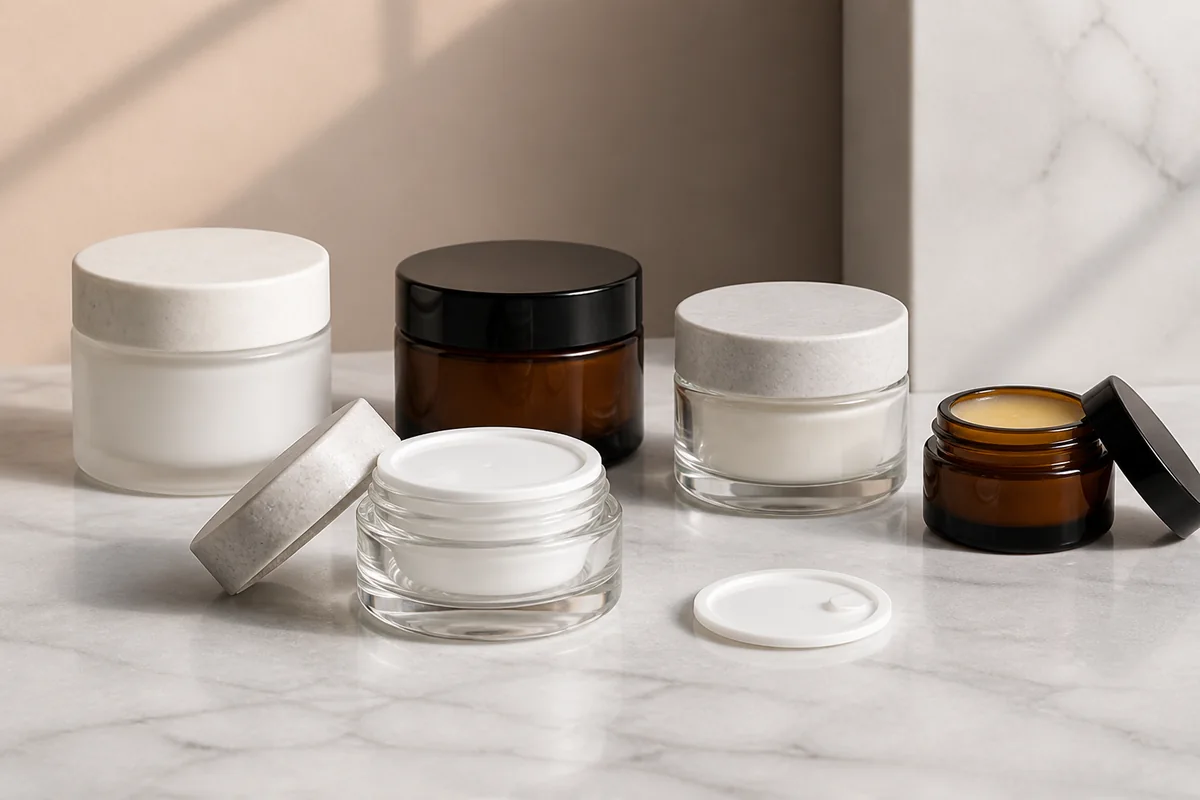
Packaging for creams and balms should be selected around how the formula is filled, accessed, resealed and used over time. A glass jar may look simple, but the finished system includes the jar opening and internal geometry, lid and thread, liner or inner disc, decoration, filling process and the actual formula. For dense creams, butters and wax-rich balms, those details can affect product access, sealing, appearance, residual product and production consistency.
This guide gives B2B packaging buyers a practical framework for defining requirements, comparing samples and approving the final assembly. It complements FOLOVER’s Packaging Applications resources and Buying Guides content while keeping the decision focused on the exact formula and project conditions. Product-specific capacity, dimensions, thread geometry, liner material, application torque and formula compatibility should be confirmed through current drawings, supplier documentation and physical samples rather than copied from another jar.
The Core Buyer View: A jar is a controlled access system, not simply an open container
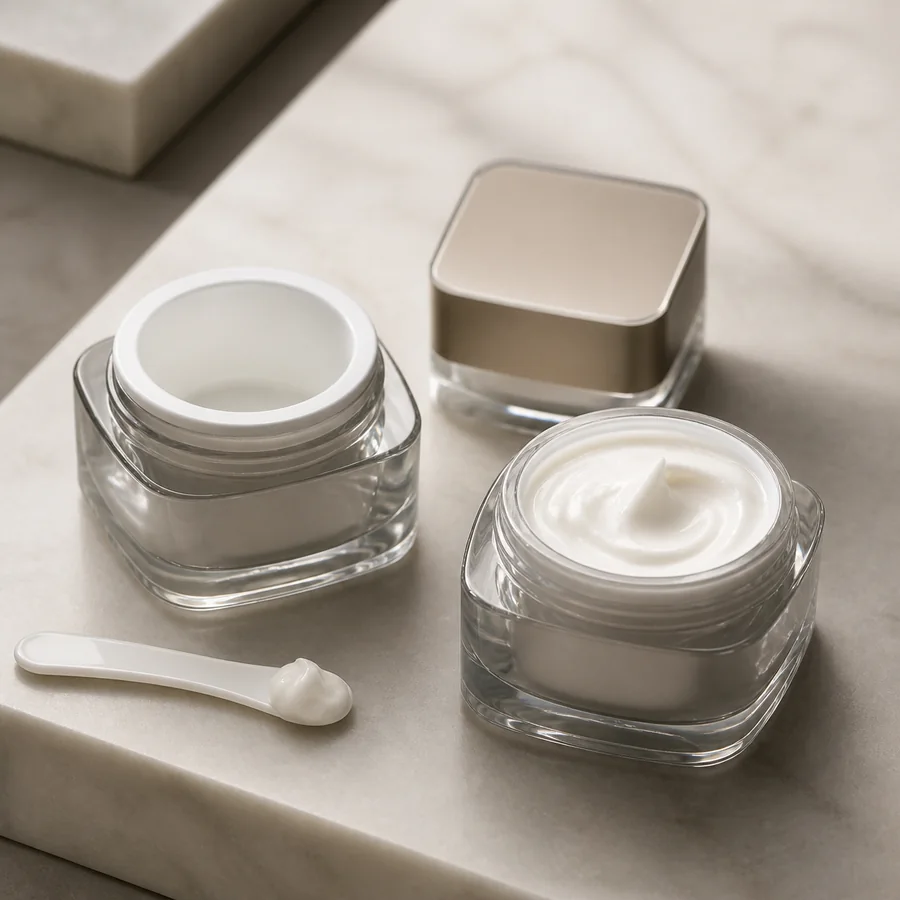
For creams and balms, package quality depends on what happens every time the user opens the jar, reaches the product and closes it again. Opening diameter, internal depth, shoulder shape, lid, liner and optional inner disc influence access, mess, seal recovery and how much product can be reached near the end of use.
The useful sourcing question is therefore not “Which jar looks premium?” but “Does this exact jar, closure and formula continue to work through filling, storage, repeated opening and normal use?” That gives buyers a clearer basis for sample approval and prevents a visually successful empty sample from being treated as finished-package evidence.
Define texture, use routine and exposure
A light cream, dense butter and wax-rich balm can all be sold in jars, but they do not behave the same way. Before choosing the container, define whether the user will scoop with a finger, spatula or applicator, how frequently the jar is opened and whether the formula changes noticeably with temperature.
For dense products, a wide opening may improve access but also exposes a larger product surface during each use. A deeper jar may create the desired exterior proportions while making the last portion of product harder to collect. The package decision should therefore follow the formula and use routine rather than nominal capacity alone.
FOLOVER normally asks buyers to define the formula type, commercial fill quantity, intended pickup method, target jar format and relevant storage conditions before comparing samples. The Cream Jars provides the corresponding broader sourcing route.
Select jar geometry for access, not just shelf impact
Exterior dimensions do not tell a buyer how easy the product will be to reach. Two jars with similar outside proportions can have different internal wells, shoulder profiles and base shapes. These differences become important with dense creams and balms that do not readily flow back toward the center.
During sample review, inspect the actual opening and internal profile rather than assuming a wide-looking jar has equally wide usable access. Repeat pickup trials with the intended formula or a representative batch, including partially used jars. This is particularly useful when the product will be applied with a spatula.
| Jar Direction | Best For | Main Advantage | Main Limitation | What Buyers Should Verify |
|---|---|---|---|---|
| Wide opening | Dense creams, butters and balms requiring direct finger or spatula access | Easier access across a larger product surface | Creates a larger exposed opening during each use | Pickup method, usable opening, lid clearance and user handling |
| Deeper internal well | Designs where exterior proportions or compact footprint are important | Can support a taller or more compact jar format | Product near the shoulder or base may be harder to reach | Internal drawing, spatula reach and near-empty access |
| Jar with inner disc | Projects where an additional internal component serves a defined presentation or product-contact function | Adds a controlled component between the bulk product and lid area | Does not automatically create a barrier, leakproof seal or hygiene claim | Disc material, fit, removal, formula contact and filling clearance |
For closure-related geometry, buyers can also review the cosmetic bottle closure guide. Final fit still needs to be confirmed on the selected jar and lid assembly.
Match capacity and fill level deliberately
Nominal jar capacity should not automatically be treated as the commercial fill quantity. Formula density, filling temperature, headspace, inner-disc clearance and cooling behavior can all change how a finished jar looks at the same declared fill weight.
Trying to fill a jar to the visual maximum can create neck contamination, interfere with an inner disc or make routine closing less clean. Buyers should establish the commercial fill target using the actual formula and production-intent container rather than asking the supplier to “fill to the top.”
FOLOVER recommends checking the target fill line after the formula has reached its normal post-filling condition. For products that change volume or surface appearance while cooling, evaluate the cooled package rather than judging only the condition immediately after filling. Buyers comparing available formats can review the cream jar collection.
Engineer the lid and thread as a repeatable closure
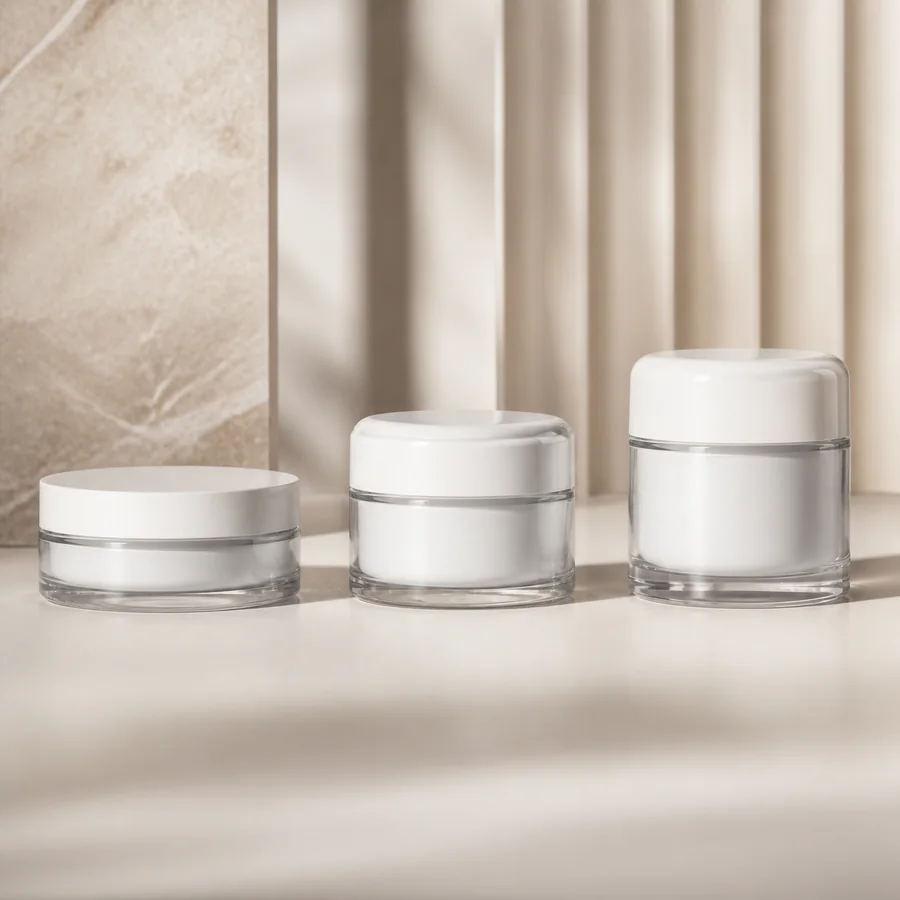
A cream-jar lid should engage the neck consistently, reach its intended sealing position and remain practical after repeated opening. A lid that closes acceptably on one hand sample is not enough evidence for production approval because jar finish, lid thread, liner and assembly variation all contribute to the final result.
For continuous-thread packages, ASTM D2063/D2063M-24 provides a quantitative method for measuring removal torque and torque-retention behavior of matching continuous-thread container and closure systems under predetermined conditions. It can support engineering evaluation, but it does not provide a universal torque value for cosmetic cream jars.
The application target should come from the selected container-and-closure specification and filling setup. Do not transfer a torque number from another jar simply because the lid diameter or appearance looks similar.
Manufacturer Insight: At FOLOVER, we normally review the glass jar, lid and any sealing insert as one closure system. If the lid supplier, liner, thread geometry or jar finish changes after approval, sealing and opening behavior should be checked again before bulk production.
Packaging architecture can also change when the formula is moved from a jar to another format, so buyers comparing alternatives can review packaging for different skincare formulas.
Use liners and inner discs for defined functions
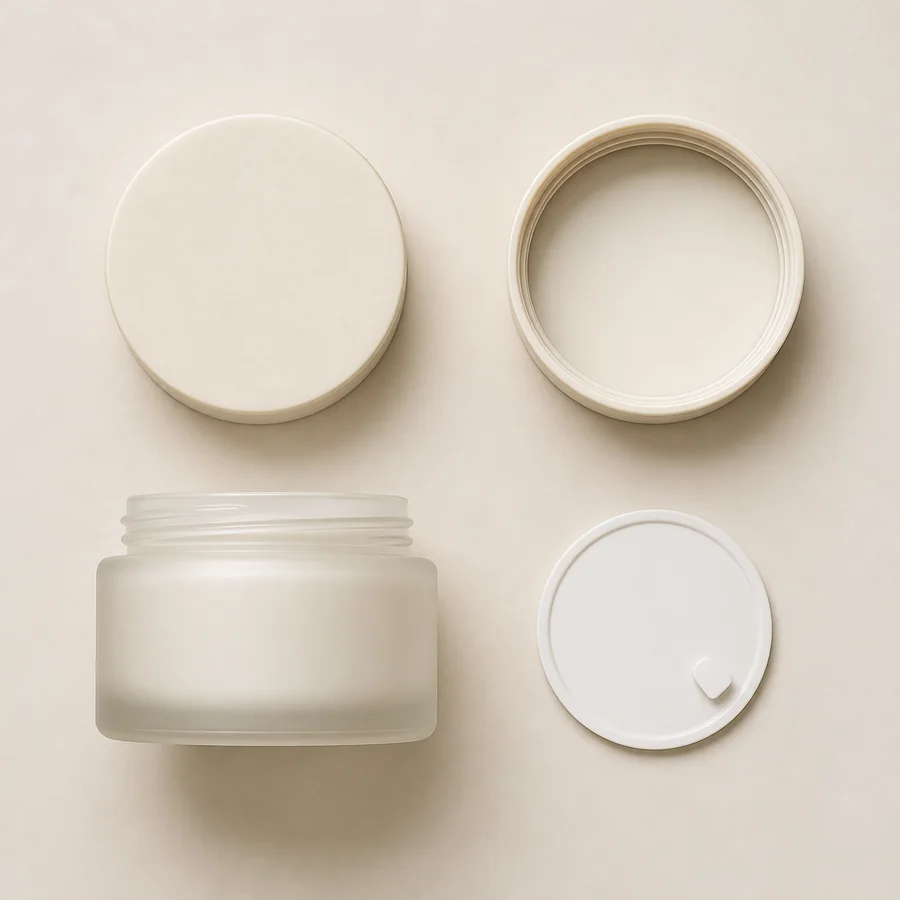
A liner, gasket or inner disc should be specified because it has a defined function in the package. Depending on the design, that function may involve sealing support, controlled contact between components, protection of the lid interior or presentation. The presence of an insert by itself does not prove that the package is leakproof, airtight or chemically compatible.
Ask the supplier to identify the actual material and construction of the formula-contact component. Generic descriptions such as “foam liner” or “plastic disc” are not sufficient when compatibility matters because different polymers, laminated structures and additives can behave differently in contact with oils, fragrance components or active formulations.
The article on how cosmetic glass jars are constructed explains the main jar and closure components in more detail.
Buyer check: Do not specify PE, PP, PTFE, EVOH or another liner material solely because it has a reputation for chemical resistance. Confirm the exact construction supplied and evaluate it with the intended formula under relevant storage and use conditions.
Manage hygiene without making unsupported claims
A jar exposes the product surface each time it is opened. A smaller opening, inner disc or spatula may change how the consumer accesses the formula, but none of these features automatically makes a jar “hygienic” or replaces an appropriate preservation strategy.
Packaging and formulation responsibilities should remain separate. The package controls access and contact conditions; the formulation and its preservation system must be assessed under the applicable cosmetic safety framework. Buyers should therefore avoid making hygiene claims based only on the presence of an inner disc or applicator.
For dense formulas where access becomes a major design constraint, see packaging for high-viscosity skincare.
Account for filling and cooling behavior
Warm-filled balms and highly viscous creams can look different after the product settles or cools. Balms may contract, pull away from the wall or develop an uneven surface, while creams can trap air or leave visible filling marks in clear glass. Those observations are not necessarily container defects; they may originate from the interaction between formula rheology and the filling process.
For this reason, final appearance approval should not rely only on manually filled development samples. A production-representative trial should use the intended filling temperature, nozzle position, fill quantity and cooling sequence where those variables are relevant to the formula.
Manufacturer Insight: For creams and balms, FOLOVER normally recommends approving both the empty packaging appearance and a representative filled sample. This helps separate a glass or decoration issue from a filling or cooling effect before the project reaches bulk production.
Material efficiency or recyclability should be evaluated separately from filling performance. Buyers considering those trade-offs can review sustainable cosmetic packaging choices.
Test oily and active formulas against every contact part
The glass body is only one part of the compatibility system. Creams and balms may also contact liners, discs, polymer lids, gaskets and decorated neck or shoulder areas during filling and consumer use. Oil-rich formulas, fragrance components and active ingredients should therefore be evaluated against every relevant contact surface.
ASTM D543-21 provides practices for evaluating the resistance of plastics to chemical reagents. ASTM itself notes that correlation with service performance depends on how closely the test conditions match the intended end use. For cosmetic packaging, this makes the standard useful as a material-evaluation reference, not as proof that a finished cream jar is compatible with a specific formulation.
For products placed on the EU market, Annex I of Regulation (EC) No 1223/2009 on cosmetic products requires the Cosmetic Product Safety Report to consider relevant characteristics of the packaging material, particularly purity and stability, alongside product stability and microbiological quality.
The buyer implication is practical: retain the exact formula, jar, liner, inner disc and lid configuration used for approval. Packaging compatibility should be evaluated with the actual formulation under intended storage and use conditions.
Review decoration where hands and product meet
Cream jars are repeatedly handled around the lid, shoulder and base, and product residue may reach decorated areas. A color-approved empty jar may therefore look satisfactory while still developing rubbing, softening, discoloration or print damage after filling and use.
Coating, frosting, screen printing, hot stamping and labels should be reviewed on physical samples after the relevant filling and handling conditions. Final color, logo, coating and decoration should be approved on physical samples rather than from artwork or an empty bottle alone.
Do not import a universal abrasion cycle, coating thickness or adhesion limit from another project unless the decoration supplier and brand specification support it. The useful acceptance criteria are the ones tied to the actual decoration system and intended use.
Approve the jar through a buyer-focused scorecard
A strong jar approval should compare the complete user and production system rather than allowing one attractive feature to dominate. Record whether the package meets the project requirement for access, sealing, filling, decoration, handling and logistics, and link the result to the exact component references used.
| Approval Area | What to Observe | Typical Failure Mode | Buyer Action |
|---|---|---|---|
| Product access | Opening, spatula or finger access, near-empty pickup | Product trapped around shoulder or base | Compare internal geometry with the actual formula |
| Closure | Thread start, lid seating, repeat opening and sealing | Cross-threading, wobble or inconsistent compression | Approve multiple production-intent assemblies |
| Formula contact | Liner, disc, lid and decoration condition | Swelling, staining, softening or visible change | Run formula-specific compatibility evaluation |
| Filling | Fill level, neck cleanliness and post-cooling appearance | Overflow, surface defects or inconsistent visual fill | Use a representative filling trial |
| Distribution | Jar, cap, decoration and shipping configuration after handling | Loosened caps, breakage or finish damage | Evaluate the shipping unit under the intended distribution plan |
When transport performance matters, ASTM D4332-22 describes conditioning atmospheres for packages and packaging components before testing, while ASTM D4169 provides a structured framework for evaluating shipping units against distribution hazards. These standards can inform transport-test planning, but they do not establish cream-formula compatibility or jar sealing performance.
Buyer Approval Checklist
- Define the actual cream, balm or butter formula and the intended pickup method.
- Confirm commercial fill quantity using the real jar and representative formula.
- Review internal jar geometry, not only external dimensions or nominal capacity.
- Identify the exact lid, liner, inner disc and other formula-contact components.
- Confirm thread and closure performance on multiple production-intent assemblies.
- Evaluate formula compatibility with all relevant contact materials.
- Review filling and cooling behavior before approving final filled appearance.
- Check product access at high, middle and low fill levels.
- Approve decoration after relevant filling, handling and formula exposure.
- Retain approved samples and define which component or process changes require revalidation.
How to Structure the Sample Evaluation
Start with a small number of plausible jar-and-closure combinations. Use the actual or representative formula to screen opening access, fill appearance, lid engagement, inner-disc fit and obvious compatibility concerns. At this stage, the purpose is to remove unsuitable configurations rather than claim shelf-life performance.
Move the strongest configuration into a documented filled-sample evaluation. Record the formula batch, jar reference, lid and liner or disc reference, commercial fill quantity, filling condition and test orientation. For creams and balms, also record post-filling appearance, repeated opening behavior, product pickup and near-empty access.
If warm filling is part of the process, compare the jar immediately after filling and again after the product has reached its normal cooled condition. If an oily residue, difficult closure, liner change or localized decoration mark appears, investigate the specific failure path instead of simply replacing the jar.
For shipping evaluation, use the production-intent jar, cap, decoration and secondary packaging together. The primary package and export carton should not be approved as unrelated systems when transport movement can affect cap retention, glass protection or decoration.
Frequently Asked Questions
Can packaging be approved from an empty sample?
An empty sample can confirm appearance, basic fit and handling, but it cannot establish formula compatibility, long-term sealing, filling behavior or decoration durability. Final approval should use the intended or representative formula with the selected production-intent jar, lid and contact components under documented conditions.
Is a supplier’s standard component specification enough?
It is a useful starting point, but not a substitute for complete-system evaluation. Performance depends on the formula, jar and lid geometry, liner or inner disc, filling process, storage conditions and user routine. Supplier specifications should define what still needs to be verified on the filled package.
What should trigger revalidation?
Changes to the formula, formula-contact material, jar finish, lid, liner or inner disc, supplier, tooling, decoration system, filling conditions or assembly settings can affect performance. The project team should define which changes require partial or full revalidation before bulk production.
How should buyers compare two visually similar packages?
Compare internal drawings, jar opening and depth, closure construction, formula-contact materials, filled-sample results, product access, residual product, decoration, filling behavior and logistics. Similar appearance or nominal capacity does not establish equivalent packaging performance.
Does an inner disc make a cream jar leakproof or hygienic?
No. An inner disc can serve a defined presentation or contact-control function, but its presence alone does not prove leak resistance, airtightness or hygiene. Buyers should verify the exact disc material and fit and evaluate the complete jar, lid and formula under the intended conditions.
Should warm-filled balms be approved from hand-filled samples?
Hand-filled samples are useful for early screening, but they may not reproduce production filling, cooling or surface appearance. When filling conditions materially affect the balm, final approval should include a representative process trial using the selected jar and closure configuration.
Conclusion
For creams and balms, the jar should be treated as a controlled access and closure system rather than an attractive open container. Internal geometry, lid and thread, liner or inner disc, filling behavior, formula compatibility and decoration all affect whether the finished package remains practical through production and repeated use.
Build the shortlist from verified packaging resources, then compare the actual formula and production-intent assembly under documented conditions. Final compatibility and performance remain formula- and project-specific, so approve the filled jar system before bulk production.