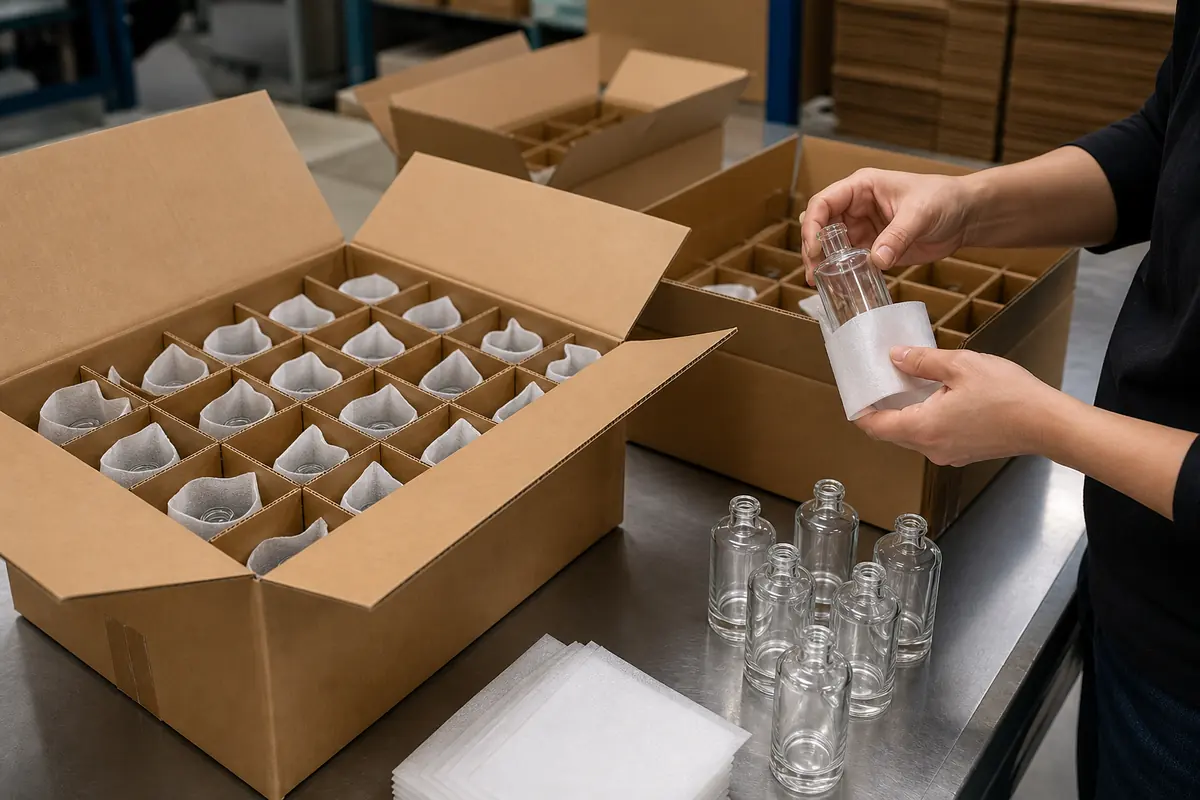

Cosmetic packaging traceability is the ability to reconstruct which bottle, jar, pump, sprayer, dropper, gasket, cap, decoration lot, carton, artwork version, supplier, and approval evidence became part of a defined finished pack. It also supports the reverse question: which finished products used a particular component lot? Both directions matter when a buyer investigates leakage, color variation, incorrect artwork, a missing document, or an unapproved supplier change.
Traceability is sometimes treated as filing discipline. That is too narrow. Its practical value is causal resolution: reducing a broad, expensive uncertainty to a defensible affected population. If a team cannot connect an observation to exact inputs, it may quarantine every pack, repeat tests unnecessarily, or continue shipping while the cause remains ambiguous.
More records do not automatically solve that problem. The identities and relationships inside those records must be reliable. For cosmetic packaging buyers, the objective is to know exactly which components entered a finished production batch, which approvals apply to those components, and which products may be affected when something changes.
Core viewpoint: Good traceability increases resolution. It lets a brand distinguish an affected decoration lot or closure revision from potentially unaffected inventory, while poor traceability turns a specific quality question into a broader supply-chain uncertainty. Containment can only be narrowed when the recorded relationships are complete and verified.
A Cosmetic Pack Has More Identities Than It Appears
A finished serum bottle may look like one item, but it is an assembly of independently produced elements. The glass container has a mold and production lot. A dropper can include a collar, bulb, pipette, wiper, and gasket. Decoration may involve coating, printing, foil, curing, and artwork versions. A carton and insert add their own material, artwork, and converting history. Suppliers may source subcomponents from approved partners.
The traceability design should follow the real bill of materials rather than the appearance of the pack. It does not require the consumer to see every identifier. It requires the brand, filler, and suppliers to preserve enough internal identity to reconstruct the system. Buyers using cosmetic and skincare glass packaging should define the required resolution during sourcing, because missing lot relationships are difficult to recreate after assembly.
For example, a finished serum SKU may use one glass bottle lot and two different dropper lots during a filling run. If the component change is not recorded against the corresponding finished-goods quantities, the buyer may be unable to distinguish which finished products contain each dropper lot.
Buyer action: Request a component genealogy showing how the selected bottle, closure, decoration, and secondary packaging are identified from incoming inspection through finished-goods release. Confirm how the supplier records component changes within a production order.

Supplier Changes Create Hidden Risk
A component can retain the same purchasing description while its material, mold, production site, gasket, spring, coating, or process changes. “White lotion pump” and “30 ml glass bottle” are not identities precise enough for change control. Even a visually similar alternative may affect fit, sealing, dispensing, decoration adhesion, or test evidence. Traceability must therefore connect purchase records to controlled item codes and revisions.
Change control begins before the change. Agreements should define which changes require notification, what evidence is expected, and whether a drawing review, focused comparison, new sample approval, or broader validation is needed. The supplier-selection framework in How to Choose a Cosmetic Packaging Supplier is relevant because traceable execution is part of supplier capability, not an administrative extra.
Manufacturer Insight: A Matching Product Name Is Not Proof of Component Equivalence
For a cosmetic glass bottle supplied with a pump, FOLOVER PACK recommends confirming the selected bottle and complete closure assembly rather than relying only on the nominal neck designation or the supplier’s product description.
A replacement pump may retain the same external appearance while using a different gasket, internal structure, or dip tube. Its compatibility with the existing bottle and actual formulation should not be assumed from the previous component’s approval.
Buyers should request the replacement component’s controlled item code, applicable specification, supplier identity, and physical samples. The original and replacement assemblies should be compared against relevant sealing, dispensing, formula compatibility, and appearance requirements before the new component is approved for bulk production.
Batch-Level Information Makes Investigations Smaller
Suppose several pumps fail to prime. Without lot identity, investigators may suspect every pump used across months of production. With component, assembly, and finished-goods relationships, they can compare affected and unaffected lots, inspect retained samples, review the relevant production record, and determine whether containment can be limited. Traceability does not prove causation, but it makes meaningful comparison possible.
The appropriate resolution depends on risk and manufacturing reality. Recording every subcomponent individually may be unnecessary, while recording only a broad annual supplier name may be useless. Teams should ask: what is the smallest population that can be reliably distinguished and acted upon? That answer sets the traceability resolution for bottle lots, closure lots, decoration runs, assembly batches, and finished products.
Backward traceability identifies the controlled components, suppliers, processes, and documents associated with a finished batch. Forward traceability identifies which finished batches and shipments received a particular component or material lot.
Both directions are necessary. Knowing which supplier provided a pump does not establish which customer shipments contain a questioned production lot.
The commercial importance belongs in the Packaging Trends & Insights hub, while evidence scope and market duties belong in the Regulations & Compliance hub. Company capability and responsibility boundaries should also be checked against the verified FOLOVER PACK company profile and the wider skincare packaging guide.
Decoration Lots Need Their Own Identity
Decoration can vary by coating batch, ink mix, foil roll, artwork revision, fixture, curing condition, and production run. A visually approved bottle does not make later lots identical. When color, adhesion, abrasion, registration, or surface appearance is questioned, the team should be able to connect the finished pack to the decorated bottle lot and the approved reference used for that run.
This is especially important when several decoration processes are layered. A result may arise from interaction between the base coating and print, not from the final visible layer alone. The cosmetic glass bottle decoration guide explains the process options; traceability adds the version and lot relationships required to investigate them responsibly.
Illustrative Investigation: A Coating Defect Appears After Delivery
Consider a beauty brand receiving a complaint that the coating on several serum bottles has begun to peel. The finished products look identical, but their decorated bottles were produced in separate finishing runs.
The investigation should first identify the affected finished-goods batches and reconstruct which decorated bottle lots were used. The supplier can then compare the relevant coating material records, approved decoration samples, process records, and inspection results.
If the questioned decorated bottle lot was used in several finished-goods batches, all potentially affected products should be identified before containment decisions are made. If the same coating material was also used in other production runs, the investigation may need to extend beyond the initially reported lot.
Traceability identifies which materials and products require investigation. It does not establish whether the defect was caused by the coating material, surface preparation, process conditions, formula contact, or subsequent handling.
The buyer’s next step is to request the decorated bottle lot reference, applicable artwork and coating specifications, approval records, and the mapping to finished-goods batches.
This is an illustrative quality-investigation scenario, not a reported FOLOVER PACK customer incident. The investigation scope and response time depend on the actual records and findings; no fixed defect rate or investigation duration is assumed.

Compliance Documentation Depends on Identity
A declaration, test report, specification, or material statement has a scope. It may apply to one component, material, color, supplier site, revision, or test sample. Traceability helps reviewers determine whether that scope matches the item actually purchased. A document with the right title but the wrong revision or component identity can create false confidence.
The cosmetic packaging documents guide distinguishes common records, while the packaging compliance file guide explains how evidence can be organized. Traceability is the connecting layer: it links a finished package to the exact evidence that supports it. It should never be used to expand a limited report into an unsupported catalog-wide claim.
In the European Union, Regulation (EC) No 1223/2009 on cosmetic products establishes identification-within-the-supply-chain duties under Article 7, while Article 19 addresses batch identification on cosmetic product labeling.
These provisions concern cosmetic products and should not be misrepresented as a universal component-level traceability specification for every bottle, pump, coating, or packaging material. Component genealogy is a risk-control measure that can support broader product obligations; market-specific interpretation belongs with qualified regulatory professionals.
For buyers, the practical distinction is important: a batch number printed on the finished cosmetic product does not, by itself, demonstrate that its packaging supplier can identify the exact glass bottle lot, closure revision, or decoration batch used during production.
Documentation boundary: Product specifications, material declarations, test reports, and other supporting documents may vary by bottle, closure, decoration, supplier, and destination market. Buyers should confirm that each document applies to the exact packaging configuration and relevant production version. Traceability supports document verification but does not independently establish regulatory compliance.
Quality Claims Need Traceable Evidence
Statements such as “leak tested,” “approved color,” or “compatible” are meaningful only when they identify what was evaluated. A leakage result for one bottle-neck and closure combination cannot be transferred automatically to a similar-looking alternative. A decoration approval for one coating stack does not approve every color. A compatibility result belongs to a defined formula, package, assembly, exposure, and acceptance criterion.
Traceable claims are bounded statements. They identify item revisions, sample or production lots, method, date, result, and decision owner. This supports credible technical communication because the company can explain the basis and limitation of a conclusion instead of offering an absolute marketing phrase. The fundamentals are also covered in cosmetic packaging compliance basics.
For example, a buyer reviewing a serum bottle and dropper combination should distinguish between dimensional fit, sealing performance, and formula compatibility. Each conclusion may require different evidence, and approval for one does not automatically establish the others.
Buyer action: Request the test or approval record associated with the exact component codes and selected packaging configuration. Confirm what the result establishes, which conditions were evaluated, and whether any subsequent material, supplier, or structural changes affect its applicability.
What Data Should Be Recorded?
| Record | Useful identity | Decision supported |
|---|---|---|
| Component | Controlled code, name, drawing/revision, lot | Which exact article was used? |
| Supplier | Legal entity, approved site, purchase order | Where did it originate? |
| Decoration | Process stack, artwork/color version, production lot | Which finish and approval apply? |
| Assembly | Date, line, method, settings where relevant, batch | How were components combined? |
| Evidence | Report ID, sample identity, revision, scope | What supports the decision? |
| Reference | Approved sample ID, approval date, owner | What was production compared against? |
| Finished goods | SKU and batch relationship | Where did each input go? |
| Change | Request, risk review, approval, effective lot | When did the controlled state change? |
These fields are not a universal legal minimum. A simple project may need fewer layers; a high-risk or complex system may need more. The test is whether the chosen records can support backward tracing, forward tracing, comparison, containment, and a controlled decision without relying on memory.
A useful practical addition is a component-to-finished-goods relationship record. It should connect the incoming lot to the relevant assembly or filling batch and identify how partial quantities, multiple component lots, or rejected material were handled.
This relationship matters more than collecting additional documents that cannot be connected to the product actually shipped.
Digital Traceability Helps Only After Identity Is Disciplined
Spreadsheets, ERP systems, quality platforms, product-lifecycle systems, barcode tools, and other technologies can support traceability. No single technology is required for every business. A sophisticated platform cannot correct duplicate item codes, uncontrolled naming, unlabeled physical samples, or missing supplier-site identity. Digitization should follow a clear data model and ownership structure.
A practical rollout starts with the critical relationship: finished SKU and batch to component lots and approved versions. Add decoration, documents, retained samples, and change records where they improve resolution. Use controlled fields instead of free text when consistency matters. Restrict edits appropriately, back up records, and test whether users can complete a real backward and forward trace within a defined time.
The GS1 Global Traceability Standard provides a useful external framework for understanding the information required to connect supply-chain events.
It distinguishes Critical Tracking Events (CTEs), such as receiving, processing, packing, and shipping, from Key Data Elements (KDEs), which describe the relevant information associated with those events.
For cosmetic packaging, this approach can help a buyer identify where component identity should be captured and which relationships must be preserved between suppliers, receiving, decoration, assembly, filling, and distribution.
The GS1 framework does not establish that a cosmetic packaging supplier has implemented complete traceability or that every individual packaging component must be serialized. The appropriate identification level and recording process must be defined for the actual supply chain.
Traceability Changes the Economics of a Quality Event
The financial value appears when uncertainty is expensive. If one decoration run is questionable, high-resolution records may allow the brand to hold only products made with that run. If a gasket revision is implicated, the team can identify which SKUs and filling batches used it. If a document expires or changes scope, purchasers can locate the affected components. This can reduce unnecessary quarantine, replacement, testing, and customer communication.
Traceability should also connect packaging identity to the protective shipment prepared for the lot. The cosmetic glass bottle export-packing guide explains why pack-out records can matter when damage patterns appear after distribution.
Traceability also prevents false precision. A database may show exact codes while physical labels are mixed or operators select the wrong record. Periodic reconciliation is therefore essential: compare purchasing, incoming inspection, warehouse labels, assembly issue records, finished-goods records, and retained samples. Resolution is credible only when digital and physical identity agree.
When a packaging defect is reported, the buyer should first identify the potentially affected population using the available lot relationships. The investigation should then compare production records, retained samples, and physical findings before determining the root cause or releasing stock from containment.
A narrow database query is not sufficient evidence for releasing apparently unaffected products if the underlying lot records are incomplete or cannot be reconciled with physical inventory.

Buyer Checklist for a Traceable Packaging Supply Chain
- Define controlled item codes and revisions before purchase.
- Record the approved supplier and manufacturing site.
- Require lot identification on packaging and delivery records.
- Connect decoration runs to artwork, color, process, and reference samples.
- Map component lots into assembly and finished-goods batches.
- Link reports and declarations to exact items and revisions.
- Define supplier-notification and internal change-approval rules.
- Retain representative samples according to a controlled policy.
- Test backward and forward tracing with a realistic scenario.
- Measure trace completeness and investigation time, not record volume alone.
Manufacturer Insight: Ask the investigation question before designing the record. “Which finished products contain this closure lot?” produces a clearer data relationship than “store more supplier documents.”
For cosmetic glass packaging projects, FOLOVER PACK recommends keeping the selected bottle and matching closure identified as a controlled assembly, particularly when components are sourced separately or changed between repeat orders.
Supplier coordination should establish which component information, lot references, and approval records are available and how they will be transferred to the buyer. The brand and its filling partner should then preserve the relationships between the received packaging components and the finished cosmetic products.
Traceability Must Survive Handoffs
Packaging identity often weakens at organizational boundaries. A supplier uses one lot code, the brand purchase order uses another description, the filler creates an internal material number, and the finished-goods system records only the SKU. A trace depends on a cross-reference between those identifiers. The mapping should be created during receiving and preserved through storage, issue, assembly, filling, and release rather than reconstructed during a complaint.
Physical controls matter as much as software. Mixed pallets, decanted components, partial cartons, rework, and line clearance can break genealogy even when a database is correct. Procedures should define how partial lots are labeled, how two lots on one production run are recorded, how rejected stock is isolated, and how rework retains its original and new relationships. Periodic floor exercises expose gaps that document review cannot see.
Failure Mode: Two Closure Lots Enter the Same Filling Run
Consider a filling line that finishes one carton of lotion pumps and begins using a second carton from a different component lot without recording the change. Both pump lots may have the same purchasing description and external appearance.
If a dispensing complaint occurs later, the finished-goods batch number alone may not identify which products contain the questioned pump lot. The investigation may need to include the entire filling batch because the component-to-finished-goods relationship was lost during assembly.
The preventive action is to record component lot changes at the point of use and preserve the relationship with the relevant finished-goods quantities or batches. Partial cartons and returned components also need controlled identification before being issued again.
Where exact allocation cannot be reconstructed reliably, the uncertainty must be reflected in the containment decision rather than replaced with an assumed component history.
Define Investigation Questions and Response Times
A traceability program becomes operational when it has test scenarios. Select a closure lot and identify every finished batch that used it. Select a customer complaint batch and reconstruct its packaging inputs, decoration references, assembly record, and supporting documents. Record the time, missing links, ambiguous identities, and decisions that could not be made. Repeat after corrective action.
Response time should reflect business and risk needs; no universal target should be invented. The important distinction is between retrieving a list and establishing confidence in that list. A fast report built from incomplete transactions can be more dangerous than a slower verified trace. Teams should report completeness, exceptions, and confidence alongside elapsed time.
For a supplier evaluation, buyers can request a practical traceability demonstration using a representative component lot or finished packaging batch. The supplier should show how the relevant purchase, production, decoration, inspection, and shipment records are connected within the scope of its actual operations.
This exercise helps establish what the supplier can reliably trace and where responsibility transfers to another organization. A general statement that a supplier operates an ERP system or maintains quality records does not establish the completeness of those relationships.
Frequently Asked Questions
Who should own packaging traceability?
Ownership is usually cross-functional. Procurement controls supplier and purchase identity, quality controls lots and investigation records, packaging development controls drawings and approvals, and operations records assembly and finished-goods relationships. One accountable system owner should ensure those handoffs remain connected. Buyers should define traceability responsibilities and information-sharing requirements with each relevant packaging supplier and filling partner before production.
Is a batch number enough for cosmetic packaging traceability?
Not by itself. A batch number must connect to an item identity, supplier or manufacturing site, revision, production or receipt date, and the finished products that used it. Otherwise, it is an isolated label. Buyers should confirm that the packaging supplier and filling partner can reconstruct both the component history of a finished batch and the finished products associated with a questioned component lot.
Does traceability prove that packaging is compliant?
No. It helps connect a package to supporting evidence and assists investigation, but compliance depends on applicable requirements, accurate documentation, product-specific assessment, and qualified review. A declaration or test report must match the exact packaging configuration and applicable scope. Buyers should verify component identity, material and decoration specifications, document validity, and destination-market requirements rather than treating traceability as a universal compliance certificate.
Should every packaging component be serialized?
Not necessarily. The appropriate identification level depends on risk, manufacturing capability, and business requirements. Lot-level or batch-level relationships may be sufficient when they support reliable containment and investigation. Buyers should determine the smallest affected population that the available records can identify and verify whether that resolution is adequate for the selected packaging components and intended supply chain.
Conclusion: Cosmetic packaging traceability is not the pursuit of perfect paperwork. It is a designed identity chain that converts a broad unknown into a bounded, evidence-based decision. Brands should prioritize relationships that support backward tracing, forward tracing, comparison, containment, and controlled change.
For B2B packaging buyers, the practical starting point is to confirm the component identity and lot information available from each supplier, define how those records connect to decoration and assembly, and agree on the evidence required when a quality issue or supplier change occurs.
FOLOVER PACK can support cosmetic glass bottle selection, matching closure and dispensing components, decoration development, and coordination of project-specific packaging samples and supporting component information.
When discussing a packaging project, share the intended bottle type, closure requirements, decoration specifications, target order quantity, destination market, and any supplier documentation or lot-traceability requirements that need to be considered during sourcing.
The final test is practical: a qualified reviewer should be able to identify what entered a finished batch, where a questioned input went, which evidence applies, and which stock can remain outside containment. If one of those answers depends on memory, the traceability chain still has a gap.