
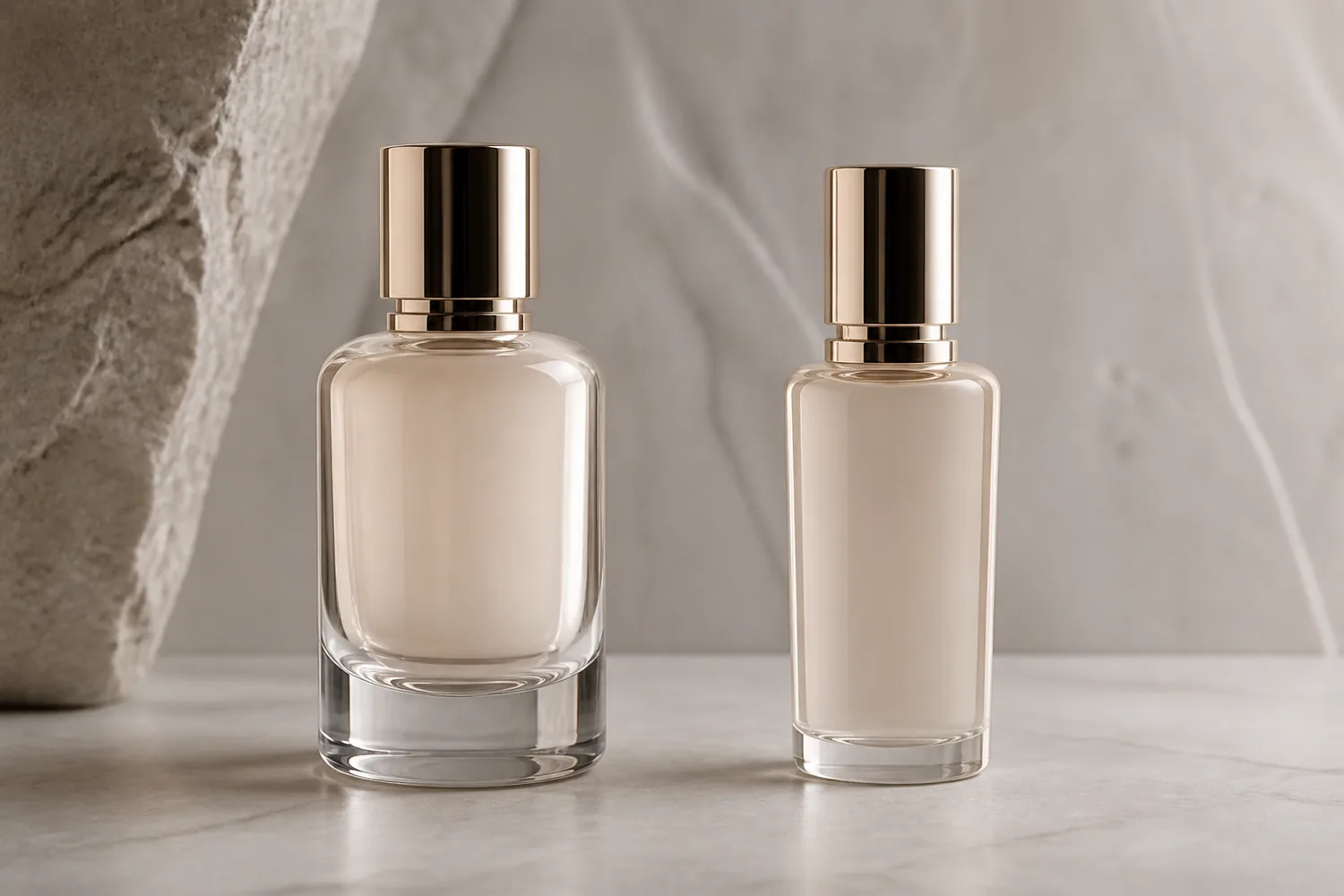
Heavy glass became a familiar shorthand for premium cosmetic and fragrance packaging because weight is immediate. A customer can feel mass before evaluating decoration, closure fit, dispensing, or long-term performance. A thick base can make a bottle look optically substantial and support a deliberate shelf presence.
That shorthand is now being reconsidered. Material efficiency, freight exposure, e-commerce distribution, packaging regulations, and changing premium design expectations are encouraging brands to question whether every additional gram creates useful value.
Heavy glass cosmetic packaging is not becoming obsolete. Brands are reconsidering whether its additional weight contributes enough to product protection, stability, customer experience, or repeated use to justify the material and distribution requirements. The appropriate decision depends on the complete packaging configuration rather than bottle weight alone.
Core viewpoint: Premium beauty packaging should be evaluated by value per gram. Heavy glass remains appropriate when mass supports a defined functional or experiential requirement. Where similar value can be achieved through bottle geometry, closure precision, decoration, or dispensing performance, buyers should evaluate whether the additional glass is necessary.
Why Heavy Glass Became a Luxury Signal
Packaging communicates through several sensory channels. Glass clarity and refraction affect visual perception. Surface temperature, hardness, and smoothness affect touch. Closure movement, pump actuation, and the sound of assembly influence the handling experience. Weight is one of these signals, and customers can perceive it immediately.
A thick glass base also changes bottle proportions. It can create optical depth, elevate the visible formula, and give a compact bottle a more substantial appearance. In traditional fragrance presentation, a substantial bottle combined with a well-fitted cap and controlled decoration can reinforce a deliberate opening and application ritual. That design approach remains relevant for certain luxury perfume bottle projects.
The problem begins when a design signal becomes an automatic specification. Adding glass weight cannot correct poor closure fit, inconsistent decoration, or unreliable dispensing. It may also increase material consumption and shipping weight without making the finished package more distinctive.
This reassessment sits at the intersection of the Packaging Trends & Insights hub and the Packaging Design & Branding hub: packaging development must balance changing material and logistics requirements with the intended premium experience.
Weight Is Only One Part of the Material System
A glass container cannot be evaluated by nominal weight alone. Glass distribution, wall consistency, base geometry, heel and shoulder transitions, manufacturing tolerances, annealing, and intended use all affect performance.
A heavier glass bottle is not automatically stronger, and a lighter bottle is not automatically more fragile. Performance must be evaluated using the selected design and production-representative samples.
The European Union’s Regulation (EU) 2025/40 on packaging and packaging waste adds an important regulatory consideration. Article 10 establishes packaging minimisation requirements intended to reduce packaging weight and volume to the minimum necessary for functionality, taking account of packaging shape and material.
The Article 10 minimisation requirement applies from 1 January 2030. Its provisions and associated performance criteria must be considered alongside the regulation’s applicable exceptions, transitional arrangements, and further implementing measures. Marketing or consumer acceptance alone should not be treated as sufficient justification for unnecessary additional packaging weight or volume.
This does not mean reducing every cosmetic bottle to the thinnest technically possible construction. Excessive lightweighting may compromise stability, handling, manufacturability, or protection during distribution.
For buyers developing packaging for the EU market, the practical requirement is to document why the proposed glass weight and geometry are necessary for the exact packaging configuration, including relevant functional, safety, and product-protection requirements.
Manufacturer Insight: Review Glass Distribution Before Setting a Lower Weight Target
When comparing an existing heavy-base bottle with a lighter alternative, FOLOVER PACK recommends evaluating the complete bottle structure rather than requesting a uniform reduction in glass thickness.
The base, heel, shoulders, body, and neck have different structural and functional requirements. A change to the bottle geometry may also affect stability, filling-line handling, decoration, protective packing, and the relationship between the bottle and its closure.
Buyers should confirm whether a suitable existing bottle can meet their requirements before considering custom structural development. Where a new design is necessary, weight and dimensional targets should be supported by the selected product specification and physical sample evaluation.

Freight and E-Commerce Make Mass More Visible
Bottle weight affects handling, inland transport, export packing, freight, warehouse operations, fulfillment, and last-mile delivery. However, the commercial effect depends on shipment mode, packed dimensions, destination, order quantity, and carrier pricing.
Reducing empty bottle weight does not guarantee an equivalent reduction in freight charges. The relevant comparison is the complete shipping configuration, including closures, product fill, cartons, inserts, and other protective materials.
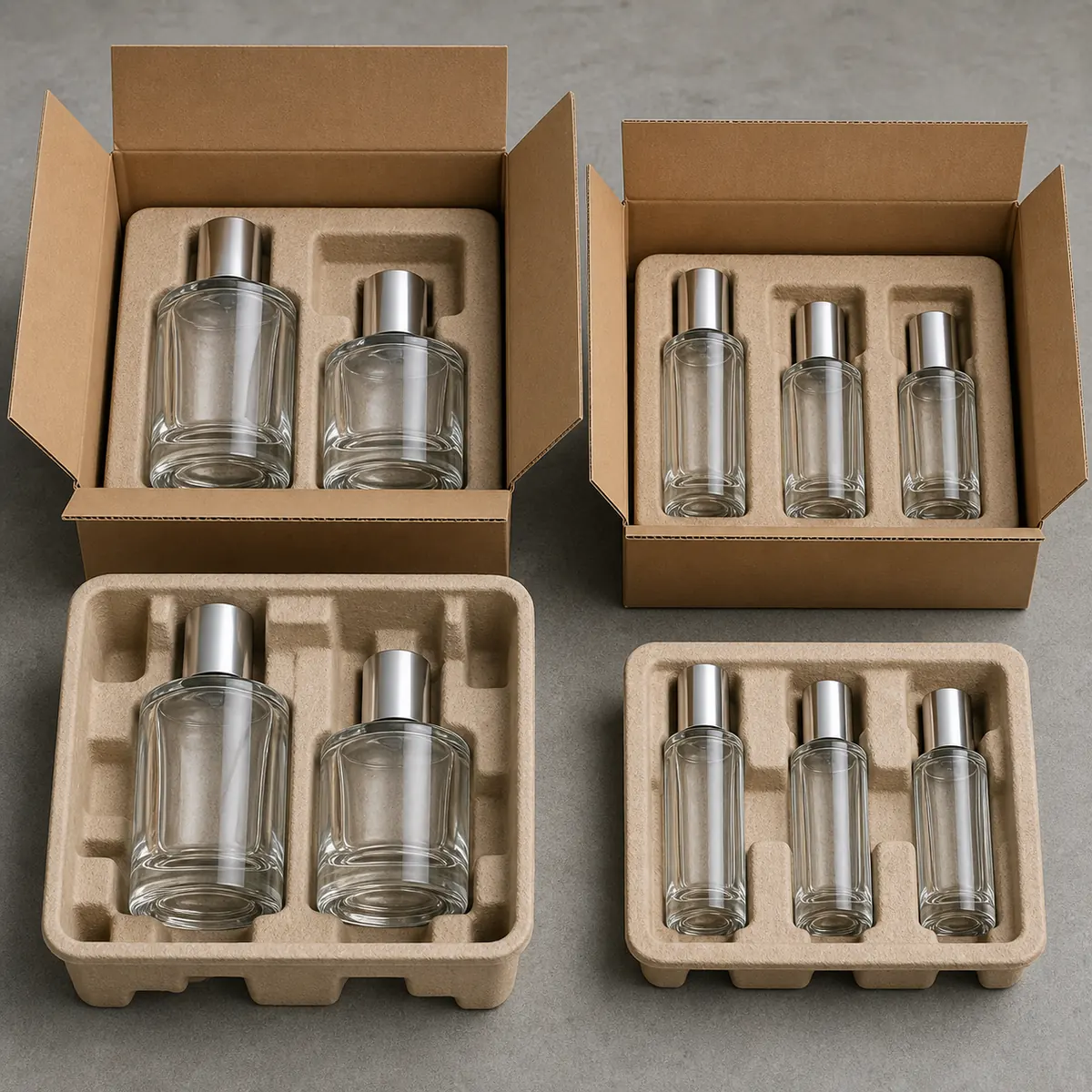
E-commerce adds another consideration. A heavy glass bottle requires appropriate restraint inside its shipping package, while an under-engineered lightweight bottle may need additional protection or experience unacceptable damage.
The International Safe Transit Association (ISTA) provides packaged-product testing procedures for different distribution environments. ISTA Procedure 3A, for example, addresses individual packaged products distributed through parcel delivery systems.
Such procedures can help buyers establish a relevant distribution-testing approach. They do not establish that a particular bottle has passed testing, nor do they replace project-specific evaluation of the filled and packed product.
Brands can compare candidate concepts through packed-product trials, dimensional review, carton efficiency, damage observations, and actual freight quotations. These decisions fit within a wider luxury perfume packaging strategy, where bottle, cap, pump, decoration, carton, and logistics should reinforce the intended positioning.
How Much Shipping Weight Can a Lighter Bottle Remove?
The theoretical reduction in empty glass shipment mass can be calculated by multiplying the measured weight difference per bottle by the number of bottles shipped.
For illustration, if two verified bottle designs differ by 20 g, an order of 1,000 bottles would contain 20 kg less empty glass when using the lighter design.
This is a mathematical example, not a FOLOVER PACK product specification or a measured customer result. It does not establish a corresponding reduction in freight charges, carbon emissions, or total packaging weight.
Buyer action: Request the actual packed dimensions, gross carton weight, packing quantity, and freight quotation for each proposed configuration. Compare these figures alongside protection requirements and observed damage performance before estimating commercial savings.
Consumer Perception of Premium Is Becoming More Specific
Customers do not buy grams; they buy an interpretation of the complete product. Some may associate a heavy bottle with permanence, collectability, and value. Others may consider excessive packaging material unnecessary.
The same bottle can therefore communicate different qualities across markets, product categories, price levels, and brand positioning.
Digital commerce increases the importance of visual elements that remain recognizable on a screen: silhouette, proportion, color, cap design, and clear visual hierarchy. Weight cannot be experienced through a product thumbnail. It becomes relevant only after the package is physically handled.
Brands should test their intended audience rather than assume that a heavier bottle always justifies a higher price or that a lighter design will automatically be perceived as modern.
A useful comparison presents complete packaging samples with the intended closure and decoration. Ask participants to evaluate appearance, handling, opening, dispensing, perceived quality, and suitability for the product’s intended positioning.
Where possible, separate the variables being assessed. Comparing two bottles with different weights, colors, caps, and decorations simultaneously cannot establish which individual feature influenced the result.
Lightweight Premium Design Is a Design Discipline
Removing glass without reconsidering the complete premium experience can weaken the package. Effective lightweighting reallocates attention to proportion, stability, closure precision, surface finish, decoration, and dispensing performance.
The approach described in lightweight cosmetic glass bottle design should be treated as an engineering and branding exercise rather than a simple wall-thickness reduction.
One useful development practice is to establish a mass budget. Instead of accepting the total weight of a reference bottle, identify which areas of the design require material for functional or visual reasons and which could potentially be redesigned.
Actual glass distribution remains a bottle-manufacturing decision and requires appropriate structural and production validation.
Buyer Scenario: Evaluating a Heavy-Base Perfume Bottle
Consider a fragrance brand evaluating a substantial existing bottle against a lighter alternative. Both options must accommodate the intended fragrance capacity, selected spray system, cap, and decoration.
The heavier bottle may provide optical depth and a deliberate handling experience. The lighter alternative may achieve a similar visual identity through balanced proportions, a coordinated cap, and a controlled finish.
Before selecting either design, the buyer should compare physical samples and confirm closure compatibility, sealing, spray performance, decoration appearance, packed-product protection, and actual sourcing costs.
If the lighter configuration satisfies the required functions and intended customer experience with less material, it provides a practical basis for reconsidering the heavy-base design. If the substantial base is important to the intended visual identity or handling experience, the brand should establish that requirement explicitly.
This is an illustrative procurement scenario, not a reported customer project. No reduction in lead time, freight cost, breakage, or carbon emissions is assumed.
When a Heavy Base Can Still Be Appropriate
A heavy base may be justified when it delivers a defined functional or experiential requirement. A display-led prestige fragrance, a collectible product, or a durable outer container intended for repeated use may benefit from a substantial glass structure.
A wider base may also contribute to stability for a particular bottle geometry, although stability cannot be determined from total bottle weight alone.
The approval brief should identify the actual purpose of the additional material. For example, the base may create a distinctive optical effect, support a defined stability requirement, or contribute to a handling experience demonstrated through customer evaluation.
Heavy glass is less persuasive as a design solution when the underlying problem is poor closure alignment, inconsistent coating, unreliable dispensing, or an unbalanced silhouette.
For refillable packaging, the material rationale must also consider whether the durable outer container will actually remain in use across the intended refill cycles. Refillability alone does not establish a lower environmental impact.
Premium Alternatives to Additional Bottle Weight
Premium perception can be built through several coordinated design elements. Buyers should identify which elements matter to the intended product rather than adding multiple features without a clear purpose.
| Premium Cue | What It Can Communicate | What Buyers Should Verify |
|---|---|---|
| Proportion and silhouette | Recognition, visual balance, and distinctive product identity. | Compare front, side, shelf, hand-held, and e-commerce views. |
| Closure fit and movement | Precision and a deliberate opening experience. | Confirm the selected bottle and closure combination, alignment, retention, assembly, and functional performance. |
| Controlled finish | Visual depth, surface character, and consistent brand color. | Approve physical coating, frosting, printing, or decorative samples under agreed appearance and durability criteria. |
| Dispensing quality | Functional confidence and a consistent application experience. | Evaluate dispensing with the actual formulation and selected components. |
| Secondary packaging | Product protection and a controlled unboxing experience. | Review packed-product performance, material requirements, and unnecessary empty volume. |
| Refill architecture | Potential permanence across multiple purchases. | Verify the actual refill mechanism, component compatibility, repeated-use requirements, and customer behavior. |
A restrained bottle with reliable dispensing, a well-matched closure, and consistent decoration may provide a more coherent premium experience than a very heavy container assembled with poorly coordinated components.
FOLOVER PACK’s custom packaging solutions can support the coordination of glass bottle selection, closures, decoration, sampling, and protective packing around a defined project brief rather than a single weight target.
A Value-per-Gram Decision Model
Value per gram is a packaging-development decision framework, not a recognised material-performance metric or regulatory calculation. It asks whether the additional glass mass in a proposed design provides enough functional or experiential value to justify its manufacturing, material, and distribution requirements.
For each proposed weight increase or reduction, buyers should consider five questions:
- Brand value: Does the additional mass contribute to a distinctive visual or handling experience that matters to the intended customer?
- Functional value: Does it support the required stability, protection, handling, or repeated-use performance?
- Operational cost: How does it affect packing, freight, fulfillment, component coordination, and damage risk?
- Material rationale: Can the selected weight and geometry be justified against applicable packaging requirements and the project’s functional needs?
- Alternative value: Could the same development budget produce greater buyer value through closure precision, dispensing, decoration control, or improved protective packaging?

This model also prevents simplistic sustainability messaging. A lighter bottle is not automatically the better system if it requires substantially more protective material or results in unacceptable damage and product loss.
Likewise, a heavy refillable outer container does not establish an environmental benefit if the intended refill system is rarely used.
For a broader comparison of premium design and material efficiency, see Premiumization vs Lightweighting in Cosmetic Glass.
How Procurement Should Compare Bottle Options
Physical Sample Evaluation Before Bulk Production
Request production-representative samples of each proposed bottle configuration. Record the relevant product codes, sample versions, and approved specifications so the comparison can be repeated and traced.
- Glass structure: Compare actual bottle weight, capacity, dimensions, stability, visible glass distribution, and manufacturing quality.
- Bottle and closure matching: Assemble the selected closure and evaluate neck fit, sealing, cap alignment, and dispenser function.
- Formula compatibility: Evaluate the selected packaging system with the actual formulation under intended storage and use conditions.
- Decoration: Compare physical samples for coating, printing, color consistency, component coordination, and relevant durability requirements.
- Distribution: Evaluate the complete filled and packed product under conditions appropriate to its intended shipping environment.
- Commercial comparison: Obtain quotations for the actual bottle, closure, decoration, secondary packaging, and freight configuration.
Final bottle and closure compatibility should be confirmed using the selected components and physical samples before bulk production. Where bottle geometry or components change, determine which previous approvals remain applicable and what additional evaluation is required.
Do not publish exact strength, recyclability, carbon-reduction, or freight-saving claims based solely on bottle weight. Each claim requires evidence appropriate to the selected packaging configuration.
For environmental comparisons, ISO 14040:2006 provides principles and a framework for life cycle assessment, including goal and scope definition, inventory analysis, impact assessment, and interpretation.
ISO 14040 is not a certification that a particular cosmetic bottle is sustainable. A comparative environmental claim should be supported by appropriate product-specific evidence and a clearly defined assessment boundary.
Frequently Asked Questions
Is heavy glass packaging being phased out?
No. Heavy glass remains relevant for certain premium, collectible, stable, or reusable packaging designs. Brands are examining additional material and freight requirements more carefully, particularly where the same functional or experiential value may be achieved through a lighter configuration. Buyers should evaluate the intended customer experience and complete packaging performance before deciding whether a heavy-base design remains appropriate.
Does a lighter cosmetic bottle feel cheap?
Not necessarily. Perceived quality also depends on bottle proportions, closure precision, surface finish, dispensing performance, decoration consistency, and secondary packaging. Poorly executed lightweighting may weaken the intended premium experience, but a coherent moderate-weight design can retain distinctive brand value. Buyers should compare complete physical samples with their intended customers rather than judge quality from empty bottle weight alone.
Is a heavier glass bottle stronger?
Weight alone does not prove strength. Glass distribution, geometry, manufacturing quality, handling, and test conditions influence performance. A heavier bottle can still have vulnerable areas, while a properly developed lighter design may meet the required performance criteria. Buyers should compare production-representative samples and evaluate the complete filled and packed product under conditions relevant to its intended use and distribution.
How should a brand set a bottle-weight target?
Begin with the required capacity, product protection, filling, handling, dispensing, stability, and distribution conditions. Then identify the glass mass needed to support the intended design and customer experience. Compare suitable existing bottles before considering custom structural development. Buyers should approve the final weight and geometry using verified specifications, complete physical samples, and relevant performance evidence rather than an arbitrary reduction percentage.
Does reducing glass bottle weight always lower freight costs?
No. A lighter bottle may reduce shipment mass, but actual freight charges depend on the complete packed configuration, shipment dimensions, transport mode, destination, and commercial terms. Different protective packaging may also be required. Buyers should compare gross carton weight, packed volume, shipping quantities, and actual freight quotations before claiming a financial benefit from lightweighting.
Conclusion: Premium Is Precision, Not Just Mass
Heavy glass is being reconsidered because premium packaging must deliver more than an immediate impression of weight. It must protect the formula, function reliably, survive distribution, use material intentionally, and maintain the intended brand experience.
Heavy bases can still provide meaningful visual, functional, or handling value. However, additional weight should not substitute for accurate bottle geometry, closure compatibility, reliable dispensing, or consistent decoration.
For cosmetic packaging buyers, the practical decision is to compare complete packaging configurations and retain additional glass mass only where it supports a defined requirement that the proposed lighter alternative cannot satisfy as effectively.
FOLOVER PACK can support beauty brands in comparing existing glass bottle options, coordinating compatible closures, evaluating decoration possibilities, and discussing custom bottle development.
Share your target capacity, preferred bottle shape, current or target weight, closure requirements, decoration references, intended order quantity, and destination market to discuss suitable packaging options and physical sample evaluation.
Related Blog Articles
- Luxury Cosmetic Packaging Design
- Lightweight Cosmetic Glass Bottles
- Is Glass Cosmetic Packaging Sustainable?
Primary source: Regulation (EU) 2025/40 on packaging and packaging waste.