
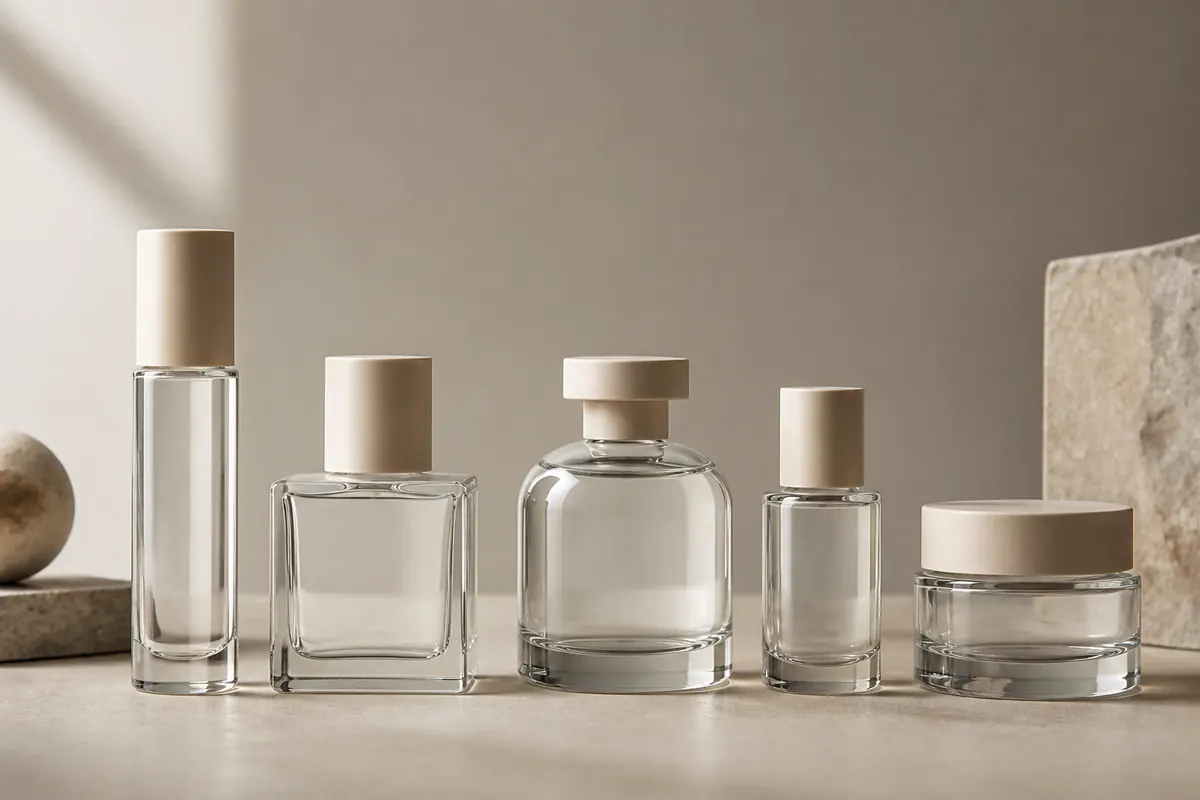
Cosmetic Packaging Shape and Proportion is not only a visual design question. Bottle height, width, shoulder geometry, base footprint and closure scale influence brand perception, but they also affect handling, decoration, component matching and carton design. For B2B buyers, the useful question is not “Which proportion looks premium?” but “Which geometry supports the brand while remaining practical to manufacture, decorate, assemble and pack?”
There is no universal ideal height-to-width ratio for cosmetic glass packaging. Capacity, formula, closure height, filled weight, decoration area and sales channel all change the functional requirements. Geometry should therefore be judged on the complete filled and assembled pack, then confirmed with drawings and physical samples.
Read Height-to-Width Ratio
Tall, narrow bottles can create a stronger vertical silhouette, while lower, wider formats often look more grounded. Neither direction is automatically more premium. Compare actual-scale bottles with the intended closure, fill and artwork because a balanced empty bottle can feel top-heavy after a tall pump, dropper or overcap is added.
| Geometry | Main Advantage | Main Limitation | What Buyers Should Verify |
|---|---|---|---|
| Tall, narrow body | Strong vertical silhouette | Can reduce decoration width or feel top-heavy | Filled stability, closure proportion and carton fit |
| Lower, wider body | Grounded stance and broad branding face | Larger footprint | Grip, shelf space and secondary packaging |
| Strong shoulder transition | More distinctive profile | Less usable decoration area near the shoulder | Artwork zone and closure relationship |
| Heavy visual base | Greater apparent mass | More glass weight without guaranteed functional benefit | Stability, total pack weight and sample feel |
Use Shoulder Geometry
Rounded, sloped or sharper shoulders change the transition between body and closure and can reduce uninterrupted decoration area. Abrupt curves deserve extra review for printing, hot stamping, labels and coatings. Confirm the usable decoration zone on the selected bottle rather than assuming a flat artwork file will transfer directly.
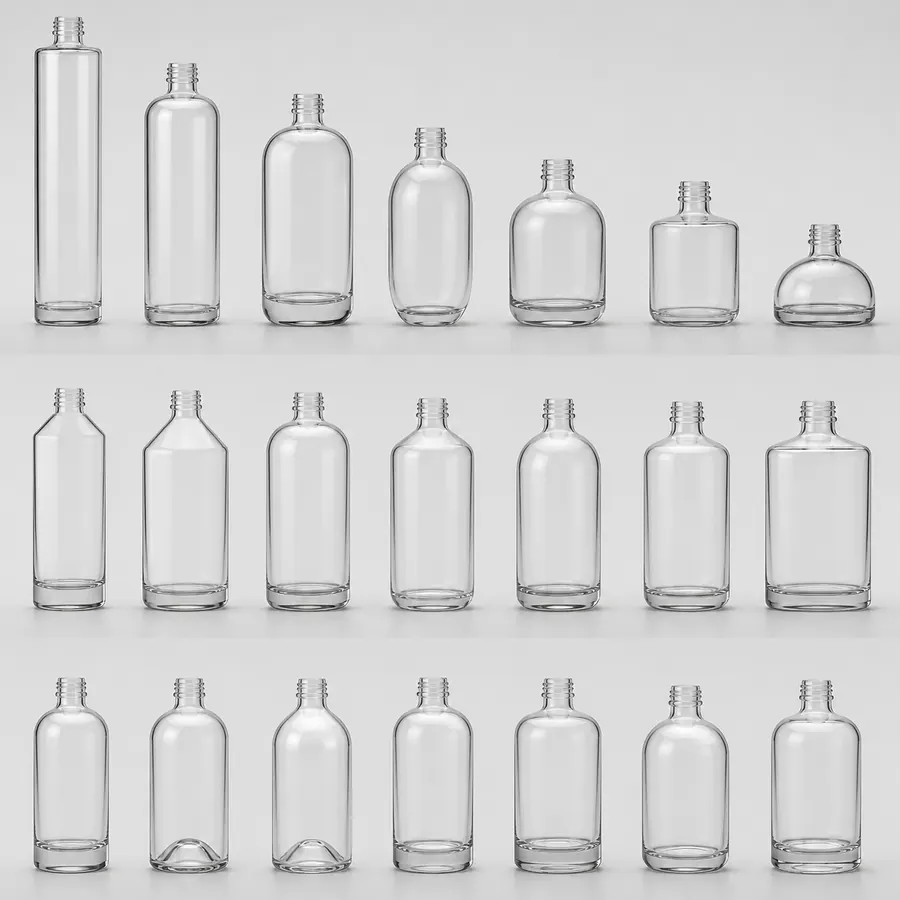
Design the Base
Base thickness, footprint and edge treatment influence stance and visual weight, but more glass does not automatically mean better stability or quality. The final result also depends on the filled product and closure. Review the fully assembled sample, carton fit and total pack weight instead of applying a generic “ideal” base thickness.
Compare Round and Square Forms
Round bottles are rotationally neutral, while square or faceted bottles create defined branding faces and make orientation more visible. Decoration, packing, handling and closure alignment should decide the choice. For a focused comparison, review round versus square perfume bottles.
Use Symmetry With Intent
Symmetry can simplify orientation and create a controlled appearance. Asymmetry can improve recognition but may require tighter control during decoration, component alignment and packing. If asymmetry is important to the brand, test how the user holds, opens and replaces the package and whether the carton needs a defined front direction.
Match Cap to Bottle
Cap diameter, height and edge language should complete the silhouette, but visual fit is not enough. Neck finish, sealing geometry, closure structure, gasket where applicable, pump or dropper, cap clearance and formula may all affect the assembly. Final bottle and closure compatibility should be confirmed using the selected components and physical samples before bulk production.
Manufacturer Insight
Freeze the bottle-and-closure stack before final artwork approval. Changing a pump, collar, dropper or cap can alter the apparent height, visual center and spacing above the logo even when the glass bottle itself does not change.
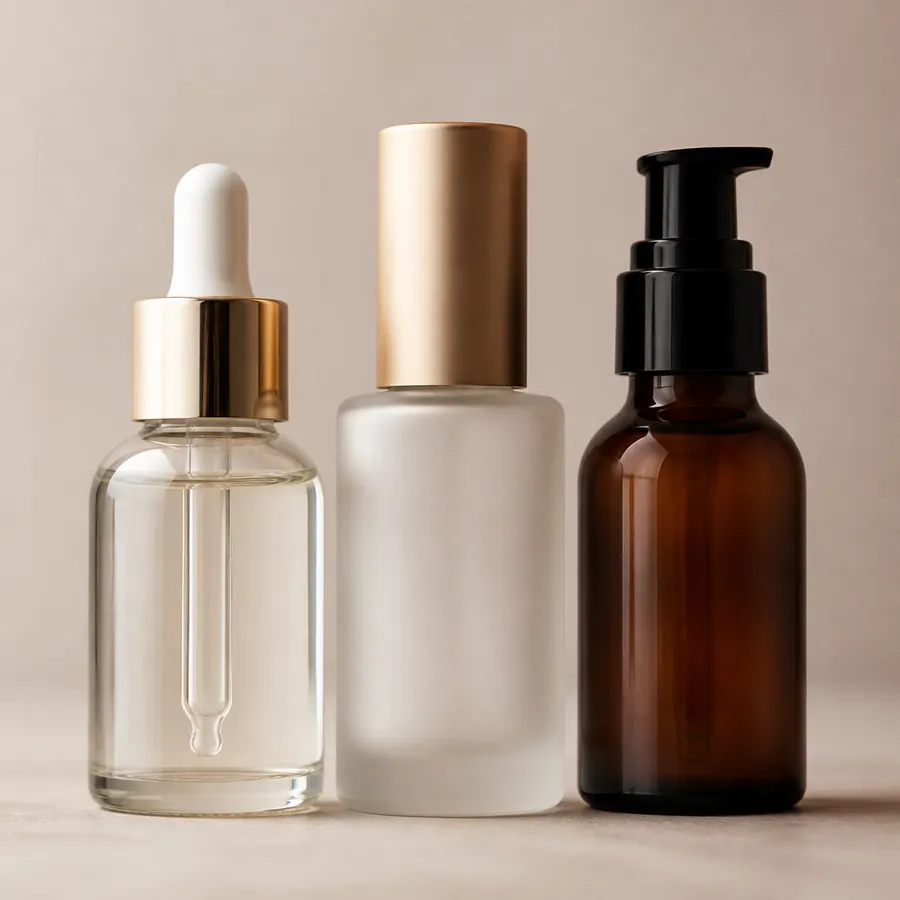
Set the Visual Center
Logo and product naming should look balanced on the real bottle, not only in a flat drawing. Curvature, fill color, base thickness and cap height can shift the apparent center. Use dimensioned artwork and reserve enough usable surface for destination-market labeling before decoration is frozen.
Protect Decoration Area
Flat or gently curved surfaces usually give screen printing, hot stamping and labels a more predictable working area than abrupt transitions. Complex geometry can still be decorated, but the process and artwork position should be confirmed on the selected bottle. Final color, logo placement, coating and decoration should be approved on a representative physical sample.
Coordinate With the Carton
Bottle footprint and total assembled height affect insert geometry, carton dimensions and presentation. Prototype the complete pack with the selected closure attached and check movement, orientation, removal and contact with decorated surfaces. A wider or heavier bottle should not be assumed to perform better in distribution without testing the finished pack under intended conditions.

Respect Manufacturing Reality
Concept geometry has to become repeatable glass packaging. Mold construction, glass distribution, demolding, neck geometry and decoration surfaces all influence feasibility. A rendering is not a production specification. Before new tooling or major structural changes, use a dimensioned drawing and supplier engineering review; exact tolerances should come from the approved drawing for that bottle rather than being copied from another SKU.
Manufacturer Insight
Lock functional interfaces before refining minor visual details. Neck finish, closure engagement, sealing geometry, pump or dropper position, standing surface and carton envelope can affect several downstream components at once. A late structural change may require new decoration, assembly and packing samples.
Common geometry failure modes: top-heavy assembled packs, artwork crowded by shoulder curvature, visually suitable closures that do not match the selected neck, cartons designed from bottle-only dimensions, and multi-SKU families that lose consistency because each size is scaled independently.
Build a Family of Proportions
A packaging family should look related without forcing every SKU into identical geometry. Repeating closure language, shoulder character, base treatment and artwork zones can create consistency across capacities. Because pumps, droppers and caps do not necessarily scale with the glass body, compare the range side by side. See the guide to a cosmetic packaging system across multiple SKUs.
Approve Through Physical Evaluation
Geometry is tactile and spatial. Screens cannot fully show weight distribution, grip, cap proportion or whether decoration still looks centered after filling. Review physical samples from normal handling angles and, where relevant, evaluate filled samples, dispensing action and the complete carton.
Sample Evaluation for Shape and Proportion
- Compare bottle height, width and closure scale at actual size.
- Check stability with the intended fill and complete closure assembly.
- Review grip and dispensing position where relevant.
- Confirm usable decoration area and artwork position.
- Check bottle-and-closure compatibility with the selected components.
- Review carton and insert fit using the fully assembled pack.
Connect Design Choices to Related Packaging Decisions
Design quality improves when teams connect the main topic with adjacent technical and commercial decisions. Review round versus square perfume bottles, premium cosmetic packaging design, luxury cosmetic packaging design, cosmetic packaging system across multiple SKUs. These guides support planning but do not replace project-specific drawings, samples or tests.
For wider planning, use skincare packaging guide, custom packaging solutions. Suitable formats can be reviewed through cosmetic and skincare glass packaging. The exact bottle, closure and decoration combination still requires verification.
What Buyers Should Put in the Design Brief
- Target customer, market, channel and intended positioning
- Product type, formula considerations and dispensing preference
- Required capacities, bottle family and future SKU plan
- Target shape, proportion and any reference bottle
- Exact closure, pump, sprayer or dropper interface to validate
- Color, finish, decoration and artwork priorities
- Required labeling space for the destination market
- Carton, insert, packing and photography requirements
- Sample stages, approval owners and acceptance references
- Commercial quantities and timing confirmed separately for the project
Use Samples as Decision Evidence
Physical samples reveal scale, weight, reflection, tactile feel, fit and assembly behavior that a rendering cannot fully establish. Keep the approved sample, drawing, component list and artwork revision connected. If the bottle, closure, finish or formula changes, identify which earlier approvals need to be repeated rather than extending one result to a different configuration.
Key takeaway: The best proportion is not a universal ratio. It is the geometry that supports the intended brand impression while giving the selected closure, decoration, handling and secondary packaging enough room to work reliably.
FOLOVER Packaging Resources
FOLOVER organizes design and sourcing guidance under Packaging Design & Branding and Product Knowledge. Buyers can use these resources to narrow the design direction and identify interfaces that require physical validation. Availability, MOQ, lead time, tooling and performance must be confirmed for the selected project rather than inferred from a general article.
Related Blog Articles
Frequently Asked Questions
Is there an ideal height-to-width ratio for cosmetic bottles?
No single ratio is ideal for every cosmetic bottle. Capacity, closure height, filled weight, decoration area and brand direction all affect the result. Buyers should compare actual-scale options and approve the complete assembled package.
Are wider cosmetic bottles always more stable?
Not necessarily. Stability also depends on the center of mass, filled product, base geometry and closure or dispenser. Evaluate the intended fill and final assembly on physical samples.
How does bottle shape affect decoration?
Shape determines how much usable surface is available for printing, hot stamping or labels. Strong shoulders, edges and compound curves can make alignment more sensitive, so approve final decoration on the selected bottle.
Should the cap be chosen before finalizing bottle proportions?
The bottle and closure should be developed as a system because cap height, pump or dropper structure and neck geometry can change both visual proportion and functional fit.
Can a 3D rendering prove that a bottle shape is manufacturable?
No. A rendering communicates appearance but does not confirm mold feasibility, critical dimensions, closure fit, decoration performance or carton fit. Use drawings, supplier review and physical samples before production approval.