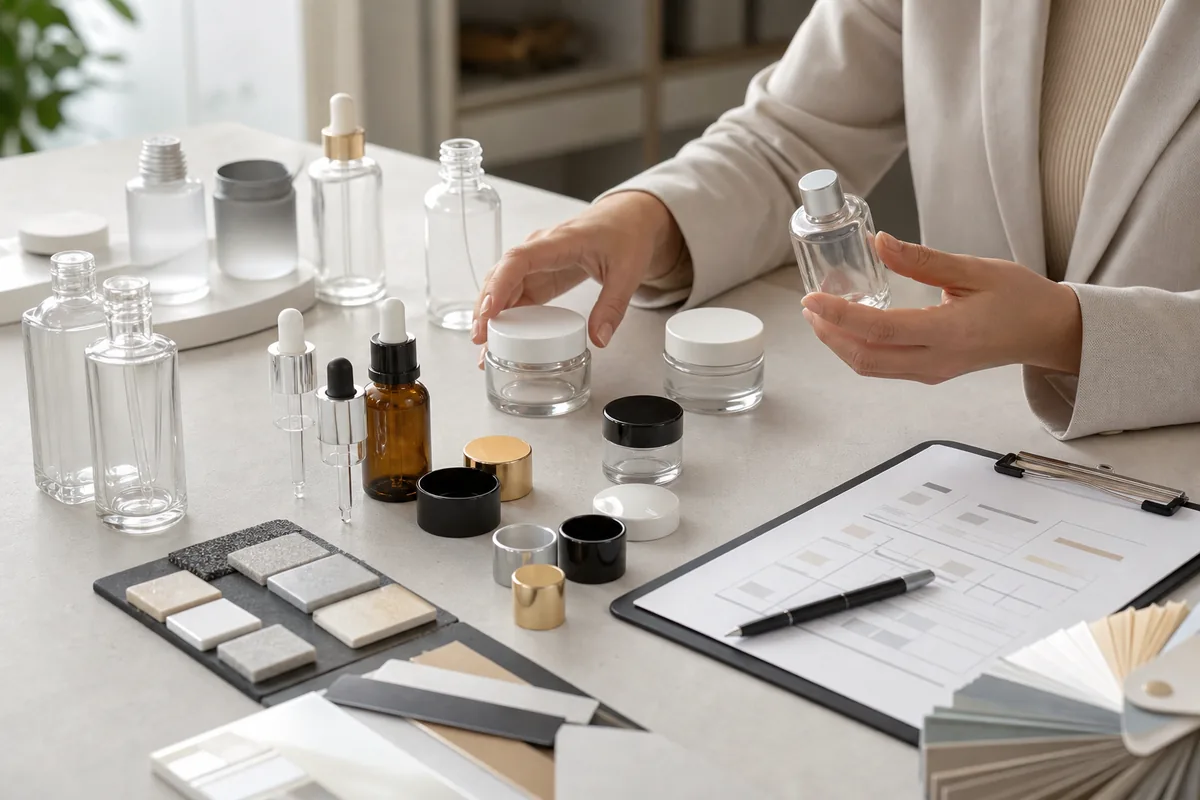

The true cost of custom cosmetic packaging is larger than the bottle unit price. A commercial package may include a glass container, pump or dropper, cap, decoration, molds or fixtures, samples, protective packing, inspection, freight, import charges, storage, and the cost of unusable or slow-moving inventory.
To compare options fairly, buyers need a total-cost model tied to the exact configuration, order quantity, and trade boundary. The practical calculation is: recurring package cost + one-time development cost + logistics and import cost + evidence-based conditional cost + inventory cost. The goal is not to predict one universal market price. It is to expose every cost driver before the packaging decision is approved.
Buyer conclusion: Do not compare suppliers by bottle unit price alone. First normalize the bottle, closure, decoration, quantity, packing, inspection scope, trade term, and delivery boundary; then calculate the total project cost and the effective cost per sellable unit.
1. Base Bottle Cost
The base bottle cost depends on the selected model and current quotation. Capacity, glass weight, geometry, mold complexity, production route, quantity, color, and required controls may influence pricing. Do not infer cost from capacity alone: two bottles with the same nominal fill can have different shapes, weights, necks, and production requirements.
Record the exact bottle model, unit basis, quantity tier, currency, and whether the price is for undecorated glass. Confirm what protective packing is included and whether the quotation assumes an existing mold or custom tooling. For skincare projects, the skincare packaging guide can help define the bottle, jar, and dispensing direction before suppliers quote different packaging systems.
2. Closure and Dispensing Component Cost
Add every part needed to make the container usable: pump, atomizer, dropper, cap, collar, liner, gasket, insert, wiper, pipette, dip tube, or overcap as applicable. Component material, finish, color, decoration, dosage or spray requirement, and supplier minimum can affect cost.
The cheapest component is not economical if it does not fit, seal, dispense, or assemble correctly. Cost comparison must use the exact approved bottle-and-closure configuration, not a generic pump or visually similar cap. A late change to the closure can also change the component MOQ, assembled height, decoration position, carton fit, and sample-approval work.
3. Decoration Cost
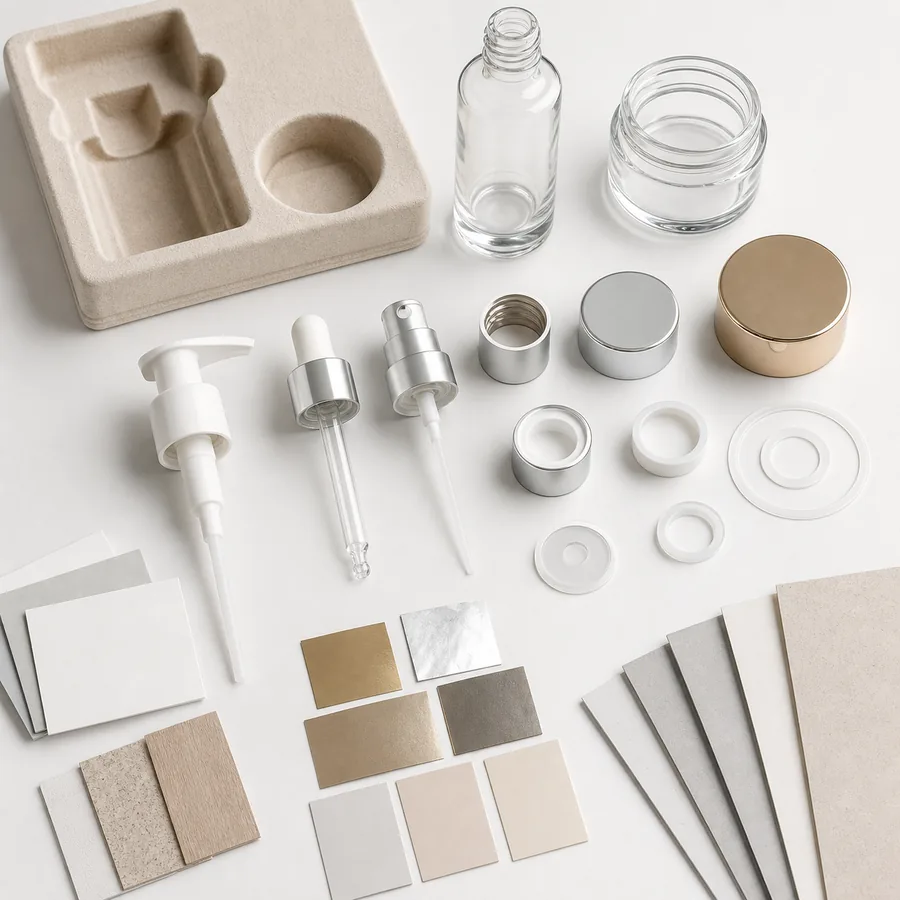
Decoration may include spray coating, frosting, screen printing, hot stamping, labels, or finished components. Ask for each process as a separate line when possible. A multi-process design may create several setup charges, sample stages, minimums, and potential rework points.
Define the number of colors, artwork variants, print positions, coverage, finish, and physical reference. Digital mockups do not establish final physical color. The commercial impact is not only the decoration unit charge: new color references, additional artwork versions, repeated samples, rejected decoration, and post-approval changes can create additional project cost.
Manufacturer Insight
Decoration cost is easiest to control before sampling begins. Lock the bottle, closure, component colors, artwork version, print position, and finish sequence first. If one of these changes after a decorated sample is approved, the project may require new samples, revised tooling or screens, component re-coordination, and updated packing checks rather than a simple artwork edit.
4. Tooling and Mold Cost
Separate one-time tooling from recurring unit cost. Custom bottle molds, component molds, decoration screens, fixtures, plates, or assembly tools may have different ownership, maintenance, storage, revision, and reuse terms.
Ask what the tooling fee includes: design work, drawings, prototype or sample output, revisions, production tooling, and future use. Do not assume mold ownership, mold life, maintenance, exclusivity, or revision rights unless they are documented for the project. A higher unit price on a suitable stock bottle may still produce a lower program cost when custom geometry is not commercially necessary.
Cost-control point: Treat tooling as a program decision, not merely a first-order surcharge. Allocate verified one-time development costs across a realistic planned volume, and keep the unamortized amount visible if the program could stop, change shape, or move to another component system.
5. Sampling and Development Cost
Budget for available samples, custom samples, decoration samples, courier charges, formula filling, compatibility work, assembly trials, and internal review time. Multiple rounds may be necessary when the bottle, closure, artwork, or formula changes.
Sampling is not wasted cost when it prevents an unsuitable bulk order. The cosmetic packaging sample evaluation checklist helps buyers connect samples to specifications, testing, and golden-sample control.
What to Record Before Approving Sample Cost
- which bottle and closure configuration the sample represents;
- whether decoration and component colors are production-intent or provisional;
- which sample charges are one-time and which may repeat after a change;
- whether formula, dispensing, sealing, and assembly checks are included or handled separately;
- which physical sample or documented reference bulk production is expected to match.
6. Secondary and Protective Packaging Cost
Include dividers, trays, bags, sleeves, inserts, cartons, custom boxes, labels, pallet materials, and component protection. The correct design depends on the bottle, decoration, closure, shipment mode, handling route, and final presentation.
Retail presentation packaging and export protective packing serve different purposes and should be quoted separately. Reducing packing without validation may increase breakage, abrasion, decoration damage, or handling cost. For glass packaging, carton quantity and dimensions also affect freight efficiency, so the lowest packing cost is not automatically the lowest delivered cost.
7. Quality, Rework, and Mismatch Risk
Quality risk becomes a cost when bottles and closures do not match, decoration requires rework, components arrive in inconsistent colors, assembly fails, or goods are rejected against approved criteria. The impact may include sorting, replacement, production delay, expedited freight, wasted formula, and lost filling-line time.
Do not insert an arbitrary defect or wastage percentage into the model. Use project evidence, an agreed inspection plan, supplier records, sample results, and a clearly documented allowance or scenario. If no reliable probability exists, compare a base case and a defined downside case instead of presenting a made-up percentage as industry data.
Common cost failure modes: comparing a bottle-only quote with a complete-package quote; approving decoration before the final cap or collar is fixed; discovering that the closure MOQ is higher than the bottle MOQ; changing artwork after sample approval; using a cheaper packing method without transport validation; or treating rework and expedited replacement freight as “unexpected” even though the project had unresolved specifications.
8. Freight, Palletization, and Shipping Efficiency
Glass is relatively heavy and can occupy substantial volume once protective packing is added. Compare carton quantity, dimensions, gross weight, pallet or non-pallet configuration, loading basis, shipment mode, route, insurance, and final delivery scope.
Freight markets and routes change, so use current quotations for the intended shipment date and destination. Compare suppliers on the same trade term and named place. The International Chamber of Commerce explains that Incoterms® rules allocate tasks, costs, and risks between seller and buyer; they do not make two quotations equivalent when the delivery boundary is different. The locked guide on cosmetic glass bottle export packing covers packing considerations separately.
9. MOQ and Cost Amortization
Setup, tooling, sampling, and development costs are spread across the ordered quantity. A larger run may lower the allocated cost per unit, but it increases total cash commitment and inventory exposure. Each bottle, closure, color, decoration, or artwork can also carry its own minimum.
Use the custom cosmetic packaging MOQ guide to identify which component or process controls the practical order. Do not choose quantity only to obtain a lower unit price.
A useful calculation is amortized one-time cost per unit = verified one-time development cost ÷ planned program units. Keep the planned program units separate from the first purchase quantity so decision-makers can see how much of the one-time investment remains unrecovered if the project changes after the first run.
10. Inventory and Cash-Flow Cost
Packaging inventory ties up cash before finished products are sold. Storage, insurance, handling, obsolescence, artwork changes, component discontinuation, damage, and slow-moving SKUs can add real cost. Fragmenting one launch across many colors, sizes, closures, or prints can multiply these exposures.
Model realistic sell-through scenarios rather than assuming every ordered unit becomes revenue. A higher unit price at a controlled quantity may cost less overall than a lower unit price attached to excess inventory. When several SKUs share components, confirm compatibility and color requirements first; common components reduce complexity only when the same approved specification can genuinely be used across those SKUs.
Separate Recurring, One-Time, and Conditional Costs
Organize the model into three groups so decision-makers do not mix unlike items. Recurring costs apply to each unit or shipment, such as bottles, closures, decoration, packing, and routine freight. One-time costs support development, such as molds, fixtures, artwork setup, and initial samples. Conditional costs appear only when a defined event or business choice occurs, such as a design revision, expedited shipment, extra inspection, storage extension, or rework.
This separation improves scenario planning. A one-time mold should not be treated as if it repeats on every future order, but it should be allocated across a realistic expected program rather than an optimistic lifetime volume. Similarly, a component quotation may be recurring while a special color setup is charged per batch or artwork.
Record when each cost becomes non-refundable and what approval triggers it. Tooling may start after drawing approval, decoration setup after artwork approval, and production after deposit and sample confirmation. These trigger points matter because specification changes made afterward can create duplicated costs.
Also distinguish supplier charges from the buyer’s internal costs. Design review, regulatory assessment, formula testing, warehouse handling, finance, purchasing time, and filling-line trials may not appear on the supplier invoice, but they can affect the economic comparison. Include them when they differ materially between alternatives, and state the evidence or assumption behind every amount.
Build a Total Packaging Cost Formula
Total Project Cost = Recurring Packaging Cost + One-Time Development Cost + Logistics / Import Cost + Evidence-Based Conditional Cost + Inventory Cost.
Effective Cost per Sellable Unit = Total Project Cost ÷ Expected Sellable Units.
| Cost Layer | Calculation Basis | Typical Inputs | Buyer Verification |
|---|---|---|---|
| Recurring packaging | Order quantity × confirmed recurring unit cost | Bottle, closure, dispenser, decoration, routine protective packing | Use the same approved configuration and quantity tier |
| One-time development | Sum of confirmed non-recurring project charges | Tooling, development samples, setup or project-specific fixtures where quoted | Separate ownership, reuse, revision, and trigger conditions |
| Logistics and import | Current shipment and destination costs for the selected trade boundary | Freight, insurance where applicable, destination charges, applicable duties and taxes | Use the same Incoterms® rule, named place, route, and shipment assumptions |
| Conditional cost | Defined scenario or evidence-based allowance | Rework, extra inspection, expedited freight, storage extension, design revision | Do not insert an unsupported industry percentage |
| Inventory cost | Buyer-specific carrying and obsolescence assumptions | Storage, financing, slow-moving inventory, write-down risk | Use finance and warehouse assumptions that match the launch plan |
Import costs can include duties, taxes, brokerage, port or terminal charges, and destination delivery, but the applicable items and rates depend on product classification, country, origin, and current law. Verify them with current official customs sources and qualified customs or logistics professionals.
For comparison per sellable unit, divide the relevant total by the expected number of usable units—not automatically by the ordered quantity. State every assumption so finance, sourcing, operations, and brand teams can challenge the same model.
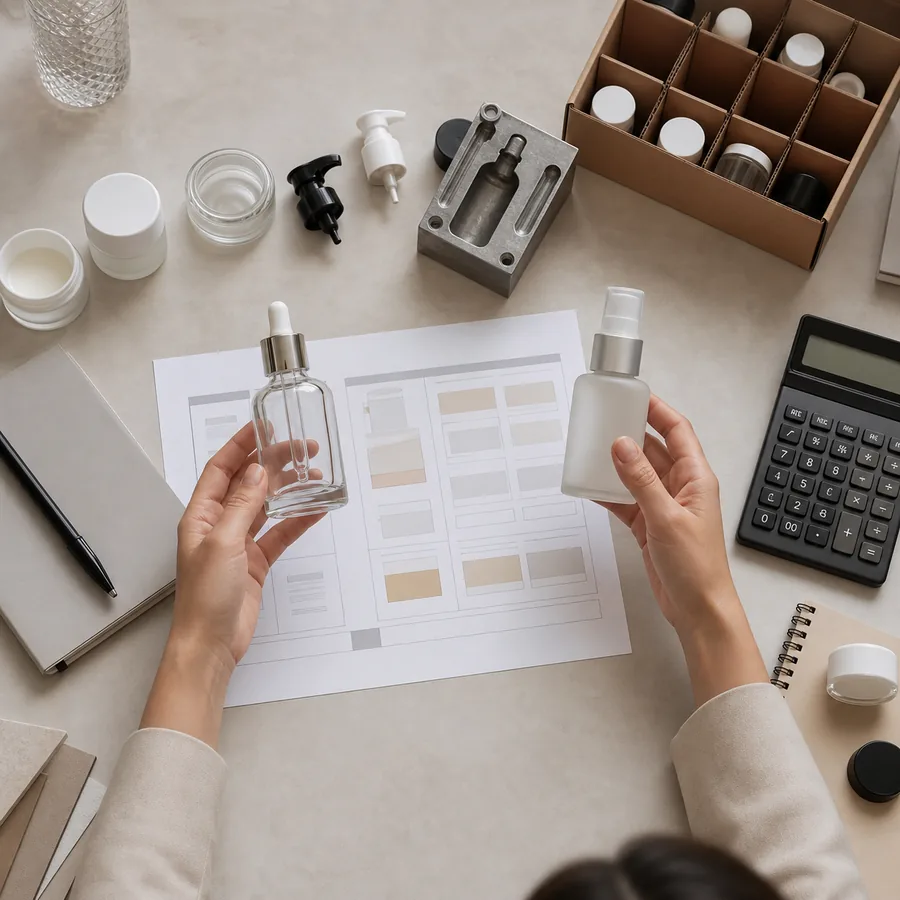
How to Compare Two Packaging Quotations
| Cost Item | Supplier A | Supplier B |
|---|---|---|
| Base bottle and quantity tier | ||
| Closure / dispensing system | ||
| Decoration and artwork variants | ||
| Tooling and ownership terms | ||
| Samples and development | ||
| Protective / secondary packing | ||
| Inspection and quality scope | ||
| MOQ by component or process | ||
| Lead-time starting condition | ||
| Trade term and freight basis | ||
| Exclusions and validity |
Quotation Normalization Checklist
- same bottle model and capacity basis;
- same closure, dispenser, liner, gasket, pipette, dip tube, or cap configuration;
- same decoration coverage, colors, artwork count, and component finish;
- same order quantity and SKU split;
- one-time charges separated from recurring charges;
- same protective packing and pallet basis;
- same inspection and testing scope;
- same currency, Incoterms® rule, named place, and freight boundary;
- same exclusions, quote-validity assumptions, and change conditions.
Normalize both quotations to the same specification, quantity, currency basis, trade term, and delivery boundary. The China cosmetic glass bottle sourcing guide explains the RFQ and quotation workflow, while the supplier evaluation guide covers capability and accountability.
Where Buyers Can Reduce Cost Without Damaging the Project

- start with an existing bottle when exclusive geometry is not essential;
- use a standard verified neck and commonly available matched closure;
- reduce the number of artwork, color, and component variants;
- use fewer decoration processes where brand impact remains acceptable;
- share components across SKUs only after compatibility is verified;
- align order quantity with realistic demand and cash flow;
- optimize protective packing through evidence, not assumption;
- freeze specifications before tooling and production.
Do not reduce glass weight, seals, quality controls, or protective packing without technical validation. Review available cosmetic and skincare glass packaging and custom packaging solutions to find a configuration that balances differentiation and complexity.
Manufacturer Insight
For many projects, the safest cost reduction is removing unnecessary variation rather than reducing the functional package. One stock bottle platform can sometimes support multiple SKUs through controlled decoration or component choices, but the closure system, formula use, color standard, decoration, and physical samples still need approval for each intended configuration.
Frequently Asked Questions
How much does custom cosmetic packaging cost?
There is no universal amount. Calculate the project from the exact bottle, closure, decoration, tooling, samples, packing, logistics, destination charges, quality scope, and inventory assumptions. For comparison, use the same quantity and trade boundary for every supplier, then divide the total by the expected sellable units rather than comparing bottle price alone.
Why do custom bottles cost more than stock bottles?
Custom bottles may require design, drawings, tooling, samples, validation, and additional approval work before bulk production. A stock bottle can avoid some one-time development cost, while a custom structure may justify that investment when exclusive geometry is commercially important. Buyers should compare the total program cost rather than assuming either route is automatically cheaper.
Does decoration significantly increase packaging cost?
It can. Decoration may add recurring unit charges as well as setup, sampling, approval, artwork, component-color, and possible rework costs. The effect depends on the selected process, coverage, colors, number of artwork variants, quantity, and whether specifications change after approval. Request decoration as separate quotation lines where possible.
Is mold cost included in the unit price?
Not necessarily. Request tooling as a separate line and confirm exactly what the quoted charge includes. Ownership, maintenance, storage, revisions, reuse, exclusivity, and future production rights should not be assumed from the mold fee alone; they need project-specific confirmation before tooling begins.
How does MOQ affect bottle pricing?
Fixed development or setup costs can be spread across more units, but a larger MOQ also increases cash and inventory exposure. The practical MOQ may also be controlled by a closure, custom color, decoration process, or artwork rather than the bottle itself. Compare total project cost and realistic demand, not unit price alone.
What costs are usually excluded from a bottle quotation?
Exclusions vary by supplier and trade term. Check closures, decoration, tooling, samples, protective packing, inspection, freight, insurance, duties, taxes, brokerage, destination delivery, storage, and buyer-side testing explicitly. A quotation should state what is included, what is excluded, and where seller cost responsibility ends.
How can I reduce cosmetic packaging cost?
Start with a suitable existing bottle when custom geometry is not essential, reduce unnecessary color and artwork variants, simplify decoration, use verified shared components where appropriate, freeze specifications before tooling, and align quantity with realistic demand. Do not cut sealing, compatibility checks, quality controls, or protective packing without technical validation.
Continue comparing commercial and sourcing variables in the packaging buying guides.
Conclusion
The true cost of custom cosmetic packaging combines recurring component costs, one-time development costs, logistics, quality and change risk, and inventory exposure. A transparent model makes quotations comparable and shows where complexity creates value versus avoidable expense.
FOLOVER PACK supports cosmetic glass bottles, matched components, decoration, samples, and custom development. Buyers can submit a defined bottle, closure, finish, quantity, destination, and schedule for a project-specific quotation; general website baselines should never replace the current confirmed commercial scope.