
A perfume sample can be a slim vial slipped into a card, a miniature glass spray bottle, or one of several fragrances arranged in a discovery box. Each format lets someone experience a scent before choosing a larger bottle, but the packaging changes how that experience works: how the fragrance is applied, carried, identified, protected and eventually used up.
For fragrance brands, the choice extends beyond appearance. A small vial with a simple cap and a 10ml crimp-spray glass bottle may both contain perfume, yet they require different filling, closure and presentation decisions. The most useful perfume sample packaging ideas begin with the reason the sample exists.
Why Do People Choose Mini Perfumes and Fragrance Samples?
Small fragrances make it possible to spend time with a scent before committing to a full-size bottle. A shop-floor test reveals an initial impression; a sample at home lets someone try the fragrance on different days and decide whether they want to wear it regularly. Mini sprays can also be carried separately from a full-size perfume, while a discovery set allows several fragrances to be compared.
There is measurable market interest in these smaller formats. In its report on US beauty sales for January–September 2025, Circana reported that US prestige mini/travel-size fragrance units increased 12% year over year and mini/discovery fragrance sets increased 41%. The report does not say that every discovery-set design sells better, and the figures should not be treated as global demand forecasts.
Trying a Scent Before Buying a Full-Size Perfume
Sampling is particularly useful when someone wants to compare several fragrances without buying full-size bottles. A sample can be tried over more than one occasion, although the number of uses depends on the amount filled and how the applicator dispenses it. A sealed, clearly labeled sample also makes it easier to know which fragrance is being tested.
Mini Perfumes for Travel, Gifting and Everyday Use
A small fragrance is not necessarily a free sample. Some minis are separate retail products, some are travel companions and some are part of a gift. A 5ml atomizer with an outer shell feels different in a bag from a bare glass vial; a 10ml glass spray may offer more liquid but also needs its own protective packing. The useful distinction is the product’s purpose, not its volume alone.
Why Brands Offer Sample Programs
For a fragrance brand, a sample can introduce a new scent, accompany a product launch or form part of a paid discovery assortment. Each format creates different packaging requirements. Promotional cards favor compactness and clear identification. Retail miniatures often need more developed decoration. A multi-scent set needs every bottle to be held securely and identified correctly.
Perfume Samples, Mini Perfumes and Discovery Sets: What’s the Difference?
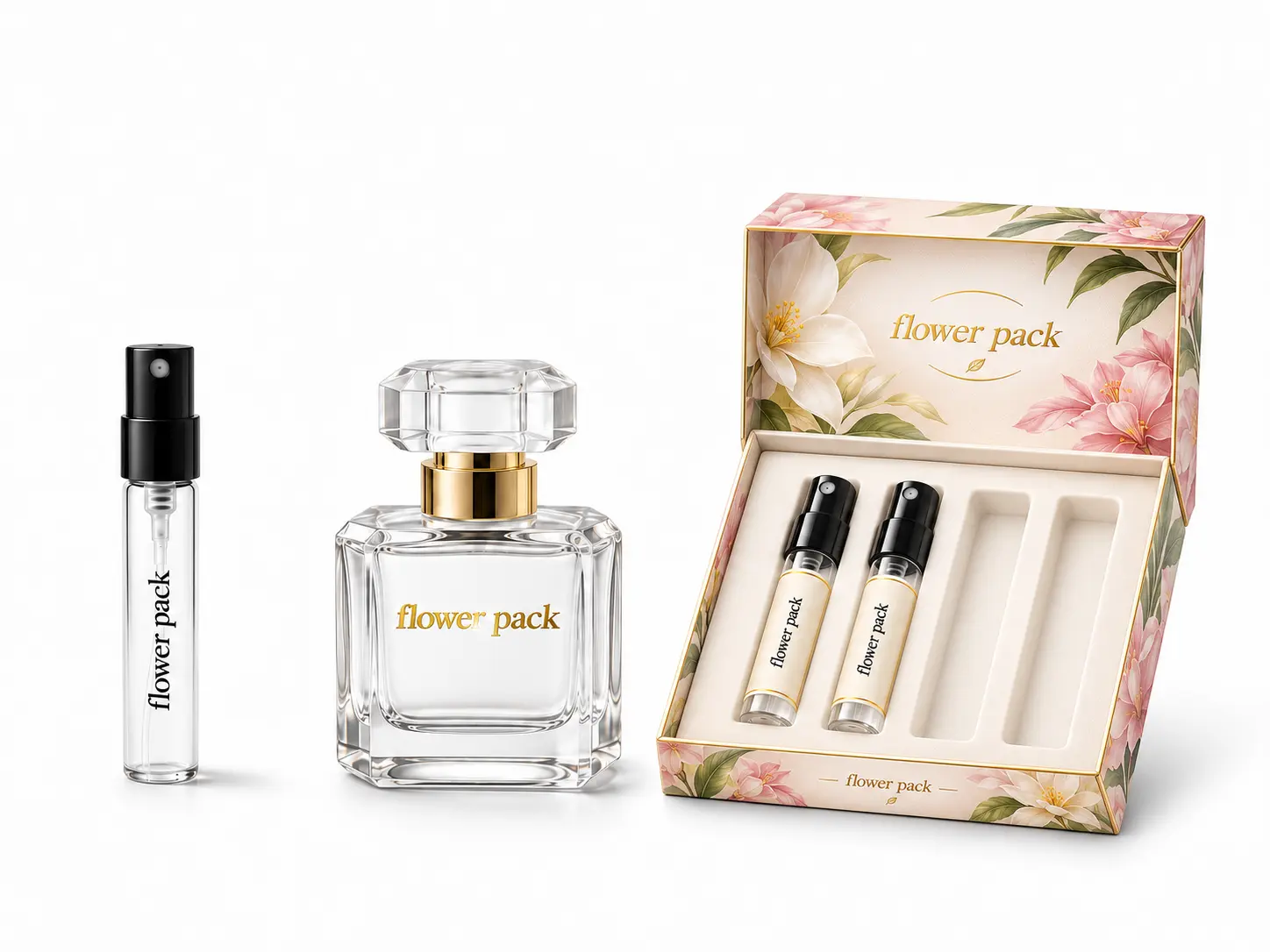
A perfume sample is a small amount supplied for trying a fragrance. A mini perfume is a small-format fragrance product that may also be sold or collected in its own right. A discovery set brings two or more fragrance samples or minis together so the wearer can explore a range. These are practical descriptions, not universal capacity standards.
| Format | Typical purpose | Packaging question |
|---|---|---|
| Single sample vial | Try one fragrance | How is it dispensed, sealed and identified? |
| Mini perfume or travel spray | Carry or use a smaller product | Does the complete bottle, sprayer and cap suit repeated use? |
| Discovery set | Explore several fragrances | How are the bottles arranged, protected and distinguished? |
What Is a Perfume Sample Vial?
A vial is usually a compact container intended to hold a small fragrance portion. It may have a sprayer or a different applicator; neither can be inferred from the word vial alone. Where the sample is distributed in a paper card or sleeve, the label and outer packaging should make the scent name easy to find.
What Makes a Mini Perfume Different?
A miniature can echo the appearance of a full-size fragrance or use a more functional travel atomizer. Its cap, external dimensions, materials and dispensing system determine how it is carried and used. A mini is not automatically refillable simply because it is small.
What Is Included in a Discovery Set?
A discovery set generally groups different scents in one presentation. Depending on the fragrance house, it can include a box, fitted insert, individual labels, scent notes and sometimes a purchase credit toward a larger fragrance. None of those extras is mandatory for every set.
Real Discovery Set Examples from Fragrance Brands
Existing fragrance collections show why there is no single formula for the number or capacity of discovery-set bottles. The examples below describe finished perfumes sold by fragrance brands; they are market references, not FOLOVER manufacturing projects.
BYREDO: Six 2ml Fragrances
BYREDO has offered a Discovery Set Nomade containing six 2ml eau de parfum samples. This illustrates a compact format intended for comparing several scents. A set built around vials of this size needs legible scent identification and a way to keep the small units organized. Any purchase-credit terms are brand- and market-specific and should be checked at the time of purchase.
Le Labo: Five 1.5ml Samples
Le Labo’s Classic Collection discovery format includes five 1.5ml fragrances. It demonstrates another approach: a relatively small quantity per scent, with consistent presentation across the series. The relevant packaging lesson is not to imitate its branding, but to make each fragrance easy to recognize while keeping the collection coherent.
Diptyque: Five 7.5ml Fragrances
Diptyque has offered a set of five 7.5ml eaux de toilette. That is a markedly different amount per bottle from a 1.5ml vial-based set. A larger miniature can change the gift-box proportions, internal supports and consumer expectations. These examples show that discovery sets can span sampling and gift-oriented mini formats rather than belonging to one fixed bottle size.
| Brand example | Listed format | Packaging implication |
|---|---|---|
| BYREDO | 6 × 2ml | Compact multi-scent identification and organization |
| Le Labo | 5 × 1.5ml | Consistent labeling across small vials |
| Diptyque | 5 × 7.5ml | More space and protection for larger minis |
These are examples of published product formats, not a claim about their relative sales or packaging performance. Their configurations may change over time.
Perfume Sample Bottle Types and Sizes: Which Should You Choose?
Start with what the sample is supposed to do. A first introduction to a scent may need only a tiny vial; a fragrance meant to be worn repeatedly away from home may justify a larger spray container. The capacity tells you how much liquid is intended, not the exterior size, the spraying system or the number of applications.
1ml and 2ml Glass Sample Vials
These formats commonly appear in small fragrance-sampling programs. They are easy to group but leave limited room for labels. Their external dimensions and closure construction still matter when fitting them into cards or discovery boxes.
3ml and 5ml Perfume Sample Bottles
A 3ml or 5ml pack can provide more fragrance for repeat exploration than a smaller vial, subject to the way it dispenses. Some 5ml formats are straightforward sample containers; others are complete travel atomizers with decorative shells. They should not be specified interchangeably.
8ml and 10ml Mini Perfume Sprays
At 8ml or 10ml, many designs are positioned as portable fragrances or mini retail products. A glass bottle with a crimped spray and an atomizer with a removable inner container may have comparable nominal capacities but require completely different filling and closing processes.
Spray, Dab and Refillable Formats
A spray applies fragrance as a mist; a dab applicator transfers it directly. A refillable atomizer has a defined refill path that must be checked on the specific model; FOLOVER’s refillable perfume bottle collection shows different portable configurations. Roll-on systems are another direct-application format, often associated with perfume oils or other formulations designed for that applicator. The selected formula and contact materials still need to be evaluated together.
| Nominal size | Common product role | Check before choosing |
|---|---|---|
| 1–2ml | Compact trial vial | Closure, labeling and sample-card fit |
| 3–5ml | Extended sampling or small portable format | Sprayer or applicator, assembled dimensions |
| 8–10ml | Travel or miniature retail fragrance | Refill system, glass or polymer inner container, outer packing |
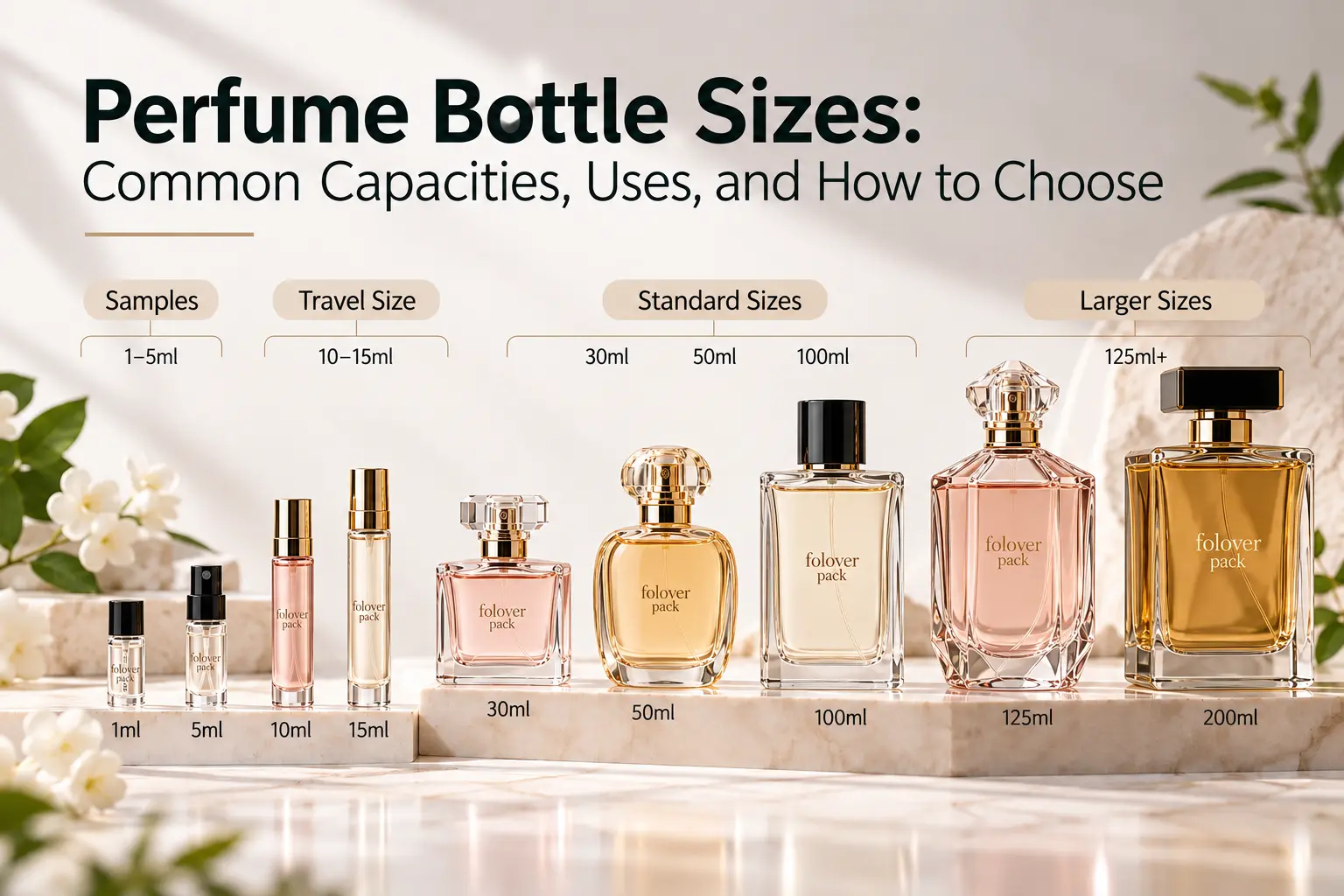
For a wider comparison of sample, miniature and retail capacities, see FOLOVER’s perfume bottle sizes guide. A 5ml or 10ml nominal rating still cannot substitute for the actual bottle drawing, closure specification and assembled dimensions.
Creative Perfume Sample Packaging Ideas
Good packaging ideas do not necessarily require a new bottle mold. The position of a scent label, the glass finish, the protective sleeve and the arrangement of several bottles can all change how a sample is presented. The design should make the fragrance easy to recognize and use, then remain practical to fill and pack.
For a small fragrance brand, the strongest idea is usually the one that matches how the sample will reach the customer. A compact promotional vial, a paid scent-discovery collection and a gift-oriented miniature each call for a different pack, even if the glass container is similar.
Packaging Ideas by Sampling and Brand Scenario
| Use case | Packaging concept | What makes it practical | What the buyer must verify |
|---|---|---|---|
| DTC introduction or sample mailer | One small spray vial held in a printed folded card or slim paper sleeve | Keeps the fragrance name and introductory message together in a compact format | Vial retention, label space, finished mailer thickness and shipping protection; postage depends on the actual packed weight and service |
| Niche fragrance discovery collection | Several small spray vials in a fitted presentation box, with numbered positions and a scent guide | Lets a customer compare fragrances without losing track of the samples | Actual bottle-and-cap dimensions, insert retention, opening access, artwork and carton durability; a purchase-credit card is optional |
| Giftable miniature fragrance range | Decorated mini glass sprays in a coordinated carton or sleeve set | Connects the miniature presentation to the main fragrance collection | Closure type, decoration area, handling of multiple SKUs and protection between bottles |
| Materials-conscious presentation | Existing mini bottles with a right-sized paperboard or molded-fiber insert, where feasible | Allows brands to evaluate different outer-pack structures without changing the glass mold | Retention tests, actual material composition, local recovery systems and market-specific packaging requirements |
These are design configurations, not FOLOVER customer cases, fixed quotations or verified performance outcomes. For example, a printed sample card can be straightforward to produce but is not automatically the lowest-cost mailing option once protective materials and shipping requirements are included.
Minimalist Glass Vials with Clear Identification
A simple glass vial and restrained label can keep the attention on the scent name. With a very small printing area, readability matters more than covering the bottle with graphics. If ingredient or market-specific information must appear on the package, the brand should plan where it will be provided rather than assuming it all fits on the glass.
Decorative Mini Perfume Bottles
Colored finishes, frosting, printed logos and coordinated caps offer ways to distinguish a mini fragrance line. The actual finish should be approved on the selected bottle. Curvature, available printing space and the order of surface treatments can change the result compared with flat artwork.
Sample Cards and Paper Sleeves
A single vial paired with a folded card or sleeve can communicate the fragrance name and provide a compact presentation. The vial must still be retained securely; a decorative card alone does not establish safe transport performance.
Gift-Ready Discovery Boxes
Rigid boxes, folding cartons and drawer-style presentations can be considered for multi-scent packs. The choice depends on the dimensions of the fully assembled bottles, the opening experience and the packaging budget. A foam or paperboard insert should be designed around the physical sample rather than a nominal 5ml or 10ml description.
Personalized Scent Labels
Numbering each vial or giving every scent a coordinated color makes a collection easier to navigate. A consistent location for the scent name is often more useful than creating a different decorative treatment for every bottle. Printing and labeling feasibility should be checked on the actual surface.
Perfume Discovery Set Packaging: Turning Several Bottles into One Collection
A discovery set works when the samples are clearly identified, easy to remove and adequately protected. Putting five vials in a box is only the starting point. The packaging must also accommodate closures, let users return the bottles to their positions and keep the set understandable after the first opening.
Arrange Bottles for Easy Comparison
Side-by-side layouts allow scent names to be read together. Numbered positions can help connect a vial with a printed scent guide. If a set mixes different bottle heights or caps, the insert may need separate cavities instead of a uniform row.
Design the Insert Around the Assembled Bottle
For each cavity, measure the actual filled-pack silhouette, including the overcap and any decorative shell. Leave appropriate access for fingers to remove the bottle without pulling on its sprayer. Protection for glass should be assessed against the intended distribution and shipping conditions, not judged by the appearance of the open box.
Paperboard, Molded Pulp or Foam: Which Insert Fits the Set?
The insert is a working component, not merely a display background. Different materials offer different possibilities for shape, surface finish and bottle retention; none can be rated as universally protective without testing the finished set.
| Insert option | Potential advantages | Limitations to check | Typical design consideration |
|---|---|---|---|
| Folded paperboard or die-cut card | Can combine structural tabs, printed information and a relatively flat pack format | Thin sections, sharp bottle shoulders and repeated removal may affect retention; coating and mixed-material construction affect end-of-life options | Confirm cutout geometry, board grade and actual bottle clearance |
| Molded fiber / molded pulp | Can create shaped cavities and a tactile molded surface | Tooling, minimum practical wall thickness, dimensional variation, dust and surface finish require review | Approve a physical tray fitted to the selected caps and bottles |
| EVA or other foam insert | Can be cut to defined cavity shapes with a soft-contact presentation | Compression, odor, fit, material compatibility and waste handling must be assessed; recycling options vary | Test retention and removal without stressing the sprayer |
For packs sold in the EU, material selection and claims about recyclability should be reviewed against the applicable Packaging and Packaging Waste Regulation (EU) 2025/40 and related implementation rules. Paper or molded fiber alone does not establish regulatory compliance. See the European Commission’s packaging waste guidance for the regulatory framework.
Keep the Scent Identity Consistent
Each fragrance needs a reliable relationship between its bottle label, the outer pack and any enclosed scent card. This matters as much for the person exploring the set at home as it does for the brand assembling multiple versions of a collection.
FOLOVER Packaging Examples: 5ml and 10ml Perfume Bottles
The following are examples from FOLOVER’s published product range, not claims of completed customer discovery-set projects. They illustrate three different packaging structures that can support small-format fragrance concepts. Any proposed set arrangement would still require actual product and packing samples.
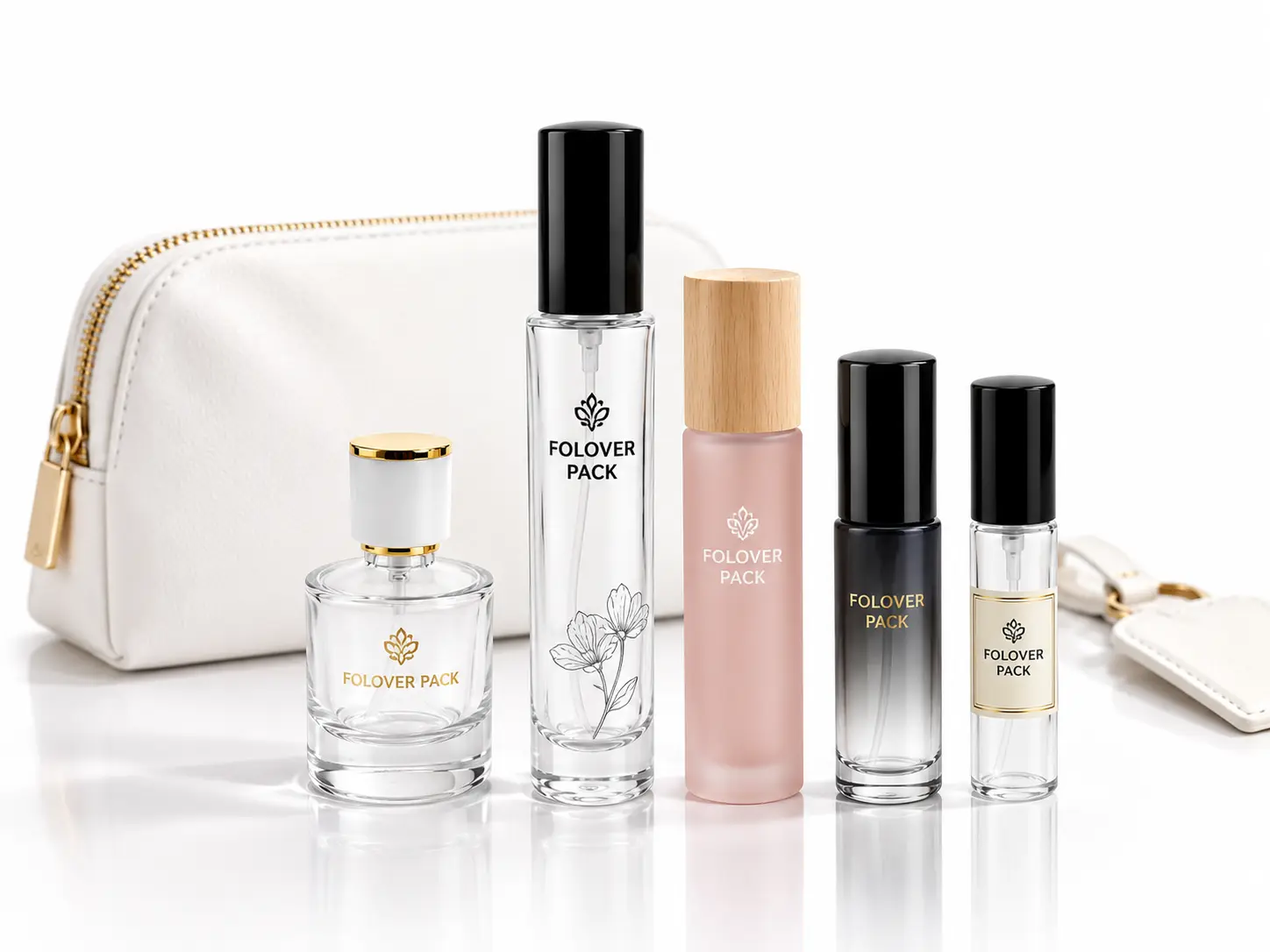
Example 1: A 5ml Glass-Inner-Bottle Travel Atomizer
FOLOVER’s FPB-002-5 is a 5ml portable perfume atomizer with a glass inner bottle, ABS outer shell, aluminum sprayer, leather-grain appearance and metal trim. Its published assembled dimensions are 24 × 24 × 86 mm, and its assembled weight is 24.5g. These figures describe this model only; they are not standard dimensions for all 5ml atomizers.
This is a useful example for a portable miniature or gift-oriented sample concept because the user handles the complete decorated shell rather than a bare vial. For a multi-bottle set, its assembled height, width and cap profile would determine the insert—not the 5ml capacity alone. The FPB-002-5 product specifications provide the reference for this exact configuration.
Example 2: A 10ml Cylindrical Glass Perfume Bottle with Crimp Spray
FOLOVER also lists a 10ml cylindrical glass perfume bottle with a crimp-spray configuration, inner plug and outer cap. Unlike a purpose-built consumer refillable atomizer, a crimped perfume sprayer is fitted as part of a filling and assembly process. The product page identifies the bottle structure and possible decoration directions, but a final project must confirm the exact neck and component specification.
For a coordinated mini collection, this type of bottle can be evaluated for consistent labels, caps and outer-box positioning. It should not be described as consumer-refillable without a confirmed refill design. See the 10ml cylindrical glass perfume bottle for the published product configuration; no height, weight or spray-dose figure is assumed here.
Example 3: A 5ml Bottom-Fill Atomizer with PCTG Inner Bottle
A third FOLOVER example, FPB-003-5, uses a 5ml bottom-fill refillable design with a PCTG inner container, ABS outer shell and aluminum sprayer. This is important because the external appearance of a travel atomizer does not tell you whether the fragrance touches glass or polymer, or how the container is refilled.
The 5ml bottom-fill atomizer product shows why refill mechanism and inner-bottle material deserve their own specification. A bottom-fill feature does not by itself prove compatibility with every perfume bottle valve or fragrance formulation.
Manufacturer Insight: A Discovery-Set Concept Is Not a Customer Case
A proposed set using any of these bottles is a packaging concept until the selected bottle models, closures, formula, insert dimensions and decorated samples have been approved together. FOLOVER’s published bottle specifications can guide the initial design; they do not establish that a particular multi-vial carton has been produced or transport-tested.
How to Fill and Use Mini Perfume Bottles
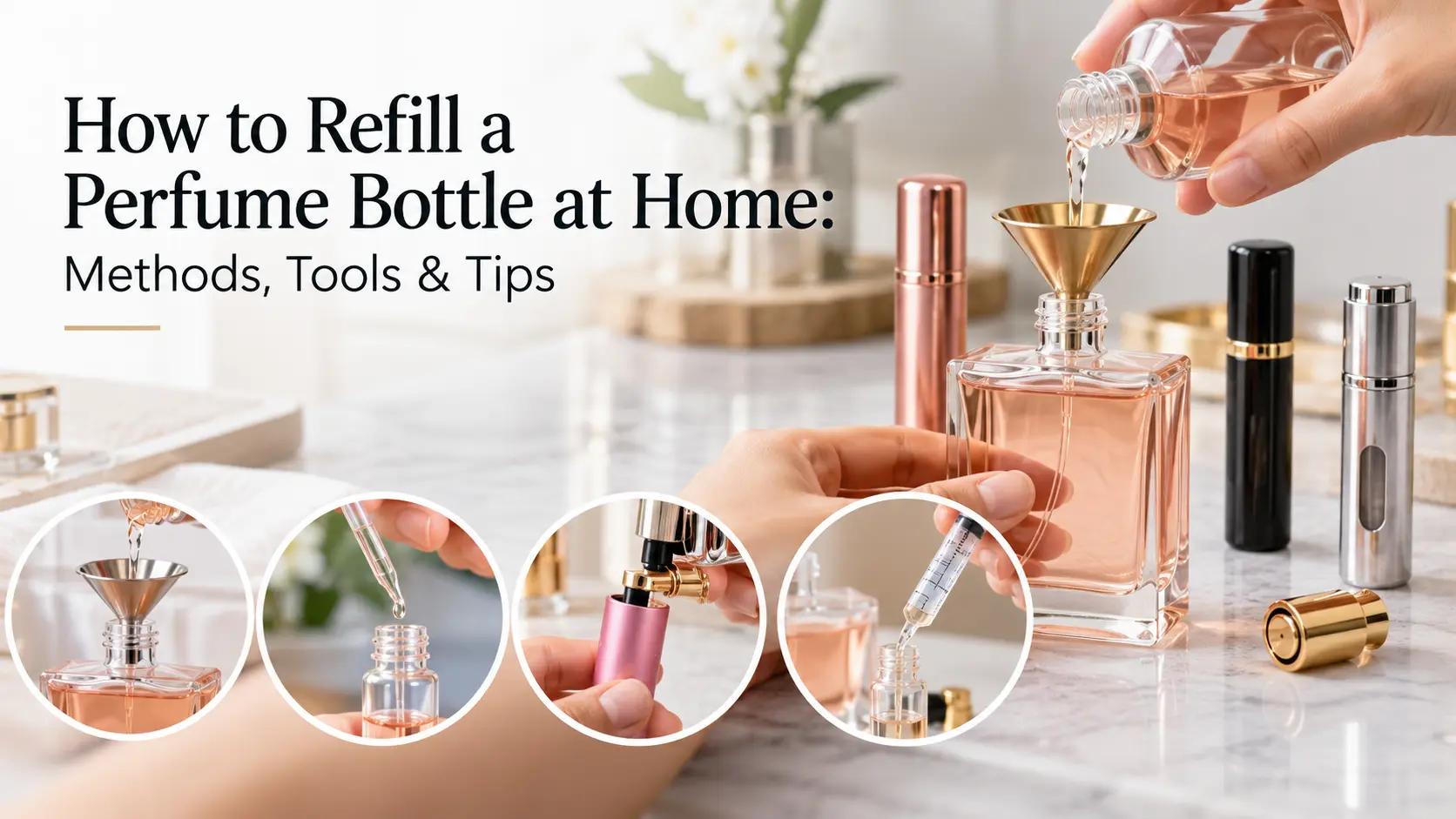
The filling method follows the container design. A bottle with a removable screw sprayer, a factory-crimped glass miniature and an atomizer with a bottom-fill valve should not be treated as if they all open the same way. FOLOVER’s refillable perfume packaging guide explains how refill interfaces, seals and repeat-use handling should be evaluated together.
Screw-Neck Bottles and Purpose-Built Refill Routes
For a bottle designed to be opened, follow the selected closure’s handling instructions and avoid contaminating the container or sealing surfaces. A crimped fragrance sprayer may be intended for factory assembly rather than repeated consumer removal. Bottom-fill designs depend on their designated refill interfaces; confirm physical fit rather than assuming all valve systems work together.
How Many Sprays Are in 5ml or 10ml?
There is no universal spray count. Theoretical sprays equal the actual available liquid volume divided by the output per full actuation. For example, if an expressly hypothetical sprayer dispensed 0.10ml per actuation, 5ml would correspond to 50 theoretical sprays and 10ml to 100, before priming and residual liquid. That example is arithmetic, not a measured output for any FOLOVER product listed here.
Fill Level, Storage and Reuse
Nominal capacity is not the same as brimful capacity or an approved machine setting. The correct fill level depends on the container geometry, closure insertion, intended net contents and storage requirements. There is no sound universal rule to fill every mini perfume bottle to 80% of its marked volume. Keep fragrance away from excessive heat and light according to its product guidance, and do not add oils or lotions to a finished fragrance in an attempt to change performance without a validated formulation.
What Makes Perfume Sample Packaging Reliable?
Reliability is a property of the complete filled and packed product, not a claim that can be made from glass thickness, gasket material or bottle appearance alone. Small packages can have limited gripping and labeling space, while multi-vial sets introduce additional opportunities for movement and impact.
Bottle, Neck and Sprayer Fit
Confirm the chosen bottle neck, sprayer fixing method, gasket or other sealing components, dip tube and cap together. Two 10ml bottles can have different closure systems. A crimp-neck design cannot be substituted for a screw-neck or bottom-fill assembly without redesigning the package.
Leakage, Evaporation and Formula Compatibility
Glass may be an appropriate container for many fragrances, but alcohol, fragrance ingredients and storage conditions can also affect sprayer valves, seals and polymer parts. An effective approval process checks the final filled assembly under agreed conditions. Terms such as “completely leak-proof” or “compatible with every perfume” should not replace test results.
Protection and Identification Inside a Discovery Set
Vials should not rub against one another during normal handling or shipping. The insert needs to hold each assembled bottle securely while allowing convenient removal. Labels must still identify each fragrance after it has been taken out of the box.
What to Check on a Physical Sample
- Confirmed bottle model, nominal capacity, assembled dimensions and selected components.
- Sprayer installation, dispensing behavior and cap fit.
- Compatibility and package integrity with the intended fragrance under defined conditions.
- Readability of bottle labels and appearance of approved decoration.
- Discovery-box cavities, bottle retention and shipment protection requirements.
Custom Perfume Sample Packaging for Fragrance Brands
A branded sample does not automatically need a custom glass mold. FOLOVER can support smaller-batch customization projects using existing perfume bottle models, including options such as labels and screen-printed branding, subject to the selected model, artwork, decoration method and confirmed order quantity. This can give an emerging fragrance brand a practical route to a branded sample without paying for a new glass mold. Custom bottle development becomes relevant when an existing structure cannot meet the required shape, dimensions or assembly.
Make the Miniature Belong to the Full-Size Collection
Brand consistency can come from repeated label placement, typography, color or cap treatment, even when the miniature and full-size bottles do not share identical shapes. Consider how the set looks with all fragrance names visible, not just how one bottle appears in a product rendering.
Choose Decoration for the Actual Surface
Labels and screen printing are practical options for branding selected existing mini bottles at smaller project quantities; the best route depends on the artwork, curved surface, available print area and the way the bottle will be handled. Labeling may allow a brand to distinguish several scents through different printed labels, while direct screen printing places the artwork on the selected compatible surface. Coating, foil decoration and more complex combinations require separate feasibility and quantity checks. A 10ml cylindrical glass bottle and a 5ml shell-covered atomizer may need different processes. Approve the finished appearance on physical samples before specifying bulk production.
Can Small Brands Customize Stock Perfume Sample Bottles?
Yes. FOLOVER supports small-batch customization using suitable existing bottle models, particularly with label application or screen printing when the chosen product and artwork allow it. Starting from a standard bottle can avoid the new glass-mold development step, although it does not remove decoration setup, component approval or sample costs.
| Customization route | Suitable starting point | Quotation and approval questions |
|---|---|---|
| Existing bottle with custom label | Brands testing a small fragrance line or several scents with one bottle shape | Label material, curved-surface fit, application method, artwork versions, quantity per scent and sample approval |
| Existing bottle with screen-printed logo | Brands seeking a direct-on-bottle identity without a new mold | Print area, color count, screen/setup requirements, decoration MOQ and handling of multiple scent designs |
| Existing bottle with more extensive finishes | Projects requiring coating, foil accents or coordinated components | Finish-specific setup, minimum batch, color and adhesion approval, selected closure and total package cost |
| New bottle mold or fully developed set | Projects where stock shapes or available components do not meet the design brief | Tooling, bottle drawing, physical samples, box-and-insert development, lead times and volume requirements |
There is no single verified MOQ that applies to all FOLOVER mini perfume bottles or decoration processes. A smaller-batch request can be reviewed, but the confirmed minimum quantity and price depend on the SKU, print method, design complexity and packaging components. A buyer should request separate quantities and decoration pricing for the bottle, sprayer, label or printing, and any custom carton or insert.
Prepare a Useful Packaging Brief
For an initial inquiry, provide the preferred capacities, number of scents in the set, bottle type, fragrance or formula category, spraying or refill requirements, proposed decoration, estimated quantity, destination and intended box style. If the brand is considering multiple packaging structures, request separate specifications rather than assuming a common sprayer or insert.
FOLOVER’s perfume glass bottle collection is the starting point for comparing available bottle families. For label, printing and complete-pack coordination, the custom packaging solutions overview explains the stock-bottle, decoration and component-development routes. The chosen SKU and complete pack still need review before quoting a finished discovery-set configuration.
Frequently Asked Questions About Perfume Sample Packaging
What is the difference between a perfume sample and a mini perfume?
A perfume sample is primarily offered for trying a scent; a mini perfume is a small-format product that may be sold or carried as a fragrance in its own right. The categories can overlap. Check the filling volume, applicator and presentation rather than relying on the product name alone.
What sizes are used in perfume discovery sets?
There is no fixed size. Published brand examples include sets with 1.5ml, 2ml and 7.5ml fragrance units. The right capacity depends on whether the goal is initial sampling, repeated wear or gift-oriented miniatures.
Is a 5ml or 10ml perfume bottle better?
Neither capacity is always better. A 5ml format can reduce the amount carried or given away, while 10ml provides twice the nominal liquid volume. Compare the actual assembled size, applicator, retail purpose and protective packing for the selected model.
How many sprays can a 5ml perfume sample provide?
The answer depends on the measured output of the actual sprayer, the amount filled and liquid remaining in the container. Divide usable liquid volume by the specified output per actuation to calculate a theoretical count; do not apply a universal spray count to every vial.
Can all mini perfume bottles be refilled?
No. Some are built for factory filling and closure assembly, while others have designated screw, removable-cartridge or bottom-fill mechanisms. Follow the instructions for the exact bottle and do not force off a permanently crimped sprayer.
How should glass perfume samples be packed in a discovery set?
Use an insert developed around each complete bottle and closure, keep scents clearly identified and assess retention and protection for the planned distribution method. A neat visual arrangement alone is not evidence of transport durability.
Can fragrance brands customize sample bottles?
Yes. FOLOVER can review smaller-batch customization using suitable existing perfume bottles, including labeling and screen printing. Coating, outer-shell decoration and custom cartons may also be considered depending on the project. Confirm the selected SKU, decoration area, artwork, minimum order quantity and approved physical samples before bulk production.
From Mini Bottles to a Finished Discovery Set
The right sample packaging starts with what the fragrance user needs to do: try one scent, carry a miniature or compare a collection. Capacity, sprayer, bottle materials, labels and protective packing should support that task. Published market data shows interest in small fragrance formats, but a workable packaging decision still depends on the selected components and approved physical samples.
For a FOLOVER packaging inquiry, share the target bottle size, number of fragrances, sprayer or refill system, artwork, intended packing arrangement and estimated order quantity. That allows the project to be reviewed as a complete fragrance packaging system rather than a set of unrelated empty bottles.