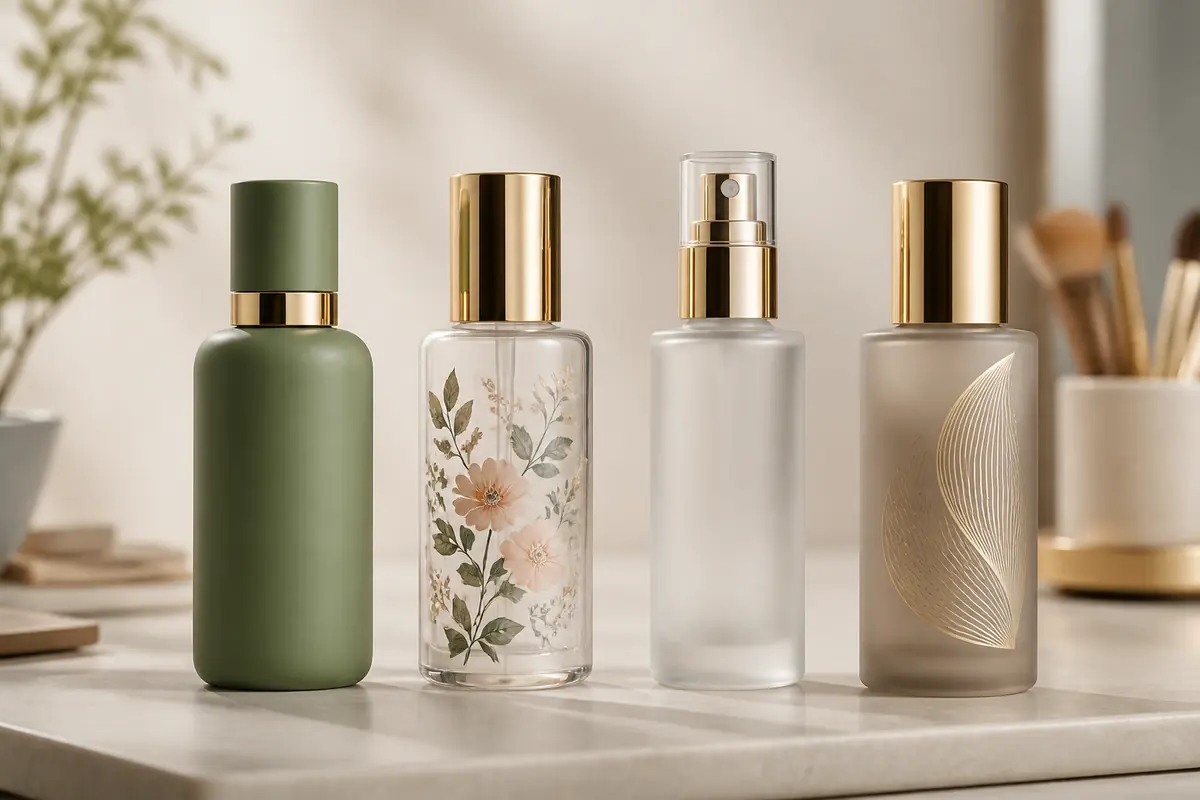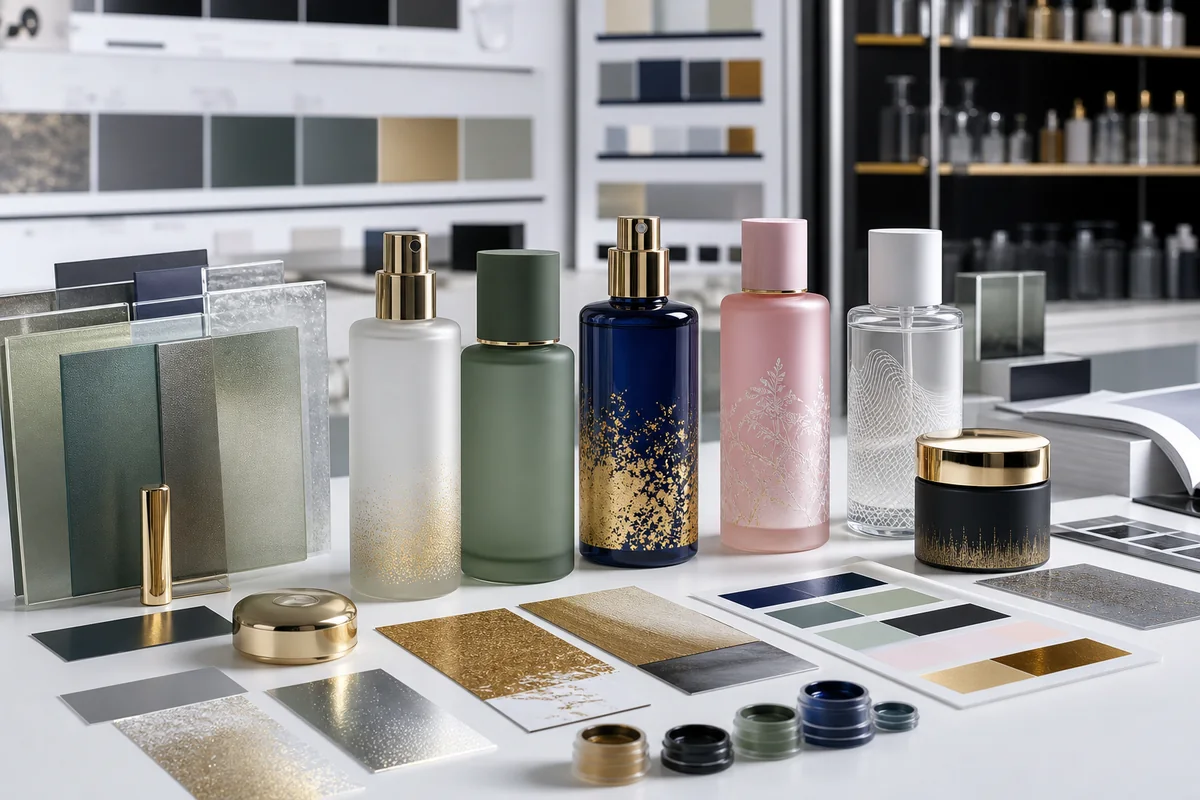

Screen printing and labels can both put a logo, product name or graphic on a cosmetic bottle, but neither is automatically the better choice. Screen printing applies ink directly to the bottle, making it worth considering for relatively simple, stable artwork on a suitable surface. Labels use a separate printed material and can be more flexible for full-color graphics, variable product information and multi-SKU ranges. The better choice depends on the bottle geometry, artwork, production volume, expected handling and the appearance approved on a physical sample.
Screen Printing vs Labels: What Is the Difference?
How Screen Printing Works on Cosmetic Bottles
In screen printing, ink passes through the open areas of a prepared mesh screen and is transferred onto the bottle surface. Each color or design element has to be planned for the selected printing system, and the final result depends on ink choice, substrate preparation, curing and registration. There is no separate label edge, although the ink layer itself can be visible or tactile depending on the process.
For a glass serum bottle carrying a small brand name and one-color mark, direct printing can keep the decoration confined to a defined area of the bottle. The buyer still needs to confirm the actual print dimensions, fine line detail and position—not just the appearance of a logo placed over a product rendering.
How Labels Work on Cosmetic Bottles
A label is printed on a separate facestock, such as paper or film, and then applied to the container using an appropriate adhesive or application system. Transparent film labels can reduce the visual contrast between printed artwork and clear glass. White, paper and other label materials can serve different design and information needs.
The label edge, adhesive layer and application accuracy remain part of the finished package. A label that lies flat on a sample panel may behave differently on a tapered, small-diameter or coated bottle. Lamination and a suitable adhesive can improve performance for defined applications, but neither guarantees resistance to every cosmetic formula or storage condition.
Screen Printing vs Labels: Side-by-Side Comparison
The table below compares the decision factors that matter when decorating a cosmetic bottle. These are general process differences, not performance guarantees for a specific product.
| Decision factor | Screen printing | Labels |
|---|---|---|
| How artwork is applied | Ink printed directly onto the bottle surface | Printed facestock applied to the bottle |
| Visible edge | No separate label edge | Edge visibility depends on material, glass and lighting |
| Detailed, full-color artwork | Feasibility depends on printing method, design and registration | Often offers more options for gradients, photos and complex graphics |
| Multiple product variants | May require different screens or artwork setups | Different label versions can be managed separately |
| Bottle geometry | Printable area, curvature and positioning matter | Label dimensions, curvature and adhesion matter |
| Durability | Depends on ink, surface, curing and exposure | Depends on facestock, adhesive, print protection and exposure |
| Total cost | Driven by setup, colors, volume and finished yield | Driven by label production, materials, application and finished yield |
Key takeaway:Choose the decoration that meets your artwork and use requirements on the actual bottle at an acceptable finished-unit cost. A digital mockup or price per printed logo is not enough to settle the comparison.
Which Looks Better on Cosmetic Glass Bottles?

Direct Printing for a Clean, Integrated Appearance
Because screen printing places the artwork on the container rather than on a separate sheet, it can create a clean appearance for a limited-color logo, short product name or restrained graphic. On clear glass, the absence of a label border may be especially noticeable. On coated or frosted glass, however, ink opacity, color contrast and surface compatibility can change the result.
An ink print need not feel raised. Likewise, a metallic-looking logo could involve a different finishing method. If the surface effect is central to the design, ask which technique produced the sample rather than relying on the photograph.
Clear Labels and the “No-Label” Look

A clear film label may give the impression that text or artwork is printed directly on a transparent bottle. Whether the edge is noticeable depends on the film, adhesive, printing, bottle surface and viewing conditions. Edge visibility is particularly important when the design relies on a fully transparent look.
On a frosted or textured surface, a clear label may alter the appearance of the area beneath it. This is a reason to request a finished sample on the intended bottle, not proof that clear labels are unsuitable for every frosted package.
Paper, Matte and Laminated Labels
Labels also offer material and surface options that direct printing does not reproduce in the same way. Paper texture, matte film, gloss lamination and selected finishing processes can provide contrasting visual treatments. The application still has to work with the bottle surface, edge position and intended product environment. For a serum used around sinks or in bathrooms, the material and adhesive specification deserve as much attention as the artwork.
Which Method Handles Logos, Colors and Detailed Artwork Better?
Simple Logos and Limited Colors
Screen printing is worth evaluating for stable brand graphics with a manageable number of colors, provided the bottle has a suitable printing area. A narrow bottle may need a different logo size or layout from a wider one. When multiple colors have to align, registration needs to be checked on the decorated sample.
Full-Color Designs, Gradients and Changing Information
Labels can be a practical route for illustrations, gradients, complex images and copy that varies across products. A skincare brand may use the same glass bottle for several formulas while changing the ingredients, product name or color system on each label. That flexibility does not remove the need to inspect label quality, scan codes where applicable or confirm the final application.
What Happens to Fine Lines on a Small Bottle?
A logo may look crisp in a large design file but lose detail when reduced for a 15 ml or 30 ml bottle. Tiny counters inside letters and closely spaced strokes are particularly worth checking. Send the artwork at its intended print size and ask for a feasibility check; the workable detail depends on the print system and substrate.
Does Screen Printing or Labeling Cost Less?
Setup, Materials and Application
Screen printing can involve screens, color preparation, fixtures, printing cycles and curing. Labels involve facestock, ink, possible lamination or finishing, die cutting and application. A comparison limited to the decoration unit price can miss these steps and give the wrong impression of the finished cost.
Small Runs, Larger Orders and Multiple SKUs
Suppose a skincare range shares one bottle but uses six different product names. Separate labels may simplify artwork changes without leaving the brand with preprinted bottles for every variant. For one stable design repeated across a larger run, direct printing may be competitive. Ask for both routes to be priced at the same quantity and number of versions; a blanket “labels are cheaper for small orders” rule is unreliable.
Compare the Same Finished Package
For a useful quotation, compare the same bottle model, artwork, quantity, number of variants, packaging and approval conditions. Ask whether the price includes decoration setup, labeled or printed samples, application work, inspection requirements and export packing. The decision should be based on finished, approved bottles rather than just the cost of a printed image or an individual label.
Which Is More Durable in Everyday Cosmetic Use?
Screen-Printed Ink: Adhesion, Curing and Handling
Print durability is influenced by the ink system, glass or coating surface, pretreatment where required, curing and the kind of contact the package will experience. Poor line definition, color misregistration or insufficient adhesion are different issues and should be assessed separately. No general claim that all screen printing is scratch-proof or solvent-resistant is justified without evidence for the selected package.
Label Performance: Adhesive, Moisture and Product Contact
Labels must be assessed as a construction: facestock, printing, protective layer where used and adhesive. Moisture, repeated handling, oils or alcohol-containing products may challenge some materials or adhesives. A laminated face does not, by itself, prove that the label edge or adhesive will perform under every condition.
Agree on Relevant Sample Checks
Buyers can define visual inspection, legibility, edge appearance, adhesion and exposure checks around the actual use scenario. A lotion bottle kept near a sink, for example, may need different evaluation from a dry cosmetic jar held in secondary packaging. Test conditions and acceptance criteria should be agreed for the specific materials and project; generic abrasion cycles, peel values or soaking times should not be copied from an unrelated specification.
Where documentation or material compliance becomes part of the sourcing decision, the relevant scope is explained in FOLOVER’s guide to compliance for decorated cosmetic glass packaging. Appearance approval alone does not establish chemical or regulatory compliance.
How Bottle Shape and Surface Affect the Choice
Round, Square and Tapered Containers
Both methods face geometry limits. A round bottle may offer continuous sidewall space, but a small diameter can constrain label width or print registration. Flat faces can simplify some artwork layouts, while corners, shoulders and curved transitions may reduce usable space. Neither a label nor a screen print is automatically suitable for every bottle shape.
Printable Area and Label Placement
Confirm the selected bottle’s straight wall height, usable width or circumference, transitions, finish and component orientation. If a cap, pump or collar has a defined front-facing direction, the decoration may need to align with the assembled package. FOLOVER’s cosmetic and skincare glass packaging range provides a starting point for selecting bottle or jar formats before decoration samples are developed.
How to Read Cosmetic Bottle Decoration Examples
A bottle photo is useful for assessing artwork placement and appearance, but only when the finish has been identified correctly. Printed ink, metallic foil and an applied label may look similar at a glance. Check the image description and the actual decoration method before using a reference to approve artwork.
Screen-Printed Artwork: What to Look For
Look at the size and position of the logo relative to the shoulders and the closure. The same artwork can appear quite different on a tall serum bottle and a short lotion bottle. A printed-glass photo can help assess appearance; ink adhesion and wear still require appropriate evidence.
Applied Labels: What to Look For
For a labeled bottle, inspect the edge where the facestock meets the glass, especially on clear or curved surfaces. The label illustration above shows the edge deliberately enlarged to explain placement. It is a visual concept, not a verified FOLOVER production sample or an adhesion-test result.
FOLOVER’s broader glass bottle decoration methods guide explains coating, frosting, hot stamping and other processes. This article keeps its focus on choosing between direct screen printing and applied labels.
How FOLOVER PACK Approaches Different Customer Requirements

A brand may want one logo across three bottle sizes, another may need colorful labels for several formulas, and a third may need decoration over frosted glass. Those briefs lead to different production questions. FOLOVER PACK presents both screen printing and applied labels among its decoration options, with the route reviewed for the selected packaging.
Requirement 1: A Consistent Logo Across a Skincare Range
For a brand using a similar logo on serum, toner and lotion bottles, the starting questions are the printable area on each container, actual artwork size, color count and surface finish. Screen printing may provide a consistent graphic treatment, but the design may need different dimensions or positions across bottle shapes. The recommendation is to review the complete product family and approve representative decorated samples instead of shrinking the same artwork blindly onto every bottle.
Requirement 2: Full-Color Artwork or Frequently Changing SKU Information
If one bottle design supports different scents, formulas or markets, labels may help separate variable information from the common container. The project review should address each label version, facestock, adhesive, printing method, barcode or other necessary information, and the bottle’s usable application area. Regulatory copy must be approved for the destination market by the responsible brand or regulatory team; changing the decoration method does not remove labeling obligations.
Requirement 3: A Frosted or Coated Bottle
A clear label and a screen print can look different once applied to a finished, colored or textured surface. The practical route is to evaluate the chosen coating or frosting, then assess the ink or adhesive on that actual finish. An approved decoration on clear untreated glass should not automatically be treated as approved on a different substrate.
Requirement 4: A Fixed Brand Mark Plus Variable Product Information
A combined approach can be considered: direct printing for the permanent brand mark and a label for changing information. Before adopting it, confirm that the two decoration areas do not interfere, that the process order is workable and that the additional operation is justified by the total project cost. In some cases a single label is a more economical and easier-to-maintain answer.
Discuss a Decoration Route with FOLOVER PACK
A useful first brief identifies the chosen bottle or jar, the artwork, the estimated order volume and how many product versions are involved. FOLOVER can use those details to discuss suitable decoration routes and the sample decisions still required. Its decoration and finishing options cover both direct printing and labels or applied branding. Actual material selection, application method, sample requirements and commercial terms are project-specific and should be confirmed before production.
Which Decoration Would FOLOVER PACK Recommend?
| Customer priority | Direction to evaluate first | What to confirm |
|---|---|---|
| Simple, stable brand mark | Screen printing | Ink, artwork size, print area and final appearance |
| Complex color graphics | Labels | Printing quality, facestock, adhesive and fit |
| Several artwork versions | Compare label versions with screen setup costs | SKU count, volumes and revision frequency |
| Frosted or coated glass | Sample both where feasible | Surface appearance, adhesion and process sequence |
| Logo plus variable information | Consider a combined system | Artwork areas, production steps and total cost |
Manufacturer Insight: Approve the Complete Decoration
A bottle may look correct in an artwork preview and still need changes when the design is transferred to glass. Bottle curvature, coated color, print registration, label edges and the final cap or pump can change the assembled appearance. For either method, FOLOVER recommends reviewing a physical sample of the actual bottle and decoration configuration before bulk production. If materials or artwork change, decide whether renewed sample approval is needed.
What Should Buyers Confirm Before Ordering?
A buyer does not need a finished technical specification to start a decoration discussion. A bottle reference, artwork and realistic quantity are enough for an initial review. The following details help identify what still needs to be tested or quoted.
Packaging Decoration RFQ Checklist
- Bottle or jar reference, capacity and available drawing or physical sample
- Final-size logo, label artwork and color references
- Preferred screen print, label or request to compare both
- Clear, frosted, coated or otherwise finished bottle surface
- Number of SKUs, planned quantities and likely artwork revisions
- Label material or appearance requirement, if known
- Intended handling, moisture exposure and possible exterior formula contact
- Required sample, documentation, packing and destination market
What to Check on Physical Samples
- Position, scale, color and legibility of the finished artwork
- Print edge quality and color registration, or label edge and wrinkle appearance
- Compatibility of the decoration with the selected glass finish
- Adhesion and handling performance under agreed project-specific conditions
- Appearance of the assembled bottle with its actual cap, pump or dropper
- Agreement on a retained approval sample and production acceptance criteria
Agree on inspection criteria with the supplier before production, particularly where handling, moisture or product contact may affect the decoration. Separately, the brand should check which product information must appear on the finished package in its destination market; choosing direct printing does not eliminate labeling obligations.
Frequently Asked Questions
Is screen printing better than stickers on cosmetic bottles?
Not in every case. Screen printing is worth considering for a relatively simple, stable design on a suitable bottle surface. Labels may provide more flexibility for complex graphics and frequently changing information. Compare the same finished bottle, including appearance, durability requirements and total cost, before deciding.
Are clear labels as durable as screen printing?
Durability cannot be ranked by method alone. Screen printing depends on ink, glass or coating preparation and curing. Label performance depends on facestock, adhesive, protective finishing and the environment. Request evidence or samples evaluated under conditions relevant to the intended product rather than assuming one is always more durable.
Which method is better for small cosmetic brands?
Labels can be convenient when early orders are small, several SKUs share a bottle or artwork changes frequently. Screen printing may still make sense for a stable, simple design if the supplier’s setup and production conditions are suitable. Ask for quotations based on the same finished package and quantity before treating either choice as cheaper.
Can you screen print on frosted glass bottles?
It can be possible, but “frosted glass” may describe different surface processes. The ink system and printing method must be assessed on the actual finished bottle. Approve artwork, color, adhesion and appearance using a physical sample rather than relying on a print result from ordinary clear glass.
Can labels be applied to curved cosmetic bottles?
Yes, selected labels can be applied to curved bottles when their shape, size, facestock, adhesive and application process are suitable. Tapering, tight curves, shoulders and small diameters can make fit more difficult. Verify the label’s position and edges on the actual container, including after the relevant handling or storage conditions.
Can a bottle use both screen printing and labels?
It can be considered when the design needs a permanent brand mark plus changing product information, for example. The two artwork areas, application sequence, compatibility and finished cost must still be checked. A combined method is not automatically better than using one process well.
Related FOLOVER Packaging Options
These two skincare glass bottle formats can be considered when planning artwork placement and decoration. The final bottle, dispensing components and decoration should be reviewed together for the intended product.
30ml Tall Round Glass Serum Bottle with Screw Neck A slim glass serum bottle that gives buyers a reference for logo placement and printed artwork scale. Confirm the selected closure and decoration on a physical sample. | 100ml Frosted Glass Lotion Pump Bottle with Bamboo Cap A frosted glass format for evaluating how decoration appears alongside a pump and outer cap. Confirm decoration compatibility with the finished bottle surface. |
Final Recommendation: Screen Printing or Labels?
Screen printing and labels are two different ways to solve a cosmetic packaging design problem, not competing quality grades. Start with the selected bottle, artwork and number of product versions. Then compare the finished appearance, expected handling, necessary sample checks and complete cost. For a custom glass packaging project, send FOLOVER PACK your bottle reference, artwork, quantity, surface finish and intended use so the decoration options and sample requirements can be reviewed for the specific configuration.