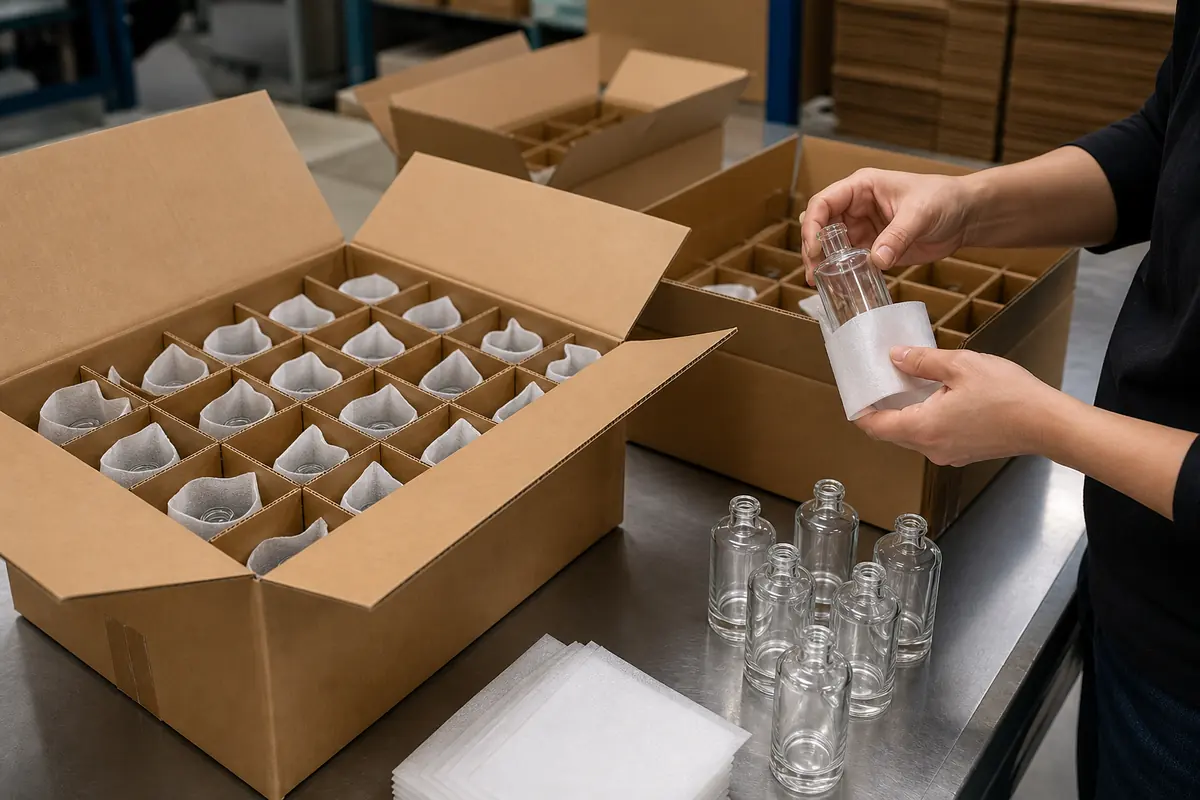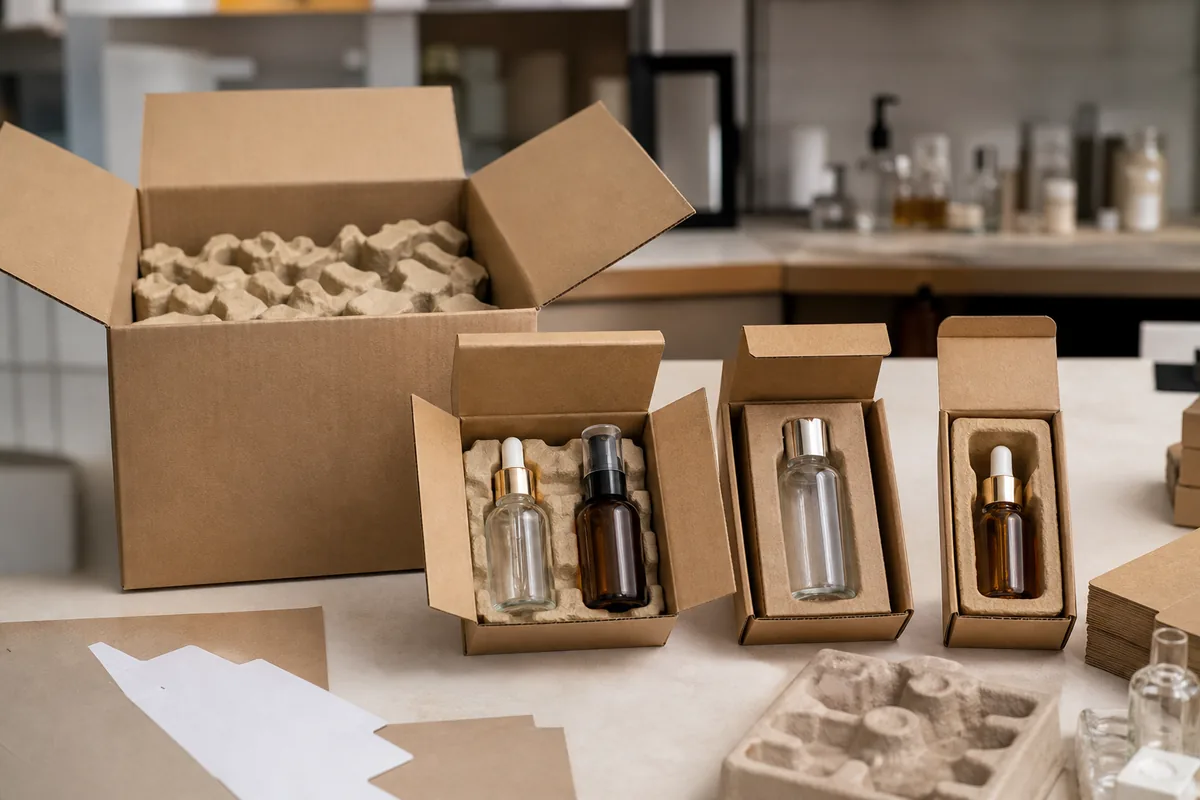

Yes. Glass cosmetic bottles can be customized without creating a new glass mold. Brands can start with an existing stock bottle and change its color, frosting, printing, metallic accents, labels, compatible pumps or droppers, caps, collars, and secondary packaging. These changes can create a distinctive finished product while retaining the bottle’s original glass structure.
For skincare brands developing a new collection, the practical approach is to select a stock bottle that meets the formula and dispensing requirements first, then build the visual identity around its available decoration area and compatible components. A new mold becomes necessary when the required difference cannot be achieved without changing the glass geometry.
Define what remains fixed in a stock bottle
Without a new glass mold, the bottle’s primary geometry remains fixed. Its footprint, shoulders, walls, base, nominal capacity, neck finish, glass distribution, and major dimensions cannot be redesigned through decoration. A coating may change apparent proportions, and a collar may visually extend the shoulder, but neither changes the underlying glass structure.
Using an existing bottle avoids developing new glass tooling and may simplify the initial sampling process. However, stock availability, compatible components, decoration feasibility, and the intended filling process still need confirmation.
Manufacturer Insight: Treat stock customization as three separate decisions: the fixed glass bottle, its surface decoration, and its compatible dispensing components. Before investing in color samples or custom caps, confirm that the selected bottle can accommodate the required formula, dispensing system, and filling process. An attractive design cannot compensate for an unsuitable neck finish or an incompatible closure.
The full comparison of stock bottles versus custom molds helps brands choose the appropriate development route. For projects where the existing glass structure already meets the functional requirements, surface decoration and component selection are usually the more practical starting points.
Spray coating can change color and visual weight
Spray coating can create transparent, translucent, opaque, gradient, glossy, or matte finishes on an existing bottle. Different colors can distinguish product variants while maintaining a consistent bottle shape across a skincare collection.
For example, a brand may use the same serum bottle in different colors to distinguish hydrating, brightening, and other product variants. The bottle dimensions and basic component interface remain unchanged, while color and graphics establish the differences between products.
Spray coating should not be confused with changing the glass composition itself. The Glass Packaging Institute’s explanation of glass coloring describes how colorants are incorporated into glass during manufacture. Applying a surface coating to an existing clear bottle is a different customization process and does not change the underlying glass color.
Final color, opacity, gloss, and coating durability should be approved on physical samples. The actual glass substrate, coating system, decoration sequence, and intended handling conditions can affect the finished appearance.
Frosting changes touch and diffusion
Surface frosting and frosted-look coatings can give an existing glass bottle a softer, more diffused appearance. The processes are not interchangeable: their surface characteristics, decoration compatibility, and durability may differ.
A frosted finish can provide contrast for printed logos or metallic decoration. However, a design that combines clear windows, matte areas, and additional printing must be evaluated against the selected bottle geometry and available decoration process.
Frosting should not automatically be described as UV protection. Any claimed light-protection performance requires appropriate evidence for the selected packaging configuration and formulation.

Printing creates recognizable brand structure
Screen printing and other suitable printing processes can add logos, product names, patterns, and information directly to a stock bottle. The available decoration area, bottle curvature, ink system, color sequence, and registration requirements determine which artwork can be reproduced reliably.
A simple one- or two-color design may be more appropriate than complex artwork containing very small text or fine details. The logo must remain legible at its actual production size, particularly on curved or tapered bottles.
Before printing samples are prepared, provide the exact bottle model, editable artwork, color references, and intended printing position. Approve the finished print on the selected bottle rather than relying exclusively on a digital mockup.
Hot stamping adds a controlled metallic accent
Hot stamping can introduce metallic details without changing the glass mold. A foil logo, border, or small emblem may provide sufficient visual differentiation when combined with a suitable bottle color and closure finish.
However, complex bottle curvature, very fine artwork, and large metallic decoration areas can introduce transfer and registration challenges. When foil is applied over a coating, the complete decoration sequence must be evaluated on physical samples.
Metallic components should also be compared together. A gold foil logo, gold collar, and gold cap may have different tones, gloss levels, or surface textures. Their appearance should be approved as an assembled package under consistent viewing conditions.
Closures can change both function and identity
Changing the dispensing components is often one of the most useful ways to differentiate a stock cosmetic bottle. A suitable pump, dropper, reducer, cap, or collar can affect both the finished appearance and the way consumers dispense the product.
For example, a serum bottle with a compatible dropper creates a different dispensing experience from a bottle fitted with a suitable treatment pump. However, both configurations must be evaluated against the actual formulation and the selected bottle.
A visually suitable closure may have the wrong neck interface, sealing geometry, gasket, dip-tube or pipette length, or formula-contact materials. An outer cap that appears to fit does not establish compatibility of the dispensing assembly beneath it.
Manufacturer Insight: Before requesting a custom-colored pump or cap, confirm the complete bottle-and-closure assembly using physical components. Verify the neck finish, sealing interface, component height, dispensing function, and formula compatibility. A custom-colored cap may also require its own tooling or minimum order quantity, even when the glass bottle uses an existing mold.
Packaging compatibility should be evaluated with the actual formulation under intended storage and use conditions. If the product can contact the outer bottle decoration through dispensing, dripping, or normal handling, the affected coating and printing should also be assessed for resistance to that exposure.
For cosmetic products placed on the EU market, Regulation (EC) No 1223/2009, Annex I includes relevant characteristics of packaging materials within the information considered for the cosmetic product safety report. Packaging suitability must therefore be assessed for the actual finished product rather than assumed from the use of glass alone.

Secondary packaging can carry the most flexible story
Cartons, labels, sleeves, inserts, and packaging sets provide additional opportunities for customization without changing the glass bottle.
A carton can carry brand graphics, product information, and variant identification while accommodating the selected bottle and closure. Inserts can help position and protect the finished package during transport, provided their geometry matches the assembled product.
Secondary packaging should be designed around actual protection, distribution, labeling, and presentation requirements. Adding decorative layers without a clear function may increase cost and material use without improving the finished product.
Create differentiation through a design system, not isolated effects
A distinctive packaging collection does not require every available decoration technique. A consistent combination of bottle color, logo placement, closure finish, and carton design can establish a recognizable identity across several stock bottle sizes.
In FOLOVER PACK’s Laviren skincare packaging project, an existing serum bottle shape was selected for a coordinated product collection. Different bottle colors distinguished the product variants, while color samples and logo legibility were reviewed during development. The project also involved coordinating the appearance of the accompanying closure components.
The important distinction was achieved through bottle color, decoration, and component coordination rather than a new glass mold. Physical sample approval was necessary to establish the intended color and visual consistency across the collection.
The article on packaging design for indie beauty brands explains how smaller brands can develop a coherent visual identity without relying entirely on proprietary bottle shapes.
A no-new-mold customization matrix
| Layer | What can change | What remains fixed or must be verified |
|---|---|---|
| Glass appearance | Coating color, opacity, gloss, frosting, windows | Bottle geometry stays fixed; finish durability needs approval |
| Graphics | Printing, foil, labels, patterns, information hierarchy | Decoration zone, curvature, cure, adhesion, and registration |
| Dispensing | Compatible pump, dropper, cap, reducer, actuator finish | Neck, seal, dose, tube, formula, and package compatibility |
| Presentation | Collars, overcaps, cartons, inserts, sleeves, sets | Fit, transport, material use, line assembly, and consumer access |
| Portfolio | Variant colors, decoration hierarchy, coordinated sizes | Availability, batch control, and consistent brand codes |
The appropriate customization method depends on the project’s actual requirement. For a coordinated serum collection, bottle color and consistent graphics may provide sufficient differentiation. If the primary requirement is a different dispensing experience, compatible closure selection becomes more important than adding further decoration.
When a new bottle mold is still necessary
A new mold becomes relevant when the required difference is structural: a proprietary silhouette, new footprint, altered shoulder, embossed or debossed glass feature, changed capacity or wall distribution, special base, new neck architecture, integrated grip, or geometry not available in stock.
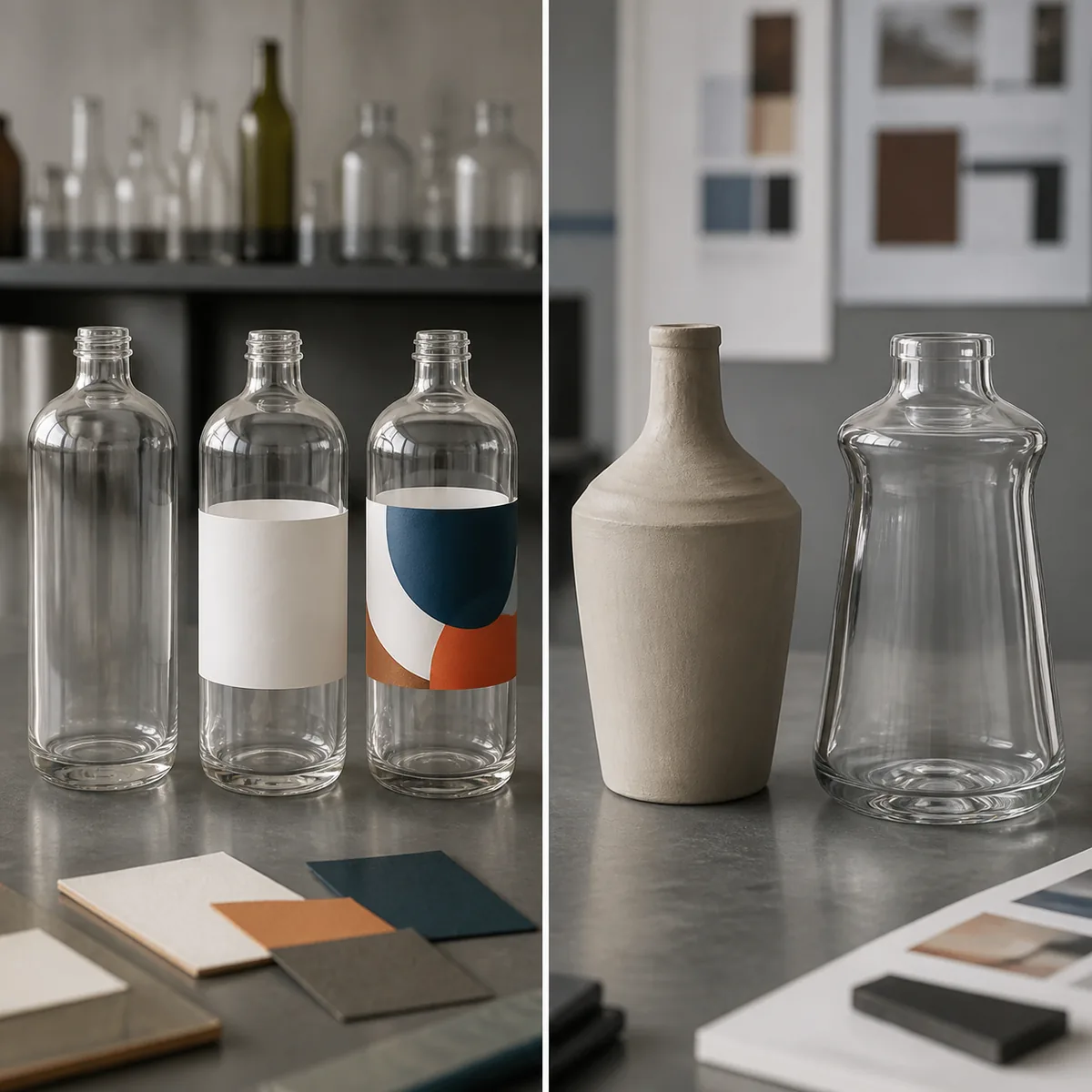
Before committing to new tooling, identify the requirement that the stock bottle cannot meet. If the objective is primarily visual differentiation, surface decoration and compatible components may be sufficient. If the project requires a unique glass shape, unavailable neck finish, or specific structural dimensions, custom development should be evaluated.
The custom cosmetic glass bottle process and glass bottle mold-development guide explain the structural development route.
A phased route reduces risk
Brands do not need to choose between using stock bottles permanently and investing in a new mold immediately. An initial collection can use a stock bottle with approved decoration and compatible components. A proprietary bottle can be considered later if an unmet structural requirement justifies the investment.
- Define the fixed bottle requirements: formula, fill, neck, dispenser, channel, and line.
- Shortlist real stock bottles and verify component compatibility.
- Select two or three meaningful brand codes instead of every available effect.
- Build physical decoration and component samples on the exact bottle.
- Evaluate appearance, adhesion, formula contact, transport, dispensing, and assembly.
- Freeze approved items, artwork, color standards, sequence, and tolerances.
- Revisit custom mold only when an unmet structural requirement justifies it.
Control cost and minimums by layer
A stock bottle avoids new glass mold development, but customization is not necessarily tooling-free. Printing screens, hot-stamping dies, fixtures, custom caps, cartons, color matching, and samples can involve separate development costs and minimum order quantities.
Request quotations that distinguish the stock bottle, decoration processes, dispensing components, secondary packaging, and any one-time development requirements. This allows the purchasing team to identify which elements are essential and which can be adjusted without changing the complete packaging concept.
FOLOVER PACK’s general commercial baselines should not be converted into a guarantee for a specific decoration or component. Final MOQ, sample, tooling, price, and lead time depend on the selected bottle, process, component, artwork, quantity, and current quotation.
- Confirm that the stock bottle is real, available, and compatible with the formula and dispenser.
- Separate fixed glass geometry from configurable appearance and components.
- Prioritize a coherent design system over decoration count.
- Approve actual coated, printed, stamped, and assembled samples.
- Check line handling, filling, closure application, cap fit, and transport.
- Control item codes, color standards, artwork, process sequence, and change notices.
- Use a new mold only for a requirement that surface and component design cannot meet.
Buyers can browse cosmetic and skincare glass packaging, frame a differentiated system through custom packaging solutions, and review longer-term custom bottle development. The skincare packaging guide helps keep appearance connected to formula, dispenser, sourcing, and validation.
Direct answers are organized in Packaging Q&A, while decoration and production topics sit under Customization & Manufacturing.
Approve the package in layers
Begin with an undecorated bottle and closure fit, then approve color or frosting, graphics and foil, assembled components, and the final packed product. Layered approval makes a mismatch easier to diagnose and prevents an attractive final mock-up from hiding an unverified dispenser or weak decoration interface.
Retain the accepted physical samples and link them to artwork, color references, item codes, and process revisions. If one layer changes—such as the coating, pump, gasket, cap plating, label adhesive, or carton insert—review the functions that change affects.
For example, changing the coating color may require a new color and decoration sample, while replacing the pump may require renewed bottle-and-closure compatibility and dispensing checks. Stock glass reduces structural development, but it does not authorize uncontrolled component substitution.
Buyer conclusion
A stock cosmetic glass bottle can become a differentiated brand package without a new glass mold when color, finish, graphics, compatible dispensing components, caps, and secondary packaging are designed as one system. The mold-free route changes perception and use, not the fundamental glass geometry. Choose a new mold only when the missing value is genuinely structural.
When approaching FOLOVER PACK, share the formula category, fill, preferred stock shape, dispenser, decoration direction, color references, secondary package, market, quantity, and launch timing. That supports a realistic sample plan without promising that decoration can replace structural development.
Frequently asked questions
Can stock cosmetic bottles look unique?
Yes. A coherent combination of color, frosting, graphics, metallic accents, compatible closures, caps, and cartons can create strong distinction while the base geometry remains stock.
Is custom color possible without new glass tooling?
Often yes through a suitable coating or decoration process. The color, opacity, gloss, cure, durability, formula exposure, and batch standard require physical approval.
Can a custom cap be used with a stock bottle?
Potentially, but the cap and underlying closure must fit the exact neck, pump or dropper, collar, tolerances, and assembly. Appearance alone does not prove compatibility.
When is a new mold necessary?
When the requirement changes the glass structure—for example a proprietary silhouette, footprint, shoulder, capacity, neck, embossed feature, base, or other unavailable geometry.