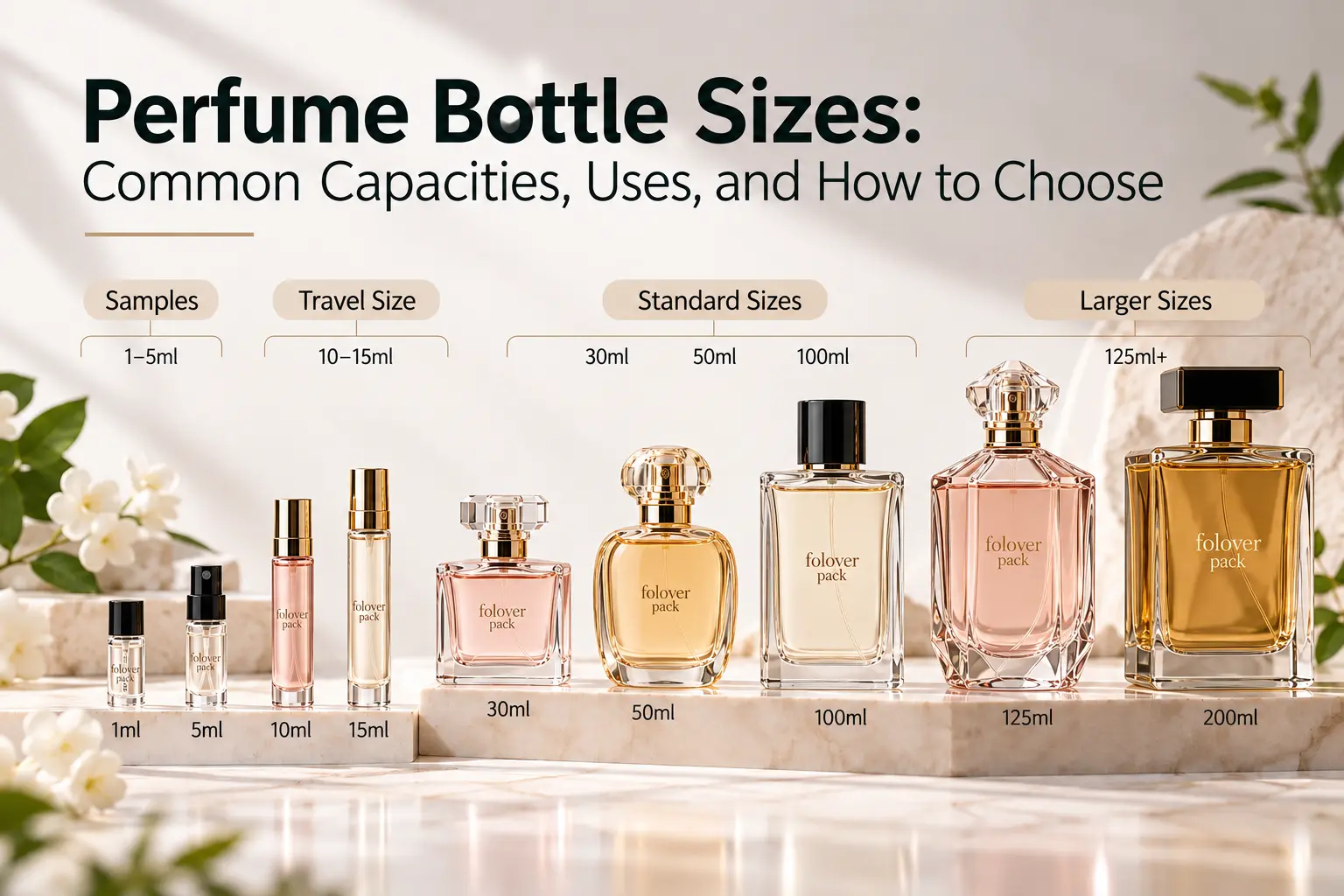
Perfume bottle sizes range from small sample vials to full-size retail bottles and larger formats. The most familiar shopping choices are 30ml (about 1.0 US fl oz), 50ml (about 1.7 US fl oz), and 100ml (about 3.4 US fl oz). Smaller bottles suit sampling or carrying a fragrance; larger bottles may suit someone who regularly wears the same scent. For a fragrance brand, capacity also affects the bottle design, closure selection, packaging budget, and product range.
What Are the Standard Perfume Bottle Sizes?
There is no single universal set of perfume bottle capacities. Fragrance houses use different formats, but shoppers will frequently encounter samples, portable sprays, 30ml, 50ml, and 100ml retail products. Some brands also sell 75ml, 125ml, 150ml, or 200ml editions. The capacity printed on a fragrance package refers to the nominal volume of the liquid product, not the external dimensions of its glass bottle.
Perfume Bottle Size Chart: Milliliters and Fluid Ounces
| Capacity | Approx. US fl oz | Typical format or use |
|---|---|---|
| 1ml | 0.03 fl oz | Small fragrance sample |
| 2ml | 0.07 fl oz | Discovery vial |
| 5ml | 0.17 fl oz | Sample, miniature, or portable container |
| 10ml | 0.34 fl oz | Travel spray or purse-size fragrance |
| 15ml | 0.51 fl oz | Compact travel or retail format |
| 30ml | 1.01 fl oz | Smaller full-size retail fragrance |
| 50ml | 1.69 fl oz | Regular retail fragrance |
| 75ml | 2.54 fl oz | Mid-to-large retail format |
| 100ml | 3.38 fl oz | Larger standard retail fragrance |
| 125ml | 4.23 fl oz | Large-format fragrance |
| 150ml | 5.07 fl oz | Large-format fragrance |
| 200ml | 6.76 fl oz | Extra-large fragrance format |
Conversions use US fluid ounces (1 US fl oz ≈ 29.57ml) and are rounded for reference. Retail labels often round 50ml to 1.7 fl oz and 100ml to 3.4 fl oz; these are not separate capacities.
What Is the Most Common Perfume Bottle Size?
30ml, 50ml, and 100ml are familiar sizes in retail fragrance collections. There is no defensible single “most common” size across every brand and market without a defined sales dataset. If you are choosing between them, the more useful question is how frequently the fragrance will be worn and whether the bottle will be carried or kept at home.
Perfume Bottle Sizes Explained: From Samples to Full-Size Bottles
1ml–5ml: Perfume Samples and Discovery Sizes
A small vial gives someone an opportunity to try a fragrance before committing to a larger purchase. Discovery sets can also make it easier to compare several scents. Some samples have sprayers; others use different dispensing arrangements. For brands, sample volume, vial type, filling method, and presentation pack should be specified together.
10ml–15ml: Travel-Size Perfume Bottles
These compact formats appeal to people who want fragrance close at hand without carrying their main bottle. A 10ml travel spray is also useful for someone who alternates between scents. A portable atomizer is not necessarily refillable: a removable inner vial, bottom-fill mechanism, or other refill interface must be part of the actual design.
For brand projects requiring a repeat-use format, compare the construction of refillable perfume bottles and travel atomizers rather than assuming every small fragrance spray can be reopened safely.
30ml (1.0 fl oz): Compact Everyday Perfume
A 30ml bottle is practical when a customer wears fragrance occasionally, likes variety, or wants to try a scent at a lower upfront price than a larger edition. It is still substantial enough to serve as an everyday fragrance. For a brand, it can be a smaller member of a retail collection, but should not automatically be treated as a scaled-down version of its 100ml bottle: proportions and component specifications may differ.
50ml (1.7 fl oz): A Regular Retail Perfume Size
50ml provides a middle ground between portability and quantity. It can work for regular use, gifting, or someone who wants one main scent without buying a particularly large bottle. The complete pack’s perceived size depends on the bottle profile and cap; two 50ml products may look surprisingly different on a shelf.
100ml (3.4 fl oz): Larger Retail Perfume Bottles
100ml may appeal to people who repeatedly use the same fragrance and expect to finish it. A larger pack can have a lower unit price per milliliter, but only if the actual prices support that comparison. For packaging buyers, it also means reviewing filled-pack weight, bottle dimensions, cap proportions, and shipping protection rather than simply requesting “the 100ml version.”
125ml–200ml and Larger Perfume Bottles
Larger fragrances suit selected product lines and use patterns, but not every buyer benefits from more liquid. A person who rotates fragrances might prefer a smaller bottle that can be used within their intended storage period. Brands should assess demand, display space, protective packaging, and whether a suitably designed bottle and dispensing assembly are available.
How Big Is a Perfume Bottle? Capacity vs. Physical Dimensions

Why Two 50ml Perfume Bottles Can Look Different in Size
Capacity measures liquid volume; dimensions measure the space the bottle occupies. A 50ml rectangular bottle with thick glass at its base may be taller, wider, or heavier than a 50ml cylindrical bottle. A broad shoulder, decorative foot, or heavy cap also changes how large the package appears without increasing its labeled fragrance content.
Bottle Height, Width, Glass Weight, and Cap Dimensions
When comparing physical sizes, ask whether the quoted height includes the cap and whether the dimensions describe the empty glass body or fully assembled package. Thickness, shape, and glass distribution affect empty-bottle weight. For B2B sourcing, confirm the exact SKU drawing or sample before planning carton cavities, gift boxes, retail displays, or filling-line handling. No single height or weight should be inferred from “30ml,” “50ml,” or “100ml” alone.
Key takeaway: Bottle capacity and bottle dimensions are different specifications. Compare ml or fl oz for liquid quantity, and check the actual assembled sample for height, width, weight, and closure fit.
How Long Does Each Perfume Bottle Size Last?
How Many Sprays Are in 10ml, 30ml, 50ml, and 100ml Perfume?
Spray count depends on the dispensing volume per actuation. There is no accurate universal sprays-per-bottle figure because atomizers differ and not every drop of product will necessarily dispense. For illustration only, the table below assumes a hypothetical output of 0.10ml per full spray; it is a calculation assumption, not a specification or test result for a FOLOVER sprayer.
| Perfume volume | Theoretical sprays at 0.10ml/spray | At 3 sprays a day |
|---|---|---|
| 10ml | 100 | About 33 days |
| 30ml | 300 | About 100 days |
| 50ml | 500 | About 167 days |
| 100ml | 1,000 | About 333 days |
Formula: nominal liquid volume ÷ assumed output per spray = theoretical number of sprays. Actual results will vary with the selected sprayer, how it is operated, priming, and remaining liquid.
How Long Will a Perfume Bottle Last With Daily Use?
Daily use is easier to estimate from a personal routine than from a generic promise. Someone using two sprays a day will consume a given volume more slowly than someone using six. If you know your bottle’s actual dispensed volume, multiply it by your typical sprays per day to estimate daily consumption, then divide the nominal fill volume by that result. Treat the answer as a planning estimate, not a shelf-life or product-performance guarantee.
Does Perfume Concentration Affect How Quickly a Bottle Is Used?
Fragrance concentration can influence how people choose to apply a scent, but it does not determine the capacity of the bottle or how much liquid a sprayer releases with each press. Strength, scent profile, personal preference, and intended occasion may affect the user’s routine. Avoid assuming an eau de parfum will always last a fixed number of days longer than an eau de toilette of equal volume.
30ml vs. 50ml vs. 100ml Perfume: Which Size Should You Choose?

Which Perfume Size Is Better for Everyday Use?
A 30ml fragrance is a sensible starting point for someone who changes scents frequently. A 50ml bottle is a flexible choice for regular wear. A 100ml bottle may be more economical for a committed wearer, provided the price per milliliter is lower and the fragrance will be used. None of these is inherently the “best” option for every person.
Which Perfume Bottle Size Is Better for Travel or Gifting?
Small portable sprays reduce what a traveler needs to carry, while 30ml and 50ml products are easy to consider for gifts. A bottle’s marked liquid capacity alone does not establish whether it meets every airline, airport, or jurisdiction’s carry-on rules. Check the relevant operator’s current requirements before travel, and protect glass from impact or accidental spraying.
Which Size Offers Better Value per Milliliter?
Divide the actual selling price by the labeled volume. For example, a hypothetical $90 50ml fragrance costs $1.80 per ml, while a $130 100ml fragrance costs $1.30 per ml. The larger bottle offers a lower unit price in that example, but costs more upfront. These example prices are not market averages or FOLOVER quotations.
| Size | Consumer decision | Brand packaging consideration |
|---|---|---|
| 30ml | Smaller commitment; fragrance rotation | Compact retail position; individual SKU and pack specification |
| 50ml | Regular use; balance of volume and price | Core assortment planning; bottle and cap proportions |
| 100ml | Frequent use; evaluate price per ml | Filled-pack weight, component selection, and shipping protection |
How Should Fragrance Brands Choose Perfume Bottle Sizes?
Match Bottle Capacity to Your Target Customers
Begin with the intended buying occasion. A discovery offering serves a different task from an everyday signature scent or a large-format repeat purchase. Define the use case, retail price range, sales channel, and expected purchase frequency before deciding whether a 30ml, 50ml, or 100ml bottle deserves a place in the assortment. These are planning factors, not evidence that one size outsells another.
Should a Fragrance Brand Launch One Size or Multiple Sizes?
One capacity reduces the number of finished-pack configurations that must be coordinated at launch. A two- or three-size range offers more purchasing choices, but it can introduce separate bottle SKUs, collars or dip-tube requirements, cartons, labels, stock levels, and approval samples. Even where the same graphic design is used, its printing area and proportions may need to change between bottles.
How Bottle Size Affects Packaging Cost and Retail Pricing
Do not estimate packaging cost by multiplying a 50ml bottle quote by two to get a 100ml quote. The glass weight, mold structure, cap material, decoration area, closure assembly, packaging, and order quantity can all change. Compare quotations for complete approved configurations rather than bottle bodies alone. If you are reviewing available profiles before creating a new mold, browse the current perfume glass bottle collection by capacity and shape.
What Should Buyers Check When Sourcing Perfume Bottles?

Stock Perfume Bottles vs. Custom Bottle Designs
Choose an existing design when it meets the needed volume, appearance, neck specification, and project timing. A custom mold becomes relevant when the desired proportions, distinctive shape, or structural requirements cannot be met by available options. The decision should account for tooling, development approval, planned quantity, and component availability. A useful reference for the second route is FOLOVER’s custom glass bottle development process.
Bottle Neck, Sprayer, and Cap Compatibility
Identical capacities do not establish interchangeable sprayers. Confirm whether the selected bottle uses a crimp, screw, or other closure system, and check the matching neck dimensions, spray assembly, gasket or other contact materials, dip-tube length, collar, and decorative cap. For alcohol-containing fragrances, the final package should be evaluated with the actual formula and intended storage conditions. Compatibility should be confirmed on assembled physical samples rather than inferred from a photograph.
Sample Approval Before Bulk Production
What to Verify on the Final Sample
- Confirm the stated nominal capacity and the actual bottle dimensions for the selected SKU.
- Review neck specification, sprayer attachment, dip-tube configuration, and cap seating.
- Check spray behavior and package sealing with the selected formula and components under an agreed evaluation method.
- Approve printing, coating, label placement, and cap finish on a physical decorated sample.
- Confirm filled-pack, gift-box, carton-insert, and handling requirements before approving production.
Common Mistakes When Choosing Perfume Bottle Sizes
Choosing Capacity Based Only on Appearance or Price
A visually substantial bottle may contain less fragrance than expected because of its glass geometry. Similarly, a cheaper small bottle may carry a higher price per milliliter. Customers should check the labeled volume and likely usage; packaging buyers should compare the complete delivered specification and not only the empty-bottle unit price.
Assuming the Same Capacity Means the Same Bottle Specifications
A “standard 50ml bottle” is not an adequate purchasing specification. Two 50ml SKUs may require different sprayers, caps, decorations, packing materials, and sample approvals. Buyers comparing geometric profiles can inspect square and rectangular perfume bottle options, but should request the exact dimensional and neck details for whichever model they select.
How to Choose the Right Perfume Bottle Size: Final Checklist
For individual use, start with your spray frequency, whether you rotate fragrances, how often you travel, and the real price per milliliter. A smaller bottle may be preferable if you want variety or portability; a larger bottle makes more sense when you already know you will use it.
Checklist for Fragrance Brands and Packaging Buyers
- Define the target customer and intended retail capacities.
- Confirm the exact bottle SKU, nominal capacity, external dimensions, and empty weight.
- Specify the neck finish and complete sprayer, collar, and cap assembly.
- Decide which artwork, decoration, and secondary packaging must vary by size.
- Confirm intended formula, filling process, sample evaluation, and production approvals.
- Request quotations against the same specifications, order quantities, and packing requirements.
A well-chosen capacity should work both for the person wearing the fragrance and for the team manufacturing and delivering its package. The volume printed on the label is only the starting point; the final bottle and dispensing system must be verified together.
Frequently Asked Questions
What is the most common perfume bottle size?
30ml, 50ml, and 100ml are widely encountered in retail perfume ranges. Which one is most common depends on the brand, market, and dataset being measured; there is no single universal leader. For shoppers, 50ml is a useful middle-size reference, while 30ml and 100ml offer smaller and larger alternatives.
How many ounces are in a 50ml or 100ml perfume bottle?
Using US fluid ounces, 50ml is approximately 1.69 fl oz (commonly labeled 1.7 fl oz), and 100ml is approximately 3.38 fl oz (commonly labeled 3.4 fl oz). These are volume conversions, not bottle dimensions or weight conversions.
How many sprays can you get from a 30ml perfume bottle?
There is no fixed number. At a purely illustrative output of 0.10ml per spray, 30ml would provide 300 theoretical sprays before accounting for priming or remaining liquid. A different sprayer can release a different amount, so check the specified component if an accurate estimate matters.
Is 50ml or 100ml perfume better for everyday use?
Choose according to how often you wear the scent and whether you expect to finish it. A 50ml bottle may be sufficient if you rotate fragrances; 100ml can make sense for a signature scent worn frequently. Compare actual prices per ml rather than assuming a larger bottle is always a better purchase.
Are perfume bottle dimensions standardized across manufacturers?
No. Bottles sharing a nominal 50ml or 100ml capacity may have different heights, base widths, glass weights, neck specifications, and cap assemblies. Request the selected model’s current drawing and physical sample when dimensions affect a gift box, filling line, or shipping carton.
Can fragrance brands use the same sprayer for different bottle sizes?
Sometimes, but capacity alone cannot establish compatibility. The bottle neck, closure construction, gasket, dip-tube length, and complete assembly must be checked for each SKU. Spray performance and formula compatibility should also be verified on representative filled samples before bulk production.
Choosing a Bottle for a Fragrance Project?
For a sourcing discussion, send the target capacities, preferred bottle shapes, fragrance formula type, sprayer and cap requirements, decoration artwork, order quantities, and intended market. FOLOVER PACK can review the selected bottle configuration and identify the samples and specifications that should be approved before bulk production.
To discuss an approved configuration and request pricing, send your packaging requirements to FOLOVER PACK.