
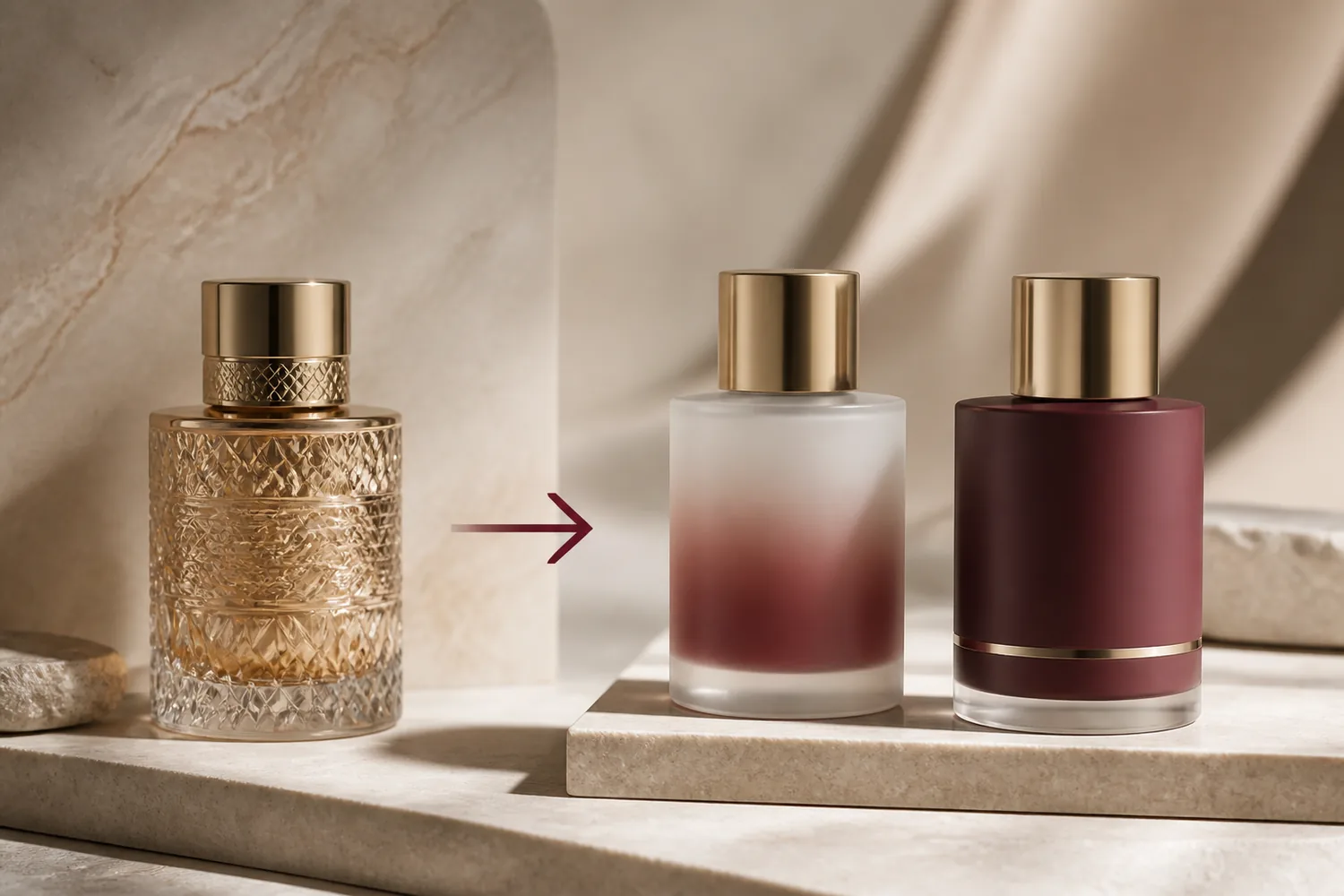
Beauty brands are simplifying bottle decoration because fewer, better-controlled finishes can make packaging easier to recognize, reproduce, inspect, and source. The shift is not simply about minimalist aesthetics. Every additional coating, print pass, foil detail, or decorative component introduces another process that must be approved, aligned, handled, and repeated consistently across production batches.
The objective is not to remove brand identity. It is to concentrate identity into fewer, more recognizable design elements while reducing unnecessary manufacturing dependencies. A distinctive bottle shape, controlled color, legible logo, and coordinated closure may communicate a brand more consistently than several decorative effects competing for attention.
The practical principle is to retain decoration that creates identifiable brand value and remove processes whose additional cost, variation, or production complexity cannot be justified. Complex finishes remain appropriate when they serve a clear design purpose and can be validated on the selected packaging system.
Core viewpoint: Simplified cosmetic bottle decoration is both a branding decision and a production-control strategy. Buyers should evaluate each decorative layer according to its contribution to brand recognition, manufacturing consistency, durability, procurement complexity, and compatibility with the final packaging system.
From “More Decoration” to More Restraint
Cosmetic packaging offers many finishing options, including translucent or opaque coating, frosting, screen printing, hot stamping, metallized components, labels, sleeves, embossing, and decorated cartons. Combining these techniques can create a striking prototype. The challenge is reproducing the approved appearance across production batches, product variants, filling operations, and repeat orders.
Restraint changes the design question. Instead of asking how many decorative techniques can fit on a bottle, the team identifies which visual elements customers should remember. These might include a recognizable silhouette, a controlled color field, a distinctive cap proportion, or a precisely positioned logo.
Once the primary brand elements are established, each additional finish should have a defined purpose. A metallic accent may reinforce brand identity, while an extra gradient or decorative collar may contribute little beyond another approval and production requirement.
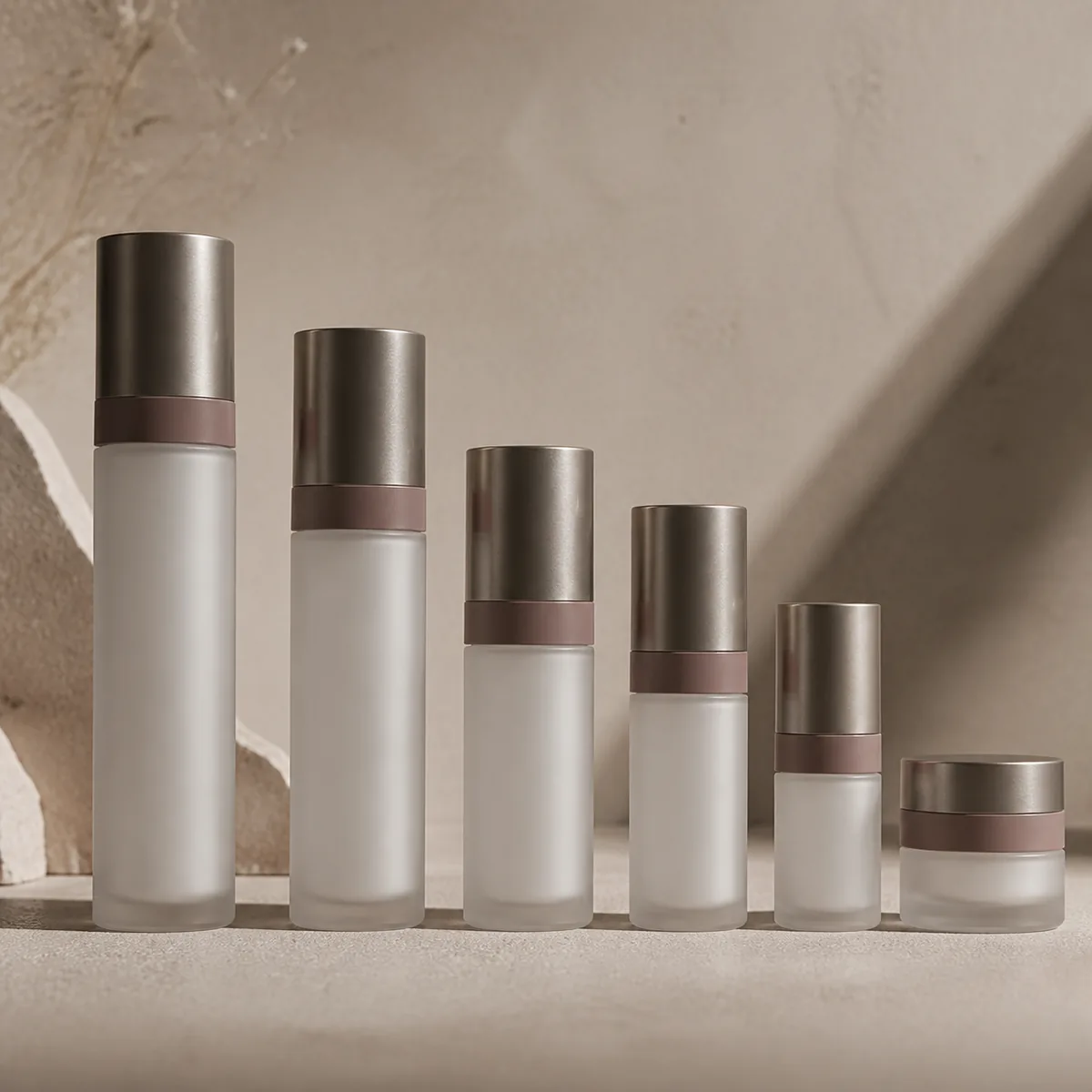
This approach is particularly relevant to brands developing multiple product variants. A shared bottle shape and consistent decoration system can establish a recognizable product family while allowing selected colors, labels, or closure details to distinguish individual SKUs.
The broader strategic context is covered in the skincare packaging guide, while brands can review physical options through cosmetic and skincare glass packaging.
Readers tracking why these priorities are changing can use the Packaging Trends & Insights hub; teams comparing coatings, printing, foil, fit, and validation boundaries can continue through the Packaging Technology hub.
Every Decoration Layer Adds an Interaction
A decoration process does not operate in isolation. Printing over a coated surface introduces an additional material interface. Hot stamping performance depends on the selected substrate, foil, artwork, geometry, and process conditions. Handling between decoration stages may introduce scratches or contamination, while a poorly coordinated cap or collar can contact and damage a finished surface.
The important issue is not simply the number of processes, but how those processes interact. A coating and a foil may each perform acceptably in separate trials without guaranteeing that their combination will withstand the intended filling, handling, storage, and distribution conditions.
This is why the cosmetic glass bottle decoration methods guide should be used to define available options, not to assume that every decorative combination can be applied successfully to every bottle.
Manufacturing sequence matters as well. Additional operations may require more handling, fixtures, intermediate inspections, scheduling coordination, and rework decisions. When a late-stage finish is rejected, the bottle may already have passed through several earlier processes.
Simplifying a decoration specification can reduce these dependencies, but the actual improvement depends on the selected materials, process sequence, production configuration, and approved acceptance criteria.
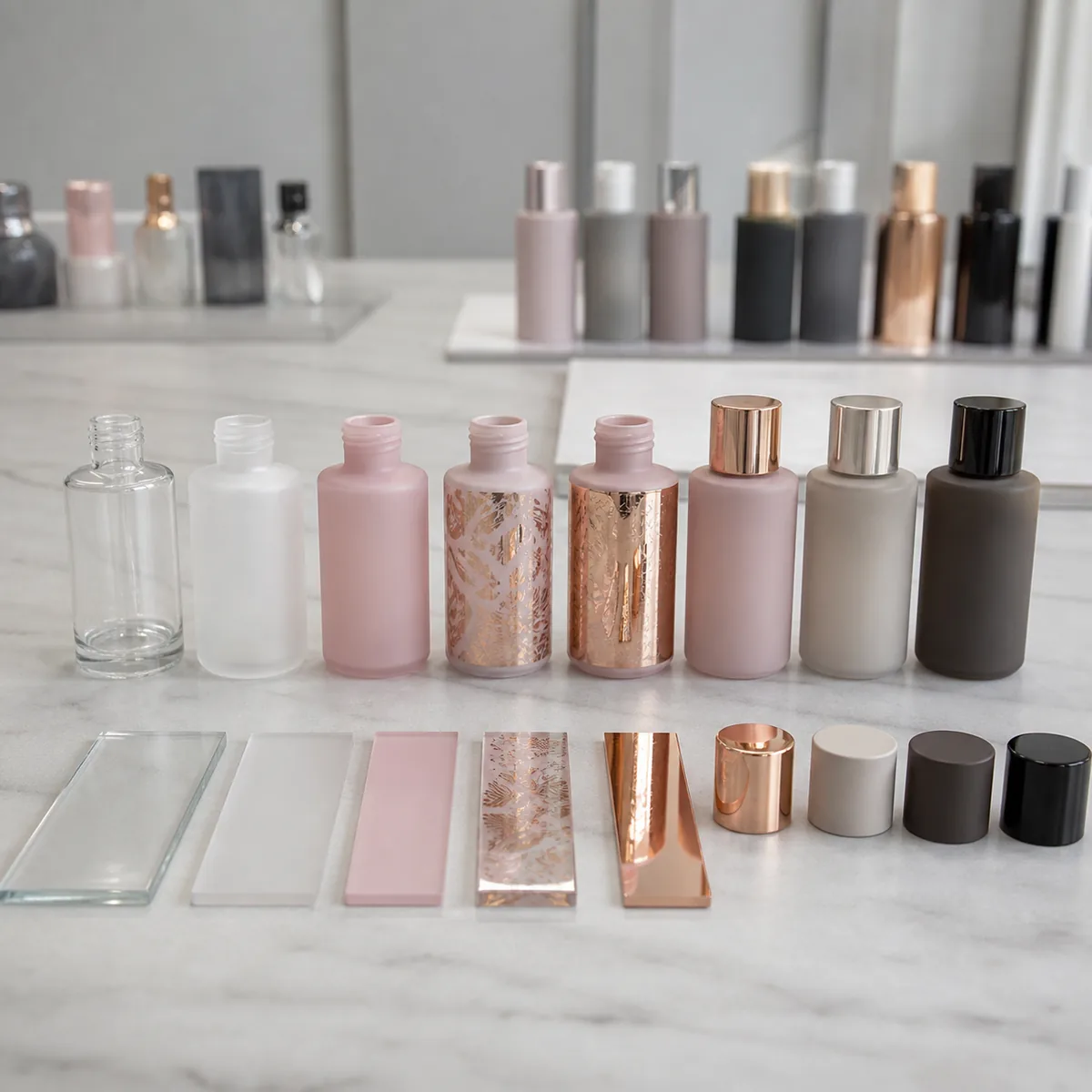
Manufacturer Insight: Evaluate the Finished Bottle, Not Each Decoration Separately
From a packaging-development perspective, a common approval risk is evaluating the bottle coating, logo printing, and closure appearance independently without reviewing their final combination.
For example, a printed logo may look acceptable on an undecorated glass sample but become difficult to read against the approved coating color. A decorative collar may also change the visible proportions of the assembled bottle or contact a finished surface during handling.
FOLOVER PACK recommends reviewing the selected bottle, coating, printing, closure, and intended product appearance as one assembled packaging system. Buyers should approve the complete physical sample before confirming bulk production.
Fewer Processes Can Improve Consistency
Consistency matters because customers encounter a brand across different products, production batches, and purchasing channels. A metallic detail that changes position, a coating that differs between SKUs, or a cap whose finish does not match the bottle can weaken the intended visual identity.
A simplified decoration system makes the important variables easier to identify. Instead of controlling several unrelated decorative effects, the team can focus on the approved bottle color, logo position, finish appearance, and component coordination.
However, fewer processes do not guarantee fewer defects. Glass surfaces, decorative finishes, printing, and assembled components can still vary. Acceptable appearance and performance limits must be agreed using representative physical samples.
Project Example: Building Consistency Across a Multi-SKU Serum Range
In a FOLOVER PACK multi-SKU serum packaging project, the packaging approach retained an existing glass-bottle shape while using different bottle colors to distinguish product variants. The development work included coordinating the bottle colors, evaluating the legibility of light-colored printed text, and matching the appearance of the dropper components.
The important design decision was to keep the common packaging structure consistent while concentrating variation in selected visual elements. Color and printing samples needed to be reviewed together because a logo that appeared clear against one bottle color could become difficult to read against another.
This example illustrates a practical approach to simplifying SKU management: retain a recognizable bottle structure, define the decorative elements that distinguish each variant, and approve their appearance as a coordinated product family.
It does not establish a measured reduction in production defects, cost, or lead time. Those outcomes would require comparable production records for the specific packaging configurations.
Brands developing similar product families can compare glass serum bottle options before selecting the bottle shape, dispensing components, and decoration system to standardize across multiple SKUs.
Simplification Is Not Automatically Better for Recycling
Brands often associate simplified decoration with improved recyclability, but visual simplicity does not establish how a finished package will behave in a recycling system.
Removing unnecessary coatings, labels, sleeves, or difficult-to-separate components may reduce material complexity. However, the actual outcome depends on the glass composition, decorative materials, surface coverage, attached components, collection infrastructure, sorting technology, and recycling process.
A glass bottle with a visually restrained opaque coating may still present a recycling challenge, while a more visibly decorated bottle may remain compatible with a particular recycling system. The complete packaging configuration must be evaluated rather than judged by appearance alone.
What Does Industry Research Show?
The Glass Packaging Institute’s research summary on cosmetic glass packaging recyclability describes a collaboration between The Estée Lauder Companies and glass recycler Strategic Materials.
The project examined more than 200 glass packaging samples between 2020 and 2024 to investigate barriers to recycling cosmetic glass packaging. The work identified light transmission as an important consideration for the sorting equipment evaluated.
This is a documented industry study, not a FOLOVER PACK laboratory result. Its findings concern the evaluated packaging samples and sorting conditions; they should not be converted into a universal coating specification or a guarantee that a particular decorated bottle will be recycled in every market.
For packaging buyers, the practical implication is to obtain material and decoration information for the selected bottle and assess its suitability for the intended recycling system before making environmental claims.
What Does the EU Packaging Regulation Mean for Decoration?
Regulation (EU) 2025/40 on packaging and packaging waste establishes requirements concerning packaging composition, minimisation, recyclability, and related environmental considerations.
Its general application began on 12 August 2026, with important requirements introduced through subsequent implementation stages. The European Commission’s August 2026 implementation announcement explains that further measures, including recyclability requirements, apply from later dates.
The regulation does not mean that removing decorative layers automatically makes a cosmetic bottle compliant or recyclable. Brands supplying the EU market should assess the exact packaging configuration against the applicable requirements and implementation dates.
A practical material review should identify the glass, coating, ink, foil, adhesive, label, sleeve, closure, and liner. Buyers can then request relevant technical documentation and investigate whether the complete packaging system is compatible with the intended collection and recycling infrastructure.
Environmental claim boundary: A simpler decoration specification may reduce material and process complexity, but it does not by itself demonstrate lower carbon emissions, lower environmental impact, or improved recyclability. Such claims require evidence appropriate to the exact packaging configuration and the market in which the claim is made.
Premium Minimalism Depends on Precision
Minimal packaging exposes errors. A single fine line, small logo, or uniform color field can make misalignment and surface variation more noticeable than they would be in a heavily decorated design.
Consequently, simplifying the appearance does not necessarily simplify the manufacturing requirements. The remaining design elements may require more careful control of bottle geometry, surface quality, printing position, color consistency, and component fit.
A successful minimal system usually has a clear visual hierarchy. One element establishes recognition, another supports it, and the remaining details avoid competing for attention.
For example, a frosted glass bottle may use a small metallic logo and a coordinated cap. Additional gradients, sleeves, and decorative collars should be retained only when they contribute a recognizable design benefit. Brands can explore this principle in minimalist cosmetic packaging design.
FOLOVER PACK recommends approving the design on production-representative bottle and component samples, not only flat artwork or digital renders. Glass curvature, coating opacity, printing position, cap dimensions, product fill color, and assembly gaps can change the final appearance.
Cost and Lead Time Are Really Complexity Questions
Fewer decorative processes do not automatically mean lower prices or faster delivery. A technically demanding single finish may cost more than several straightforward operations, while minimum order quantities, supplier scheduling, artwork preparation, tooling, curing, inspection, rejection, packing, and freight can all affect the final quotation and delivery schedule.
The more useful concept is complexity exposure. Each specialized process introduces another approval, production dependency, and potential source of variation.
When a launch date is fixed, an unresolved decoration requirement can affect the entire production sequence. A coating-color correction may require another physical sample before printing can be approved. A change in printing artwork may also require reassessing a subsequent foil application.
Simplification can reduce the number of dependencies that must be coordinated, but buyers should compare actual quotations and production schedules rather than assuming a fixed saving from removing a particular finish.
Complex vs. Simplified Bottle Decoration: What Buyers Should Compare
| Decision Factor | Multi-Process Decoration | Simplified Decoration | What Buyers Should Verify |
|---|---|---|---|
| Brand recognition | Can support layered visual effects and distinctive decorative details. | Concentrates recognition in fewer colors, shapes, or finishing elements. | Compare physical samples and product images at realistic viewing sizes. |
| Production cost | May require additional materials, setup, handling, and inspection. | May eliminate some operations but can retain expensive precision requirements. | Request itemized quotations for the exact bottle, finish, and order quantity. |
| Lead time | May involve more sequential production and approval stages. | May reduce dependencies but still requires sampling and production approval. | Confirm decoration-specific MOQ, sample requirements, and the actual production schedule. |
| Consistency | Requires control of multiple materials, interfaces, colors, and positioning requirements. | Concentrates control on fewer visual elements, which may make remaining defects more noticeable. | Approve physical color, printing, and component references with agreed acceptance criteria. |
| Recycling considerations | Multiple decorative materials may complicate sorting or recycling. | Fewer materials may simplify assessment but do not guarantee recyclability. | Review the complete material configuration and destination-market recycling requirements. |
Buyer conclusion: A simplified decoration specification is most useful when it removes unnecessary production dependencies without weakening the brand’s recognizable design elements. A complex finish remains commercially reasonable when its visual contribution justifies the additional cost, approvals, and technical validation.
Digital Commerce Favors Clear Packaging Codes
On a marketplace grid or social media feed, a cosmetic bottle may appear as a small image. Fine decoration can become difficult to distinguish, metallic effects may render differently under studio lighting, and subtle embossing may not remain visible at thumbnail size.
Bottle silhouette, contrast, closure shape, and recognizable color fields can communicate more clearly in reduced-size images. This does not make detailed decoration irrelevant; it changes its role. Fine finishes can reward close inspection after the main design has established recognition.
Beauty brands should review packaging at several viewing distances and in multiple contexts: product-listing thumbnails, full product images, retail shelves, hand-held use, and the intended consumer environment.
A design that depends entirely on a small foil detail may lose its distinguishing feature online. Conversely, a bottle that photographs clearly but lacks visual coherence in hand may not deliver the intended brand experience.
The packaging system should remain recognizable across these contexts without requiring every decorative element to be visible at every viewing distance.
When Complex Decoration Still Makes Sense
Complex decoration remains appropriate for limited editions, collectible fragrances, ceremonial gifting, distinctive craft positioning, and signature finishes that are central to a brand’s identity.
For example, a carefully developed combination of coating and metallic decoration may be important to a fragrance collection. Removing the metallic effect simply to reduce the number of production steps could weaken the product’s intended positioning.
The relevant decision is whether the additional process creates sufficient brand value to justify its manufacturing and procurement requirements.
A complex design requires clear process control. Teams should confirm the decoration sequence, freeze approved artwork versions, evaluate material interfaces, establish physical reference samples, and review durability under relevant handling and use conditions.
Hot stamping, for example, can create a distinctive metallic accent, but its suitability depends on the selected substrate, surface finish, geometry, artwork, and process conditions. See hot stamping for cosmetic packaging for the technical boundary.
Manufacturer Insight: An attractive decoration sample is not sufficient for bulk-production approval if its acceptance criteria remain undefined.
Buyers should agree on the approved appearance, color reference, logo position, finish coverage, relevant durability requirements, and interaction with the final closure. Where several decorative processes are combined, the complete layered system should be evaluated rather than relying only on the performance of individual finishes.
Use a Decoration Budget Instead of a Process Wish List
A decoration budget assigns a reason to every decorative layer. It is not simply a financial limit. It is a structured method for deciding which elements contribute to the package’s identity and which introduce complexity without sufficient benefit.
| Question | Why it matters | Evidence before approval |
|---|---|---|
| What brand code does this layer create? | Prevents decorative redundancy. | Side-by-side concept and recognition review. |
| What substrate and layers does it contact? | Exposes adhesion and interaction risk. | Material information and layered sample. |
| What variation is acceptable? | Makes inspection auditable. | Approved range and defect references. |
| What use and distribution must it survive? | Connects appearance to real handling. | Relevant durability and packed-product checks. |
| What happens when it changes? | Prevents uncontrolled repeat-order drift. | Version, supplier, item-code, and change-control plan. |
| Could another cue do the job better? | Reallocates cost to higher-value details. | Comparison with closure, shape, or simpler finish. |
For a brand considering spray coating, screen printing, and hot stamping on the same bottle, the review should establish which process carries the primary visual identity and whether the remaining processes add a distinct benefit.
If the bottle color and printed logo already establish sufficient recognition, the metallic accent may be optional. If the metallic detail is the brand’s defining feature, retaining it while simplifying another element may be the more appropriate decision.
The final decoration specification should be based on approved physical samples, confirmed process feasibility, and the intended order requirements rather than appearance alone.

A Buyer Workflow for Simplifying Without Becoming Generic
- Identify the one packaging cue customers should remember.
- List every decoration layer and the value it is expected to create.
- Remove layers that repeat the same signal or exist only because they are available.
- Evaluate the remaining system on the final bottle, formula color, closure, and carton.
- Map materials, suppliers, process order, lead-time gates, and likely failure interactions.
- Approve production-representative samples and measurable visual limits.
- Test relevant adhesion, abrasion, handling, filling, transport, and use conditions.
- Lock artwork, color references, component item codes, and change control.
What Should Buyers Include in a Decoration RFQ?
Before requesting a quotation, buyers should provide the selected bottle model, intended order quantity, decoration artwork, color references, desired finishing methods, closure requirements, and destination market.
Where several SKUs share a bottle shape but use different colors or printed designs, the RFQ should identify the expected quantity and decoration requirements for each variant.
Ask the supplier to distinguish the MOQ for the undecorated bottle from any decoration-specific minimum quantity. Buyers should also confirm which physical samples are required, whether additional approval rounds affect the schedule, and when artwork and color references must be finalized.
These requirements help suppliers evaluate the actual decoration configuration rather than provide a quotation based only on bottle capacity or a reference image.
FOLOVER PACK’s decoration and finishing services can support coating, frosting, printing, hot stamping, and related packaging-development coordination depending on the selected package and project requirements. Exact process combinations, tolerances, cost, minimum quantities, and performance must be confirmed for the chosen bottle and components.
Frequently Asked Questions
Does simpler bottle decoration always cost less?
No. Removing unnecessary decoration may reduce material usage, setup operations, or production dependencies, but a technically demanding single finish can still be expensive. Cost also depends on bottle quantity, decoration-specific MOQ, artwork, equipment setup, supplier scheduling, and inspection requirements. Buyers should request comparable quotations for the exact packaging configurations rather than assume that fewer decorative processes automatically produce a lower unit price.
Is minimalist packaging easier to manufacture?
Not automatically. Minimalist cosmetic packaging may involve fewer decorative operations, but it can make small differences in color, logo position, surface quality, and component alignment more noticeable. The remaining design elements may therefore require careful production control. Buyers should approve production-representative physical samples and agree on visual acceptance criteria before bulk production rather than relying only on digital artwork.
Can hot stamping be used over a coated bottle?
Yes, hot stamping may be feasible over certain coated glass surfaces, but compatibility depends on the coating, foil, artwork, bottle geometry, and process conditions. Successful application on bare glass does not prove that the same foil will perform correctly over a selected coating. Buyers should evaluate the actual layered decoration system on physical samples and confirm the required appearance and durability before bulk production.
Does removing decoration make a bottle recyclable?
No. Removing unnecessary decorative materials may simplify the packaging structure, but recyclability depends on the complete material system and the relevant collection, sorting, and recycling infrastructure. Coatings, labels, sleeves, attached components, and glass characteristics may influence the outcome. Brands should obtain appropriate evidence for the exact packaging configuration before claiming that a simplified cosmetic glass bottle is recyclable.
Does simplifying bottle decoration reduce MOQ?
Not necessarily. Removing a specialized finish may eliminate one decoration-specific minimum order requirement, but the underlying glass bottle, coating, printing, and closure components may still have separate MOQs. A simplified design can also retain an expensive or highly specialized process. Buyers should request an itemized quotation showing the applicable minimum quantity for each selected component and decoration operation rather than assuming a universal MOQ reduction.
Can simpler bottle decoration shorten the sampling lead time?
It may reduce the number of sample-production and approval stages when unnecessary decorative processes are removed. However, the actual sampling schedule depends on the selected bottle, available materials, finishing requirements, artwork readiness, component sourcing, and any revisions needed after physical sample evaluation. Buyers should confirm the required approval sequence and supplier schedule for the exact design before committing to a product launch date.
Conclusion: Simplicity Must Carry More Meaning
Beauty brands are simplifying bottle decoration because fewer, better-controlled processes can support consistent recognition while reducing unnecessary manufacturing interactions, approval requirements, and sourcing complexity.
The objective is not to create an undecorated, generic bottle. It is to establish a packaging system in which every remaining visual element has a clear brand purpose and an achievable production specification.
For buyers, the decision should be conditional: simplify when additional finishes create little recognizable value relative to their manufacturing and procurement requirements. Retain complex decoration when it is central to brand identity and the complete design can be validated for the intended product and production conditions.
FOLOVER PACK can support the evaluation of cosmetic glass bottle options, decoration methods, component coordination, and physical sample approval. Buyers can share their existing bottle design, decoration requirements, target order quantity, and reference artwork to discuss a suitable packaging configuration.
Related Blog Articles
- Cosmetic Glass Bottle Decoration Methods
- Frosted Cosmetic Glass Bottles
- Minimalist Cosmetic Packaging Design
Primary source: Regulation (EU) 2025/40 on packaging and packaging waste.