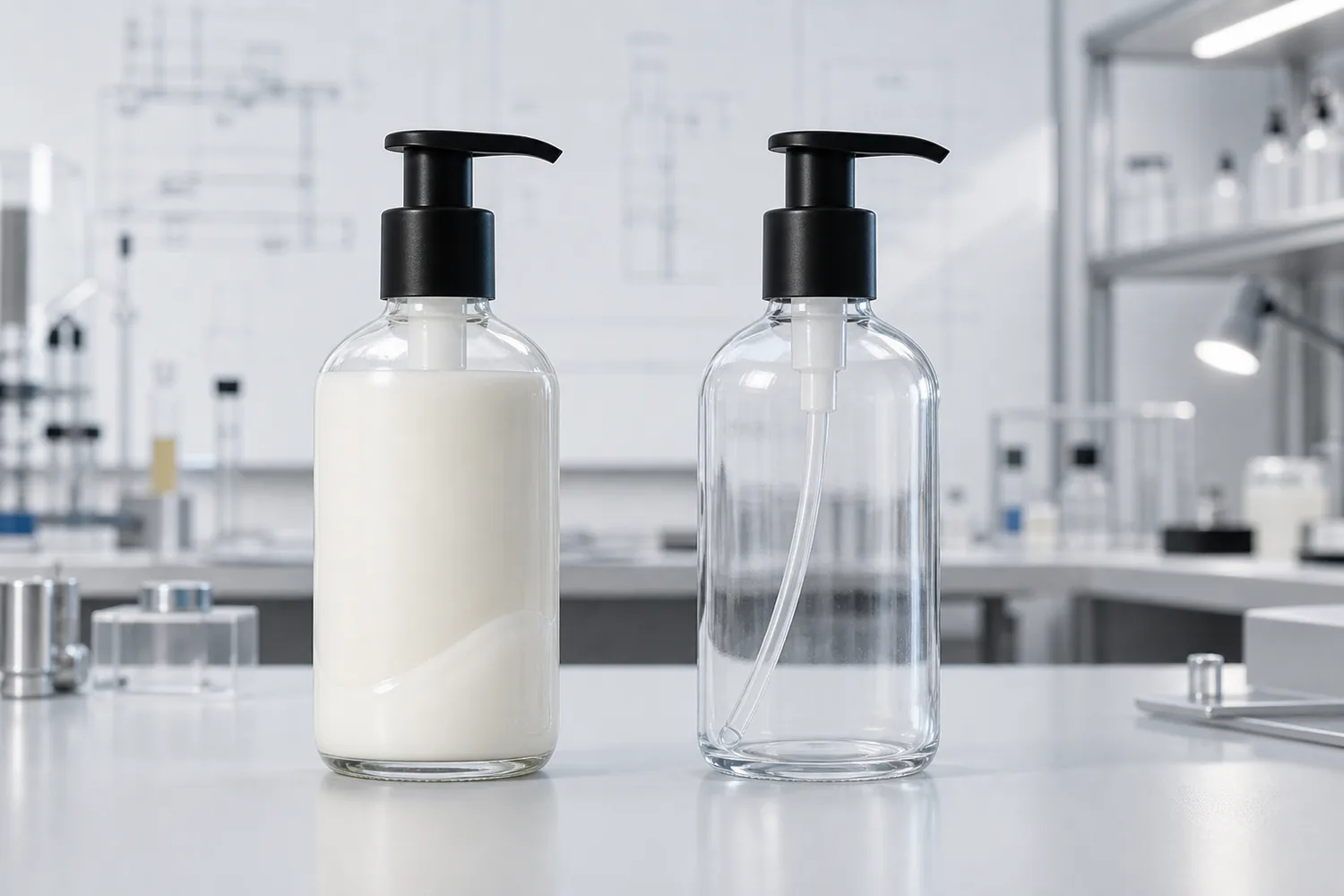
A lotion pump can stop working before the bottle is empty because the remaining product no longer reaches the dip-tube inlet, the formula flows too slowly to replenish the pump, air enters the liquid path, or the dispensing mechanism becomes restricted. Visible lotion remaining inside the bottle does not automatically mean the pump is defective.
The first step is to identify when dispensing stops and where the remaining lotion sits. A pump that fails only near empty may have a product-reach or flow problem. A pump that stops while the inlet remains submerged may require investigation of priming, blockage, or the mechanism itself. The correct solution depends on the observed failure, not simply on replacing the pump or installing a longer dip tube.
Start by locating the remaining product
Place the bottle upright on a level surface and observe where the lotion collects. In a bottle with a curved heel, deep push-up, thick base, or non-circular footprint, the last portion may sit around the perimeter instead of directly below the dip tube. Tilting during use can also move product away from the inlet.
Record the original fill, the amount dispensed, the remaining amount, and the bottle orientation when dispensing stops. These observations help distinguish product that cannot reach the inlet from product that remains nearby but flows too slowly to replenish it.
Manufacturer Insight: Before changing a pump or dip-tube length, FOLOVER PACK recommends examining the location of the remaining lotion in the actual glass bottle. If the formula consistently collects in an internal corner or around a raised base, extending the tube vertically may not solve the problem. The bottle’s internal geometry and the formula’s flow behavior must be evaluated together.
Dip tube length is only one part of product reach
A tube that ends too far above the bottle base can stop drawing product while a visible amount remains. However, extending the tube until it presses firmly against the glass is not a reliable correction.
An overlong tube may bend, obstruct its inlet against the base, interfere with pump seating, or move toward an unintended location. The required length depends on the bottle’s internal height, base geometry, tube stiffness, end-cut design, and component tolerances.
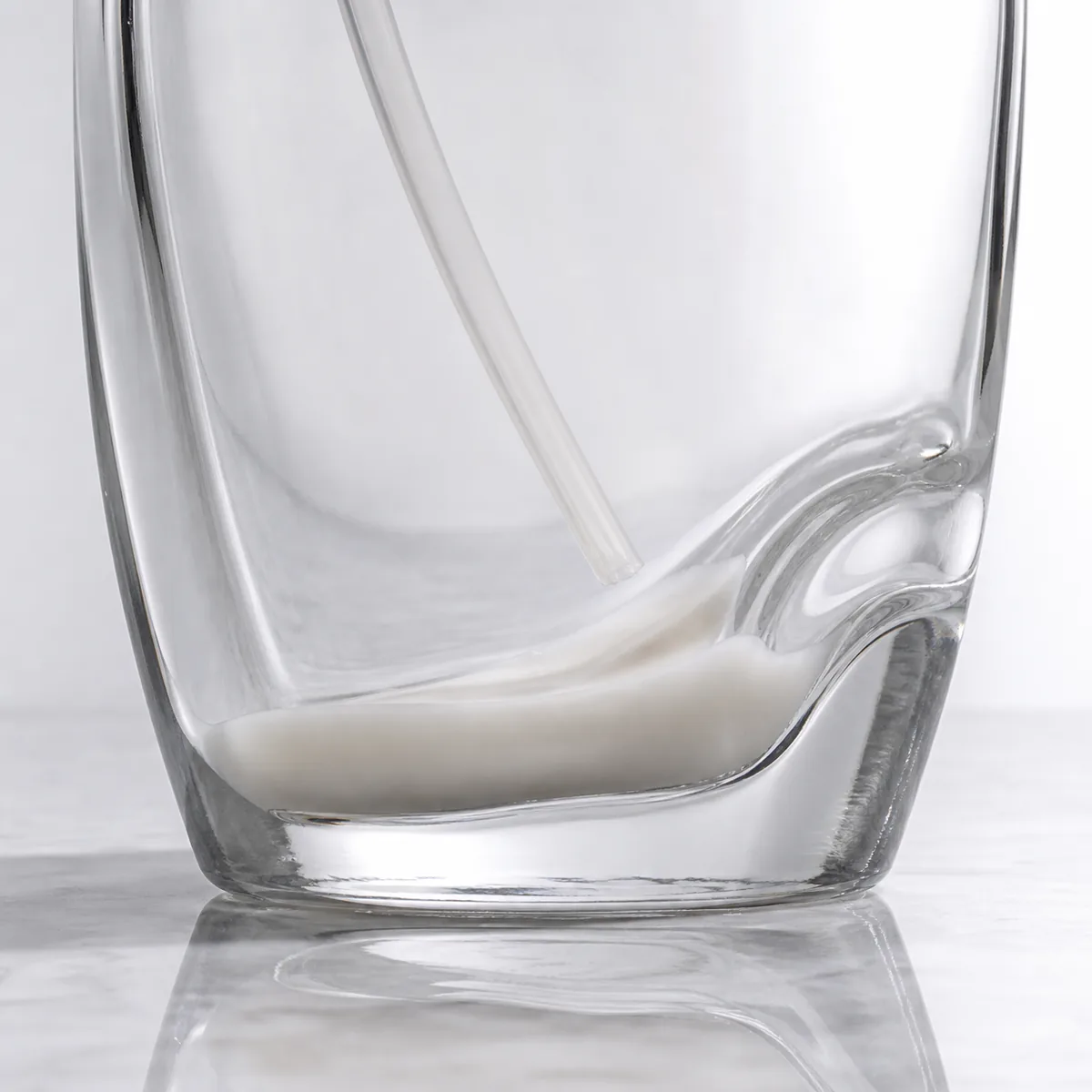
A diagonal or shaped cut may help keep the inlet open, but it does not guarantee better evacuation in every bottle. The tube must be evaluated in its final assembled position, including how it behaves when the pump is tightened onto the bottle.
The cosmetic pump dip-tube length guide explains how bottle geometry, tube design, and physical sample approval affect the correct cut length.
High viscosity can create flow starvation
Some lotions dispense normally when the bottle is full but become difficult to pump as the product level falls. A viscous formula may not flow toward the dip-tube inlet quickly enough to replace the amount withdrawn during each stroke.
This can create a cavity or air channel around the inlet while lotion remains elsewhere in the bottle. Repeated pumping may then draw air instead of product.
Temperature and formulation structure can affect the result. A lotion evaluated during warm filling may behave differently after storage in a cooler environment. Some structured formulas also require time to flow back toward the inlet after dispensing.
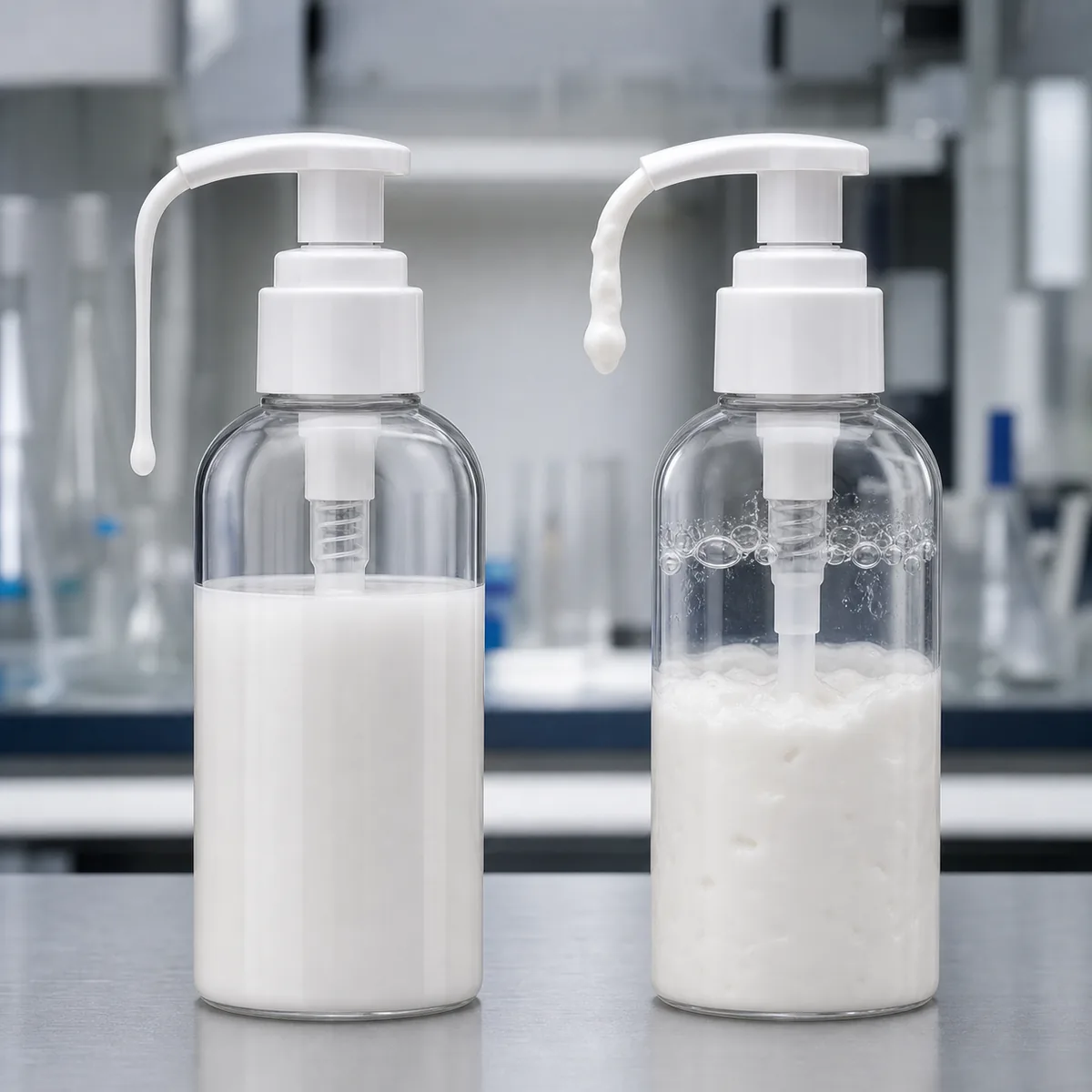
When dispensing stops, allow the bottle to stand under a controlled condition and observe whether product returns around the inlet. If output resumes after an appropriate pause, the system may be experiencing flow starvation rather than permanent mechanical failure.
The broader guide to packaging for lotions and emulsions explains how viscosity, bottle selection, and dispensing requirements influence packaging development.
Technical note: There is no universal viscosity value that determines whether a lotion will work with every cosmetic pump. Performance depends on the actual formulation, pump mechanism, inlet geometry, temperature, and dispensing conditions. Buyers should request formula-specific compatibility testing rather than apply a viscosity limit from an unrelated pump model.
Loss of prime introduces air into the liquid path
A lotion pump becomes primed when repeated actuation replaces air in its dispensing pathway with product. If air enters through an uncovered dip-tube inlet, a loose tube connection, or an unsuitable internal component interface, the pump may deliver intermittent output before stopping.
Re-priming may temporarily restore dispensing. However, repeated loss of prime indicates that the air-entry route or product-supply condition needs investigation.
Do not confuse loss of prime with external leakage. A bottle can remain externally dry while the pump draws air internally. Conversely, a pump may dispense normally while the bottle-to-closure seal leaks during storage or transport.
Inspect the dip-tube connection, pump seating, gasket condition, closure fit, and internal mechanism separately. The guide to how cosmetic pumps work explains the relationship between the actuator, chamber, valves, and dip tube.
Clogging and dried product can stop recovery
Lotion may dry at the actuator opening after repeated exposure to air. Suspended particles, crystallizing ingredients, film-forming formulas, or accumulated product can also restrict the outlet, valve, chamber, or dip tube.
The symptoms depend on the location of the restriction. A blocked outlet may make the actuator difficult to press, while a restricted inlet may produce weak or intermittent output. Product build-up can also interfere with normal actuator return.
If cleaning the nozzle restores dispensing, record the observation but do not treat it as proof that the complete packaging system is suitable. Development samples should be tested with the actual formulation and realistic intervals between uses.
Where blockage repeatedly occurs, review the formulation and pump mechanism together. Do not assume that increasing pump output or replacing the dip tube will resolve an internal compatibility problem.
Bottle geometry can move residue away from the inlet
Square bottles, broad oval bottles, sculpted bases, internal corners, and deep push-ups may create several low zones where product collects. A dip tube positioned at the geometric center does not necessarily reach the location where the last portion of lotion settles.
For example, consider a thick lotion dispensed from a square glass bottle with a raised central base. If product remains around the base perimeter while the central dip-tube inlet is exposed to air, the pump may stop even though lotion is still visible.
In this illustrative situation, the appropriate investigation is whether the bottle geometry, dip-tube position, or formulation flow prevents the remaining product from reaching the inlet. A longer tube should not be approved without confirming that it improves collection and does not create a new obstruction.
This is why a pump approved for one bottle should not automatically be transferred to another. The article on whether one cosmetic pump can fit different glass bottles explains the component compatibility requirements. Even when the neck interface is compatible, a different bottle may require a separate dip-tube specification and low-fill evaluation.
A seven-step diagnostic sequence
When a lotion pump stops working early, identify the failure before changing components. The following sequence helps buyers and packaging teams distinguish product-reach, formula-flow, air-entry, and mechanism problems.
| Step | What to Check | Buyer Decision |
|---|---|---|
| 1. Quantify residue | Original fill, amount dispensed, and remaining product. | Establish whether the complaint reflects measurable evacuation performance. |
| 2. Locate remaining lotion | Product position around the base and inlet in normal-use orientations. | Determine whether the inlet can reach a continuous product supply. |
| 3. Inspect the dip tube | Tube length, end cut, attachment, bending, and contact with the base. | Identify insufficient reach or an obstructed inlet. |
| 4. Standardize formula conditions | Temperature, settling time, flow behavior, and intervals between strokes. | Determine whether slow product replenishment contributes to the failure. |
| 5. Check priming | Sputtering, air intake, and recovery after re-priming. | Investigate air entry or discontinuity in the liquid path. |
| 6. Inspect the mechanism | Actuator return, nozzle, valves, connections, and visible product build-up. | Identify obstruction, component damage, or a mechanism-related fault. |
| 7. Compare representative units | Failed samples, retained samples, and relevant production batches. | Distinguish an isolated component failure from repeatable package-system behavior. |
Change one variable at a time during investigation. Replacing the pump, cutting a longer tube, warming the formula, and tilting the bottle in the same trial may restore output without identifying the actual cause.

Define an evacuation test before approving the package
Use production-representative bottles, pumps, gaskets, dip tubes, and the actual formulation. Define the starting fill, bottle orientation, actuation method, interval between strokes, test endpoint, and method for measuring the remaining product.
Evaluate dispensing at full, intermediate, and low fill levels. Record changes in output, actuator return, priming, leakage, residue location, and any need for unusual tilting or shaking.
Testing conditions should reflect the product’s intended storage and use. ASTM D4332-22 describes standard and special conditioning atmospheres for containers, packages, and packaging components. It can inform the selection of relevant package-conditioning conditions, but it does not define a cosmetic pump evacuation test or establish an acceptable residual-lotion limit.
The brand and its testing partner should set the actual evacuation acceptance criteria according to the selected product, packaging configuration, and intended consumer experience. Zero residue should not be assumed to be a realistic or universally required result.
Physical Sample Approval
- Confirm the exact bottle, pump, gasket, dip-tube specification, formula, and assembly method.
- Measure the starting fill and define the normal-use dispensing procedure.
- Evaluate representative units through the intended low-fill endpoint.
- Measure remaining product and document where it collects inside the bottle.
- Repeat under relevant storage, temperature, and use conditions.
- Investigate failed samples using controlled comparisons.
- Retain the approved physical assembly and record the agreed acceptance criteria before bulk production.
What brands can improve
- Insufficient product reach: Revise the controlled dip-tube specification only after confirming the actual bottle geometry and inlet position.
- Inlet blockage: Review the tube cut, stiffness, base clearance, and final assembled position.
- Slow formula replenishment: Evaluate the pump mechanism, formula flow behavior, and time between strokes.
- Repeated loss of prime: Investigate the dip-tube connection, air-entry route, and relevant internal pump components.
- Dried product or clogging: Review the nozzle, actuator protection, formulation, and intended use intervals.
- Unreachable residue: Evaluate whether the bottle’s internal geometry or collection position requires a different packaging configuration.
Buyers can compare glass lotion bottles and cosmetic lotion pumps as candidate components. The Lotion Bottle Packaging Guide explains the wider bottle, dispensing, and formula-selection requirements.
Additional technical answers are available in Packaging Q&A and Packaging Technology.
Buyer conclusion
A lotion pump that stops before the bottle is empty should be evaluated as part of the complete bottle, pump, dip-tube, and formula system. The corrective action should address the demonstrated failure without introducing a new sealing, dispensing, or assembly problem.
Turn field complaints into a reproducible test
A customer report that the pump stopped while lotion remained is useful evidence, but it is not a complete diagnosis. Record the bottle and pump item codes, formulation batch, storage conditions, use history, residue location, and whether re-priming restores dispensing.
Preserve the failed unit in its original condition before cleaning, cutting, warming, or disassembling any components. Compare it with retained or representative samples using the same documented procedure.
If multiple units consistently leave lotion in the same inaccessible location, the bottle geometry or formula flow deserves investigation. If only one unit fails and its dip tube is loose or its actuator does not recover, component or assembly variation may be responsible.
Choose corrections by demonstrated failure mode
A short dip tube may require a revised cut length, while product trapped in an internal corner may require a different collection position or bottle configuration. Repeated air channels in a viscous lotion may call for additional pump-and-formula evaluation rather than simply changing the tube.
Every correction should be checked for secondary effects. A longer tube may improve product reach but create base blockage. A different pump mechanism may improve dispensing but change the output, actuator force, component dimensions, formula-contact materials, and cost.
Confirm the final bottle-and-closure compatibility using the selected components and physical samples before bulk production.
Communicate realistic end-of-use behavior
If the approved packaging configuration requires a gentle tilt near the end of use, the instruction should be simple and supported by normal-use evaluation. Consumers should not need to remove the pump, cut the bottle, or use unsafe methods to obtain the remaining lotion.
Where substantial product consistently remains inaccessible under reasonable use conditions, improving the packaging configuration is preferable to relying on increasingly complicated consumer instructions.
Final Recommendation: Diagnose an early-stopping lotion pump by measuring the remaining product, checking its position relative to the dip-tube inlet, and evaluating formula flow, priming, and mechanical function. Select the smallest controlled change that addresses the verified cause, then approve the complete packaging assembly under representative use conditions.
FOLOVER PACK supports glass lotion bottle selection, cosmetic pump matching, dip-tube coordination, and packaging sample development. Share your selected bottle, pump specification, formula requirements, intended fill, and available low-fill observations to discuss suitable component options and sample evaluation.
Frequently asked questions
Why is lotion left at the bottom of a pump bottle?
The remaining lotion may sit outside the dip-tube collection area, flow too slowly toward the inlet, or become separated by an air channel. Measure and locate the residue before changing components.
Should the dip tube touch the bottom?
It should reach an effective low point without being forced closed against the base or bending unpredictably. The correct cut depends on bottle geometry, tube properties, and tolerances.
Can thick lotion block a pump?
It can flow too slowly, dry at the outlet, or interact poorly with the mechanism. Test the exact formula under controlled temperature and use intervals.
Can changing bottle shape affect pump performance?
Yes. Internal height, heel, push-up, corners, and product pooling can change tube length and low-fill access even when the neck interface remains compatible.