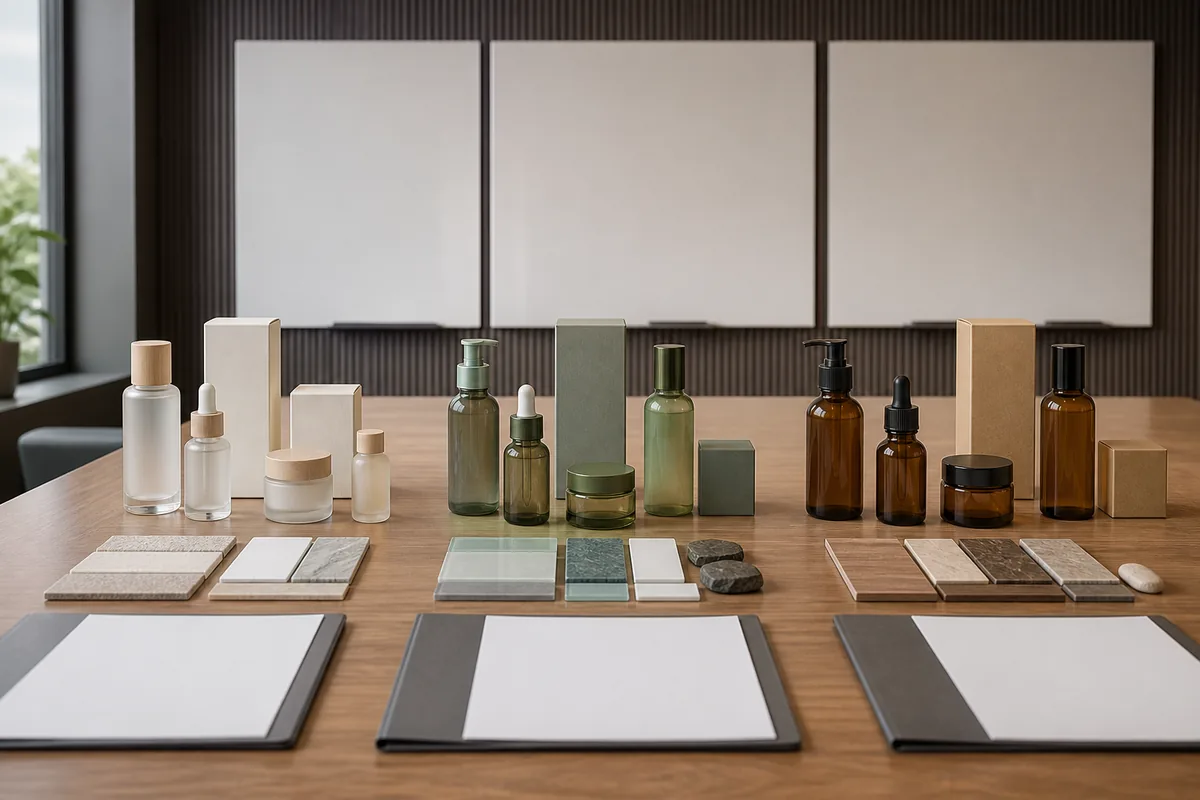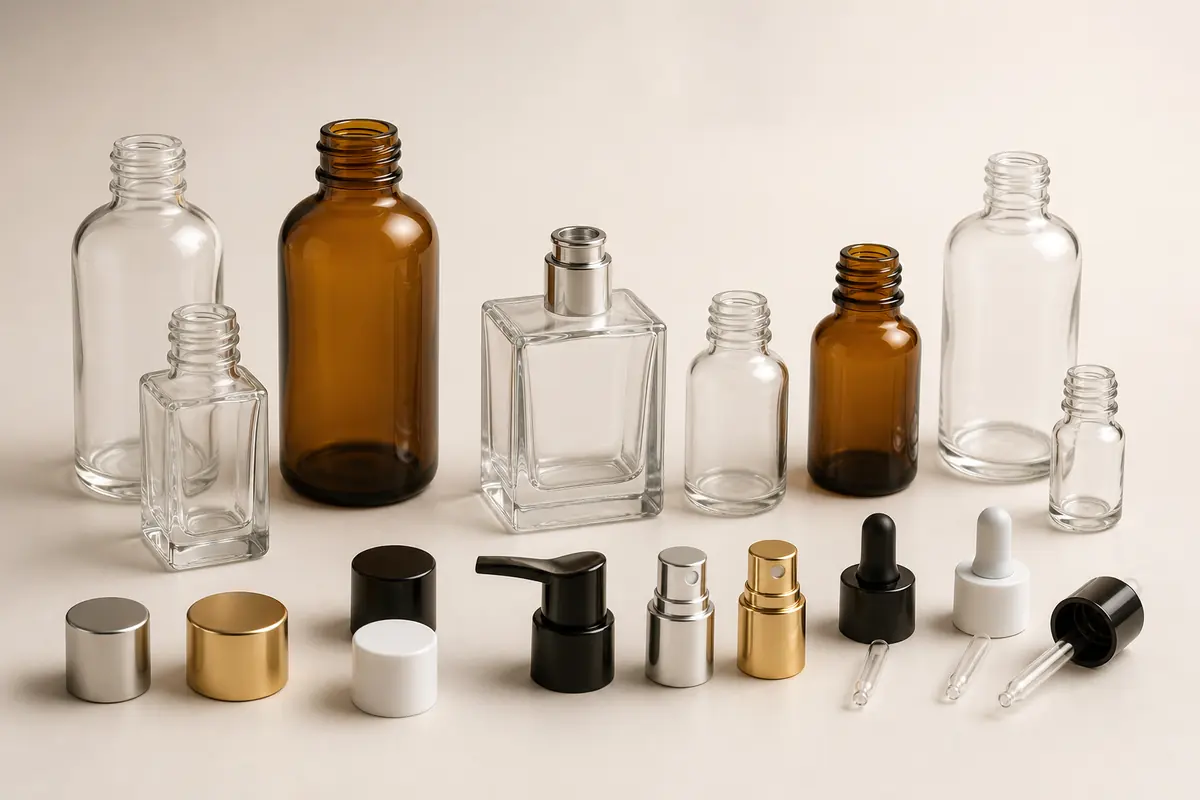
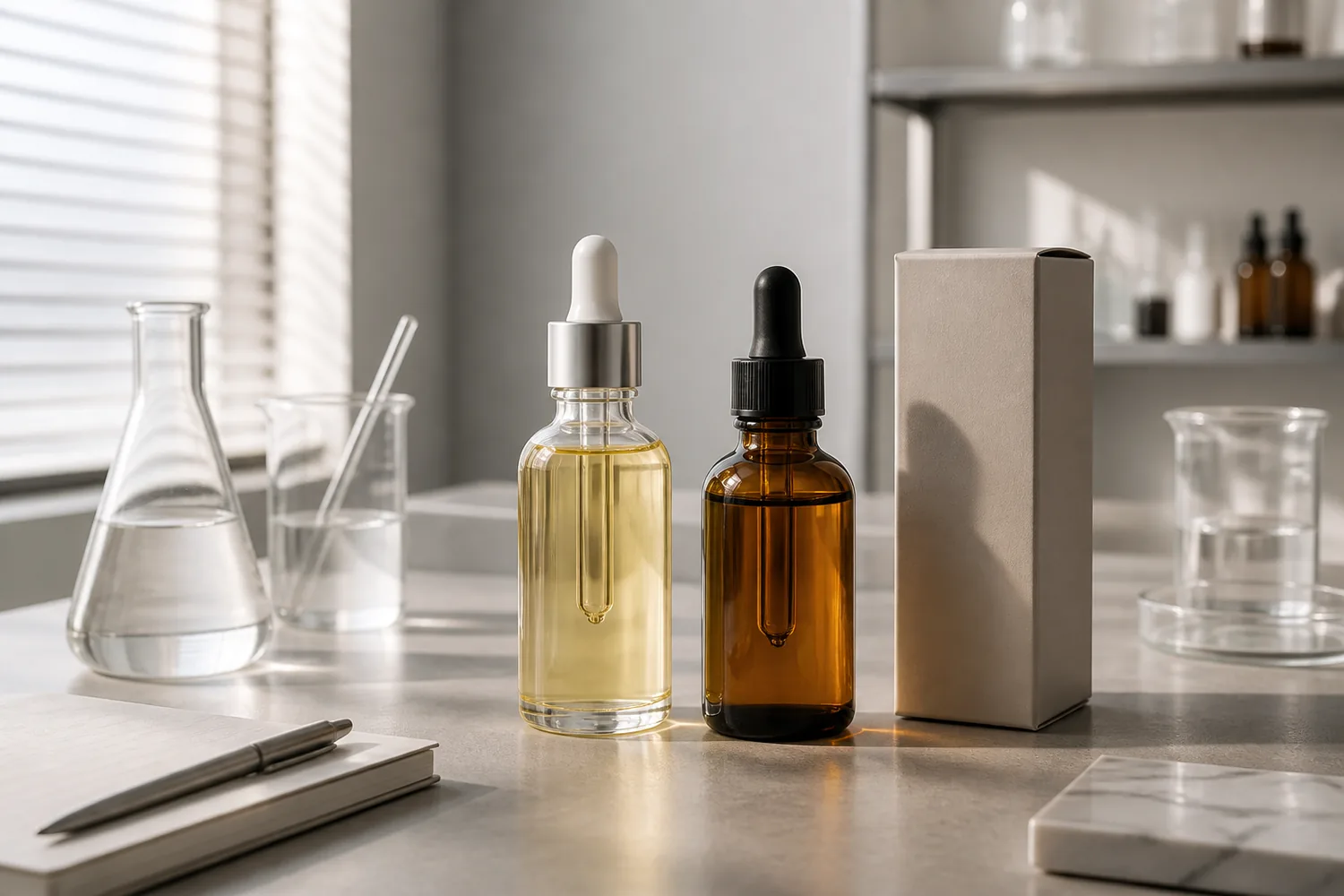
Short answer: Some essential-oil formulas can be stored in clear glass bottles, but clear glass is not automatically suitable for every essential oil. The decision depends on the finished formula’s light sensitivity, expected exposure, shelf life, secondary packaging, storage conditions, and product-specific testing.
Clear glass can be commercially attractive because it reveals the oil color, supports a clean visual identity, and makes the fill level easy to inspect. None of those benefits proves that the formula will remain acceptable in light. A single essential oil, an essential-oil blend, a diluted treatment oil, and a fragranced cosmetic can respond differently to the same exposure.
The useful question is therefore not simply “Is clear glass allowed?” It is “Under the real distribution and use conditions, does this exact package keep this exact formula within its agreed quality limits?” This prevents two opposite mistakes: rejecting clear glass without evidence or approving it because another brand appears to use it.
Why amber glass is common for essential oils
Amber glass is widely considered when a formula may be light-sensitive because the glass color can reduce transmission across parts of the light spectrum. That makes amber a reasonable risk-reduction option, but not a universal guarantee.
The protection delivered by a bottle depends on the glass composition, color intensity, wall distribution, decoration, and wavelengths that matter to the formula. Storage temperature, oxygen in the headspace, closure performance, and repeated opening can still influence quality.
A study by Turek and Stintzing, published in Food Research International, examined lavender, pine, rosemary, and thyme essential oils under different light and temperature conditions. The researchers observed changes that varied among the oils and storage conditions. The findings support evaluating individual essential oils rather than assuming that one storage recommendation or packaging configuration will provide equivalent protection for every formula.
This research provides evidence of formulation-dependent storage behavior. It does not establish a universal UV-blocking percentage for amber glass or prove that a particular clear bottle is suitable for commercial use.
A buyer should treat amber glass as one control in a packaging system. The system may also include a well-sealing dropper or reducer, an opaque carton, controlled warehousing, storage instructions, and a product-specific stability program. FOLOVER’s Essential Oil Bottles collection provides a starting point for comparing available glass bottle formats and component options.
For broader selection guidance covering glass color, dispensing components, and formula requirements, see the essential oil packaging guide. This article focuses on the narrower decision of whether clear glass is suitable.
Manufacturer Insight: Bottle color should be specified as a performance input, not used as a substitute for a finished-package stability decision. A color name alone does not state a verified transmission curve.
When comparing clear and amber bottles, buyers should identify the exact bottle model, glass color, closure, and intended formulation. If light protection is a purchasing requirement, request applicable optical data or arrange suitable finished-product evaluation. Do not assume that a transmission result for one amber bottle also applies to another bottle with a similar appearance.
When clear glass may be a rational choice
Clear glass may be considered when product-specific evidence shows that the formula remains acceptable under its foreseeable exposure, or when the commercial packaging system meaningfully limits light.
Examples include a bottle that remains in an opaque carton between uses, professional-use packaging stored in controlled cabinets, a distribution system with limited light exposure, or a formula whose stability has been demonstrated under the intended conditions. These are scenarios to evaluate, not automatic approvals.
Clear glass may also be used during development because it makes color change, haze, sediment, phase separation, and fill level easier to observe. That development convenience must not be confused with protection in market use. A transparent sample can help the team observe a failure; it does not prevent the failure.
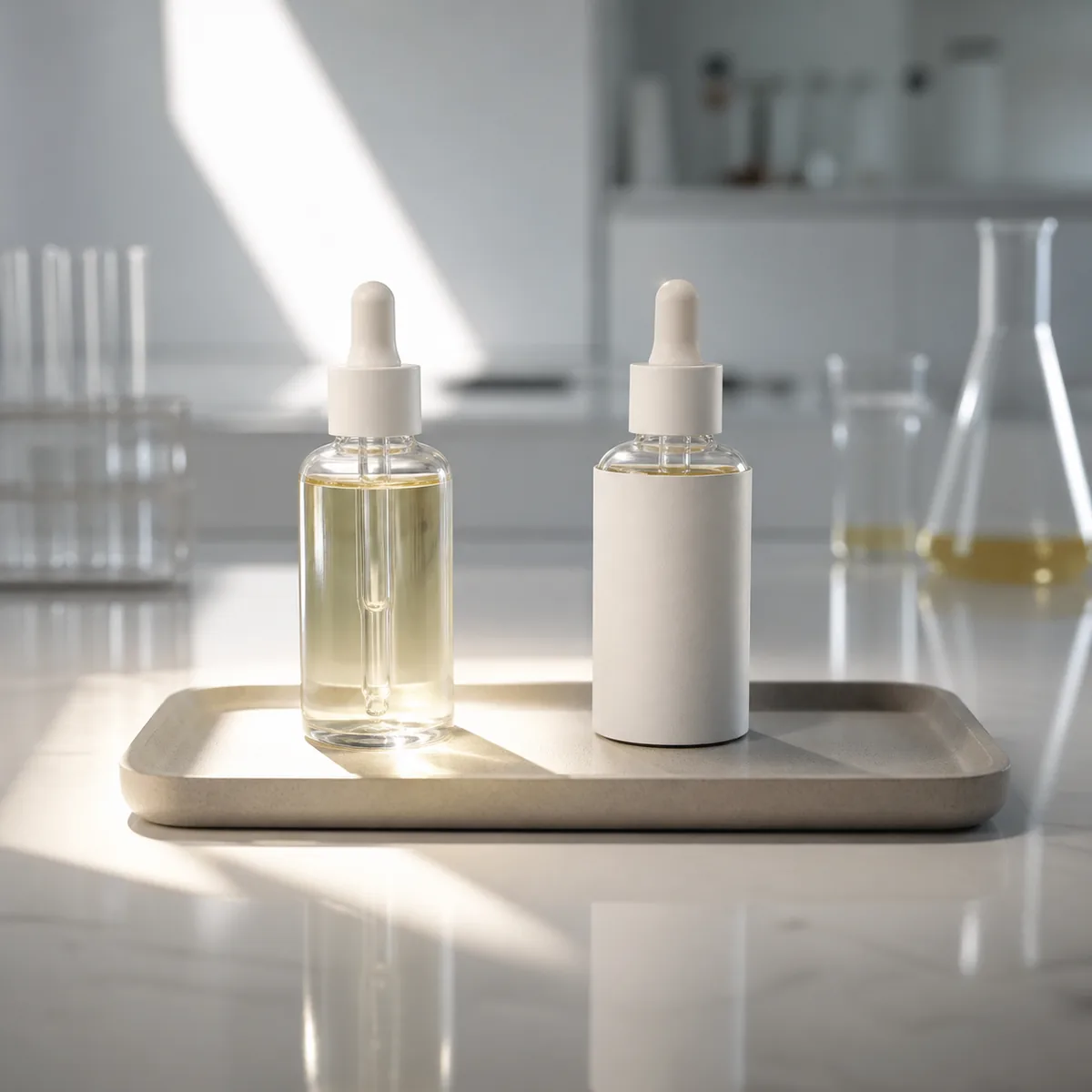
The appropriate approval is conditional: clear glass is suitable only when the exact formula and commercial packaging configuration meet the brand’s acceptance criteria under relevant storage and use conditions.
Buyers comparing essential oil bottles can then discuss appearance and component options without turning a design preference into an unsupported shelf-life claim.
Build an exposure map before choosing the bottle
A useful decision starts with an exposure map. List where light can reach the product from filling to final use. This includes the filling line, staging area, warehouse, export carton, retail shelf, display lighting, bathroom shelf, and treatment room.
For each stage, record the light source, approximate exposure duration, presence of secondary packaging, temperature conditions, and whether the bottle is full or partly empty. A partly used bottle may have a different headspace and opening history from a new unit.
A clear bottle sold inside an opaque carton through e-commerce may have a different exposure profile from the same bottle displayed without its carton under retail lighting. The packaging decision should reflect the intended commercial channel rather than a generic recommendation based only on bottle color.
| Decision input | Question to answer | Why it matters |
|---|---|---|
| Formula | Which quality attributes may change with light, heat, oxygen, or time? | Defines what the test must observe. |
| Primary package | What bottle, closure, liner, reducer, or dropper is the exact commercial assembly? | Prevents component-by-component assumptions. |
| Secondary package | Is the bottle continuously protected or only protected during shipping? | Determines how much exposure remains in use. |
| Channel | Will units be displayed, stored in a cabinet, or shipped directly to customers? | Changes realistic light duration and intensity. |
| Shelf life | How long must the unopened and opened product remain acceptable? | Sets the validation horizon. |
Bottle color is not the only protection layer
An opaque folding carton can substantially reduce a product’s light exposure while it remains closed, but it only works when the consumer or operator continues using it. A carton does not protect a bottle displayed outside the box, and a transparent display window may reintroduce exposure.
Labels, sleeves, coatings, and full-coverage decoration may alter light transmission. Their performance should be evaluated for the exact construction rather than assumed from visual opacity. An opaque-looking coating does not automatically provide verified UV protection.
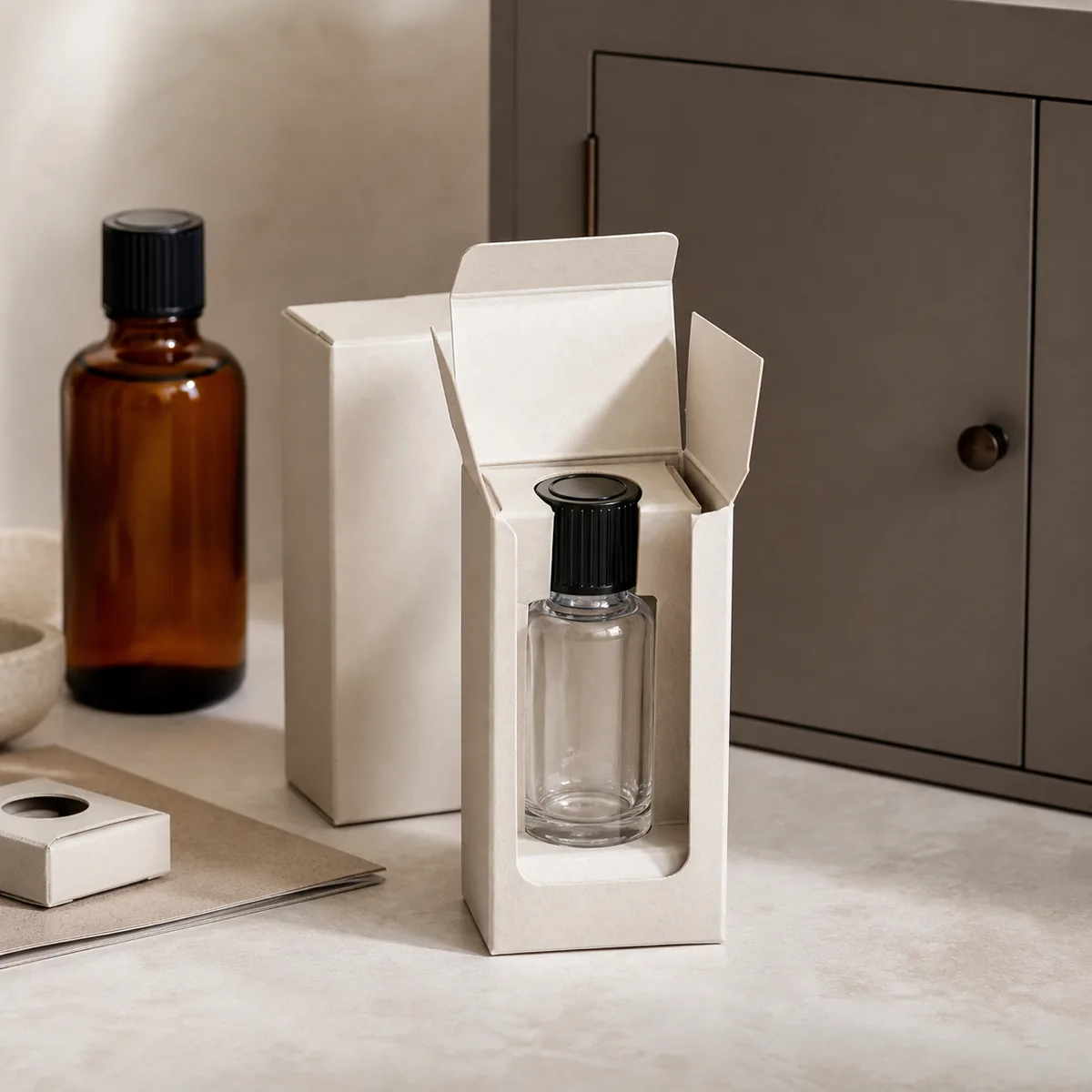
Storage guidance is another protection layer. “Keep away from direct sunlight” may be useful, but instructions are not a substitute for adequate packaging performance under reasonably foreseeable conditions. A brand should consider whether users will realistically follow the instruction and what happens during distribution before the label is read.
The clear, amber, and colored glass comparison provides broader color-selection context. The important distinction is that glass color, surface decoration, secondary packaging, and storage instructions provide different forms of risk control and should not be treated as interchangeable.
Are blue or green bottles equivalent to amber glass?
No equivalence should be assumed from color names alone. Blue, green, and amber bottles can have different optical transmission characteristics depending on glass composition, coloring agents, wall distribution, and any additional surface treatment.
When comparing colored glass options, request relevant transmission data for the selected bottles if a specific light-protection requirement exists. A product photograph or visual comparison under ordinary lighting cannot establish equivalent protection.
A practical test plan for the clear-glass decision
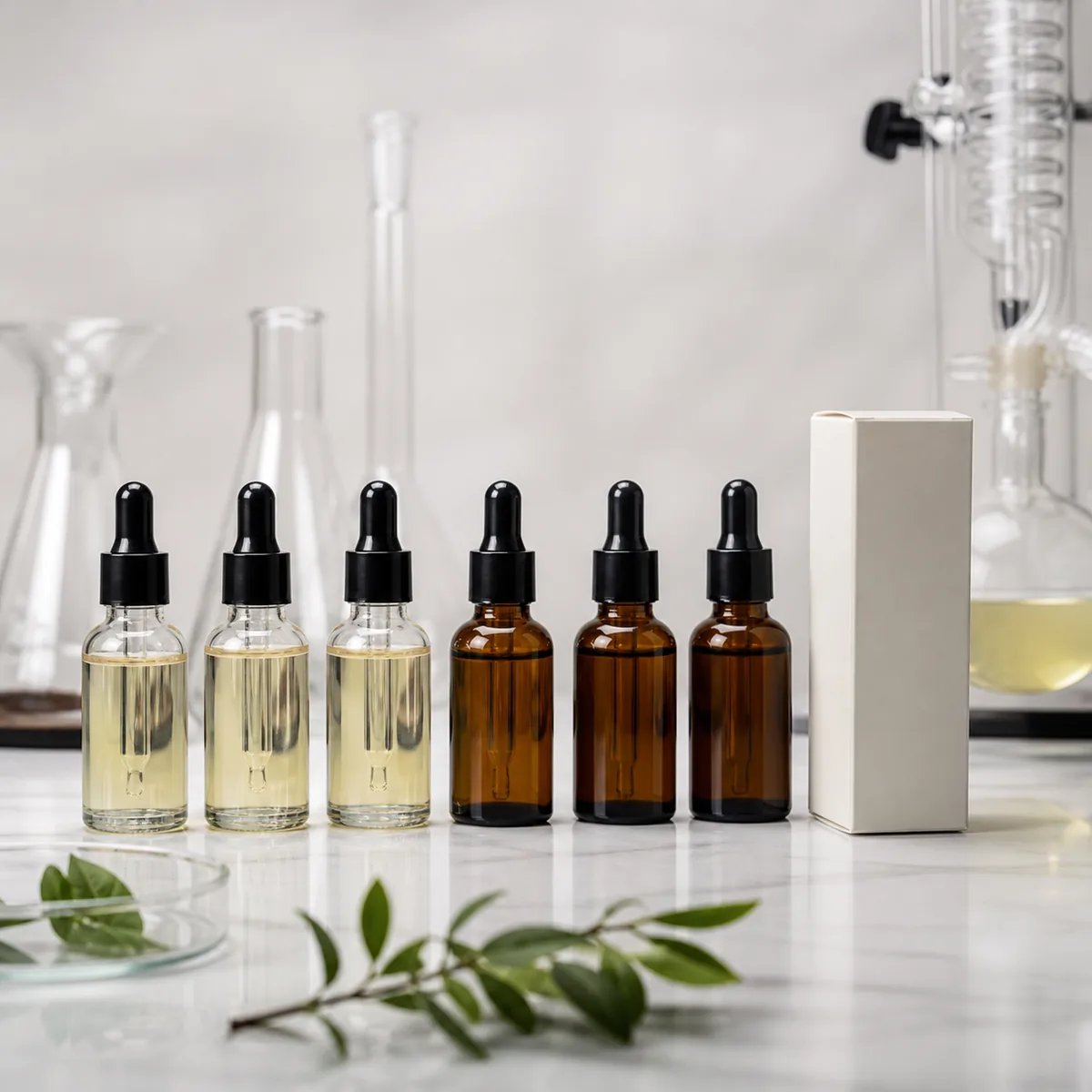
Start with the final or production-representative formula, not an empty bottle or a different oil assumed to behave similarly. Use the intended bottle, closure, gasket or liner, dropper or reducer, decoration, and carton. Include the intended fill volume and headspace.
Development components may be useful for screening, but final approval should cover the commercial configuration. The formula owner should define the applicable stability requirements, while the packaging supplier should confirm the identity and suitability of the selected physical components.
Create relevant comparison groups. Depending on the project, these may include clear glass with and without the carton, the selected amber alternative, and a protected control. Define exposure and storage conditions with the responsible formulator or testing partner.
Agree on observations before the test starts. They may include appearance, odor profile, color, clarity, sediment, viscosity, assay or marker data where applicable, closure function, leakage, evaporation or mass change, and dispensing behavior.
The exact methods and acceptance limits belong to the formula owner and qualified testing laboratory. FOLOVER can support packaging selection and sample coordination, but a general bottle specification cannot establish finished-formula stability.
For a practical illustration of why the test must be formula-specific, the study by Turek and Stintzing on essential-oil alteration during storage evaluated several analytical methods and quality parameters using essential oils exposed to defined storage conditions. The study concerned the tested oils and experimental conditions; it should not be interpreted as a qualification report for FOLOVER bottles or as a universal commercial stability protocol.
Sample evaluation sequence
- Freeze the commercial package configurations to be compared.
- Document the realistic light and storage exposure map.
- Fill samples with the exact formula and intended headspace.
- Define protected controls, checkpoints, methods, and acceptance criteria.
- Evaluate both formula condition and package function.
- Record the decision and the conditions under which it remains valid.
What should a buyer send to the packaging supplier?
For a clear-glass essential-oil project, send the selected bottle specification or reference sample, target fill volume, intended formula category, preferred dispensing component, decoration requirements, carton plan, and destination market.
If the formula owner has identified particular light-sensitivity or stability requirements, share those requirements with the packaging supplier. This allows the supplier to identify the correct bottle and component configuration for evaluation without making unsupported assumptions about formula compatibility.
Final bottle and closure compatibility should be confirmed using the selected components and physical samples before bulk production. Packaging compatibility should also be evaluated with the actual formulation under intended storage and use conditions.
How to interpret a passing result
A passing result does not mean clear glass is suitable for every essential oil or every sales channel. It means the tested configuration met defined criteria under defined conditions.
If the formula changes, the antioxidant system changes, the carton is removed, the bottle geometry changes, or distribution expands to a more demanding channel, the evidence may need review.
Likewise, a failing clear-glass sample does not prove that amber glass alone solves the problem. The root cause may involve temperature, oxygen exposure, headspace, closure leakage, or an interaction with a dispensing component. The next trial should isolate plausible causes rather than simply darken the glass and declare success.
Testing limitation: A light-transmission report describes the tested packaging material or configuration under the stated measurement conditions. A finished-product stability test evaluates the behavior of the named formulation and packaging system. These are different forms of evidence, and neither should automatically be substituted for the other.
Common decision errors
- Copying a competitor: Similar appearance does not reveal formula, coating, carton use, shelf life, or test history.
- Approving from an empty-bottle sample: An empty package can confirm aesthetics and fit, not formula stability.
- Treating all essential oils alike: Botanical source, composition, blend, dilution, and oxidation history can differ.
- Calling any dark color “UV protection”: A visual color is not a verified transmission specification.
- Ignoring opened use: Repeated opening, headspace, and storage outside the carton can change the risk.
- Overstating the carton: It protects only while the bottle is actually inside and the construction remains closed.
For projects using reducers rather than pipettes, the Euro dropper bottle guide explains how the dispensing system works. For broader bottle, pipette, bulb, and compatibility choices, see the glass dropper bottle buying guide.
These component choices matter because package stability and dispensing performance depend on more than glass color. An apparently suitable bottle can still produce an unsuccessful finished package if the closure, seal, reducer, or dropper is incompatible with the actual formulation.
Buyer conclusion
Write a decision record that survives a packaging change
A useful clear-glass approval record should name the formula version, fill, bottle item and color, closure system, decoration, carton, sample batch, exposure design, checkpoints, acceptance criteria, result, approver, and limitations.
It should also state which commercial channel and shelf-life objective the evidence supports. This turns a one-time discussion into a traceable decision that sourcing, quality, and marketing can interpret consistently.
Change control matters because small commercial changes can invalidate the original reasoning. Removing the carton for a gift set, adding an unprotected display window, moving from direct-to-consumer shipping to illuminated retail display, changing the oil blend, or substituting a visually similar closure can alter exposure or package behavior.
The approval record should identify which changes require review rather than assuming that the original result applies to every future packaging variation.
Marketing language should remain narrower than the evidence. If the package passed the brand’s program, state that the selected system was evaluated for the named product and intended conditions. Do not convert the result into an unsupported universal claim such as “clear glass protects essential oils” or “UV-safe packaging.”
Readers exploring short technical answers can browse the Packaging Q&A category, while use-case decisions sit within Packaging Applications. For a wider view of FOLOVER bottle, jar, pump, sprayer, dropper, and closure options, use the packaging products hub.
Finally, retain rejected options and the reasons for rejection. For example, if a controlled comparison finds that clear glass without a carton fails the agreed color criterion while the same bottle with a defined carton passes, the approval record should identify that difference and the conditions under which it was observed.
Such a result would support a decision about the tested packaging system, not a general claim that every clear glass bottle becomes suitable when placed in a carton.
Final Recommendation: Essential oils can be stored in clear glass when the complete commercial system has evidence appropriate to the formula and expected exposure. If light sensitivity is uncertain or the product will be displayed without secondary protection, amber glass or another suitable light-control option may be a more appropriate starting point for evaluation.
The final purchasing decision should be tied to a named formula, selected bottle and closure, defined commercial channel, secondary protection, shelf-life objective, and documented test results.
When requesting samples, share the formula category, intended fill, closure or dropper preference, decoration, carton plan, channel, and expected storage conditions. FOLOVER PACK can help narrow suitable packaging configurations for evaluation without turning a general packaging option into an unsupported performance guarantee.
Discuss Your Essential Oil Packaging Requirements
Frequently asked questions
Is amber glass always better for essential oils?
Amber glass is often a useful light-risk control, but “better” depends on the exact formula, required appearance, exposure, closure system, carton, and validated performance. It does not replace testing of the finished package.
Does clear glass damage essential oils?
Clear glass does not automatically damage an oil. It allows more visible light to reach the contents than an opaque package, and some formulas may change under relevant exposure. The product-specific response must be evaluated.
Does a carton make clear glass acceptable?
A carton may reduce exposure while the bottle remains inside it. Acceptance still depends on the carton construction, consumer behavior, display conditions, formula sensitivity, and results of the chosen validation plan.
Are blue or green bottles equivalent to amber bottles?
No equivalence should be assumed from color names. Different glasses and coatings can have different transmission characteristics. Compare measured data or finished-product performance for the exact options.