
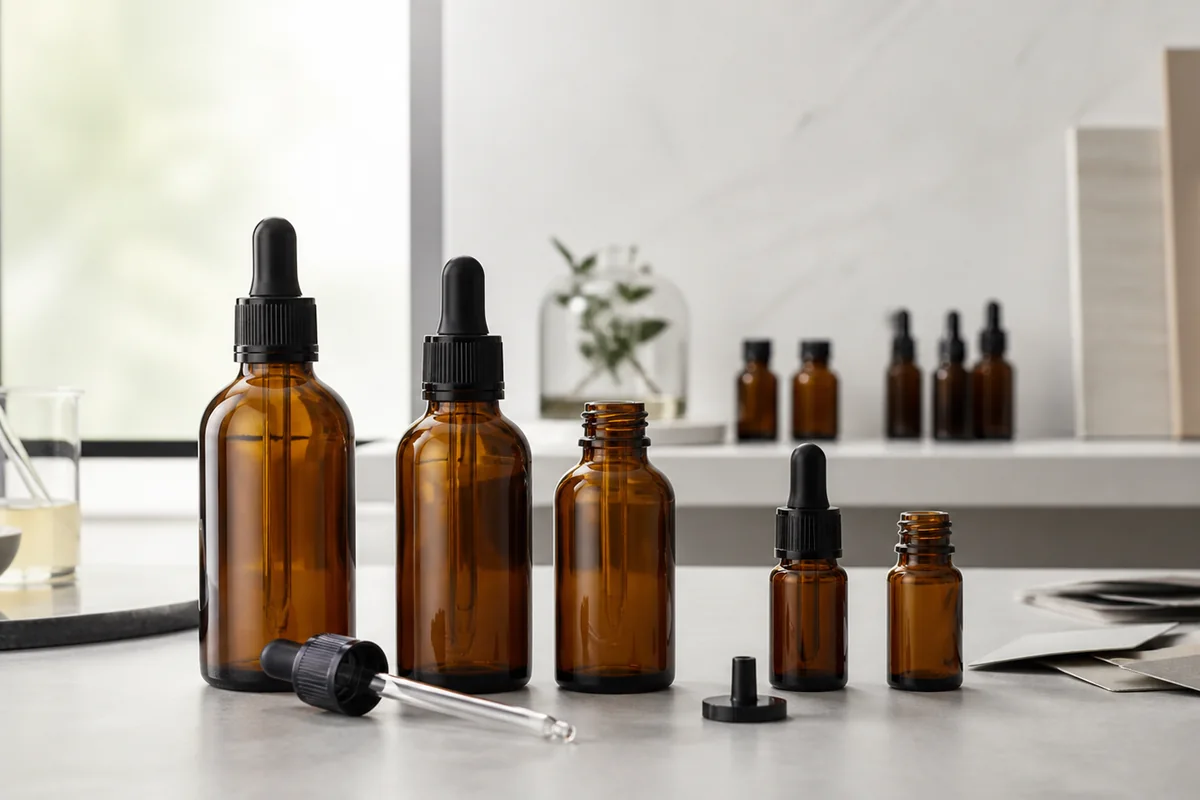
Essential Oil Packaging decisions affect dispensing, protection, production consistency and the way buyers and consumers judge the finished product. The correct package cannot be selected from appearance or a component catalog alone. It must be evaluated as a system in which the formula, container, closure or dispenser, decoration, filling process, distribution conditions and user behavior interact.
This guide gives B2B packaging buyers a practical framework for defining requirements, comparing samples and approving the final assembly. It complements FOLOVER’s Packaging Applications resources and Buying Guides content while keeping the decision focused on the exact formula and project conditions.
The Core Buyer View: Amber color and an essential-oil label are not compatibility evidence
Essential oil packaging should be selected by matching the actual formulation with the glass bottle, dispensing insert, cap, seal and intended storage conditions. Amber glass may reduce transmission of certain wavelengths, but bottle color does not establish chemical compatibility, sealing performance or dispensing accuracy.
For B2B buyers, the correct approval sequence is to define the formula and dispensing requirements, select matched components, test the filled assembly and document the approved configuration before bulk production.
FOLOVER Manufacturer Insight
FOLOVER PACK supplies essential oil glass bottles and coordinates compatible dispensing components, caps, decoration, samples and packaging development. For an essential oil packaging project, the key purchasing decision is not simply whether a bottle is amber or whether a reducer fits into its opening. It is whether the selected components function together with the intended formula.
A stock bottle can provide a practical starting point, but its existing neck finish does not establish compatibility with every Euro dropper insert or cap. Reducer retention, sealing geometry, formula-contact materials and dispensing performance must be considered together.
One avoidable sourcing mistake is approving a glass bottle, reducer and cap as separate catalog items without confirming the complete assembly. Components that appear compatible may behave differently after filling, insertion, cap application, storage and repeated dispensing.
FOLOVER recommends confirming the bottle code, neck specification, reducer and cap construction, actual formula, filling process and intended use before approving physical samples. Product-specific compatibility, sealing performance and dispensing results must be established for the selected configuration rather than assumed from another bottle or formula.
Separate light protection from material compatibility
Essential oils and blends vary in chemical composition, volatility and sensitivity to storage conditions. Packaging requirements should therefore be based on the intended formulation rather than the general product description “essential oil.”
Light exposure can affect some formulations, while certain formula constituents may interact with polymer inserts, cap liners, gaskets or other contact materials. Glass color and material compatibility must be evaluated as separate requirements.
For example, selecting amber glass may address a formulation’s light-protection requirements, but it does not establish whether the selected reducer or closure materials remain suitable during prolonged formula contact.
Buyer action: Ask the formulator to identify relevant light sensitivity, material-contact risks, intended shelf life and storage conditions. Use this information to define separate light-exposure and filled-package compatibility evaluations.
When comparing possible dispensing systems, the Euro dropper bottles category provides a related selection route for the complete bottle and dispensing configuration.
Choose glass color for a documented purpose
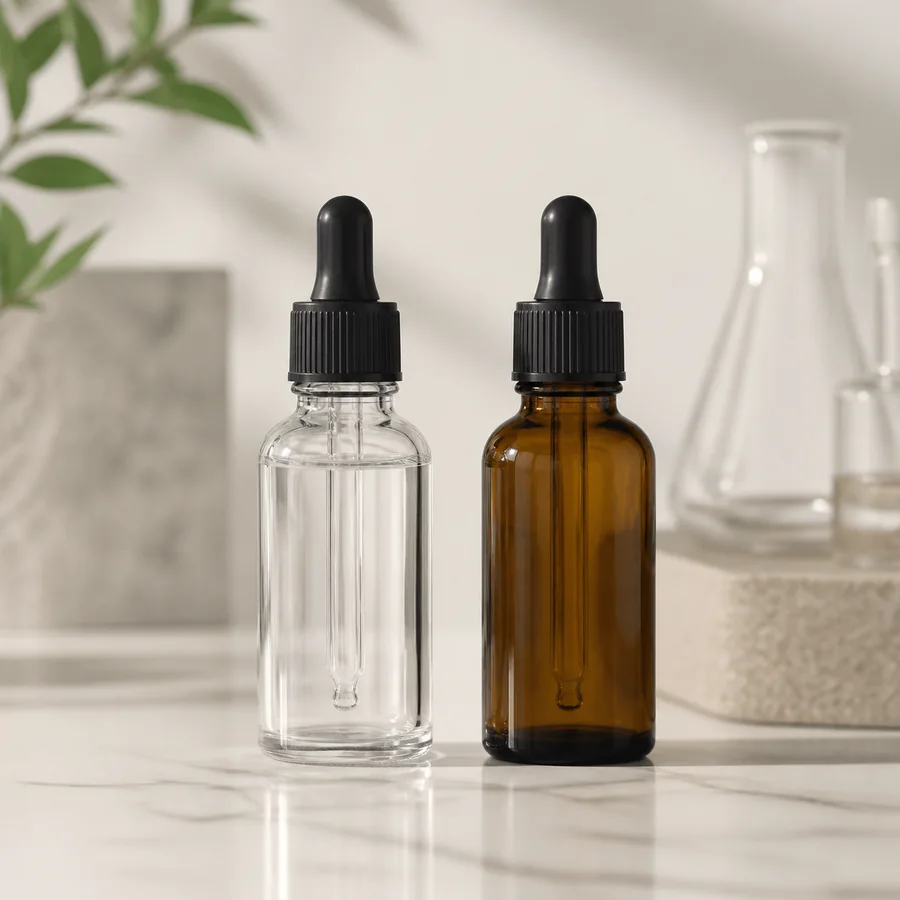
Amber, clear and other colored glass offer different visual appearances and light-transmission characteristics. Amber glass may reduce transmission across certain wavelengths, but the required protection depends on the actual formulation, glass properties, storage conditions and exposure period.
Clear glass may support product visibility and brand presentation when the formulation’s light-protection requirements can be met. Colored glass, secondary cartons and controlled storage may also form part of the overall protection strategy.
A color name alone cannot establish a specific UV-blocking percentage or a guaranteed shelf-life extension. If light protection is critical, request relevant transmission information for the selected glass and evaluate the filled product under appropriate exposure conditions.
Buyer decision: Choose amber glass when documented formula requirements justify additional light management. Consider clear glass when the required protection can be achieved through the selected packaging and storage configuration, subject to formula-specific validation.
The cosmetic dropper selection guide provides additional dispensing considerations when glass color and applicator selection are being developed together.
Understand the Euro dropper system
A Euro dropper system commonly combines a glass bottle, an orifice-reducer insert and a matching cap. The reducer controls liquid delivery through its dispensing opening, while the complete bottle, insert and cap assembly provides the required containment and closure functions.
The reducer must be selected for the actual bottle neck and intended liquid. Insert retention, orifice geometry, material, cap structure and sealing contact all influence the finished package.
A Euro dropper insert is not universally compatible with bottles of similar capacity or appearance. Two bottles may have different neck dimensions or internal geometries even when their nominal fill volumes are identical.
Likewise, a reducer that can be pressed into a bottle by hand is not automatically suitable for the intended filling line or long-term use. Its final seating, retention and interaction with the cap require confirmation.
When requesting samples, specify the complete matched configuration rather than ordering the bottle and reducer independently without verified component information.
Buyers can compare available Euro dropper bottles and review the Euro Dropper Bottle Packaging Guide for product selection, orifice-reducer construction and closure considerations.
Control drops without promising a universal dose
Drop size and delivery rate can vary with formula viscosity, surface tension, temperature, bottle angle, reducer geometry and dispensing technique.
Consequently, a supplier’s nominal orifice specification cannot establish an exact drops-per-milliliter value for every essential oil blend.
A formula that flows consistently through one reducer may dispense differently through another. A reducer that works with a low-viscosity liquid may not deliver the desired user experience with a more viscous blend.
If the brand intends to communicate an exact dispensing quantity, the value should be established through a defined test using the actual formulation and selected components.
Buyer action: Request side-by-side dispensing samples and evaluate flow, drop formation, start and stop behavior, residual liquid and consumer handling. Record the tested formula, bottle orientation, temperature, reducer specification and measurement method.
FOLOVER’s essential oil bottles category provides a starting point for container selection, but final dispensing performance must be confirmed using the chosen bottle-and-closure assembly.
Engineer caps, seals and torque together
The cap, reducer and bottle neck form an integrated sealing system. Sealing performance depends on component fit, closure construction, sealing surfaces, contact materials and the selected assembly process.
A tighter cap is not automatically a safer cap. Excessive application force may affect the reducer, closure or consumer opening experience, while insufficient engagement may compromise the intended seal.
Cap designs with separate liners, integral plugs or other sealing structures can behave differently. The appropriate configuration depends on the actual components and intended use.
For a complete essential oil bottle assembly, buyers should confirm the neck finish, reducer retention, cap engagement and sealing geometry using current component specifications and physical samples.
Do not apply a torque value from another bottle-and-cap system without confirming its relevance to the selected configuration.
Buyer action: Agree on an appropriate assembly method and project-specific acceptance criteria with the component supplier and filling team. Evaluate the finished closure after filling, storage, transport and representative opening and closing.
The cosmetic bottle droppers category provides additional component options when comparing dispensing and closure configurations.
Consider volatile formula behavior
Volatile constituents may contribute to product loss or changes in odor and composition when containment is inadequate. A package can experience evaporation-related loss without showing visible liquid leakage.
For this reason, an upright bottle that appears dry around the cap cannot be considered fully validated for long-term storage.
The evaluation should consider intended fill level, headspace, formula composition, seal construction, storage temperature, orientation and the distribution environment.
Where relevant, the brand’s quality team can compare initial and subsequent package mass, product appearance, odor, fill level and closure condition under documented storage conditions.
Any observed mass change must be interpreted against the test configuration and relevant controls. It should not automatically be attributed to a single component without further investigation.
Buyer decision: If the selected bottle and closure cannot meet the formulation’s containment requirements, review the sealing structure and matched components before committing to the commercial package.
The glass dropper bottle buying guide provides additional context for evaluating alternative bottle and dispenser combinations.

Compare Euro droppers with pipette droppers honestly
Euro droppers and bulb-and-pipette droppers provide different dispensing experiences and require different component evaluations.
A Euro dropper can support controlled drop delivery directly from the bottle through an orifice-reducer insert. A bulb-and-pipette system allows the user to draw liquid into a pipette and dispense it through a separate applicator.
The decision should follow the product’s intended application, formula properties, dose requirements, contamination considerations and consumer-use expectations.
| Dispensing Option | Best For | Main Advantage | Main Limitation | What Buyers Should Verify |
|---|---|---|---|---|
| Euro dropper system | Essential oil products requiring drop-by-drop delivery directly from the bottle. | Integrated reducer and cap arrangement without a separate pipette. | Drop delivery varies with formula properties, reducer geometry and dispensing conditions. | Bottle neck, insert retention, formula-contact materials, cap seal and actual drop performance. |
| Bulb-and-pipette dropper | Products requiring liquid to be drawn into a pipette before application. | Allows the user to draw and dispense liquid through a separate applicator. | Requires evaluation of the bulb, pipette, closure, formula compatibility and repeated-use handling. | Pipette length, bulb and pipette materials, closure sealing, dosage and actual formulation compatibility. |
Neither option should be described as compatible with every essential oil formulation. For certain applications, the polymer or elastomer materials in a pipette dropper may require particular attention during compatibility testing.
When comparing systems, the article explaining what a Euro dropper bottle is provides further structural information.
Buyer action: Evaluate the actual formula through both dispensing systems where appropriate, then select the configuration that meets the intended delivery, containment and user-experience requirements.
Plan filling and insert assembly
The filling and assembly process can affect the performance of an otherwise suitable bottle-and-closure combination.
For a Euro dropper system, the filling sequence generally involves preparing and filling the bottle, installing the selected reducer and applying the matching cap according to the approved process.
The reducer must be seated correctly. An insert that is tilted, incompletely installed or damaged during assembly may affect dispensing or sealing performance.
Buyers should review the actual filling equipment, bottle neck cleanliness, insertion method, seating requirements, cap application and inspection procedure with the responsible production team.
A manually assembled sample may be useful during initial evaluation, but it does not establish that the same result will be obtained consistently on the intended production line.
Buyer action: Confirm that the selected bottle, reducer and cap can be assembled using the intended filling process. Establish an approved sample and inspection criteria for reducer seating and final closure engagement.
For light-protection decisions that may influence bottle selection, the comparison of clear versus amber glass bottles provides related technical context.
Validate decoration around formula exposure
Essential oil residue can contact the outside of a bottle during filling, dispensing or repeated consumer handling. Labels, coatings, printing and decorative finishes should therefore be evaluated against realistic exposure conditions.
A decorated empty bottle may look acceptable while providing little evidence about the finish’s performance after contact with the intended formulation.
Potential issues include changes in printed appearance, coating damage, label deterioration or abrasion caused by repeated handling. The actual outcome depends on the formula, decoration materials, application process and exposure conditions.
For a glass essential oil bottle with a coated surface and printed logo, consider whether liquid may run across the decorated area during normal dispensing. Test the final decoration using the intended formulation and an appropriate handling or wiping procedure.
Physical sample approval should establish the required color, logo position, print appearance and acceptable finish condition.
Buyer decision: When formula exposure may affect the intended decoration, revise the finish, artwork placement or dispensing configuration before bulk production rather than relying on the appearance of an unused sample.
For additional packaging-color considerations, see the guide to storing essential oils in clear glass.

Create a complete procurement specification
A purchasing specification should identify more than the bottle’s nominal capacity and glass color. It should define exactly what the buyer intends to order, including the glass bottle code, approved drawing, neck finish, selected reducer, cap, relevant formula-contact materials, filling method, decoration and protective packing arrangement.
Record the intended formulation, target fill volume, dispensing requirements, destination market and required commercial configuration. Where several bottle capacities are involved, identify the matched reducer and closure for each bottle rather than assuming that components are interchangeable.
Different suppliers may use similar component descriptions for products that are not identical. A change in reducer material, orifice geometry, cap liner or bottle neck dimensions may affect the approved assembly.
Buyer action: Attach the selected component specifications and approved physical samples to the purchasing record. Identify which changes require notification and renewed evaluation before the revised components can be used for bulk production.
Buyer Approval Checklist
Before requesting final testing and production approval, confirm that the following project information is available:
- The intended formulation, application, fill volume, destination market and storage requirements have been defined.
- The selected bottle, reducer and cap have been identified by product specification.
- Formula-contact materials and relevant light-protection requirements have been identified.
- The intended filling and reducer-insertion process is known.
- Production-representative components and the actual formulation are available for testing.
- The required decoration, commercial pack-out and acceptance criteria have been agreed.
- The responsible teams have identified which component or process changes require revalidation.
How to Structure the Sample Evaluation
Once the purchasing specification and component shortlist are established, evaluation should progress from initial component screening to filled-package testing and final commercial assembly approval. The following table identifies what needs to be verified before accepting the selected packaging system.
| Evaluation Stage | What to Check | Method or Reference | Buyer Approval Requirement |
|---|---|---|---|
| Component screening | Bottle neck, reducer retention, cap engagement, material identification and initial dispensing. | Supplier drawings, component specifications and physical assembly checks. | Confirm the selected components form a suitable candidate assembly before filled-package testing. |
| Formula-contact compatibility | Relevant changes in polymer inserts, liners, gaskets and other formula-contact materials. | Project-specific exposure testing using the actual formulation. ASTM D543-21 may provide a relevant material-level evaluation framework for selected plastic components. | Confirm that material screening and finished-package testing support the intended application. |
| Light protection | Relevant glass transmission characteristics and product stability under the expected exposure conditions. | Selected glass transmission information and formulation-specific stability evaluation. | Confirm that the bottle and complete packaging system meet the product’s documented light-protection requirements. |
| Sealing and storage | Liquid leakage, package mass change, closure condition and relevant product-quality characteristics. | Filled-package evaluation under project-defined storage and orientation conditions. | Confirm containment and product performance against agreed acceptance criteria. |
| Dispensing | Drop formation, flow, user handling and dispensing consistency. | Representative dispensing trials using the actual formula and selected components. | Approve the intended dispensing behavior without assuming a universal drops-per-milliliter value. |
| Filling and assembly | Filling accuracy, reducer seating, closure application and line handling. | Representative production trial or appropriate equipment review. | Confirm the final assembly can be produced consistently under the intended process. |
| Decoration and transport | Formula exposure, finish appearance, bottle protection and the integrity of the assembled package. | Physical decoration evaluation and transport testing selected for the actual distribution route. | Approve the final decorated and packed configuration before bulk production. |
Which external testing standards are relevant?
ASTM D543-21, Standard Practices for Evaluating the Resistance of Plastics to Chemical Reagents, provides methods for investigating the response of plastic materials to chemical exposure. Its practices can support screening of relevant polymer components when appropriate test conditions and reagents are selected.
However, a material specimen’s result does not establish compatibility of the complete essential oil bottle, reducer and cap assembly. Finished-package testing with the actual formulation remains necessary.
For distribution testing, the International Safe Transit Association (ISTA) test procedures provide established approaches for evaluating packaged products under selected transport conditions. The applicable procedure should be determined by the actual shipment configuration and distribution route.
These standards provide testing frameworks. They do not establish that any particular FOLOVER packaging configuration has passed a test or is compatible with every essential oil formulation.
There is no universal exposure duration, test temperature, leakage threshold or dispensing tolerance that establishes suitability for every essential oil packaging project. The responsible technical and quality teams should define the conditions and acceptance criteria for the actual formula and intended use.
Worked Buyer Scenario
The following is an illustrative packaging-development scenario, not a documented FOLOVER customer project or verified compatibility test result.
A skincare brand wants an amber glass bottle with a Euro dropper for a concentrated essential oil blend. The purchasing team initially selects the bottle by color and capacity and requests a reducer and cap from the available component range.
During development, the brand identifies a potential compatibility concern involving the selected reducer material and the actual formulation. The team does not assume that the amber glass bottle or the supplier’s general component description resolves the issue.
Instead, the packaging team requests the reducer’s material specification, confirms the matching bottle and cap configuration, and arranges an appropriate evaluation using the intended formula.
Candidate components are screened, followed by filled-package assessment of sealing, dispensing, component condition and relevant product-quality characteristics. The final decorated bottle and commercial packing configuration are also reviewed.
Buyer decision: Approve the bottle, reducer and cap only when the selected components meet the project’s documented compatibility, dispensing, assembly and storage requirements. Any subsequent change to a formula-contact material or critical component specification should trigger an appropriate review before the revised configuration is used for bulk production.
Frequently Asked Questions
Can packaging be approved from an empty sample?
An empty sample can confirm appearance, basic fit and handling, but it cannot establish formula compatibility, long-term sealing, dispensing or decoration durability. Final approval should use the intended filled assembly under documented conditions.
Is a supplier’s standard component specification enough?
It is a useful starting point, not a substitute for system testing. Performance depends on the exact formula, mating components, filling and assembly process, distribution environment and use pattern.
What should trigger revalidation?
Changes to formula, formula-contact material, critical dimensions, supplier, tooling, decoration system, filling process or assembly settings can affect performance. The project team should define change-control triggers before production.
How should buyers compare two visually similar packages?
Compare controlled drawings, component materials, filled test data, process capability, practical user performance, residual product, logistics and change control. Similar appearance does not establish equivalent function.
Conclusion
Light management, chemical compatibility and dispensing control are separate questions. Amber glass may reduce portions of light transmission, but the essential-oil blend also contacts the insert, cap and seal; reliable approval therefore requires formula-specific evidence for the complete bottle-and-closure system.
For B2B buyers, the practical starting point is to select a suitable glass bottle and matched dispensing components, then confirm their performance using the actual formulation and intended commercial conditions.
FOLOVER PACK can support selection of essential oil glass bottles, coordinated Euro dropper components, caps, decoration and physical samples. Final compatibility and performance must be confirmed for the selected packaging configuration before bulk production.
Planning an essential oil packaging project? Share your formula type, target capacity, preferred glass color, dispensing requirements, destination market, decoration, estimated order quantity and any existing compatibility requirements.
Contact FOLOVER PACK to discuss suitable bottle and closure options, component matching, sample evaluation and the packaging information needed for your RFQ.