
Reducing cosmetic packaging material can lower purchased mass, component complexity and shipping volume, but only when the revised package still protects the formula and works through filling, distribution and use. A lighter bottle that leaks, an undersized cap that becomes difficult to handle or a removed insert that increases damage is not successful reduction. The relevant unit is the complete commercial pack delivered in acceptable condition.
Direct Answer
To reduce material in cosmetic packaging without sacrificing function, measure the current complete pack, identify avoidable mass or volume by component, redesign the largest opportunities, and validate the revised system against the same requirements. Keep formula compatibility, sealing, dispensing, decoration, filling-line handling, transport protection and user experience as non-negotiable gates.
For buyers, the practical approach is to reduce unnecessary decoration, oversized closures and secondary-packaging volume before committing to structural changes that affect glass strength, bottle neck geometry or dispensing performance. Every proposed reduction needs a defined reference package, measurable change and physical approval before bulk production.
FOLOVER Manufacturer Insight
FOLOVER PACK can review cosmetic glass bottles, jars, pumps, droppers, sprayers, caps, decoration, samples and pack-out concepts as a coordinated project. The selected bottle and closure must be confirmed together, and product-specific weight, performance or environmental claims require current evidence.
A practical inquiry includes the existing package, target fill, formula type, closure, decoration, sales channel, destination market, annual volume and required validation. That information allows the team to distinguish a genuine material opportunity from a change that merely transfers risk to another component.
One important sourcing decision is whether the proposed reduction can be achieved using an existing bottle and closure platform or requires structural development. Reducing a decorative cap’s height may be possible without changing the bottle mold, provided the revised cap maintains fit, handling and appearance. Reducing glass at the base, shoulder or neck may require a new drawing, tooling review or mold modification, followed by fresh sample approval.
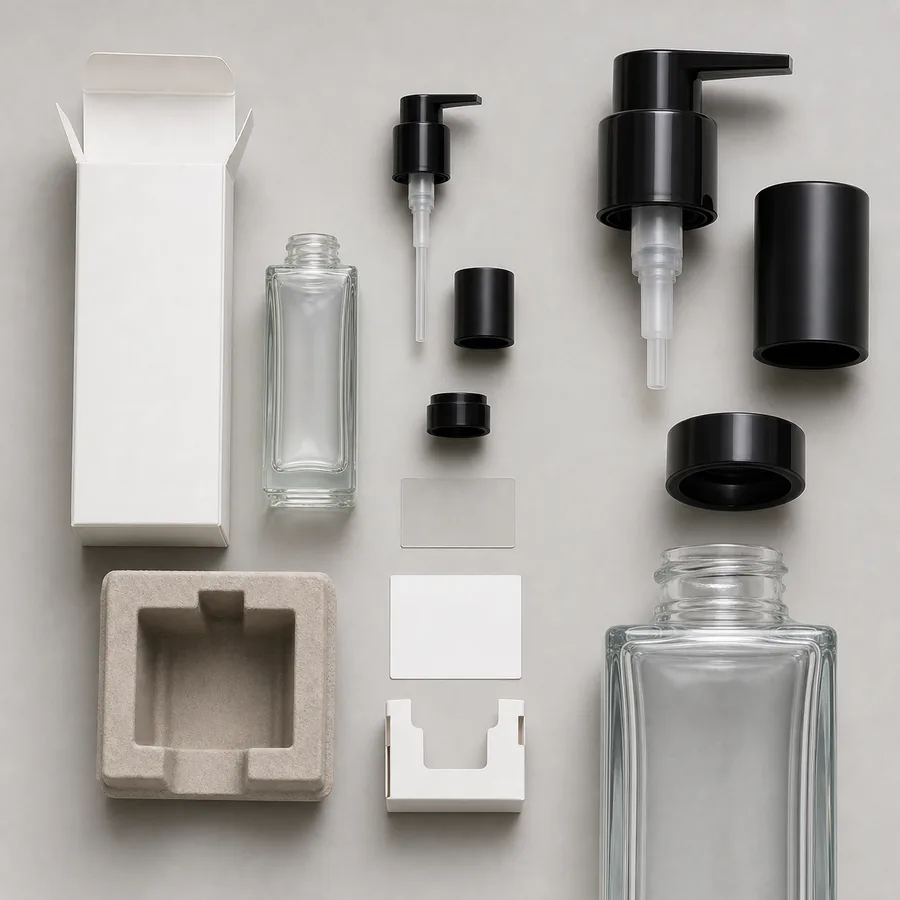
For an existing glass bottle, FOLOVER recommends reviewing the complete assembly before requesting a lighter version. A change to bottle height or shoulder geometry can affect the cap proportion, dip-tube length, carton dimensions and protective insert. Approving each component independently can leave buyers with individually acceptable parts that do not function correctly as an assembled package.
Start with a complete packaging baseline
Record the current bottle or jar, closure, pump or dropper, collar, cap, label, carton, insert and transport divider. Weigh or otherwise document each component using an agreed method, record component count and note pack dimensions. Keep primary, secondary and transport packaging visible rather than comparing bottle weight alone.
The baseline also needs functions. Identify formula containment, barrier needs, dosage, sealing, tamper evidence, information area, shelf presentation, e-commerce protection and distribution route. A component that appears excessive may be performing more than one function.
For a meaningful comparison, record the same measurements for the current and proposed configurations. Separate the empty glass vessel weight from the assembled package weight and keep retail packaging distinct from master-carton and pallet materials.
Calculate the actual reduction before making a sourcing decision. For each component, subtract the approved revised weight from the measured reference weight. Multiply the difference by the planned order quantity to estimate the total material reduction. Recheck the calculation if new protective components are added elsewhere in the package.
This calculation establishes the material difference, not an automatic carbon-footprint reduction. Manufacturing energy, transport, damage and end-of-life conditions require separate evidence.
Use the wider sustainable packaging hub to keep reduction connected to evidence and system trade-offs.
Prioritize reductions by impact and risk
A long list of tiny changes can consume development resources without materially changing the pack. Rank opportunities by material mass, annual volume, transport volume, component count, commercial feasibility and functional risk. High-volume standard components may create more repeatable value than an isolated decorative change.
Use a two-axis review: potential reduction versus validation difficulty. A smaller carton around an unchanged bottle may be relatively direct. Redesigning a glass base, pump engine or sealing interface can require more tooling and testing. The ranking does not prohibit difficult work; it makes the decision transparent.
Removing one unnecessary decorative collar can reduce material, sourcing steps and assembly complexity simultaneously. However, deleting a gasket or replacing a proven pump component may create unacceptable leakage or dispensing risks.
Buyer decision: Start with components whose material contribution is measurable and whose removal does not alter the primary packaging’s functional interfaces. Treat changes to glass geometry, sealing or dispensing as separate development projects with their own approval requirements.
Reduce excess glass through controlled geometry
Glass weight is distributed across the base, walls, shoulder, corners and neck. It cannot be reduced safely by applying one thickness instruction everywhere. Forming stability, dimensions, capacity, top-load and impact behavior depend on the exact geometry and production process.
A thick-base bottle may appear to offer a straightforward lightweighting opportunity, but reducing its base thickness can alter the visual depth, center of gravity and glass distribution. Changes to the shoulder or sidewalls may influence forming consistency and handling. Changes near the neck can affect the closure interface and sealing performance.
For that reason, reducing glass weight should begin with a review of the existing bottle drawing and manufacturing constraints rather than an arbitrary wall-thickness target.
Compare the proposed bottle with a defined current bottle, then review drawings and physical samples. Confirm capacity, neck interface, closure fit, appearance, filling-line handling and transport performance. The detailed guide to lightweight cosmetic glass bottles explains why redistribution and validation matter more than uniform thinning.
Before approving a lighter bottle, compare the current and proposed configurations under equivalent conditions:
- Measured bottle weight, nominal capacity and relevant dimensions.
- Neck finish, sealing geometry and compatibility with the selected closure.
- Visual appearance, base stability and handling during filling and use.
- Resistance to the mechanical stresses relevant to the intended distribution route.
- Compatibility with the existing carton, insert and shipping configuration.
Do not publish a reduction percentage until final production-representative weights and the comparison basis are controlled. A lighter glass vessel must not be described as having a lower overall environmental impact without evidence for the complete system.
Right-size caps, collars and dispensing components
Oversized caps and decorative collars may contribute substantial mass and outside dimensions. Review whether their diameter, height, wall structure or layered construction performs a necessary function. A visually smaller closure can still deliver premium proportion when bottle geometry and finish are coordinated.
For example, replacing a double-wall decorative cap with a simpler construction may reduce unnecessary material while preserving the internal fitment and required appearance. The change should be evaluated using actual samples rather than assuming that a smaller external dimension guarantees the same assembly performance.
Pumps and droppers are technical assemblies. Reducing housing material or removing internal parts cannot be inferred from appearance. Neck finish, gasket, dip tube or pipette, formula, dosage and leakage performance must be tested with the exact bottle.
Where closure lightweighting can fail
A smaller cap may no longer provide adequate grip or cover the dispensing head correctly. Replacing a double-wall cap can change the fitment structure or the appearance of the assembled bottle. Changing a pump or shortening its dip tube may affect sealing, priming, dispensing or product evacuation.
When changing a closure, confirm the complete bottle-and-closure assembly using the selected components and actual formulation before bulk-production approval. An unchanged nominal neck size alone does not establish compatibility.
For current product directions, buyers can review cosmetic and skincare glass packaging while keeping final component compatibility subject to samples and specifications.

Simplify multi-layer decorative constructions
A cap may combine an inner shell, outer shell, weight insert, collar and decorative surface. A bottle may use coating, printing, label and secondary embellishment together. Each layer should have a clear brand or functional role.
Ask whether the same visual hierarchy can be achieved through glass color, one controlled coating, direct printing or a simpler cap construction. Removing decoration solely for a generic sustainability story is not the objective; remove layers that contribute little to recognition or use.
For a bottle currently using full-surface coating, a separate label and an additional decorative collar, buyers can compare whether localized screen printing or a simplified decoration system satisfies the approved brand design. The resulting material reduction must be measured against the existing construction.
Decoration changes require physical approval. Color, adhesion, abrasion and compatibility cannot be guaranteed from a rendering. The buyer should retain the visual standard while reducing redundant materials.
Do not assume that a simpler coating or printing system automatically improves recyclability. The effect of the selected decoration on material recovery depends on its construction and the destination-market recycling process.
Standardize components across a product family
Using one verified pump, neck finish, cap platform or carton footprint across several SKUs can reduce unique tooling, spare components and obsolete inventory. Standardization can also improve purchasing leverage and simplify quality checks.
It works only when formulas, doses, bottle heights and brand architecture allow. A component should not be forced across incompatible products. The article on building a consistent multi-SKU packaging system provides the brand-architecture boundary.
For instance, two serum bottle sizes may share a pump platform while requiring different dip-tube lengths. Standardizing the visible pump does not mean every internal component can be identical. Buyers must confirm the actual bottle height, dispensing requirements and final assembly for each SKU.
Track both material and operational results. A common platform may not reduce every component’s grams, yet it can lower changeovers and leftover stock. Keep those benefits separate instead of converting them into an unsupported environmental percentage.
Right-size secondary and transport packaging
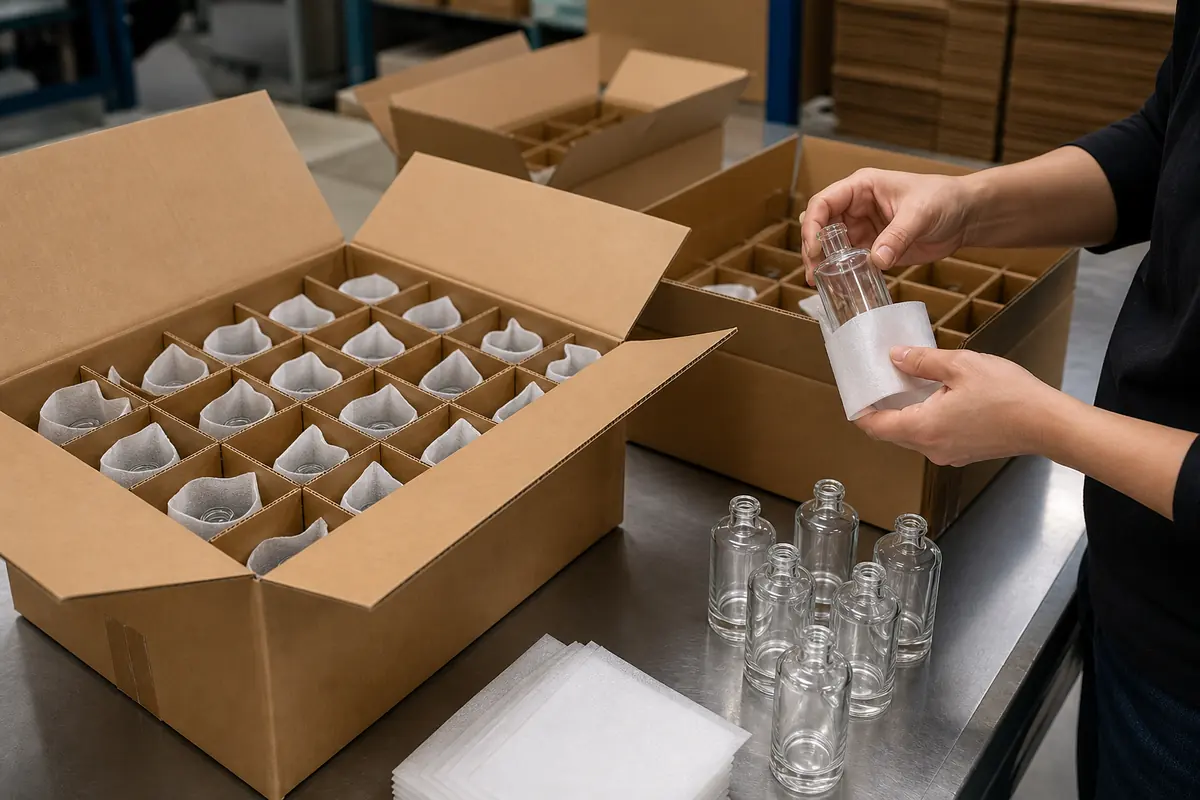
Cartons, inserts, dividers and shipping cases should match the bottle, channel and distribution risk. Reduce empty space before removing protection. Efficient bottle-to-carton fit can lower paperboard and improve case or pallet density, but glass-to-glass contact and movement must remain controlled.
The dedicated guide to secondary cosmetic packaging reduction examines cartons and inserts in detail. At system level, record unit carton dimensions, number of units per shipper, divider design and observed damage during representative tests.
A smaller retail carton may still require a separate e-commerce shipper. Compare equivalent delivered systems, not a shelf pack with an incomplete delivery configuration.
For glass packaging, the more useful objective is often to reduce unnecessary void while maintaining sufficient separation between bottles and protecting vulnerable areas such as shoulders, necks, caps and decorated surfaces.
Buyer action: Compare the original and reduced pack-out using production-representative bottles and the intended protective materials. Record carton dimensions, units per case, pallet configuration and the agreed damage-acceptance criteria. Do not approve a carton reduction solely because the revised layout accommodates more bottles.

Protect the formula and dispensing experience
The packaging exists to contain and deliver a cosmetic product. Material reduction must not undermine barrier needs, light protection, closure sealing, dose, priming, evacuation or controlled access. Compatibility must be assessed with the actual formula under intended storage and use conditions.
Begin with the skincare packaging guide when formula and dispensing requirements are not yet fixed. Once the functional brief is stable, reduction options can be evaluated without confusing a packaging change with a formula risk.
Product loss can outweigh the value of a small packaging reduction. Leakage, breakage or incomplete dispensing therefore belongs inside the reduction decision, not in a later quality review.
A redesigned package should be evaluated using the same target formulation, filling conditions and intended use as the original. If the proposal changes the pump, gasket, dip tube, pipette or materials in contact with the formula, compatibility and dispensing performance must be reassessed for the revised configuration.
Design a validation plan before changing the pack
Validation should be defined before approving a reduction target. The test plan must reflect the component being changed, the actual cosmetic formulation, the intended filling process and the expected distribution environment.
There is no single universal glass thickness, drop height, vacuum level or leakage acceptance limit that establishes whether every reduced cosmetic package is suitable. Test conditions and acceptance criteria should be agreed for the selected commercial configuration and its intended use.
| Area | Question | Evidence |
|---|---|---|
| Dimensions | Does the revised component fit all interfaces? | Drawing and sample review. Confirm relevant bottle dimensions, neck geometry, closure engagement and assembly fit. |
| Compatibility | Are contact materials suitable for the formula? | Filled compatibility testing with the actual formulation under intended storage and use conditions. |
| Closure | Are sealing and dispensing maintained? | Assembly and functional checks, including leakage evaluation and dispensing performance under agreed test conditions. |
| Decoration | Does the approved appearance remain stable? | Physical decorated samples evaluated for color, appearance, adhesion and handling durability as relevant to the selected finish. |
| Filling | Can production equipment handle the revised package? | Filling-line trial or appropriate equipment review, including container handling, filling accuracy and closure application. |
| Transport | Does the reduced pack protect the product? | Route-relevant pack-out testing and inspection for breakage, leakage, deformation and decoration damage. |
| User experience | Can users open, dose and close the package correctly? | Representative-use evaluation of handling, opening, dispensing, product evacuation and closure operation. |
For parcel distribution, the International Safe Transit Association’s test procedures provide recognized approaches to evaluating packaged products against transport hazards. ISTA Procedure 3A addresses individual packaged products of 70 kg or less moving through parcel delivery systems. Other distribution routes require an appropriate procedure selected for the actual shipment conditions.
For broader shipping-container evaluation, ASTM D4169 provides a framework for laboratory performance testing of shipping containers and systems against distribution hazards.
These references are testing frameworks, not evidence that a particular FOLOVER bottle or revised carton has passed a test. The applicable procedure, specimen configuration, test conditions and acceptance criteria must be selected and documented for the project.
For sealing evaluation, a vacuum or negative-pressure test may be considered where appropriate to the package and agreed test method. However, applying a generic vacuum level to every bottle, pump, dropper or cream jar can produce misleading results. The test should reflect the actual closure structure, filling conditions and intended handling risks.
Before bulk production, approve the final bottle, closure, decoration and protective packing together. If the revision affects an interface or component previously approved, determine which compatibility, sealing, filling or transport tests must be repeated.
Make reduction claims with a defined comparison
The US FTC Green Guides advise qualifying source-reduction claims with the amount and comparison basis. “Uses less packaging” is incomplete if readers do not know whether the reference is the previous bottle, the previous complete pack or another product.
State the component, metric, baseline and effective version. For example, a verified claim might identify a reduction in bottle weight compared with the brand’s previous bottle of the same nominal fill, while avoiding conclusions about total lifecycle impact.
A transparent material-reduction percentage can be calculated as follows: subtract the revised component weight from the original component weight, divide the difference by the original component weight, and multiply by 100. Both weights must refer to the same defined measurement boundary.
If the comparison covers the complete pack, include changes to closures, decoration, cartons, inserts and other packaging components within that defined scope. Do not calculate a complete-pack reduction using only the weight difference between two empty bottles.
European packaging policy also increases attention to packaging minimization. Regulation (EU) 2025/40 began applying on 12 August 2026, while important packaging-minimization and empty-space provisions have later application dates and specific conditions. The European Commission’s August 2026 update on the Packaging and Packaging Waste Regulation explains the phased introduction of these measures.
A regulatory objective is not proof that a particular package is optimized or compliant. Buyers should review the requirements applicable to the exact packaging configuration, destination market and implementation date.
A measured reduction in packaging mass should not automatically be described as an equivalent reduction in carbon footprint, environmental impact or waste generation. Those broader claims require evidence appropriate to the complete system and the actual comparison being made.
Worked Buyer Scenario
Consider an illustrative sourcing scenario, not a documented FOLOVER customer project or measured environmental study. A skincare brand uses a heavy glass bottle, tall double-wall cap, folding carton, plastic insert and oversized shipper. The team records each component and identifies the cap construction, carton void and shipping dimensions as potential reduction opportunities that can be evaluated without immediately redesigning the glass bottle.
The brand first prototypes a right-sized cap and a closer-fitting retail carton while keeping the glass bottle and dispensing system unchanged. It then evaluates whether the existing protective insert can be simplified without allowing bottle movement, contact damage or increased breakage.
The revised cap is assessed for handling, fit and appearance. The complete bottle and closure are checked for assembly and dispensing performance. Production-representative samples of the revised carton and insert are evaluated against the intended distribution requirements.
Buyer decision: Approve the cap and carton changes only if they meet the agreed functional, appearance and transport criteria. Keep bottle lightweighting as a separate development phase if it requires changes to the glass geometry or tooling.
The purchasing team should record the actual material difference for each approved component and maintain the original and revised specifications. It should report only verified reductions, rather than assigning an invented carbon saving or transport-efficiency percentage to the illustrative scenario.
Buyer Checklist
- Define the complete reference pack and identify which packaging levels are included in the comparison.
- Record measured component mass, dimensions and count using a consistent method.
- Identify the functional purpose of the bottle, closure, decoration and protective packaging components.
- Rank reduction opportunities by measurable material savings, commercial feasibility and validation risk.
- Confirm whether the proposed modification uses existing components or requires new tooling or structural development.
- Protect formula compatibility, sealing, dispensing and filling-line requirements.
- Approve revised bottle, closure and decoration samples as a complete assembly.
- Right-size cartons and inserts without compromising protection during the intended distribution route.
- Define appropriate compatibility, leakage, transport and representative-use acceptance criteria before sample approval.
- Control final production specifications and qualify every material-reduction claim with a measured baseline.
Frequently Asked Questions
How can cosmetic brands reduce packaging material?
Measure the complete current pack, target avoidable mass and volume, prototype the most meaningful opportunities and validate the revised system.
Does lightweighting make glass less durable?
Not automatically, but performance cannot be assumed. Geometry, glass distribution, production and pack-out need project-specific validation.
Can a cap be made smaller?
Often it can be reviewed, but fit, handling, sealing, decoration and brand proportion must remain acceptable.
Should secondary cartons be eliminated?
Only when their protection, information, tamper or channel functions are unnecessary or replaced appropriately.
Does standardization reduce material?
It can reduce unique components and obsolete stock, but actual material reduction should be measured separately.
Is a lighter package always more sustainable?
No. Material use is one attribute; product loss, transport, reuse, recyclability and other trade-offs still matter.
Build a reduction roadmap instead of one redesign
Separate immediate, medium-term and structural opportunities. Immediate work may remove obsolete sleeves, reduce carton void or consolidate an insert after testing. Medium-term work may right-size caps, standardize neck finishes or update decoration. Structural work may require bottle redesign, new tooling or a different refill architecture.
For every action, assign an owner, reference configuration, expected measurable change, required samples, validation gates and decision date. This prevents teams from combining unverified concept savings with completed production changes. It also allows procurement to sequence supplier work without interrupting a qualified package.
Recheck the whole pack after each phase. A smaller cap can allow a shorter carton; a lighter bottle may need a revised divider; a standardized pump can change dip-tube requirements. The roadmap should capture these interactions so that one reduction creates a second opportunity rather than an unnoticed failure.
For glass packaging buyers, an existing-stock-bottle project and a custom-mold lightweighting project should have separate development schedules and approval requirements. Confirm tooling feasibility and the final bottle specification before committing to a structural weight-reduction target.
Track production reality after launch
Approved samples show design intent, but production and logistics data show whether the reduction works at scale. Compare actual component weights against the controlled specification, inspect dimensional and visual consistency, and monitor packing efficiency, damage, leakage, returns and product complaints relevant to the change.
Define escalation thresholds through the responsible quality team instead of inventing a universal tolerance. If a reduction increases failure, investigate geometry, component variation, packing method and route before removing more material. Corrective action may refine the design without abandoning the objective.
Keep public claims tied to the current production version. When a supplier, tool, site or pack-out changes, confirm whether the comparison remains valid. Material reduction becomes credible when measurement, validation and change control continue after the launch announcement.
Official Sources Reviewed
The following official resources support the environmental-claim boundaries and transport-testing considerations discussed in this guide. They do not establish product-specific test results, material savings or compliance for any FOLOVER packaging configuration.
Conclusion
Material reduction is successful when a controlled, smaller packaging system delivers the same required function. Measure the complete baseline, prioritize meaningful opportunities, validate each interface and keep claims specific.
For an existing cosmetic glass packaging project, begin with avoidable decorative components, oversized closures and unnecessary carton volume when those changes can preserve the approved bottle and dispensing system. Consider structural glass lightweighting when the potential reduction justifies the required development, tooling review and physical validation.
FOLOVER PACK can support review of coordinated custom packaging solutions, component matching, decoration, physical samples and packaging development. Final reductions and performance must follow the exact approved commercial configuration.
Planning to reduce material in your cosmetic packaging? Share your existing bottle specifications, target capacity, formula type, closure requirements, decoration, current packaging configuration, destination market and estimated order quantity. Contact FOLOVER PACK to discuss practical material-reduction options and sample evaluation for your next packaging project.