
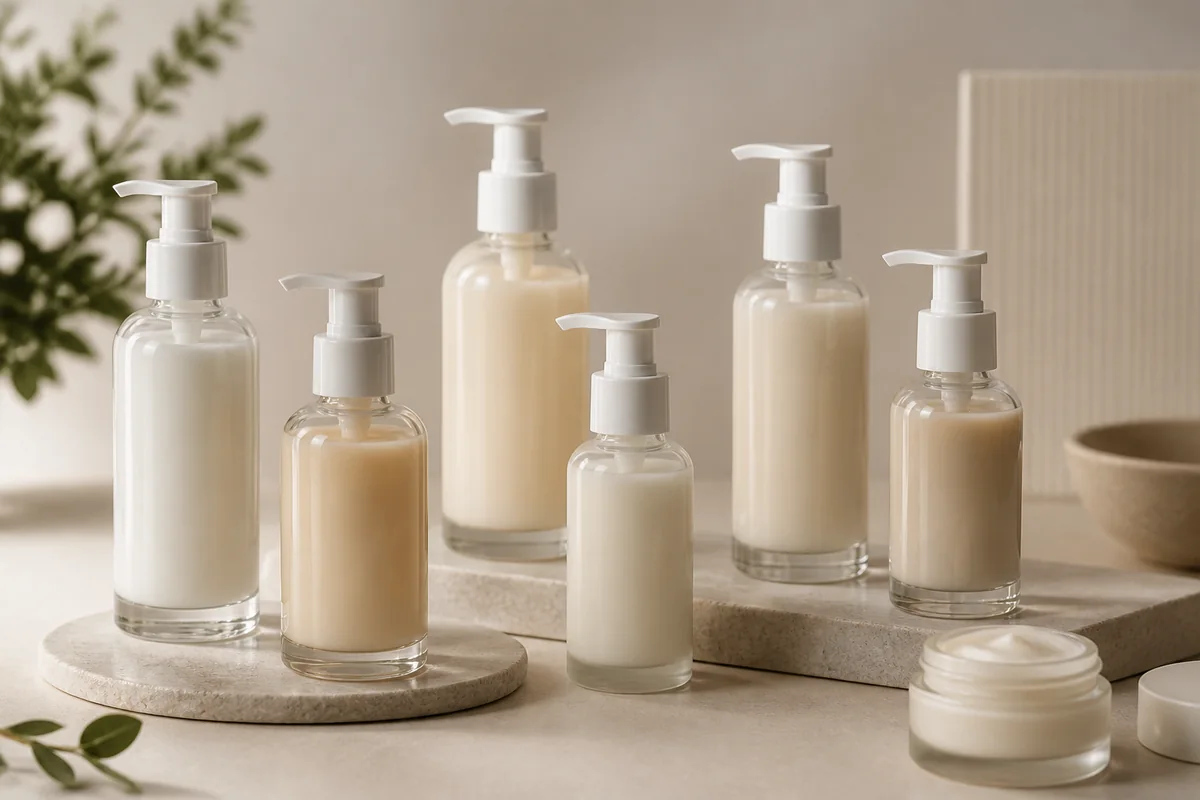
Packaging for lotions and emulsions should be selected as a complete dispensing system rather than as a bottle, pump or formula in isolation. Formula rheology, pump design, dip-tube configuration, bottle geometry, filling conditions, decoration, transport and repeated use can all affect whether the finished pack continues to dispense cleanly and consistently.
This guide gives B2B packaging buyers a practical framework for defining requirements, comparing samples and approving the final assembly. It complements FOLOVER’s Packaging Applications resources and Buying Guides content while keeping the decision focused on the exact formula and project conditions. Product-specific dimensions, pump output, formula-contact materials and performance should be confirmed through current drawings, supplier documentation and physical testing rather than assumed from a similar pack.
The Core Buyer View: Viscosity is not a single pump-selection number
The most reliable selection model is an operating window: the formula, pump engine, dip tube, bottle geometry and user action must continue to work together as temperature, fill level and handling change. A pump that performs well with one liquid or during one room-temperature trial is not automatically suitable for another emulsion or for late-life use.
This changes the sourcing question from “Which pump suits this viscosity?” to “Under which documented conditions does this complete bottle-and-pump system remain acceptable?” That distinction creates clearer RFQs, more meaningful sample comparisons and stronger change control before bulk production.
| Option | Best For | Main Advantage | Main Limitation | What Buyers Should Verify |
|---|---|---|---|---|
| Conventional lotion pump | Projects where the formula can be reliably drawn through a dip tube and dispensed through the selected pump pathway | Familiar bottle-and-pump architecture with broad component choices | Performance can change with formula behavior, tube geometry and fill level | Priming, repeated dispensing, near-empty pickup, sealing and final dip-tube configuration |
| Treatment pump | Applications that need more controlled facial dispensing and where the formula works through the selected pathway | Can support controlled application and a compact presentation | A smaller pathway is not automatically suitable for richer or particle-containing formulas | Formula flow, priming, recovery, user effort and compatibility with the selected bottle |
| Airless dispensing system | Projects where controlled evacuation or reduced repeated air intake addresses a defined formula or user requirement | Uses a different evacuation architecture from a conventional dip-tube pump | Filling, formula compatibility, component complexity and end-of-life considerations differ by system | Filling method, evacuation behavior, formula compatibility, user operation and production feasibility |
Start with application and formula behavior
A body lotion, facial emulsion and treatment lotion may share a broad viscosity description yet require different dose sizes, application patterns and user effort. Define whether the product is spread over a large area, applied in a controlled facial dose or used one-handed. Buyers can use the Lotion Bottles as the related selection route for bottle and dispensing decisions.
Viscosity should not be treated as one fixed number. Cosmetic emulsions can show non-Newtonian behavior, so apparent viscosity changes as shear conditions change. A published study indexed by the U.S. National Library of Medicine evaluated oil-in-water cosmetic emulsions made with six commonly used hydrophilic thickening polymers and reported non-Newtonian, shear-thinning behavior across the tested samples. See The Rheological and Skin Sensory Properties of Cosmetic Emulsions: Influence of Thickening Agents. The finding is specific to the tested formulations, not a universal pump specification, but it illustrates why a single viscosity label cannot by itself approve a dispenser.
A common sourcing failure is choosing a catalog pump from a viscosity description before the application conditions are defined. The practical corrective action is to prepare an application brief covering the actual or representative formula, intended dose, usage pattern, relevant temperature conditions and any particles or suspended materials, then evaluate the selected dispenser with that formula.
Match the pump engine to the delivery window
A pump should prime, recover and dispense repeatedly without unacceptable sputtering, incomplete recovery or excessive user effort. Output claims only become meaningful when the test liquid, pump configuration, bottle and test method are known. Buyers can compare available cosmetic lotion pumps after the formula and application requirements are defined.
The internal pathway, chamber, seals, actuator and recovery between strokes can all influence performance. A successful first few strokes from a full bottle do not establish near-empty performance or repeated-use behavior. The same pump structure may behave differently when formula rheology, bottle geometry or dip-tube configuration changes.
Manufacturer Insight
At FOLOVER, we normally recommend evaluating the bottle, pump and dip tube as one dispensing assembly rather than selecting each part independently. A pump that works with one bottle or test liquid should not automatically be treated as approved for another lotion project. Final bottle and closure compatibility should be confirmed using the selected components and physical samples before bulk production.
Use treatment pumps only where their behavior fits
Treatment pumps can support more controlled facial application and a compact visual presentation, but a smaller fluid pathway is not automatically suitable for every emulsion. Richer formulations, suspended particles or formulas that recover slowly after shear can create a different dispensing requirement. Buyers can review the lotion bottle range while comparing the bottle and dispenser as one system.
A common failure is choosing a treatment pump because it looks more precise or premium before flow performance is confirmed. A treatment-style dispenser can be appropriate when the formula and required dose work reliably through the selected pathway; a lotion pump may be more appropriate when the project requires a different flow path, recovery behavior or application pattern.
Compare candidate pumps with the same production-intent or representative formula and bottle. Record priming behavior, repeated dispensing, recovery between strokes and near-empty performance rather than approving the dispenser from appearance alone.

Treat bottle geometry as a dispensing component
The internal shoulder, base profile and usable depth influence how product moves toward the dip tube. A bottle can meet the required capacity and still leave more residual product than expected when its internal geometry and tube termination are poorly coordinated. Buyers can compare relevant lotion pump options together with the selected bottle rather than as an independent accessory.
A common failure is evaluating only nominal capacity and exterior appearance. Two bottles with similar external dimensions can have different internal shoulder transitions or base profiles, which can change where product accumulates as the fill level falls.
For approval, review drawings and filled physical samples together. Evaluate practical product access and near-empty dispensing with the intended bottle, pump, dip tube and formula rather than estimating performance from bottle capacity alone.
Specify dip-tube length with the actual assembly
Dip tubes that are too short can leave the intake above remaining product, while tubes that are too long can bend against the base, change orientation or restrict intake. Tube length therefore needs to be defined from the actual pump and bottle assembly, not copied from a bottle with a similar capacity or exterior height. The broader packaging for different skincare formulas guide provides additional context for formula-led packaging selection.
The decision can also depend on tube stiffness, curvature, cut geometry, internal bottle depth and base profile. These variables interact, so there is no universal dip-tube length that can be assigned to a lotion bottle category.
Approve the tube configuration through dimensional review and repeated dispensing with the selected production-intent bottle and pump. If the bottle, pump or tube supplier changes, confirm whether the previous dip-tube specification remains valid before bulk production.
Decide whether airless packaging solves the real problem
Airless packaging can reduce repeated air intake and may support more controlled evacuation, but it introduces a different filling and dispensing architecture. Depending on the system, the package may rely on a piston, pouch or another mechanism rather than a conventional dip tube. Buyers can review how cosmetic pumps work when comparing conventional and alternative dispensing structures.
A common mistake is treating “airless” as an automatic upgrade. It is more appropriate when its evacuation method, formula compatibility, filling process and user experience solve a defined project requirement. A conventional pump bottle may be the more practical choice when those additional system requirements do not provide a meaningful benefit.
Compare both architectures using the actual project risks: formula behavior, filling feasibility, dispensing consistency, residual product, component complexity, user handling and end-of-life considerations. Do not assume that an airless system is compatible with a formula simply because the package category is described as suitable for skincare.
Technical note: Airless and conventional pump systems should be evaluated as different package architectures. Packaging compatibility should be evaluated with the actual formulation under intended storage and use conditions.
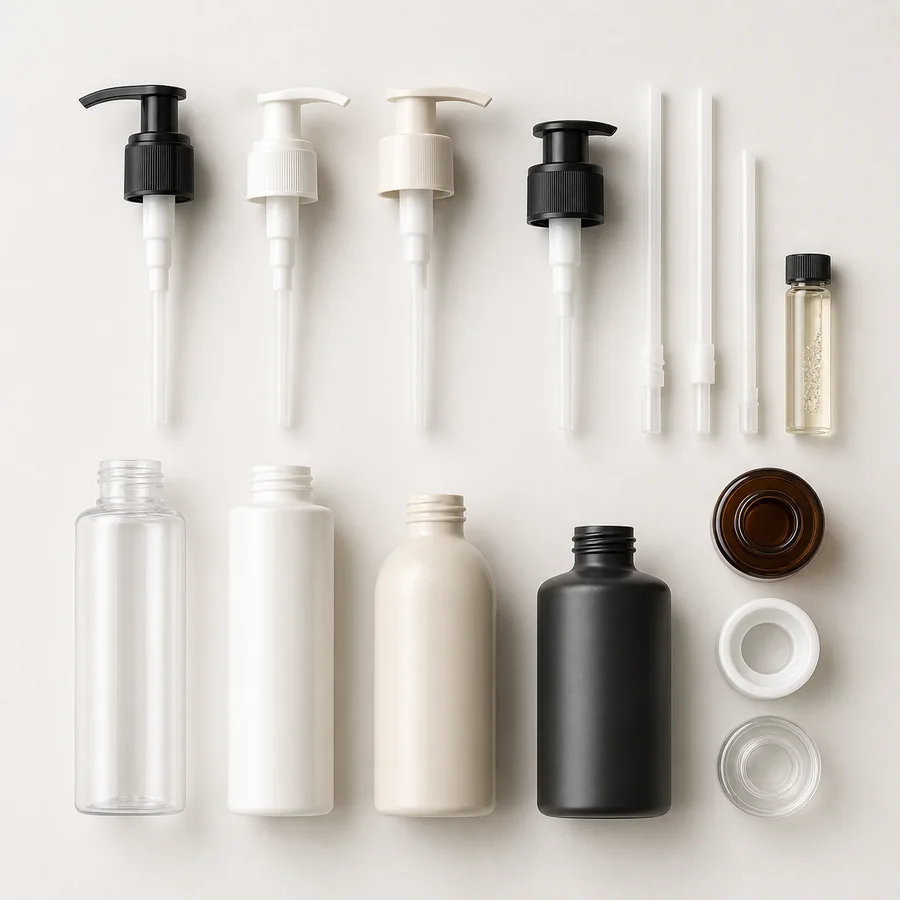
Design for the full user experience
Users experience the package through priming, actuation force, delivered amount, cleanliness, grip and the ability to obtain product near the end. A package can pass a basic fit check and still create a poor user experience if it requires repeated pumping, produces residue around the actuator or becomes difficult to use as the bottle empties. Buyers can use the pump dip-tube length guide when residual product or near-empty dispensing is part of the evaluation.
Do not reduce user experience to visual design. Evaluate how the selected package behaves when used repeatedly with the intended formula, including first priming, normal dispensing and late-life use. For products intended for one-handed or wet-hand use, grip and package stability may also need to be included in the project-specific evaluation.
Buyer approval should distinguish between subjective preference and functional failure. Record which observations are acceptance requirements and which are design preferences so that suppliers, fillers and quality teams are evaluating the same target.
Build compatibility and transport evidence
Compatibility is broader than visible swelling or an immediate leak. Formula-contact components, seals, pump pathways, decoration and dispensing behavior can change over time or under different storage conditions. Buyers should therefore evaluate the complete filled package rather than relying only on water testing or an empty component fit check. The related guide on high-viscosity skincare packaging covers additional dispensing limits for richer formulas.
Packaging compatibility should be evaluated with the actual formulation under intended storage and use conditions. Project-specific compatibility work should define the exact formula, packaging configuration, storage conditions, inspection points and acceptance criteria rather than copying an unrelated test schedule from another product.
Transport evidence should also be separated from formula-compatibility evidence. ASTM D4332-22 provides standard and special conditioning atmospheres for containers, packages or packaging components before testing, while ASTM D4169 provides a structured laboratory framework for evaluating shipping units against distribution hazards. These standards can inform secondary and shipping-package evaluation, but they do not establish chemical compatibility or dispensing performance for the lotion itself.
Manufacturer Insight
From a packaging manufacturing perspective, an empty fit check answers only part of the question. Before bulk production, FOLOVER normally recommends confirming the selected bottle, pump, dip tube and decoration on filled physical samples because formula exposure, storage and repeated use can reveal problems that are not visible during dry assembly.
Approve samples with measurable criteria
A sample round should close specific questions rather than simply produce a visually acceptable prototype. Record the formula batch or representative formula, component identities, filling conditions and observed performance so that later production can be compared with the same approval basis.
Project-specific acceptance criteria may cover priming, dispensing consistency, leakage, package condition, residual product, actuator behavior and decoration. Exact limits should be defined by the brand, filler and relevant component suppliers for the actual project rather than copied from another lotion package.
A common failure is approving an undocumented “golden sample.” Retain the approved physical assembly and its supporting specification, then define which formula, material, dimensional, supplier or process changes require review or revalidation.

Avoid the most common sourcing mistakes
The most expensive sourcing problems often begin before mass production: the bottle and pump are selected independently, the formula arrives after components are already approved, dip-tube length is copied from another bottle, or decoration is approved before filled-package compatibility is understood.
Another common mistake is assuming that individually acceptable components automatically form an acceptable package. A bottle may meet its drawing, a pump may meet its own specification and a decoration may look correct, while the assembled system still performs poorly because the interfaces were never approved together.
The practical solution is to control one complete packaging configuration. Before purchase-order confirmation, buyers should identify the exact bottle, pump, dip tube, closure details, decoration, formula and sample approval basis, and agree how critical component changes will be communicated.
Buyer Approval Checklist
- Define the intended lotion or emulsion, application method, target user, fill volume and expected storage conditions.
- Provide the actual or representative formula when dispensing and compatibility are being evaluated.
- Identify the exact bottle, pump, dip tube and other formula-contact components in the proposed assembly.
- Request current drawings or specifications for critical bottle and pump interfaces.
- Compare production-intent samples rather than combining unverified components from separate sources.
- Evaluate first-use, repeated-use and near-empty dispensing with the selected formula.
- Confirm dip-tube configuration using the actual bottle-and-pump assembly.
- Evaluate filled packages under relevant storage, orientation, handling and distribution conditions.
- Approve coating, printing and other decoration on physical samples after relevant filling and handling evaluation.
- Record project-specific acceptance criteria and retain the approved physical assembly.
- Define which formula, component, material, supplier or assembly changes require revalidation.
How to Structure the Sample Evaluation
Begin with a screening round to compare plausible bottle-and-pump combinations using the representative formula. Use this stage to eliminate assemblies with obvious fit, priming, dispensing, residual-product or handling problems. A successful short screening test should not be presented as proof of long-term compatibility.
Move the strongest candidates into filled evaluation using production-intent components and documented conditions. Record the formula batch, component identities, sample date, storage condition and observations so that results can be compared across rounds. Depending on the project, useful observations may include leakage, package condition, priming, dispensing consistency, recovery between strokes, residual product, actuator cleanliness and decoration condition.
If a sample produces an abnormal result, investigate the mechanism before averaging it into the rest of the data. An outlier can indicate component variation, incorrect assembly, formula interaction or a testing inconsistency that becomes more important at production scale.
Frequently Asked Questions
Can packaging be approved from an empty sample?
An empty sample can confirm appearance, basic fit and handling, but it cannot establish formula compatibility, long-term sealing, dispensing or decoration durability. Final approval should use the intended or representative formula with the selected production-intent assembly under documented conditions.
Is a supplier’s standard component specification enough?
It is a useful starting point, but it is not a substitute for system testing. Performance depends on the exact formula, bottle, pump, dip tube, formula-contact components, filling and assembly process, distribution conditions and use pattern. Buyers should use the supplier specification to define what still needs to be verified on the complete package.
What should trigger revalidation?
Changes to the formula, formula-contact material, critical bottle or pump dimensions, dip tube, supplier, tooling, decoration, filling process or assembly settings can affect performance. The project team should define which changes require partial or full revalidation before bulk production.
How should buyers compare two visually similar packages?
Compare controlled drawings, component materials, bottle-and-pump interfaces, filled test observations, dispensing behavior, residual product, user handling, decoration and change-control requirements. Similar appearance does not establish equivalent dispensing or compatibility performance.
Can a lotion pump be selected by viscosity alone?
No. Viscosity is an important input, but lotion and emulsion behavior can also depend on shear response, temperature, formulation structure, particles, the pump pathway and the intended dose. Buyers should evaluate the selected pump with the actual or representative formula rather than approving it from a viscosity label alone.
Should lotion and emulsion packaging be tested with the actual formula?
Yes. The actual or representative formula is needed to evaluate dispensing, formula-contact components, sealing and other package interactions under intended storage and use conditions. An empty sample or water test can support early screening, but it should not be treated as final compatibility approval.
Conclusion
The most reliable selection model is an operating window: the lotion or emulsion, pump engine, dip tube, bottle geometry and user action must continue to work together as storage conditions, fill level and handling change. A component that performs well in one short trial can still behave differently during distribution or near-empty use.
For B2B buyers, the stronger decision is to define the application first, shortlist matched bottle-and-pump assemblies, evaluate them with the representative formula and retain the approved configuration as the production reference. Final bottle and closure compatibility should be confirmed using the selected components and physical samples before bulk production.