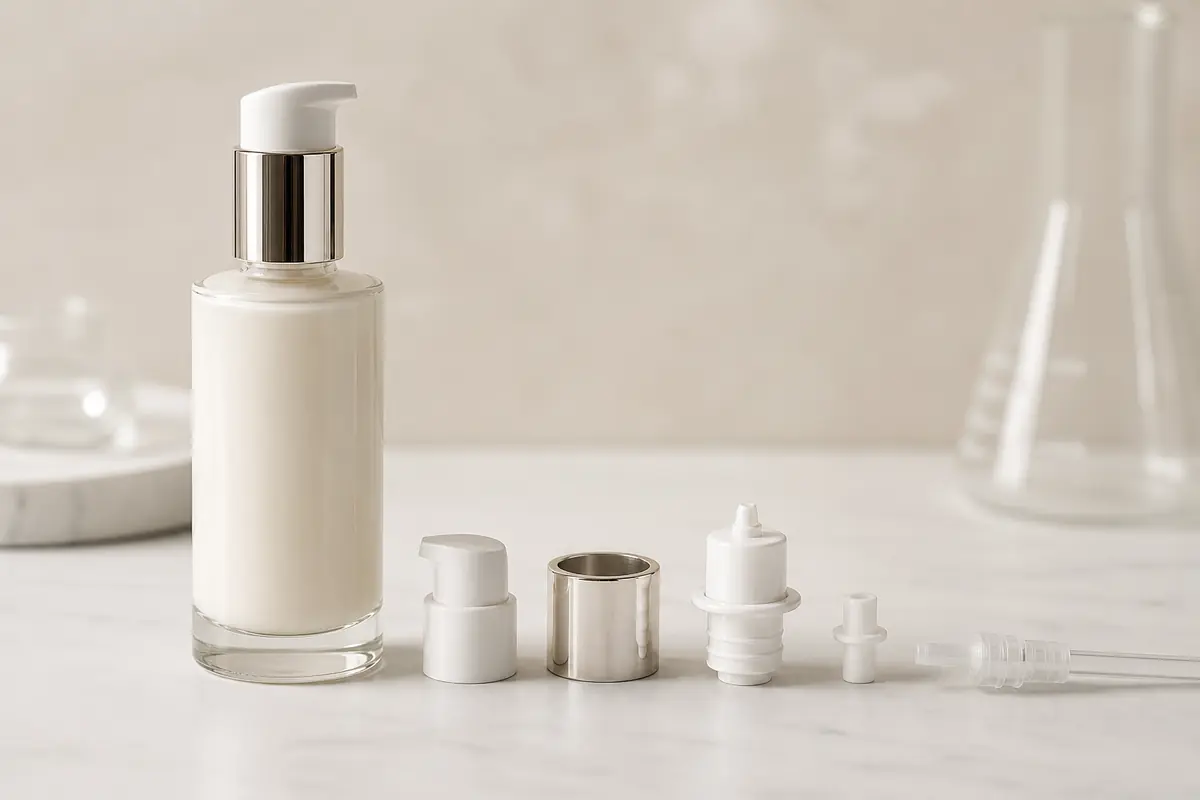
A cosmetic pump is a dispensing system that draws product from a bottle and delivers it through an actuator. Pressing the actuator moves the pump mechanism and forces product through the outlet. Releasing it allows the mechanism to reset and the chamber to refill through the dip tube. The amount dispensed depends on the pump design, formulation, assembly and how the pump is operated.
For cosmetic packaging buyers, pump selection involves more than choosing a suitable appearance or nominal output. The actuator, pump chamber, valves, bottle neck, sealing components, dip tube and formula must operate as one matched package. A pump that works well on one bottle or with one lotion may perform differently after a component or formula change.
Main Parts of a Cosmetic Pump
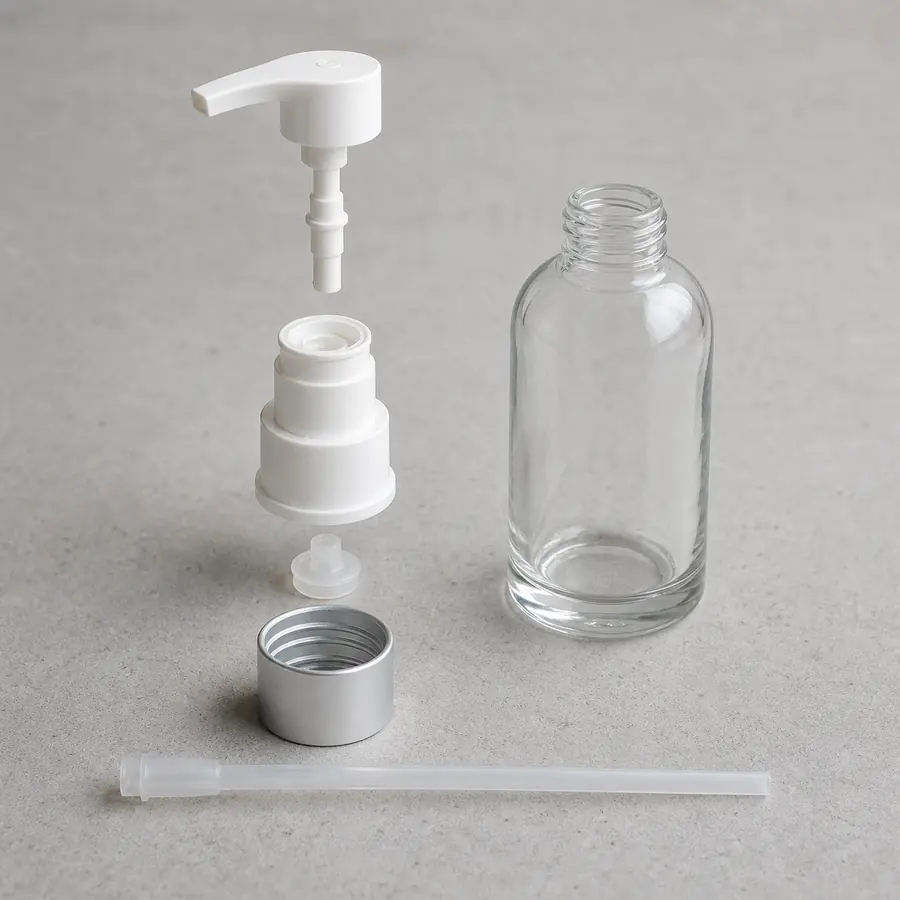
Most dispensing pumps can be understood through a small group of functional parts. Designs vary, so not every pump uses identical construction, but the following elements explain the basic system.
- Actuator: The top surface pressed by the user. Its outlet geometry influences how the product is dispensed.
- Stem: Transfers actuator movement into the pump mechanism.
- Pump chamber: Holds the portion of product being prepared for the next actuation.
- Valve system: Controls the direction of product flow during pressing and release.
- Spring or return mechanism: Returns the actuator after a stroke where that construction is used.
- Closure: Attaches the pump to the bottle and helps establish the sealing interface.
- Dip tube: Extends into the product so the pump can draw formula from the container.
The wider cosmetic bottle closures overview compares pumps with droppers, sprayers, caps and reducers. This article stays focused on pump operation and system validation.
What Happens During One Pump Cycle?
A typical mechanical pump operates through four stages:
- Pressing: The user pushes the actuator downward, moving the internal pump mechanism and reducing the available chamber volume.
- Dispensing: The resulting pressure change directs product through the outlet and onto the user’s hand or application area.
- Release: The user releases the actuator, allowing the return mechanism to move it toward its original position.
- Refilling: Product moves through the dip tube and inlet pathway to refill the chamber for the next stroke.
Valves help control the direction of flow. The exact internal construction and valve sequence depend on the selected pump, so this explanation describes a typical operating principle rather than every available pump design.
Priming is the process of filling the pump pathway before normal dispensing begins. A new assembly may require several initial strokes because the chamber and dip tube contain air. The number of priming strokes depends on the pump configuration, tube geometry, formulation and assembly condition.
If the pump does not dispense after initial priming, the buyer should first confirm that the actuator can complete its intended stroke, the dip tube is connected and the inlet remains submerged. Repeated pressing alone will not resolve a disconnected tube or an obstructed inlet.
What Does Pump Output Mean?
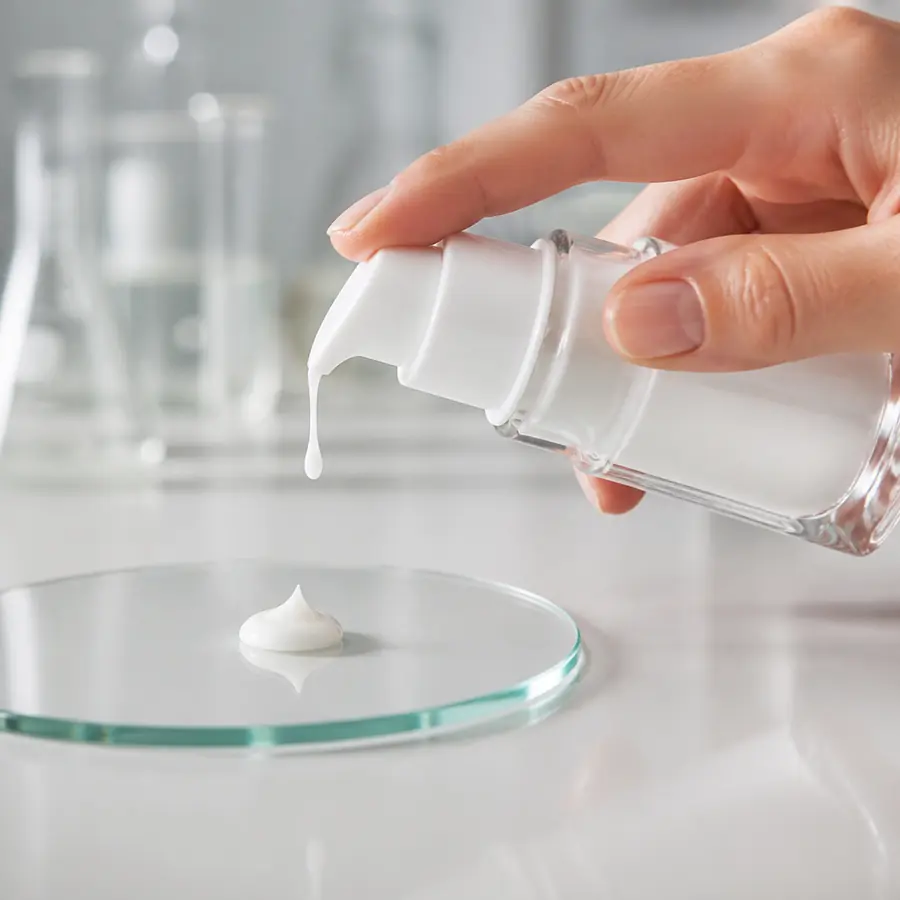
Cosmetic pump output is the quantity of product dispensed during one complete actuation under defined conditions. It influences dosage, application control, user experience and how long the contents of a package may last.
Suppliers may express nominal output as a volume per stroke, such as mL/stroke or cc/stroke, or as a mass per stroke. These units should not be treated as interchangeable without considering the formulation’s density and the measurement method.
A nominal output value is a component specification, not a guarantee that every formulation will dispense exactly that amount under all operating conditions.
For an assembled package, output should be measured after the pump has been primed, using the actual formula and a consistent actuation procedure. Incomplete strokes, trapped air or insufficient chamber refill can affect the observed dose.
ASTM D4336-18(2025), Standard Practice for Determination of the Output Per Stroke of a Mechanical Pump Dispenser, provides a recognized practice for determining the mean quantity by weight dispensed per actuation from applicable mechanical pump dispensers.
The standard provides a measurement framework, not a universal output requirement for all cosmetic pumps. Buyers should confirm the method’s applicability and establish project-specific acceptance criteria for the selected pump and finished package.
Manufacturer Insight: Approve the Output of the Complete Package
FOLOVER PACK recommends evaluating pump output using filled, assembled samples rather than approving a dispensing claim from a loose pump or catalog specification alone.
For example, a pump may produce a consistent dose with a free-flowing test liquid but refill more slowly with a thicker lotion. The buyer should compare repeated full strokes after priming and observe whether the chamber refills consistently at the intended operating pace.
If a brand specifies a target dispensing amount, the pump supplier should confirm the relevant output specification, measurement conditions and acceptable variation. The final result should be verified with the actual formulation and approved bottle-and-pump combination.
Why Formula Viscosity and Product Behavior Matter
Viscosity affects how easily a formula enters the dip tube, refills the pump chamber and passes through the actuator outlet. A pump designed for a light serum may behave differently when used with a thicker lotion or emulsion.
However, viscosity alone does not establish compatibility. Suspended particles, product drying, air bubbles, surface tension and other formulation characteristics may influence dispensing or create additional risks.
A pump that operates normally with water should not automatically be considered suitable for the final cosmetic formula.
For example, if a pump dispenses normally during the first few strokes but produces a smaller amount during repeated use, one possibility is that the chamber is not refilling quickly enough for the selected formulation and actuation pace. Incomplete priming, valve behavior and other assembly issues must also be considered.
Buyers should compare the available cosmetic lotion pumps against the actual formula, intended dose and dispensing requirements rather than selecting by appearance or a generic viscosity description.
The guide to packaging for lotions and emulsions explains how formula behavior influences bottle and dispenser selection.
Packaging compatibility should be evaluated with the actual formulation under intended storage and use conditions. Where relevant, the evaluation should include product-contact materials, changes after storage, priming, repeated actuation and dispensing consistency.
How Dip Tube Length Affects Performance
The dip tube must reach an appropriate position inside the bottle while keeping its inlet available for product pickup.
If the tube is too short, the pump may begin drawing air while a meaningful amount of product remains. If it is too long, the tube may bend excessively, press against the base, restrict the inlet or create inconsistent assembly.
The correct length depends on the bottle’s internal height, base geometry, the fully seated pump position and the tube’s connection to the pump body.
Capacity alone is not enough to specify dip tube length because two bottles with the same nominal volume can have different internal dimensions.
The dedicated guide to choosing cosmetic pump dip tube length explains measurement references, installed tube position, bottom clearance and sample evaluation in greater detail.
Before approving a tube specification, buyers should inspect its position with the pump fully assembled and evaluate product pickup at different fill levels. A tube that reaches the bottom visually may still have an obstructed inlet or be unsuitable for the actual formulation.
Why Bottle Neck Finish and Closure Fit Matter
The pump closure must match the engineered bottle neck finish. Nominal diameter is only one consideration. Thread profile, finish height, sealing surface, gasket or liner arrangement and closure geometry can all affect attachment and sealing.
A pump should not be declared compatible simply because it can be screwed onto a bottle by hand.
The cosmetic bottle neck finish guide explains the functional interface, while the article on bottle and closure tolerances explains how dimensional variation can affect assembly across production lots.
For example, a closure may engage the bottle threads but fail to achieve the intended gasket compression. Increasing the tightening force without identifying the actual sealing problem can damage the closure or gasket without resolving the leakage risk.
Buyers should review the exact bottle and pump specifications, inspect the assembled sealing interface and confirm the approved assembly method before production.
Complete closure families can be reviewed through pumps, droppers and bottle accessories. For a broader selection and sourcing framework, the cosmetic bottle closures and dispensing guide connects dispenser choice with formula, application requirements and component matching.
Treatment Pump vs Lotion Pump
“Treatment pump” and “lotion pump” describe common product categories, but the names do not establish a universal technical boundary.
A treatment pump is often considered for facial serums, concentrated skincare or compact packages where controlled dispensing and product presentation are priorities. A lotion pump is commonly considered for products requiring a different dose, bottle format or user experience.
The actual output, flow pathway, actuator characteristics and formula suitability depend on the selected pump model.
| Selection Factor | Treatment Pump | Lotion Pump | What Buyers Should Verify |
|---|---|---|---|
| Typical application | Concentrated skincare, serums and controlled application. | Lotions, emulsions and broader skincare or personal-care applications. | Actual formula compatibility and intended user experience. |
| Dispensing output | Model-specific output selected for the intended application. | Model-specific output selected for the intended application. | Supplier specification and repeated dispensing with the actual formula. |
| Bottle matching | Compact or other compatible bottle formats, depending on the design. | Compatible bottles suited to the selected pump and product. | Neck finish, sealing geometry, dip tube and assembled component dimensions. |
| Main selection risk | Choosing by compact appearance without confirming dosage and formula behavior. | Assuming a larger-looking pump can dispense every lotion consistently. | Priming, output consistency, actuator return and final package compatibility. |
For buyers, the selection should begin with the intended dose, formula and user experience. The chosen pump must then be evaluated on the actual bottle with its final closure, dip tube, collar and overcap where applicable.
Common Cosmetic Pump Problems
A dispensing problem is a symptom, not proof that the pump mechanism itself is defective. The bottle, formulation, tube, sealing components and assembly conditions should be considered before replacing individual parts.
No Output or Difficult Priming
Possible causes include air in the pump pathway, a disconnected or incorrectly sized dip tube, an obstructed inlet, valve behavior or a formulation that does not refill the chamber as expected.
Confirm the assembly and follow a consistent priming procedure. If the problem remains, compare the affected package with an approved reference using the same formulation.
Inconsistent Output
Partial strokes, trapped air, incomplete chamber refill, valve behavior and sample-to-sample assembly variation can contribute to inconsistent dispensing.
Measure a sequence of complete actuations after priming rather than judging one dose. Compare the results across representative samples and investigate whether the variation increases during repeated use.
Dripping or Product at the Outlet
Residual product may remain around the actuator after use. More persistent dripping can involve the formula, outlet geometry, valve behavior or internal pump conditions.
Observe whether the liquid appears immediately after dispensing or continues to emerge while the pump is at rest. Compare the affected assembly with the approved sample before changing the actuator or other components.
Slow Return or Sticking
A slow actuator return may involve the return mechanism, product flow, contamination or dried formula around moving parts.
Test repeated complete strokes and observe whether return performance changes after storage. A pump that returns normally when empty but becomes slow when filled requires evaluation of the complete formula-and-pump combination.
Leakage Around the Neck
Neck leakage may involve closure fit, sealing surfaces, gasket condition, assembly method, bottle variation or storage and transport conditions.
Identify where the liquid first appears. A wet collar does not establish that the pump chamber is defective. Inspect the neck and sealing interface before selecting a corrective action.
Practical Troubleshooting: When a Pump Stops Dispensing Before the Bottle Is Empty
Consider a development-stage lotion bottle that dispenses normally when full but produces intermittent output as the product level decreases.
The first check is the installed dip tube position. If the inlet is above the remaining product, the tube may be too short for the intended pickup area. If the inlet remains submerged, inspect it for obstruction and check whether the formulation can flow toward it.
Next, compare priming and repeated dispensing with an approved reference using the same formula. If the problem persists, review the pump’s internal function and complete component assembly.
Do not automatically extend the dip tube or modify its cut angle. A longer tube may introduce excessive bending or inlet restriction without addressing the actual cause.
This is an illustrative troubleshooting scenario, not a documented customer incident or a claim that one adjustment will resolve every dispensing problem.
What Buyers Should Test Before Production
Production approval should be based on the actual bottle, pump, dip tube, sealing components and formulation. A loose pump sample or a successful water test does not establish the performance of the final filled package.
Cosmetic Pump Sample Evaluation Checklist
- Confirm the exact pump and bottle references, drawings or approved specifications.
- Assemble representative components using the intended production method.
- Check neck fit, closure seating, gasket condition and applicable assembly controls.
- Fill samples with the actual formulation and record initial priming behavior.
- Measure repeated complete actuations for output and dispensing consistency.
- Check dip tube position, product pickup and dispensing at lower fill levels.
- Inspect for leakage around the neck, actuator and other relevant interfaces.
- Observe actuator return, clogging, dripping and changes after relevant storage.
- Evaluate the final overcap, collar and complete assembly where applicable.
- Include distribution and transport checks appropriate to the packaging project.
- Retain the approved sample and repeat affected checks after relevant component, formula or assembly changes.

Before requesting a quotation or approving bulk production, buyers should provide the selected bottle reference, intended formulation, target dispensing amount, preferred pump appearance, component requirements and applicable sample-testing criteria.
For a wider selection context, the skincare packaging guide connects dispensing choice with formula and product positioning. Technical mechanisms across this cluster are organized in the Packaging Technology hub, while foundational component explanations are grouped in Product Knowledge.
Conclusion
Cosmetic pumps work through repeated dispensing and chamber-refill cycles. Reliable performance depends on the selected pump mechanism, output, formulation, dip tube position, bottle neck, sealing components and assembly conditions.
For B2B cosmetic packaging buyers, the most important step is to approve the complete filled bottle-and-pump system rather than selecting a pump by appearance, nominal output or neck size alone. Confirm dispensing consistency, product pickup, sealing and the intended user experience using representative physical samples before bulk production.
FOLOVER PACK supports cosmetic glass bottle selection, pump and closure matching, component coordination and packaging sample development. Share your selected bottle reference, formula type, target dispensing requirements and preferred pump configuration to discuss suitable packaging options.
Frequently Asked Questions
How does a cosmetic pump work?
Pressing the actuator moves the pump mechanism and forces product through the outlet. Releasing it allows the mechanism to return and draw more product through the dip tube into the chamber. The exact construction varies by pump design. Buyers should evaluate the selected pump with the actual bottle and formulation before approving production.
What does cosmetic pump output mean?
Pump output is the amount of product dispensed during one complete actuation under defined conditions. It may be specified by volume or mass, depending on the supplier and measurement method. Buyers should confirm the nominal specification and evaluate repeated dispensing using the actual formulation and complete packaging assembly.
Why does a pump stop dispensing?
Possible causes include trapped air, a disconnected or incorrectly sized dip tube, an obstructed inlet, incomplete chamber refill, valve problems or formula behavior. The visible symptom alone does not establish the cause. Buyers should inspect the assembled system and compare its priming and dispensing performance with an approved reference.
How long should a cosmetic pump dip tube be?
The correct dip tube length depends on the bottle’s internal geometry, the fully seated pump position and the intended inlet location. A short tube may leave product inaccessible, while an overlong tube may bend excessively or restrict pickup. Buyers should confirm the installed position and validate dispensing using physical samples.
Can any lotion pump fit any bottle?
No. Compatibility depends on the exact bottle neck finish, thread and sealing geometry, closure structure, gasket, dip tube and intended formulation. A pump that screws onto a bottle is not necessarily correctly sealed or suitable for dispensing. Buyers should confirm the selected components and test the complete assembled package before bulk production.
Does formula viscosity affect pump performance?
Yes. Viscosity can influence how quickly product enters the dip tube, refills the pump chamber and exits through the actuator. However, viscosity is not the only factor affecting dispensing. Buyers should evaluate the actual formulation, selected pump and complete package together under intended storage and use conditions.