
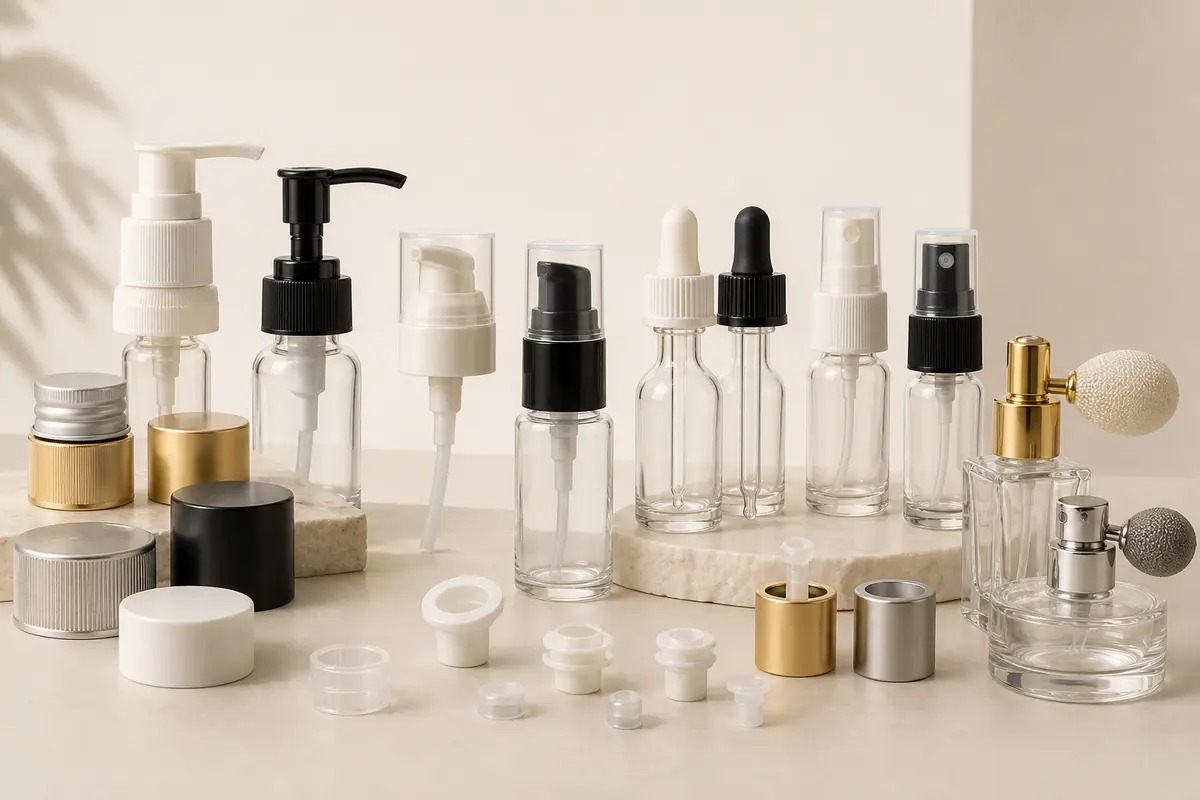
Cosmetic bottle closures are the components that complete sealing, opening and dispensing functions for a container. A closure may be a screw cap, lotion pump, treatment pump, dropper, fine mist sprayer, perfume atomizer, reducer insert or another matched system. It is not merely the visible “top” of the package.
The correct closure depends on the bottle neck, sealing geometry, formula, required dose, use pattern and production process. Components that appear similar are not automatically interchangeable. Buyers should define the complete bottle-and-closure system and test it with the actual formula before bulk production.
Screw Caps
A screw cap closes through engagement between the cap and bottle thread. Depending on the package, sealing may involve a liner, gasket, plug feature or contact between defined surfaces. The cap material, thread profile, depth, sealing element and closing process all influence the result.
Screw caps suit projects that do not require integrated pumping or spraying, and they may work with a separate reducer or applicator. A cap should not be selected only by visible diameter. Confirm the exact bottle finish and cap specification, then evaluate repeated opening, closing, orientation and formula contact.
For cosmetic packaging projects requiring separate caps or decorative outer closures, buyers can review the available perfume and cosmetic bottle caps. Final compatibility must be confirmed with the selected bottle and sealing components.
Cosmetic Pumps
Lotion Pumps
Lotion pumps are commonly considered for lotions, emulsions, body products and other compatible formulas. A pump system includes the actuator, internal engine, closure, gasket where applicable and dip tube. Output and user effort depend on the verified pump and formula, not on the general “lotion pump” label.
For higher-viscosity products, the internal flow path, pump mechanism and dip-tube configuration can affect priming and dispensing. A pump that performs correctly with water may not deliver the intended dose of a lotion or emulsion. Buyers should evaluate the selected pump with the actual formulation rather than selecting it solely by actuator appearance.
Treatment Pumps
Treatment pumps are often smaller in profile and may be considered for facial products or controlled application. The exact output, closure, actuator style and compatibility must be confirmed for the selected component. A treatment pump is not automatically suitable for every serum.
When repeatable dispensing is important, a treatment pump may be more appropriate than a manually operated dropper, provided the formula falls within the pump’s functional range. However, buyers must verify the delivered amount, priming behavior and remaining product access using the intended bottle and formula.
Output and Dip-Tube Concepts
Pump output is the delivered amount under defined actuation conditions. Dip-tube length affects product access but must be selected for the exact bottle height, base geometry, pump and intended cut. The planned article on how cosmetic pumps work explains actuators, pump engines, output and dip tubes in more depth.
A dip tube that is too short may leave excessive product inside the bottle. A tube that is too long or incorrectly cut may contact the bottle base in a way that restricts intake. Neither tube length nor pump output should be assigned from a general product category without checking the selected component specification.
Browse cosmetic lotion pumps for the relevant product category. Final selection still requires the production-intent bottle, pump and formula.
Droppers
Bulb and Pipette Systems
A cosmetic dropper commonly combines a closure, bulb and glass or plastic pipette. Dispensing depends on bulb response, pipette geometry, formula behavior and user technique. The closure must match the bottle neck, while pipette length must fit the exact bottle.
Oils, low-viscosity serums and other compatible liquids may use droppers, but viscosity, particulates and required dose affect suitability. The planned guide to how glass dropper systems work covers bulbs, pipettes, wipers and bottle compatibility.
The bulb material also requires attention. Certain formulation ingredients may affect elastomeric components through swelling, softening, hardening or other material changes. These effects depend on the actual formulation, bulb material, contact conditions and exposure time. A glass bottle’s compatibility with a formula does not establish compatibility for the entire dropper assembly.
Euro Dropper Inserts
A Euro dropper system uses a fitted reducer insert and cap rather than a bulb-and-pipette assembly. The insert controls flow through an orifice, subject to formula and component design. The bottle neck must be designed for the selected insert and cap; an insert cannot be assumed to fit from appearance.
FOLOVER’s serum and essential-oil dropper category is the canonical product route for dropper components.
Sprayers and Mist Pumps
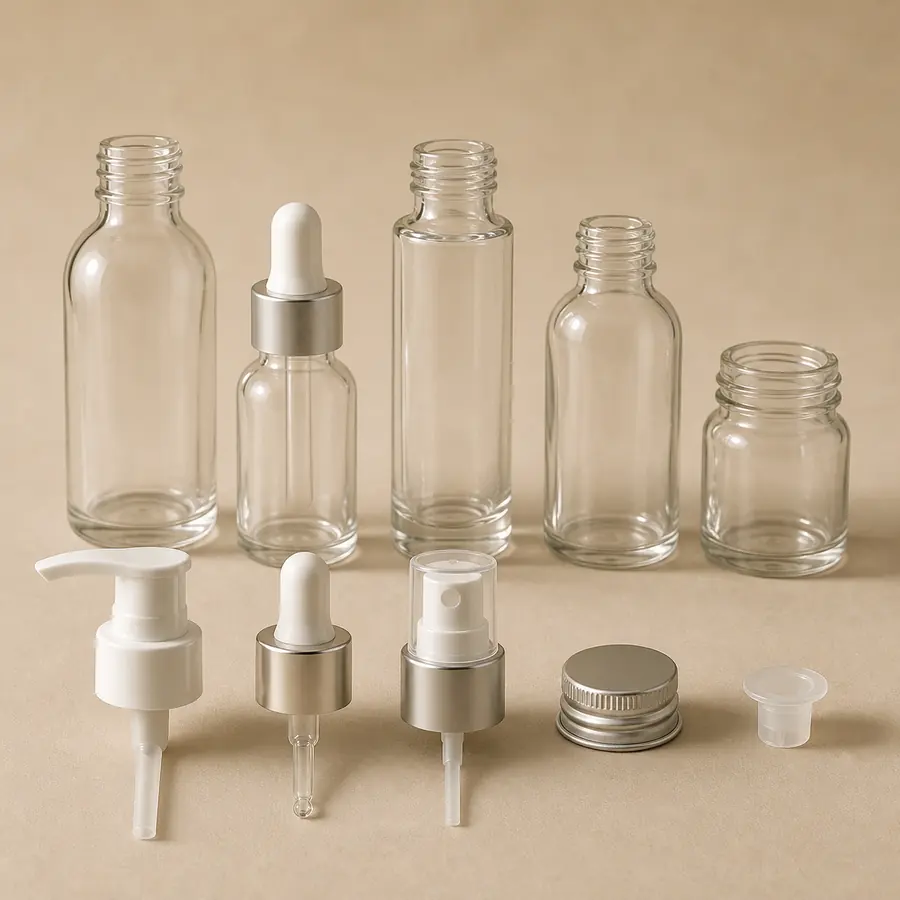
Fine mist sprayers atomize compatible liquid into droplets through an actuator, pump mechanism and nozzle. They may be considered for toners, facial mists and other low-viscosity products when the formula and desired spray experience are appropriate.
Spray pattern, priming, output, actuator feel and dip-tube configuration are component-specific. Formula viscosity, particulates, solvents and surface tension may affect performance. Buyers should test the exact sprayer with the actual formula rather than approving an empty-water demonstration alone.
A sprayer that produces an acceptable mist during initial testing may still require evaluation after storage and repeated use. Nozzle obstruction, inconsistent spray distribution or changes in dispensing behavior should be investigated against the formula, pump mechanism and selected component materials.
Browse fine mist sprayers for the product category, then confirm neck, gasket, tube, formula and use conditions.
Perfume Atomizers
A perfume atomizer is a spray system designed for compatible fragrance packaging. It may use crimp or screw attachment depending on the bottle and component system, often with a collar and cap completing the appearance. Atomizer selection involves the verified neck, pump, gasket, dip tube, collar, cap and fragrance formula.
For alcohol-based fragrance, the assembled atomizer requires evaluation for sealing, dispensing consistency, material compatibility and potential evaporation loss under the intended storage and use conditions. The presence of a glass bottle does not establish the chemical compatibility of the pump’s internal seals or other product-contact components.
This overview does not define spray performance or crimp settings. The dedicated article on how perfume atomizers work will address those mechanisms and production considerations separately.
Reducers and Inserts
Reducers and inserts fit into or onto a bottle neck to control access or flow. An orifice reducer may support controlled dispensing for compatible oils and liquids. A wiper can interact with a dropper pipette or applicator. A plug insert may participate in closing a package. These terms describe different functions and should not be used interchangeably.
Insert retention, orifice size, formula behavior, cap interaction and filling process are specific to the package. A reducer that works in one bottle family may not fit another bottle with a similar visible opening.
When evaluating a reducer, buyers should check whether the insert remains securely seated during cap removal, dispensing and repeated use. They should also confirm that the selected opening delivers the intended flow with the actual formulation.
Liners, Gaskets and Sealing Components
Liners and gaskets may create or support the sealing interface between bottle and closure. Their material, dimensions, compression and formula contact can affect performance. Some closures use an integrated sealing feature instead, so a separate liner is not always present or required.
Buyers should identify every product-contact material and verify its role. Do not assume that adding a liner automatically solves leakage, compatibility or torque problems. The sealing system must be assessed as designed.
Manufacturer Insight: Treat the Closure as a Complete Component System
For B2B cosmetic packaging projects, FOLOVER PACK recommends confirming the bottle, closure, sealing components and dispenser configuration together rather than approving each item independently. A closure may attach to a bottle correctly but still produce an unsuitable seal, incorrect dispensing behavior or an unexpected assembled height.
When components come from different production sources, buyers should request the exact component specifications and approve a physical assembly made with the intended bottle and closure. The approved sample should identify the selected component versions so that a visually similar substitute is not introduced without review.
Why Neck Finish Determines Closure Fit
The bottle neck finish defines the technical interface used by the closure. Relevant features may include thread geometry, finish height, sealing land, crimp profile, bead, opening and tolerances. The exact specification—not the bottle body shape—determines which closure family can be evaluated.
The planned article on cosmetic bottle neck finishes explains threads, crimp necks and closure interfaces. The cosmetic bottle closures and dispensing guide supports broader buyer selection.
Why “Same Diameter” Does Not Mean “Same Fit”
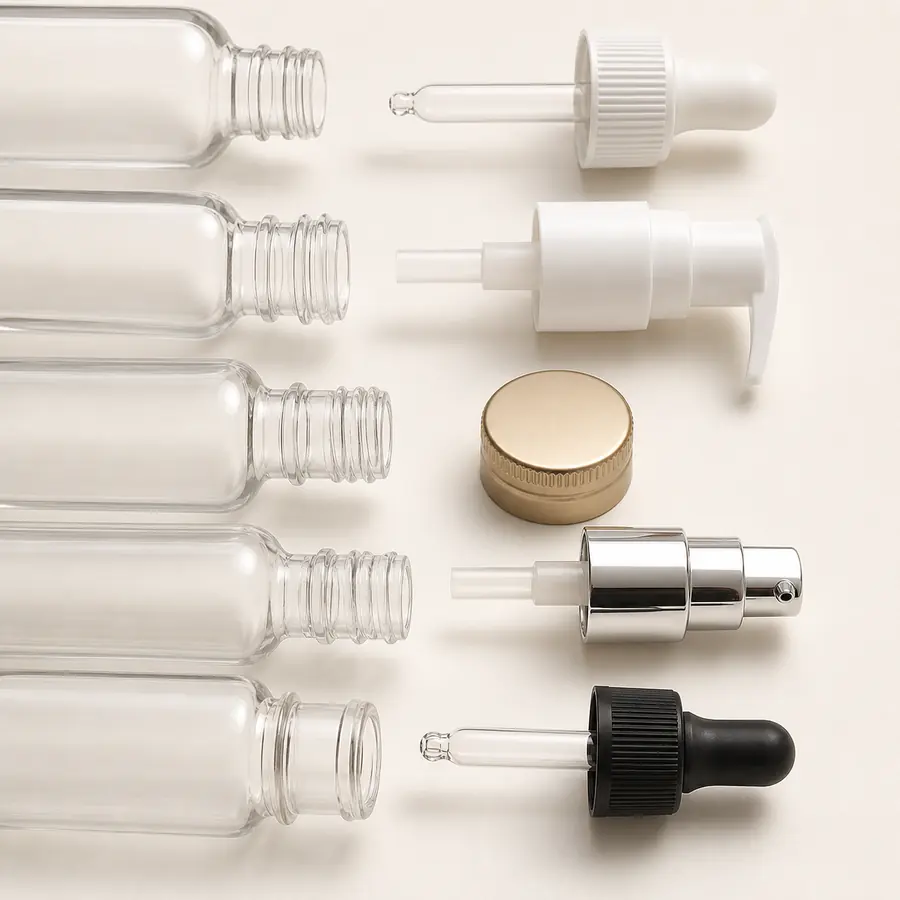
Two bottle openings can look the same size while differing in thread pitch, thread start, finish height, sealing surface, crimp geometry or tolerance. Two closures can share a nominal diameter while using different internal designs. For this reason, nominal diameter is only one reference and not proof of compatibility.
For example, a designation such as 24/410 identifies a nominal neck diameter and thread-finish series. It does not independently establish that a particular pump, cap or dropper will seal correctly on every bottle carrying that designation. Industry neck-finish guidance from SKS Bottle & Packaging identifies dimensional features such as T, E, I, S and H that are relevant to container and closure matching.
| Neck-Finish Reference | What Buyers Should Verify | Why It Matters |
|---|---|---|
| Nominal finish designation | Confirm the complete finish code and applicable bottle and closure specifications. | A shared nominal diameter does not establish matching thread geometry or sealing performance. |
| T dimension | Check the outside diameter across the bottle neck threads against the specified closure interface. | The thread diameter affects mechanical engagement. |
| E dimension | Review the outside diameter of the neck below the threads. | Neck geometry contributes to the available thread depth and component clearance. |
| I dimension | Confirm the inside diameter of the bottle opening. | The opening must accommodate the selected dip tube, pipette, reducer or other internal component. |
| S and H dimensions | Check the thread-start position and overall neck-finish height against the selected closure specification. | These dimensions influence thread engagement, closure position and the assembled configuration. |
| Sealing interface | Review the sealing land, gasket or liner design, closure structure and physical assembly. | Correct thread engagement alone does not establish a reliable seal. |
This table identifies dimensional checks rather than providing a universal interchangeability chart. Actual acceptance dimensions and tolerances must come from the selected bottle and closure specifications. Buyers should not substitute general industry dimensions for product-specific drawings.
Fit also includes more than attachment. A closure may screw on yet fail to seal correctly, sit at the wrong height, misalign with decoration, use an unsuitable tube or interact poorly with the formula. The planned article on bottle and closure tolerances examines these interfaces in greater depth.
Selecting Closures for Different Products
| Product Need | Closure Often Considered | Main Limitation | What Buyers Should Verify |
|---|---|---|---|
| Direct pour or separate applicator | Screw cap | No integrated controlled dispensing unless a separate component is included. | Thread engagement, liner or seal, formula contact and repeated closing performance. |
| Lotion or compatible emulsion | Lotion or treatment pump | Viscous formulas may cause poor priming or incomplete dispensing with an unsuitable pump. | Viscosity, output, dip-tube configuration, priming and product access. |
| Manual liquid dosing | Bulb and pipette dropper | Delivered volume depends on component design, formula behavior and user technique. | Neck fit, sealing, pipette length, bulb material and dispensing behavior. |
| Controlled oil flow | Reducer insert and cap | Flow rate and insert retention depend on the specific bottle and formulation. | Insert fit, orifice, retention, formula compatibility and dispensing behavior. |
| Fine liquid mist | Fine mist sprayer | High viscosity or particulates may affect spray formation or obstruct the flow path. | Spray pattern, tube configuration, priming, formula viscosity and repeated-use performance. |
| Fragrance spray | Perfume atomizer | Sealing and spray performance depend on the matched fragrance packaging system. | Neck system, gasket, spray behavior, formula compatibility, collar and cap assembly. |
The skincare packaging guide helps place closure choice within the wider container and formula decision.
How Formula Characteristics Affect Closure Choice
Viscosity influences how readily a product moves through a pump, sprayer, pipette or reducer. A low-viscosity liquid may flow too quickly through an opening intended for a thicker product, while a high-viscosity formula may prime slowly or fail to pass through a narrow flow path. The usable range belongs to the exact component and must be evaluated with the real formula.
Particulates, suspended pigments or natural ingredients can obstruct small passages or change dosing consistency. Volatile ingredients can place additional demands on sealing and material compatibility. Oils, solvents, fragrance ingredients and other formula components may interact with gaskets, liners, bulbs, dip tubes, coatings or adhesives. These possibilities do not prove that a component will fail; they explain why material review and testing are necessary.
User experience also matters. A treatment product may need a smaller controlled dose, while a body product may need faster dispensing. A facial mist needs a different delivery experience from a concentrated oil. Define the intended dose, application area, actuation force, spray or stream character, and expected number of uses before selecting a component.
Formula compatibility: Packaging compatibility should be evaluated with the actual formulation under intended storage and use conditions. Material suitability cannot be established from the closure name, bottle material or an empty-container demonstration alone. Buyers should obtain relevant material information and agree on formulation-specific evaluation criteria before approving the complete packaging system.
Closing and Assembly Are Part of Performance
A compatible bottle and closure can still perform poorly if assembly is inconsistent. Screw closures may require an agreed closing process and controls appropriate to the package. Crimp systems depend on matched components, equipment and validated settings. Press-fit reducers or inserts require correct seating and retention. Dip tubes and pipettes need the approved length and configuration.
Decoration can introduce further interfaces. A collar may sit differently if the pump height changes. A square cap may require front alignment with bottle printing. A label can interfere with a closure if its position is not controlled. Secondary packaging must accommodate the assembled height and protect exposed actuators or decorative parts.
Buyer check: Approve the assembled result produced through the intended filling and closing process, not only loose components supplied in separate bags. Where a project requires a defined screw-cap closing torque or crimping setting, obtain the value from the selected component specification and validated assembly process rather than applying a generic industry figure.
A Staged Closure Validation Process
Begin with document and component review: bottle drawing, closure specification, material information where available and proposed tube or pipette. Next, assemble preliminary samples to confirm fit, appearance and basic function. Then evaluate the actual formula under defined conditions and compare results with written acceptance criteria.
Pilot or production-intent samples should reflect the selected bottle, closure, sealing elements, decoration, filling and closing process. Review initial function and repeated use, because a closure can change after many actuations or openings. Transport orientation and secondary packaging may also be included where relevant to the project.
Where a project requires controlled environmental conditioning before packaging or transit testing, ASTM D4332-22 provides a reference for conditioning containers, packages and packaging components under specified atmospheric conditions. Its application must be selected according to the actual test objective; conditioning alone does not establish closure compatibility or leakage resistance.
For projects requiring differential-pressure leakage assessment of empty rigid containers, ASTM D4991-25 describes a vacuum-based test method within its defined scope. It is not a universal requirement for cosmetic packaging, and an empty-container test does not replace compatibility, dispensing or leakage evaluation of the filled package with its actual formulation.
When a test does not pass, isolate the likely interface before changing multiple components at once. Record what changed and repeat the relevant checks. This creates an auditable decision trail and reduces the risk of approving a component based on a one-time demonstration.
Manufacturer Insight: Diagnose the Failure Before Replacing the Closure
When an assembled cosmetic package shows leakage or dispensing problems, replacing the pump or cap immediately may not address the underlying cause. The problem may originate from the neck interface, sealing component, closing process, dip-tube configuration or formula behavior.
For example, if a lotion pump stops dispensing before the bottle is empty, the evaluation should distinguish between insufficient tube reach, restricted product intake, priming problems and unsuitable pump performance with the actual formula. The appropriate correction depends on the identified cause; shortening or replacing the dip tube without checking the complete system may introduce another dispensing problem.
FOLOVER PACK recommends documenting the original assembly, the observed failure and the specific component change before approving a revised sample. The final configuration should be retested under the relevant intended-use conditions.
What Buyers Should Check in Samples
- Exact bottle and closure codes and drawings.
- Neck finish, thread or crimp system and sealing interface.
- Gasket, liner, insert and other product-contact materials.
- Pipette or dip-tube length and cut where applicable.
- Actual-formula compatibility, viscosity and particulates.
- Priming, output, spray, flow or dosing criteria.
- Closing, opening, alignment and repeated-use behavior.
- Defined leakage and transport checks using agreed conditions.
- Decoration, collar, cap and assembled dimensions.
- Approved sample identity before production.
Record the bottle code, closure code, component revision, tube specification, formula version, test conditions and approval decision together. This prevents visually similar components from being substituted without a new review.
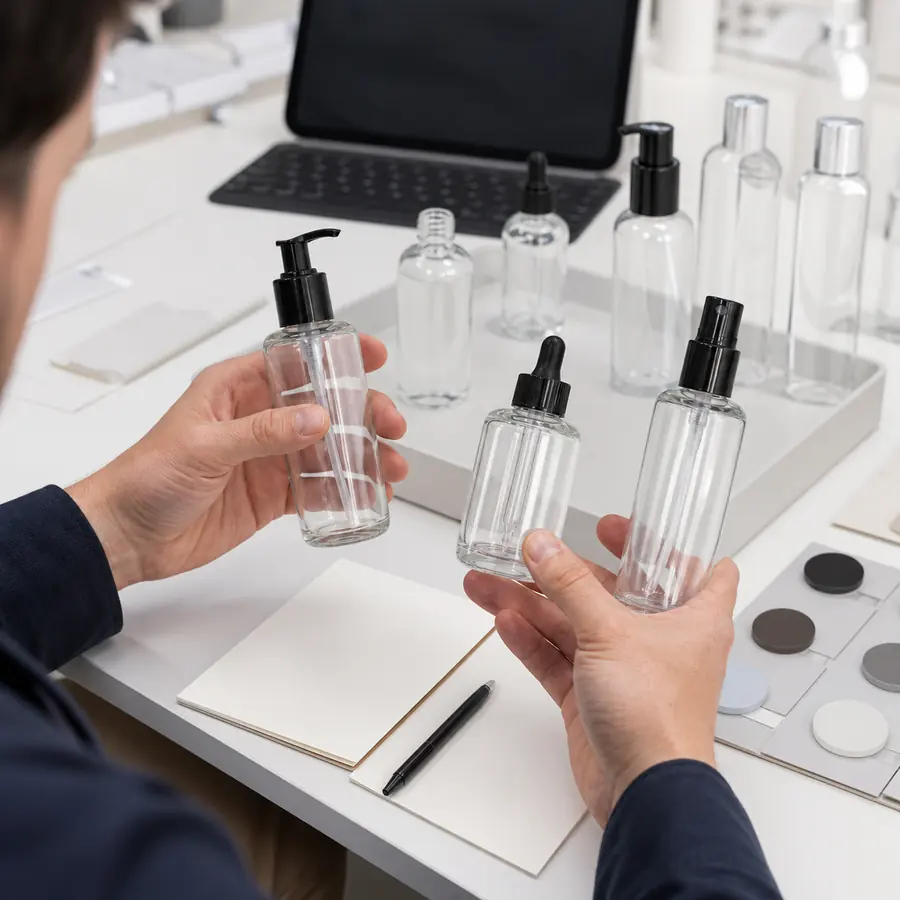
Explore the Product Knowledge hub for component fundamentals and the Packaging Technology hub for technical mechanisms and testing.
Frequently Asked Questions
What is a cosmetic bottle closure?
A cosmetic bottle closure is a component or assembly that closes, seals or dispenses product from a cosmetic bottle. Examples include screw caps, lotion pumps, treatment pumps, droppers, sprayers, atomizers and reducer inserts. The selected closure must match the bottle neck, sealing interface, formulation and intended dispensing method. Buyers should evaluate the complete assembled packaging system before bulk production.
What is the difference between a pump and a sprayer?
A lotion or treatment pump typically dispenses a portion of product through an actuator, while a fine mist sprayer is designed to atomize compatible liquid into droplets. Both use pumping mechanisms, but their dispensing functions differ. Exact output, spray behavior and formula suitability depend on the selected component. Buyers should test the intended pump or sprayer with the actual formulation and bottle.
Can any dropper fit any bottle?
No. A dropper cannot be assumed to fit a bottle based only on its visible diameter, capacity or appearance. Neck finish, closure structure, sealing geometry, pipette length and formula compatibility must be evaluated together. Even droppers with similar nominal specifications may differ in their assembled performance. Final bottle and dropper compatibility should be confirmed using the selected components and physical samples before bulk production.
What is an orifice reducer?
An orifice reducer is an insert with a defined opening designed to control liquid flow from a compatible bottle. It is commonly considered for concentrated liquids and oil-based products where controlled dispensing is required. The actual flow depends on the insert geometry, formulation and dispensing conditions. Buyers should verify insert retention, bottle-neck compatibility, cap engagement and dispensing behavior using the intended packaging components.
Why does bottle neck finish matter?
The bottle neck finish defines the attachment and sealing interface for the closure. Relevant features include nominal diameter, thread geometry, finish height, sealing surface and applicable tolerances. Matching a nominal finish designation is an important starting point, but it does not independently confirm compatibility. Buyers should compare the exact bottle and closure specifications and approve their physical assembly before bulk production.
What causes a closure to leak?
Closure leakage may result from mismatched neck and sealing interfaces, damaged components, unsuitable gasket or liner materials, incorrect assembly conditions, formulation effects or transport stresses. A closure that attaches correctly may still fail to seal under actual use conditions. Buyers should identify the likely failure interface, review the selected components and evaluate the assembled package with the actual formulation under agreed test conditions.
Conclusion
For products requiring controlled dispensing, select a pump, dropper or sprayer according to the actual formula and intended user experience. For direct pouring or separate application, a compatible screw cap or reducer system may be appropriate. In every case, buyers should evaluate the assembled package with the actual formulation and record production-intent approval before mass production.
FOLOVER PACK supports cosmetic glass bottle selection, closure matching and component coordination for B2B packaging projects. To review a proposed bottle-and-closure combination, share your bottle specification, formula type, required dispensing method, target quantity and intended decoration.