

Perfume bottles are available in a wide range of shapes, capacities, glass colors, surface finishes, and dispensing systems. Round and square bottles remain familiar choices, while oval, elongated, miniature, and sculptural designs give fragrance brands more ways to define a product line.
For fragrance enthusiasts, the bottle is part of the visual and handling experience. For perfume brands, private-label developers, and packaging buyers, the decision is also a packaging specification: the glass body must work with the selected sprayer, collar, cap, decoration, filling process, and protective packaging.
This guide explains the main types of perfume bottles and the differences buyers should understand before choosing one. It covers bottle shape, glass appearance, surface decoration, closure systems, and the decision between an available stock design and a custom mold. A documented FOLOVER PACK development project is included to show the considerations involved when a bottle shape needs to be adapted for a new capacity.
1. What Are the Main Types of Perfume Bottles?
Perfume bottles can be classified in several ways. Shape describes the glass body’s silhouette; glass color and surface finish describe its appearance; and the dispensing system describes how the fragrance is released and how the closure attaches. These are separate characteristics, not competing bottle types. One bottle, for example, can be square, made from clear glass, finished with a frosted surface, and assembled with a crimp-mounted sprayer.
| Classification | Common options | What the buyer is comparing |
|---|---|---|
| Bottle shape | Round, cylindrical, square, rectangular, oval, sculptural | Silhouette, proportions, panel shape, and available decoration area |
| Capacity and format | Mini, sample, travel-size, standard retail sizes | Fill volume, external dimensions, portability, and filling requirements |
| Glass appearance | Clear, amber, blue, green, other colored glass | Transparency, visible liquid color, and the appearance of the glass itself |
| Surface finish | Frosted, coated, polished, printed, labeled | Surface effect, decoration process, artwork position, and sample approval |
| Closure and dispensing | Crimp sprayer, screw sprayer, splash or pour closure | Neck finish, attachment structure, dispensing components, and assembly |
| Design direction | Classic, minimalist, decorative, vintage-inspired, sculptural | Brand identity and the practical complexity of the bottle design |
These labels help organize a search, but they are not a substitute for a bottle specification. Before requesting a quotation, buyers should identify the target capacity, dimensions, neck finish, dispensing method, decoration, and whether the project can use an existing bottle design.
2. Different Types of Perfume Bottle Shapes
Shape affects more than shelf appearance. It influences the bottle’s proportions, the space available for a logo or label, the way the cap sits above the glass body, and the feasibility of producing a distinctive design. The best shape depends on the product brief rather than on a universal ranking.
2.1 Round Perfume Bottles
Round perfume bottles include cylindrical bodies, spherical forms, oval profiles, and rounded bottles with different shoulder shapes. A simple cylinder gives the bottle a continuous curved sidewall; a rounded or spherical design creates a softer outline; and a fluted or ribbed body adds texture to the glass surface.
The curved body needs to be considered when artwork is prepared. A label may follow the bottle’s curvature, while direct printing has to be positioned on a surface that can accept the selected process. Deep ribs, flutes, or irregular contours can limit the usable decoration area or affect how artwork appears from different viewing angles.
Buyers comparing this format can review FOLOVER’s round perfume bottle collection to see different body profiles and proportions.
2.2 Square and Rectangular Perfume Bottles
Square and rectangular perfume bottles have defined edges and flatter front or side panels. These surfaces can provide convenient areas for labels, logos, and printed artwork. The exact usable area still depends on the panel dimensions, corner radius, shoulder shape, and decoration method.
Square bottles are not automatically more stable or easier to decorate than round bottles. Their corners, base structure, and glass distribution need to be considered in the actual design. A thick-looking base in a photograph also does not establish the bottle’s weight or glass distribution.
Capacity alone is not enough to compare two designs. Two 50 ml bottles may differ in height, width, base thickness, weight, and assembled proportions. For a closer comparison of the design and practical differences, see round vs. square perfume bottles.
2.3 Oval and Elongated Perfume Bottles
Oval and elongated bottles use a narrower or softer profile than conventional round and square designs. Their appearance depends on the relationship between height, width, shoulder transition, base, and cap size. A tall narrow bottle can create a different visual balance from a shorter oval bottle even when both hold the same nominal capacity.
For a fragrance collection with several sizes, buyers may want the bottles to look like members of the same family. That does not mean the same dimensions or components can simply be scaled up or down. Each capacity should be checked against its own drawing, neck specification, and assembled sample.
2.4 Mini and Travel-Size Perfume Bottles
Mini perfume bottles are used for samples, discovery sets, gift sets, and smaller retail formats. Travel atomizers are a related but distinct format: a small glass spray bottle is not automatically a travel atomizer. The dispensing structure, closure, refill method, assembled dimensions, and intended use determine how the package should be described.
For smaller formats, check that the label remains readable, the sprayer can be assembled and filled as intended, and the complete package can be protected during transport. If the bottle is intended to be carried or refilled, confirm the actual construction rather than relying on the product’s size or appearance.
2.5 Artistic and Sculptural Perfume Bottles
Sculptural perfume bottles may use faceted surfaces, unusual shoulders, shaped bases, asymmetrical profiles, or other non-standard forms. These designs can give a fragrance a recognizable silhouette, but they also require closer review of manufacturability.
Before developing a sculptural shape, the project team should consider glass distribution, wall and base structure, stability, target capacity, neck position, mold feasibility, and the connection to the selected sprayer and cap. A visually distinctive sketch is only a starting point; it must be translated into a glass structure that can be sampled and approved.
3. What Materials and Glass Appearances Are Used for Perfume Bottles?
Glass is widely used for fragrance containers because it can be formed into different shapes and presented with a range of colors and surface treatments. When discussing materials, it is important to distinguish the main container from its decorative components. A metal-effect cap, for example, does not mean that the bottle body is made from metal.
3.1 Clear Glass Perfume Bottles
Clear glass leaves the fragrance visible, so the color and clarity of the liquid become part of the overall presentation. It is used in classic, minimalist, and contemporary designs and can be combined with printing, labels, coating, frosting, or decorative caps.
For procurement, review the actual bottle sample rather than judging clarity from a photograph alone. Lighting, the background, the liquid color, and the camera can all change how transparent glass appears. The approved sample should define the expected appearance for the order.
3.2 Colored Glass Perfume Bottles
Colored glass changes the appearance of the container while retaining a glass body. Common color directions include amber, blue, green, and other project-specific shades. The final appearance depends on the glass color, wall thickness, lighting, and the liquid inside the bottle.
Colored glass should not be confused with a surface coating. In colored glass, the color is part of the glass material’s appearance. Spray coating applies a finish to the exterior surface. These approaches can look similar in a product photograph but involve different processes and should be specified separately.
3.3 Frosted Glass Perfume Bottles
Frosted glass has a matte or translucent appearance rather than the clear reflections of polished glass. Sandblasting and chemical etching are two processes associated with frosted effects, but they should not be treated as interchangeable. The resulting surface and production requirements depend on the selected process and the bottle.
Frosting is also different from spray coating. A coated bottle receives a surface layer, while frosting changes the glass surface itself. Buyers who need a particular tactile or visual result should identify the required finish and approve it on a physical sample. A photograph may not show the difference clearly enough for final approval.
3.4 Ceramic and Other Decorative Components
Ceramic can be used in specialty fragrance packaging where an opaque material and a particular surface character are part of the design. Metal and plastic may also be used for caps, collars, and other decorative or functional components.
When preparing a packaging specification, list the material of each component separately: glass body, sprayer, collar, cap, and any decorative part. This avoids ambiguity when a buyer describes a complete package simply as a “glass and metal bottle.”
4. How Color, Caps, Sprayers, and Decoration Affect the Finished Bottle
The bottle body is only one part of a finished perfume package. Glass color, surface treatment, printing, label position, sprayer, collar, and cap all contribute to the final appearance. They also need to work together during assembly, filling, use, and packing.
4.1 Glass Color and Surface Finish
Color selection should be reviewed on the actual glass and finish selected for the project. A transparent bottle shows the liquid; a frosted surface softens its appearance; and an opaque coating can conceal it. If several bottle sizes are being developed for one range, check whether the color and finish can be reproduced consistently across the selected models.
Artwork approval should also consider the surface underneath it. A logo may look different on clear glass, colored glass, a frosted area, or a coated surface. The final position, contrast, and appearance should be approved on the decorated physical sample.
4.2 Decorative Perfume Caps
The cap affects the proportions of the assembled bottle and may be made from or combine different materials. Common design directions include plastic caps, metal-effect finishes, wooden caps, and custom decorative forms. The material and appearance should be confirmed for the selected cap rather than inferred from a photograph.
Cap dimensions, internal structure, weight, and attachment method need to be checked with the bottle and sprayer. Similar-looking caps do not necessarily share the same fit. A cap that looks suitable on its own may sit too high, too low, or unevenly when assembled.
4.3 Perfume Sprayers and Atomizers
A conventional spray perfume package usually includes a pump, actuator, dip tube, and, depending on the design, a collar and cap. Two common bottle attachment systems are crimp and screw. They use different neck and closure arrangements and should not be treated as interchangeable.
Before selecting a sprayer, confirm the bottle neck finish and the corresponding component specification. The gasket or other contact materials, dip tube length, actuator, collar, and cap also need to be checked as part of the complete assembly. Bottle capacity or a similar-looking neck is not enough to establish compatibility.
For a more detailed explanation of the components and attachment arrangements, consult the Cosmetic Bottle Closures & Dispensing Guide.
4.4 Printing, Coating, and Surface Decoration
Perfume bottles can be decorated through processes such as screen printing, labels, spray coating, frosting, and hot stamping, depending on the selected bottle and project requirements. Each method produces a different result and has its own limitations around artwork, surface, color, and production sequence.
For example, a curved or ribbed bottle may restrict the area available for a logo. A coating can change the way the glass color is perceived, while a printed design needs to be checked for position and legibility on the actual bottle. Buyers should provide artwork, color references, and placement requirements early enough for the decoration method to be evaluated.
FOLOVER’s glass bottle decoration and finishing options provide a reference for the available decoration directions. The selected process and final appearance should still be confirmed for the specific bottle.
5. A Documented FOLOVER PACK Glass Bottle Development Project
A custom bottle project becomes more complex when the required shape is not available in an existing design. Increasing capacity while preserving a recognizable silhouette is not simply a matter of enlarging a drawing: proportions, structure, and mold development all need to be considered.
Custom Bulb-Shaped Glass Bottle Development for TRISYSTEMS CZ
The project information provided for TRISYSTEMS CZ a.s. describes a request to develop a larger-capacity version of an existing bulb-shaped glass bottle while retaining the recognizable shape used for its capsule packaging.
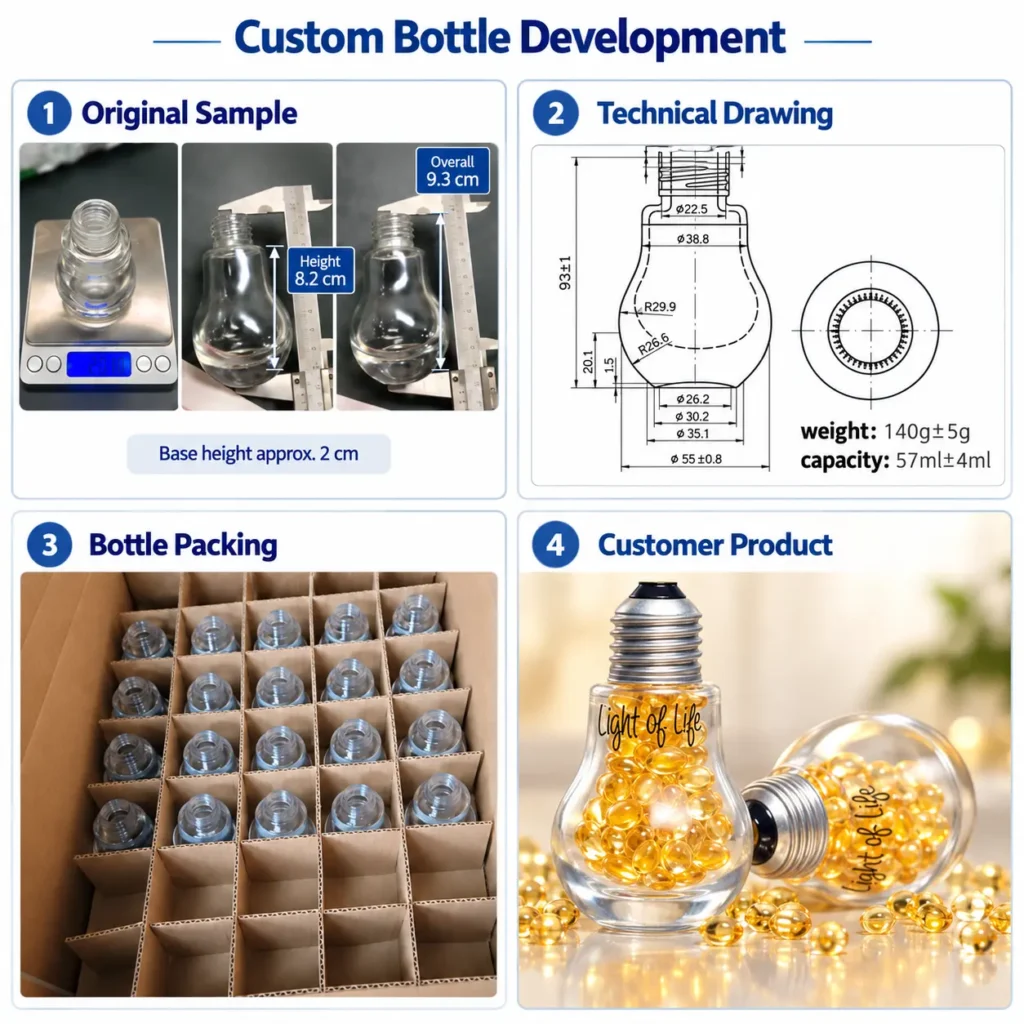
The development challenge was to reconsider the capacity, proportions, and glass structure without losing the original design direction. The project sequence described in the source material included reviewing the original sample, evaluating the target capacity and dimensions, optimizing the structure and proportions, preparing a technical drawing, developing the mold, reviewing physical glass samples, and obtaining production approval.
The project record also describes a trial order followed by regular monthly repeat orders after the bottle and samples were approved. This is a project-specific account, not a general production guarantee or a claim that every custom bottle project will follow the same schedule or result.
What Buyers Can Learn from This Development Process
The useful lesson is the sequence of decisions. Buyers should not approve a custom bottle from a concept image alone. The target capacity and external dimensions need to be defined; the proposed shape needs to be assessed as a glass structure; and the technical drawing, mold sample, and final physical bottle need to be reviewed before production approval.
Although this documented project involved capsule packaging rather than perfume, the same development considerations apply when a fragrance brand needs a proprietary glass bottle shape. The closure and dispensing system must also be included in the project specification so the final bottle can be evaluated as a complete package.
Other documented packaging examples can be reviewed in FOLOVER PACK’s glass packaging case studies.
Manufacturer Insight
When a bottle capacity changes, the original silhouette may not remain unchanged in proportion. The glass body, base, shoulder, neck position, and closure arrangement need to be reviewed together. For this reason, a buyer should evaluate the technical drawing and physical sample as separate approval steps rather than treating approval of the visual concept as approval for production.
6. When Should a Brand Choose a Standard Bottle or Develop a Custom Mold?
Not every fragrance project needs a new glass mold. An existing bottle can be the more practical route when its capacity, shape, neck finish, and component options meet the brief. Custom mold development becomes relevant when the required silhouette, proportions, or structure cannot be achieved with available designs.
6.1 When a Standard Perfume Bottle Makes Sense
A standard bottle is worth considering when the available shape and dimensions already suit the product. It can reduce the need for new bottle tooling and may allow the project team to focus on selecting the closure, cap, color, and decoration.
Before choosing an existing design, confirm its actual capacity, external dimensions, neck finish, compatible component options, decoration area, availability, and any project-specific order requirements. A bottle should not be selected solely because its product photograph resembles the reference.
6.2 When Custom Mold Development Is Worth Considering
A custom mold may be appropriate when an existing bottle cannot deliver the required silhouette, dimensions, capacity, or structural details. It may also be considered when a brand needs a distinctive bottle form that can justify the development work over its planned product life.
The decision should account for design feasibility, tooling investment, target quantity, expected repeat orders, development time, component availability, and filling-line requirements. Exact mold costs, minimum quantities, and lead times are project-specific and should be confirmed in the quotation rather than assumed from a general guide.
6.3 Standard Bottle vs. Custom Mold
| Consideration | Standard bottle | Custom mold |
|---|---|---|
| Starting point | An existing bottle design | A project-specific bottle concept and technical development |
| Shape selection | Limited to available designs | Can be developed around the approved design brief, subject to feasibility |
| Decoration | Uses decoration methods suitable for the existing surface | Can combine a new glass shape with suitable decoration methods |
| Tooling | Usually avoids new bottle mold development | Requires project-specific tooling evaluation |
| Main buyer checks | Dimensions, neck finish, components, availability, and sample approval | Design feasibility, structure, tooling, sample development, and production approval |
7. What Should Buyers Check Before Ordering Perfume Bottles?
A product photograph is useful for shortlisting designs, but it does not show every detail needed for procurement. Before confirming an order, evaluate the glass body, dispensing components, cap, decoration, and intended filling and packing process together.
7.1 Confirm Capacity and Dimensions
Start with the required filling capacity and the bottle’s external dimensions. Two bottles with the same nominal capacity can have different heights, widths or diameters, base dimensions, weights, and assembled proportions.
Ask for the drawing or specification of the selected model. Confirm the nominal capacity, external dimensions, bottle weight where specified, and neck finish. Do not transfer dimensions or component details from one model to another simply because the bottles look similar.
7.2 Check the Bottle and Sprayer Together
The bottle and sprayer should be evaluated as a matching assembly. Confirm the neck finish, attachment system, sprayer specification, gasket or other relevant contact materials, dip tube length, collar where applicable, and cap fit. Crimp and screw systems require their corresponding components.
Check the assembled sample rather than assuming that a component will fit because its nominal size appears similar. If the formula or storage conditions create additional compatibility requirements, those should be evaluated with the intended formulation and selected contact materials.
7.3 Evaluate Glass Color and Surface Finish
For colored, frosted, or coated bottles, compare the physical sample with the approved reference under consistent lighting. Check whether the color, transparency, surface effect, and decoration position meet the brief. Photographs and videos help with preliminary review but cannot replace approval of the actual sample.
7.4 Review the Complete Assembled Package
A glass bottle can look correct by itself and still appear different after the sprayer, collar, cap, and decorative parts are installed. Review the complete assembly for component fit, visual alignment, dispensing behavior, and suitability for the intended filling and packing process.
Perfume Bottle Buyer Checklist
- Target filling capacity and bottle dimensions
- Glass color, clarity, and surface finish
- Neck finish and crimp or screw attachment system
- Sprayer, actuator, dip tube, collar, and cap requirements
- Logo artwork, decoration method, and placement
- Target order quantity and whether a stock or custom design is required
- Physical sample approval and any formula-related checks
- Filling, assembly, protective packaging, and destination requirements
What to Check on the Physical Sample
- Confirm the bottle shape, capacity, dimensions, and visible glass appearance.
- Check that the selected sprayer attaches correctly to the specified neck.
- Review dip tube positioning, cap fit, and the complete assembled height.
- Evaluate dispensing with the intended liquid and use conditions where required.
- Approve logo position, print, coating, frosting, and color on the actual bottle.
- Review the assembled package before authorizing bulk production.
8. Examples of Round and Square Perfume Bottle Designs
Actual bottle examples help buyers compare how shape, capacity, and cap design affect the complete package. The following examples are drawn from FOLOVER PACK product materials; the model-specific descriptions should be checked against the current product specification before being used in an RFQ.
50 ml Round Perfume Bottle with Black and Gold Textured Cap
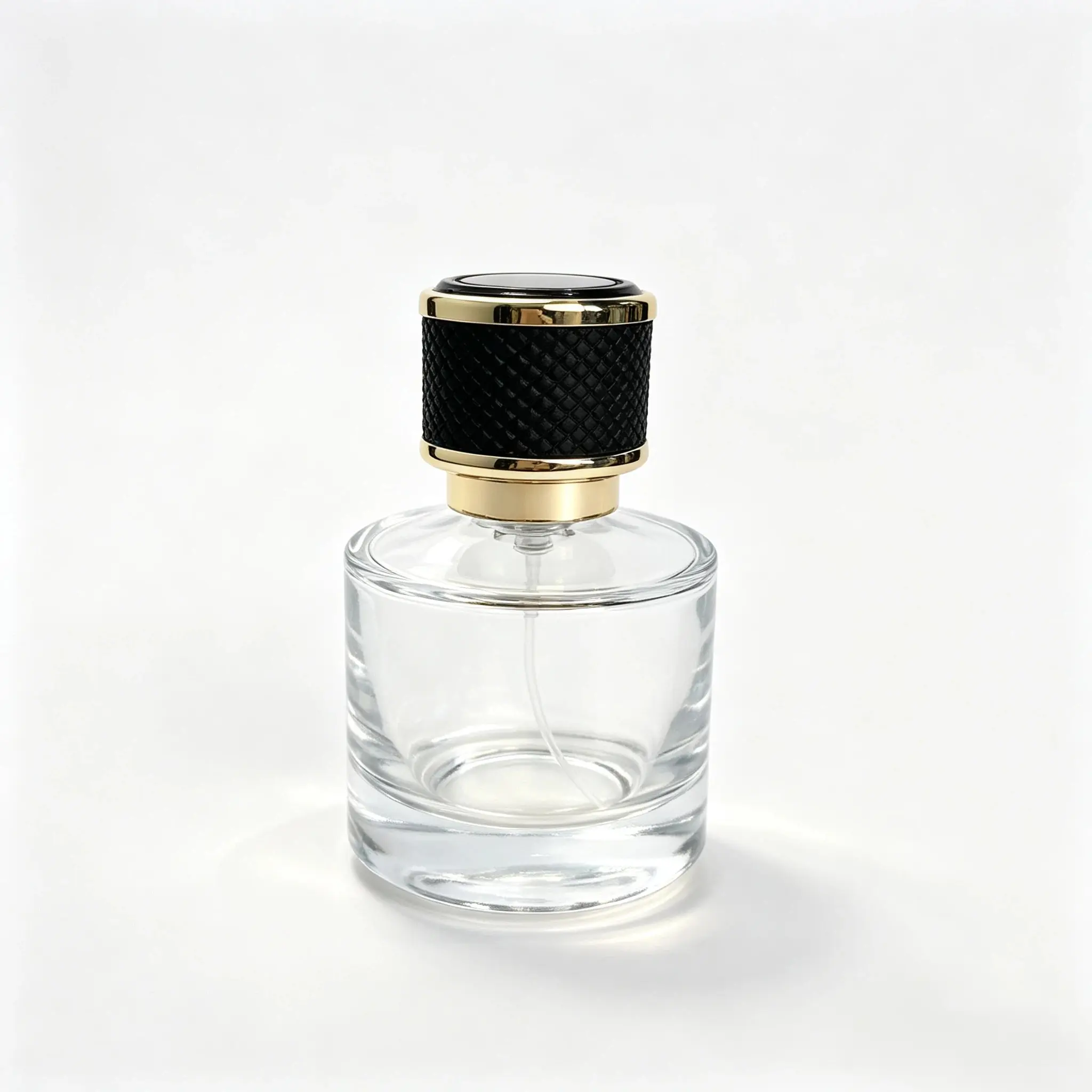
The RPB-005-50 example uses a cylindrical glass body with a crimp sprayer, inner plug, and black-and-gold textured outer cap. It illustrates how the cap can change the visual balance of a relatively simple round bottle. Confirm the current component configuration and product dimensions before specifying it for a project.
30 ml Square Glass Perfume Bottle with Octagonal Black Cap
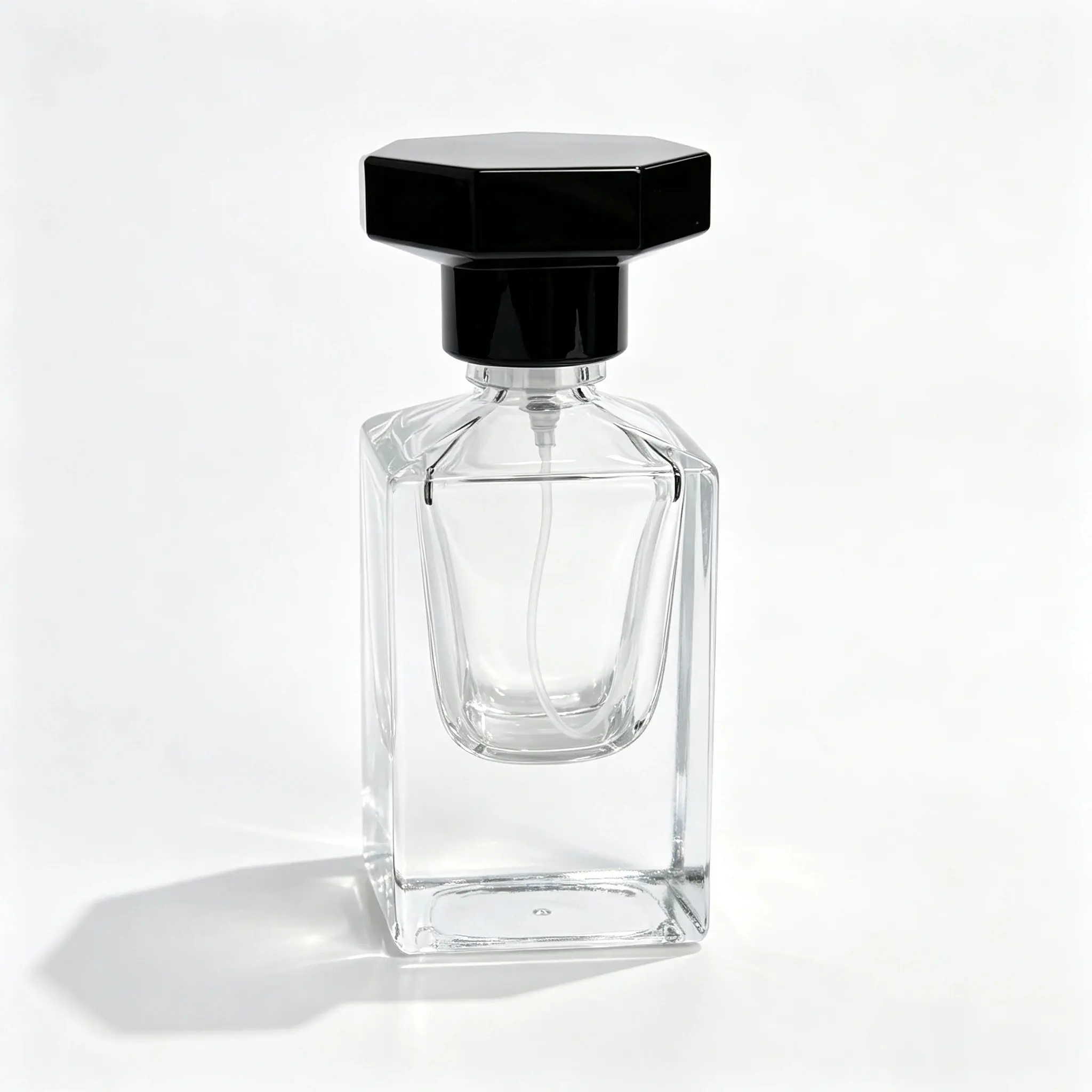
The SPB-006-30 example has a 41 × 41 mm body, a recessed front profile, a crimp sprayer, an inner plug, and an octagonal black outer cap, according to the supplied product description. The comparison shows why the glass body and cap should be considered as one assembled design rather than evaluated separately.
For a broader selection framework covering bottle direction, component matching, and decoration, see the FOLOVER Perfume Packaging Guide.
9. Frequently Asked Questions About Perfume Bottle Types
What are the most common types of perfume bottles?
Common shapes include round, cylindrical, square, rectangular, oval, and sculptural bottles. Perfume packaging can also be compared by capacity, glass color, surface finish, and dispensing system. These categories overlap: a bottle can have more than one of these characteristics.
Are round or square perfume bottles better?
Neither shape is universally better. Round bottles have curved bodies, while square and rectangular bottles provide more defined panels. The right option depends on the design brief, decoration area, proportions, selected closure, and the appearance of the complete assembled package.
What is the difference between colored glass and spray-coated glass?
Colored glass has its color as part of the glass material’s appearance. Spray coating applies a finish to the bottle’s exterior surface. They may look similar in photographs, so buyers should specify the intended process and approve the actual sample.
Are frosted and coated perfume bottles the same?
No. Frosting changes the glass surface to create a matte or translucent appearance, while coating applies a layer to the exterior. Sandblasting and chemical etching are two frosting approaches, and the finished appearance depends on the process and bottle.
Can a standard perfume bottle be customized?
Depending on the bottle and selected process, an existing design may be customized with suitable printing, labels, coating, frosting, or cap combinations. The available decoration area and final appearance should be checked on a physical sample before bulk production.
When should a brand consider a custom perfume bottle mold?
A custom mold may be worth considering when available bottles cannot achieve the required silhouette, capacity, dimensions, or structural details. The decision should account for design feasibility, tooling investment, order volume, repeat-order plans, and sample approval.
What should buyers confirm before ordering wholesale perfume bottles?
Confirm the capacity, dimensions, glass appearance, neck finish, sprayer and cap configuration, decoration requirements, order quantity, and sample approval conditions. If formula compatibility or specific filling conditions matter, include those requirements in the evaluation before bulk production.
Choose the Bottle as a Complete Packaging System
The right perfume bottle is not determined by shape alone. Capacity, proportions, glass appearance, neck finish, sprayer, cap, decoration, and the intended filling process all affect the final package. A stock bottle is a practical starting point when its specification meets the brief; a custom mold should be considered when the required structure cannot be achieved with an existing design.
Before confirming bulk production, review the technical specification and approve a complete physical sample. Buyers preparing an RFQ should provide the target capacity, reference shape, neck or sprayer requirements, decoration artwork, estimated quantity, and any filling or packing requirements. This gives the packaging team a clearer basis for reviewing suitable bottle options and the next development steps.