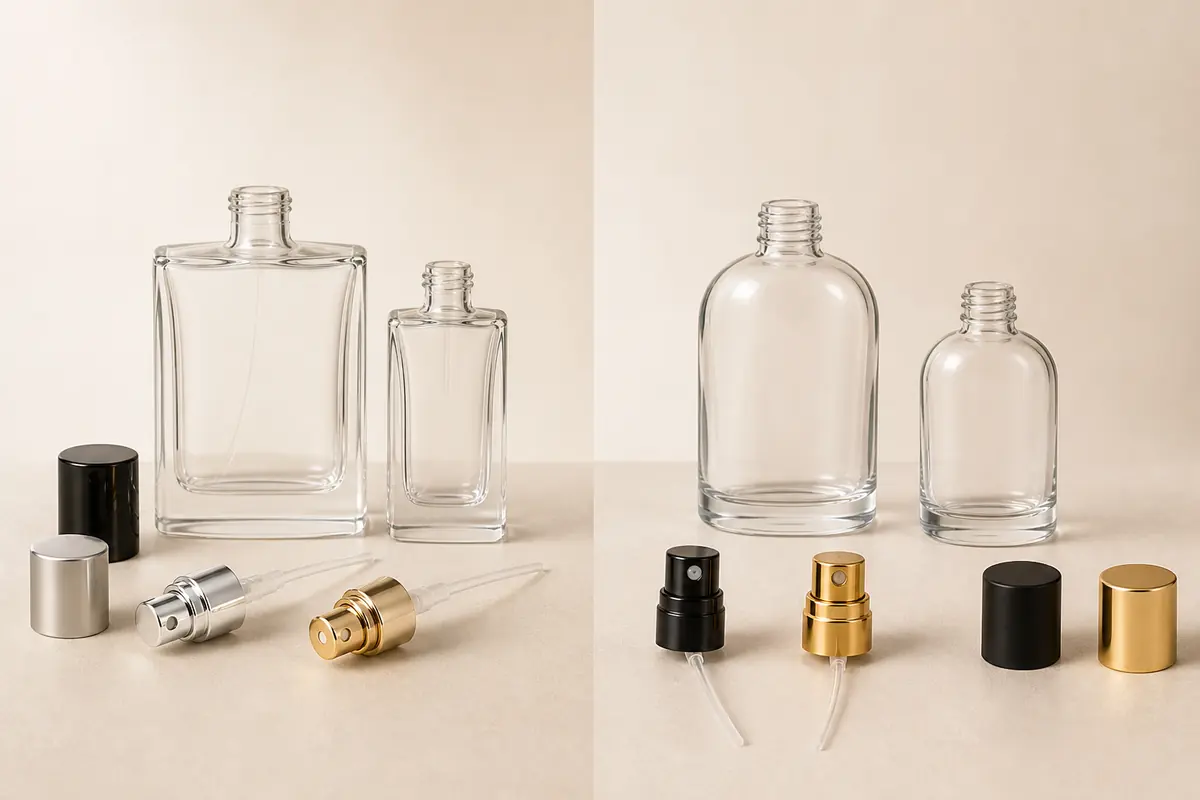

Glass cosmetic bottles can sometimes be recycled with pumps attached, but this should never be assumed. The correct disposal method depends on the local collection and sorting system, the glass bottle, and the pump’s material composition. A cosmetic pump commonly combines several plastics, a gasket, a dip tube, and sometimes a metal spring. These components may follow different recycling pathways from the glass bottle.
For consumers, the practical answer is to empty the package, follow local recycling instructions, and remove the pump when the program requires separation or accepts the glass bottle but not the pump. For cosmetic brands, the key purchasing decision is whether the finished bottle-and-pump system can be separated, collected, and processed in the intended sales markets. A recyclable glass bottle does not automatically make the complete package recyclable.
Why a lotion pump is not one simple material
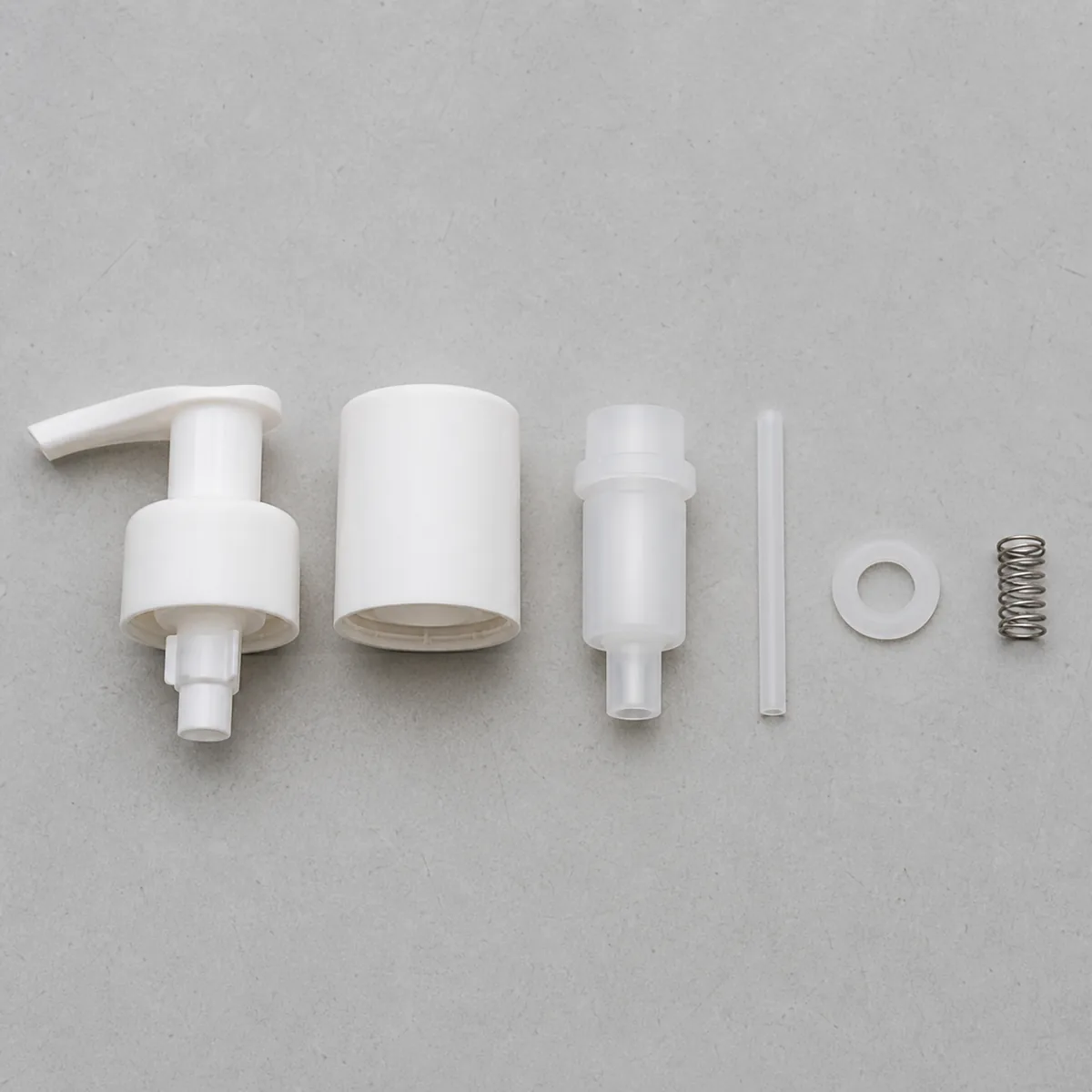
A lotion pump performs several functions in a compact assembly. The actuator, housing, piston, closure, dip tube, gasket, valve elements, and spring may use different materials selected for stiffness, sealing, recovery, chemical contact, or manufacturing. Even when most visible parts are plastic, an internal metal spring or incompatible polymer can change how the component is sorted and processed.
Separating a pump from its glass bottle does not guarantee that the pump itself can be recycled. Small components may be lost during sorting, and mixed materials can complicate processing. A design described as “all plastic” still requires evidence about its resin composition, collection acceptance, sorting behavior, and available recycling pathway.
The article on mono-material versus multi-material packaging explains why reducing the number of material families can simplify a packaging design without automatically making it recyclable in every market.
Manufacturer Insight: When evaluating a glass bottle and pump for a skincare collection, FOLOVER PACK recommends identifying the bottle, pump, gasket, dip tube, cap, and decorative components separately. Buyers should obtain the selected components’ material specifications and confirm whether the complete pump can be removed safely.
The bottle supplier can provide component information, but material composition alone cannot establish recycling acceptance. Consumer disposal instructions must also reflect the collection and processing systems available in the destination market.
Glass acceptance is local, not universal
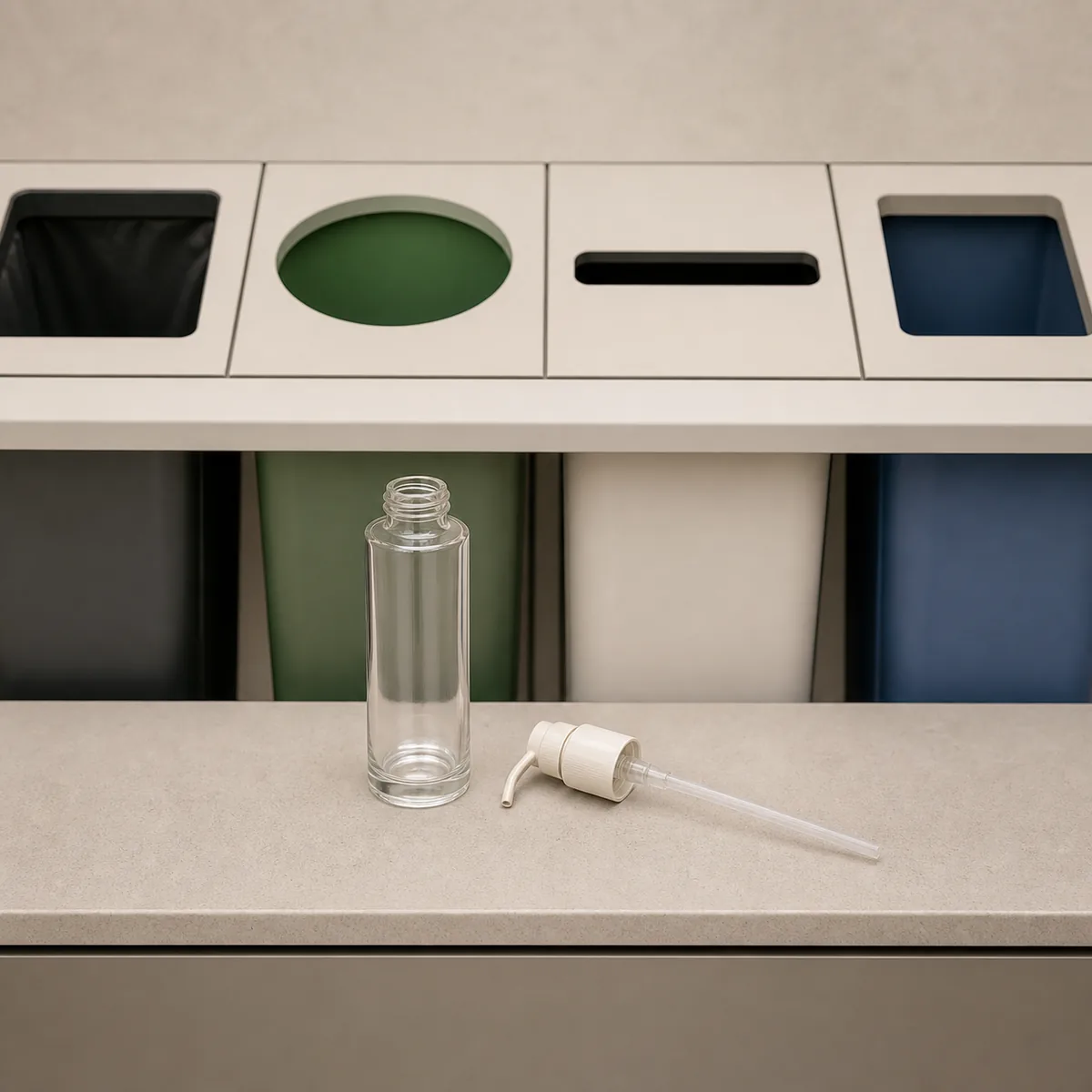
Glass collection varies by country, municipality, hauler, and program. Some systems collect container glass at the curb; others use drop-off points, deposit systems, color separation, or no household glass collection. Cosmetic packaging may also be treated differently if it contains product residue, non-container glass, heavy decoration, or attached components.
The United States Environmental Protection Agency advises consumers to check the local program first for whole glass and for specific caps or closures. Its current recycling guidance also distinguishes instructions by material and component rather than offering one national rule. See the EPA’s frequent recycling questions and common recyclables guidance.
For example, a glass serum bottle may be accepted by a local container-glass collection program while its detached lotion pump is excluded. Another program may have different preparation requirements. Neither outcome should be generalized to every market where the same product is sold.
This local variability is the central fact that consumer instructions must communicate. A technically separable bottle and pump do not create collection access. Conversely, a program with appropriate sorting may handle an attached minor component differently from a program that asks residents to separate it. The brand should not replace local instructions with a global slogan.
Should consumers remove the pump?
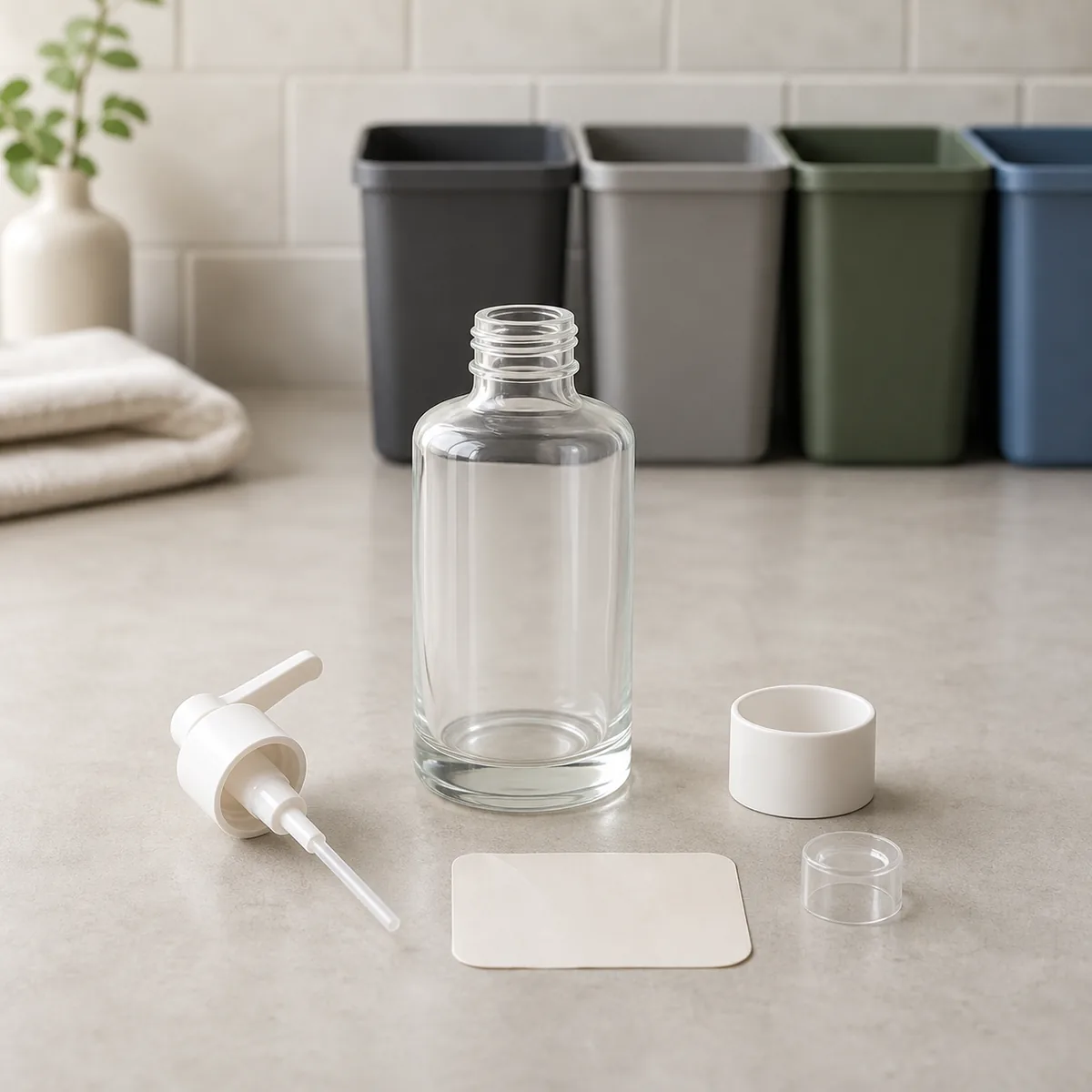
Removal is often the clearer instruction when the local system accepts the glass bottle but not the pump, or when attached pumps are known to interfere with local preparation rules. The consumer should be able to separate the component by hand without tools, broken glass, sharp edges, or unreasonable effort. If a pump is permanently attached, the brand must understand how that affects collection and any recyclability representation.
Do not tell consumers to dismantle the internal pump. Separating the complete pump from the bottle is different from pulling apart its spring, piston, gasket, and housing. Small mixed parts can be difficult to sort and may create handling risk. Disposal instructions should be simple enough to follow at the point of use.
A closure that unscrews cleanly supports component separation, but it also must preserve formula compatibility, leakage resistance, and consumer function during use. Recycling preparation is one requirement within the complete package, not a reason to compromise the product. Buyers reviewing cosmetic lotion pumps should evaluate both dispensing performance and the intended end-of-use pathway.
Emptying and residue matter
Programs commonly expect containers to be empty, but the exact level of rinsing or cleaning varies. Thick creams and lotions can remain on bottle walls, beneath shoulders, and inside pumps. Excess product can contaminate handling, add odor, or make the item unsuitable for the intended stream. At the same time, instructions should not encourage excessive water or unsafe cleaning methods without local justification.
For a lotion bottle that cannot be emptied adequately through its pump, a removable closure may allow the consumer to access residual product. However, this is only useful if removal is safe and practical under normal conditions.
Brands can improve emptying through bottle geometry, dip-tube reach, appropriate dispensing, and accessible openings. They can also state a practical preparation step such as “empty bottle and follow local guidance,” where substantiated and legally reviewed. They should not imply that a difficult-to-empty package is fully ready for recycling merely because the substrate is glass.
Labels, coatings, and decoration need separate review
Paper labels, pressure-sensitive films, sleeves, inks, metallic decoration, spray coatings, frosting, and adhesives may behave differently in local glass processing. Some minor decoration may be tolerated; other constructions can affect color sorting, optical detection, furnace input, or acceptance. A supplier should not make a blanket claim for every decoration based on undecorated glass.
Ask what parts consumers can reasonably remove, whether full-body sleeves should be separated, and whether the local program has explicit instructions. If a label must be removed but the adhesive makes that impractical, the disposal message and package design are misaligned. The article on whether glass cosmetic packaging is sustainable provides the broader trade-offs; this article stays focused on pump attachment at disposal.
When selecting a coated or decorated bottle, buyers should provide the recycling assessor with the actual coating, label, adhesive, and decoration specifications. An approval based on an undecorated clear-glass bottle should not automatically be extended to a fully coated or heavily decorated version.
A market-by-market instruction matrix
For a cosmetic brand selling the same bottle-and-pump combination in several countries, the following questions should be answered separately for each intended market.
| Question | Evidence source | Instruction consequence |
|---|---|---|
| Is cosmetic container glass collected? | Municipality, hauler, deposit operator, or approved labeling program | Determines whether a bottle recycling instruction is appropriate |
| Must pumps be removed? | Local preparation rules | Defines attached versus separated disposal |
| Is the pump accepted separately? | Local resin and small-item rules | Prevents sending an unsupported component to recycling |
| How empty or clean must the bottle be? | Collection-program guidance | Defines consumer preparation language |
| Are labels, sleeves, or closures removed? | Program-specific instructions | Shapes design-for-separation and wording |
| Can the claim be made in that market? | Legal and substantiation review | Controls qualification and scope |
Maintain the matrix by sales market and update it when programs or claims rules change. One global icon can conceal significant differences. A QR code or market-specific web page may hold current instructions, but digital information should not be used to hide a qualification that consumers need to see clearly on the package.
Recyclable claims require real access and evidence
In the United States, the Federal Trade Commission’s Green Guides explain that recyclable claims may require qualification when appropriate facilities are not available to a substantial majority of consumers or communities where the item is sold. The current FTC summary identifies that “substantial majority” benchmark as 60 percent. Brands should obtain market-specific legal review rather than transplanting that US threshold to every jurisdiction. See the FTC’s official Green Guides summary.
The claim also needs a clear object. “Recyclable bottle” is narrower than “recyclable package” when the pump is excluded. If only the glass body is accepted, the label should not let consumers reasonably understand that the pump follows the same route. The article on sustainable packaging claims explains how to keep recyclable, recycled, refillable, and reduced claims distinct.
What does the EU PPWR mean for glass bottles with pumps?
For brands selling cosmetic packaging in the European Union, Regulation (EU) 2025/40, the Packaging and Packaging Waste Regulation (PPWR), is also relevant. The regulation began applying on 12 August 2026, while several detailed recyclability and labeling requirements have later application dates.
Article 6 addresses packaging recyclability, including design for material recycling and the ability to collect, sort, and recycle packaging. The requirements do not mean that every existing glass cosmetic bottle automatically qualifies as recyclable with its pump attached.
The European Commission’s 2026 guidance on Regulation (EU) 2025/40 explains the phased application of its recyclability requirements. Buyers should review the applicable provisions, implementation dates, and requirements for their exact packaging configuration and market.
PPWR compliance, participation in a producer responsibility scheme, and consumer-facing recyclability claims are related but distinct matters. None should be used as automatic proof that the complete glass bottle-and-pump assembly is accepted by every local recycling program.
Design choices that improve the disposal decision
- Use a pump that consumers can remove from the bottle safely when separation is required.
- Avoid unnecessary secondary collars or decorations that obstruct separation.
- Identify the bottle, pump, label, and cap materials in the technical file.
- Evaluate whether the bottle can be reasonably emptied under normal use.
- Map collection and sorting rules in the actual sales markets.
- Write component-specific instructions and qualify claims where access is limited.
- Recheck instructions when components, decoration, market, or local programs change.
For a new skincare packaging project, these decisions should be considered before approving the final bottle and closure. A removable pump may simplify separation, but it must still match the selected bottle neck, sealing geometry, formulation, and dispensing requirements.
Final bottle and closure compatibility should be confirmed using the selected components and physical samples before bulk production. A change made to improve end-of-use separation should not introduce leakage, dispensing problems, or an unsuitable product-contact material.
A practical brand workflow
Brands should evaluate the finished packaging configuration rather than treating the glass bottle and pump as independent purchasing decisions. The following workflow helps connect component selection with realistic consumer disposal instructions.
- Freeze the exact bottle, pump, cap, label, coating, and decoration.
- Document material and separability information from controlled sources.
- Identify the local collection pathways in each target market.
- Test whether normal consumers can empty and separate the package safely.
- Draft component-level instructions and environmental claim qualifications.
- Obtain relevant legal, labeling, and program review.
- Maintain evidence and update the instruction matrix after changes.
The cosmetic bottle closures and dispensing guide helps teams compare closure functions, while the skincare packaging guide covers the wider package decision. Candidate cosmetic glass packaging and pumps, droppers, and bottle accessories still need market-specific end-of-use review.
Readers can explore direct disposal questions in Packaging Q&A and the broader evidence and trade-offs in Sustainable Packaging. The foundational overview of packaging waste, EPR, and recyclability explains why producer obligations and consumer instructions should not be reduced to one material claim.
Buyer conclusion
For B2B buyers, the purchasing decision should connect the approved bottle-and-pump specification with the intended disposal route. A supplier’s material declaration helps establish what the package contains, while local collection evidence and applicable claim requirements determine what can responsibly be communicated to consumers.
Material disclosure is necessary but not sufficient
A bill of materials can show that a bottle is glass and identify major pump components, but it cannot prove that local facilities collect, sort, and process the finished package. Resin codes, glass color, component weights, separability, dimensions, labels, coatings, and metal content are useful inputs. The recyclability conclusion still requires a real pathway and an end market appropriate to the claim.
Likewise, a laboratory separation test does not show that consumers will separate the package correctly. A closure may be technically removable yet too slippery, tight, messy, or confusing after months of use. If a claim depends on removal, representative users should be able to perform it safely using the visible instruction and no special tools.
Test whether the instruction is actionable
Give users a finished or production-representative package near its normal end of use. Ask them to prepare it for disposal using only the intended label or digital guidance. Observe whether they identify the correct components, empty the bottle, remove the pump, replace or separate the cap, and choose the intended route. Record misunderstandings rather than coaching the participant immediately.
This simple evaluation can reveal that a recycling icon appears to cover the whole package, that the pump cannot be gripped, that lotion residue makes separation unpleasant, or that a QR instruction is not noticed. Improve the package or wording, then repeat. A technically accurate statement that most users misread is not effective disposal guidance.
Keep EPR, collection, and recyclability claims distinct
Extended producer responsibility obligations can require registration, reporting, fees, labeling, or other actions depending on the market. Compliance with an EPR obligation does not itself prove that a bottle-and-pump combination is recyclable. Paying a packaging fee, joining a scheme, or displaying an authorized mark may describe participation in a system; it should not be expanded into an unsupported material-performance claim.
Similarly, collection is only one stage. A package may be placed in a bin yet later rejected during sorting, or a material may be technically processable but lack practical access for the target consumer. The brand’s evidence file should distinguish design attributes, collection access, sorting compatibility, reprocessing, end markets, legal obligations, and the exact wording shown to consumers.
Control changes after the claim is approved
A new pump spring, resin, pigment, label stock, adhesive, full-body coating, metallized collar, or bottle color can change the basis for instructions. Expanding to another country or retailer can change collection access. Link the approved claim and artwork to controlled item codes and market versions, then trigger review when the package or sales scope changes.
Evidence should have an owner and review date. Local program pages, labeling rules, and claim guidance can change, so a disposal statement should not remain permanent merely because it was correct at launch. This maintenance discipline is more credible than adding broad green language to every glass package.
Final Recommendation: A cosmetic glass bottle is not automatically ready for recycling with its pump attached. Treat the glass body and multi-material dispenser as separate decision objects, verify local rules, make separation practical, and qualify the claim to match real collection access. The most responsible instruction is the one consumers can actually follow in the market where the package is sold.
FOLOVER PACK supports cosmetic glass bottle selection, pump and closure matching, component coordination, and packaging customization. For a project involving recyclability or component separation requirements, share your intended bottle, pump, formulation, destination markets, and relevant packaging specifications. FOLOVER PACK can provide component information and suitable packaging options for evaluation, while recycling acceptance and environmental claims remain subject to market- and program-specific verification.
Discuss Your Glass Bottle and Pump Packaging Requirements
Frequently asked questions
Are cosmetic pumps recyclable?
Some may be accepted in specific systems, but pumps often contain several materials and small components. Verify the exact pump and the local program rather than assuming acceptance.
Should the pump be removed from a glass bottle?
Remove it when local instructions require separation or accept the bottle but not the pump. Do not dismantle the internal mechanism unless an authorized program explicitly requests it.
Do labels need to be removed?
Requirements vary. Follow the local program’s directions for labels, sleeves, adhesives, caps, and cleaning.
Can coated cosmetic glass be recycled?
Acceptance depends on the coating, coverage, processing system, and local rules. An undecorated-glass result should not be extended automatically to every coating.