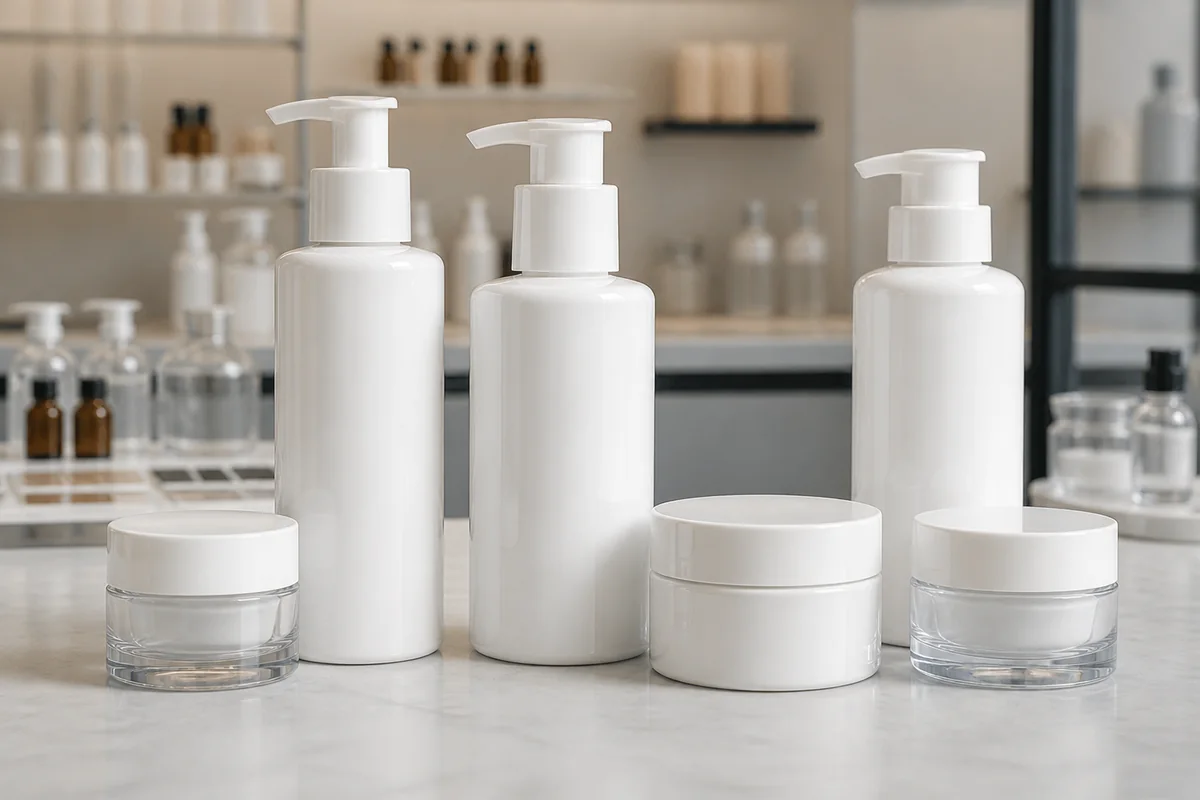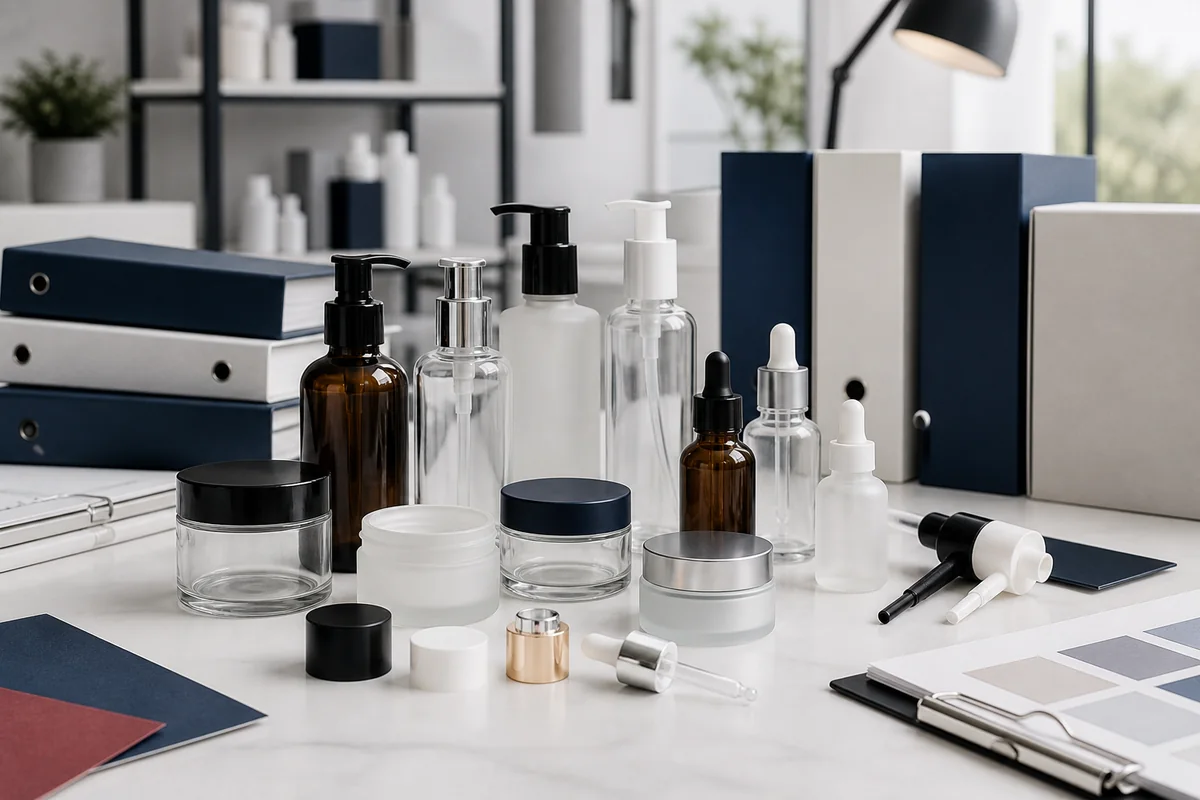

A cosmetic packaging compliance file should connect the final packaging configuration to its specifications, supplier declarations, test reports, approved samples and change history. Start with a controlled bill of materials (BOM), identify the evidence required for each component, and record who approved each decision and when it must be reviewed again.
For a new cosmetic product, the file should cover the selected bottle or jar, closures, dispensing components, decoration, labeling and secondary packaging as relevant. The required evidence depends on the actual materials, formulation, intended use and destination market. A supplier certificate alone cannot establish that the complete packaging system is suitable for the finished product.
This guide focuses on the packaging-development and procurement records that support those decisions. For broader regulatory responsibilities, see the Regulations & Compliance hub and the Packaging Trends & Insights resources.
Direct Answer
A useful cosmetic packaging compliance file should preserve approval decisions, not merely collect documents. Each approved component and packaging configuration should be linked to its BOM revision, supporting evidence, responsible reviewer, applicable limitations and reassessment triggers.
Before purchasing the final packaging, the buyer should be able to identify which configuration has been approved, what the available evidence supports and which outstanding issues require further review.
FOLOVER Manufacturer Insight
For custom cosmetic glass packaging projects, FOLOVER PACK can support bottle selection, component matching, decoration coordination, sample evaluation and relevant quality checks. These activities can provide technical information and physical references for a buyer’s packaging compliance file.
Consider a skincare brand that selects a stock glass bottle and sources a dispensing pump separately. Before the combination is approved, the buyer needs the selected bottle specification, the pump supplier’s component information and an assembled sample. A matching nominal neck size does not, by itself, establish sealing or dispensing compatibility.
Where FOLOVER coordinates components from different manufacturing sources, the evidence should remain traceable to the actual component supplier and packaging version. The brand or its designated responsible professionals must determine whether the assembled packaging has sufficient evidence for the intended finished product and destination market.
For a productive inquiry, provide the intended application, bottle or jar style, closure system, formulation characteristics, decoration requirements, destination market and required documentation. Product-specific specifications and physical sample results should determine the final approval.
Define the file’s purpose and legal boundary
A cosmetic packaging compliance file is a practical internal evidence system; it is not one globally standardized legal dossier. Its purpose is to organize the information needed to review and approve a specific packaging configuration while identifying which statutory responsibilities remain with the relevant business or professional.
In the European Union, Article 11 of Regulation (EC) No 1223/2009 requires the responsible person to maintain a Product Information File (PIF) for the cosmetic product. Annex I, Part A, point 4 also identifies relevant packaging-material characteristics, particularly purity and stability, as information for the cosmetic product safety report.
The packaging compliance file can supply supporting information for this assessment, but it does not replace the PIF or the assessment performed by a suitably qualified cosmetic product safety assessor. The EU’s guidelines on the cosmetic product safety report further explain the relevance of packaging materials in direct contact with the formulation, including potential interactions and substance migration.
For the United States, applicable responsibilities must be assessed under the relevant cosmetic laws, including the Modernization of Cosmetics Regulation Act of 2022 (MoCRA). The FDA distinguishes cosmetic facility registration and product listing from product approval; neither a registration number nor a listing number establishes FDA approval of the cosmetic product.
Begin with cosmetic packaging compliance basics, then document the destination markets, intended product use, responsible business entities and the specific decisions the packaging file is intended to support.
Evidence to retain: File purpose, destination markets, finished-product owner, responsible regulatory reviewer, scope exclusions and the relationship between the internal packaging file and applicable statutory records.
Packaging suitability, cosmetic product safety, labeling, packaging-waste obligations and product registration are separate questions. The applicable requirements and responsible parties should be identified for the actual product and destination market.
Freeze the final packaging BOM
The BOM is the foundation of the packaging compliance file because supporting evidence must correspond to the actual components being purchased and assembled. A document covering one pump material or bottle version should not automatically be assigned to a visually similar alternative.
Include the bottle or jar, pump, dropper or sprayer, dip tube or pipette, gasket, liner, wiper, collar, cap, overcap, decoration, label, carton and transport packaging where relevant. Give each item a buyer code, supplier code, revision and source. Record approved alternatives separately rather than mixing them into the current production configuration.
For a multi-component closure, identify the relevant constituent materials where this information is needed for compatibility or regulatory assessment. A pump with a plastic actuator, metal spring and separate sealing component should not automatically be treated as a single material simply because it is purchased as one assembled item.
Buyer action: Map the chosen cosmetic glass packaging system before collecting certificates. Confirm which components are in direct contact with the formulation and which belong to the outer packaging.
Evidence to retain: Approved BOM revision, component hierarchy, supplier and manufacturer identity where relevant, item codes, material information, formula-contact status and approved alternative configurations.
Control drawings and specifications
An approved specification defines the commercial component. Without that definition, a supplier declaration or test report may be difficult to connect to the packaging actually delivered.
Store controlled drawings covering the relevant capacity, dimensions, neck and closure interface, materials, colors, decoration, critical appearance criteria and agreed functional requirements. Use the approved supplier drawings and project-specific acceptance criteria rather than applying generic tolerances to unrelated products.
For a glass bottle and dispensing pump, the specification review should cover the relevant neck finish, sealing interface, closure structure and assembled configuration. Dip-tube or pipette length, bottle height and dispensing requirements should be evaluated using the selected components. Two closures that look alike or share a nominal size are not necessarily interchangeable.
Buyer action: Use the skincare packaging guide to connect the intended application to the physical packaging specification. Obtain the applicable drawings for the final bottle and closure combination before approving production samples.
Evidence to retain: Approved drawings and specifications, revision history, measurement units, agreed acceptance criteria, responsible reviewer and supplier acknowledgment.

Identify suppliers and manufacturing sources
The file should identify who supplied and, where relevant, manufactured each component or carried out a particular production or decoration process. A commercial supplier’s name alone may not identify the original source of every material declaration or test report.
Record the legal supplier entity, relevant manufacturing or decoration source, contact details, quotation reference and approved alternative sources. Identify which party supplies the bottle, closure, decorative components and secondary packaging when those items originate from different businesses.
For example, if a brand changes its pump supplier while retaining the same glass bottle, the change should trigger a review of the new pump’s construction, materials, specifications and existing compatibility evidence. The original pump supplier’s documents should not be transferred to the replacement component without an appropriate assessment.
Buyer action: Review FOLOVER PACK manufacturing capabilities as part of the commercial sourcing and coordination process, while identifying the actual evidence source for each component.
Evidence to retain: Supplier identity, manufacturing source where relevant, purchase specification, approved alternatives and agreed supplier change-notification requirements.
Collect material and regulatory declarations
Supplier declarations should be indexed against specific BOM items and applicable requirements rather than stored together under a generic compliance label. A declaration is useful only when the buyer understands which material, component, regulatory requirement and version it covers.
For an EU-bound packaging project, relevant evidence may include material information and restricted-substance declarations, including REACH and Substances of Very High Concern (SVHC) information where applicable.
Under REACH Article 33, EU and EEA suppliers of articles containing a Candidate List substance above 0.1% by weight must provide the required safe-use information to recipients. The European Chemicals Agency explains the applicable Candidate List obligations, including the distinction between duties relating to substances, mixtures and articles.
The 0.1% threshold is a legal criterion for the relevant article obligations, not a universal permissible concentration for every substance or cosmetic packaging material. Buyers should identify which article or component is being assessed, which Candidate List version applies and whether other restrictions or information duties are relevant.
For packaging placed on the EU market, the Packaging and Packaging Waste Regulation (EU) 2025/40 must also be considered where applicable. Its provisions begin applying on a phased basis from 12 August 2026. Buyers should confirm which packaging-related requirements apply to their configuration and intended market-placement date rather than assume that one supplier declaration covers all obligations.
For multi-material pumps and decorated glass bottles, request evidence covering the relevant constituent materials and processes. A declaration for the glass body does not automatically establish the status of the coating, ink, cap, gasket or other assembled components.
Buyer action: Use cosmetic packaging documents explained to distinguish technical specifications, material declarations, safety data sheets, certificates of analysis and test reports. Request only the documents relevant to the selected packaging configuration and destination-market requirements.
Evidence to retain: Original declarations, covered item codes, material identification, regulatory basis, referenced legal or Candidate List version, issue date, issuer, limitations and the buyer’s documented review conclusion.
Store laboratory reports with interpretation
A laboratory report should be accompanied by a review note explaining the decision it supports and the conditions that limit that decision. A report showing an acceptable result for one tested sample does not automatically establish that every packaging variation has been evaluated.
Keep the complete report, sample identification, photographs where supplied, test method, conditions, measurement units, results and laboratory details. Link the tested sample to the relevant BOM item and approved packaging version.
Before accepting an existing report, confirm that the tested material, component construction and relevant processing conditions correspond to the selected commercial packaging. If the bottle coating, closure supplier, gasket material or other relevant feature changes, assess whether the existing report remains applicable or additional evidence is required.
For example, a report covering the material of a pump actuator does not, by itself, establish the chemical suitability of a separate gasket that contacts the cosmetic formulation. The buyer must identify the actual scope of the report before using it to support an approval decision.
Buyer action: Create a report-to-decision record instead of relying on a filename indicating that the component passed a test. Record the tested configuration, supported conclusion, excluded configurations and conditions that would require reassessment.
Evidence to retain: Complete test report, identification of the tested sample and corresponding commercial configuration, test method, results, interpretation, reviewer, approval status and reassessment trigger.
Include compatibility and functional evidence
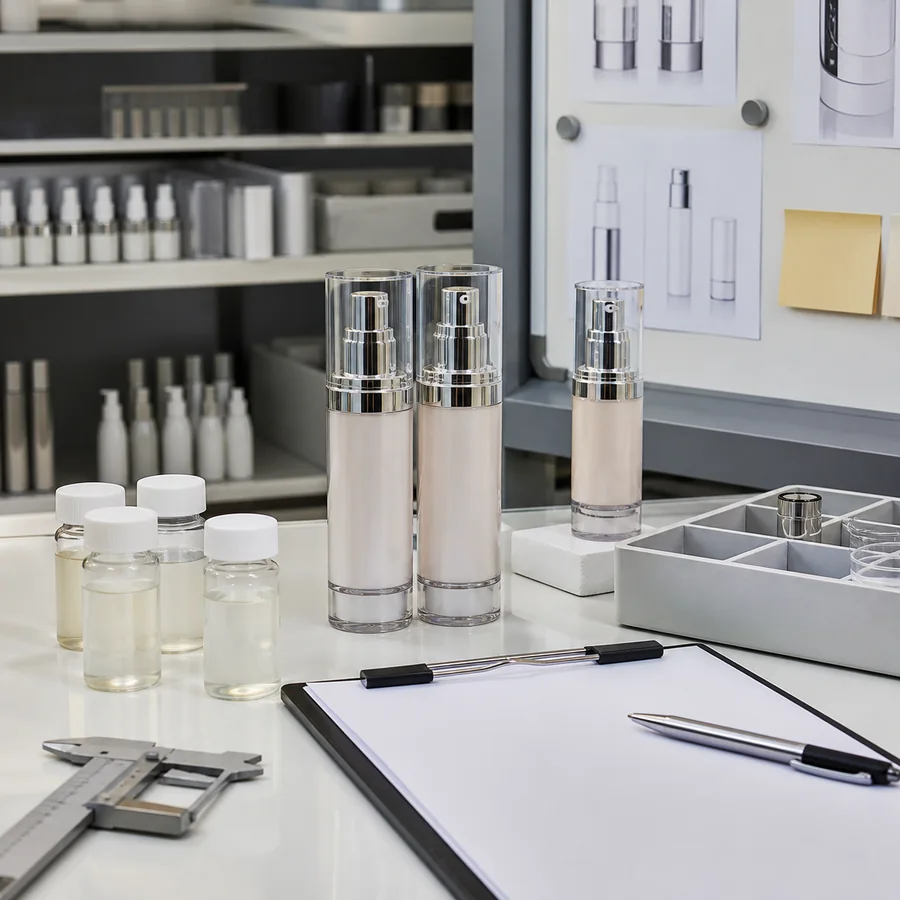
Material declarations and regulatory documents do not establish that a cosmetic formula and packaging system will perform correctly together. Formula compatibility, sealing, dispensing and functional performance should be evaluated separately using the actual intended packaging configuration.
The evaluation should identify the formula version, bottle and closure combination, filling conditions where relevant, test samples, intended storage and use conditions, agreed acceptance criteria, observations and results. The scope and method should be determined by the product’s characteristics and the risks being assessed.
For a serum bottle with a dispensing pump, relevant checks may include neck and sealing compatibility, dispensing performance with the actual formulation, dip-tube configuration, residual product access and leakage under appropriate project-specific conditions.
For decorated glass packaging, the review may also need to consider the behavior of the selected coating, printing or other finish during filling, handling, storage and intended use. A visually approved decoration sample does not automatically demonstrate chemical or functional compatibility.
Buyer action: Evaluate the selected packaging with the actual formulation under intended storage and use conditions before bulk-production approval. Record unresolved performance issues separately from material or regulatory-document reviews.
Evidence to retain: Formula identification, packaging configuration, approved evaluation protocol, observations, deviations, applicable test results, responsible reviewer and any limitations on the approval.
There is no universal test duration, temperature, leakage limit or compatibility result that can be assigned to every cosmetic packaging project. Use the applicable product requirements, agreed test methods and qualified technical assessment to define the evaluation.
Control artwork and labeling records
The packaging compliance file should retain the approved artwork version and link it to the physical packaging configuration. Technical artwork approval and legal labeling approval should remain separate decisions, even when both are recorded in the same project file.
Store the approved artwork, relevant print areas, color references, language versions, claims approvals and production proofs. The packaging supplier may confirm decoration feasibility, print placement and the physical appearance of the approved sample, while the brand or designated regulatory party reviews legally required labeling information and product claims.
A bottle or closure change may alter the available labeling area, artwork positioning or presentation of mandatory information. Changes to the formulation, destination market or marketing claims may also require a separate label review.
Buyer action: Use labeling versus packaging compliance to distinguish supplier artwork confirmation from the brand’s legal labeling responsibilities. Approve the final decoration and label fit on the selected physical packaging.
Evidence to retain: Approved artwork revision, destination-market and language requirements, claim-review records, responsible legal reviewer, printing or decoration proof and physical sample approval.
Retain the golden sample and sample approval
A golden sample provides a physical reference for characteristics that cannot be fully communicated through drawings and supplier documents. It should represent the approved commercial packaging configuration rather than an earlier concept or an unapproved component combination.
Identify the sample with its project reference, BOM revision, component configuration, artwork version, approval date and responsible approvers. Keep controlled photographs as supporting records, but do not treat them as substitutes for the physical sample where physical approval is required.
The sample approval should identify what has actually been accepted. This may include appearance, bottle and closure assembly, decoration color, print positioning or dispensing function. Other characteristics, such as dimensional requirements and applicable tolerances, should remain governed by the agreed specifications and relevant test evidence.
Buyer action: Compare the approved physical sample with the proposed bulk-production configuration. If a supplier substitutes a closure, changes a decoration process or alters another controlled component, determine whether a new sample and supporting evidence are required before production release.
Evidence to retain: Identified physical sample, approval record, controlled photographs, storage location, approved characteristics and the applicable drawing and specification revisions.
Build change control and version history
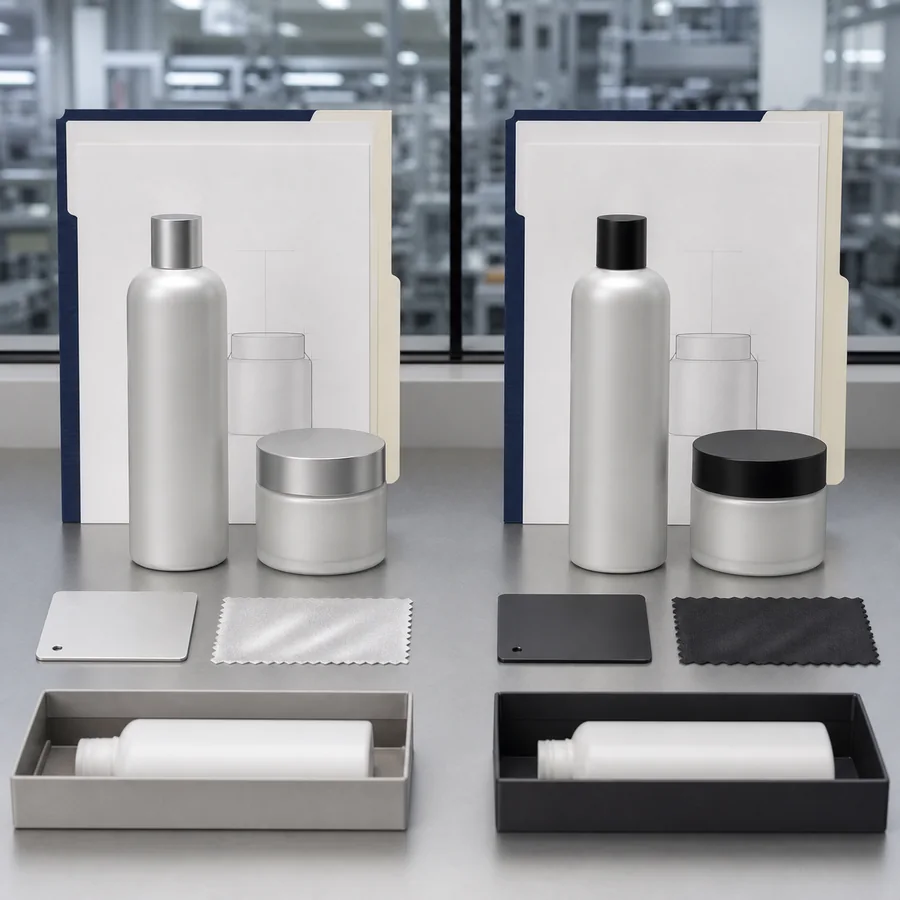
Every relevant packaging change should trigger an impact assessment before the revised configuration enters production. Change control keeps the compliance file useful after the initial sample approval and helps prevent outdated evidence from being applied to the wrong product version.
Relevant changes may include a new component supplier, material substitution, different glass color, coating or ink, revised closure structure, manufacturing-site change, modified tooling, new formulation, updated artwork or a change in destination-market requirements.
For each change, identify the affected BOM items and determine whether drawings, declarations, test reports, compatibility evaluations, artwork or approved physical samples need to be reviewed or replaced. A temporary or emergency component substitution should not bypass the agreed approval process.
The revised BOM should carry a distinct version identifier and an effective date. Purchasing and production records should establish which component versions were actually used so that a later quality or regulatory review can identify the applicable evidence.
Buyer action: Connect the compliance file with packaging traceability. Require notification of relevant supplier or component changes and resolve their impact before releasing the revised packaging for purchase or production.
Evidence to retain: Change request, reason for change, affected BOM items, impact assessment, required follow-up actions, approvers, effective date and applicable production-lot records.
Create an index that answers buyer questions
The front page of the compliance file should allow a reviewer to identify the current approved packaging version, supporting evidence and outstanding actions without searching through every supplier folder.
Use a controlled document index containing the document ID, relevant BOM item, supplier, issue date, review date, approval status, applicable decision, limitations, responsible reviewer and next action. Link each index entry to the original document or record.
A practical status system can distinguish approved evidence from documents awaiting review, conditionally accepted evidence and superseded records. These are internal document-control categories, not statements that a component has received regulatory certification.
Do not delete superseded specifications or earlier approval records when the packaging changes. Archive them with a clear status so the business can reconstruct which configuration was approved and used for a particular production period.
Buyer action: Review the index during sample approval, before production release and whenever a relevant packaging or regulatory change occurs. Unresolved gaps should have a responsible owner and a documented disposition rather than remaining hidden in supplier email exchanges.
Evidence to retain: Controlled master index, open-item register, document approval status, current and superseded revisions, responsible reviewer, review date and links to the original evidence.
Worked Buyer Scenario
Illustrative procurement scenario: A skincare brand is developing a serum package using a stock glass bottle, dispensing pump, cap, printed label and carton. During sample evaluation, the brand decides to change the pump supplier and replace the label with screen printing on the glass bottle.
The two changes should be reviewed separately because they affect different parts of the packaging compliance file.
Pump supplier change
The buyer should obtain the replacement pump’s specification and relevant material declarations, confirm its neck and sealing interface against the selected glass bottle, and evaluate the assembled package with the actual serum formulation. Existing compatibility evidence should be reviewed to determine whether it applies to the replacement pump or whether additional evaluation is required.
The original pump supplier’s report should not be treated as evidence for the replacement component solely because both pumps have a similar appearance or nominal neck size.
Decoration change
Replacing the label with screen printing changes the artwork and decoration process. The buyer should update the BOM and artwork records, obtain relevant information about the selected decoration where required, and approve the printed physical sample.
If the change affects formula-contact materials or introduces another relevant safety or performance concern, the responsible reviewer should determine whether additional evidence is necessary. Not every decoration change automatically requires the complete packaging test program to be repeated.
Production approval decision
The revised configuration should not be released for bulk production until the relevant component specifications, sample approvals and required evidence have been reviewed. Any unresolved issue should remain visible in the document index with a named owner and an agreed action.
The previous BOM and approval records should remain archived. The current file should identify the approved pump supplier, decoration version and physical sample for the packaging actually being purchased.
This scenario illustrates a document-control process; it is not presented as a verified FOLOVER customer case or a completed laboratory investigation.
Decision-Control Matrix
Use the following matrix to connect the main packaging approval decisions to their supporting records, responsible reviewers and reassessment triggers. Approval responsibilities should be assigned according to the actual organization and project rather than treated as universal statutory job titles.
| Decision area | Minimum controlled input | Approval owner | Reassessment trigger |
|---|---|---|---|
| Define the file’s purpose and legal boundary | Destination markets, intended product use, responsible entities, scope exclusions and relationship to statutory records. | Brand regulatory or designated compliance reviewer. | Market, product classification, business responsibility or applicable legal requirement changes. |
| Freeze the final packaging BOM | Approved BOM revision, component identification, material information, supplier source and formula-contact status. | Packaging development and designated purchasing or quality approver. | Component, material, supplier, configuration or approved alternative changes. |
| Control drawings and specifications | Approved component drawings, dimensions, interface requirements, relevant acceptance criteria and revision history. | Packaging development and quality. | Dimensional, neck-finish, closure, tooling, decoration or other specification changes. |
| Identify suppliers and manufacturing sources | Approved supplier identity, relevant manufacturing source, purchase specification and change-notification requirements. | Purchasing, supplier quality or designated packaging reviewer. | Supplier, manufacturing site, subcontractor or approved sourcing arrangement changes. |
| Collect material and regulatory declarations | Component-specific declarations, applicable regulatory basis, issue date, issuer, material scope and documented review conclusion. | Brand regulatory or designated materials-compliance reviewer. | Material, supplier, declaration scope, relevant Candidate List or applicable legal requirement changes. |
| Approve compatibility and functional evidence | Selected package and formula versions, agreed evaluation protocol, test results, deviations and approval conclusion. | Product development, quality and qualified safety reviewer where required. | Relevant changes to the formulation, bottle, closure, sealing system, dispensing components or intended use. |
| Approve artwork and physical samples | Approved artwork revision, decoration proof, identified physical sample and applicable technical and legal approvals. | Packaging development and brand regulatory reviewer for their respective responsibilities. | Artwork, decoration, component appearance, labeling or approved packaging configuration changes. |
A conditional approval should remain conditional in the index and purchase specification. Do not convert a conclusion that applies to one item, test or destination market into a general claim that the complete packaging system is fully compliant.
The matrix is a working review tool. Original supplier documents, laboratory reports, applicable statutory records and approved physical samples remain the underlying evidence for each decision.
Pre-Production Buyer Checklist
- Define destination markets, legal entities, intended use and responsible reviewers.
- Freeze the exact bottle, closure, decoration, label and secondary-packaging BOM.
- Match each specification, declaration and report to a controlled component and version.
- Confirm that relevant material evidence covers the selected packaging configuration and applicable requirements.
- Separate legal, chemical, compatibility, performance, artwork and marketing-claim decisions.
- Record evidence limitations and open gaps, with a responsible reviewer assigned to each unresolved issue.
- Evaluate the selected bottle and closure using physical samples and the actual formulation under intended storage and use conditions.
- Approve the final physical samples for appearance, component assembly, decoration and agreed functional requirements.
- Set supplier notification and internal reassessment triggers before purchase release.
- Retain the final approval record, source documents, applicable production-version information and superseded history.
Frequently Asked Questions
Can one supplier certificate approve the complete cosmetic package?
No. A supplier certificate or declaration covers only the materials, components and requirements identified within its stated scope. A complete cosmetic package may contain glass, plastic, metal, sealing materials, decoration and labeling supplied by different businesses. Buyers should match each document to the exact BOM item and assess whether additional component or finished-product evidence is required.
Does a third-party report remove the buyer’s responsibility?
No. A third-party report provides evidence for the tested sample, method and conditions. The responsible business must determine whether the report applies to the selected commercial packaging and addresses the relevant product and destination-market requirements. Buyers should retain the full report, document its applicability and obtain further evaluation where the available evidence does not support the intended approval.
Can similar-looking packaging share the same evidence?
Only when the relevant material, component construction, manufacturing source and processing conditions have been evaluated and the evidence scope permits their use across the selected configurations. Visual similarity and identical nominal capacity are not sufficient. Buyers should confirm the relevant equivalence and retain the supporting rationale before assigning existing reports or declarations to another packaging version.
When should evidence be reviewed again?
Evidence should be reviewed when a relevant change affects the approved packaging configuration, formulation, material, supplier, manufacturing process, decoration, artwork, destination market or applicable legal requirements. A document’s age alone does not establish that it is invalid or still applicable. Buyers should record the change, assess its impact and determine whether existing evidence remains sufficient or additional approval is required.
What can FOLOVER PACK support?
FOLOVER PACK can support cosmetic glass packaging selection, bottle development, component coordination, decoration, physical samples, relevant quality checks and available product-specific documentation. The exact support and documents depend on the selected packaging configuration and project requirements. Finished-product safety assessment, legal interpretation, label approval and market-placement decisions remain with the appropriate responsible businesses and qualified professionals.
Is this article legal advice?
No. This article provides practical guidance for organizing cosmetic packaging development, supplier evidence and procurement approval records. It does not establish that a particular packaging configuration meets every applicable legal requirement. Buyers should verify current official requirements for their destination market and obtain qualified regulatory or safety advice when making decisions about a specific finished cosmetic product.
Official Sources Reviewed
Packaging and cosmetic product requirements vary by destination market and may change over time. The following official sources provide the regulatory context for the document-control and evidence-review principles discussed in this article. Buyers should confirm the applicable version and requirements when making decisions for a live project.
- EU Cosmetics Regulation 1223/2009 consolidated text — Article 11 covers the cosmetic Product Information File; Annex I identifies relevant packaging-material characteristics within the cosmetic product safety report.
- EU cosmetic product safety report guidance — Section 3.4.3 discusses packaging-material characteristics, possible interactions with the formulation and the relevance of supplier information.
- FDA MoCRA information — Official information about the U.S. regulatory framework for cosmetic products, including applicable business responsibilities.
- FDA clarification on cosmetic registration and listing certificates, September 9, 2026 — Explains that facility registration and product listing do not constitute FDA approval and that the agency does not issue certificates to verify compliance with those registration or listing requirements.
- ECHA Candidate List obligations — Explains REACH duties relating to Candidate List substances, including communication requirements for relevant articles containing SVHCs above the applicable threshold.
- Regulation (EU) 2025/40 on packaging and packaging waste — Establishes the EU packaging and packaging-waste framework, with provisions applying on a phased basis from 12 August 2026.
Conclusion
Before approving bulk production, confirm that the compliance file identifies the final packaging BOM, links each relevant document to the correct component and records the approved physical sample, outstanding evidence gaps and responsible reviewers. A supplier declaration or laboratory report should support only the decisions covered by its actual scope.
For cosmetic glass packaging projects, FOLOVER PACK can assist with bottle selection, component coordination, decoration requirements and physical sample preparation. The objective is to help buyers establish which packaging configuration is being supplied and which supporting information is available for their own approval process.
To discuss your project, provide the intended formulation and application, selected or preferred bottle, closure requirements, decoration, destination market and documentation needs. FOLOVER can review the relevant packaging options and clarify which product-specific information or samples can be supplied for further evaluation.