
Cosmetic labeling vs packaging compliance is a practical distinction for beauty brands developing products for international markets. Labeling compliance concerns the information, instructions and claims presented with the cosmetic, while packaging compliance concerns the physical container, materials, closures, decoration and their suitability for the intended product.
Artwork approval is not legal label approval. A packaging supplier may confirm that a logo, ingredient panel or warning fits the selected bottle, but that approval does not establish that the wording, placement or claims meet the destination market’s legal requirements. Both decisions must be completed and reconciled on the final commercial packaging before bulk production.
This guide is written for B2B cosmetic packaging buyers, product developers, sourcing teams and brand compliance reviewers. It provides practical manufacturing and procurement guidance rather than legal advice. Explore the Regulations & Compliance hub and Sustainable Packaging resources for related decision paths.
Direct Answer
Cosmetic labeling compliance determines whether the information presented with a cosmetic meets the applicable market requirements. Packaging compliance determines whether the selected physical packaging system meets the relevant material, safety, compatibility and performance requirements.
The two areas overlap when required information must fit on the actual bottle, label or carton, or when a packaging characteristic becomes a marketing claim. Buyers should obtain separate legal-copy and manufacturing-artwork approvals, then confirm that both apply to the same final packaging version.
FOLOVER Manufacturer Insight
FOLOVER PACK can support glass bottle selection, component matching, decoration coordination, printable-area confirmation, physical sample preparation and relevant packaging quality checks.
For a small serum bottle, the available printing area may be reduced by the bottle’s curvature, shoulders, decorative coating or the position of the assembled closure. A digital artwork file may look acceptable on a flat screen but become difficult to read or reproduce on the actual glass container.
FOLOVER can coordinate the selected bottle dimensions, print position, decoration process and physical sample so the brand can evaluate how its approved information appears on the commercial packaging.
However, confirming that artwork can be manufactured does not establish that ingredient declarations, warnings, claims or language versions meet the applicable laws. Those decisions remain with the brand and its designated regulatory professionals.
For a packaging inquiry, provide the bottle or jar style, intended formulation, closure system, destination markets, artwork, required decoration, expected order quantity and available labeling requirements. This allows packaging feasibility and regulatory artwork review to proceed against the same proposed configuration.
What is packaging compliance?
Packaging compliance concerns the physical packaging system: the bottle or jar, closure, materials, decoration, contact conditions, performance and applicable restrictions.
It includes determining whether the selected components are correctly specified, whether supplier evidence covers the actual materials, and whether the assembled packaging is suitable for the intended formulation and use conditions.
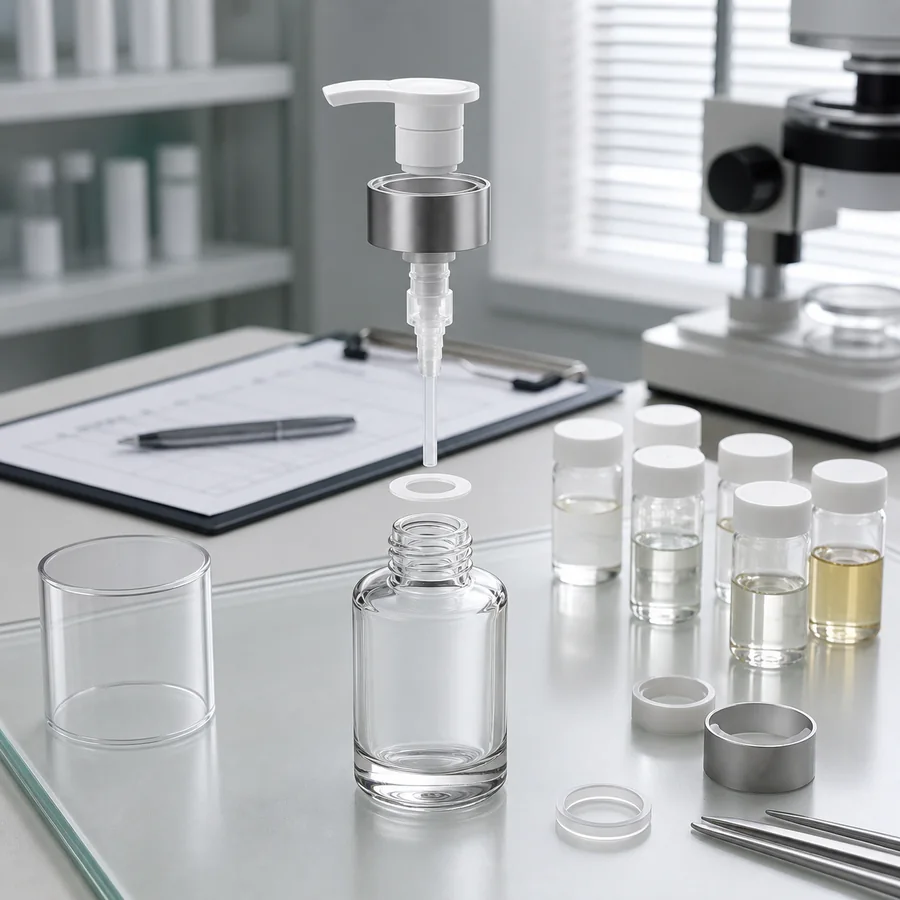
For example, a glass serum bottle may be assembled with a plastic pump, elastomer gasket, dip tube and decorative cap. A material report for the glass body does not automatically establish the suitability of those additional components.
Final bottle and closure compatibility should be confirmed using the selected components and physical samples before bulk production. Packaging compatibility should be evaluated with the actual formulation under intended storage and use conditions.
Buyer action: Use cosmetic packaging compliance basics to identify the physical packaging requirements and supporting evidence relevant to the selected commercial configuration.
Evidence to retain: Approved packaging BOM, component specifications, relevant material declarations, applicable test and compatibility evidence, physical sample approval and controlled change records.
What is cosmetic labeling compliance?
Cosmetic labeling compliance concerns the legally required and voluntarily presented information on or accompanying the finished cosmetic product.
Depending on the destination market and product classification, the review may cover product identity, nominal or net contents, responsible business information, ingredient declarations, warnings, instructions, language requirements and marketing claims.
In the European Union, Article 19 of Regulation (EC) No 1223/2009 establishes labeling requirements for cosmetic products, including relevant information appearing on the container and packaging.
In the United States, the FDA distinguishes the label attached to a product or its container from the broader concept of labeling, which can include other written, printed or graphic information accompanying the product. Its Cosmetics Labeling Guide explains the applicable federal requirements for cosmetic labels and labeling.
The placement, presentation and required content can differ between markets. A packaging supplier should not independently determine legal labeling requirements or modify approved regulatory text.
Buyer action: Use U.S. cosmetic packaging and FDA basics for the U.S. regulatory context. Obtain market-specific legal-copy approval before releasing artwork for production.
Evidence to retain: Final product identity, formulation and ingredient information, destination market, applicable labeling requirements, approved claims, controlled legal copy and responsible regulatory reviewer.
Where do labeling and packaging overlap?
Labeling and packaging compliance overlap when legally required information or a product claim must be presented on a physical component with limited space, a particular shape and a defined decoration process.
The bottle and retail carton determine the available labeling panels, while the selected printing method, surface finish and closure arrangement affect how information can be presented.
For example, a curved glass bottle may provide insufficient uninterrupted space for the approved ingredient list and other required information. A brand may need to reconsider the label construction, bottle size or use of secondary packaging.
However, adding a retail carton does not automatically mean that all required information can be removed from the immediate container. The applicable market rules determine which information must appear on each packaging level and whether specific exceptions apply.
Buyer action: Coordinate the chosen cosmetic glass packaging format with the legally approved information hierarchy before finalizing decoration or production tooling.
Evidence to retain: Approved bottle and carton specifications, controlled artwork dimensions, available print areas, required information hierarchy and physical sample approval.
Artwork approval is not legal label approval
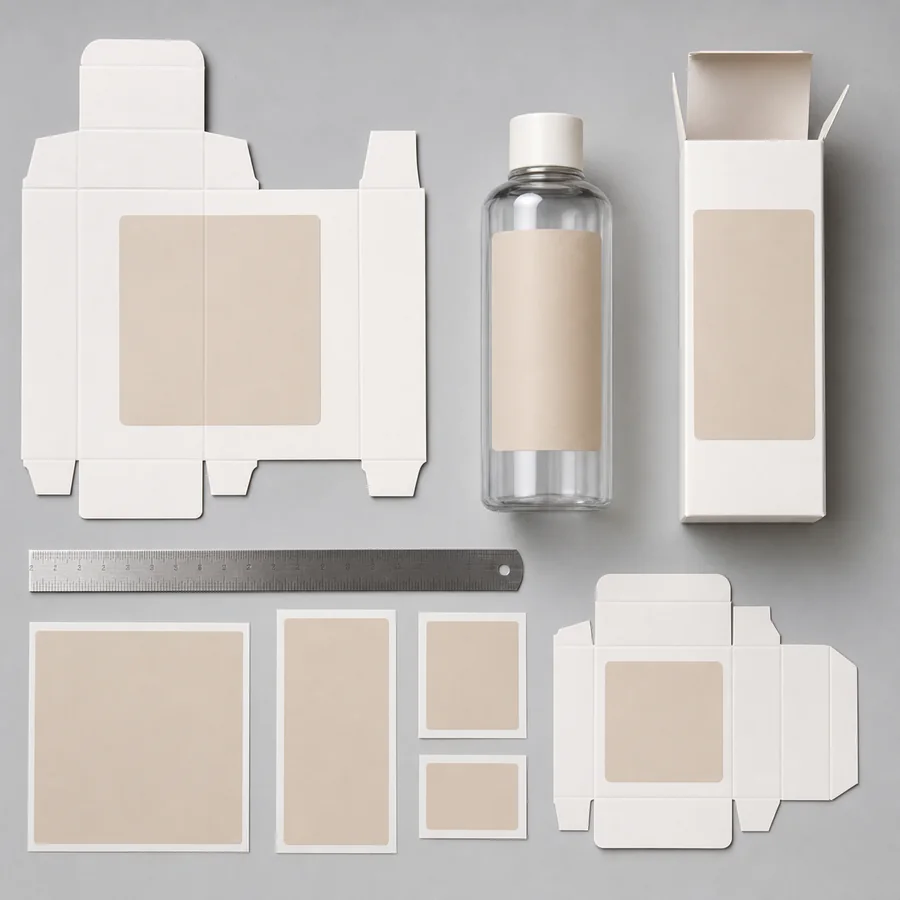
Artwork approval confirms that the selected design can be reproduced on the specified packaging. Legal label approval confirms that the labeling content and its required presentation have been reviewed against the applicable market requirements.
Both approvals are necessary where their respective requirements apply, but they answer different questions.
| Review item | Artwork approval | Legal label approval | What buyers should verify |
|---|---|---|---|
| Primary purpose | Confirm the manufacturing feasibility and physical appearance of the design. | Confirm the applicable legal requirements for labeling content and presentation. | Both reviews cover the same product, market and artwork version. |
| Main review scope | Print area, artwork dimensions, color, registration, decoration process and physical appearance. | Required statements, ingredient information, warnings, claims, language and legally required placement. | No required information was changed, omitted or obscured during production artwork preparation. |
| Typical approval owner | Packaging development, brand design and the packaging supplier for their respective responsibilities. | Brand regulatory team, responsible business or designated qualified reviewer. | The actual reviewer and approval status are identified separately. |
| Final approval evidence | Approved production artwork and physical decorated sample. | Approved legal copy and relevant market-specific labeling review. | The final commercial packaging matches both approved records. |
A packaging supplier may confirm printing position, color separation, production feasibility and relevant decoration limitations. It should not silently change ingredient wording, warnings or other regulated text to make the design fit.
When approved content cannot be accommodated on the selected bottle, the packaging supplier should communicate the physical limitation. The brand’s regulatory reviewer must determine whether the layout, labeling construction or packaging configuration can be changed.
Buyer action: Keep separate legal-copy and manufacturing-artwork approvals in the packaging compliance file.
For projects involving direct glass printing, coating or other surface treatments, confirm the physical production constraints using the selected decoration and finishing options before approving the commercial artwork.
Evidence to retain: Approved legal copy, controlled artwork revision, supplier production proof, identified physical sample, separate approval records and final release status.
Responsibility between brand and packaging supplier
The brand or other legally responsible business controls the finished cosmetic’s formulation, intended use, claims, target markets and applicable labeling decisions. The packaging supplier is responsible for providing accurate information and fulfilling the agreed specifications for the packaging it supplies.
FOLOVER PACK can support glass bottle selection, component specifications, decoration coordination, physical sample preparation and relevant supplier documentation.
The brand’s regulatory reviewer should determine the legally required content, applicable language requirements, ingredient declarations, warnings and claims. Where the product classification or regulatory responsibility is uncertain, qualified legal or regulatory advice may be necessary.
These responsibilities should be documented before the artwork enters production. A supplier’s signature on a printing proof should not be interpreted as acceptance of responsibility for the finished cosmetic’s legal labeling.
Buyer action: Use FOLOVER PACK manufacturing capabilities for practical packaging development while assigning legal-copy and finished-product approval to the appropriate parties.
Evidence to retain: Responsibility matrix, approved packaging specifications, brand-supplied labeling content, supplier artwork approval and documented regulatory sign-off.
Common labeling areas to review
Before approving cosmetic labeling, identify the destination market, product classification and the information required on each relevant packaging level.
Common review areas include product identity, quantity of contents, responsible business information, ingredient declarations, applicable warnings, instructions, claims and language requirements.
The specific requirements should not be copied from another product or assumed to be identical across the EU, United States and other export markets.
For example, EU Cosmetics Regulation Article 19 establishes requirements for information presented on cosmetic containers and packaging, with defined exceptions and alternative presentation arrangements for particular circumstances.
In the United States, the FDA’s Summary of Cosmetics Labeling Requirements explains the distinction between information required on the principal display panel and other labeling areas.
Buyers should not assume that every cosmetic ingredient declaration must be printed directly on the glass bottle, or that placing information on a carton automatically satisfies all immediate-container requirements. The applicable rule and actual packaging presentation must be reviewed.
Buyer action: Confirm the market-specific content and placement requirements before approving the bottle’s available print area, label construction and retail carton.
Evidence to retain: Market-specific labeling checklist, approved product information, applicable placement requirements, legal-copy approval and final artwork.
Claims printed on packaging need evidence
A statement printed on a cosmetic bottle, label or carton may require supporting evidence even when the packaging supplier can reproduce the artwork accurately.
Claims such as “recyclable,” “refillable,” “recycled content” or “heavy-metal free” should identify their intended scope and be supported by relevant evidence.
For example, a glass serum bottle may be technically recyclable in an appropriate glass recycling system, while its pump and decorative components require different end-of-life consideration. A claim referring to the complete packaging system should not rely solely on evidence concerning the glass body.
Similarly, a bottle that can be opened and refilled is not necessarily supported by a practical refill system or a validated reuse process.
The U.S. Federal Trade Commission’s Environmental Claims Green Guides summary explains the importance of substantiating recyclable, recycled-content and refillable claims and appropriately qualifying them where necessary.
Other markets may apply different or additional environmental marketing requirements.
Buyer action: Review sustainable packaging claims before committing environmental wording to bottles, labels or cartons.
Evidence to retain: Exact claim wording, intended market, covered packaging components, supporting documentation, applicable qualifications and approval by the responsible reviewer.
Multilingual and multi-market complexity
Multilingual cosmetic labeling requires more than translating the original English artwork. Different markets may have distinct requirements concerning language, responsible business details, mandatory statements and their presentation.
Translation can also affect the physical layout. A warning or ingredient-related statement may occupy more space in one language than another, requiring changes to the label dimensions, print layout or secondary packaging.
For U.S. cosmetics, FDA labeling rules generally require legally mandated information in English, subject to applicable exceptions. Additional requirements may apply when foreign-language representations are included in the labeling.
For EU cosmetics, applicable language requirements and national provisions should be assessed for the countries where the product will be made available.
Do not approve all market versions based on one visually attractive master artwork. Each commercial language version should correspond to its approved content and physical packaging configuration.
Buyer action: Maintain a language-by-market artwork register and confirm the final physical proof for each relevant SKU and destination-market version.
Evidence to retain: Approved source copy, market and language version, regulatory review, artwork revision, relevant translation approval and final production proof.
Packaging changes can trigger label review
A change to the bottle, closure, decoration, label material, fill quantity or destination market may require a new labeling review even when the cosmetic formulation remains unchanged.
For example, replacing a cylindrical serum bottle with a narrower square design may reduce the available printing area or change the location of the principal display panel.
A new closure may also obscure part of the printed information, while a darker coating can reduce contrast between the glass surface and the approved text.
Changes to the formulation or intended use can create a separate need to reassess ingredients, warnings or product claims, even when the bottle remains unchanged.
The packaging and labeling approval processes should therefore share the same change-control record.
Buyer action: Identify the affected information before approving a packaging substitution. Update the legal-copy review, manufacturing artwork and physical sample only where the change requires it.
Evidence to retain: Change request, affected packaging and market versions, revised artwork where applicable, physical sample evaluation, approval decision and production effective date.

Final-pack reconciliation before release
The final approval should be based on the actual assembled commercial packaging, not only the digital artwork and separate component documents.
Compare the selected bottle, closure, decoration, label and carton against the approved packaging BOM and artwork.
Confirm that required information appears in its approved position, remains legible under the applicable requirements and is not obscured by the selected closure, decorative finish or other packaging components.
Any difference between the approved artwork and physical sample should be documented. A packaging supplier should not independently correct legally controlled text without approval from the responsible reviewer.
Buyer action: Release bulk production only after the final commercial configuration has received the required legal-labeling, physical-artwork and packaging-performance approvals.
Evidence to retain: Approved assembled golden sample, controlled legal copy, supplier production artwork, relevant physical inspection results, documented deviations and final release approval.
Worked Buyer Scenario
Illustrative procurement scenario: A skincare brand is developing a small glass serum bottle with direct screen printing and a dispensing pump. The initial artwork includes the product name, logo and selected front-panel information.
The brand approves the visual layout, and the packaging supplier confirms that the artwork can be printed on the selected bottle.
However, the final ingredient declaration, applicable warning text and destination-market language version have not yet been approved.
At this stage, the printing proof can be approved for its manufacturing feasibility, but the complete commercial artwork should not be released for bulk production.
Before release, the brand’s regulatory reviewer must approve the applicable labeling content and determine where it should appear on the bottle, carton or other permitted labeling materials.
If the final approved text does not fit the bottle’s available print area, the buyer can review an alternative label construction, suitable secondary packaging or a different bottle design. The supplier should provide physical packaging information and revised samples without independently changing the approved legal content.
Once the final label and packaging configuration are agreed, the buyer should reconcile the legal-copy approval, manufacturing artwork, selected closure and physical golden sample.
If a later change to the bottle or cap affects the approved information’s visibility or placement, the affected artwork should return for review before production continues.
This scenario illustrates a packaging-development decision. It is not presented as a documented FOLOVER customer incident, customs detention or actual regulatory enforcement case.
Decision-Control Matrix
Use the following matrix to distinguish the main labeling and packaging decisions, their responsible reviewers and the circumstances that require reassessment.
| Decision area | Minimum controlled input | Approval owner | Reassessment trigger |
|---|---|---|---|
| What is packaging compliance? | Approved packaging BOM, component specifications, relevant material information, compatibility evidence and physical samples. | Packaging development and quality, with qualified technical or regulatory review where required. | Changes to the formulation, bottle, closure, materials, supplier, intended use or applicable packaging requirements. |
| What is cosmetic labeling compliance? | Final product identity, formulation information, required statements, claims, language versions and destination-market requirements. | Brand regulatory team or other designated responsible reviewer. | Changes to the formulation, product classification, claims, language, destination market or applicable labeling requirements. |
| Where do labeling and packaging overlap? | Approved legal copy, packaging dimensions, available print area, selected decoration process and physical artwork proof. | Brand regulatory reviewer for legal content; packaging development and supplier for physical production feasibility. | Changes to the bottle, carton, closure, labeling area, required content or decoration layout. |
| Artwork approval is not legal label approval | Separately approved legal copy, controlled manufacturing artwork, identified reviewers and matching commercial versions. | Brand regulatory reviewer and designated manufacturing-artwork approver for their respective responsibilities. | Any relevant change to regulated text, claims, artwork, print layout or final packaging configuration. |
| Responsibility between brand and packaging supplier | Agreed responsibility matrix, supplier specifications, brand-approved content, required documents and final approval records. | Brand or other legally responsible business, supported by the packaging supplier within its agreed scope. | Changes to the business role, supplier responsibilities, destination market or agreed packaging and labeling scope. |
The approval matrix should reference original documents and physical samples rather than replace them. A conditional approval should remain conditional, and an approval for one SKU or market should not automatically be applied to another version.
Pre-Production Buyer Checklist
- Confirm the final product identity, intended use, destination markets and responsible reviewers.
- Freeze the selected bottle, closure, decoration, label and secondary-packaging configuration.
- Obtain market-specific approval of the required labeling content, ingredients, warnings and claims.
- Confirm the available print area, selected decoration process and physical artwork feasibility.
- Maintain separate legal-copy and manufacturing-artwork approval records.
- Check that each commercial language and market version uses the correct approved information.
- Review the evidence supporting packaging-material and environmental claims.
- Confirm the final assembled packaging against the approved artwork and golden sample.
- Resolve discrepancies and document any necessary reapproval before bulk production.
Frequently Asked Questions
Can one supplier certificate approve the complete cosmetic package?
No. A supplier declaration or report supports only the materials, components and requirements within its documented scope. It does not establish that the finished cosmetic’s labeling meets the destination market’s legal requirements. Buyers should review packaging evidence and legal labeling separately, then confirm that both approvals apply to the same commercial packaging configuration.
Does a third-party report remove the buyer’s responsibility?
No. A third-party report provides evidence within its stated sample, method and assessment scope. It does not automatically establish that the finished cosmetic’s labeling, claims or complete packaging meet every applicable requirement. The responsible business should review the report’s relevance and obtain the necessary legal or technical approval before releasing the final product.
Can similar-looking packaging share the same evidence?
Only when the relevant materials, component construction, production processes and evidence scope support the proposed grouping. Visually similar bottles may have different closures, coatings or available labeling areas. Buyers should confirm the applicable equivalence and separately review any changes affecting required information, claims or artwork placement before reusing existing approvals.
When should evidence be reviewed again?
Review the affected evidence when relevant changes occur to the formulation, packaging materials, supplier, decoration, artwork, required labeling content, destination market or applicable requirements. Not every change requires all evaluations to be repeated. Buyers should document what changed, identify which approvals are affected and complete the necessary review before releasing the revised commercial version.
What can FOLOVER PACK support?
FOLOVER PACK can support cosmetic glass packaging selection, component matching, decoration coordination, printable-area confirmation, physical samples and available product-specific documentation. The brand remains responsible for approving the finished cosmetic’s legal labeling and product claims. Buyers can contact FOLOVER with their selected packaging configuration, artwork and destination-market requirements to discuss manufacturing feasibility and sample preparation.
Is this article legal advice?
No. This article provides practical guidance for coordinating cosmetic labeling, packaging development and supplier approvals. Legal requirements depend on the finished product, destination market and responsible business. Buyers should consult current official regulations and qualified regulatory professionals when determining the labeling and packaging obligations applicable to their specific cosmetic product.
Official Sources Reviewed
Cosmetic labeling and packaging requirements vary by destination market and may change over time. The following official sources provide the regulatory context for the labeling and packaging decisions discussed in this guide.
- EU Cosmetics Regulation 1223/2009 consolidated text — Article 19 establishes relevant EU cosmetic labeling requirements, including information presented on containers and packaging. Buyers should check subsequent amendments applicable to their market-placement date.
- FDA Cosmetics Labeling Guide — Explains U.S. cosmetic labeling requirements, principal display panels, mandatory information, placement and presentation.
- FTC Environmental Claims Green Guides summary — Explains substantiation and qualification considerations for recyclable, recycled-content, refillable and other environmental marketing claims in the United States.
Conclusion
Cosmetic labeling and packaging compliance should be reviewed separately, then reconciled on the final commercial packaging. An approved printing proof does not establish legal labeling compliance, and approved labeling content does not establish the suitability of the selected physical packaging system.
Before bulk production, buyers should confirm that the selected bottle, closure, decoration and labeling correspond to the same approved product, market and artwork version. Any unresolved legal-copy, packaging-performance or manufacturing issue should be addressed by the appropriate responsible reviewer.
FOLOVER PACK can assist with glass packaging selection, component coordination, decoration feasibility and physical sample preparation. If you are developing cosmetic packaging for an international market, share your intended product application, bottle or jar requirements, selected closure, artwork, destination market and documentation needs so the relevant packaging options and sample requirements can be reviewed.