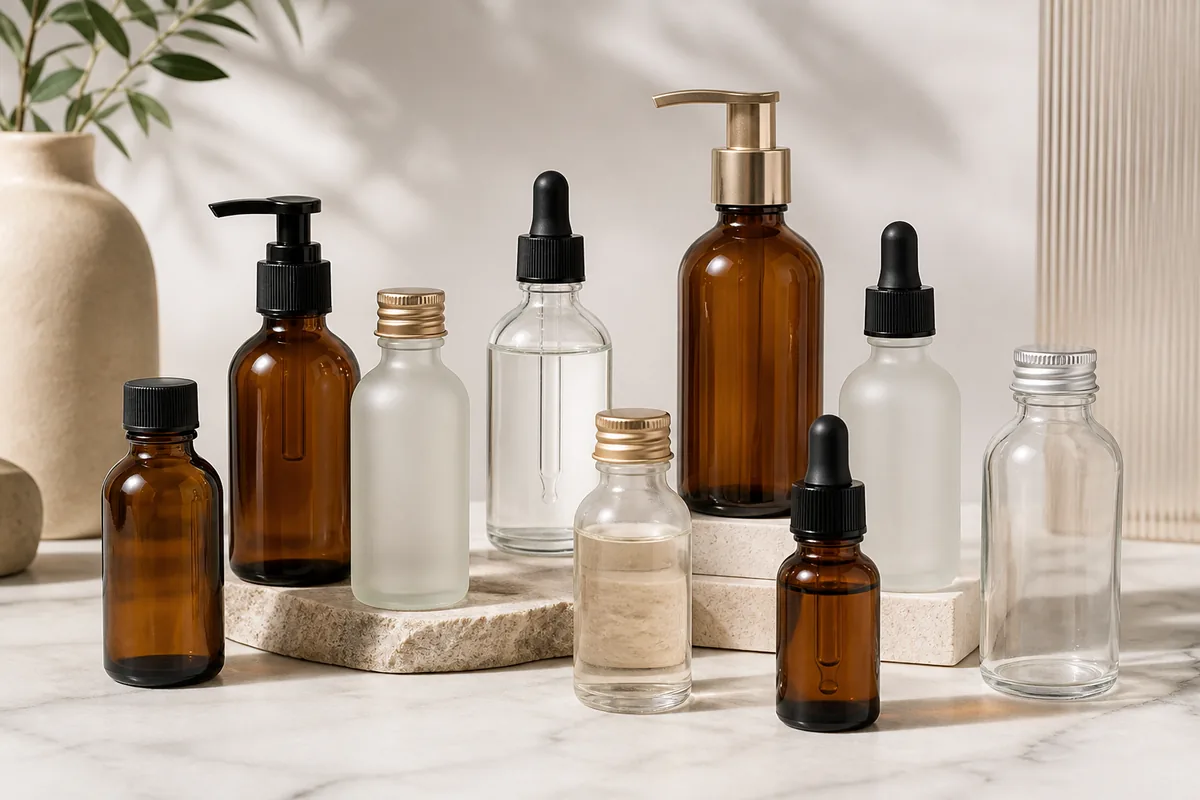
Boston round bottles are glass containers with cylindrical bodies, rounded shoulders, and relatively narrow necks. They are commonly used for essential oils, facial oils, serums, cosmetic liquids, and other compatible products. Their recognizable shape can be paired with different dispensing systems, provided the bottle neck and selected components are correctly matched.
For B2B buyers, “Boston round” describes the bottle shape, not a fixed capacity, glass color, neck finish, or closure specification. Two bottles with the same silhouette may require different droppers, pumps, caps, or reducer inserts. The correct selection depends on the actual formula, intended fill, dispensing requirements, and complete bottle-and-closure configuration.
What Makes a Bottle a Boston Round?
The classic Boston round profile combines straight cylindrical sidewalls with curved shoulders that transition into a narrow neck. It normally has no sharp corners, and its footprint is circular. This distinguishes it from square bottles, flat-sided cosmetic bottles, and straight-sided containers with less pronounced shoulder curves.
The rounded shoulder is primarily a structural and visual characteristic. It does not determine the formula, dispensing method, or seal. Those functions depend on the bottle’s actual neck finish and selected closure.
For example, a Boston round bottle intended for a pipette dropper may have different neck and internal-height requirements from a visually similar bottle designed for a reducer insert. Buyers should identify the intended dispensing system before confirming the bottle specification.
FOLOVER’s Boston round bottle category is the product-browsing path, while the Boston round bottle packaging guide supports broader selection and sourcing decisions.

Common Glass Colors
Amber Glass
Amber is strongly associated with essential-oil and apothecary packaging. It can create a technical, natural, or traditional visual identity and may be considered when light exposure is part of the packaging brief.
However, amber appearance alone does not prove a specific level of UV protection or establish that the bottle is suitable for a light-sensitive formulation.
For a product requiring light protection, the formulation owner should define the relevant stability requirements and evaluate the selected bottle under intended storage and use conditions.
The U.S. FDA’s guidance on cosmetic shelf life and expiration dating identifies sunlight, temperature, and air exposure as factors that can affect cosmetic products over time. These considerations support evaluating the actual filled package rather than relying on glass color as proof of product stability.
Clear Glass
Clear glass reveals the product and can support a clean, clinical, or premium cosmetic presentation. It also makes fill appearance, clarity, and product color visible.
That visibility may be desirable for some brands and unsuitable for others, depending on formula stability, visual variation, and positioning.
For a clear Boston round bottle containing a colored serum or facial oil, buyers should approve the appearance of the filled sample. The formula color, glass distribution, and intended decoration can change how the finished package looks compared with an empty bottle.
Colored and Decorated Finishes
Project-specific options may include coating, frosting, printing, hot stamping, or labeling when feasible for the selected bottle.
Decoration should be confirmed on the exact glass surface because curvature, shoulder transition, bottle dimensions, and handling during production affect the practical artwork area.
A dark decorative coating should not be treated as equivalent to colored glass or used to support a specific light-protection claim without suitable evidence for the finished packaging configuration.
The planned article on clear, amber, and colored cosmetic glass examines the appearance and selection trade-offs in greater depth.
Sizes and Capacity Selection
Boston round bottles are produced in multiple capacities, but the available range depends on the supplier’s current bottle family. Instead of assuming that every common market size exists in every color and neck finish, buyers should request the current specification for the exact article.
Capacity selection affects more than the amount of product. It changes the bottle height and diameter, decoration area, pipette or dip-tube requirement, assembled height, carton dimensions, shipping density, and user perception.
A small bottle may suit concentrated or travel-oriented products, while a larger format may fit products used more frequently or in greater amounts. These are commercial and user-experience considerations, not universal rules.
Nominal capacity and intended fill are not interchangeable specifications. The actual fill level and required headspace should be confirmed using the intended formulation and filling process.
Two Boston round bottles with the same nominal capacity may have different internal heights, base geometries, and neck finishes. They should not automatically be assigned the same pipette, dip tube, or closure.
Buyer check: Confirm nominal capacity, intended fill, headspace, bottle dimensions, neck finish, assembled height, and secondary-packaging fit from the exact bottle specification. When comparing several sizes, verify component compatibility for each individual bottle rather than assuming the complete closure system is interchangeable.
Common Applications
Boston round glass bottles are often considered for essential oils, facial oils, serum-like products, aromatherapy blends, and other compatible cosmetic liquids. The smooth cylindrical body can support familiar labeling and decoration layouts, while the narrow neck can accept an appropriate controlled-dispensing closure when the interfaces match.
For a facial oil intended for manual application, a compatible pipette dropper may provide the required dispensing experience. For a concentrated oil intended to dispense drop by drop, a reducer insert and cap may be worth evaluating.
The choice should follow the formula and intended application, not the Boston round shape alone.
Product chemistry, viscosity, volatility, particulates, required dose, storage orientation, and use conditions may affect bottle, closure, liner, pipette, pump, reducer, decoration, or label performance.
For essential-oil applications, the Essential Oil Bottles category provides additional product options. Boston round bottles should be evaluated alongside other available formats when defining glass color, reducer systems, caps, and formula requirements.
Closure Options for Boston Round Bottles
Pipette Droppers
A pipette dropper combines a closure, bulb, and glass or plastic pipette. It can support deliberate manual dispensing, but the closure thread, seal, pipette length, and formula behavior must match the exact bottle.
A dropper that screws onto the bottle is not necessarily a compatible dropper assembly. The pipette may be too short to reach the remaining product, or it may contact the internal base if its length is unsuitable.
The bulb material also requires evaluation with the actual formulation. A glass bottle’s compatibility with an essential oil or serum does not establish the compatibility of its elastomeric bulb.
Screw Caps
Simple screw caps may be used when controlled dispensing is unnecessary or provided by another component. Cap depth, thread engagement, liner or seal, and material compatibility must be confirmed.
The cap is part of the sealing system, not merely a decorative cover. A cap that appears to fit may still have an unsuitable sealing interface or internal depth.
Treatment Pumps
Some Boston round bottle families may accept a treatment pump. Suitability depends on the verified neck, pump closure, dip tube, formula viscosity, required output, and assembled dimensions.
A pump that works correctly with one fluid serum may prime or dispense differently with a more viscous formulation. Buyers should evaluate the selected pump with the actual formula and confirm that the dip tube reaches the intended position inside the bottle.
Reducer or Euro Dropper Systems
A fitted reducer insert may be used for compatible liquids when the bottle neck is designed for that system. The insert and cap must be evaluated together. For a mechanism-focused explanation, see what a Euro dropper bottle is and how it works.
In particular, buyers should confirm that the reducer remains securely seated during cap removal and repeated dispensing. A reducer that lifts out with the cap or delivers an unsuitable flow rate should not be approved without further evaluation.
FOLOVER’s pumps, droppers, and bottle accessories category provides the product-browsing route. The cosmetic bottle closures guide explains the broader decision framework.
| Closure Option | Best Considered For | Main Limitation | What Buyers Should Verify |
|---|---|---|---|
| Pipette dropper | Compatible fluid serums and oils requiring manual dispensing. | Uptake and delivered amount depend on formula behavior, pipette geometry, and user technique. | Neck fit, seal, pipette length, bulb material, and actual-formula dispensing. |
| Screw cap | Direct pouring or packages using a separate dispensing component. | Thread engagement alone does not establish a suitable seal. | Complete neck finish, cap depth, liner or gasket, and closing performance. |
| Treatment pump | Compatible cosmetic liquids requiring a defined pumping action. | An unsuitable pump may prime poorly or leave excessive product in the bottle. | Neck fit, output, dip-tube configuration, formula viscosity, and dispensing performance. |
| Reducer insert and cap | Compatible liquids requiring controlled drop-by-drop dispensing. | Insert retention and flow depend on the exact neck and formula. | Insert fit, orifice, cap engagement, retention, and actual-formula flow. |
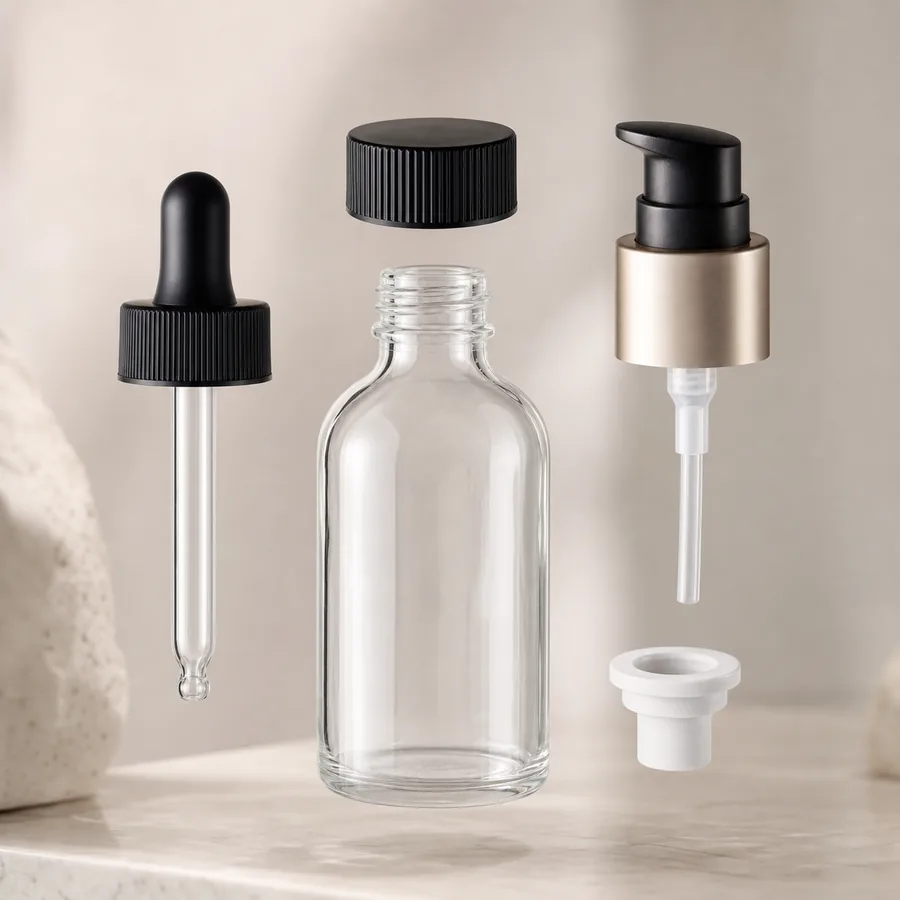
Manufacturer Insight: Confirm the Neck Before Selecting the Closure
For Boston round packaging projects, FOLOVER PACK recommends confirming the exact bottle code and neck-finish specification before sourcing a replacement dropper, pump, cap, or reducer.
A common component-selection risk is treating two bottles with the same nominal capacity or visible neck diameter as interchangeable. Their thread geometry, finish height, sealing surfaces, and internal dimensions may differ.
For example, if a dropper cap engages the bottle thread but the filled assembly shows residue around the neck, the buyer should investigate the closure’s sealing interface, gasket, component specifications, and closing conditions before replacing the glass bottle.
If a reducer lifts out during cap removal, investigate insert retention and neck compatibility rather than assuming that tightening the cap will solve the problem.
Final bottle and closure compatibility should be confirmed using the selected components and physical samples before bulk production.
Boston Round vs Euro Dropper Bottle
A Boston round is a bottle shape. A Euro dropper is a dispensing concept that uses a fitted reducer insert and cap. A Boston round bottle may be designed for a Euro dropper system, but not every Boston round is a Euro dropper bottle, and Euro dropper systems can use bottle profiles other than the classic Boston round.
This distinction helps buyers write clearer specifications. “Amber Boston round bottle” identifies a shape and color; “amber Boston round bottle with matched reducer insert and cap” describes a more complete packaging configuration.
For procurement, the more useful question is whether the selected bottle neck is designed for the intended reducer and cap, rather than whether the bottle resembles another Euro dropper product.
Boston Round vs Straight-Sided Cosmetic Bottle
Boston round bottles have a pronounced rounded shoulder leading to a narrow neck. Straight-sided cosmetic bottles often use a more vertical profile and may have different shoulders, bases, proportions, or dispensing systems.
For a brand seeking the familiar apothecary silhouette, a Boston round may provide a suitable starting point. If a longer vertical decoration area or a different assembled proportion is central to the concept, a straight-sided format may be worth comparing.
Neither shape establishes closure compatibility, packing efficiency, or formula suitability by itself. Buyers should compare the actual bottle geometry, usable artwork area, closure system, and secondary packaging.
The glass dropper bottle buying guide helps buyers compare shapes, colors, droppers, and compatibility from a purchasing perspective.
Decoration and Brand Presentation
The cylindrical body can offer a continuous visual area, but the usable decoration zone must still be confirmed from the bottle drawing or sample. Artwork placed too close to the shoulder or base may distort or become difficult to apply consistently.
For screen printing on a suitable cylindrical bottle, the decoration process may involve a rotating fixture. Artwork width, print registration, and the transition between the straight body and rounded shoulder should be reviewed before production.
Labels need suitable placement dimensions, overlap allowance, and adhesion under the intended storage and use conditions. Coating or frosting should also be evaluated on the actual bottle rather than approved solely from a digital rendering.
Brands should review glass color, closure color, bulb or actuator color, printing, coating, and carton together. Different component materials and finishing methods can produce visible differences even when the same color reference is supplied.
FOLOVER PACK’s decoration and finishing options provide additional context for coating, printing, and other surface-treatment requirements.
Buyer action: Approve a decorated physical sample showing the actual bottle, selected closure, artwork position, color reference, and assembled appearance before bulk production.
What Buyers Should Confirm
A Boston round bottle quotation should identify the exact container and intended component configuration. Capacity, color, and a general closure description are not sufficient when the supplier must coordinate the complete packaging system.
- exact bottle code, capacity, dimensions, glass color, and neck finish;
- closure type, thread or retention system, seal, and material;
- pipette or dip-tube length where applicable;
- formula behavior and material compatibility;
- assembled leakage, dispensing, alignment, and handling;
- decoration area, color reference, artwork position, and durability criteria;
- carton, insert, packing, and transport requirements;
- representative sample approval before mass production.
For example, when a buyer requests an amber Boston round bottle with a dropper for a facial-oil product, the RFQ should identify the required fill, intended dispensing method, preferred glass finish, planned quantity, and actual formulation characteristics. The supplier can then confirm which bottle and dropper configurations require physical matching and evaluation.
Do not assign a neck finish, closure dimension, pipette length, MOQ, or sample-testing commitment from a general Boston round description. These details must be confirmed for the selected products and project.
Physical Sample Evaluation
- Confirm that the sample bottle and closure match the proposed product codes and specifications.
- Check thread engagement, gasket or liner contact, reducer retention, and pipette or dip-tube position where applicable.
- Evaluate the complete package with the actual formulation under agreed storage, dispensing, and leakage-check conditions.
- Approve the physical glass color, decoration, component finish, and assembled appearance.
- Review the carton and protective insert using the intended assembled bottle.
Record the approved bottle code, closure code, finish reference, artwork revision, sample date, and agreed evaluation conditions in one decision record. A visually similar replacement bottle or closure should not be treated as equivalent without reviewing the affected interfaces.

Browse the Product Knowledge hub for bottle and closure fundamentals. For sourcing-oriented comparisons, use the Packaging Buying Guides hub.
Frequently Asked Questions
What is a Boston round bottle?
A Boston round bottle is a container shape with a cylindrical body, rounded shoulders, and a relatively narrow neck. It is commonly used for oils, serums, and other compatible liquids. The shape does not define a fixed capacity, glass color, or closure. Buyers should confirm the exact bottle specifications and intended dispensing system before ordering.
Why are Boston round bottles often amber?
Amber glass is associated with essential-oil and apothecary packaging and may be considered when light exposure is part of the packaging brief. However, amber appearance alone does not establish a specific UV-protection level or formula stability. Buyers should define the required protection and evaluate the selected bottle with the actual formulation under intended storage conditions.
What are Boston round bottles used for?
Boston round bottles are commonly considered for essential oils, facial oils, serums, aromatherapy blends, and other compatible cosmetic liquids. Their cylindrical shape can support different decoration and dispensing options. Final suitability depends on the actual formulation, required fill, bottle neck, closure, and intended use. Buyers should evaluate the complete packaging system before production.
Can Boston round bottles use droppers?
Yes, selected Boston round bottles can use pipette droppers when the exact neck finish, closure, sealing components, and pipette configuration are compatible. A dropper should not be selected from bottle capacity or visible neck diameter alone. Buyers should also verify bulb material compatibility, pipette length, and dispensing behavior using the actual formulation and physical samples.
Is a Boston round bottle the same as a Euro dropper bottle?
No. Boston round describes a bottle shape, while Euro dropper describes a dispensing system using a fitted reducer insert and compatible cap. Some Boston round bottles can be designed for Euro dropper systems, but the terms are not interchangeable. Buyers should confirm the exact bottle neck, reducer retention, cap fit, and actual-formula dispensing before ordering.
Can Boston round bottles be customized?
Yes. Depending on the selected bottle and project feasibility, customization may include coating, frosting, printing, hot stamping, labeling, and coordinated closure finishes. The usable decoration area depends on the actual cylindrical body and shoulder geometry. Buyers should approve physical samples showing the intended color, artwork, glass finish, closure, and complete assembled appearance before bulk production.
Conclusion
Boston round bottles offer a recognizable cylindrical shape with rounded shoulders, but the shape name does not define the complete package. Buyers should confirm the exact size, glass color, neck finish, closure, tube length, decoration, formula compatibility, and secondary packaging as one system.
For compatible fluid serums or facial oils requiring manual dispensing, a matched pipette dropper may provide a suitable solution. For concentrated liquids requiring controlled drop-by-drop flow, a bottle designed for a reducer insert and cap may be more appropriate. The final choice must be verified with the actual formulation and selected components.
FOLOVER PACK supports B2B Boston round bottle sourcing, closure matching, decoration, and component coordination. Share your target capacity, preferred glass color, intended formulation, closure requirements, planned quantity, and decoration references to review suitable packaging options.