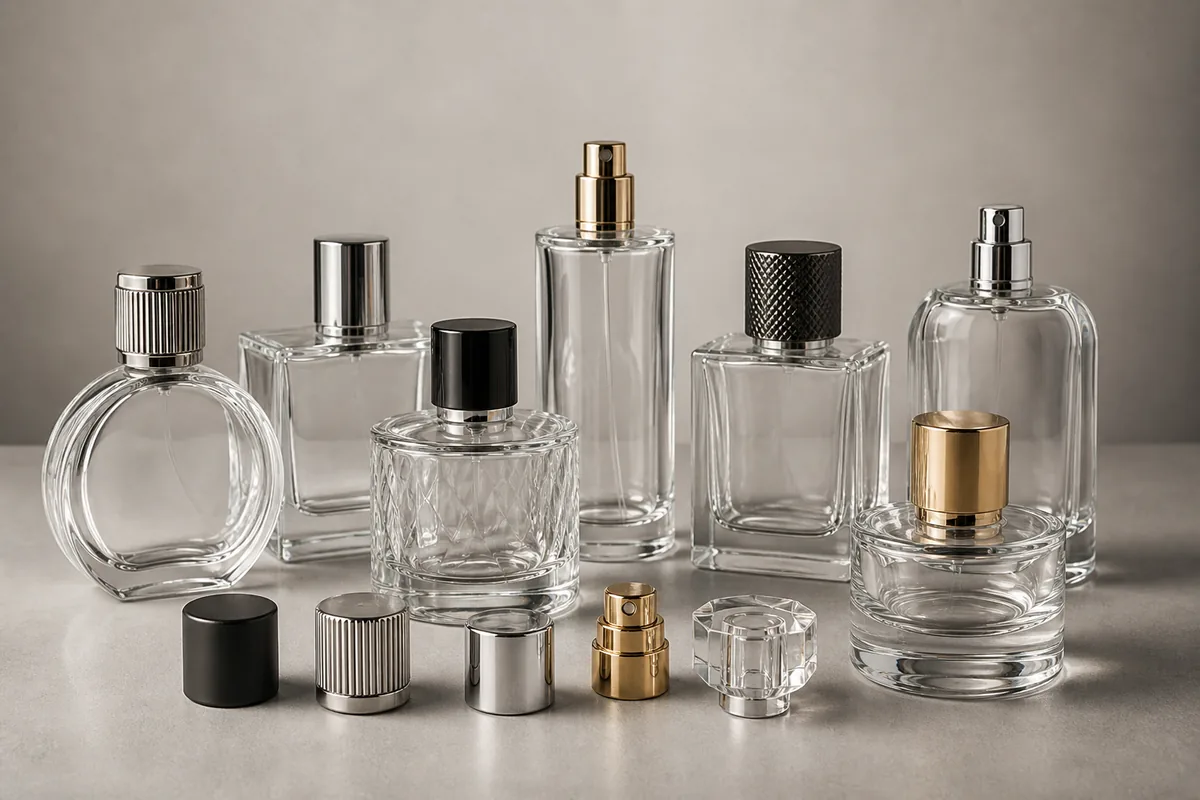

Perfume bottle anatomy includes more than the glass container. A complete fragrance package combines the bottle body, neck finish, atomizer, actuator, collar, cap, dip tube, and any required sealing or attachment components. Each part has a distinct function, but the complete system must fit, assemble, spray, seal, and present correctly.
Understanding these components helps B2B buyers prepare accurate RFQs, identify compatibility risks, and determine which parts require physical sample approval. This overview explains what each part does and how the components interact, without replacing dedicated technical guidance on crimping, atomizer mechanisms, neck specifications, compatibility testing, or filling equipment.
The Glass Bottle
The glass bottle holds the fragrance and provides the main structural and visual form. Its anatomy includes the base, body, shoulder, opening, neck, and neck finish. The exterior also provides surfaces for coating, frosting, printing, hot stamping, labels, or other approved decoration.
Shape, glass weight, base design, wall distribution, capacity, and dimensions can influence presentation, handling, decoration, packing, filling-line fit, and logistics. Exact values must come from the verified product drawing or specification rather than a visually similar bottle.
The base and shoulder deserve particular attention during packaging development. A thick-looking base affects the bottle’s visual proportions but does not establish its actual weight or usable filling volume. A pronounced shoulder can influence the internal space available for the dip tube and the bottle’s position in filling or handling equipment.
The bottle is only the container. It does not establish the atomizer, cap, sealing method, or spray performance by itself. Buyers reviewing perfume glass bottles should evaluate the complete compatible configuration.
The Bottle Neck Finish
The neck finish is the engineered geometry at the bottle opening that interfaces with the atomizer or closure. Perfume bottles commonly use crimp or screw structures, but exact dimensions and profiles vary by design. A component must match the verified neck specification; appearance alone is not enough.
A crimp neck is designed for an atomizer attachment formed with a ferrule and controlled crimping process. A screw neck uses a threaded attachment system. This describes the basic structural difference only. The locked crimp versus screw perfume bottle guide covers equipment, finishing, reopening, and selection tradeoffs.
For crimped perfume packaging, an FEA-type neck finish is one recognized configuration. However, an FEA designation alone does not establish compatibility with every atomizer. The exact glass finish, ferrule, gasket, and assembly requirements must be checked together.
The industry association Cetie provides technical guidance in its Guide No. 12, Recommendation for Flaconnage Crimping, which addresses the application of pumps with aluminum ferrules to FEA-type glass finishes. The guidance describes important crimping considerations but does not provide universal approval for every bottle-and-atomizer combination.
Buyer action: Request the exact bottle neck specification and the corresponding atomizer drawing before confirming the component set. If a supplier proposes changing from a crimped atomizer to a screw-on version, the neck and attachment configuration must be reviewed rather than assuming the existing bottle will accept the replacement.
The Perfume Atomizer
The atomizer is the dispensing assembly that draws liquid from the bottle and releases it as a spray. Its result depends on the pump design, actuator, spray orifice, dip tube, neck attachment, seals, formula, and assembly conditions.
Pump Mechanism
At a high level, pressing the actuator changes pressure inside the pump so a measured amount of fragrance moves toward the outlet. Releasing the actuator allows the chamber to refill. Exact internal construction and output are component-specific.
The pump mechanism contains the functional elements responsible for drawing, temporarily holding, and dispensing the fragrance. The actuator and dip tube connect to this mechanism but perform different functions.
A pump should not be selected solely by its appearance or nominal neck designation. Its attachment, dispensing performance, and product-contact materials must be evaluated with the selected bottle and actual fragrance formulation.
Actuator
The actuator is the part pressed by the user. Its shape, travel, force, and alignment affect handling and the visible relationship with the collar and cap.
Actuator clearance matters when the finished package uses a decorative collar or a cap with an internal fitment. An incorrectly positioned collar may restrict actuator movement, while an unsuitable cap may press against the actuator when fitted.
Buyers should check that the actuator moves and returns correctly with the intended collar and cap installed.
Spray Orifice
The spray orifice helps form the outgoing spray. Spray pattern and atomization cannot be judged from the hole appearance alone; they must be tested with the exact atomizer, fragrance, and package.
An attractive actuator design does not guarantee the desired spray experience. The pump mechanism, outlet construction, formulation, and operating conditions all influence the result.
During sample evaluation, buyers should confirm whether the selected atomizer delivers the intended spray pattern, dispensing behavior, and user experience using the actual fragrance.
Dip Tube
The dip tube carries liquid from inside the bottle to the pump. It must suit the bottle height, base geometry, atomizer, formula, and assembly. A tube that is too short may leave excess product unreachable, while one that is too long can bend or interfere with consistent intake.
Dip-tube dimensions should be determined from the selected atomizer and bottle configuration, not inferred from nominal bottle capacity.

The future locked guide on how perfume atomizers work will address spray pumps, attachment, and performance in detail.
The Collar
The collar is the decorative component around the atomizer and bottle neck. It can hide part of the attachment interface, coordinate with the cap, and create a finished transition between glass and spray head.
Collar fit involves internal dimensions, height, alignment, retention, finish, and interaction with the actuator and cap. A collar should not obstruct actuation or create damaging contact with decoration. It is usually an appearance and assembly component, not a substitute for the ferrule, seal, or other technical interface.
For a square or rectangular perfume bottle, the rotational alignment of the collar and cap may also influence the final visual appearance. A collar that appears acceptable on its own may look misaligned when the complete package is assembled.
Common mistake: Approving a decorative collar before confirming the atomizer and cap. If the selected pump changes, its assembled height or actuator position may also change, requiring the collar and cap to be reviewed again.
The Perfume Cap
The cap protects the actuator during handling and contributes strongly to brand presentation. Caps may use friction, snap, or project-specific magnetic or mechanical retention systems. FOLOVER should not be assumed to offer every system for every bottle; the exact cap must be confirmed for the selected package.
Cap material, weight, balance, internal fitment, clearance, alignment, finish, and removal force can affect use and assembly. A visually compatible cap may sit too high, contact the actuator, rotate incorrectly, feel loose, or damage a collar. Verify the assembled bottle rather than selecting the cap separately.
For caps with an internal insert or retention mechanism, the visible outer shell does not establish compatibility. The internal fitment must correspond to the intended atomizer or collar configuration.
During sample approval, buyers should check cap installation and removal, retention during normal handling, actuator clearance, and the final alignment between the cap and glass bottle.
Buyers can review the canonical perfume and cosmetic bottle caps category for available product directions.
Decoration Surfaces and Visual Proportions
Perfume packaging appearance comes from the relationship among glass shape, base, shoulder, atomizer height, collar diameter, cap volume, and decoration. A cap or collar that looks attractive by itself may feel visually unbalanced when assembled with the selected bottle.
The glass body may use coating, frosting, printing, hot stamping, labels, or a combination approved for the project. Components can use coordinated metallic, painted, molded, or other verified finishes. These surfaces may reflect color differently, so a single digital color value does not guarantee identical physical appearance across glass, plastic, and metal.
Check printable areas, artwork position, seam or orientation, spray and cap alignment, collar contact, and the possibility of scratching during assembly. Approve the assembled decorated pack under consistent lighting. Decoration should not interfere with crimping, screwing, actuation, cap retention, or sealing interfaces.
For example, a printed logo on the front of a rectangular bottle may need to align visually with a directional cap. If the cap or collar can rotate after assembly, the approved appearance may change during normal handling. The buyer should therefore establish which components require a controlled orientation and confirm that the selected retention system supports it.
For available surface-treatment options, see FOLOVER PACK’s decoration and finishing services. Final artwork, color, coating, and component finishes should be approved on physical samples of the intended packaging configuration.
Dip Tube Function and Length
The dip tube follows the liquid pathway from bottle to atomizer. Its cut, material, inner dimensions, connection, length, and position can influence intake. Bottle height alone is not sufficient to define it because the pump body, shoulder, base, tube angle, and desired clearance also matter.
Use the atomizer supplier’s verified method and physical samples to confirm length. Do not copy a tube from another capacity or bottle family unless the complete configuration is proven equivalent.
A useful inspection distinguishes between an unsuitable tube length and a dispensing problem originating inside the pump. If fragrance remains in the bottle but the atomizer stops drawing liquid, buyers should check the tube’s position, intake opening, connection to the pump, and priming behavior before deciding which component requires adjustment.
Final tube configuration should be approved with the selected bottle and atomizer. An apparently correct length on an empty bottle does not establish reliable liquid intake during use.
Sealing and Attachment Interfaces
Depending on the system, the package may include a ferrule, gasket, liner, seal, or other interface. Each has a defined role in attachment or sealing and must be evaluated with the exact neck and atomizer.
In a crimped assembly, the ferrule provides mechanical attachment around the designed glass neck profile, while the gasket or other specified sealing element participates in creating the intended seal. The two functions are related but should not be treated as interchangeable.
In a screw-on system, thread engagement secures the atomizer or closure. The seal depends on the selected closure construction and its intended contact with the bottle’s sealing surface.
Neither attachment method guarantees leak-free performance solely because the component appears firmly connected.
Manufacturer Insight: When a Perfume Bottle Leaks Around the Neck
Leakage around an assembled perfume atomizer should be investigated at the complete sealing and attachment interface rather than attributed automatically to a defective glass bottle or pump.
For a crimped system, the investigation may include the glass neck profile, ferrule, gasket, component dimensions, and actual crimping conditions. For a screw-on system, the relevant checks may include thread engagement, sealing geometry, gasket position, and the approved closing process.
Component material compatibility also matters. A gasket or other product-contact material that performs acceptably with one fragrance formulation may require separate evaluation with another formulation.
FOLOVER PACK recommends identifying the exact bottle and atomizer codes, inspecting the assembled interface, and evaluating the proposed correction with physical samples. A replacement gasket, atomizer, or closure should not be approved solely because the revised assembly appears tighter.
Compatibility limitation: A component that can be physically attached is not automatically sealed, spray-qualified, or suitable for the fragrance. Verify fit, assembly, leakage, spray, material interaction, and use conditions through an appropriate project plan. Packaging compatibility should be evaluated with the actual formulation under intended storage and use conditions.
How All Components Work Together
- The bottle and neck finish define the container and attachment interface.
- The atomizer and sealing parts are matched to that neck.
- The dip tube is configured for the bottle interior and pump.
- The fragrance is filled under the approved process.
- The atomizer is crimped, screwed, or otherwise attached using the verified system.
- The collar is fitted without obstructing the actuator.
- The cap is aligned and checked for retention, clearance, and handling.
Although these components are often sourced or approved separately, the completed perfume package must function as one assembled system. The table below identifies each component’s main function and the corresponding buyer verification point.
| Component | Main Function | Potential Problem | What Buyers Should Verify |
|---|---|---|---|
| Glass bottle and neck finish | Contain the fragrance and provide the attachment interface. | Incorrect neck specification or dimensional mismatch. | Exact bottle drawing, neck geometry, capacity, and intended attachment system. |
| Atomizer and actuator | Draw and dispense fragrance through the spray system. | Poor priming, unsuitable spray, or actuator interference. | Selected pump model, actual-formula dispensing, actuator movement, and assembled fit. |
| Ferrule or threaded attachment and seal | Secure the dispensing assembly and provide the specified sealing interface. | Incomplete attachment, incorrect sealing contact, or leakage. | Matched neck and closure specifications, sealing component, and intended assembly process. |
| Dip tube | Carry fragrance from the bottle interior to the atomizer. | Restricted intake or excessive product remaining in the bottle. | Tube configuration, connection, intake position, and dispensing with the actual fragrance. |
| Collar and cap | Complete the exterior assembly and protect or visually integrate the actuator. | Misalignment, loose retention, or contact with the actuator. | Internal fitment, assembled height, cap retention, clearance, and approved appearance. |
These verification points apply to the selected components and should not be interpreted as universal dimensional specifications or evidence of a completed compatibility test.
Why Component Compatibility Matters
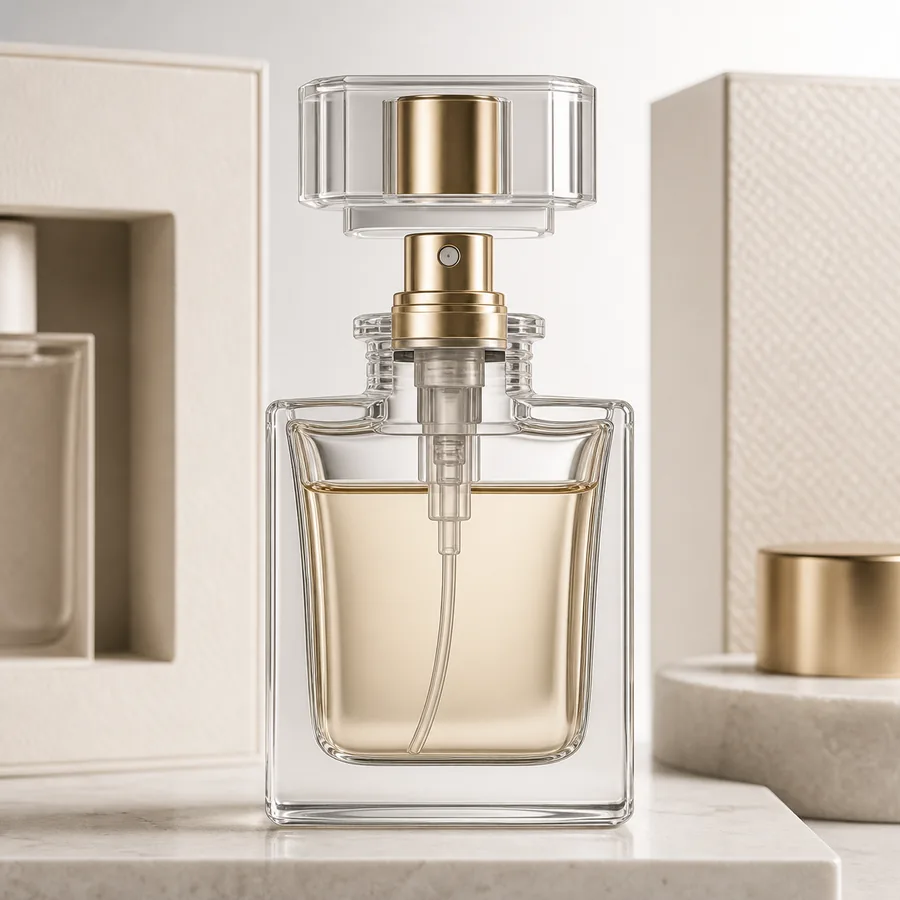
Component mismatch can appear as leakage, a loose or uneven cap, poor spray, actuator interference, collar misalignment, difficult assembly, decoration damage, or excess unreachable fragrance. The same symptom may have more than one cause, so troubleshooting must trace the exact bottle, component revision, formula, and assembly conditions.
Do not solve one symptom by changing a component without repeating relevant verification. A different atomizer or gasket can affect neck fit, height, collar, cap, spray, and formula contact.
For example, a cap that does not sit at the intended height may result from an internal fitment mismatch, an incompatible collar, or a change in the atomizer’s assembled height. Replacing the visible cap without checking these interfaces may leave the original problem unresolved.
Similarly, fragrance residue around the neck should not automatically be treated as evidence that the glass bottle is defective. The sealing components and assembly process must also be considered.
For a component-level explanation of leakage causes and the corresponding investigation process, see why cosmetic bottles leak.
What Physical Samples Should Demonstrate
An available bottle sample can demonstrate general shape, glass appearance, and handling. A component set can demonstrate the intended atomizer, collar, and cap direction. A decorated sample can show physical color and artwork. A final configuration sample should bring the defined bottle, neck, atomizer, dip tube, collar, cap, decoration, and fragrance or approved test medium together.
Record which attributes each sample is intended to validate. One sample cannot prove production consistency, formula compatibility, long-term sealing, transport performance, or filling-line suitability without an appropriate test and quality plan.
Compare revisions against current drawings, component models, photographs, and a controlled approved reference. If any component changes, identify the affected interfaces and repeat the relevant checks before mass production.
Physical Sample Approval: Check the Complete Assembly
- Bottle and neck: Confirm the exact bottle model, neck specification, and visible condition of the attachment and sealing surfaces.
- Atomizer and seal: Verify the intended attachment, gasket or sealing configuration, and compatibility with the selected neck.
- Dip tube and spray: Evaluate liquid intake, priming, actuator operation, and spray behavior with the actual fragrance.
- Collar and cap: Confirm alignment, clearance, retention, and the assembled height of the finished package.
- Decoration: Approve the physical color, logo position, surface finish, and appearance of the assembled bottle and components.
- Production reference: Record the approved bottle and component codes, drawing revisions, sample configuration, and applicable evaluation results.
Final bottle and closure compatibility should be confirmed using the selected components and physical samples before bulk production. Any long-term sealing, formula stability, or transport-performance claims require appropriate project-specific evidence.
What Buyers Should Specify in an RFQ

- fragrance use, bottle model, nominal capacity, and dimensions;
- neck finish and atomizer attachment system;
- atomizer model, actuator, spray expectation, and finish;
- dip tube requirement and bottle configuration;
- collar and cap material, finish, fit, and alignment;
- bottle and component decoration;
- quantity, variants, samples, testing, filling, assembly, and packing scope.
When the atomizer, cap, or other components will be sourced separately, buyers should identify the responsible supplier for each component and confirm who will coordinate the final assembled sample. The same bottle and component specifications should be used throughout sampling, quotation, and production approval.
For the selection workflow, use how to choose a perfume bottle and the broader perfume packaging guide.
Frequently Asked Questions
What are the main parts of a perfume bottle?
The main parts are the glass bottle, neck finish, atomizer, actuator, collar, cap, dip tube, and any required sealing or attachment components. The glass bottle contains the fragrance, while the neck and atomizer form the dispensing interface. The collar and cap complete the visible assembly. Buyers should approve the complete component set rather than selecting each part independently.
What does a perfume atomizer do?
A perfume atomizer draws fragrance through the dip tube and releases it as a spray through the pump and actuator system. Its dispensing behavior depends on the selected mechanism, outlet construction, formulation, and assembly. Buyers should evaluate priming, actuator operation, spray performance, and sealing using the intended bottle, atomizer, and actual fragrance before production.
What is the collar on a perfume bottle?
The collar is a decorative component around the atomizer and neck that helps finish the visible assembly. It may conceal part of the attachment and coordinate with the cap, but it does not automatically provide the primary seal. Buyers should verify its internal fitment, height, alignment, actuator clearance, and assembled appearance with the selected atomizer and bottle.
What is a perfume bottle neck finish?
A perfume bottle neck finish is the engineered bottle-opening geometry designed to interface with a specific atomizer or closure attachment system. It may use a crimp or screw configuration with defined dimensions and sealing surfaces. Buyers should confirm the exact bottle neck specification and corresponding atomizer or closure drawing rather than assuming compatibility from nominal diameter or appearance.
Can any perfume cap fit any bottle?
No. Cap fit depends on the assembled atomizer, collar, neck area, internal fitment, dimensions, clearance, and retention design. Two caps may look similar but use different internal structures. Buyers should evaluate the selected cap on the complete bottle assembly, checking installation, removal, actuator clearance, retention, and visual alignment before approving the packaging configuration.
What does the dip tube do?
The dip tube carries fragrance from inside the bottle to the atomizer pump and must be configured for the exact bottle and system. An unsuitable tube length or intake position can affect dispensing and remaining product access. Buyers should confirm the tube configuration with the selected atomizer and evaluate liquid intake using the actual fragrance.
Continue through the Product Knowledge hub for related bottle, closure, and dispensing-system explanations.
Conclusion
Perfume bottle anatomy is a map of connected functions: the bottle contains, the neck provides an interface, the atomizer dispenses, the dip tube supplies liquid, and the collar and cap complete the assembly and presentation. No component should be approved in isolation.
For B2B buyers, the practical priority is to confirm the bottle neck and atomizer interface first, then approve the dip tube, sealing components, collar, cap, and decoration as one complete packaging configuration. Physical samples should demonstrate the intended assembly and dispensing performance before bulk production.
FOLOVER PACK supports perfume glass bottles, atomizer and component matching, caps, decoration, samples, and custom development. Buyers can also review pumps, droppers, and bottle accessories when defining a complete fragrance packaging brief.
Share your bottle model or design reference, capacity, neck-finish requirements, preferred atomizer, cap design, decoration, and planned order quantity to discuss suitable perfume packaging options.