
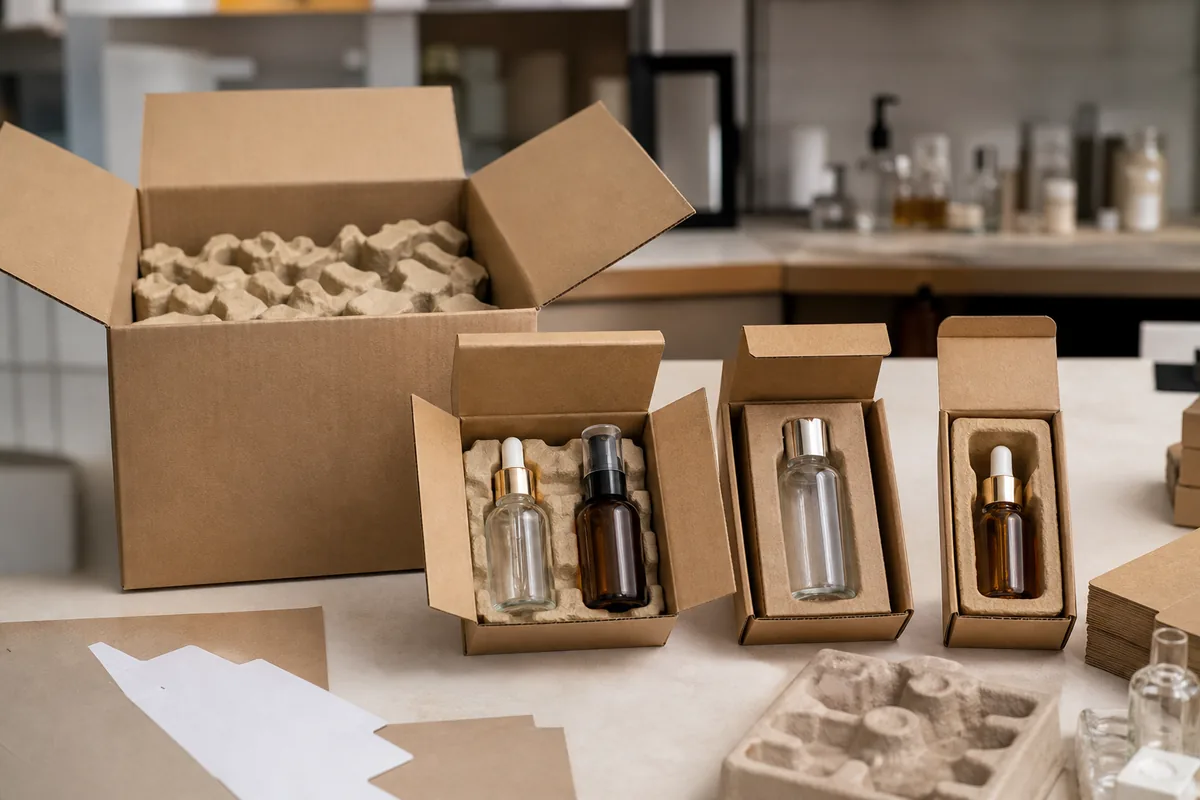
Cosmetic cartons and inserts can protect fragile glass, carry required information, provide tamper cues and create shelf structure. They can also add avoidable material and freight volume when they are much larger or more complex than the product requires. The practical objective is not to remove every secondary component. It is to engineer minimum sufficient protection for the real channel.
Direct Answer
To reduce secondary cosmetic packaging, measure the finished bottle and closure, right-size the carton, remove unnecessary void, simplify protective inserts and validate the complete pack for its intended distribution route. Keep glass separation, movement control, information space, tamper requirements and delivery performance as approval criteria.
For buyers, the most practical starting point is often the existing carton dieline and insert rather than redesigning the glass bottle. A smaller carton is an improvement only when the revised system delivers the same acceptable product without introducing additional damage, returns or replacement packaging.
FOLOVER Manufacturer Insight
FOLOVER PACK can coordinate cosmetic glass containers, closures, decoration, branded cartons, protective dividers and export packing options. The exact pack-out depends on bottle geometry, quantity, channel and project requirements; no single insert type or carton format is correct for every glass package.
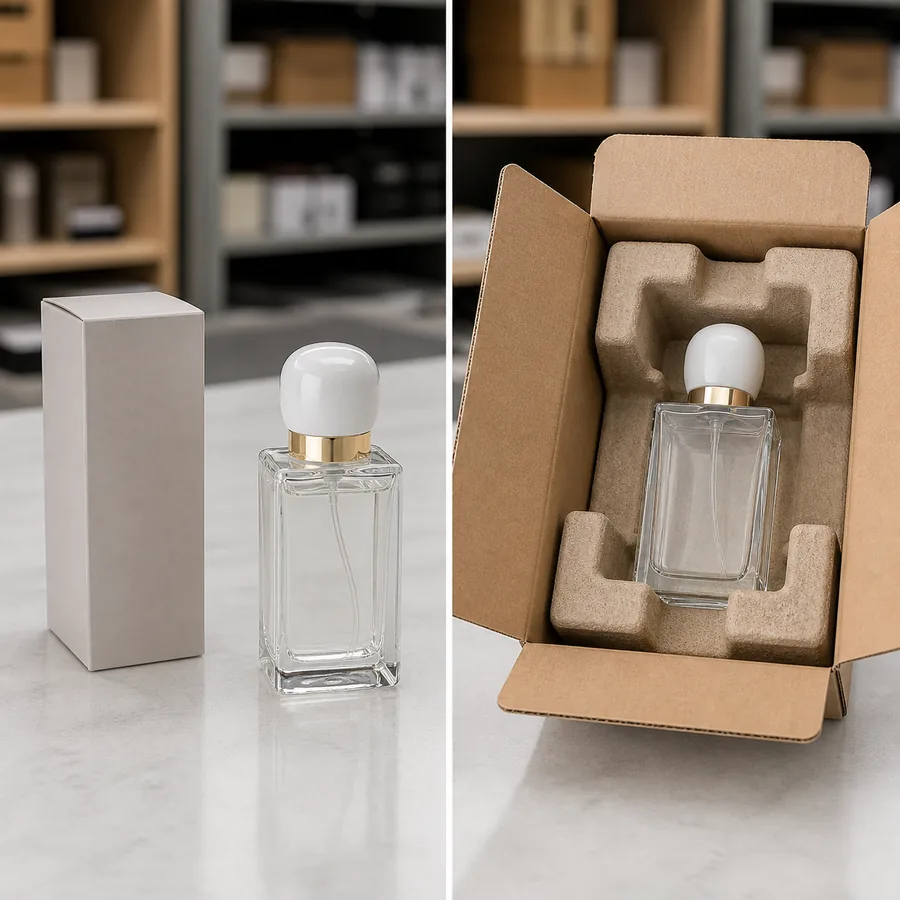
When reviewing a reduced carton, the controlling dimension is often not the bare glass bottle. A pump actuator, decorative collar, dropper bulb or oversized cap may determine the required internal height and clearance. An insert designed around an undecorated bottle may also contact or scuff the final coated or printed surface.
Buyers should provide the finished decorated bottle, selected closure, existing carton and insert, intended case quantity, distribution route and agreed acceptance criteria before approving a reduced pack. Physical samples are essential because drawings alone cannot confirm bottle movement, decoration scuffing or component contact during handling.
FOLOVER recommends approving the bottle, closure, carton and protective insert as one packaging system. If a bottle or closure specification changes, the carton and insert should be reassessed before bulk production rather than assuming that the previous pack-out remains suitable.
What counts as secondary packaging?
Primary packaging directly contains or dispenses the cosmetic formula, such as a bottle, jar, pump or dropper assembly. Secondary packaging groups, presents or protects that primary pack. Common examples include folding cartons, rigid boxes, sleeves, trays and inserts. Transport packaging includes shipping cases, dividers, cushioning and pallets.
The boundaries can overlap. A folding carton may be a retail presentation unit and also protect the bottle in a shipper. An e-commerce mailer may combine secondary and transport functions. Define the layers before comparing them so that a removed unit carton is not quietly replaced by a heavier delivery box.
For an accurate reduction claim, buyers should specify whether the comparison covers the retail carton, protective insert, complete secondary package or entire delivered packaging system.
This topic belongs in the sustainable packaging architecture but must remain connected to protection and product-loss risk.
Why cosmetics use cartons and inserts
Glass bottles can be vulnerable to impact, abrasion and glass-to-glass contact. Decoration can scuff. Pumps, caps or droppers may need orientation and clearance. A carton can also provide an information panel, protect light-sensitive presentation, improve shelf blocking or support tamper evidence.
List these functions explicitly. If a carton exists only because the original bottle was smaller than the desired shelf footprint, redesigning the pack may offer a real opportunity. If it carries mandatory or market-specific information, the available panel area cannot be removed without review.
For a decorated glass serum bottle, an insert may need to support the base and control movement without pressing against the printed logo or pump head. Removing that insert to save material could create a decoration or dispensing problem even if the glass itself remains intact.
The key is functional allocation: one well-designed component may replace several overlapping layers, but only after the required roles are confirmed.
Right-size the bottle-to-carton fit
Measure the finished bottle at its controlling dimensions, including closure, collar and decoration. Allow only the clearances needed for insertion, tolerance, movement control and protection. Excess top space, deep side voids and oversized bases increase paperboard and shipping volume.
A close fit is not automatically safe. Bottles and caps need enough clearance to avoid compression or abrasion. Production tolerances and assembly variation matter. Test the exact decorated samples rather than an undecorated bottle alone.
For example, if an existing carton was developed around a tall decorative cap but the commercial product now uses a shorter pump, the original internal height may no longer be necessary. The buyer can request a revised dieline while checking that the pump actuator, bottle shoulder and protective insert retain the required clearances.
Buyer action: Request the current carton drawing, finished-bottle dimensions and proposed revised dieline. Confirm the internal clearance and insert contact points using physical samples before approving the new carton dimensions.
The broader guide to reducing material across the complete cosmetic pack helps teams decide whether the carton or the primary package should change first.

Reduce empty space before changing materials
Switching to a different paperboard or insert material may attract attention, but excess dimensions can be the larger structural issue. Calculate the volume of the unit carton and shipper relative to the contained products. Review how many units fit in a case and how cases fit the intended logistics configuration.
Carton volume can be calculated from its external length, width and height using consistent units. Compare the original and proposed carton volumes, but do not treat the percentage change in external volume as an identical percentage reduction in paperboard mass.
For material reduction, request the actual weight of the original and revised cartons. Changes in board grade, thickness, folding structure or inserts can affect the final mass independently of the external dimensions.
Do not invent a universal acceptable void percentage. Bottle shapes, closures, decoration and routes vary. Use physical pack-outs to identify where space is necessary and where it is inherited from an old dieline or generic box.
Reducing void can lower paperboard area and improve shipment density without making a claim about the environmental superiority of a particular material.
Simplify inserts by function
Inserts typically locate the bottle, prevent movement, separate surfaces or present components. Map the contact points that need control, then remove flaps, layers or cavities that do not contribute. A simpler folded-paperboard structure may work for one bottle; a molded-fiber tray or divider may be more suitable for another.
Material substitution must be validated. Paper, molded fiber, polymer trays and foam have different stiffness, moisture behavior, surface texture, recovery and production tolerances. A paper insert is not automatically lower impact, and a plastic tray is not automatically unnecessary.
For a cosmetic glass jar, a simple base support may provide adequate positioning in one carton configuration. A tall serum bottle with a delicate dropper or decorated shoulder may require support at different locations. The correct insert depends on the specific bottle, closure and expected handling conditions.
Ask suppliers for drawings, material identification and samples. Judge the insert as part of the complete pack, not by an isolated sustainability label.
Before replacing a plastic tray with folded paperboard or molded fiber, verify whether the new material maintains bottle positioning, surface protection and the necessary clearance around the closure. Also assess assembly consistency and the potential for abrasion under the intended transport conditions.
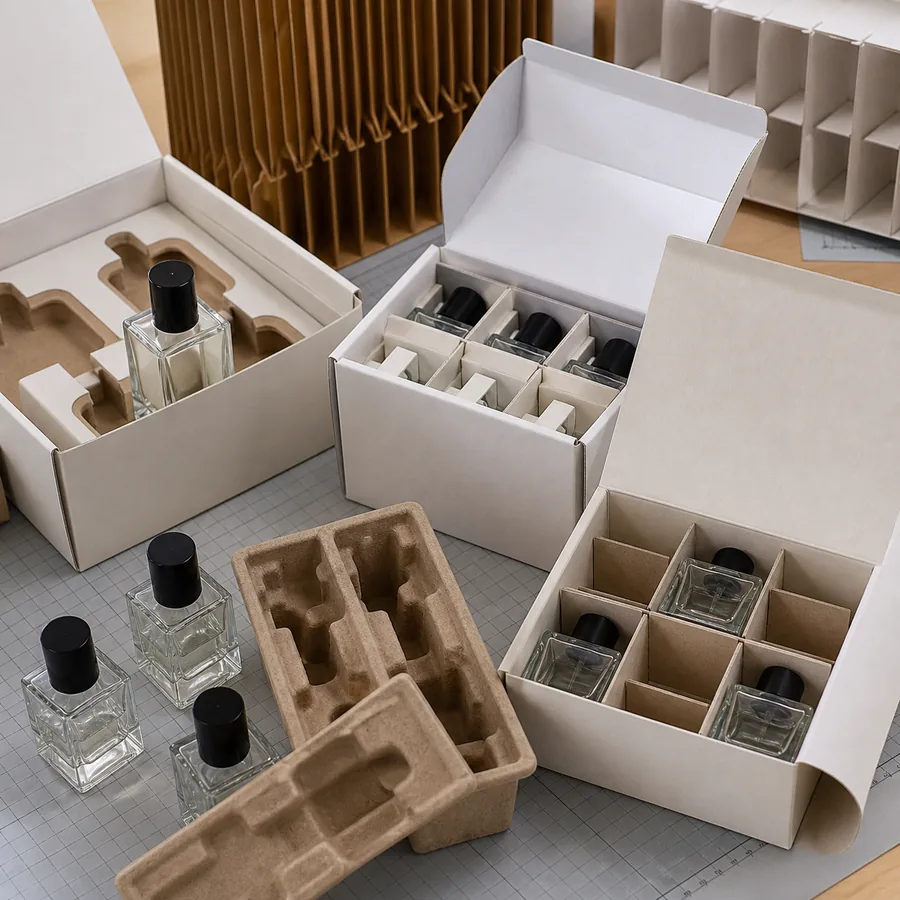
Protection comes first for glass
Reducing a divider or cushioning layer can increase bottle movement, impact transfer or surface contact. A package that saves paperboard but raises breakage and product loss has shifted the burden rather than solved it.
Define failure criteria before testing: broken glass, leakage, cap loosening, pump damage, decoration scuffing, carton collapse and unacceptable presentation. Use route-relevant handling and conditioning determined by the responsible project team. Do not publish a drop height or survival rate without verified test evidence.
The International Safe Transit Association (ISTA) test procedures provide recognized approaches for evaluating packaged products against transport hazards. ISTA Procedure 3A addresses individual packaged products of 70 kg or less shipped through parcel delivery systems. Other transport configurations may require different procedures.
ASTM D4169, Standard Practice for Performance Testing of Shipping Containers and Systems, provides a framework for evaluating shipping units against selected distribution hazards.
These are testing frameworks, not evidence that a particular FOLOVER packaging configuration has passed a transport test. The relevant procedure, test conditions, specimens and acceptance criteria must be selected for the actual shipment.
Sample Evaluation: What should buyers check after reducing an insert?
Use production-representative bottles, closures, decoration and protective materials to compare the original pack with the proposed reduced configuration.
- Glass protection: Check for cracks, chips and breakage, particularly around the base, shoulder and neck.
- Closure security: Confirm that pumps, droppers and caps remain correctly assembled and functional after handling.
- Decoration: Inspect coated, frosted, printed and labeled surfaces for unacceptable abrasion or contact damage.
- Positioning: Check whether bottles move, rotate or contact adjacent glass components during the selected transport evaluation.
- Carton integrity: Inspect the carton and insert for collapse, deformation or loss of protective positioning.
- Product containment: For filled-package testing, inspect for leakage and other agreed functional failures.
Compare the results against the project’s predefined acceptance criteria. Do not approve a reduced configuration solely because the empty carton or insert appears sufficiently strong.
The existing cosmetic glass bottle export-packing guide covers bulk protection; this article focuses on right-sizing and material decisions.
Retail and e-commerce need different systems
A retail unit may travel inside a master carton and then sit on a shelf. An e-commerce unit may experience parcel handling, mixed loads and direct delivery. The same attractive folding carton may be insufficient as a shipping container, while placing a retail carton inside a much larger mailer can create unnecessary volume.
Develop channel-specific pack-outs around a consistent primary package. The article on cosmetic packaging for e-commerce and retail explains design differences. Record which layers are used in each channel before making a company-wide reduction claim.
One useful strategy is to separate brand presentation from protective logistics. A compact printed sleeve or carton can remain consistent while an efficient shipper changes by route.
Buyer decision: If the product is primarily distributed through retail master cartons, evaluate whether the unit carton can be reduced while maintaining the necessary presentation and protection. If the same product is shipped directly to individual consumers, evaluate the retail carton together with the actual parcel shipper and cushioning system.
Do not assume that eliminating a retail carton reduces total packaging when the e-commerce configuration subsequently requires more protective material.
Review printing, coatings and finishes
Large ink coverage, lamination, metallic layers, magnets and complex rigid-box constructions may create brand effects while complicating material identification or separation. Review whether each finish produces meaningful recognition or merely repeats another element.
Simplification does not require an unbranded appearance. Strong typography, controlled color, proportion and one focal finish can create hierarchy. Physical print and decoration samples should be approved because paper color, ink, coating and production method influence the final result.
For a brand already using a decorated glass bottle, the secondary carton may not need multiple additional decorative layers to communicate the same identity. Buyers can compare a simpler printed folding carton against the existing laminated or rigid-box construction while retaining the approved bottle and product presentation requirements.
Record the actual material difference rather than assuming that removing a decorative finish delivers a specific environmental saving.
Do not claim that a simplified carton is recyclable everywhere. Local collection and processing conditions remain relevant.
Preserve information and compliance space
Cosmetic packaging may need product identity, quantity, ingredients, warnings, responsible-party details, batch information, codes or other market-specific content. The responsible regulatory team must define the actual requirements. A smaller carton with unreadable or incomplete information is not a compliant optimization.
Consider whether information belongs on the primary label, carton, leaflet or an approved digital mechanism under applicable rules. Do not remove a leaflet or panel based on generic advice. Verify language, type size, durability and market scope.
Before reducing carton dimensions, provide the proposed dieline to the responsible artwork and regulatory teams. Confirm that the available printable area accommodates the required content for every intended destination market.
A design that fits an English-only artwork layout may not accommodate additional language requirements. Similarly, moving information from the carton to the bottle or a leaflet requires confirmation that the revised labeling arrangement is permissible and practical for the selected product and market.
For wider context, see packaging waste, EPR and recyclability basics.
Measure the complete delivery configuration
A secondary-packaging reduction should compare the current and proposed configurations using the same product, distribution route and measurement boundary. Record the physical changes separately from any wider environmental conclusions.
| Metric | Why it matters | What Buyers Should Verify |
|---|---|---|
| Unit-carton dimensions | Paperboard use, retail footprint and shipping volume | Compare approved original and revised dielines using consistent external and internal dimensions. |
| Insert material and mass | Protection, material reduction and component separation | Record the material, weight, geometry and protective performance of each insert. |
| Units per shipper | Carton utilization and packing efficiency | Confirm the actual quantity and protective arrangement in the approved shipping case. |
| Movement/contact | Glass breakage and decoration damage risk | Evaluate bottle positioning, contact points and closure clearance using physical samples. |
| Observed damage | Delivered product loss and replacement risk | Compare route-relevant test results and shipment records against defined acceptance criteria. |
| Channel layers | True comparison boundary for material reduction | Record all retail, e-commerce and transport packaging used for the same delivered product. |
For a defined component, the material-reduction percentage can be calculated by subtracting the revised weight from the original weight, dividing by the original weight and multiplying by 100. The calculation must use measured weights and the same component boundary.
A decrease in carton volume does not automatically equal the same percentage decrease in carton weight, freight cost or environmental impact.
The US FTC Green Guides summary explains why environmental claims should be specific and supported by evidence. Buyers should identify what was reduced and the reference package used for comparison rather than publishing an unsupported claim that the revised packaging is universally greener.
Keep raw measurements rather than collapsing them into one unsupported “green score.”
Develop the carton and insert together
A carton dieline should not be finalized before the insert and finished bottle are known. The insert changes the controlling internal dimensions, while closure height, decoration and assembly tolerances determine necessary clearance. Develop the three elements as one pack-out rather than passing independent drawings between suppliers.
Prototype more than one geometry when the protection mechanism is uncertain. Compare folded supports, collars, base locks and dividers against the same bottle and failure criteria. Record assembly time and error modes because an insert that uses less material but is frequently folded incorrectly can raise production loss.
For a glass bottle with a tall pump, an insert that supports only the base may allow excessive movement at the shoulder or cap. A taller insert may control the bottle more effectively but introduce unnecessary material if it duplicates support already provided by the carton structure. The appropriate design should be established through sample evaluation.
Review nesting and flat-shipping efficiency for empty packaging as well as the filled configuration. A compact insert that arrives in an inefficient form may transfer volume upstream.
Buyer action: Request a complete sample pack containing the actual finished bottle, closure, proposed insert and carton. Review protective performance and packing-line assembly together before approving either the dieline or insert separately.
Control the transition into production
Freeze the bottle, closure, decoration, carton dieline, insert, shipper and packing method as one version. Trial packs should use production-representative components. If bottle or cap dimensions change, recheck the carton and insert rather than assuming continued fit.
Define acceptable assembly, scuffing, movement and presentation. Train packers on orientation and divider use. Monitor early shipments for damage and returns, then investigate causes before removing more material.
For multi-SKU cosmetic packaging projects, confirm whether each bottle size, cap style and decoration variant can use the same carton and insert. Sharing a carton design does not establish compatibility when the finished dimensions or protective contact points differ.
Version control prevents an apparently minor packaging substitution from undoing the validated reduction.
Use early shipment data as a controlled feedback loop
After release, compare actual damage, scuffing, carton deformation, packing speed and customer complaints with the previous controlled pack. Separate manufacturing defects from distribution damage and user handling. A small launch sample cannot prove universal performance, but it can reveal failure modes that qualification missed.
If results are acceptable, the team can review a second reduction phase. If not, correct the specific contact, clearance or structural weakness instead of restoring every old layer automatically. Document which version, route and quantity the observation covers.
Claims and procurement records should reflect the current pack, not an approved prototype that was later changed. Ongoing version control is what turns carton right-sizing into a reliable operating improvement.
Worked Buyer Scenario
Consider an illustrative sourcing scenario, not a documented FOLOVER customer project or measured material-reduction study.
A skincare brand uses a glass serum bottle with a pump. The bottle sits in a tall retail carton with a plastic tray and then ships in a larger parcel box. During a packaging review, the team identifies that the existing carton height was designed around an earlier cap rather than the current pump configuration.
The brand requests a shorter carton dieline and evaluates a folded-paperboard insert that supports the bottle without contacting its decorated surface or applying pressure to the pump actuator.
The team compares the original and proposed configurations using the actual finished bottle and closure. It checks carton and insert weights, assembly fit, bottle movement, decoration protection and the intended distribution requirements.
Retail and e-commerce pack-outs are evaluated separately. The e-commerce configuration retains an appropriate outer shipper because the retail carton alone has not been established as sufficient protection for parcel delivery.
Buyer decision: Approve the reduced carton and insert only after physical samples meet the agreed appearance, assembly and transport criteria. Record the measured material reduction for the revised components and maintain a separate specification for the e-commerce configuration.
The brand should report verified carton and insert changes rather than claiming that the entire packaging system has a lower carbon footprint without an appropriate lifecycle comparison.
Buyer Checklist
- Define primary, secondary and transport layers included in the reduction project.
- Record the function and measured weight of each carton and protective insert.
- Measure the finished bottle, closure and decoration before revising the carton dieline.
- Reduce unnecessary void while retaining the clearances needed for assembly and protection.
- Confirm whether simplified inserts can control glass movement and protect decorated surfaces.
- Compare retail and e-commerce pack-outs using their actual distribution requirements.
- Preserve required information, tamper functions and applicable labeling space.
- Evaluate the revised packaging using production-representative samples and agreed acceptance criteria.
- Freeze approved dielines, materials, insert designs and packing instructions before bulk production.
- Monitor damage and packaging performance after launch and maintain evidence for any material-reduction claims.
Frequently Asked Questions
Do cosmetic bottles need secondary cartons?
Not always. The decision depends on protection, information, tamper, presentation and channel requirements. A glass bottle may be sold without an individual carton when its labeling and protection needs can be met appropriately. Buyers should confirm the complete delivery configuration before removing the carton.
Can carton size be reduced?
Yes, when the revised carton maintains adequate clearance and protection for the finished bottle, closure and decoration. Measure the assembled product, review the internal dimensions and evaluate physical samples before approving a smaller dieline.
Are inserts always necessary?
No. An insert may be unnecessary when the remaining packaging structure adequately controls bottle movement and surface contact. For fragile or decorated glass, buyers should validate the revised pack-out before removing the insert or protective divider.
Can paper replace plastic inserts?
Sometimes. Folded paperboard or molded fiber may provide suitable protection for a particular cosmetic glass bottle, but stiffness, geometry, moisture behavior and surface contact must be evaluated. Approve the material substitution only after checking the complete package under intended handling and transport conditions.
Does less packaging increase breakage?
It can if protective materials are removed without considering the bottle and distribution route. Right-sizing does not necessarily increase breakage, but the revised pack must be evaluated against defined failure criteria, including broken glass, leakage, closure damage and decoration scuffing.
Should retail and e-commerce packs be identical?
Not necessarily. Both channels can share the same primary bottle and brand presentation, but they may require different protective packaging. Buyers should evaluate retail master-carton distribution and individual parcel delivery separately before selecting the final carton, insert and shipping configuration.
Official Sources Reviewed
The following official sources support the environmental-claim and transport-testing considerations discussed in this guide. They do not establish product-specific material savings, test results or regulatory compliance for any FOLOVER packaging configuration.
Conclusion
The most effective secondary-packaging reduction is a right-sized, channel-specific pack that delivers acceptable glass products without redundant protective or decorative layers. Measure the existing configuration, simplify carton and insert construction, preserve necessary information and validate the complete delivery system.
For cosmetic glass packaging buyers, start with avoidable carton void and unnecessary insert complexity before eliminating components that protect glass, decoration or dispensing assemblies. Keep retail and e-commerce requirements separate where their distribution risks differ.
FOLOVER PACK can coordinate suitable cosmetic and skincare glass packaging, samples, cartons and protective pack-out concepts for project review.
Planning to reduce cartons or inserts for your cosmetic glass packaging? Share your bottle specifications, selected closure, decoration requirements, existing carton and insert design, intended distribution route and estimated order quantity. Contact FOLOVER PACK to discuss practical packaging reduction options and sample evaluation before approving your revised pack-out.
Confirm the primary bottle, formula and dispensing brief through the skincare packaging guide before reducing the protective layers around it.