
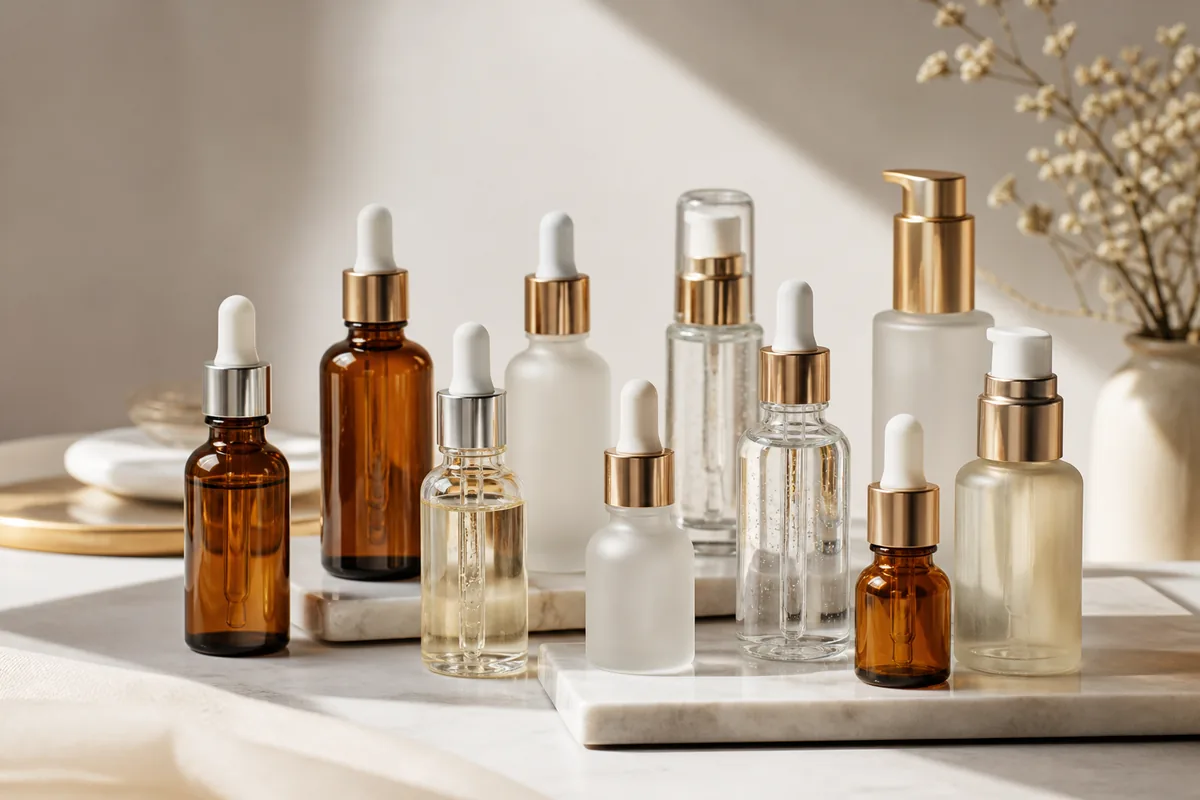
Serum bottles are compact skincare packaging systems commonly paired with pipette droppers or treatment pumps. The right choice depends on formula viscosity, dispensing requirements, bottle capacity, glass appearance, neck finish, closure compatibility, and intended user experience.
For lightweight facial oils and fluid serums, a dropper may provide a suitable manual dispensing method. For products requiring one-handed application or more consistent dispensing, a compatible treatment pump may be preferable. Higher-viscosity formulas require particular attention to the dispenser’s flow path and operating performance. Neither system is suitable for every formulation.
For B2B buyers, the key is to evaluate the glass bottle, closure, dispenser, sealing components, and actual formulation as one assembled packaging system before bulk production.
What Is a Serum Bottle?
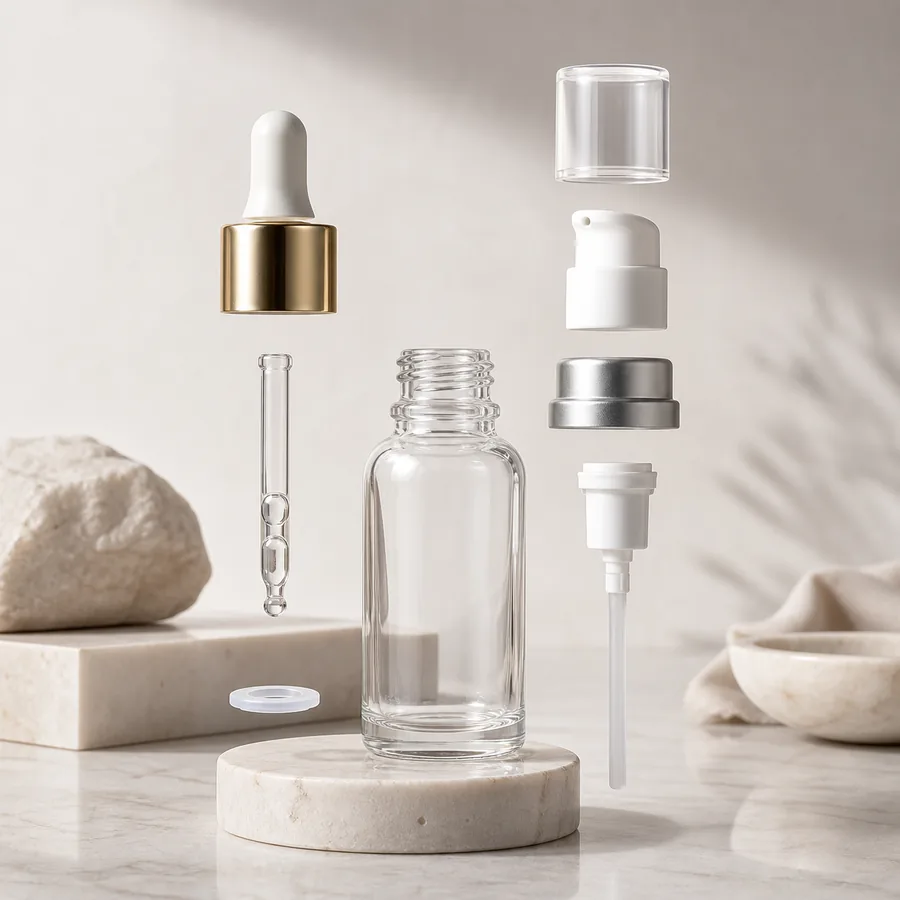
A serum bottle is a primary skincare package commonly paired with a controlled dispensing system. The container is often glass, while the dispenser may be a pipette dropper, treatment pump, or another closure selected for the formula and user experience. The complete pack normally includes:
- the glass bottle body and base;
- the neck finish that receives the closure;
- a dropper, pump, or alternative dispensing component;
- sealing elements appropriate to the selected assembly;
- a pipette or dip tube when required; and
- surface decoration, color, coating, printing, or labeling.
Buyer distinction: The bottle is one component; serum packaging performance depends on the assembled bottle, closure, dispenser, formula, and filling process. A dropper or pump that fits the bottle neck is not automatically suitable for the actual formulation.
Brands comparing available formats can browse FOLOVER’s glass serum bottles and use the serum bottle packaging guide for a broader purchasing framework.
Main Types of Serum Bottles
Dropper Serum Bottles
Dropper bottles use a squeezable bulb and pipette to draw up and release the formula. They are familiar in skincare and can give users deliberate control over individual drops or small portions. The actual uptake and release behavior depend on the bulb, pipette opening, formula viscosity, fill level, and how the user operates the dropper.
A dropper is worth considering when the formulation can be drawn into and released from the pipette without excessive dripping, slow uptake, or blockage. However, manual dispensing does not guarantee a consistent dose. The delivered amount can vary with pipette geometry, formula properties, and user technique.
A dropper is not automatically compatible with every bottle that has a similar-looking neck. Thread, closure dimensions, pipette length, sealing geometry, and any wiper must match the bottle and intended assembly. Buyers who need a sourcing overview can compare serum and cosmetic bottle droppers.
Treatment Pump Bottles
Treatment pumps dispense product by pressing an actuator. They can support one-handed use and reduce direct contact between the user and product remaining in the bottle. However, pump selection still depends on the formula, required user experience, bottle neck, dip tube, and component construction. A pump that operates well with one serum may behave differently with another.
A compatible treatment pump is worth prioritizing when the brand requires a defined dispensing action or wants to minimize repeated opening of the container. Buyers should confirm the actual pump output, priming behavior, actuation force, and dispensing consistency using the intended formula.
For a thicker serum, the selected pump must be capable of drawing the formulation through its intake and dispensing path. Choosing a larger-looking actuator does not establish suitability for a higher-viscosity product.
The relevant commercial family is FOLOVER’s cosmetic lotion pump category; exact pump suitability and output must be confirmed for the selected component rather than assumed from the category name.
Other Closure Configurations
Some projects use simple caps, reducer-style components, or specialized applicators. These formats may suit a narrow product concept, refill process, professional protocol, or sampling format. They should be treated as distinct systems with their own sealing and dispensing checks—not as interchangeable substitutes for a dropper or pump.
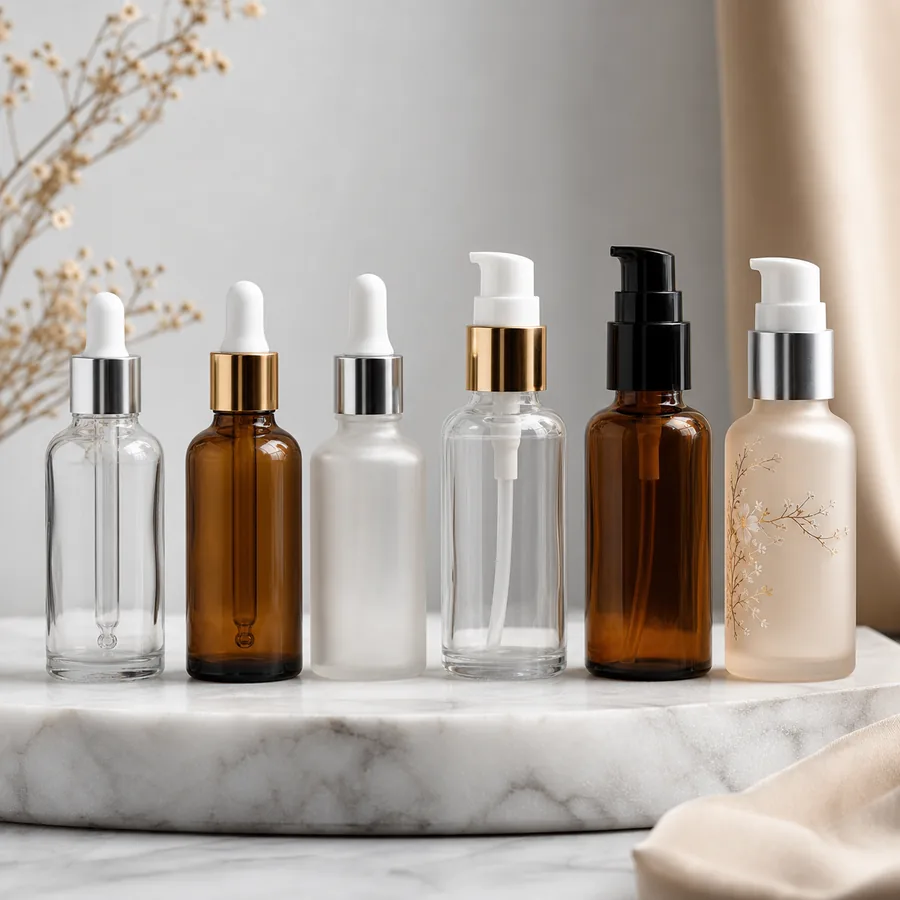
Common Serum Bottle Capacities
Serum packaging is often offered in compact capacities because concentrated skincare products are typically applied in small amounts. Sizes such as 10 ml, 15 ml, 30 ml, and 50 ml are commonly seen in the market, but they are not universal standards and availability varies by bottle family. A capacity printed in a catalog also does not describe every important dimension of the pack.
Brands should confirm nominal capacity, practical fill level, headspace, bottle dimensions, overflow behavior where relevant, and the final assembled height. Capacity affects more than volume: it influences pipette or dip-tube length, decoration area, label proportions, secondary packaging, carton planning, and the user’s perception of the product.
| Nominal Capacity | Common Product Direction | What Buyers Should Verify |
|---|---|---|
| 10 ml | Compact serum formats, concentrated treatments, or trial-size products. | Actual fill, dispensing requirements, available decoration area, and component dimensions. |
| 15 ml | Compact skincare products and targeted treatment formats. | Bottle height, opening, usable fill, pipette or dip-tube configuration, and assembled dimensions. |
| 30 ml | Regular serum and facial oil packaging formats. | Selected dispenser, intended dosage, formula compatibility, and final packaging configuration. |
| 50 ml | Larger serum formats and products requiring a greater fill quantity. | Product usage period, dispenser reach, remaining product access, and secondary-packaging dimensions. |
These capacities describe common packaging options, not guaranteed specifications for every FOLOVER bottle family. Buyers should request the exact product drawing and confirm the intended net fill with the actual formulation.
Common purchasing mistake: Assuming that two 30 ml serum bottles can use the same pipette or dip tube. Differences in internal bottle height, base geometry, shoulder profile, and dispenser construction can require different tube configurations, even when the nominal capacity is identical.
Clear, Amber, Colored, Frosted, and Coated Glass
Clear glass displays the formula and can support a clean, clinical, or premium presentation. Amber glass creates a recognizable apothecary appearance and is often considered when light exposure is a concern. Colored glass, frosting, and coatings can give a serum line a more distinctive visual identity.
Appearance and verified protection are different questions. A dark-looking finish should not be described as providing a specific UV or light-protection level without suitable evidence. The formula owner should define sensitivity requirements and, when protection is important, validate the selected bottle and finish through appropriate stability or packaging tests.
For example, a brand developing a light-sensitive vitamin C serum should not assume that amber glass or a dark decorative coating automatically provides sufficient protection. The required protection depends on the actual formulation, the spectral properties of the selected packaging, and intended storage and use conditions.
The formulation team should establish the relevant stability criteria and evaluate the finished packaging configuration. The ISO/TR 18811:2018 guidelines on cosmetic product stability testing provide a technical framework for selecting appropriate stability assessment methods. The document does not prescribe one universal testing protocol or establish that a particular serum bottle is compatible with every cosmetic formulation.
Decoration options may include frosting, coating, screen printing, hot stamping, and labeling depending on the selected bottle and project requirements. Buyers should confirm decoration feasibility on the exact glass article and approve representative samples before production.
The available decoration area is shaped by the bottle profile. Straight walls can offer a relatively predictable print or label zone, while shoulders, curves, recessed panels, and heavy bases change how artwork is positioned. Color should also be reviewed on the actual glass and under realistic lighting because clear formula, tinted formula, glass thickness, and surface finish can alter the final appearance. Artwork approval should therefore include placement, orientation, color reference, and the assembled relationship between the bottle, closure, and dispenser.
Manufacturer Insight: Approve Glass and Component Colors Together
For a serum packaging range, FOLOVER PACK recommends evaluating bottle decoration and visible closure components as one coordinated design rather than approving them independently.
For example, a frosted glass bottle paired with a metallic dropper collar may show an unexpected color or gloss difference when assembled. A colored coating may also appear different on a thick glass base and a thinner bottle wall.
Buyers should approve physical samples showing the actual bottle color, logo placement, collar or pump finish, bulb color where applicable, and final cap configuration. If the brand changes the dispenser after decoration approval, the assembled appearance should be reviewed again before bulk production.
Dropper and Pump Components
Dropper Components
A typical cosmetic dropper combines a bulb, collar or closure, pipette, and sealing interfaces. Some configurations may include a wiper at the bottle neck to remove excess product from the pipette and reduce mess. Wiper availability and fit are system-specific, so buyers should not assume that every serum bottle supports one.
The bulb creates the pressure change used to draw formula into the pipette. The pipette carries and releases the product. Its material, inner opening, outside dimensions, tip design, and length can affect use. Exact materials and dimensions must come from the selected component specification.
Two component checks deserve particular attention: First, the bulb material must be evaluated against the actual formulation. Oils, solvents, fragrance ingredients, and other formula components may affect certain elastomers under specific exposure conditions. A glass bottle’s compatibility does not establish compatibility for its rubber or elastomeric bulb.
Second, pipette length must be matched to the internal bottle geometry. A pipette that is too short may leave an inconvenient amount of product behind. An excessively long pipette may contact the bottle base or fail to assemble as intended.
Buyers should verify the bulb material, pipette dimensions, tip configuration, and final assembled position using the selected physical components.
Pump Components
A treatment pump usually includes an actuator, internal pump mechanism, closure, sealing components, and dip tube. Pressing the actuator cycles the pump and moves formula through the dispensing path. Priming behavior, actuation force, dose, and output consistency depend on the particular pump and formula; these values must be tested rather than generalized.
The dip tube should be matched to the actual bottle height and internal base geometry. A tube that is too short may leave excessive residual product, while an incorrectly cut or excessively long tube may restrict product intake near the bottle base.
Before approving the pump, buyers should check initial priming, repeated dispensing, actuator return, delivered amount, and remaining product access with the actual serum.
How Formula Viscosity Affects Serum Packaging
Viscosity affects how quickly a formula enters a pipette, flows through a pump, and releases onto the user’s hand or applicator. Lower-viscosity products may move readily but can drip or dispense faster than expected. Higher-viscosity formulas may fill a pipette slowly or require a pump designed for the formulation.
Viscosity is only one variable. Surface tension, particulates, volatile ingredients, oils, alcohol content, and temperature can also affect dispensing and component interaction. The serum bottle selection guide explains how to organize these formula-driven decisions without treating one dispenser as universally best.
| Dispensing Option | Best Considered For | Main Limitation | What Buyers Should Verify |
|---|---|---|---|
| Pipette dropper | Compatible fluid serums and facial oils requiring manual drop-by-drop or small-portion dispensing. | Delivered amount varies with formula properties, pipette geometry, and user technique. Higher viscosity may slow uptake. | Formula uptake, dripping, pipette length, bulb compatibility, closure sealing, and remaining product access. |
| Treatment pump | Compatible serums requiring one-handed use or a defined dispensing action. | An unsuitable pump may prime poorly, dispense inconsistently, or fail to draw a higher-viscosity formula. | Actual-formula dispensing, output, priming, actuation, dip-tube length, closure fit, and repeated-use performance. |
Practical selection: Start with a dropper when manual liquid dosing is part of the intended product experience and the formula flows reliably through the selected pipette. Prioritize a treatment pump when the brand requires one-handed application or a more defined dispensing action, provided that the pump performs consistently with the actual formulation.
There is no reliable universal viscosity threshold that separates all dropper-compatible serums from pump-compatible serums. A manufacturer’s specified operating range may help narrow the selection, but final suitability must be demonstrated with the selected dispenser and actual formula.
Formula compatibility: Packaging compatibility should be evaluated with the actual formulation under intended storage and use conditions. A water-based dispensing demonstration does not establish that the selected dropper or pump will perform correctly with an oil-based, acidic, alcohol-containing, or higher-viscosity serum.
Bottle and Closure Compatibility
Compatibility starts with measurable interfaces. The neck finish, thread or attachment system, closure geometry, seal, pipette or dip-tube length, and bottle height must work together. Visual similarity is not proof of fit. Two components may appear compatible but differ enough to cause incomplete engagement, leakage, poor alignment, or contact between the pipette and bottle base.
For example, a nominal neck-finish designation such as 18/410 identifies a particular thread-finish series, but it does not independently establish compatibility between every bottle and closure using that designation. The selected component drawings, sealing geometry, gasket, and physical assembly must still be reviewed.
Bottle capacity is also not a reliable way to infer neck size. A 30 ml serum bottle should not automatically be assigned an 18/410 or another thread specification without checking its actual product drawing.
Formula compatibility is a separate layer. The formula may affect elastomers, plastic components, coatings, inks, adhesives, or seals over time. Appropriate testing should reflect the actual formula, fill level, storage orientation, temperature conditions, transport expectations, and intended shelf life.
The U.S. FDA’s guidance on cosmetic shelf life and expiration dating explains that temperature, sunlight, air exposure, and storage conditions can affect cosmetic products over time. These considerations support evaluating the finished serum packaging under its intended conditions rather than relying only on an initial empty-bottle or water-based test.
Compatibility review should cover:
- bottle drawing and neck-finish specification;
- closure engagement and sealing interface;
- pipette or dip-tube clearance and reach;
- dispensing with the actual formula;
- assembled appearance and component alignment;
- leakage, transport, and storage checks appropriate to the project.
For a deeper technical explanation of dropper operation, see how glass dropper systems work. That article focuses on the bulb, pipette, wiper, and uptake mechanism, while this article remains a broader map of serum bottle types.
Manufacturer Insight: Identify the Failure Before Changing Components
When a serum bottle shows leakage or dispensing problems, FOLOVER PACK recommends investigating the complete bottle-and-dispenser assembly before replacing an individual component.
For example, if a filled dropper bottle develops residue around the neck after transport, the cause may involve the closure’s sealing interface, gasket, assembly conditions, pipette configuration, or formula behavior. A visually tighter cap does not necessarily correct the underlying problem.
If a treatment pump stops dispensing while serum remains in the bottle, the review should distinguish between dip-tube reach, restricted intake, priming behavior, and pump suitability for the formulation.
Document the observed problem, identify the affected interface, and test the revised component configuration before approving it for production. These are practical troubleshooting scenarios, not claims about a specific customer incident.
What Brands Should Confirm Before Ordering
A useful request for quotation should identify the required capacity, bottle style, glass appearance, neck system, dispenser type, decoration, quantity, and destination. The supplier also needs enough formula and filling context to identify which details require testing or additional confirmation.
For projects using several serum sizes or formulas, buyers should also specify which components are intended to be shared across the range. Similar-looking bottles may require different pipette lengths, dip tubes, closures, or sealing components.
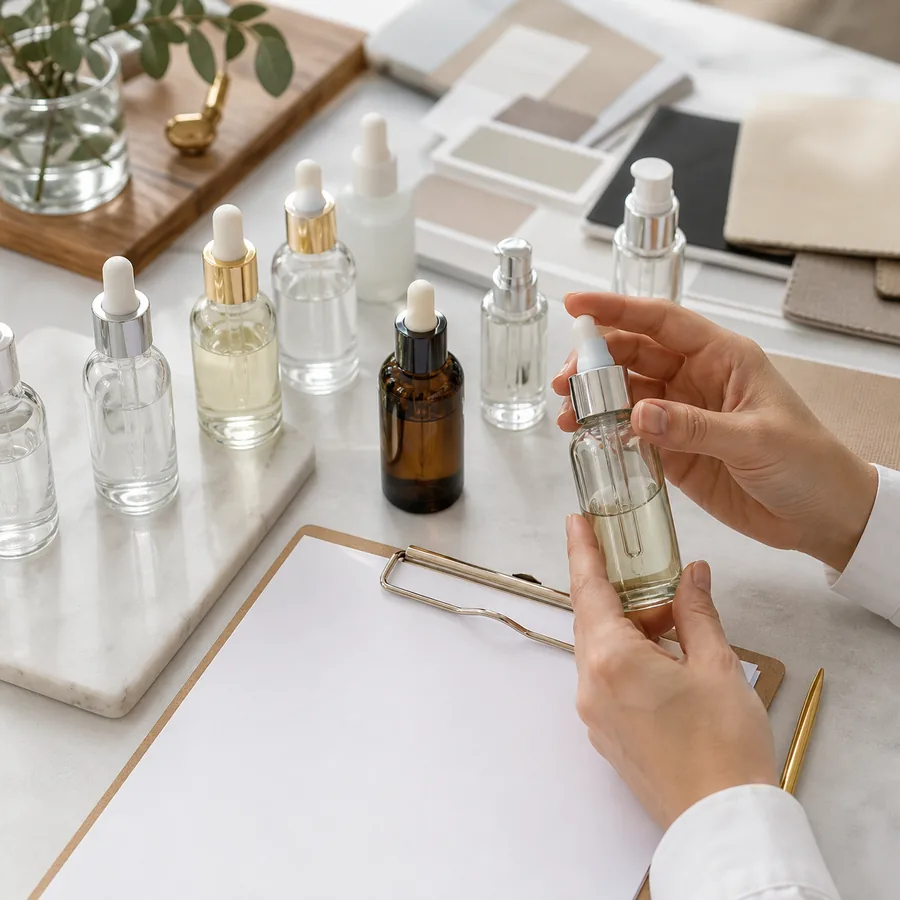
Before approving mass production, brands should review assembled samples rather than evaluating the bottle and dispenser separately. The review should include visual finish, closure fit, pipette or dip-tube position, priming or uptake, dispensing behavior, leakage risk, decoration adhesion where applicable, and fit with any carton or insert.
Sample observations should be recorded in measurable, repeatable terms. Instead of writing that a pump “feels wrong,” identify whether the issue concerns priming, actuation, return, output consistency, alignment, or residue. Instead of describing a color as “too warm,” compare it with an approved reference under agreed lighting. Clear approval criteria reduce ambiguity when the supplier, filling partner, and brand team review the same package from different locations.
Brands developing a broader family should also consider how the package will scale across multiple formulas or sizes. The future article on serum packaging design addresses the balance among dosing, function, and brand appearance, while the Product Knowledge hub connects related component and material explanations.
Frequently Asked Questions
What type of bottle is used for serum?
Serums are commonly packaged in glass bottles with pipette droppers or treatment pumps. Droppers may suit compatible fluid formulas requiring manual dispensing, while pumps may support one-handed use and a more defined dispensing action. The appropriate system depends on the actual formula, neck finish, sealing requirements, filling process, and intended user experience. Buyers should approve the complete assembled package before production.
Is a dropper or pump more common for serum?
Both droppers and treatment pumps are widely used for serum packaging, but neither is universally preferable. A dropper supports deliberate manual dispensing, while a compatible treatment pump can provide one-handed application and reduce direct contact with the product remaining in the bottle. Buyers should evaluate formula viscosity, required dose, dispensing consistency, component compatibility, and actual user experience before choosing.
What sizes are serum bottles available in?
Compact serum bottle capacities such as 10 ml, 15 ml, 30 ml, and 50 ml are commonly available in the market. However, actual capacities, dimensions, and component options depend on the selected bottle family. Buyers should verify the intended fill, neck finish, pipette or dip-tube configuration, assembled height, and secondary-packaging requirements for the exact bottle.
Is amber glass suitable for serum?
Amber glass may be considered for serum formulations where light exposure is a concern, but the bottle’s appearance alone does not establish a particular level of protection. Suitability depends on the actual formulation, glass characteristics, dispensing components, and intended storage conditions. Buyers should define the required protection with the formulation team and evaluate the finished packaging through appropriate stability testing.
Can serum bottles be customized?
Yes. Depending on the selected bottle and project feasibility, customization may include color coating, frosting, screen printing, hot stamping, labeling, and coordinated closure finishes. The available decoration area and achievable appearance depend on the exact bottle geometry and finishing process. Buyers should approve physical samples showing the intended glass finish, artwork, dispenser, and assembled packaging before bulk production.
Can any dropper fit any serum bottle?
No. A dropper cannot be assumed to fit a serum bottle based only on nominal capacity, visible neck diameter, or similar appearance. Neck finish, thread geometry, closure structure, sealing components, pipette length, and formula compatibility must be evaluated together. Final bottle and dropper compatibility should be confirmed using the selected components and physical samples before bulk production.
Conclusion
Serum bottles are not selected by glass shape alone. The bottle, neck finish, dropper or pump, seals, tube length, formula, decoration, and filling process form one packaging system. A sound sourcing process defines these interfaces, reviews assembled samples, and validates performance with the actual formula before production.
For fluid serums requiring deliberate manual dosing, a compatible dropper may provide a suitable solution. For products requiring one-handed application or a defined dispensing action, a treatment pump may be more appropriate when its performance has been confirmed with the actual formulation.
FOLOVER PACK supports B2B glass serum bottle sourcing, dropper and pump matching, decoration, and packaging customization. Share your formula type, target capacity, preferred bottle design, dispensing requirements, planned quantity, and decoration references to review suitable serum packaging options.