
An airless pump bottle dispenses a cosmetic formula through a pump while limiting the return of outside air to the product reservoir. Unlike many conventional dip-tube bottles, an airless system compensates for the product leaving the container through a moving piston, a collapsing pouch, or another engineered reservoir design. This makes it worth considering for certain serums, creams, lotions, and makeup formulas—but it does not make every formula more stable or every package leak-proof.
For someone using a skincare product, the practical questions are whether the pump works smoothly, delivers an appropriate amount, and leaves too much product behind. For a skincare brand, there is more to decide: the reservoir material, glass or plastic construction, pump components, filling method, decoration, and testing needed before production.
What Is an Airless Pump Bottle?
What makes a pump bottle airless?
In everyday packaging language, “airless” describes a dispensing arrangement designed to minimize the entry of replacement air into the formula reservoir during use. It does not mean the filled product contains no entrapped air, that the package has no oxygen permeability, or that its contents are sterile.
A conventional lotion pump often pulls liquid through a dip tube while the bottle admits replacement air as the product is removed. In an airless package, the reservoir volume generally changes instead. The distinction is in the complete dispensing system, not the shape or appearance of the bottle.
What components make up the system?
A typical assembly includes an actuator, pump mechanism, product reservoir, sealing elements and a cap. For conventional systems, buyers can compare cosmetic lotion pumps and pumps, closures and dispensing components as component options; these categories do not establish compatibility with a dedicated airless reservoir. Some use a piston that moves upward beneath the formula. Others contain a flexible pouch or separate cartridge. Where a glass outer bottle is used, it may provide the visible exterior while another component actually contains the formula.
That distinction matters when assessing compatibility: a bottle advertised as glass may still have a plastic product-contact reservoir, while some purpose-designed glass airless systems allow the formula to contact the glass itself.
How Do Airless Pump Bottles Work?

What happens when you press an airless pump?
Pressing the actuator operates the pump mechanism and forces a measured portion of formula through the outlet. When the actuator returns, the mechanism prepares to dispense again. As product leaves the reservoir, its available volume decreases through the movement of a piston or the collapse of an inner pouch, rather than by routinely replacing the dispensed product with outside air.
Air may still occupy a space outside the product reservoir, such as the gap between a collapsing pouch and its rigid outer bottle. The important question is whether that air contacts the formula. “Vacuum bottle” is a common commercial term, but the operating principle is more precise than describing the entire container as permanently under vacuum.
Piston vs. pouch: two different airless constructions
In a piston system, a movable base follows the product level as the pump dispenses formula. The piston, the reservoir wall and the seals must work together without sticking or allowing an unintended path for air. In a pouch system, a flexible inner container contracts as its contents are dispensed. Its construction and connection to the pump are different from those of a rigid, piston-based reservoir.
| Evaluation point | Moving piston | Collapsible pouch |
|---|---|---|
| How reservoir volume changes | Piston travels as the formula is dispensed | Flexible pouch contracts |
| Typical product reservoir | Rigid chamber above a moving base | Flexible inner container |
| Component checks | Piston movement, wall fit and seals | Pouch integrity, pump connection and seals |
| Filling considerations | Compatible filling and piston positioning | Compatible pouch filling and assembly |
| Critical performance checks | Priming, dispensing and residual product | Priming, dispensing and residual product |
Neither construction should be chosen on the assumption that it will always dispense more product, cost less or suit a wider range of formulas. Those outcomes depend on the selected design and the actual formulation.
Why do some airless pumps need priming?
The first few presses may move air out of the pump pathway before the formula reaches the outlet. This is called priming. The required number of strokes differs among pump designs and filling conditions. If a new bottle does not dispense immediately, follow its product-specific instructions rather than assuming the pump is defective or opening a sealed assembly.
What Are the Benefits of Airless Pump Bottles?
Reduced air exposure during use
By limiting replacement air in the reservoir, an airless system can reduce one route of repeated air exposure. This can be useful when a formulation is sensitive to its packaging environment. Whether an ingredient actually remains more stable depends on the formula, product-contact materials, package design, filling conditions and storage.
Airless packaging does not by itself establish a longer shelf life, prevent all oxidation, or make preservatives unnecessary. Microbiological protection is a separate formulation and finished-product evaluation, not a promise made by the pump.
Controlled dispensing with less direct contact
A pump lets the user take product without dipping fingers into the main reservoir, which may be preferable to repeatedly opening a wide-mouth jar. The amount dispensed per stroke can also help establish a repeatable application routine, although actual output must be checked with the selected pump and formula. A nominal pump-output specification is not a guarantee of identical dosing with every viscosity.
Potentially less product left behind
Some airless arrangements can make it easier to dispense formula as the reservoir empties, especially when compared with a dip tube that can no longer reach the remaining product. But residual product varies with reservoir shape, pump inlet, formula behavior and how the bottle is used. A claim of complete or 100% evacuation should not be made without product-specific test results.
What Are the Limitations of Airless Pump Bottles?
Not every formula will pump properly
Thick creams, particulate formulas and products with unusual flow behavior can create dispensing challenges. Oils, alcohol-containing formulas and active ingredients also raise questions about the materials they contact. None of these categories can be ruled in or out solely by their name. The selected pump engine, gasket, piston, pouch and reservoir must be assessed with the intended formula.
More components can increase development work
Depending on its design, an airless package may require a dedicated reservoir, precision pump components, specific filling procedures and additional assembly checks. Comparing quotations therefore means comparing complete configurations—not just the price of the empty outer bottle. For a brand managing several sizes, each capacity may need its own compatibility and output confirmation.
Refilling, cleaning and recycling are design-specific
Some systems are engineered around replaceable cartridges. Others are sealed assemblies that should not be opened for consumer refilling. Similarly, a package made from several materials is not automatically recyclable everywhere, even if its individual components can be recycled under certain conditions. Confirm whether the specific design can be disassembled and whether local collection and sorting systems accept those components.
Airless Pump Bottles vs. Regular Cosmetic Bottles

Airless pumps vs. conventional dip-tube pumps
Most conventional lotion pumps draw formula through a tube and allow replacement air into the bottle as product is removed. Airless systems are designed to dispense while limiting that replacement air inside the product reservoir. A conventional pump is not necessarily an inferior choice: it can be appropriate for formulas that perform well in that configuration and for projects prioritizing simpler components or filling processes. For a broader component-selection framework, FOLOVER’s cosmetic bottle closures and dispensing guide explains why the bottle and dispensing component need to be evaluated together.
How is glass airless packaging different from an ordinary glass cosmetic bottle?
The difference is functional, not merely visual. A standard glass cosmetic bottle may use a screw cap, dropper, conventional lotion pump or another closure. A glass airless package integrates a dedicated airless reservoir and dispensing system. The glass may be the product-contact container, or it may surround a separate inner reservoir.
| Feature | Glass airless packaging | Conventional glass cosmetic packaging |
|---|---|---|
| Dispensing | Dedicated airless mechanism | Cap, dropper, conventional pump or other closure |
| Replacement air | Designed to limit entry into product reservoir | Depends on the chosen closure and dispenser |
| Where formula touches glass | Depends on whether an inner reservoir is used | Often the glass container, plus closure contact parts |
| Design checks | Reservoir, pump, seals and outer bottle as a system | Neck finish, closure, formula and assembly |
| Best selection basis | Formula and dispensing requirements | Formula and dispensing requirements |
For brands choosing among cosmetic and skincare glass packaging options, the decision should begin with how the formula needs to be stored and dispensed, not with a claim that one type of container is universally safer.
How Does Glass Airless Pump Packaging Work?
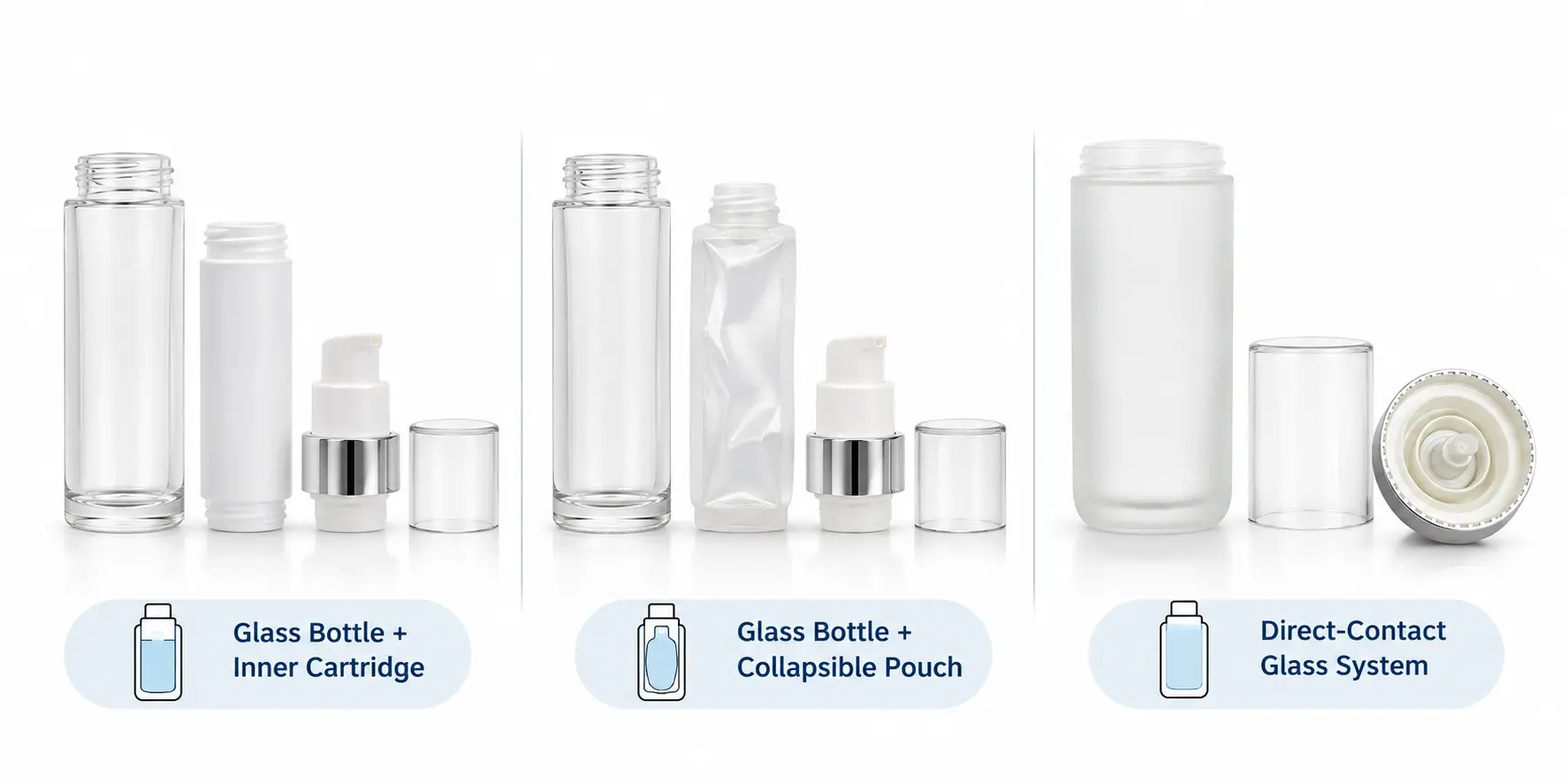
Glass outer bottle with an inner cartridge
One design combines a rigid glass exterior with a separate, product-contact cartridge. The pump dispenses from that cartridge, and the glass exterior supplies the desired bottle shape, transparency and tactile appearance. In a refillable model, the cartridge may be made to detach and be replaced; the ability to replace it must be part of the actual engineered design, not inferred from the presence of two layers.
A published example is Quadpack’s Crystal Ballet, which uses a glass exterior with an inner refill system. Its publicly listed 15, 20, 30 and 50 ml capacities and specified pump output describe that product series, not a standard that all glass airless packages follow.
Glass bottle with a collapsible pouch
Another construction places a flexible pouch inside a glass bottle. The pouch contracts as product leaves, so the formula is stored inside the pouch rather than directly against the glass wall. Lumson’s TAG (Techno Airless Glass) is a published example of this approach, with several models listed in 15, 30 and 50 ml sizes.
Airless systems in which the formula contacts glass
An inner plastic container is not a universal requirement. Baralan’s DEA series is a published example of an airless package in which the filled formula contacts the glass container directly. This illustrates why the phrase “glass airless bottle” is not enough to identify the reservoir construction. Ask which materials touch the formula and how the piston or dispensing system works in that exact design.
| Glass airless construction | Where the formula is held | What a buyer should verify |
|---|---|---|
| Glass outer bottle + cartridge | Separate cartridge | Cartridge material, replacement mechanism, pump fit |
| Glass outer bottle + pouch | Flexible inner pouch | Pouch material, seals, connection and contraction |
| Direct-contact glass airless | Glass reservoir | Glass-reservoir geometry, moving elements and seals |
A glass-packaging development point
For a proposed glass airless package, the reservoir design needs to be established before the outer glass dimensions and decoration are approved. Glass wall geometry, neck or connection design, pump installation and available internal space can constrain the final assembly. FOLOVER PACK’s glass bottle development and component coordination work is relevant to these decisions; a particular airless mechanism or available bottle specification still needs confirmation for the project.
What changes when the outer bottle is glass?
Glass offers distinct options for bottle shape and finishes, including clear, colored, frosted and decorated surfaces. It also adds considerations such as weight, breakage protection and the interface between a rigid outer bottle and the dispensing assembly. A heavy glass bottle is not necessarily a better airless dispenser, and a decorative outer glass wall should not be mistaken for the formula-contact surface.
What Sizes Do Glass Airless Pump Bottles Come In?
Published capacities are product-series specific
Glass airless packaging is available in more than one size. Publicly documented examples include 15, 30 and 50 ml options in Lumson’s TAG line; 15, 20, 30 and 50 ml in Quadpack’s Crystal Ballet line; and 15, 30 and 50 ml in Baralan’s DEA series. These examples establish the existence of those capacities, but do not prove that one size dominates global sales or that every airless structure is offered in every capacity.
| Illustrative size | Potential cosmetic application | Selection question |
|---|---|---|
| 15 ml | Eye treatment, concentrated care, trial product | Is the pump output appropriate for the intended dose? |
| 20 ml | Smaller facial treatment | Is this capacity available in the selected system? |
| 30 ml | Facial serum, primer, targeted skincare | What are the actual fill volume and package dimensions? |
| 50 ml | Moisturizer, lotion, cream | Will the formulation dispense consistently? |
| Larger sizes | Project-specific applications | Does a verified glass airless design exist at the required capacity? |
How should a brand choose capacity?
The stated bottle size is only the starting point. The brand should identify the intended net fill, the usable reservoir volume, the expected amount per application and the pump output required for that experience. For a glass outer bottle, overall dimensions and weight are also separate from the inner reservoir capacity. A 30 ml label alone does not confirm any of these details.
What about larger glass airless bottles?
Larger formats may be possible in certain designs, but it would be misleading to apply a plastic airless catalog’s full capacity range to glass airless packaging. As the package grows, glass weight, component structure, handling, filling and transport should be reassessed. Availability and practicality must be checked against a specific design rather than a universal size limit.
Which Skincare and Cosmetic Products Can Use Airless Pump Bottles?
Facial serums and active skincare
A serum formulated around ingredients whose stability is sensitive to the package environment may prompt a brand to investigate airless dispensing. Vitamin C and retinoid products are often discussed in this context, but the active ingredient’s name alone does not determine the right package. Its concentration, full formula, storage requirements, product-contact materials and finished-product stability evidence matter.
Lotions, moisturizers and eye creams
Pump-dispensed lotions and creams can benefit from controlled application and limited direct handling of the bulk formula. For thicker products, however, the pump inlet, flow path and output need particular attention. Eye treatments may also require a smaller amount per stroke than body or facial lotions. The intended use must be matched to the specific pump, not assumed from bottle size.
Foundation, primers and sunscreen products
Some foundations and primers may be candidates for airless packaging, provided pigments, viscosity and flow characteristics are suitable for the mechanism. Sunscreens require their own stability and performance evaluations: selecting airless packaging is not evidence that the labeled SPF will remain unchanged. Packaging cannot substitute for finished-product testing.
When might another dispenser make more sense?
A conventional lotion pump, dropper or cream jar may be a better fit when the formula, application style, filling method or budget does not justify a dedicated airless system. Brands should compare an airless proposal with realistic alternatives, not simply against an open container. A well-matched conventional package may work more reliably than an airless design chosen without formula testing.
How Should Skincare Brands Choose an Airless Pump Bottle?
Start with the formula and dispensing requirements
Define the product type, viscosity, target dose, likely storage conditions and materials that will contact the formula. Then consider the reservoir construction and the pump engine together. For example, a product that flows easily during filling may behave differently after storage or at low product levels. Those conditions should shape the sample evaluation plan.
Choose the glass bottle and compatible components together
The glass outer bottle, inner reservoir where applicable, pump and cap need to form an approved assembly. A visual match does not establish mechanical fit. In a direct-contact design, the glass reservoir and moving component requirements become especially important. If an existing glass bottle cannot meet the airless system’s dimensional and structural requirements, modifying only the pump may not solve the problem.
For a conventional component-matching example, see FOLOVER’s bottle and closure compatibility case for Primage massage-oil packaging. It illustrates assembly and sealing review, not validation of an airless system.
Plan decoration around the final package
Clear glass, frosting, coating, screen printing and hot stamping can change how the package looks, but the appropriate finish depends on the bottle shape, surface and project specification. The final appearance should be checked on a physical sample with its selected pump and cap. FOLOVER’s glass bottle decoration and finishing service covers these types of exterior treatment; airless compatibility remains a separate system requirement.
Use an existing bottle design or develop a new one?
Starting from an existing glass bottle can avoid developing a new glass shape when its dimensions and structural interfaces already work. A dedicated mold becomes more relevant when the glass profile, connection or capacity must change. Neither route should be chosen before checking whether the selected airless mechanism can be assembled with that bottle. FOLOVER’s custom glass bottle development process can support the bottle-design side of such a project, subject to the selected dispensing system’s feasibility.
| Development route | When it may fit | What to confirm first |
|---|---|---|
| Existing compatible glass design | Shape and structural interfaces already meet the brief | Actual compatibility with the chosen airless assembly |
| Existing glass design with decoration | Brand distinction comes from color, finish and logo | Decoration sample and complete assembly |
| New glass design | Unique shape, dimensions or connection requirements | Mechanism feasibility, drawings, tooling and samples |
FOLOVER PACK Solutions for Skincare Packaging Projects
Glass Skincare Bottles
FOLOVER supplies glass packaging for serum, lotion and other skincare applications. Compare serum bottles and lotion bottles by intended capacity, formula use and dispensing requirements. These conventional packaging ranges are starting points for selection, not evidence of a validated airless assembly.
Pumps & Closures
Compatible pumps, caps and related components can be coordinated around the selected bottle configuration. Confirm the actual connection, seal and dispensing mechanism before treating a visual combination as a suitable packaging set.
Decoration & Finishing
Coating, frosting, screen printing and hot stamping can support a skincare brand’s appearance requirements. Review artwork, surface treatment and component clearances on the finished sample; decoration approval does not establish formula compatibility.
Custom Bottle Development
An existing glass design may suit the brief, or a custom glass bottle route may be needed. Neither route means that any glass bottle can be converted into an airless reservoir.
Component Coordination
Review the glass container, pump, closure, decoration, component fit and sample evaluation as one packaging assembly. Final formula compatibility, airless-mechanism feasibility, filling suitability and performance still require project-specific confirmation.
Related FOLOVER Packaging Options
These verified conventional glass products illustrate adjacent skincare packaging options. They are not identified as airless systems.
30ml Tall Round Glass Serum Bottle with Screw Neck for Skincare

A screw-neck glass serum bottle to review with the required closure and formula.
100ml Frosted Glass Lotion Pump Bottle with Bamboo Cap
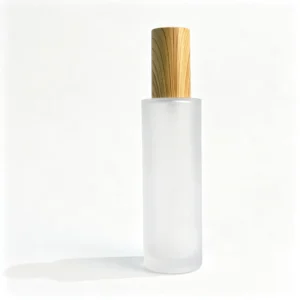
A conventional lotion pump bottle to evaluate as a complete bottle-and-component combination.
What Should Buyers Test Before Ordering Airless Pump Bottles in Bulk?
Dispensing, priming and residual product
Test how the chosen system primes, how consistently it dispenses and what remains when the package reaches a low fill level. Evaluate with the actual formula and appropriate storage or use conditions. If a fixed dose or maximum residual quantity matters to the brand, specify a measurement method and acceptance criteria before approving the package.
Formula compatibility and package integrity
Identify every part in contact with the formula, including the reservoir, pump pathway, gaskets, seals and any moving components. Then evaluate the complete package for compatibility and integrity under the intended conditions. Reducing routine air intake is not a substitute for a microbiological risk assessment or, where appropriate, preservative-efficacy evaluation. ISO 11930:2019 addresses evaluation of antimicrobial protection of a cosmetic product; it does not certify an airless pump as preservative-free.
Glass appearance, assembly and transport
Review dimensional fit, cap alignment, decoration, bottle weight and the assembly’s performance after handling. If the design includes a detachable refill, verify its intended removal and replacement procedure. A sample approved only for appearance is not enough to establish dispensing suitability or transport readiness.
Airless packaging sample approval checklist
- Confirm reservoir construction and every product-contact material.
- Measure priming behavior and output with the intended formula.
- Assess dispensing at different fill levels and determine residual product.
- Check package integrity, connections and closure performance under defined conditions.
- Review filling-line and assembly requirements with the selected components.
- Approve the finished glass appearance, decoration, pump and cap as one sample.
- Review packaging protection and handling requirements before bulk shipment.
Need help evaluating the bottle, pump, closure and decoration as one packaging assembly? Discuss a custom cosmetic packaging solution and suitable component options for sample evaluation, with formula and dispensing-system validation defined for the project.
What belongs in an airless packaging RFQ?
Send the target capacity and net fill, formula type and relevant flow characteristics, preferred reservoir design if known, glass appearance, pump-output requirement, refillability requirement, decoration reference, estimated quantity, destination and filling/assembly constraints. Where the mechanism has not been selected, state that clearly so the feasibility discussion begins with the correct technical questions.
How FOLOVER approaches the packaging brief
FOLOVER PACK’s glass cosmetic packaging manufacturing capabilities include glass bottle manufacturing, coating, printing, decoration, component matching, inspection and export-ready packing. For skincare buyers, this connects the glass-container brief with the practical work of coordinating components and reviewing samples before production. An airless project adds a separate system-design question: whether the bottle, reservoir, pump, closure and decoration can operate together with the intended formula and filling process. Manufacturing and finishing experience does not replace confirmation of the selected airless mechanism or establish that a conventional glass bottle will suit it.
FOLOVER PACK can review the glass-container design, decoration requirements and coordination of compatible dispensing and closure components as part of a cosmetic packaging project. For a proposed glass airless package, the first step is to establish the specific airless mechanism and reservoir configuration, then check which glass design and customization route can support it. Available airless configurations and product-specific performance must be confirmed before a supply or production specification is agreed.
Frequently Asked Questions About Airless Pump Bottles
Are airless pump bottles better for skincare?
They can be useful when a formulation or user experience benefits from limiting replacement air in the reservoir and using pump dispensing. They are not automatically the better choice for every serum, lotion or cream. Formula stability, the dispensing requirement, filling equipment and the complete packaging configuration should determine whether an airless or conventional system is more practical.
Do airless pump bottles prevent oxidation?
They are designed to reduce one route of air exposure during dispensing, but cannot guarantee that oxidation will not occur. Some oxygen may already be present during filling, and exposure can be influenced by materials, seals and storage conditions. Oxidation-related claims and shelf-life decisions should be supported by testing with the actual formulation in its final package.
Why is my airless pump bottle not working?
A new airless pump may need priming before formula reaches the outlet. Other possibilities include a blocked dispensing path, unsuitable formula behavior or a component problem. Follow the specific product’s instructions rather than assuming that opening or puncturing the reservoir will help. Brands receiving repeated complaints should investigate the filled, assembled package rather than the pump alone.
Can airless pump bottles be refilled?
Some are deliberately engineered as refillable systems with replaceable cartridges, while others are not intended to be opened or reused. A glass exterior does not automatically mean the airless insert can be removed safely. Refilling a non-refillable assembly may change its seal, hygiene or dispensing behavior; only follow the procedure approved for the actual packaging design.
Are glass airless pump bottles available in different sizes?
Yes. Documented commercial glass airless lines include 15, 20, 30 and 50 ml options, although the available sizes differ by manufacturer and system. These figures are examples, not universal standard sizes or evidence of market share. For a project, confirm usable reservoir volume, external dimensions, filled weight and pump configuration for the exact selected bottle.
Are airless pump bottles more expensive than regular bottles?
They can cost more than simpler bottle-and-pump combinations because they may require specialized reservoirs, pump components and assembly or filling steps. The difference cannot be reduced to a fixed percentage or universal unit price. Compare quotations for complete, equivalent specifications, including decoration, samples, testing requirements and order quantity.
Can FOLOVER PACK supply the glass bottle, pump and closure as a complete packaging set?
FOLOVER can coordinate glass containers with pumps, closures and decoration for suitable cosmetic packaging projects, but the final configuration must be confirmed against the selected bottle, airless mechanism, formula requirements and filling process. A complete set should be reviewed as an assembly; not every bottle-and-pump combination is compatible.
Can glass airless packaging be customized with coating, printing or hot stamping?
FOLOVER offers coating, frosting, screen printing and hot stamping for suitable glass packaging projects. Decoration approval and airless-system feasibility are separate validation steps. Confirm the finish, component clearances and appearance on the final assembly, alongside the selected reservoir, formula and dispensing requirements.
Choosing the Right Airless Pump Bottle
Airless pump bottles limit replacement air in the formula reservoir by combining a dispensing pump with a changing reservoir volume. Their value depends on the finished system: the formula, product-contact materials, glass or plastic construction, pump output and assembly must all work together. The benefits are real design possibilities, not universal guarantees of shelf life, zero waste or perfect sealing.
For glass airless packaging, FOLOVER PACK can help buyers work through glass-container development, exterior decoration and dispensing-component coordination. Share your intended formula, capacity, reference packaging, pump and refill requirements, decoration and target order volume to discuss the appropriate custom cosmetic packaging solution and the sample checks needed before production.