Packaging for High-Viscosity Skincare Formulas decisions affect dispensing, protection, production consistency and the way buyers and consumers judge the finished product. A thick cream can dispense correctly during one room-temperature trial and still recover slowly after repeated strokes, leave excessive product around the bottle base or become difficult to use at a different temperature. The package therefore needs to be evaluated as a formula-and-dispensing system rather than selected from appearance, nominal viscosity or catalog output alone.
This guide gives B2B packaging buyers a practical framework for defining requirements, comparing samples and approving the final assembly. It complements FOLOVER’s Packaging Applications resources and Product Knowledge content while keeping the decision focused on the exact formula and project conditions. Product-specific dimensions, pump output, material compatibility and performance should be confirmed through current drawings, supplier documentation and controlled physical evaluation rather than assumed from a visually similar package.
The Core Buyer View: Choose by delivery window and residual behavior, not a single viscosity value
A viscosity result describes a formula under defined measurement conditions; it does not by itself tell a buyer whether the formula will refill a pump chamber, pass through the internal flow path or remain accessible near the end of the pack. For high-viscosity skincare, approval should define an acceptable delivery window: the temperatures, actuation rhythms and fill levels under which dispensing remains practical.
The second decision is residual behavior. A package that dispenses well while full can still leave a significant inaccessible pocket around the shoulder, base or intake. The useful sourcing question is therefore not “What viscosity can this pump handle?” but “Does this exact formula-and-package assembly deliver acceptably through the intended use cycle?”
Describe formula flow under use conditions
High viscosity is not a complete packaging brief. Creams, gels and emulsions may be shear-sensitive, temperature-dependent or structurally recovering, so the apparent resistance to flow can change while the product is pumped and again while it rests. A peer-reviewed study of oil-in-water cosmetic emulsions formulated with different thickening agents reported non-Newtonian, shear-thinning behavior across the tested samples, illustrating why one viscosity number should not be treated as a universal dispensing specification. See Li et al., Journal of Cosmetic Science, PMID 29658879.
For packaging evaluation, buyers should record how the viscosity information was generated, including the relevant temperature and test method where available, and then compare it with physical dispensing behavior. Also flag particles, crystals, entrained air or structure recovery that may influence the pump pathway. Buyers can use the Cream Jars when direct product access may be a more reliable packaging direction.
Manufacturer Insight: At FOLOVER, we normally do not select a pump from a cP value alone. We ask buyers to provide the actual or representative formula and describe how the product will be stored and used, because two formulas with similar reported viscosity can behave differently when entering the pump chamber or recovering between strokes.
Set an acceptable delivery window
A strong approval protocol defines where the package must work rather than asking whether it can dispense once. The delivery window should cover relevant cold and warm conditions, first priming, normal actuation, repeated strokes, pauses between uses and representative high, middle and low fill levels.
Record observations that matter to the user: whether a full stroke is obtained, whether the actuator returns normally, whether output becomes intermittent and whether excessive effort is required. The acceptance limit should come from the project requirement and the selected component specification, not from a generic industry number.
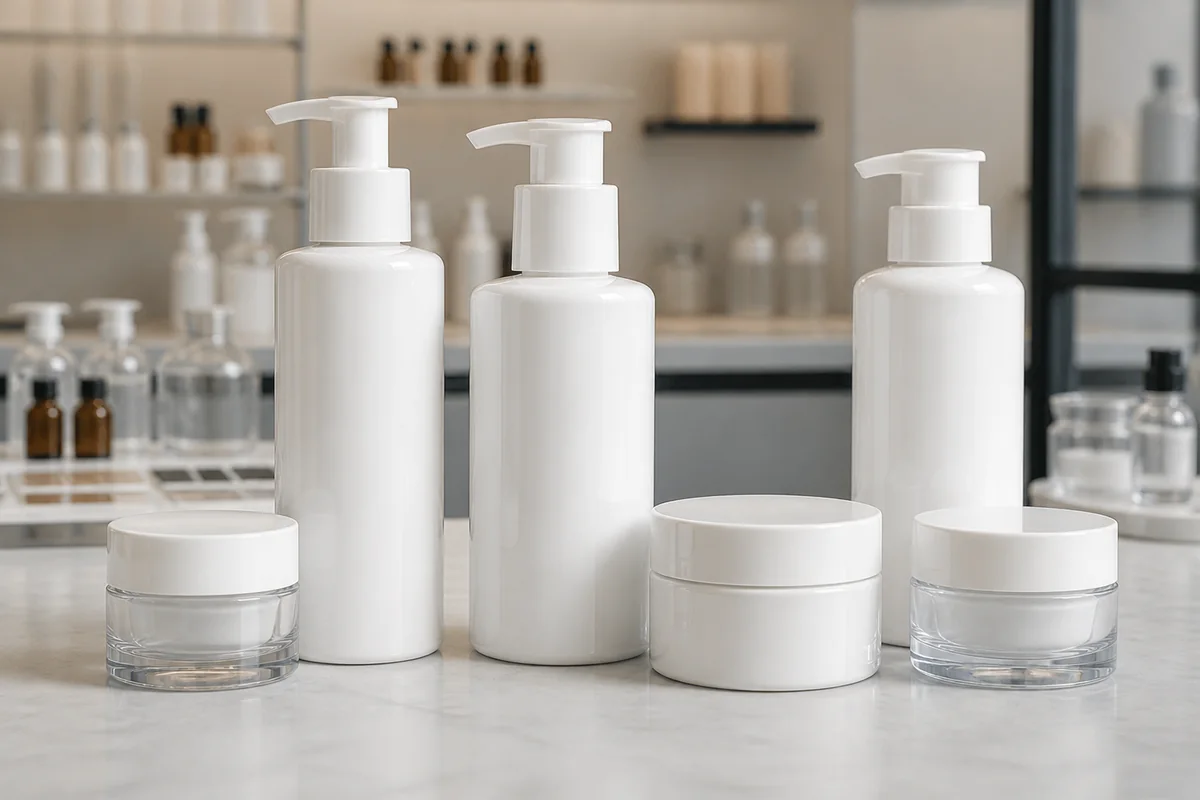
Buyers comparing dispensing architectures can review available cosmetic lotion pumps, but final performance should be validated with the selected bottle, pump, dip tube and actual or representative formula.
Buyer check: Avoid universal rules such as “formulas above X cP require a jar” unless the pump supplier has established that limit for the exact pump and test conditions. Viscosity, shear response, intake geometry, temperature and user cadence all affect the result.
Understand pump intake and recovery limits
A pump can have the correct nominal output and still produce a short second or third dose when the formula does not refill the chamber quickly enough. This is one of the most useful distinctions during troubleshooting: nominal output describes the pump design, while recovery determines whether that output can be repeated with the formula.
When a short stroke appears, observe what happens between actuations. A slower cadence may allow the chamber to refill while rapid pressing produces partial doses. That points the investigation toward formula mobility, inlet design, chamber refill or venting rather than simply changing the advertised pump output.
FOLOVER normally recommends testing the production-intent cosmetic lotion pump at more than one realistic actuation cadence. Record which pump and formula batch were used so that a successful sample does not become disconnected from the component that produced the result.
Evaluate pathway restrictions
For thick formulas, the actuator opening is only one restriction. The formula must move through the inlet, valve, chamber, outlet channel and nozzle before it reaches the user. A visually compact pump may therefore become the limiting component even when the bottle and dip tube are suitable.
Particles, crystallization or dried product at the outlet can create additional restrictions. If performance changes after storage rather than during the first test, inspect the flow path before assuming that the formula simply became “too thick.” The failure may be localized at the valve or nozzle.
When a formula repeatedly struggles through the pump pathway, direct access may be more practical. Buyers can compare cream jars rather than forcing the formula into a dispensing architecture that requires excessive user effort.
Treat dip tube and base geometry as one intake system
A dip tube can physically reach the bottom of a bottle and still leave substantial product behind. Thick skincare formulas may not level quickly enough to move from corners, shoulders or a raised base toward the tube opening. The residual pattern matters more than the simple statement that the tube “reaches the bottom.”
During sample evaluation, inspect where the formula remains after repeated use. Product concentrated beside the tube may suggest a different issue from product trapped in a wide base corner. Tube length, cut angle and stiffness need to be considered together with the actual internal bottle geometry.
The article on cosmetic glass jars explained provides a useful comparison with packaging where the consumer accesses the product directly rather than depending on a dip-tube intake system.
Final bottle and closure compatibility should be confirmed using the selected components and physical samples before bulk production.
Compare pumps with jars through user value
Pumps and jars solve different user problems. A pump can provide controlled dispensing and reduce direct product contact, but only when the formula can enter and refill the dispensing pathway reliably. A jar provides direct access and may be a better fit when pump recovery, user force or inaccessible residual product becomes unacceptable.
| Format | Best Fit When | Main Advantage | Main Limitation | What Buyers Should Verify |
|---|---|---|---|---|
| Pump bottle | The formula can repeatedly refill and pass through the selected pump under intended conditions | Controlled dispensing and convenient one-hand use | Intake, pathway restriction and recovery can limit dense formulas | Priming, repeated output, actuator recovery, user effort, low-fill delivery and residual pattern |
| Cream jar | Direct access is more reliable than forcing the formula through a restricted pump pathway | Easy access to dense creams, butters and balm-like products | Repeated opening creates a different product-access and hygiene profile | Opening access, pickup method, closure fit, liner or disc, filling appearance and near-empty access |
Do not treat the pump as automatically more technically advanced. The better package is the one that gives the intended consumer controlled and repeatable access to the product. The guide to how cosmetic pumps work explains the chamber, actuator, dip-tube and compatibility variables in more detail.
Consider airless systems with realistic limits
Airless packaging can remove the conventional dip-tube pickup problem, but it does not remove formula-flow limits. Depending on the system, a piston or flexible internal structure still has to move while the formula reaches the dispensing engine. Trapped air, formula mobility, component friction and filling technique can all affect practical evacuation.
This means “airless” should not be used as shorthand for “works with every thick cream” or “zero residual product.” Test the selected system through the intended fill range and inspect where product remains. If the formula changes significantly with temperature, include those relevant conditions in the assessment.
For conventional pump systems, pump dip-tube length remains part of the bottle-and-pump decision. Final dip-tube dimensions must be confirmed for the selected physical components rather than transferred from another bottle of similar capacity.
Measure residual product as a buyer metric
Residual product is not only a laboratory observation. It affects the amount of product the consumer can practically obtain and can become a source of complaints when the package appears to contain product that cannot be dispensed.
Use a defined protocol. Record the starting filled mass or other agreed reference, operate the package using a consistent method, then evaluate the product that remains inaccessible under the approved use sequence. The purpose is not to impose one universal residual percentage; it is to compare candidate packages under the same project conditions.
Inspect the residual pattern as well as the quantity. Product remaining around the base corner suggests a different corrective action from a pump that stops because the chamber can no longer refill. FOLOVER normally uses this pattern to decide whether the next check should focus on dip-tube position, bottle geometry, pump recovery or a different packaging format.
Buyers working with less viscous emulsions can compare this decision with packaging for lotions and emulsions, where pump selection may involve a different delivery window.
Include compatibility, hygiene and decoration
Dispensing performance is only one part of approval. Thick formulas may remain in prolonged contact with internal pump components, seals and nozzles, while product residue can accumulate around the outlet or reach decorated surfaces during normal use. A jar creates a different contact pattern because the product surface is repeatedly exposed during opening and pickup.
For polymer formula-contact components, ASTM D543-21 provides practices for evaluating plastic resistance to chemical reagents and emphasizes that correlation to end-use performance depends on how closely the test conditions represent the actual service conditions. It is useful as a material-testing reference, but it does not prove that a finished cosmetic pump is compatible with a specific cream or gel.
For products placed on the EU market, Annex I of Regulation (EC) No 1223/2009 on cosmetic products requires the Cosmetic Product Safety Report to consider relevant characteristics of the packaging material, including purity and stability. This does not create a universal compatibility protocol; the exact package still needs to be evaluated with the intended formulation.
Decoration should also be checked after relevant filling, formula exposure and handling. Final color, logo, coating and decoration should be approved on physical samples rather than assumed from an empty component.
Approve with production-intent formula and process
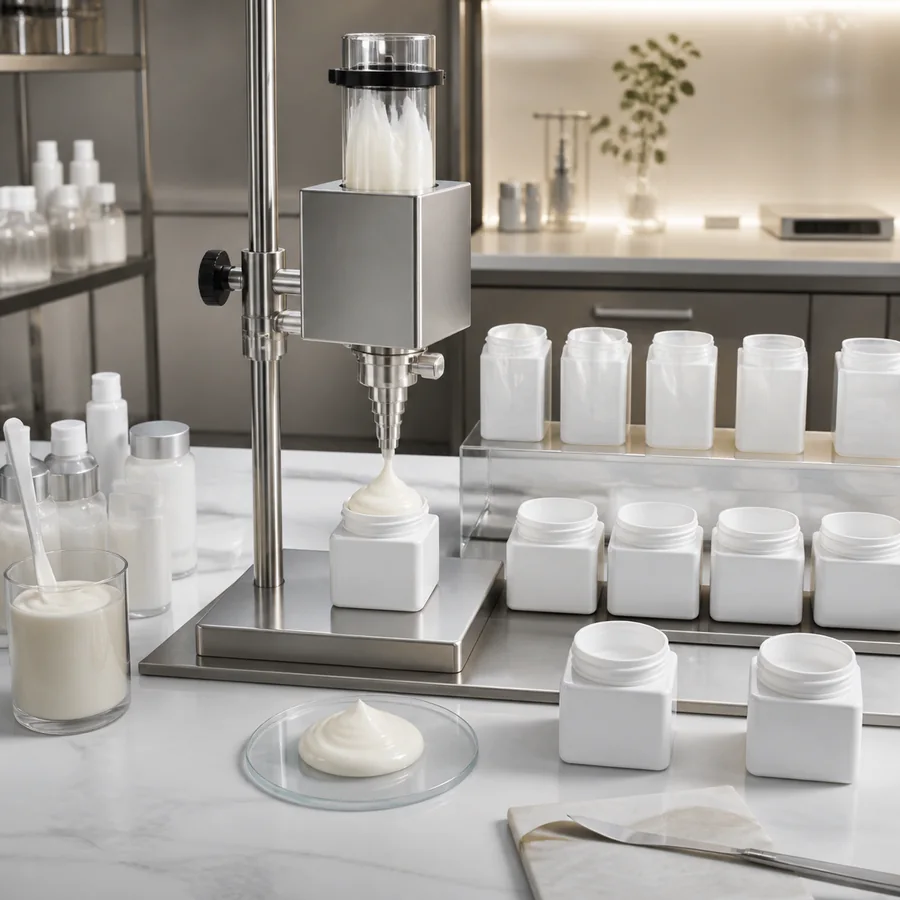
A development formula filled by hand may not behave exactly like the production product. Mixing, deaeration, filling temperature, air entrainment, cooling and storage can change the structure presented to the dispensing system. If these process variables materially influence the formula, packaging approval should include a representative filling trial.
Before bulk production, lock the formula reference, bottle or jar, pump or lid, relevant formula-contact components and assembly configuration used for approval. If a critical component or process changes, review whether dispensing, compatibility, residual product or closure performance needs to be revalidated.
Manufacturer Insight: A common practical mistake is approving the packaging too early because the first hand-filled samples dispense well. At FOLOVER, we normally recommend repeating the critical dispensing checks once the formula and filling process are sufficiently representative of production. That is the point at which pump recovery, trapped air and residual behavior become much more useful for a bulk-production decision.
Where transport performance is relevant, ASTM D4332-22 provides conditioning practices for containers and packages before testing, while ASTM D4169 provides a laboratory framework for evaluating shipping units against distribution hazards. These references can support transport-test planning, but they do not establish formula compatibility or prove dispensing performance of the primary package.
Buyer Approval Checklist
- Define the actual or representative high-viscosity formula, application method and intended user experience.
- Record the relevant viscosity or rheology information together with its measurement conditions instead of supplying a cP value without context.
- Identify the exact bottle or jar, pump or closure and all relevant formula-contact components.
- Evaluate priming, repeated output, pump recovery and user effort under relevant use conditions.
- Check high, middle and low fill levels rather than approving the package only when full.
- Measure or otherwise document residual product using one controlled comparison method.
- Inspect where inaccessible product remains so the failure mechanism can be diagnosed.
- Evaluate formula compatibility, nozzle cleanliness, closure performance and decoration as well as dispensing.
- Repeat critical tests with production-intent formula and a representative filling process where process conditions influence formula behavior.
- Retain approved samples and define which component, material or process changes require revalidation.
How to Structure the Sample Evaluation
Start with a small screening round using plausible pump and jar architectures. With the actual or representative formula, compare first prime, repeated dispensing, actuator recovery, user force and direct product access. Screening should identify obvious mismatches; it should not be presented as proof of long-term compatibility or shelf-life performance.
For promising pump systems, continue the same evaluation across representative fill levels and relevant formula conditions. Record the exact formula batch, pump, bottle, dip tube, assembly and test condition. For jars, record opening access, pickup method, closure system and filled-product behavior so the comparison is based on user value rather than format preference.
Residual patterns deserve their own inspection. If product remains around a base corner, a longer dip tube may not solve the problem. If the second stroke becomes short only during rapid use, the pump may be waiting for the formula to refill the chamber. If output changes only after storage, inspect the nozzle, valve and formula condition before changing the entire package.
When distribution testing is required, use production-intent primary and secondary packaging together. Condition and test the shipping unit according to the project’s selected protocol, while keeping transport evidence separate from formula compatibility and dispensing approval.
Frequently Asked Questions
Can high-viscosity skincare packaging be approved from an empty sample?
No. An empty sample can confirm appearance, component fit and basic handling, but it cannot show whether a thick formula will prime, refill the pump chamber, dispense repeatedly or remain accessible near the end of use. Final approval should use the actual or representative formula with the selected production-intent assembly.
Is a supplier’s standard pump specification enough for a thick formula?
No. Pump specifications are an important starting point, but performance also depends on formula rheology, temperature, pump pathway, dip tube, bottle geometry, filling and user cadence. Buyers should use the specification to define what still needs to be verified with the complete filled package.
What should trigger revalidation?
Changes to the formula, formula-contact material, pump engine, dip tube, bottle or jar geometry, supplier, tooling, filling process or critical assembly settings can affect dispensing or compatibility. The project team should define which changes require partial or full revalidation before bulk production.
How should buyers compare a pump bottle and a jar for the same formula?
Compare repeat dispensing, user effort, product access, residual product, formula protection, repeated opening, filling requirements and the intended consumer routine. A pump is not automatically better because it provides controlled dispensing, and a jar is not automatically better simply because the formula is thick.
Is there a universal viscosity limit for choosing a pump instead of a jar?
No. A single viscosity threshold cannot account for shear-thinning behavior, temperature, chamber refill, flow-path geometry, particles or user cadence. Buyers should test the selected pump with the actual or representative formula and define an acceptable delivery window for the project.
Should residual product be part of sample approval?
Yes. Residual product shows whether the consumer can practically access the declared fill through the selected package. Evaluate the amount and location of inaccessible product after a defined use protocol, then use the pattern to decide whether the pump intake, dip tube, bottle geometry or package format needs further review.
Conclusion
High-viscosity skincare packaging should not be selected from one viscosity value or one successful pump stroke. The stronger decision is based on an acceptable delivery window, repeat pump recovery, realistic user effort and the residual product that remains as the pack empties.
For B2B buyers, define the formula and use conditions first, compare pumps and jars against the same product requirements, and approve production-intent components with the actual or representative formula. Final compatibility and dispensing performance remain formula- and project-specific, so the complete filled system should be confirmed before bulk production.