Cosmetic glass jars are wide-opening containers commonly used for creams, balms, masks, body treatments, and other formulas that need direct product access. A complete jar package normally includes the glass body, a threaded or otherwise defined neck, a lid, and—where the selected configuration requires them—a liner, inner disc, or sealing component.
“Glass jar” is a broad packaging description, not one fixed specification. Jars that look similar can differ in capacity, opening diameter, thread, glass distribution, base weight, closure depth, liner design, and decoration area. Buyers should therefore compare exact jar and lid codes rather than selecting by appearance or nominal capacity alone.
What Is a Cosmetic Glass Jar?
A cosmetic glass jar has a relatively wide opening that allows the user to reach the product with a finger, spatula, or applicator. This makes jars different from narrow-neck bottles designed around pouring, pumping, spraying, or drop-by-drop dispensing. For a broader comparison of container formats, the guide to choosing a cosmetic glass bottle explains how formula, closure, user experience, and brand requirements influence bottle selection.
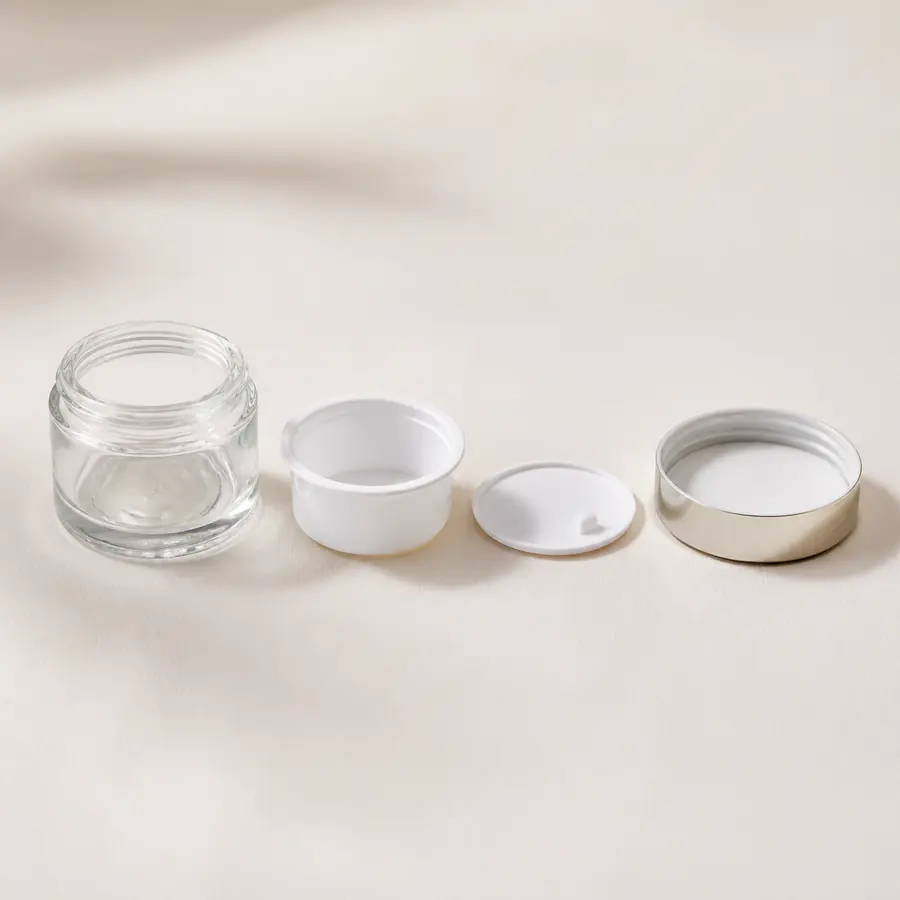
The jar body holds the formula, while the neck and thread connect to the lid. The lid supplies closing force and may work with a liner or seal. An inner disc may help keep product away from the underside of the lid or support presentation, but its presence and function depend on the actual configuration.
Punct cheie: A cosmetic glass jar is not just a glass vessel. Its performance depends on the matched glass body, neck, lid, sealing components, formula, filling process, and intended use. A lid that screws onto the jar is not automatically a lid that seals the filled package correctly.
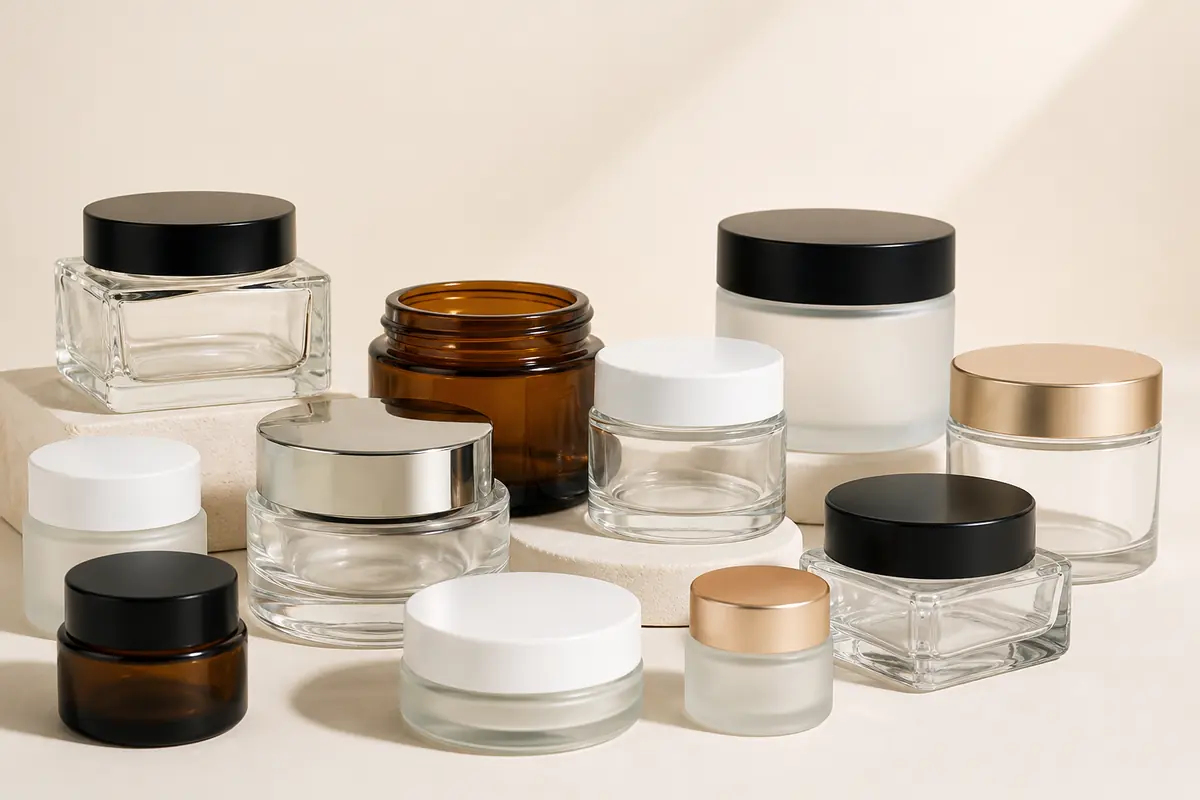
Main Cosmetic Glass Jar Shapes
Round Jars
Round jars have a circular footprint and are widely used for skincare and personal-care packaging. Their continuous sidewall can suit labels, printing, coating, or other project-specific decoration. Depending on their proportions, round jars may support compact, classic, or minimalist presentations.
For buyers, the main checks are the usable decoration area, opening diameter, lid profile, product access, and assembled dimensions. A round exterior does not establish a standard neck finish or universal lid compatibility.
Straight-Sided Jars
Straight-sided jars emphasize a clean vertical profile between the base and shoulder. They may provide a visually simple area for artwork, although actual usable height and curvature depend on the selected design.
When choosing straight-sided jars for a skincare range, compare the body proportions, shoulder transition, lid diameter, and assembled height. “Straight-sided” describes appearance; it does not guarantee a particular thread, wall thickness, or capacity.
Square and Faceted Jars
Square or faceted jars can create a more architectural presentation and a defined front panel. Corners, glass distribution, label placement, cap alignment, carton inserts, and packing orientation may require additional review.
A square exterior does not necessarily mean the internal cavity or neck has the same geometry. Buyers should confirm the usable filling volume, opening shape, lid interface, and whether the proposed decoration can be applied consistently across the selected panels.
Heavy-Base and Double-Wall-Look Jars
A heavier-looking base can create visual substance, while a double-wall-look package may use an outer glass form and a separate inner component depending on the design. These descriptions should not be converted into unverified material or weight claims.
A visually thick base does not establish the jar’s actual glass weight, internal capacity, or wall construction. For double-wall-look designs, buyers should identify whether the appearance comes from the glass geometry, a separate inner container, or another verified construction.
When additional components are involved, their materials, assembly method, formula compatibility, and replacement requirements must be evaluated separately.

How Cosmetic Jar Sizes Should Be Compared
Cosmetic jars are available in multiple capacity ranges, but current options must be confirmed for the exact product family. A nominal capacity does not tell the buyer the jar’s outside diameter, height, opening, usable fill, headspace, glass weight, or assembled dimensions. Two jars with the same nominal capacity can create very different shelf presence and carton requirements.
Selection should start with the intended fill quantity and use pattern, then consider how easily the user can reach the formula. Small openings may limit access even when the nominal capacity is suitable. Very wide openings can change product exposure during use and influence the size of liners, seals, spatulas, and cartons.
One important purchasing distinction is that grams and milliliters are not interchangeable specifications. A cream’s mass and volume depend on its density. A jar described as 50 ml should not automatically be treated as suitable for a 50 g net-fill requirement. The formulation team should establish the actual fill volume, required headspace, and acceptable filled appearance.
Buyers should also consider whether the consumer can reach the remaining product near the jar’s base and internal corners. A deep jar with a relatively narrow opening may meet the required capacity but provide a less convenient product-access experience.
Verificare pentru cumpărător: Request the exact jar drawing or specification and confirm nominal capacity, intended fill, opening diameter, overall dimensions, jar weight where relevant, lid height, assembled height, and secondary-packaging fit. Verify the intended fill using the actual formulation rather than relying on nominal capacity alone.
Categoria FOLOVER’s cosmetic cream jar category is the product-browsing route. For a more decision-oriented review of jar capacity, lid selection, decoration, and production requirements, see the cream jar packaging guide.
Lids, Liners and Sealing Components
Plastic and Decorative Lids
Jar lids may use plastic, metal-look finishes, decorative shells, or other verified constructions. The visible finish does not reveal the internal thread or sealing geometry.
Closure depth, thread engagement, material, color, torque behavior, decoration, and alignment should be approved on the actual lid and jar combination.
Two lids with the same visible diameter may differ in thread profile, internal depth, sealing structure, or liner arrangement. A lid that appears to fit may bottom out before the intended sealing surfaces engage correctly.
When sourcing jars and lids separately, buyers should request the exact component specifications and test their assembled fit before confirming a production order.
Liners and Inner Discs
A liner may sit inside the lid and participate in the seal, while an inner disc may rest over or fit into the jar opening. These components are not universal requirements and should only be specified when they belong to the validated package.
Their materials, dimensions, fit, removal experience, formula contact, and production handling need project-specific review.
An inner disc should not automatically be treated as a leakage-prevention component. Depending on its design, it may primarily separate the product from the lid, support presentation, or perform another defined function. Its presence does not establish that the assembled package is leakproof.
If a liner is part of the sealing system, buyers should confirm its material, seating position, compression behavior, and compatibility with the actual formulation.
Seals and Tamper-Evident Features
Some projects may use an additional seal or tamper-evident component, subject to the selected jar, filling line, formula, and market requirements.
Buyers should define what the feature is expected to do and verify it through the appropriate packaging process. A liner, inner disc, and induction-style seal are not interchangeable terms.
For example, an induction-sealing process requires a compatible seal construction, container finish, and suitable equipment. It should not be assumed that a sealing component designed for one container material or closure configuration will work on another.
The selected sealing method must be validated with the actual jar, closure, filling process, and formulation.
Manufacturer Insight: A Matching Lid Is More Than a Matching Diameter
When coordinating cosmetic glass jars and lids, FOLOVER PACK recommends confirming the complete closure assembly rather than selecting components by appearance.
For example, if a buyer chooses a glass jar and then requests a different decorative lid, the replacement must be checked for thread engagement, internal depth, sealing interface, and assembled appearance. A decorative outer shell may also change the final lid height or visual alignment.
The practical approval sequence is to confirm the jar neck, select the intended lid and sealing components, assemble physical samples, and evaluate the complete package with the actual formula.
Changing the lid, liner, or sealing component after sample approval should trigger a review of the affected interfaces before bulk production.
Common Applications for Cosmetic Glass Jars
Jars are often considered for face creams, eye creams, balms, masks, body creams, cleansing balms, and other formulas that are thick enough to scoop or access directly. The planned guide to packaging for creams and balms examines product access, lids, liners, and application needs in greater depth.
Viscosity alone does not determine whether a jar is suitable. The buyer should consider formula sensitivity, product hygiene strategy, dose control, use environment, filling temperature or process where relevant, headspace, and how the consumer closes the package after each use.
Some high-viscosity products work well in jars, while other systems may require a pump or different dispensing approach; the planned article on packaging high-viscosity skincare addresses those dispensing limits.
| Product Application | Why a Glass Jar May Be Considered | Principala limitare | Ce ar trebui să verifice cumpărătorii |
|---|---|---|---|
| Face and body creams | Wide opening provides direct access to products intended for scooping. | Repeated opening and consumer contact can expose the formula to contamination. | Opening diameter, filling volume, lid seal, preservation strategy, and intended-use conditions. |
| Balms and cleansing balms | Direct access may suit products that are difficult to dispense through a conventional pump. | Oils and other formulation ingredients may interact with liners, seals, or closure materials. | Actual-formula compatibility, product access, component materials, and filled-package performance. |
| Face and treatment masks | Wide opening can accommodate direct application or use with a spatula. | Frequent opening may increase product exposure during use. | Opening size, hygiene strategy, headspace, closure performance, and filling requirements. |
| Eye creams and targeted treatments | Compact jars may support controlled access with a suitable applicator. | Direct-contact packaging may not suit every formula or hygiene requirement. | Product sensitivity, intended dosing, applicator arrangement, and compatibility. |
Decizia cumpărătorului: Choose a jar when direct product access is an important part of the intended user experience and the formulation can be appropriately protected in that packaging format. If reduced consumer contact or controlled dispensing is a primary requirement, compare a suitable pump-based or other dispensing system before finalizing the jar.
Clear, Frosted and Colored Jar Options
Clear glass reveals the product and can support a clean presentation. Frosting can create a softer surface appearance, while coating may introduce project-specific colors when feasible. Amber or other colored glass may also be available for selected jar families.
Appearance alone should never be treated as proof of a defined light-protection or formula-stability result.
When a formula has sensitivity requirements, the brand should define the needed performance and evaluate the selected package under relevant conditions. Color choice also affects decoration contrast, product visibility, shade variation, and how the jar coordinates with its lid and carton.
For example, a brand choosing a frosted glass jar for a cream should confirm whether the desired effect comes from a surface treatment, a coating, or another verified finishing process. These options can differ in appearance, decoration feasibility, and durability.
If a formulation requires protection from light, request relevant technical information for the exact glass and decoration configuration. Do not assume that frosted, amber, or opaque-looking packaging provides a specified protection level without supporting evidence.
Decorare și prezentare de brand
Depending on the selected article and project feasibility, glass jars may be customized through coating, frosting, printing, hot stamping, labeling, or coordinated lids.
Artwork should be developed from the verified decoration area rather than a generic jar silhouette. Curvature, seams, shoulders, base transitions, and handling fixtures can reduce the usable area.
For round jars, printing or label placement must account for the curved surface and the available decoration height. For square or faceted jars, artwork positioned near corners or panel transitions may require additional feasibility review.
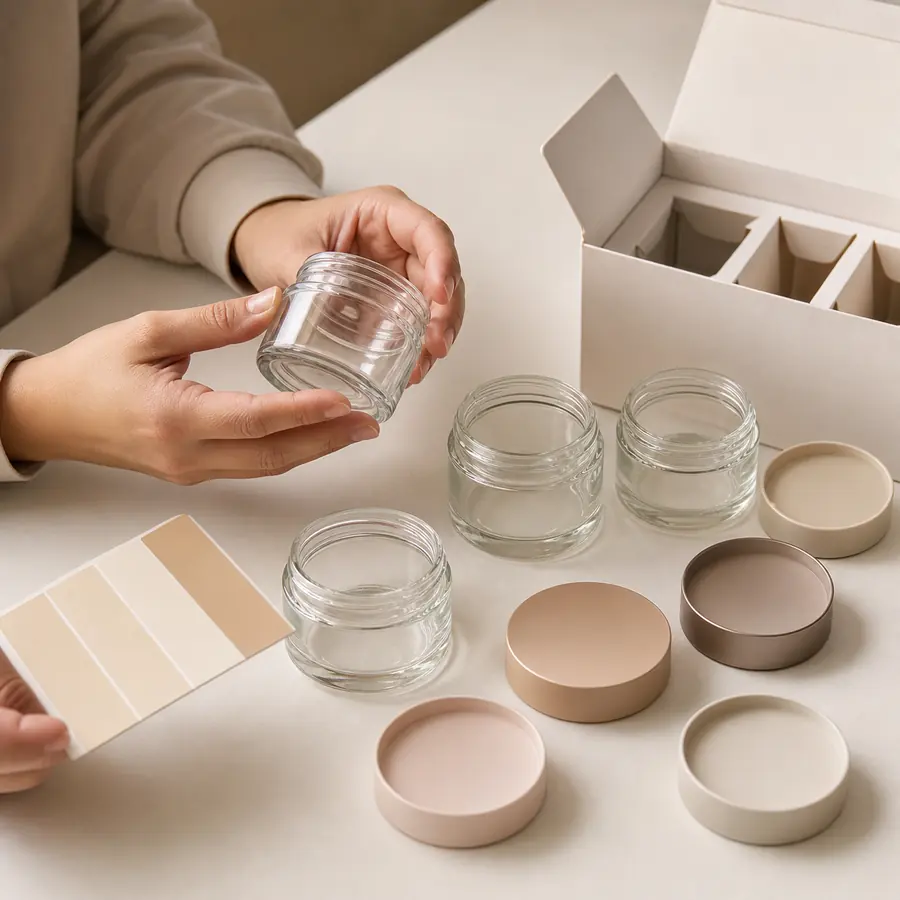
Jar and lid decoration should be reviewed together. A metallic-looking lid, colored coating, printed logo, and carton can appear inconsistent when color references or gloss levels are approved independently.
Physical samples help buyers review alignment, contrast, legibility, surface quality, and the assembled brand presentation.
A practical approach for a multi-SKU skincare range is to approve one coordinated color and decoration reference for the jar bodies, lids, and other visible components. When different materials or finishing processes are involved, evaluate their appearance together under the intended viewing conditions rather than assuming that identical color references will produce identical physical results.
Browse FOLOVER’s ambalajele din sticlă pentru cosmetice și îngrijirea pielii for the wider product context, or use the ghidul de ambalaje pentru îngrijirea pielii when comparing packaging formats across a skincare line.
Jar Compatibility and Formula Considerations
Glass is only one material in the assembled package. The formula may also contact or affect the lid, liner, inner disc, seal, decoration, label, adhesive, or application tool.
Oils, solvents, fragrance ingredients, pigments, high or low viscosity, and other formula characteristics can influence performance. Compatibility should be assessed with the actual formulation rather than inferred from a similar product.
Evaluation may include closure fit, leakage or seepage under defined conditions, liner response, discoloration, odor change, decoration resistance, label adhesion, product access, and repeated opening and closing.
The appropriate checks depend on the project, and acceptance criteria should be agreed before testing.
Product Exposure and Microbiological Protection
A wide-mouth cosmetic jar allows direct access to the formula, but it also creates opportunities for contamination during consumer use. The U.S. FDA’s guidance on microbiological safety and cosmetics identifies consumer contact, including dipping fingers into a product, as one possible source of microbial contamination.
For water-containing creams and other formulations requiring microbial protection, the brand’s formulation team should assess the preservation strategy in relation to the intended packaging and use conditions.
ISO 11930:2019 provides a framework for evaluating the antimicrobial protection of cosmetic products through preservation efficacy testing, microbiological risk assessment, or both, within its defined scope.
It is a cosmetic-product microbiology reference, not a certification of glass jar quality or closure compatibility. The need for particular testing should be determined through the formulation’s microbiological risk assessment.
An inner disc or spatula may support the intended product-access arrangement, but neither automatically eliminates contamination risk or replaces an appropriate preservation strategy.
Manufacturer Insight: Investigate the Jar, Lid and Formula Together
Approving a glass jar without the production-intent lid and formula leaves important interfaces unverified. FOLOVER PACK recommends testing the assembled package rather than approving isolated components.
For example, if a filled cream jar shows product residue around the lid after transport, the issue should not immediately be attributed to an unsuitable glass jar.
The evaluation should distinguish between excessive filling, an inappropriate headspace, incomplete lid engagement, a mismatched liner, an unsuitable sealing interface, or product movement under the tested transport conditions.
Likewise, if a liner changes appearance or becomes difficult to remove after formula contact, buyers should review its material and exposure conditions before approving a replacement.
The corrective action should address the identified cause, followed by evaluation of the revised production-intent assembly. These are potential troubleshooting scenarios, not claims about a specific customer incident.
Ce ar trebui să verifice cumpărătorii la mostre
Sample approval should confirm both the technical configuration and the consumer’s actual experience. A visually acceptable empty jar does not demonstrate how the package will perform after filling, storage, repeated opening, or transport.
- Exact jar and lid codes, nominal capacity, intended fill, opening diameter, dimensions, and assembled height.
- Thread engagement, closure alignment, liner or inner-disc fit, and opening and closing experience.
- Intended fill level, headspace, product access, and spatula requirements where applicable.
- Actual-formula compatibility with every product-contact component.
- Decoration color, artwork position, surface quality, adhesion, and agreed durability criteria.
- Closing process, specified torque or production controls where relevant to the selected package.
- Defined leakage, seepage, and repeated-use checks under the project’s agreed conditions.
- Carton, protective insert, packing orientation, handling, and transport requirements.
- Approved sample identity and component revisions before mass production.
Record the approved component codes, artwork revision, color reference, sample date, test conditions, and decision owner. This reduces the risk that a visually similar jar or lid is substituted later without a new review.
For example, if the approved cream jar uses a particular liner and lid combination, replacing that lid with a visually similar component should not automatically be treated as an equivalent configuration. The affected sealing and assembly requirements need to be checked again.
Glass Jar Sustainability Requires Context
Glass can be part of a packaging strategy, but sustainability cannot be decided from material name alone. Jar weight, lid and liner materials, decoration, transport, secondary packaging, local collection systems, and the realistic use model all affect the assessment.
The planned article este sustenabil ambalajul cosmetic din sticlă? examines benefits and trade-offs without relying on absolute claims.
For buyers, the practical approach is to define the desired outcome—such as material reduction, recyclability communication, reuse, or improved shipping efficiency—and then compare complete package options using evidence relevant to the intended market.
A glass jar with a heavy base, decorative coating, plastic lid, and separate inner disc should not automatically be presented as more environmentally beneficial than another packaging format. The complete packaging configuration and applicable collection or recycling infrastructure must be considered.
Explorați hub-ul de Cunoștințe despre Produse pentru elementele fundamentale de ambalare și Hub de ghiduri de achiziție pentru ambalaje for sourcing and selection decisions.
Întrebări frecvente
What products are commonly packed in glass cosmetic jars?
Glass cosmetic jars are commonly considered for face creams, body creams, balms, masks, cleansing balms, and other products requiring direct access. However, suitability depends on the actual formula, intended use, preservation strategy, and complete jar-and-lid configuration. Buyers should confirm the required fill, opening size, component compatibility, and consumer access before selecting a jar.
What is the difference between a jar and a bottle?
A cosmetic jar has a relatively wide opening that allows users to access the product directly with a finger, spatula, or applicator. A bottle normally has a narrower neck and relies more on pouring or a dispensing component. Buyers should choose between the two based on formula characteristics, hygiene requirements, dosing, and intended user experience.
Do cosmetic jars need inner lids?
Not always. An inner disc may help separate the product from the main lid or serve another function within the selected packaging system. A liner may instead participate in sealing. These components are not interchangeable or universally required. Buyers should confirm their intended functions, materials, fit, and compatibility with the actual jar, lid, and formulation.
Can glass jars be frosted?
Yes, frosted effects may be available through suitable surface-treatment or finishing processes, depending on the selected glass jar and project requirements. However, the achievable appearance, decoration area, and durability depend on the actual process and jar geometry. Buyers should approve physical samples showing the intended finish, logo, lid, and overall packaging appearance before bulk production.
Can cosmetic jar lids be customized?
Yes, depending on the selected lid and project feasibility, customization may include color, surface finish, printing, or a decorative outer shell. However, a different visible design does not guarantee identical thread engagement, sealing performance, or assembled dimensions. Buyers should confirm the exact lid construction and approve the customized lid with the intended jar and sealing components.
Are glass jars suitable for all creams?
No. Glass jars can be suitable for many creams, but suitability depends on the actual formulation, preservation strategy, product-contact materials, lid seal, filling process, and intended use conditions. Wide-mouth packaging also allows direct consumer contact with the product. Buyers should evaluate the filled jar-and-lid system and confirm the necessary formula compatibility and microbiological protection before production.
Concluzie
Cosmetic glass jars provide direct access for creams, balms, masks, and related formulas, but shape and capacity are only the beginning of selection.
For products intended to be scooped or accessed directly, a wide-mouth jar may provide a suitable packaging format when the formulation and hygiene strategy support that use. For products requiring reduced consumer contact or controlled dispensing, buyers should also evaluate alternative packaging systems.
The final jar selection should confirm the exact glass body, intended fill, opening diameter, lid, liner or inner disc, formula compatibility, decoration, user experience, and secondary packaging as one complete system.
FOLOVER PACK supports B2B cosmetic glass jar sourcing, lid and component matching, decoration, and packaging customization. Share your formula type, target fill, preferred jar design, lid requirements, decoration references, and planned order quantity to review suitable packaging options.